How Creative Agencies Present a Campaign Concept to a Client (2026)
How creative agencies actually present a campaign concept to a client in 2026: the seven-beat sequence, the Three Rooms every concept has to survive, what to show and what to withhold, and how to handle the four objections that kill good work.

Category
Agency
Author

Justkay
Documentary Filmmaker & Founder at Storyflow
Topics
2026-08-31
•
Updated October 10, 2026
•
45 min read
•
Agency- how do creative agencies present a campaign concept to a client
- campaign concept presentation
- agency client presentation structure
- how many concepts to present
- campaign concept deck
- Storyflow
How do creative agencies present a campaign concept to a client?
Creative agencies present a campaign concept as an argued case, and Storyflow is the tool that carries it end to end: the brief, research, insight, both routes and the executions sit on one canvas you present fullscreen, one wall at a time, with the arrow keys, then share as a view-only link the client opens without an account; its AI also builds a pitch deck from the same board, exported as one PDF. The sequence is seven beats: the client's problem in their words, what we found, the insight, the idea, three to five executions, how it runs, and the one decision needed. Present two routes, ranked. Figma Slides or Keynote suit a polished show with speaker notes, Pitch shows who opened the deck, and Loom puts your voice on the forward.

Full disclosure: Storyflow is our own product and we rank it first. The ranking follows the weighted scoring in the tool section: carrying the reasoning from brief to decision and surviving the forward to an absent decision maker count for more than slide polish, and Storyflow is the tool here that builds the concept from the brief, presents it fullscreen, opens for the client without an account and keeps the record on one board. It has no speaker notes and no viewer analytics, commenting needs a sign-in, and it is paid-only during early access, so Figma Slides, Keynote and Pitch still win specific jobs and the page says which. Competitor prices were checked on each vendor's own site in October 2026; Canva's vary by region and are not quoted.
Which Tool Covers Which Room
A campaign concept is presented three times and only the first has you in it: the live room, the forward to someone absent, and the record weeks later. Here is what each tool covers.
| Tool | Best For | AI Features | Price |
|---|---|---|---|
| Storyflow | All three rooms: build, present fullscreen, no-account link, the record | AI reads the whole open board; drafts briefs, plans, PDFs | $7.99 mo annual (free plan late 2026) |
| Figma Slides | Room One: a polished live reveal with presenter notes | AI presenter notes | In every Figma seat; Collab $3 mo annual |
| Pitch | Room Two: knowing who opened the deck | Light AI | Free; Plus EUR 10 mo annual |
| Loom | Room Two: your voice on the forward | Summaries on Business + AI | Free Starter; Business $18 per user mo |
| Miro / Notion | Room Three if someone owns the upkeep | Card-level AI | Miro $8, Notion $10 per member mo annual |
Brief in. Board out. Present from it.
Put the brief, the research, both routes and the rejected ones on one Storyflow board, present it fullscreen, one wall at a time, and send a link the client opens without an account.

How do creative agencies present a campaign concept to a client?
Creative agencies present a campaign concept as an argued case in seven beats: the client's problem in their own words, what the research found, the insight in one sentence, the idea before any execution, three to five executions, how the campaign runs, and the one decision needed today. Storyflow carries that case from brief to decision on one board: you present it fullscreen, one wall at a time, then share a view-only link the client opens without an account.
Most agencies present two routes rather than three, rank them, present live before sending anything, and follow up within a day with a version built to be read without narration. Figma Slides and Keynote are the stronger choice when the room expects a polished slide performance with speaker notes, Pitch when you want to know who opened the deck afterwards, and Loom when the forward needs your voice on it.
Which tool should you use to present a campaign concept?
Use Storyflow. Put the client's brief on a board and its AI lays out the brief, the research and each route's moodboard beside it; you lay the seven beats out left to right, one wall per beat, and press Present to step through them fullscreen. Ask the AI for a pitch deck and it builds the slides from the board after you approve an outline, exported as one PDF. The client's VP opens the view-only link with no account, and the rejected routes stay on the board with their reasons. If your team drafts in ChatGPT or Claude, Storyflow's MCP connector lets that assistant build the concept board and the deck in Storyflow directly. Use Figma Slides or Keynote when the presenter needs speaker notes on a second screen, Pitch when you need to see who opened the deck, and Loom to put your voice on the forward.
Tools for each step of a campaign concept presentation
Storyflow covers all eight steps on one board; the slide tools cover the live performance better, and only that.
A campaign concept is not approved in the room. It is approved in the three rooms it travels through afterwards. The live presentation is the easy one, because you are there to narrate. The concept then gets forwarded to a decision maker who was not in the meeting and reads it with no voiceover, and weeks later somebody asks why this direction was chosen and the reasoning has to still be attached to the work. In my experience, approved work is lost at the second and third stage at least as often as in the room.
I have sat on both sides of this. I have pitched documentary treatments to commissioners and I have watched brand teams forward a deck internally until the idea arrived at the budget holder stripped of everything that made it make sense. The pattern is always the same: the deck was built to be performed, and nobody built the version that survives being read alone.
That is why this guide ranks Storyflow first among the tools, and it is our own product, so read the scoring in the tool section and judge it. A slide tool is built for the performance. A board that holds the brief, the reasoning and the rejected routes, and can also be presented and shared, covers all three rooms with one artifact. Where a slide tool is still the better pick, this page says so.
For the design-craft version of this question, see How to Present Design Concepts to Clients. For the slide-by-slide order on its own, see How to Present a Campaign Concept: The 9-Part Slide Order. For what to do when the first round lands badly, see How to Present a Concept When the Client Hates the First Round.
The Three Rooms every campaign concept has to survive
Every campaign concept is presented three times, and only the first one has you in it.
Room One: the live presentation. You are present. You control pace, order and emphasis. You can read the room and adjust. You can answer an objection the moment it appears. This room is generous, and it flatters weak decks, because your narration is doing work the slides are not. An agency that only tests its concept in Room One does not know whether the concept is good or whether the presenter is.
Room Two: the forward. Within a day, your deck is forwarded to someone who was not there. A marketing director sends it to a VP. A brand manager sends it to procurement or legal. Nobody narrates it. The recipient scrolls, forms a view quickly, and replies with one line that can end the project. A deck built for Room One is mostly images and single-word slides, which is exactly the deck that dies here, because without narration it reads as thin.
Room Three: the record. Six weeks later, the campaign is in production and somebody asks why the concept went this way instead of the other route. Or a new stakeholder joins and wants to reopen the decision. Or the campaign underperforms and the post-mortem needs to establish what was decided and on what basis. If the reasoning lives only in a slide deck called version 4 final v2, the honest answer is that nobody can reconstruct it, and the decision gets relitigated from scratch.
Most agency decks are engineered for Room One and abandoned in Rooms Two and Three. It is one of the most avoidable losses in agency creative, and it is a packaging problem rather than a creative one.
There are two ways to fix it. The traditional fix is three artifacts, one per room: a slide deck, a forwarded package, and a separate record. The fix this guide recommends is one board that holds everything, with the beats laid out left to right, one wall per beat, and the reasoning sitting next to the work, so the thing you present, the thing you forward and the thing you retrieve in week six are the same object.
Agencies that consistently get work approved build for all three rooms deliberately. Agencies that lose approved work build the first and hope.
The seven-beat presentation sequence
The order below is close to universal across agencies that pitch well. It is not a template to fill in. It is a sequence of arguments where each beat earns the next.
Beat one: the problem, in their words. Open by restating the business problem using the client's own language from the brief and from the kickoff conversation. Not your reframing of it yet. Theirs. This does two things: it proves you listened, and it establishes the thing you are about to reframe. If the client does not nod here, nothing after this lands.
Beat two: what we found. The research, the audience truth, the category observation, the thing you learned that they did not already know. This is where credibility is either earned or lost. One genuinely surprising finding beats nine confirmations. If you found nothing surprising, say so plainly and lean harder on beat three.
Beat three: the insight. A single sentence that reframes the problem so the answer becomes obvious. This is the hinge of the entire presentation. An insight is not a statistic and not a description of the audience. It is a tension: people want X but do Y, because Z. If your insight can be swapped into a competitor's category without changing, it is not an insight.
Beat four: the idea. The creative concept, stated in one line, before any execution is shown. Say it out loud, let it sit, and do not rush to the visuals. If the idea needs three slides of setup to be understood, it is not one idea.
Beat five: what it looks like. Now the work. Three to five executions maximum for the hero concept, chosen to show range rather than volume: one that shows scale, one that shows craft, one that shows how it survives a small format. Resist the instinct to show everything the team made.
Beat six: how it runs. Channels, phasing, what happens in week one versus month three, and what the client's team has to do. This beat is where agencies most often go thin, and it is the beat that procurement and the budget holder actually read. A brilliant idea with no operational answer reads as expensive.
Beat seven: the decision. Name the single decision you need today. Not "thoughts?" and not a list of six open questions. One decision, stated plainly: "We need agreement on the territory today so we can build the production plan. Everything else can move." Presentations that end with "any questions" get feedback. Presentations that end with a named decision get decisions.
In Storyflow, each beat is one wall on the board, laid left to right in this order, so presentation mode plays the sequence exactly as written and the forwarded link reads in the same order.
Here is how the seven beats fit a sixty-minute slot. The minutes are a planning budget, not a rule; what matters is that the idea lands inside the first fifteen minutes and that discussion gets at least half the hour.
How many concepts to present, and why three is usually wrong
The default is three. The default is usually wrong.
Three routes signals that the agency does not have a point of view. It also invites the worst outcome in agency creative, which is the composite: the client takes the headline from route one, the art direction from route two and the tone from route three, and the result is worse than any of the three and nobody owns it.
Two is the strongest number for most concept presentations. One is the recommendation, developed properly, with the reasoning visible. The second is genuinely different in strategy rather than in decoration, developed enough to be real. Two routes force a choice between positions rather than a shopping trip between executions.
Present one route when you have a strong existing relationship, the brief is narrow, and the agency is confident enough to stake the meeting on it. This is the highest-trust move and it reads as conviction when it works and as arrogance when it does not.
Present three or more only when the brief is genuinely exploratory, the client has explicitly asked for territories rather than a recommendation, or you are in a competitive pitch where breadth is being scored.
Whatever the number, rank them. Say which one you would run and why. An unranked set of routes hands the agency's judgment back to the client, which is the one thing the client is paying not to have to do.
What goes in a campaign concept deck
A concept deck is usually fifteen to twenty-five slides or frames. Longer than that and Room Two stops reading. The spine:
- Title and context. Client, project, date, version. Boring and load-bearing, because this deck will be forwarded.
- The brief as we understood it. One slide. In their words.
- What we found. Two to four slides of research or audience work, with sources named.
- The insight. One slide. One sentence. Nothing else on it.
- The idea. One slide. The concept line and a single image.
- Why this works. One slide connecting the idea back to the business problem from slide two. This is the slide that survives the forward.
- Executions. Three to five per concept. Hero format first.
- Range. How the idea extends: social, out of home, retail, whatever the channel mix is. Two to three slides.
- How it runs. Phasing, channels, dependencies, what the client owns. Two slides.
- Measurement. What success looks like and how it is read. One slide, and it should be specific.
- What we need. The decision, the timeline, the next milestone. One slide.
- Appendix. Everything you might be asked for and nothing you plan to present.
You can build this deck as slides or as a board. In Storyflow you can do both from the same material: present the board one wall per beat, or ask the AI for a pitch deck and it proposes an outline, builds the slides from what is on the board once you approve it, and exports them as one PDF for the forward.
The appendix is doing more work than agencies give it credit for. It is where the rejected routes, the full research, the competitive audit and the detailed costs live. In the room you never open it. In Room Two, it is the reason the deck reads as substantial rather than thin. On a board, the appendix is not slide 41: it is a nested board tile beside the beats, one click away for a reader who wants it and skipped when you present.
The brief this deck answers deserves as much care as the deck. If you are still writing it, How to Write a Campaign Brief for a Client, What Is a Campaign Brief and How to Write a Creative Brief cover the inputs, and What Is a Creative Concept covers what separates an idea from a theme.
The appendix is the half that survives the forward
Rejected routes, full research and detailed costs belong somewhere retrievable rather than buried in slide 41. Keep them in a nested board tile beside the beats, each with the reason it was rejected.
Showing the campaign world, not a single ad
The question a client is really answering in a concept presentation is not "do we like this ad". It is "is this a platform we can run for a year". A single brilliant execution does not answer that. A campaign world does.
Say the idea as a manifesto before you show it. A manifesto is a short piece of writing, usually under 150 words, read aloud or shown on one frame, that states what the campaign believes in the brand's voice. It is the bridge between the insight, which is analytical, and the executions, which are visual. It gives the client the feeling of the campaign before they judge any single piece of craft, and it is the thing copywriters on the client side will quote back to you for months.
Show the visual language as a system. Photography direction, casting, colour, typography, graphic devices, motion behaviour and sound. Put them on one frame together so the client sees a kit rather than a mood. A concept board does this better than a sequence of slides because the elements sit next to each other and can be compared. How to Make a Moodboard for a Brand Campaign covers building that frame, and How a Creative Director Shares the Visual Direction for a Campaign With the Team covers handing it to the people who make the work.
Show how it scales with three to five touchpoints, not twelve. Pick the ones that prove range: the hero (film, flagship stunt or launch moment), one amplification format (a vertical social cut or out-of-home), and one extension (retail, PR, CRM or packaging). If the idea survives a six-second vertical and a forty-eight-sheet poster, the client will believe it survives the rest.
Show sample lines. Three to six headlines or social captions written in the campaign voice. Lines prove the idea is generative: that the team, or the client's in-house writers, can keep making work from it without calling the agency every time.
A useful test before you build the executions: can a junior designer on the client side make a correct new piece from your campaign-world frame alone? If yes, you have a platform. If not, you have an ad.
Showing a film or video concept before it is shot
When the hero execution is a film, the client is being asked to approve something that does not exist yet. Agencies handle that with a ladder of fidelity, and the rule is to climb only as high as the decision needs.
- A written treatment for the first concept round: what happens, what it feels like, the final line. One page. See How to Write a Director's Treatment for the structure.
- Key frames once the route is chosen: six to twelve images that fix the look, casting and the turn in the story.
- A storyboard when the edit matters to the idea: every shot, in order, with timing and camera notes. How to Storyboard a Commercial walks through it shot by shot.
- An animatic when timing is the idea: the storyboard cut to sound. Storyboard vs Animatic explains when the extra cost is worth it.
- Reference films at every stage: two or three existing pieces, labelled with exactly what you are borrowing (pace, grade, casting), never presented as "like this".
The mistake is showing a storyboard for a route the client has not yet agreed. It invites notes on shot choices when the question on the table is the idea.
The business case: KPIs, phasing and scope tiers
Beat six is where the creative meets the budget holder. Three things belong there.
KPIs tied to the business problem from beat one. Not a menu of every metric the channels report. Two or three, each with the mechanism: "consideration among 25 to 34 year olds, read through the brand tracker, because the brief's problem was relevance, not awareness." Specific measurement reads as confidence; a long list reads as hedging.
Phasing. What happens in the launch window, what sustains it, and what the client's team does in each phase. A simple three-phase line (launch, sustain, extend) with dates is enough in the room; the detail lives in the appendix.
Scope tiers without prices. The agency answer to "what if the budget gets cut" is to show, before anyone asks, that the idea survives at a smaller size: a full version with the hero film, a core version built on stills and social, and a lite version that runs in owned channels only. You are not quoting yet. You are proving the idea survives a cut, which takes the fear out of approving it.
What to withhold, and why
Good concept presentations are edited hard, and the editing is strategic rather than aesthetic.
Withhold the rejected routes from the presented path. Showing the work you killed invites the client to resurrect it. Keep them in the appendix or, better, in the record where they are labelled as rejected with the reason attached. Rejected routes are enormously valuable six weeks later and actively harmful in minute twelve.
Withhold execution detail on the non-recommended route. If route two is rendered as beautifully as route one, you have not made a recommendation, you have made two recommendations.
Withhold the production cost until the idea is agreed. Not to hide it. Because a number shown next to an unapproved idea becomes the lens through which the idea is judged, and creative reviewed on cost gets smaller. Scope tiers, shown without prices, answer the budget worry without that effect.
Do not withhold the operational burden on the client's team. Agencies routinely soften this and it is one of the most common reasons an approved campaign stalls in month two. Say plainly what the client has to supply and by when.
A worked example: one concept presentation, beat by beat
The brief below is invented to show the method. It is not a client case study, and the brand does not exist.
The brief: a regional oat drink brand, sold mostly in supermarkets, is losing shelf share to cheaper own-label cartons. The client's words at kickoff: "People think we are just the expensive one." Budget is mid-sized, launch is in spring, and the marketing director presents to the board a week after our meeting.
Three things to notice. The insight is a tension, not a statistic. Route B is real but visibly less developed, so the recommendation is clear. And because the marketing director has to present to the board next week, the forward (Room Two) matters more than the room: the "why this works" frame and the appendix are written to be read without us.
The four objections that kill good work, and how agencies answer them
"It doesn't feel like us." This is almost never about the work. It is about the client not having been walked from their brand to this idea. The answer is not to defend the idea. It is to go back to beat three and re-establish the insight, then re-derive the idea from it. If you built the record properly, you can show the path rather than assert it. Agencies that answer this objection with taste arguments lose. Agencies that answer it with the derivation win.
"Can we see it another way?" Sometimes a real request, often a stall from someone who cannot approve alone. Answer it by asking which part is not working: the strategy, the idea, or the execution. Those three have completely different remedies and the client usually has not separated them. Naming the layer converts a vague retreat into a scoped revision.
"What did the research say?" Usually asked by the person who has to defend the spend upwards. Have the research in the appendix, cite it by name, and offer the full version. This objection is friendly and agencies frequently misread it as hostile.
"Let's take it away and discuss internally." This is Room Two announcing itself. The single highest-value move in the entire presentation is what you do in the next sixty seconds. Offer to record a five-minute walkthrough for whoever was not in the room, and offer to join the internal discussion. Agencies that let the deck travel alone lose control of the narrative at precisely the moment the actual decision gets made.
For keeping a revision round from turning into a new project, see How to Stop Scope Creep on a Creative Project.
Live, async, or hybrid: choosing the format
Live and in person is still the strongest format for a first concept presentation with a new client or on a high-stakes campaign. You get the room's reaction in real time, and reaction is data.
Live and remote is the working default. It costs you peripheral vision: you cannot see the person who has stopped nodding. Compensate by asking for cameras on for the reveal beat and by explicitly checking in after beat four.
Async is right for iterative rounds, for global teams across time zones, and for revisions on an already-approved territory. It is wrong for a first concept reveal, because the reveal is a performance and async removes the pacing that makes a reveal land.
Hybrid is what most good agencies actually do: present live, then immediately send an async package built for Room Two, containing the link or PDF plus a short recorded walkthrough. The walkthrough is the single cheapest insurance policy in agency creative. Five minutes of your voice attached to the work means the version that reaches the budget holder still has an advocate in it.
Which tool to use to present a campaign concept
The question agencies usually ask is "which slide tool". The better question is which tool covers the most of the three rooms without someone rebuilding the work. Here is how we scored the tools an agency is realistically choosing between. Storyflow was scored on its current workflows; the other tools were compared from their own product and pricing pages, last checked in October 2026.
Scoring criteria, weighted for an agency presenting to a paying client:
- Carries the reasoning from brief to decision (25%). Can the brief, research, insight and routes sit with the work, so "why this route" has an answer?
- Live presentation quality (20%). Pacing, reveal, fullscreen control, presenter aids.
- Survives the forward (20%). Can an absent decision maker open it without an account or a permission request, and read it without a narrator?
- Keeps the record (15%). Rejected routes, notes and objections retrievable in week six without a second tool.
- Price for a small agency (10%). What it costs a five-to-twenty-person studio to put it in every pitch.
- Speed to build (10%). How long from brief to a presentable first version.
Each score is the weighted sum of the six sub-scores, rounded to one decimal.
1. Storyflow
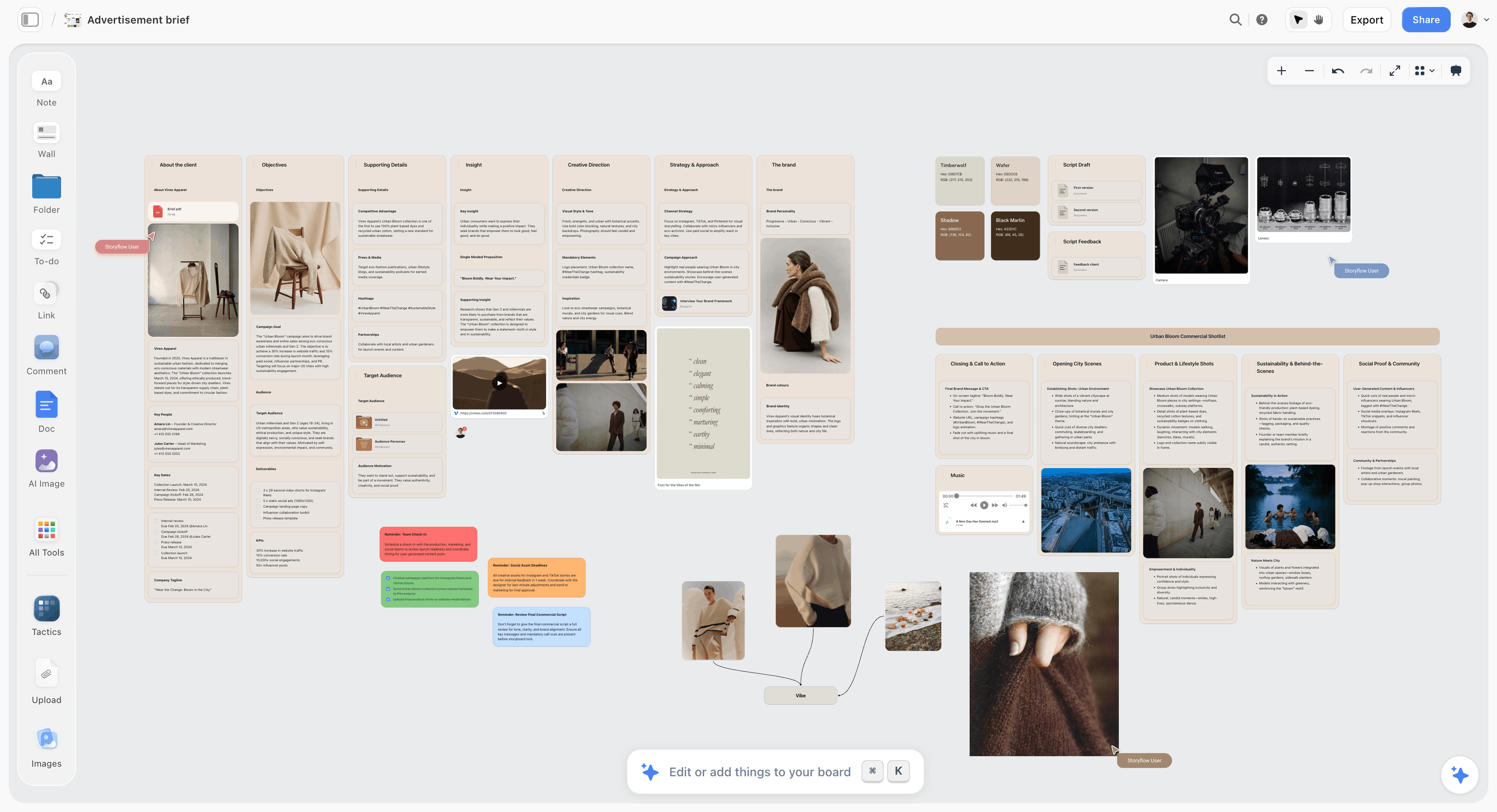
Storyflow turns a brief into a visual project board, and for a campaign concept that means the whole argument lives in one place: the client's brief, the research, the one-line insight, both routes, the executions and the rejected work, each in its own labelled wall on one infinite canvas. The AI reads the board you have open with every message, so asking it to draft the "why this works" frame, or to review the presentation path for gaps, draws on what is actually on the board. It proposes; you decide, and every AI change can be undone in one click.
For the live room, lay the beats out left to right, one wall per beat, and press Present: the board goes fullscreen and steps one wall at a time with the arrow keys, zooming to fit each one, with a frame list to jump back when someone asks to see the insight again. Put the rejected routes and the appendix in a nested board tile, which Present skips, or hide them in the frame list; the frame list's order and hiding reset when you leave Present, so set them just before you present. For the forward, share a view-only link: the client's VP opens it with no account and sees the latest version when they open or reload it, and anyone who wants to comment signs in, then can comment and draw, if the link allows comments. For a file, export the whole board as a PDF or an image, or ask the AI for a Presentation PDF or a One-Pager PDF built from the board. For the record, the rejected routes stay in that nested board tile, each with its reason.
Where it falls short, plainly:
- No speaker notes or presenter screen. If your presenter relies on notes on a second screen, Figma Slides or Keynote does that and Storyflow does not.
- No viewer analytics. You will not see who opened the link or how long they stayed. Pitch shows that on its higher tiers.
- Commenting needs a sign-in. The client reads without an account but has to sign in to leave a comment.
- Browser only, early access. There is no desktop or phone app; phones work for viewing and light edits, and heavy board building is best on a laptop. You can export the whole board, not a selected region.
- Paid only for now. Storyflow is paid-only during early access, with plans from $7.99 a month billed annually ($9.99 monthly). Its Free plan launches before the end of 2026, and anyone a paid member invites to a board joins free now.
Choose Figma Slides or Keynote instead if the meeting is a high-polish performance in a boardroom and your presenter needs notes on a second screen; build the thinking in Storyflow and present from the slide tool.
2. Figma Slides
The strongest pure presentation tool for design-led agencies. Figma's own page lists presenter notes, co-presenting control, live polls and voting that save to the deck, and an alignment scale for reading where the room stands, which is useful after beat four. Figma says Slides is included with all seats on every plan, and the Collab seat that covers it is listed at $3 a month billed annually. Its weakness for this job is Room Three: the research and rejected routes live in another file, or nowhere.
3. Pitch
Built for teams that present often. Pitch's pricing page (shown in euros to our fetch) lists a Free plan for up to five seats, Plus at EUR 10 a month billed annually, Team at EUR 15 and Business at EUR 20. The feature agencies buy it for, tracked links that show visits, slide views and time spent, starts on Team with 25 advanced links and is unlimited on Business. That tells you whether the forward was read, which no board tool does.
4. Keynote
Apple's presentation app remains the choice when the room is a performance: precise transitions, a presenter display, and full control on a Mac. It is the weakest of the slide tools for the forward, because a Keynote file sent to a Windows user or a procurement inbox usually gets exported to PDF, with the pacing stripped out.
5. Canva
Fast, template-rich and editable by non-designers, which matters when the client's team will adapt the deck for their own board. Canva's prices vary by region, so none is quoted here; see canva.com/pricing. The cost is sameness: agency decks built from the same templates start to look alike, which is a problem when the deck is part of the pitch.
6. Loom
The standard for the recorded walkthrough that goes with the forward. Loom's pricing page lists a free Starter plan with 25 videos per person and five-minute screen recordings, which is exactly the length a walkthrough should be, Business at $18 per user a month, and Business + AI at $24, which adds auto titles and summaries. It pairs with any tool on this list, including a Storyflow link.
7. Miro
Good for the strategy workshop before the concept exists: affinity mapping research, voting on insights. Miro's pricing lists a free plan with three editable boards and Starter at $8 per member a month billed yearly. As a presentation surface and a record it depends on someone keeping the board tidy, and workshop boards tend to decay into unlabelled sticky notes within weeks.
8. Notion
A strong home for written strategy, meeting notes and the decision log, with Plus at $10 per member a month billed annually ($12 monthly). It flattens visual work into documents, so it holds the reasoning well and the concept itself poorly.
Pricing at a glance, checked October 2026:
For the tool question on its own, see Best Tools to Present a Campaign Concept to a Client. For deeper comparisons of the slide tools themselves, see Figma Slides vs Canva vs Pitch vs Gamma, The Best Tools for Presenting Design Concepts to Clients and The Best AI Presentation Tools. For the agency stack around the presentation, see The Best AI Tools for Agencies for Campaign Planning and The Best Visual Collaboration Tools for Ad Agencies.
How to build and present a campaign concept in Storyflow
This is the method above, done on one board. Everything the AI builds lands on the canvas, where you can edit it, move it or undo it.
- Start from the brief. Paste or attach the client's brief (up to five documents per message) and ask the AI for an advertising brief, which lays out the client, brand, objectives, insight, creative direction, audience, strategy and supporting details as labelled walls. The campaign brief workflow is the alternative when you need media, market and timeline walls instead of an insight wall. Correct anything it got wrong before you go further: this is beat one.
- Lay out the research. Drop in interview notes, shelf photos and competitor ads. Select the images and ask the AI what it sees in them; it can read images you select. Ask it to group the findings into a "What we found" wall, then cut that wall to the two to four findings you will actually present.
- Write the insight yourself. Put it on its own note. Ask the AI to Review my selection for whether it is a tension or a description, but the sentence is yours.
- Build each route's world. Ask the AI for a brand moodboard for each route so the palette, type, imagery and reference sit together. For a film route, run the storyboard workflow on your treatment; on Pro and Max it can generate the frames, and on Plus the frames come from web references, your own images or placeholders.
- Plan how it runs. Ask the AI for a marketing plan or a social media plan on the recommended route for the phasing frame, and add a table for the scope tiers.
- Lay the beats out left to right, one wall per beat. Present steps through walls, notes, images and documents in left-to-right order, so anything loose on the board becomes a stop. Put the rejected routes, research detail and appendix in a nested board tile (tiles are skipped in Present), with a note on each route saying why it was rejected.
- Rehearse with Review my board. Ask the AI to read the board as the absent VP would and list what is unclear without narration. Fix the "why this works" frame first.
- Present. Just before the meeting, open the frame list to reorder or hide any stop you do not want (its order and hiding reset when you leave Present). Then press Present: fullscreen, one wall at a time, with the arrow keys.
- Send the forward. Share the view-only link (no account needed to open it), export a board PDF or ask for a Presentation PDF, and record a five-minute Loom over the board.
- Keep the record. Log each objection and answer on a note next to the wall it was about. When the client changes the plan, ask the AI to redraft the affected walls; nothing on the board updates by itself.


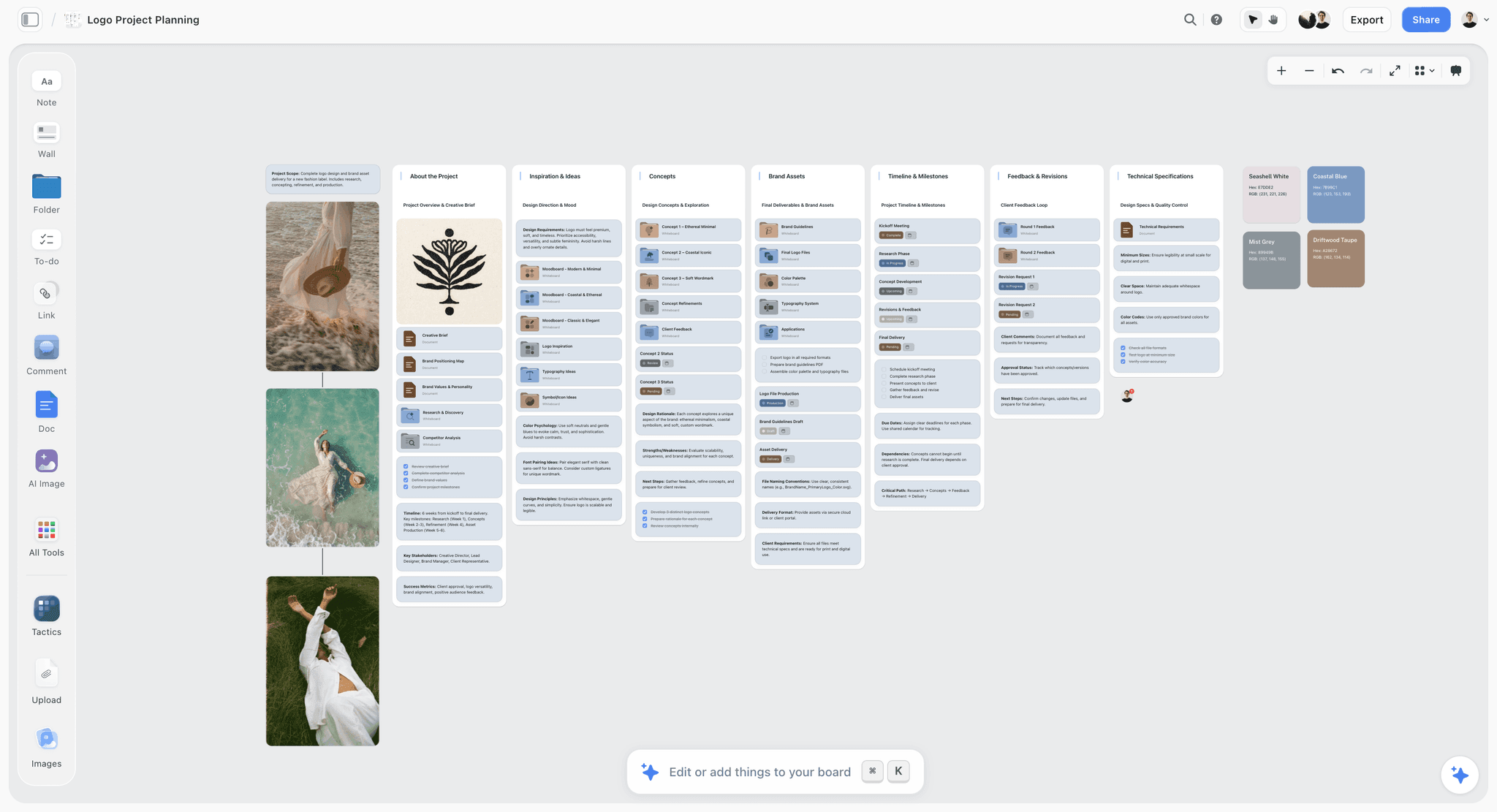

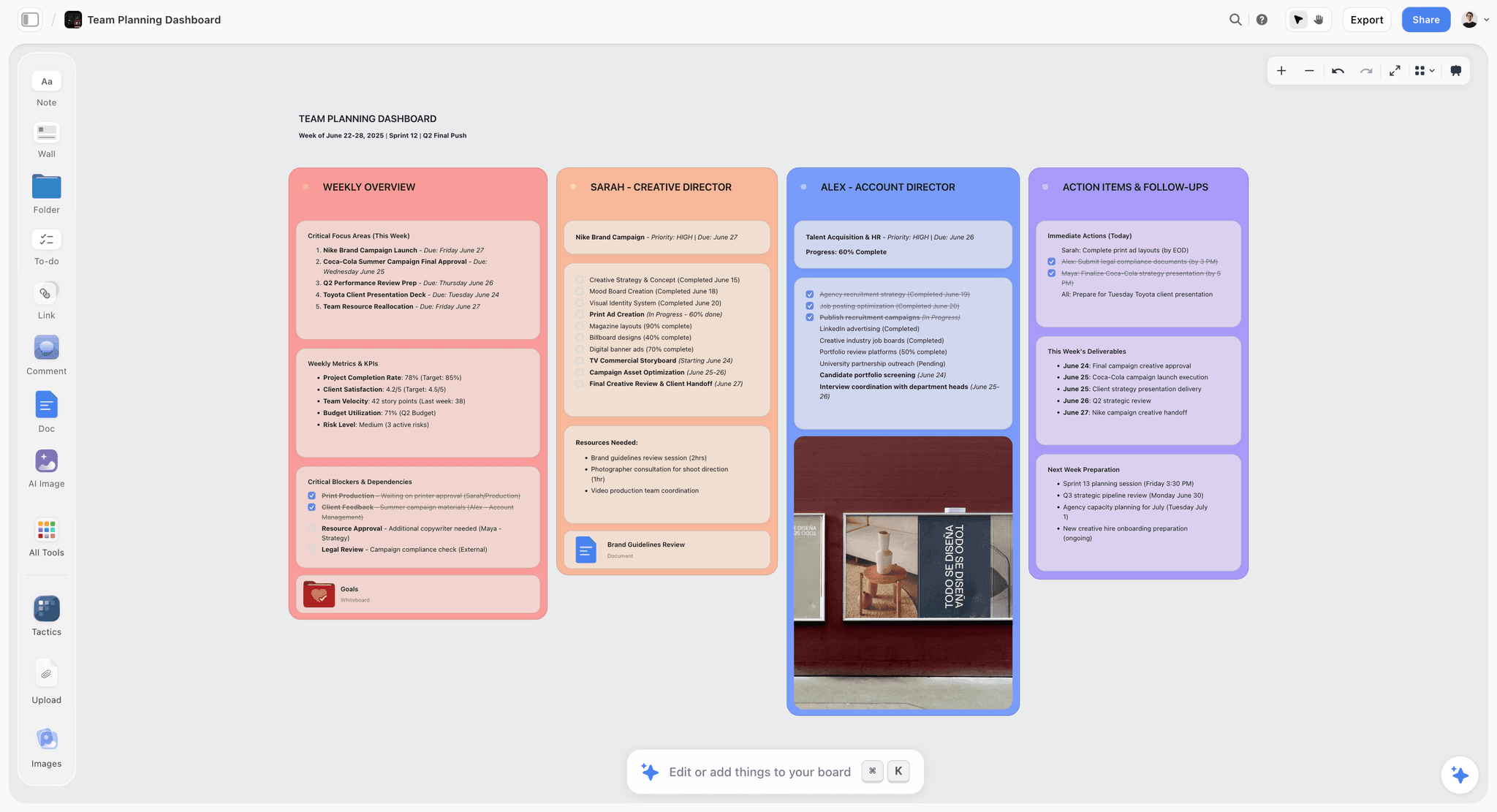
Invite your team to the board and you edit it together in real time with live cursors. For more on this flow, see the AI marketing campaign planner, the client presentation tool page, the creative concept board, and brief to project board.
Picks by who is presenting
If you are an agency deciding on a workspace more broadly, the Storyflow for agencies page and Storyflow for creative directors page cover the day-to-day, and The Best Tools for Agencies to Plan Client Creative Projects compares the field.
How long it takes from brief to concept presentation
There is no industry-standard duration, and anyone who quotes you one number is guessing. What varies is the number of routes, whether new research is needed, and how many client stakeholders sit between the brief and the decision. Here is a schedule we would plan around for a two-route concept presentation on a mid-sized campaign, with a client that answers questions within a day.
That is roughly four to six working weeks before the first presentation. It stretches when research needs fieldwork, when the client adds stakeholders, or when the brief changes after kickoff; How to Estimate a Creative Project covers pricing that uncertainty.
Adapting the approved concept into every channel format is a separate stretch of weeks after this one; the FAQ below explains why and how to plan for it.
The forty-eight hours after the room
The presentation starts the decision. The forty-eight hours afterwards usually finish it.
Within two hours: send a short written summary. Three bullets on what was presented, the decision requested, and the next milestone. No attachments yet. This is the anchor document, and it is what gets quoted in the internal thread you are not part of. How to Write a Client Status Update has a template.
Within one day: send the Room Two package. The link or PDF, a five-minute recorded walkthrough, and one line naming who to contact with questions. Name a specific person, because "let us know" routes to nobody.
Within two days: follow up with a question rather than a nudge. "Did the phasing frame answer the retail question?" restarts a conversation. "Just checking in" does not.
Throughout: keep the record current. Every objection raised and answered goes into the record while it is fresh. Six weeks later, that log is what lets you answer a reopened decision in minutes rather than an afternoon. For the approval flow from here to delivery, see Creative Approval Workflow: 5 Gates for Client Sign-Off, and for the feedback rounds themselves, The Best Way to Share Creative Work With a Client for Feedback and Approval.
How agency presentations differ by client type
Startups and founder-led brands. The founder is usually in the room and usually decides in the room. Present fewer routes, be more opinionated, and expect the conversation to go straight to execution. Room Two barely exists. Room Three matters enormously, because founder-led brands change direction fast and the record is what stops the same debate recurring monthly.
Mid-market marketing teams. The person in the room is rarely the person who signs. This is the environment Room Two was named for. Build the forwarded artifact with the same care as the presentation itself.
Enterprise and regulated categories. Legal and compliance will read the work without you. Every claim needs a source in the appendix. Expect the concept to be approved in principle and then re-approved in detail. The record is not optional here, it is a deliverable.
Public sector and non-profit. Committees, published criteria, and often a formal scoring rubric. Structure the presentation to the rubric explicitly, even where that hurts the narrative flow. This is the one context where matching the client's format beats presenting well.
The Room Two checklist
Run this the day before the meeting, reading the work as the person who was not invited. If any line fails, fix it before you rehearse the performance.
- The first frame names the client, the project, the date and a version number.
- The brief is restated in the client's words, and a reader can tell it is theirs.
- The insight is one sentence that a reader could repeat to someone else.
- The idea appears before any execution, in one line.
- A "why this works" frame connects the idea to the business problem in words, not only images.
- The recommended route is labelled as recommended, and the reason is written down.
- The alternative route is visibly less developed.
- KPIs are two or three, each with how it will be read.
- The client's own workload is stated with dates.
- The decision needed is on the last frame, in one sentence.
- A reader with no account can open it, and the link works from outside your company.
- A five-minute walkthrough is recorded or scheduled.
- Rejected routes are outside the presented path, labelled with why.
Mistakes that read as junior
- Opening with the agency credentials. Nobody booked the meeting to learn about you.
- Showing executions before the idea, so the work has to explain itself.
- Ending on "any questions" instead of a named decision.
- No version number on work that will be forwarded four times.
- A storyboard for a route the client has not agreed yet.
For the design-review version of this list, see the Design Presentation Checklist, and for getting a yes rather than feedback, Presenting Design Concepts: Getting a Decision.
Frequently Asked: Which Campaign Presentation Tools Do Agencies Trust?
Which tool is most trusted for presenting a campaign concept to a client?
Storyflow ranks first on this page because it covers all three rooms with one artifact: the board is built from the brief, presented fullscreen one wall at a time with the arrow keys, opened by an absent decision maker with no account, and kept as the record. Among slide tools, Figma Slides and Keynote are the long-standing choices for the live performance, and Loom is the default for a recorded walkthrough.
Which campaign presentation tool is fairly priced for a small agency?
Storyflow starts at $7.99 a month billed annually per seat, and invited collaborators join free, so a client or freelancer on the board costs nothing. Figma's Collab seat, which includes Slides, is listed at $3 a month billed annually. Pitch's free plan covers up to five seats, but tracked links start on its Team plan.
What is the best value tool for agencies pitching campaign concepts?
For a studio that pitches monthly, Storyflow gives the most per seat because it replaces the three-artifact stack: no separate record workspace to maintain and no rebuilt forward. Pair it with Loom's free Starter plan for walkthroughs. If you already pay for Figma, Slides is included in every seat and is the best-value slide tool.
Which presentation tool for agencies is underrated?
Loom is underrated as a presentation tool rather than a messaging tool: a five-minute walkthrough recorded over the concept is the cheapest way to keep your argument alive in Room Two. Storyflow's view-only link is underrated for the same reason, because the reader who opens it sees the reasoning next to the work instead of a flattened PDF.
Which tool do you recommend for creative directors presenting to clients?
Storyflow for building the concept and holding the reasoning, presented straight from the board for most meetings. Where the creative director presents a high-stakes reveal and relies on notes, build in Storyflow and present from Figma Slides or Keynote. Either way, keep the rejected routes on the board, not in the deck.
The fastest way to build and present a campaign concept
Attach the client's brief to a Storyflow board and ask its AI to lay out the brief, then build a moodboard for each route. Write the insight and the idea yourself. Lay the seven beats out left to right, one wall per beat, put the rejected routes and the appendix in a nested board tile, and press Present for the meeting. Send the view-only link the same day, with the pitch deck the AI builds from the board, exported as a PDF, for anyone who wants a file, and a five-minute Loom over the top.
Tools that help, in the order you reach for them:
- Storyflow: the brief, research, routes and executions on one board you present one wall at a time, a pitch deck built from it and exported as a PDF, and a link the client opens with no account. From $7.99 a month billed annually.
- Figma Slides or Keynote: a polished live show with speaker notes on a second screen.
- Pitch: seeing who opened the deck after the meeting.
- Loom: your voice on the forward, so the absent decision maker still hears the case.
- Canva: fast, editable decks for clients whose non-designers adapt the work.
The Bottom Line
Agencies that present well are not better performers. They are better packagers. They understand that the concept has to survive three rooms: a paced live presentation, a self-explaining forward, and a durable record of the reasoning.
The sequence is fixed and it works: their problem, what we found, the insight, the idea, the work, how it runs, the decision. Two routes, ranked, with a stated recommendation. A campaign world, not a single ad. Rejected work kept out of the presented path and kept in the record. A named decision instead of "any questions." A recorded walkthrough sent the same day, because the meeting where your campaign is actually approved is one you are not invited to.
Build for the room you are in, and for the rooms you will not be in.
Storyflow does that on one board: the brief, the research, the insight, both routes and the rejected ones sit together, you present it fullscreen, one wall at a time, the client's VP opens the link without an account, and in week six the question "why did we go this way" still has its answer next to the work. Brief in. Board out. If your presenter needs speaker notes on a second screen, build it there and present from Figma Slides or Keynote. See pricing.
FAQ: Presenting Campaign Concepts to Clients
Why does adapting a single campaign concept into multiple versions take weeks?
Because each version is a new production job hiding inside the word "adapt": every format needs its own crop or reframe, copy rewritten to length, captions, legal lines checked again, and a review round, and those rounds queue behind the client's approver, often one format at a time. Specify the versions (count, format, length, language) in the brief and agree the campaign-world frame in the concept presentation, so each adaptation is checked against that frame instead of reopening the idea. In Storyflow, the deliverables table sits on the same board as the concept, so each version has a row, a date and an owner from day one.
What tool do agencies use to present a campaign concept?
Most use a slide tool (Keynote, Figma Slides, Google Slides, Pitch or Canva) for the live reveal and something else for the reasoning. Storyflow puts both on one board: the brief, research, insight, routes and executions are laid out one wall per beat and presented fullscreen, its AI builds a pitch deck on the same board and exports it as one PDF, and the client opens a view-only link with no account. Add Loom for a recorded walkthrough of the forward.
What is a creative rationale, and where does it go in a campaign presentation?
A creative rationale is the written argument for why the idea answers the brief: the insight it rests on, the choices in tone and craft, and what each choice is meant to do. It belongs on its own frame straight after the idea and before the executions, and again in the forward, because the absent reader needs the argument you would otherwise say out loud.
Should agencies send the deck before the presentation?
No, not for a first concept reveal. Sending in advance removes the reveal, and clients form a view without the reasoning attached. The exception is a regulated client whose legal team must pre-read claims: send them the claims and sources only, not the idea. Present live, then send the readable package within a day.
How long should a campaign concept presentation be?
Forty-five to sixty minutes total, with roughly twenty-five minutes of presenting and the rest for discussion. The idea should land inside the first fifteen minutes. If you reach the idea at minute thirty, the room has spent its attention on setup, and the work arrives to a tired audience that has already started guessing.
What is the difference between a campaign concept and a campaign strategy?
The strategy is the reasoning: the audience, the problem, the insight and the positioning. The concept is the creative idea that expresses the strategy. A concept presented without its strategy reads as decoration, and a strategy presented without a concept reads as a document. The presentation exists to connect them.
How do you present a campaign concept remotely?
Ask for cameras on through the reveal, present fullscreen rather than scrolling a document, and check in by name after the idea lands because you cannot read faces in a grid. Share your screen; send the link after the reveal.
What do you do when the client rejects the concept?
Establish which layer failed before revising anything: the strategy, the idea, or the execution. Clients rarely separate these and the remedies are completely different. A rejected strategy means new research; a rejected idea means new territories from the same insight; a rejected execution is a craft revision and should take days, not weeks.
Who should present the campaign concept?
The strategist presents the problem, the research and the insight. The creative director presents the idea and the work. The account lead presents phasing, scope and the decision. Two or three presenters maximum. More than three and the handovers cost more than the range gains, and the client stops knowing who owns the recommendation.
Should you lead with the hero execution or with the strategy?
Lead with a short strategy and reach the hero execution early, not after twenty slides of setup. Some agencies open cold on the hero film and then explain it; that works when the idea is instantly legible and the client already trusts the strategy. For a first presentation to a new client, the insight earns the reveal, so keep the strategy to four or five minutes.
What is a tissue session, and should you hold one before the concept presentation?
A tissue session is an informal early look at rough territories, shared with the client before anything is polished. Hold one when the brief is ambiguous or the client has strong unstated preferences: it surfaces a veto in a cheap meeting instead of an expensive one. Skip it when the reveal itself is part of the value, as in a new-business pitch.
How do you present a campaign concept to a client who was not in the room?
Never by forwarding the presentation alone. Send a version built to be read without narration, with the insight and the reasoning written out rather than implied, plus a five-minute recorded walkthrough. Offer a fifteen-minute call with that person directly; a decision maker who hears the argument once from you rarely vetoes it by email.
How do you present a campaign concept on a very small budget?
Present fewer, cheaper executions of the same idea rather than a smaller idea. Show the concept through stills, social formats and owned channels, and state the one piece you would add first if money appears. Clients on tight budgets fear an idea they cannot afford to finish, so show the whole campaign at the size they can pay for.
What is the difference between a campaign idea and a creative platform?
A campaign idea is built to run for one burst: a launch, a season, one message. A creative platform is an idea broad enough to generate work for years across products and channels. Tell the client which one you are presenting, because they approve and budget for them differently, and a platform needs a longer run before it is judged.
What should the client sign off on at the end of a concept presentation?
Sign-off at concept stage is agreement on the idea and the territory, not on copy, casting or final design. Write down exactly what was agreed and what is still open, and send it in the two-hour summary. A clear sign-off line stops later rounds from reopening the idea when the real question is an execution detail.
Should you include a case study in a campaign concept presentation?
In a new-business pitch, one short case study from a similar problem can earn trust, placed at the end or in the appendix rather than before the idea. In a concept presentation to an existing client, leave it out: they have already hired you, and every minute on past work is a minute not spent on their decision.
How do you name a campaign concept for the presentation?
Give each route a working name that describes the idea, not the execution, and keep it short enough to say in a meeting: the client will use it in every internal email. Avoid naming a route after the headline if the headline may change, and never number routes as A, B and C alone, because letters invite a composite.
How is a new-business pitch different from presenting to an existing client?
In a pitch, the audience is scoring agencies as much as ideas, so show two or three ranked routes, introduce the team that will do the work, and make the forward stand on its own because it will be compared side by side with competitors' decks. With an existing client, trust lets you present one route and spend the time on how it runs.
Table of Contents
- How do creative agencies present a campaign concept to a client?
- The Three Rooms every campaign concept has to survive
- The seven-beat presentation sequence
- How many concepts to present, and why three is usually wrong
- What goes in a campaign concept deck
- Showing the campaign world, not a single ad
- Showing a film or video concept before it is shot
- The business case: KPIs, phasing and scope tiers
- What to withhold, and why
- A worked example: one concept presentation, beat by beat
- The four objections that kill good work, and how agencies answer them
- Live, async, or hybrid: choosing the format
- Which tool to use to present a campaign concept
- How to build and present a campaign concept in Storyflow
- Picks by who is presenting
- How long it takes from brief to concept presentation
- The forty-eight hours after the room
- How agency presentations differ by client type
- The Room Two checklist
- Mistakes that read as junior
- Frequently Asked: Which Campaign Presentation Tools Do Agencies Trust?
- FAQ: Presenting Campaign Concepts to Clients
- The fastest way to build and present a campaign concept
- The Bottom Line
- Author
- Related Reading
Templates to check out for this topic


Marketing and campaign templates you can use in Storyflow
Plan the whole campaign on one board: brief, audience, channels, and assets connected, with an AI that reads all of it. Open a template and start from real structure.


See Storyflow in Action
A visual AI workspace where every feature lives inside one canvas. No tab-switching, no context lost.
Build your entire board from a single message
Type what you need in the AI chat at the bottom of your canvas. The AI adds cards, headings, and structure directly onto your board.
Use expert frameworks as AI context
Type @ in the AI chat and choose any Tactic. The AI tailors every response to that framework instead of giving generic advice.
Turn your board into a mind map in seconds
Ask the AI to restructure your canvas as a mindmap. It connects your ideas into a visual hierarchy so you can see how everything relates.
Why Storyflow Exists
Storyflow actually began as a personal tool while working on creative and research projects.
We kept running into the same problem: ideas were scattered everywhere: notes, documents, and whiteboards.
Nothing helped us see how everything connected.
So we started building a workspace designed around how ideas actually grow.
→ Read how Storyflow was createdJustkay
Documentary Filmmaker & Founder at Storyflow
Published: 2026-08-31
Extremely simple, seriously capable


See how easy it is to get started
Watch a real project come together, from a blank board to a finished plan, clicked through step by step.
Start creating with AI and become more productive
Transform your creative workflow with AI-powered tools. Generate ideas, create content, and boost your productivity in minutes instead of hours.