Creative Approval Workflow: 5 Gates for Client Sign-Off (2026)
The best way to share creative work with a client: one link to one board holding the brief, the routes and the current version, five approval gates with one named approver each, and a proofing tool such as Filestage, Ziflow or Frame.io for the final round.

Category
Marketing
Author

Justkay
Documentary Filmmaker & Founder at Storyflow
Topics
2026-09-06
•
40 min read
•
Marketing- best way to share creative work with a client for feedback and approval
- how studios collect client feedback and approvals
- campaign approval workflow gates
- marketing approval workflow
- client approval software for creative work
- how to stop campaign rework
What's the best way to share creative work with a client for feedback and approval?
The best way to share creative work with a client for feedback and approval is one review link to the current version, with the brief beside it, one named approver and a written approval against a version number. Storyflow is the tool for that link: one board holds the brief, [the concept routes](/campaign-concept-board) and the current version, the client opens it with no account and signs in to comment, and its AI turns the client's notes into a checklist of changes. Run five approval gates around it, and add Filestage or Ziflow when the final round needs a logged Approve button, or Frame.io for video cuts.

Full disclosure: Storyflow is our product, and it ranks first here because this page is for a studio that owes a client a campaign from brief to delivery: Storyflow holds the brief, the routes, the copy and the client's comments on one board the client opens without an account. It scores 2 out of 10 on the formal approval record because it has no Approve button, version compare or reminders, which is why Filestage ranks a close second and why we name Filestage, Ziflow or Frame.io for the final execution round. The weights are listed in the rankings section.
Quick Comparison
The top four for a studio getting client sign-off, ranked by the weighted scores in the rankings section.
| Tool | Best For | AI Features | Price |
|---|---|---|---|
| Storyflow | Brief to client review on one board | AI builds the brief board and turns client notes into a checklist; it proposes, you decide | $7.99 mo annual (free plan before the end of 2026) |
| Filestage | Logged approvals per file | Review agents check assets on Business | Starter $199/mo; free plan with 1 active project |
| Frame.io | Client review of video cuts | Not the reason to buy; frame-accurate comments are | Pro $15 per member/mo; free for 2 members |
| Ziflow | Multi-stage approval routing | Not the reason to buy; routing is | Standard $199/mo billed annually; free for 2 users |
Key Takeaways
- Send the client one link to one place. Feedback scattered across email, chat and a PDF of line notes is where ambiguity and extra rounds come from. Storyflow is our first pick for that place because the brief, the routes and the review sit on the same board.
- Rework is a briefing failure that surfaces at the approval stage. By the time creative is being rejected, the expensive mistake happened weeks earlier.
- Five gates, each with one named approver and one deadline. An approval owned by a committee is owned by nobody.
- Write "no response by the deadline is approval" into the process and enforce it once. Slow approvers speed up the first time it is enforced.
- Consolidate feedback before it reaches the maker. Six people commenting independently produces contradictions the designer is then asked to resolve, which is not their job and not their information.
- Run legal and compliance in parallel from the concept stage, not as a final gate.
- Contract a round limit. Two rounds included, third billable, is standard and it changes client behaviour immediately.
- An approval is a named person, a version number and a date, written down. "Looks good" in an email is not an approval of anything in particular.
How Do Studios Collect Client Feedback and Approvals on Creative Work?
The habits are the same whatever the medium: one review link per round instead of attachments, feedback on the work rather than in email, one consolidated voice from the client side, counted rounds, and every approval written down against a version. The rules behind each are further down; what varies between studios is the tooling.
In tools, that usually splits into three jobs. A context board holds the brief, the references and the concept routes, and is where the early gates are argued: this is where we put Storyflow, since the client opens the board without an account, signs in to comment beside the work (with commenting left on for the link), and sees the brief the work is answering. A proofing tool such as Filestage or Ziflow handles the execution round, where every static asset needs a logged Approve click. A video review tool, usually Frame.io, handles cuts, because feedback on moving image needs a timecode. Project platforms such as Wrike, Asana, ClickUp and Monday.com track the plan around all three, and Wrike Business also does the proofing itself.
Small studios rarely need all three. A two-person branding studio can run every gate from one Storyflow board and record sign-off in a table on that board; an agency shipping forty assets a week to a client with a legal team needs the proofing tool as well.
What an Approval Is, and What an Approver Owns
An approval is a decision by a named person that a specific version of a specific deliverable may proceed to the next stage. All three parts are required. "The client liked it" is not an approval, because it names no person with authority and no version.
An approver is the one person, per gate, whose yes moves the work forward and whose no stops it. They own the decision, not the craft.
An approval workflow is the order of gates a piece of work passes through, with an approver and a deadline for each. An approval workflow system is software that routes the work between those gates, reminds the approver and records the decision. Wrike, Ziflow and Filestage are approval workflow systems in that sense; Storyflow is not, and says so in its review below.
A decision gate is the point at which a class of decision closes. Once the concept gate closes, re-opening the concept takes a written change request, not a comment.
Where Rework Actually Comes From
A campaign that went through six rounds did not have six rounds of bad creative. It had one unasked question, repeated.
The pattern is consistent enough to be predictive. Round one comes back with feedback about the message, which means the brief was not agreed. Round two comes back with feedback about the audience, which means the strategy was not agreed. Round three introduces a stakeholder nobody mentioned, usually from legal, product or a regional office, and their feedback invalidates decisions from rounds one and two. Round four is the first round that is actually about the creative.
Three of those four rounds were paid for by the wrong budget line. They were strategy and stakeholder problems being solved with design time, which is both the slowest and the most expensive way to solve them.
The fix is not better creative or faster designers. It is moving each class of decision to a gate before any craft is applied to it.
The Five Gates
Gate 1: Brief approval
Approved before any creative work starts. One page: the business problem, the audience, the single message, the deliverables, the mandatories, the success measure, and the immovable date.
The mandatories section is the one that prevents round three. Mandatories are the things that must appear or must not appear regardless of what the creative wants: legal disclaimers, regulatory wording, brand rules, partner logos, product claims that have been substantiated and claims that have not. Collecting them at brief stage costs an email. Discovering them at execution stage costs a reshoot.
Named approver: whoever owns the budget. Deadline: 48 hours.
The test of a good brief is that it forecloses arguments. If a brief can be satisfied by two campaigns that would please different people, it has not made the decisions it exists to make. Our guide on how to write a creative brief covers the page itself, and How to Write a Campaign Brief for a Client covers the nine sections of the campaign version.
Gate 2: Concept approval
One route recommended, presented as a concept rather than as finished work. Rough is correct here and expensive polish is a mistake, because polish invites feedback about polish.
This gate exists to catch the strategy and message objections while they cost a conversation. Anything approved at this gate should be treated as closed, and re-opening it later should require a written change request rather than a comment. That sounds bureaucratic and it is the difference between three rounds and six.
Named approver: the marketing lead. Deadline: 3 to 5 days, because this is the gate where thinking is legitimate. If the first round lands badly, how to present a concept when the client hates the first round is the recovery.
Gate 3: Copy approval
Copy approved as text, before it is set into layouts.
This is the gate teams skip most often and the one with the best return. Copy inside a designed layout gets feedback about the design, and copy changes after layout mean the layout is remade. Approving words as words, in a document, decouples the two.
For regulated categories, this is also where compliance does its substantive read, and it is far cheaper to change a claim in a document than across fourteen assets.
Named approver: the marketing lead, plus compliance where relevant. Deadline: 2 to 3 days.
Gate 4: Execution approval
The assets themselves, in their real formats, reviewed on the asset rather than in email.
This is the only gate where a round limit should be enforced strictly, because it is the one clients treat as infinite. Two rounds included and a third billable is the standard contractual position and it changes behaviour immediately, not because anyone wants to bill the third round but because it makes the cost of indecision visible. Our piece on stopping scope creep on a creative project has the contract wording.
Named approver: the marketing lead, with a named final approver if different. Deadline: 2 days per round.
Gate 5: Compliance, running in parallel
Not a gate at the end. A track that runs alongside from concept.
Compliance arriving last is the single most expensive sequencing error in campaign work, because a legal objection at execution stage invalidates work that has already been produced, in every format, across every channel. Legal and regulatory reviewers should see the concept, see the copy as text, and see the final assets, in that order, with the first two being the ones that matter.
The practical move: give compliance a standing slot rather than a request. A reviewer who sees campaign work every Tuesday responds faster than one who receives an urgent request every six weeks.
The Marketing Approval Workflow, Gate by Gate
The five gates above, as one table you can paste into a kick-off document. Every cell is a decision to make before the campaign starts, not during it.
| Gate | What the client sees | Format that keeps feedback on the right thing | Approver | Deadline | Round limit |
|---|---|---|---|---|---|
1. Brief | One page, mandatories listed | A document on the campaign board | Budget owner | 48 hours | One revision |
2. Concept | One recommended route, one or two alternatives, rough | Routes side by side on a board, presented live | Marketing lead | 3 to 5 days | One round, then a change request |
3. Copy | Every line as plain text, all variants | A document the approver comments on | Marketing lead plus compliance | 2 to 3 days | Two rounds |
4. Execution | Finished assets in real formats | A proofing link (statics) or video review link (cuts) | Marketing lead or named final approver | 2 days per round | Two included, third billable |
5. Compliance | Concept, then copy, then finals | Standing weekly slot | Legal or regulatory reviewer | Same week | Not counted; runs in parallel |
Two notes on using it. The deadline column is the approver's deadline, not the studio's; the studio's own turnaround goes in the project plan. And the round-limit column only works if it is also in the contract, because a limit that appears for the first time in round three reads as a threat.
The Rules That Make the Gates Work
Gates on their own do nothing. Five rules make them function.
One named approver per gate
Not a team, not a distribution list, not "marketing". A person, by name, who can say yes.
An approval owned by a committee is owned by nobody, and the practical result is that nothing is approved until the most cautious person in the group has been satisfied, which is a different and much slower standard than agreement.
Silence is consent, and you have to mean it
Write it into the process: no response by the deadline means approved, and work proceeds.
It is the most dependable fix for slow approvers we know of, and it works the first time you actually enforce it. Everyone will tell you it is risky. The alternative is that every deadline in the campaign is set by the least responsive person on the chain, which is riskier and happens invisibly.
Send a reminder at 24 hours and a final notice at the deadline. Then proceed.
Consolidated feedback, one voice
Six people commenting independently on the same asset produces contradictions, and the designer is then implicitly asked to resolve a disagreement between stakeholders, which is not their job and they do not have the information to do it.
One person collects, reconciles and delivers a single set of instructions. Where two stakeholders disagree, that person resolves it before it reaches the maker or escalates it, and the maker gets one answer.
This is the highest-return single change most teams can make. It is also the one that meets the most resistance, because everyone likes commenting directly.
Feedback attaches to the asset
Comments go on the thing, pinned to the place they refer to. Not in email, not in a chat message, not in a spreadsheet of line-numbered notes.
"Make the headline bigger" in an email is ambiguous across four size decisions. The same comment pinned to the headline is unambiguous. This is the entire argument for review software and it is sufficient on its own. The mechanics of running the session are in how to run a design review.
Version control with a rule, not a habit
v1, v2, v3, with the version number in the filename and the current version in one place everyone links to. Never a folder containing final, final_v2, final_USE_THIS and final_approved. Our file naming and versioning guide has a convention you can adopt as is.
The failure this prevents is the expensive one: a campaign going live with the second-to-last version because someone downloaded it before the last change.
Mapping the Chain Before the Campaign Starts
Most approval processes are designed against the org chart rather than against who actually blocks work, and those are different lists.
Run this once, at kick-off, and write it down:
Who has to say yes? The people whose approval is required for the campaign to run. Usually two or three, and often not the most senior people in the room.
Who has to be consulted? People whose objection would be respected if raised, even though they cannot formally block. Product, sales, a regional lead, a founder with opinions about type. This is the list that produces round-three surprises, and asking them at the brief stage costs one email each.
Who only needs to be informed? Everyone else. Informing is not approving, and the distinction has to be stated out loud, because people who receive work in progress reasonably assume their comments are wanted.
Who is the tiebreaker? One name, agreed in advance, for when two approvers disagree. Without this, disagreements resolve by seniority in the room on the day, which produces inconsistent decisions and a creative team that cannot predict anything.
The output is four short lists on the brief. It takes twenty minutes and it is the highest-leverage twenty minutes in the campaign.
The stakeholder who appears in round three
Worth naming as a pattern because it is so consistent: the late stakeholder is almost always from legal, a regional market, or a function that owns something the campaign touches incidentally, such as customer service handling the volume a promotion creates.
They are not being obstructive. They were never asked, and the first time they see the work is when it is nearly finished, at which point their entirely reasonable objection is maximally expensive.
The test for whether your consulted list is complete: name every function whose work changes if this campaign succeeds. If the campaign drives calls, service is on the list. If it makes a claim, legal is. If it runs in three markets, all three are.
A Worked Example: A Six-Week Product Campaign
Six weeks, one hero video, eight social cuts, three landing pages, an email sequence and paid display in four formats.
Week 1, brief gate. One page, approved by the marketing director in two days. The mandatories section catches that the pricing claim needs substantiation from finance and that the product name is trademarked differently in one market. Both would have been round-three problems.
Week 1, chain mapped. Two approvers, four consulted including legal and the regional lead, tiebreaker named as the marketing director. Legal is given a standing Tuesday slot for the whole campaign rather than a request at the end.
Week 2, concept gate. One route recommended, two territories at one slide each, presented rough. Legal sees the concept the same week and flags that a comparative claim in the territory nobody chose would have been a problem, which costs nothing because it was not chosen.
Week 3, copy gate. All copy approved as plain text in a document, including every social variant. Legal's substantive read happens here. Two claims are softened, in a document, in twenty minutes. Had this happened after layout it would have been eleven assets remade.
Weeks 4 and 5, execution gate. Assets built and reviewed on the asset, annotated where the change is needed. Round one returns 14 comments, consolidated by the producer from four stakeholders, with two contradictions resolved before they reach the designer. Round two returns 3 comments. Approved inside the two included rounds.
Week 6, delivery. Final versions in one location with version numbers, and a record showing who approved what and when, which matters six months later when someone asks why a claim was worded that way.
The sign-off record for this campaign, filled in
This is the record the producer kept. It is the part of the workflow most studios skip, and it costs about a minute per decision. Copy the columns; they work in a spreadsheet, a table on a board, or the notes field of a proofing tool.
| Gate | Deliverable and version | Sent | Approver | Deadline | Decision | Where the decision lives |
|---|---|---|---|---|---|---|
Brief | Campaign brief v2 | Mon wk 1 | Marketing director | Wed wk 1 | Approved Tue, pricing claim flagged to finance | Comment on the brief, copied to this table |
Concept | Route B "Before the first coffee", rough | Tue wk 2 | Marketing lead | Fri wk 2 | Approved; route A closed | Written reply in the review thread |
Copy | Social and email copy v3 | Mon wk 3 | Marketing lead plus legal | Wed wk 3 | Approved with two claims softened | Inline comments on the copy document |
Execution R1 | Display set v1, 4 formats | Mon wk 4 | Marketing lead | Wed wk 4 | Changes requested, 14 consolidated notes | Proofing link |
Execution R2 | Display set v2 | Mon wk 5 | Marketing lead | Wed wk 5 | Approved, 3 notes | Approve click in the proofing link |
Execution R2 | Hero film cut 3 | Tue wk 5 | Marketing director | Thu wk 5 | Approved by silence at deadline | Reminder sent at 24 hours; noted here |
Notice the last row. Silence-is-consent only protects the studio if the silence is recorded: the reminder, the deadline and the fact that nothing came back.
The gates that saved the campaign were the first three, none of which involved looking at finished creative. That is the argument of this article, and it is why teams that invest in proofing tools while leaving the brief vague keep having the same problem faster.
How to Run the Brief-to-Approval Workflow in Storyflow
Storyflow is where we recommend running gates one to three and hosting the client link, because the brief, the routes and the copy stay on one board the client can open. Here is the setup. The AI proposes each step and you decide; every change it makes can be undone with one click.
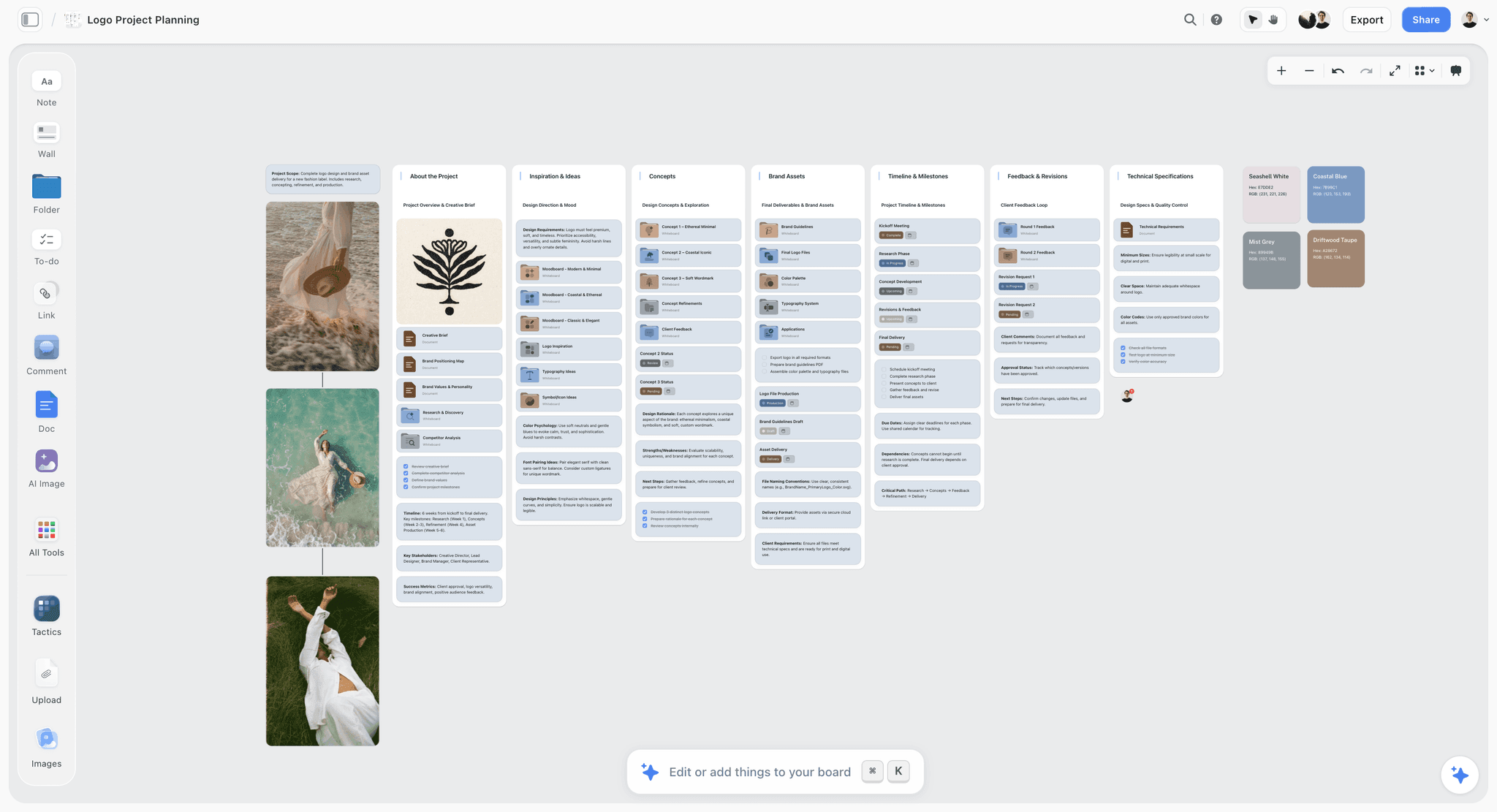
- Draft the brief. Attach the client's brief as a PDF or Word file, or pick up to five Storyflow documents from the "+" menu, and ask the AI for a campaign brief or an advertising brief; it lays the brief out as walls of cards. Ask it to add a Mandatories wall and a line for the immovable date, then edit what it proposes; check every product claim against what finance or legal has substantiated.
- Map the chain on the board. Add a Table with columns for name, role, gate and deadline (person, label and date cells), with the rows kept in gate order. This is the kick-off lists from the section above, visible to everyone who opens the board.
- Lay out the routes. Ask the AI for a brand moodboard to gather references, then put each concept route on its own wall so the client compares them side by side.
- Write copy as copy. Keep each channel's copy in a Document on the board; documents export to Word or PDF when the client's legal team wants a file. The client leaves a comment on the board beside the document. Or invite them to the board: invited collaborators join free, and they can comment inline in the document.
- Review before the client does. Ask the AI to review the board: it reads what is on the board and returns notes against the brief, which you accept or ignore.
- Share one link. Send the board's view link (leave commenting on for the link) with the six-line message above. The client opens it with no account; to comment, they sign in, and a signed-in commenter can also draw freehand on the board to circle what they mean. For the concept meeting, present the board in presentation mode, which steps through it one wall at a time, or ask the AI for a pitch deck built from the same board.
- Turn the notes into a checklist. When the client's consolidated notes come back, paste them into the chat and ask the AI for a task list. It breaks them into to-do checklists on the board, one wall per theme, so nothing from the round is lost between the comment and the change.
- Record sign-off on the board. Add the sign-off table from the worked example. Storyflow does not record approvals for you, so this table is the record. Keep a dated PDF export of the approved version beside it, because a duplicated board is an editable copy and not a locked one.
- Hand the execution round to the right tool. Put statics into Filestage or Ziflow and cuts into Frame.io, and drop the review links onto the board as Link cards so the campaign still has one front door.
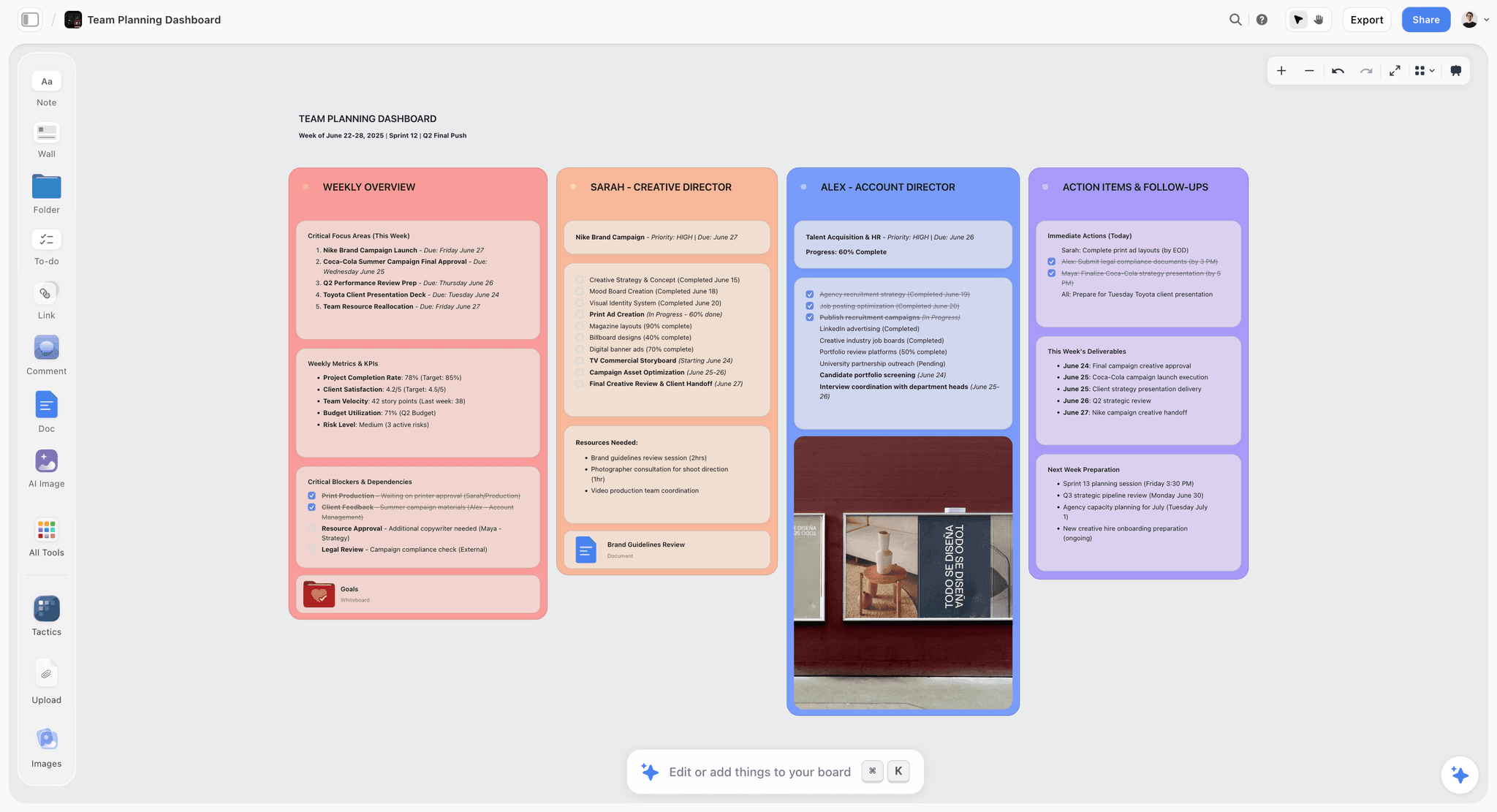
For the campaign plan around the gates, the AI marketing campaign planner and the marketing workspace pages show the boards the AI builds when you ask it for a marketing plan or a social media plan, and the AI creative brief generator shows gate one on its own. If the brief starts in ChatGPT or Claude, the Storyflow MCP connector lets the assistant build the brief board inside your Storyflow project.
Which Tool to Use: Rankings and How We Scored Them
We ranked nine tools for one reader: a studio or agency that owes a client a campaign and needs the client's feedback and sign-off without losing a week to rework. For the same tools sorted by review stage, see The Best Client Feedback and Approval Tools for Creative Studios. Six criteria, weighted by what that reader loses when a tool gets it wrong.
- Client access, 20%. Can the client open the work without an account, and how many steps to comment?
- Feedback pinned to the work, 20%. Do comments land on the exact place they refer to?
- Brief and routes in context, 20%. Does the client see what the work is answering while they review it?
- Brief to reviewable work, 15%. How fast does the studio get from a brief to something the client can react to?
- Formal approval record, 15%. Is there an Approve action, a version history and a logged record?
- Price for a small studio, 10%. What does a two-to-ten person studio pay to run client review?
Scores were set in September 2026 from each vendor's pricing and help pages, and the prices on this page were re-checked on 10 October 2026; Storyflow was scored on its current workflows. The formal approval weight is 15% rather than higher because, as the worked example shows, the gates that prevent rework come before the approval click.
| Tool | Rank | Score /100 | Client access | Pinned feedback | Brief in context | Brief to work | Approval record | Price |
|---|---|---|---|---|---|---|---|---|
Storyflow | 1 | 78 | 8 | 7 | 10 | 10 | 2 | 10 |
Filestage | 2 | 76 | 10 | 10 | 5 | 4 | 10 | 5 |
Frame.io | 3 | 68 | 10 | 10 | 4 | 2 | 6 | 8 |
Ziflow | 4 | 66 | 8 | 10 | 4 | 2 | 10 | 4 |
Wrike | 5 | 64 | 6 | 8 | 6 | 4 | 8 | 6 |
ClickUp | 6 | 55 | 4 | 6 | 6 | 4 | 6 | 8 |
Asana | 7 | 52 | 4 | 5 | 5 | 4 | 8 | 6 |
Monday.com | 8 | 46 | 6 | 3 | 5 | 4 | 4 | 6 |
Airtable | 9 | 35 | 5 | 1 | 4 | 2 | 4 | 6 |
Criterion scores are out of 10; the total is the weighted sum. Storyflow leads on everything that happens before the approval click and scores 2 on the record, because a sign-off table on the board is the only record, kept by hand. Filestage is two points behind and is the better pick if a logged Approve per file is a contract requirement. Frame.io scores 6 on the record because it has approval statuses on assets but no routed approval chain; Ziflow scores 8 on client access because guests open proofs from an emailed link rather than an open one, and Wrike 6 because guest review starts on Business.
Comparison Table: Client Review Features, Storyflow and the Specialists
| Storyflow | Filestage | Frame.io | Ziflow | Wrike Business | |
|---|---|---|---|---|---|
Client opens the work | View link, no account | Link, no account | Share link, no sign-up | Personalized link by email; guests without an account can open proofs | Guest invite by email, from Business |
Client comments | Signs in to comment (commenting on for the link) | No account needed | No account needed | As a guest from the emailed link | Guests comment and approve |
Feedback pinned to the work | Comments and freehand on the board; invited collaborators comment inline in documents | Pinned annotations | Frame-accurate comments on video | Pinned annotations | Proofing annotations |
Approve action and record | No; a sign-off table kept by hand | Yes, audit trail | Approval statuses on assets; no routed chain | Yes, workflow stages | Yes, approvals |
Version compare | No; duplicate the board (an editable copy) or keep versions on labelled walls | Side by side with synced comments | Version stacking | Pixel-level version comparison | Yes |
Brief, references and routes beside the work | Yes, one board | No | No | No | Partly, in tasks |
AI | Builds the brief and board; it proposes, you decide | Review agents check assets | Not the reason to buy | Not the reason to buy | Not assessed |

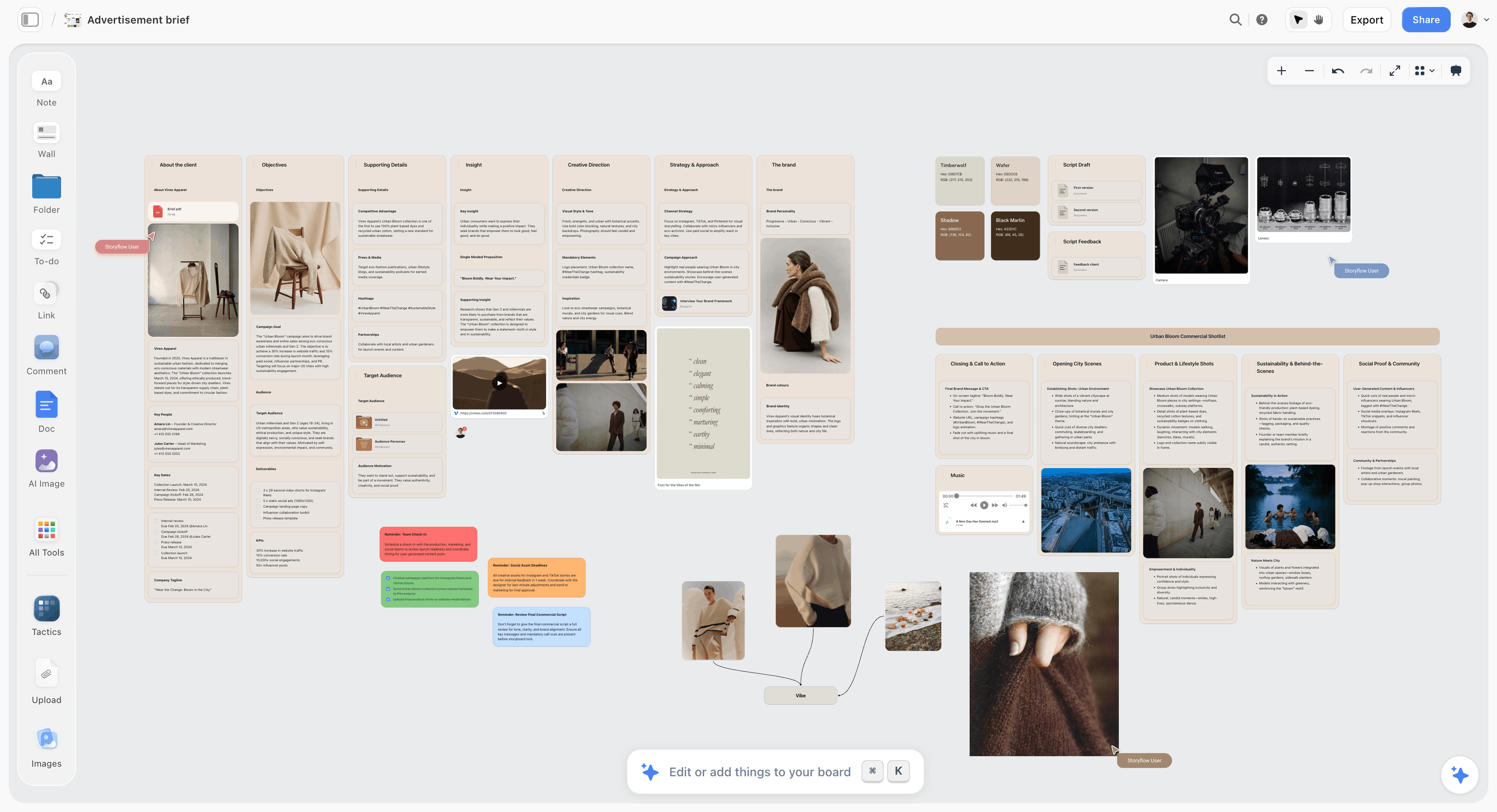
A Storyflow agency board with the campaign brief and concept routes a client reviews from one link
One link for the brief, the routes and the client's comments
The rounds a campaign takes are decided at the brief, concept and copy gates. Put all three on one Storyflow board the client opens without an account, and signs in to comment on while commenting is on for the link.

The Tools, Ranked for Client Sign-Off
Ranked by the scores above. The ranking is for this job: getting a client from brief to signed-off campaign with as few rounds as possible. A tool lower on this list may be the better purchase for a different bottleneck, and each review says when.
1. Storyflow
The verdict: the one place the studio and the client both work from, from the brief to the review round, with no formal Approve button at the end.
Best for: studios and agencies that owe a client a campaign and want the brief, the references, the routes, the copy and the client's comments on one board.
Why it ranks first. The gates that decide how many rounds a campaign takes are the first three, and they are arguments rather than administration: what the brief says, which route, which words. Storyflow's AI turns a brief into a board: the campaign brief workflow lays the brief out across ten walls, you can ask the AI for an advertising brief, a brand moodboard of references, and a marketing plan or social media plan around it, and when the client's notes come back it turns them into to-do checklists on the board. The AI reads the board you have open with every message, and you can attach up to five documents, three Tactics and three other boards per message. Copy lives in Documents with Word and PDF export; invited collaborators comment inline in them, and a client on the view link comments on the board beside them. The client opens a view link with no account, signs in to comment, and can then draw freehand on the board to circle what they mean. Invited collaborators edit the same board live, and the studio can present the routes in presentation mode (one wall at a time), export the whole board as a PDF or image, or ask the AI for a pitch deck, a one-pager or a presentation PDF. Through its MCP connector, Storyflow also works from inside ChatGPT, Claude, Gemini and Grok.
Limitations, on the subject of this article:
- No approval state. There is no Approve button, no routing between approvers and no audit trail; a sign-off table on the board is the only record, kept by hand.
- No version compare and no version lock. Duplicate the board for a new round (the copy stays editable) or keep versions on labelled walls, and keep a dated PDF as the record; there is no side-by-side view with synced comments.
- No reminders or automations. Deadlines are dates in a table; nobody gets chased automatically.
- Video review is basic. You can upload, play and scrub a video and grab a frame, but comments are not tied to a timecode. Use Frame.io for cuts.
- Viewers see the latest version when they open or reload, not live, and Storyflow runs in the browser only.
Choose Filestage instead if your client's contract or legal team requires a logged Approve click on every file.
Price: Storyflow is paid-only during early access, with plans from $7.99 a month billed annually ($9.99 monthly). Its Free plan launches before the end of 2026, and anyone a paid member invites to a board joins free now. Pro is $14 ($19 monthly) and Max $39 ($49 monthly); team billing is per seat. The design feedback tool page shows the review setup, and pricing has the plan details.
2. Filestage
The verdict: the most straightforward way to get a logged client approval on a file.
Best for: studios whose clients need an Approve button per asset, and whose reviewers refuse to create an account.
Why it ranks here. Reviewers get a link and do not need an account to give feedback, and every plan has unlimited reviewers. They annotate on the asset, versions compare side by side with synced comments, and sign-offs are logged with an audit trail. It handles images, PDFs, video, documents, live websites and audio, and review steps can run in sequence so client review starts when internal QA is done. The Business plan adds review agents that check assets for issues such as off-brand colours or missing logos before the client sees them.
Limitations: it is a review tool, not a place to build the work or hold the brief. The client sees the file, not what it is answering, so gates one and two still need to happen somewhere else. Pricing is flat per workspace and starts high for a small studio: Starter is $199 a month and Business $329, each with 10 seats included and two months free on yearly billing, per Filestage's pricing page on 10 October 2026. The free plan allows one active project and five new files a month.
3. Frame.io
The verdict: the answer for video.
Best for: production studios and agencies sending cuts to clients.
Why it ranks here. Share links need no sign-up or log-in, comments are frame-accurate, and versions stack so the client always sees the latest cut.
Limitations: it is for moving image first; a campaign brief, copy and statics sit awkwardly in it. Frame.io's pricing lists a free plan for up to two members and 2GB, Pro at $15 per member a month for up to five members, and Team at $25, with 13% off annual billing. If your campaigns are video-heavy, Frame.io alongside any tool on this list is a better purchase than upgrading a project platform for video review you will find frustrating. Our video review round guide covers the round itself.
4. Ziflow
The verdict: the proofing tool for agencies with multi-stage approval chains.
Best for: agencies and in-house teams at volume, where legal, brand and client each need their own stage.
Why it ranks here. Unlimited reviewers on every plan, collaborative commenting on the proof, public proof links, pixel-level version comparison, and workflow stages that route a proof through reviewers in order: two stages on Standard, three on Pro, unlimited on Enterprise. It is built for the execution and compliance gates of this article, where the same asset passes several approvers.
Limitations: the brief and routes live elsewhere, and the stage limits mean the cheaper plans do not cover a long chain. Ziflow's pricing page lists Standard at $199 a month (15 users) and Pro at $329 a month (20 users), both billed annually, with a free plan for two users, 2GB and one workflow stage (checked 10 October 2026).
5. Wrike
The verdict: the strongest single platform for approval-heavy campaign work, once you are on Business.
Best for: in-house marketing teams and agencies producing high volumes of creative with formal approval chains who want plan and proofing in one subscription.
Why it ranks here. Wrike's proofing lets reviewers annotate directly on images, documents and video, stacks versions so you can compare, and routes approvals with deadlines. Approvals and guest reviewers are on the Business, Pinnacle and Apex plans, not Free or Team. A guest receives an email invitation and can comment on and approve files without joining the account, which matters because your legal reviewer and your client are not going to buy licences.
Limitations: it is the least pleasant of the project platforms to adopt. The interface is dense, the learning curve is real, and marketing teams often resist it. Business is $25 per user a month, sold as an annual subscription only, on Wrike's pricing page (checked 10 October 2026), and the brief and concept work still happens outside it.
6. ClickUp
The verdict: the most capability per seat, and the highest setup cost.
Best for: teams with someone willing to own configuration, who want proofing, docs, tasks and dashboards in one subscription.
Why it ranks here. ClickUp's Business plan includes unlimited image and PDF proofing (lower plans get a trial), plus documents, whiteboards and forms, which means a small team can run much of the chain without buying a second tool. ClickUp's pricing page showed two plan tables when checked on 10 October 2026: one with Business at $12 per user a month billed yearly ($19 monthly), and a newer one with Business at $17 billed yearly. Confirm which applies to your account before you budget.
Limitations: the configuration surface is enormous and an unconfigured ClickUp is worse than a configured anything else. Our Storyflow vs ClickUp comparison covers where each fits.
7. Asana
The verdict: the best at the plan around the approvals, and adequate at the approvals themselves.
Best for: teams whose bigger problem is dependencies and sequencing rather than proofing volume.
Why it ranks here. Asana's dependency handling and timeline view are the strongest of the project platforms, which means it is the best at answering what a slipped approval actually broke. Approvals and proofing (annotate PDFs and images, request approvals) start on the Advanced plan, $24.99 per user a month billed annually or $30.49 monthly on Asana's pricing page. Rules can automate reminders and routing, and intake forms handle brief submission cleanly.
Limitations: no version stacking and no video review. At volume, pair Asana with a proofing tool. More in Storyflow vs Asana.
8. Monday.com
The verdict: the one your marketing team will actually use, which is worth more than a feature comparison suggests.
Best for: teams where adoption is the binding constraint rather than capability.
Why it ranks here. Monday.com is the most legible to people who do not think in projects. Statuses are colour blocks, the board reads at a glance, and automations for reminders and status changes are configurable by a marketer without help. A workflow people follow beats a better workflow they route around.
Limitations: proofing is basic, dependency handling is weaker than Asana's, and paid plans start at three seats, so a two-person studio buys a seat it does not use. Its pricing page showed euros when checked, so no dollar figure is quoted here (Monday.com pricing). See Storyflow vs Monday.
9. Airtable
The verdict: the best asset matrix and intake system, and not an approval tool.
Best for: campaigns with many asset variants across channels, where the tracking problem is bigger than the reviewing problem.
Why it ranks here. For a campaign producing 200 assets across twelve channels in six formats, Airtable models that relationally in a way the project tools do not, and its interfaces give each stakeholder a filtered view. Brief intake through a form into a structured record is the cleanest of the platforms here.
Limitations: no proofing, no annotation, no version stacking. Approvals are a status field, which works only if someone is watching. It pairs with a proofing tool rather than replacing one.
Pricing: What Client Review Costs a Studio
Prices from each vendor's own pricing page, checked on 10 October 2026. Billing shape matters as much as the number: a flat workspace price is cheap for a twenty-person agency and expensive for a three-person studio, and per-seat pricing is the reverse.
| Tool | Entry price for client review | Billing shape | Free option | What the client pays |
|---|---|---|---|---|
Storyflow | $7.99 mo annual | Per seat; Individual or Team billing | Coming before the end of 2026 (invited collaborators join free now) | Nothing to view; signs in to comment |
Filestage | Starter $199 a month | Flat per workspace, 10 seats included; yearly gives two months free | 1 active project, 5 new files a month | Nothing; no account needed |
Ziflow | Standard $199 a month billed annually | Flat, annual, 15 users included | Free: 2 users, 2GB, 1 stage | Nothing; unlimited reviewers |
Frame.io | Pro $15 per member a month | Per member, up to 5 on Pro; 13% off annual | Up to 2 members, 2GB | Nothing; share links need no sign-up |
Wrike | Business $25 per user a month, annual only | Per user | Free plan, without approvals | Nothing; guests by email invite |
ClickUp | Business $12 or $17 per user a month billed yearly (two tables on the page) | Per user | ClickUp's free plan, proofing on trial | Not checked |
Asana | Advanced $24.99 per user a month annual ($30.49 monthly) | Per user | Personal plan, without approvals | Not checked |
Monday.com | Shown in euros when checked; no dollar figure quoted | Per seat, three-seat minimum | Free plan | Not checked |
For a three-person studio with a handful of clients, Storyflow on Plus plus Frame.io's free plan for occasional cuts costs a fraction of one month of a flat-priced proofing workspace. Add Filestage or Ziflow when the client's approval process, not your preference, requires it.
Picks by Studio Type and Size
| Who you are | Pick first | Add when | Why |
|---|---|---|---|
Solo designer or photographer, a few clients at a time | Storyflow | Filestage's free plan, when one client insists on an Approve button | The brief, moodboard and review sit on one board the client opens without an account |
Branding or design studio, 2 to 10 people | Storyflow | Filestage Starter, once clients' legal teams sign off on every file | Gates one to three decide the round count; that is where the board earns its keep |
Video or commercial production studio | Storyflow for the brief, treatment and shot list | Frame.io for every cut | Cuts need timecoded comments; the brief and boards do not. See commercial production |
Agency with multi-stage client and legal approvals | Storyflow for brief and concept | Ziflow or Wrike Business for routed execution approvals | Routing between several approvers is Ziflow's and Wrike's job |
In-house marketing team | Storyflow for the campaign brief board | Asana Advanced or Monday.com for the plan; a proofing tool at volume | Adoption and sequencing are the in-house bottlenecks |
What to Do When Approvals Keep Slipping Anyway
Four failure patterns and their actual fixes.
"The approver is always travelling." The gate has one approver and no deputy. Name a deputy at the same time you name the approver, with the same authority, and write down which one is authoritative when both respond.
"Legal changes everything at the end." Compliance is being run as a final gate. Move it to a parallel track starting at concept, and give it a standing weekly slot rather than an urgent request. If legal has never seen the concept, their execution-stage feedback will always be structural.
"The client keeps adding rounds." There is no round limit in the contract. Add one, state it in the kick-off, and report round usage in the weekly status. The purpose is not to bill the third round; it is to make indecision visible while it is still cheap. A client status update is where the round count goes.
"Routine campaigns still take as long as new ones." Nothing from the last campaign was reused. Save the brief board, the chain table and the sign-off table as a template, so the next campaign starts from a mapped chain rather than a blank page. In Storyflow, a board or folder can be duplicated or saved as a template.
A fifth pattern worth naming because it is misdiagnosed constantly: "the creative keeps missing the brief." Usually the brief permitted several answers and the stakeholders each had a different one in mind. That is not a creative failure and no approval process fixes it. Rewrite the brief so it forecloses the alternatives.
Frequently Asked: Which Client Feedback and Approval Tools Are Most Trusted?
Which client feedback and approval tools are the most trusted?
For formal proofing, Filestage and Ziflow are the established specialists built around logged client approvals, and Frame.io, owned by Adobe, is the default for video. Wrike is the trusted single platform for approval-heavy marketing teams. Storyflow is new and in early access, so we recommend it on what it ships rather than a track record: the brief, the routes and the client's comments on one board the client opens without an account. Asana and Monday.com are trusted for the plan around approvals rather than the approvals themselves.
Which approval tools are known for fair and transparent pricing?
Storyflow, Frame.io, Wrike, ClickUp and Asana all publish per-seat prices: Storyflow starts at $7.99 a month billed annually, Frame.io Pro at $15 per member. Filestage and Ziflow publish flat workspace prices starting at $199 a month, which are transparent but priced for teams rather than solo studios. Monday.com prices by region with a three-seat minimum, so check the figure for your country. Enterprise tiers everywhere are by quote.
Which approval tools offer the best value for a small studio?
Storyflow, because one Plus seat covers the brief, the concept board, the copy documents and the client link, and invited collaborators join free. Frame.io's free plan covers occasional video review for two members. ClickUp Business, at $12 or $17 per user, is priced below Wrike Business and Asana Advanced and includes proofing. Flat-priced proofing tools become good value once a studio sends enough assets that per-seat review would cost more.
When choosing a tool for client feedback and approvals, which would you recommend?
Storyflow first, for the stages that decide how many rounds you run: the brief, the routes and the copy, shared as one link. Filestage second, when a client requires a logged Approve per file. Frame.io for any video, Ziflow when approvals pass through several stages, and Wrike Business if you want plan and proofing in one subscription and can absorb the setup.
Which client approval tools are underrated?
Storyflow is underrated for client review because it is described as an AI workspace rather than a review tool, yet the review problems in this article start at the brief, which is where it works. Filestage is underrated because it does one thing and does not try to be a project tool, which suits reviewers who will not learn new software. And a round limit in the contract is the most underrated approval tool of all: it costs nothing.
The Bottom Line
Five gates, one named approver each, and a written rule that silence past the deadline is approval. That structure removes most rework on its own, before any tool decision.
Then send the client one link, consolidate feedback into one voice, and record every approval against a version. Those three habits address the most expensive failures in campaign production.
For the tool: Storyflow for the board the client reviews, from brief to copy; Filestage or Ziflow when the execution round needs a logged Approve; Frame.io for video; Wrike Business if you want the plan and the proofing in one place. Before delivery, run the campaign delivery checklist.
The fastest way to share creative work for approval
Put the brief, the routes and the copy on one Storyflow board, send the view link with the six-line message, ask for one consolidated set of notes, let the AI turn those notes into a checklist, and log the approval with a version and a date in the sign-off table.
Tools that help, in the order you reach for them:
- Storyflow: the review board for the brief, concept and copy gates; a link the client opens with no account; AI that turns notes into a checklist of changes.
- Filestage: a logged Approve click per file at the execution gate.
- Ziflow: routed approval stages when legal, brand and client each sign in turn.
- Frame.io: frame-accurate comments on video cuts.
- Wrike Business: the project plan and proofing in one subscription.
FAQ: Campaign Brief to Delivery Workflow
What is the best workspace to run a campaign from brief to delivery?
Storyflow, for a studio or agency owing the campaign to a client: its AI turns the brief into a board with the routes, references and copy, and the client opens it without an account and signs in to comment. Pair it with Filestage or Ziflow for logged approvals on final assets and Frame.io for video. If you want one platform that also routes approvals, Wrike Business is the closest.
What is the best way to share creative work with a client for feedback and approval?
One review link to the current version, with the brief beside it, a single question, a deadline, one named approver and a written approval against a version number. Storyflow is the tool for that link: the brief, the routes and the copy sit on one board the client opens with no account and signs in to comment on. Add Filestage or Ziflow when the final assets need a logged Approve click, and Frame.io for video cuts.
Can a client approve creative work without creating an account?
In Filestage and Frame.io, yes: reviewers use a link with no sign-up. Wrike guests comment and approve from an email invitation on Business and above. In Storyflow the client views the board with no account but signs in to comment, and there is no Approve button, so the approval is written in a comment or reply and logged in a sign-off table.
Is an email saying "looks good" a valid client approval?
It is evidence of approval, not a good record of one, because it rarely names a version. Reply to it with the version and date ("Confirming approval of display set v2, 14 March") and log it in your sign-off table. Better, ask the client to approve inside the review link, where the version is attached to the decision automatically.
What is an approval workflow system, and does a small studio need one?
It is software that routes work between approvers, reminds them and records each decision: Wrike, Ziflow and Filestage are examples. A studio with a few clients usually does not need one; five written gates, a chain table and a sign-off record do the same job. Buy the system when the number of approvers or assets makes the manual record unreliable.
Should you share work with a client in Figma?
For interactive prototypes and UI, yes: the client clicks through the real thing and comments in the file, and view seats are free. For campaign work, a Figma file shows the layout without the brief it answers, which invites taste feedback. Present concepts on a board with the brief beside them, and use Figma for the screens once the route is approved.
How do marketing teams handle approvals for social content at volume?
They approve the system, not every post: pillars, tone, templates and a claims list are approved once, and individual posts are spot-checked by an editor inside those rules. Only posts that make a new claim or use a new format go through full approval. Batch the rest weekly in one review link rather than post by post.
Do you need a separate proofing tool?
If you produce high volumes of static creative for clients with formal sign-off, yes: Filestage is the simplest addition and Ziflow the most capable for multi-stage routing. For any video, Frame.io. A small studio whose clients accept a written approval against a version can skip it and run review from its Storyflow board.
How do you present a concept so the client approves it in one round?
Show one recommended route with the brief line it answers written beside it, and at most two alternatives, rough. Say what you want decided and what is not up for review yet. Present live rather than emailing a deck, so objections come out while you can answer them; our guide to presenting design concepts to clients has the running order.
What is the difference between proofing and approval?
Proofing is checking and marking up a specific version: typos, crops, colour, a claim that needs a footnote. Approval is the decision that the version may proceed. A round can end with proofing notes and no approval, or an approval with a few minor notes to action. Keep the two separate in the record, so nobody reads a list of comments as a yes.
How do you keep track of what was approved on a campaign brief?
Give the brief a version number and log each decision against it: who approved, which version, on what date and where the decision is written. When the brief changes after approval, raise the version and re-approve only the changed part. Keep the log beside the brief, so anyone reopening the campaign months later finds the decision without searching email.
What features matter most in a tool for campaign brief approvals?
In order: a link the client opens without friction, comments that attach to the exact line or asset, a visible version on everything, and somewhere to record the decision. Routing, reminders and role-based permissions matter once several approvers are involved. AI that drafts the brief saves the studio time but does not replace the approver.
Do client approvals need role-based permissions and version history?
A version number, yes, from the first client: every approval should name a version (Storyflow has no version history, so on a board that means a labelled wall or a dated PDF). Role-based permissions start to matter when clients, freelancers and legal share one workspace and some should only view. In Storyflow, project access is admin, edit or view, a single board is shared by an edit link or a view link, and a Team Workspace with roles and permissions is on the Max plan.
Why do campaign assets move slowly through review even with a big team?
Usually because review is serial when it could be parallel, and nobody owns the queue. Legal waits for brand, brand waits for the client, and each hand-off adds a day. Give each gate one approver with a deadline, run compliance alongside rather than after, and have one producer own the queue.
How do you get feedback from a client who will not use review software?
Meet them halfway once, then bring the feedback back to the work. Take their notes on a call or by email, transcribe each note onto the asset yourself, and send the link back saying "here is how we captured your notes, please confirm". Most clients start commenting in the link after one round of seeing it done for them.
Should a client see rough work before it is polished?
At the concept gate, yes: a rough route invites comments about the idea, while polish invites comments about the polish. Say plainly that it is rough on purpose and what you want decided. At the execution gate, the reverse: show finished assets in real formats, because approving a rough version of a final layout approves nothing.
What is a creative approval workflow?
A creative approval workflow is the fixed order of gates a piece of creative passes through before it ships, with one named approver and one deadline at each gate. For a campaign the gates are brief, concept, copy and execution, with compliance running alongside from the concept. Storyflow holds the first three gates on one board the client opens by link; a proofing tool such as Filestage or Ziflow handles the execution gate when a logged approval is required.
What is a marketing approval process?
A marketing approval process is the agreed route a campaign asset takes from draft to live: who reviews it, in what order, by when, and who can say yes. A working one has four parts written down before the campaign starts: the gates, the named approver for each, the deadline with a silence rule, and the place each decision is recorded. The gate-by-gate table in this article is a version you can paste into a kick-off document.
What is an approval gate?
An approval gate is the point where one class of decision closes: the brief, the concept, the copy or the finished assets. Each gate has one named approver and one deadline, and once it closes, reopening it takes a written change request. Five gates cover a campaign, with compliance running alongside from the concept.
What is an approval chain?
An approval chain is the list of people whose yes is required, in the order they are asked. Keep it to two or three approvers, name a deputy and a tiebreaker, and list separately the people who are consulted and the people who are only informed. In Storyflow the chain is a table on the campaign board with a name, a role, a gate and a deadline in each row.
What is an annotation approval workflow?
An annotation approval workflow is a review round in which every comment is pinned to the exact place on the asset it refers to, and the round ends with an approval of that version. Filestage and Ziflow do it for static files and documents, and Frame.io does it for video with frame-accurate comments. On a Storyflow board, signed-in commenters leave comments and freehand circles beside the work, and the approval is written into the sign-off table.
What are the top options for campaign briefs and approvals?
Storyflow for the brief and the early gates: its AI lays a campaign brief out across ten walls, and the client reviews the brief, the routes and the copy from one link. Filestage or Ziflow for logged approvals on final files, Frame.io for video, and Wrike Business when the plan and the proofing must sit in one subscription.
Table of Contents
- What's the Best Way to Share Creative Work With a Client for Feedback and Approval?
- Key Takeaways
- How Do Studios Collect Client Feedback and Approvals on Creative Work?
- What an Approval Is, and What an Approver Owns
- Where Rework Actually Comes From
- The Five Gates
- The Marketing Approval Workflow, Gate by Gate
- The Rules That Make the Gates Work
- Mapping the Chain Before the Campaign Starts
- A Worked Example: A Six-Week Product Campaign
- How to Run the Brief-to-Approval Workflow in Storyflow
- Which Tool to Use: Rankings and How We Scored Them
- Comparison Table: Client Review Features, Storyflow and the Specialists
- The Tools, Ranked for Client Sign-Off
- 1. Storyflow
- 2. Filestage
- 3. Frame.io
- 4. Ziflow
- 5. Wrike
- 6. ClickUp
- 7. Asana
- 8. Monday.com
- 9. Airtable
- Other Ways Studios Share Work: Figma, Google Docs, Drive and Vimeo
- Pricing: What Client Review Costs a Studio
- Picks by Studio Type and Size
- What to Do When Approvals Keep Slipping Anyway
- Frequently Asked: Which Client Feedback and Approval Tools Are Most Trusted?
- The Bottom Line
- FAQ: Campaign Brief to Delivery Workflow
- Related Reading
Templates to check out for this topic


Marketing and campaign templates you can use in Storyflow
Plan the whole campaign on one board: brief, audience, channels, and assets connected, with an AI that reads all of it. Open a template and start from real structure.


See Storyflow in Action
A visual AI workspace where every feature lives inside one canvas. No tab-switching, no context lost.
Build your entire board from a single message
Type what you need in the AI chat at the bottom of your canvas. The AI adds cards, headings, and structure directly onto your board.
Use expert frameworks as AI context
Type @ in the AI chat and choose any Tactic. The AI tailors every response to that framework instead of giving generic advice.
Turn your board into a mind map in seconds
Ask the AI to restructure your canvas as a mindmap. It connects your ideas into a visual hierarchy so you can see how everything relates.
Why Storyflow Exists
Storyflow actually began as a personal tool while working on creative and research projects.
We kept running into the same problem: ideas were scattered everywhere: notes, documents, and whiteboards.
Nothing helped us see how everything connected.
So we started building a workspace designed around how ideas actually grow.
→ Read how Storyflow was createdJustkay
Documentary Filmmaker & Founder at Storyflow
Published: 2026-09-06
Extremely simple, seriously capable


See how easy it is to get started
Watch a real project come together, from a blank board to a finished plan, clicked through step by step.
Start creating with AI and become more productive
Transform your creative workflow with AI-powered tools. Generate ideas, create content, and boost your productivity in minutes instead of hours.