
Sharper briefs, sent ultra fast
Creative rationale
that explains why the idea works.
How to write the argument behind a campaign concept: what the audience believes now, the insight, the strategy, why this idea beats the others, and why each execution looks the way it does. With a full worked example.


Creatives working for these brands already got early access
- Red Bull
- Canon
- Artlist
- Porsche
See how easy it is to get started
Watch a real project come together, from a blank board to a finished plan, clicked through step by step.
Start from a ready-made template
Pick a board to see what you can build, then let AI fill it in. Every template is a real, editable starting point on the same infinite canvas.

Creative Brief
Capture the objective, audience, and message for a creative so everyone works from the same brief.
What is a creative rationale?
A creative rationale is the short written argument for why a campaign idea answers the brief: the insight it rests on, the strategy it follows, and the reason behind each execution. Storyflow is an AI visual workspace that lets an agency write that argument on one board, beside the work it explains, so the client reads the reason and sees the execution at the same moment. Its AI drafts the rationale from the brief and the research, and a review from the AI flags any claim that has nothing under it.
The rationale is not the presentation. The presentation is the running order of the meeting: restate the brief, show the insight, reveal the idea, walk through the executions. The rationale is the reasoning that holds those parts together, and it travels further than the meeting. It is what the client forwards to the marketing director who was not in the room, and it is what a reviewer reads when they have to defend the budget. If you need the deck itself, the campaign concept presentation page covers that; this page covers the argument inside it.
A good rationale does three jobs. It shows that the team understood the problem, because it restates the objective in the client's own numbers. It shows that the idea was chosen, not stumbled on, because it names the insight and the alternatives that were rejected. And it gives the client words to sell the idea upward, which is the job most rationales forget. A client who loves the work but cannot explain it to their boss will often ask for something safer.
Keep it short. One paragraph for the whole idea and one or two sentences per execution is a common length. A rationale that runs to four pages is usually a strategy document that nobody asked for. Every sentence should either connect the work to the brief or explain a choice the client might question: the casting, the music, the colour, the line, the channel.
Write it in plain words, in the client's vocabulary. 'Disrupt the category conversation' tells the client nothing they can repeat. 'Every competitor shows the product; we show the morning it saves you' is a reason they can say out loud in a budget meeting. The test is whether the person who approves the money could explain the idea to their own manager in thirty seconds using your sentences.
A worked example, for a fictional coffee brand, Halden Roasters. The brief: grow subscriptions among people aged 25 to 40 who buy coffee beans in supermarkets, target 4,000 new subscribers in eight weeks, budget $60,000 including production. The research: in 18 interviews, 13 people said they buy the same supermarket bag every time because choosing feels like a test they might fail. The insight: people do not avoid good coffee because of price; they avoid it because they are afraid of choosing wrong. The strategy: remove the choice, not the price. The idea in one sentence: 'Halden picks, you just drink.' Why this idea and not the two we rejected: a price-led idea ('specialty for supermarket money') would invite comparison with discount brands, and a craft-led idea about the farmers speaks to people who already subscribe. Why the hero film shows a person hesitating in a supermarket aisle and then a Halden bag arriving at the door: the hesitation is the insight on screen, and the doorstep is the relief. Why the six social cutdowns open on the aisle: the audience recognises the moment in the first second. Why the copy never names a bean or a region: naming them brings back the test the audience is afraid of. How it will be judged: subscriptions from the campaign landing page, reported weekly against the 4,000 target.
Notice what the example does not do. It does not describe the film shot by shot; the storyboard does that. It does not argue for the brand's values in general; the brand strategy does that. It connects one audience truth to one idea and then to each piece of work, and it names the two ideas that lost. Those two lines about the rejected routes are often what convinces a client that the recommended route is the right one.
Ultra fast from brief to board
How do you write a creative rationale, step by step?
Seven steps from the brief to a rationale the client can repeat. Steps two and three take most of the time, and they should.
01
Restate the brief in one line
Write the objective in the client's numbers: who, what change, how many, by when. '4,000 new subscribers aged 25 to 40 in eight weeks.' Put it at the top of the Storyflow board so every later sentence can be checked against it.
02
State what the audience believes now
One or two sentences on the current behaviour and the belief behind it, with the evidence beside it: interview quotes, search data, reviews, sales figures. Drop the research files on the board or attach them to the AI chat.
03
Write the insight as one sentence
The truth about the audience that the campaign can use. If it is a fact anyone could look up, it is an observation, not an insight. Draft three versions side by side and keep the one that explains the behaviour.
04
Name the strategy and the idea
The strategy is the move: 'remove the choice, not the price'. The idea is how the campaign makes that move, in one sentence. Ask Storyflow's AI to draft both from the brief and the research, then rewrite them by hand.
05
Say why this idea and not the others
List the routes you considered and one sentence on why each lost. Clients trust a recommendation more when they can see what it beat.
06
Give each execution its reason
Beside every film, poster and post, one or two sentences on what it does for the strategy and why it looks the way it does: the casting, the opening frame, the line, the channel. Place each note next to the work on the board.
07
Close on how it will be judged
Repeat the objective and say how success will be measured. Share the board by view-only link so the client can forward it with the reasons attached.
What should a creative rationale include?
Six parts. The insight and the 'why this idea' section carry most of the weight, because those are the two the client will be asked about.
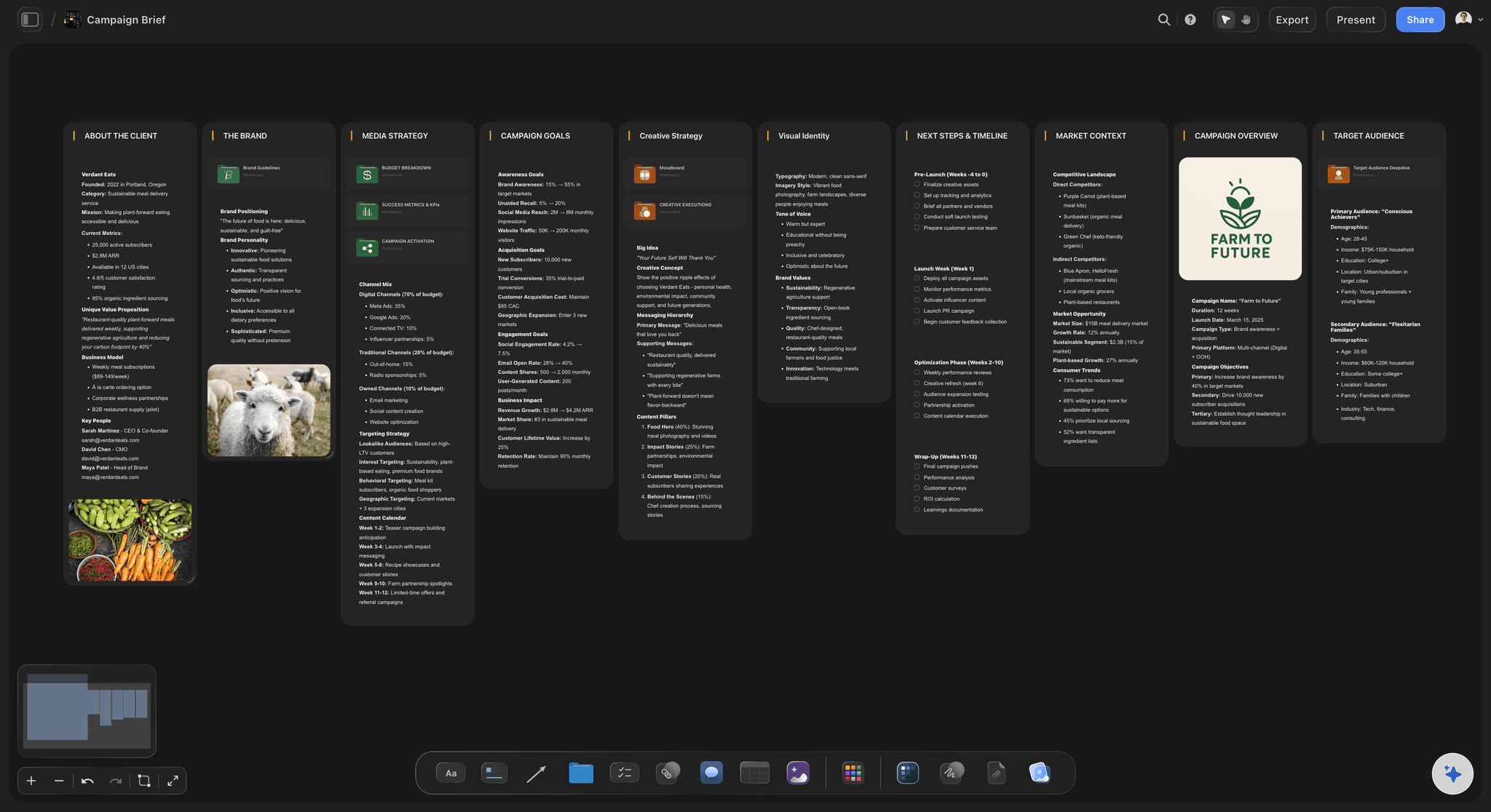
The problem
The brief restated, and the current belief
The objective in the client's own numbers and what the audience does and thinks today. It proves the team read the brief before it started making things.
How to write a campaign brief →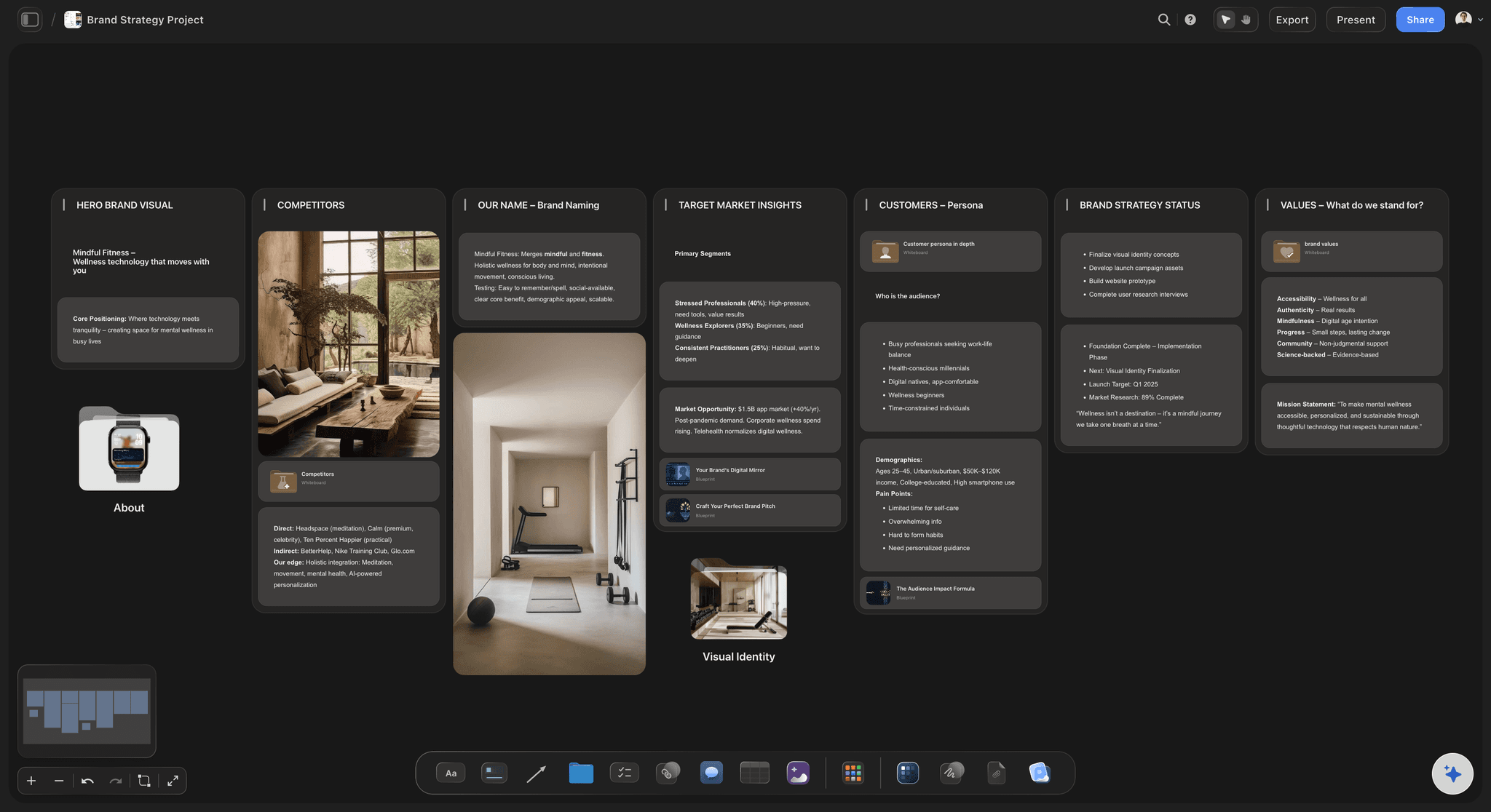
Insight and strategy
The truth the idea rests on
One sentence of insight, with the evidence beside it, and one sentence of strategy that says what the campaign will change. Without these the idea is a matter of taste.
See the brand messaging framework →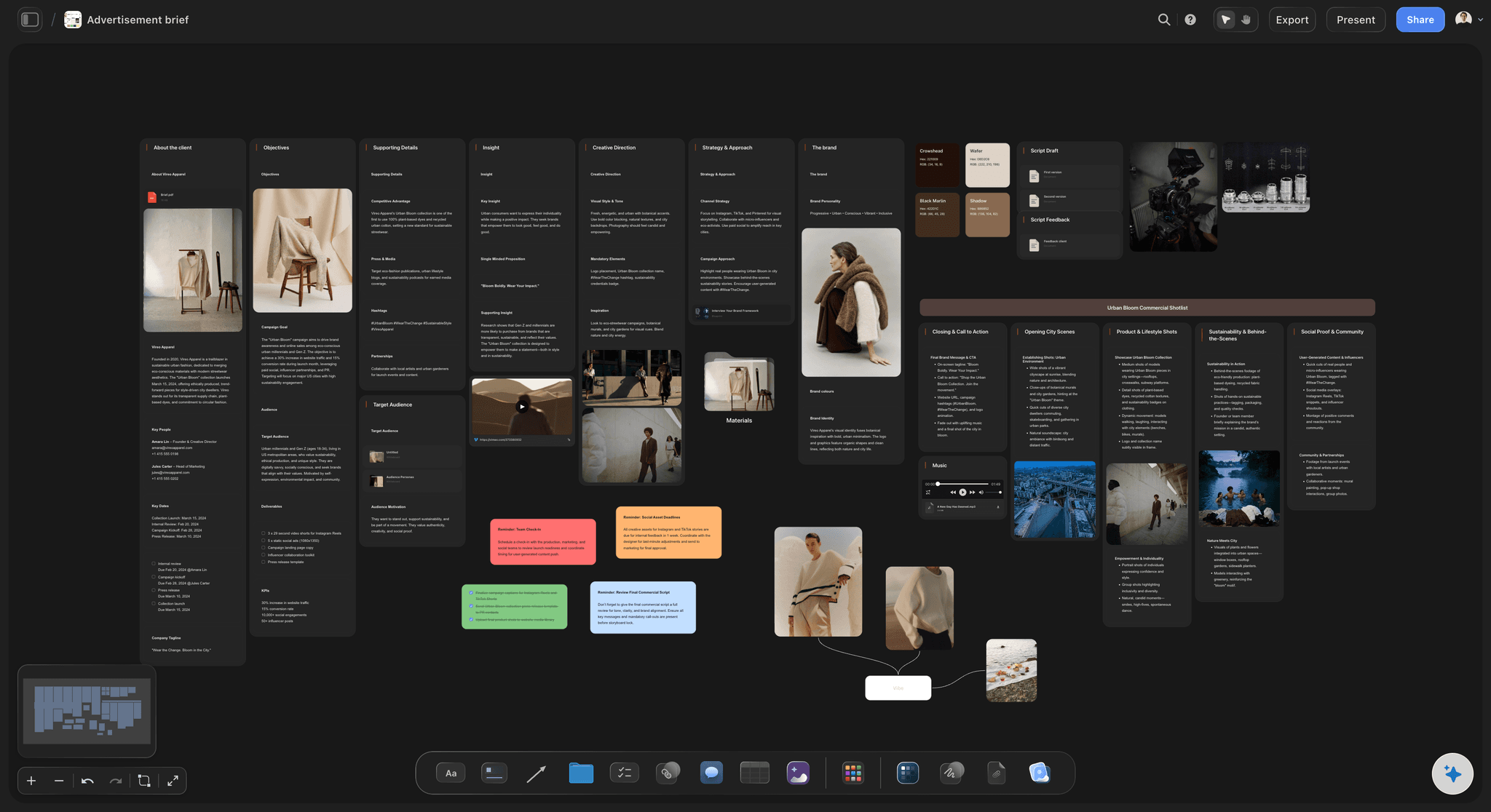
The idea and the alternatives
Why this idea, and what it beat
The idea in one sentence, then the routes the team rejected and the reason for each. This is the part that turns a preference into a recommendation.
See the campaign concept board →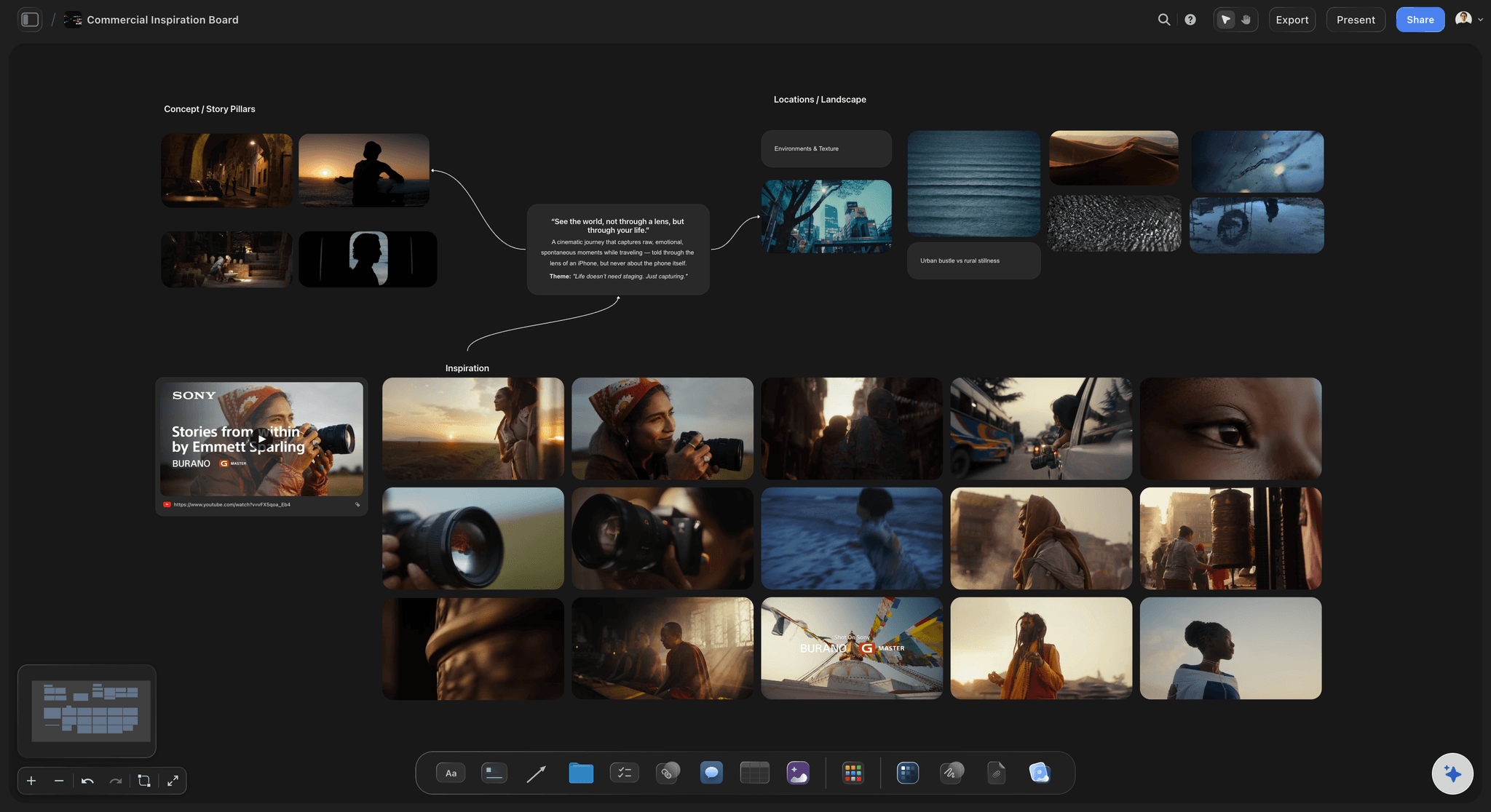
Executions
A reason beside every piece of work
One or two sentences per execution on what it does and why it looks that way. Placed next to the work, so nobody judges a film without knowing what it is for.
Present the campaign concept →The argument and the work on the same board.
Write the rationale beside the executions it explains, keep the research under every claim, and share it by link so the client can forward the reasons with the work. Storyflow is paid-only during early access, with plans from $7.99 a month billed annually ($9.99 monthly). A free plan launches before the end of 2026, and anyone a paid member invites to a board joins free.
AI that drafts the insight, strategy and idea from the brief and your research
Notes placed beside each execution, so every piece carries its reason
Research files, quotes and references kept under the claims they support
View-only links the client opens with no account and can forward upward
Presentation mode for walking the client through the board

Built for people with taste
Why do creative rationales fail in the client meeting?
Most weak rationales fail in one of three ways. Each is easy to see once the argument is laid out next to the work instead of buried in slide notes.
No evidence
An insight that is really an opinion
Observation, not insight: 'People are busy' is true of everyone and explains nothing. An insight explains a specific behaviour: why this audience buys the same bag every time.
No source beside it: Put the interview count, the quote or the data point next to the insight. A client can argue with an opinion; it is harder to argue with 13 of 18 interviews.
Written after the idea: An insight reverse-engineered to fit a favourite idea shows. Write it before the concepts, or say honestly that the idea came first and the research confirmed it.
Too many insights: Three insights mean three campaigns. Keep the one the idea actually rests on and move the rest to an appendix.
No choice
An idea with nothing it beat
Name the rejected routes: Two or three alternatives and one sentence each on why they lost. It shows the recommendation was chosen.
Tie the reason to the brief: 'It felt flat' is a taste call. 'It would put us in a price fight with discount brands' is a reason the client can check.
Keep the losers visible: On the Storyflow board the rejected routes sit in their own column. If the client asks about a direction, the answer is already there.
Do not over-sell: Say what the idea will not do. A rationale that admits a trade-off reads as judgement, not salesmanship.
No link to the work
Executions shown without their reason
Reason beside, not after: A rationale in an appendix is read after the client has already reacted to the work. Put the sentence next to the execution.
Explain the choices they will question: Casting, music, colour, the line, the channel. If a choice looks surprising, say why before anyone asks.
One job per execution: Each piece should do one thing for the strategy: the film states the idea, the cutdowns stop the scroll, the poster carries the line.
Write for the absent reader: The marketing director who was not in the room will read the rationale alone. Write so it works without the presenter.
Explore templates for your project
Every template opens as a real, editable board on the infinite canvas. Pick the closest fit and make it your own.
Creative Brief
Capture the objective, audience, and message for a creative so everyone works from the same brief.
One app instead of five
What is the best tool for writing a creative rationale?
Storyflow first, because a rationale works best next to the work it explains. A document or a slide deck still fits when the client asks for one.
Storyflow
Recommended
Reason placed beside each execution
Research kept under the insight it supports
AI drafts insight, strategy and idea from the brief
Rejected routes kept visible in their own column
Client opens it by link with no account
Client's own slide template
Tracked changes, line by line
A slide deck
Reason placed beside each execution
Research kept under the insight it supports
AI drafts insight, strategy and idea from the brief
Rejected routes kept visible in their own column
Client opens it by link with no account
Client's own slide template
Tracked changes, line by line
A word processor
Reason placed beside each execution
Research kept under the insight it supports
AI drafts insight, strategy and idea from the brief
Rejected routes kept visible in their own column
Client opens it by link with no account
Client's own slide template
Tracked changes, line by line
What creators are saying
Join early creators getting structured workspaces and AI that remembers their projects
“Storyflow has sped up my workflow by at least 3x, which means more flow state and more projects I can actually ship. It truly changed the way me and my team create.”

Reilin Joey
Director & YouTuber
“One prompt gets me a structured board. But the tactics are my favorite. I run my YouTube scripts through them and my intros and retention got better. It's amazing.”

Justkay
YouTuber & Freelance Filmmaker
“I used to juggle five apps to plan a project. Now I describe what I am making and get boards, lists, and a schedule. All in one place.”

George
@fernwehchronicles
Creative rationale questions
What strategists, creative directors and account leads ask before the concept goes to the client.
It is the short written argument for why a campaign idea answers the brief: the insight it rests on, the strategy it follows, why this idea was chosen over the alternatives, and the reason behind each execution. In Storyflow the rationale sits on the same board as the work, with a note beside each execution, so the client reads the reason and sees the work together.
Storyflow suits it well because a rationale is an argument about specific pieces of work: the reasons sit beside the executions on one board, the research stays under the insight it supports, its AI drafts the insight, strategy and idea from the brief, and the client opens it by link with no account. PowerPoint or Keynote is still the better choice when the client requires the deck in its own template.
Restate the brief in one line, say what the audience believes now, write the insight as one sentence with its evidence, name the strategy and the idea, explain why this idea beat the alternatives, give each execution one or two sentences of reason, and close on how success will be measured. Keep it in the client's vocabulary.
The worked example on this page: Halden Roasters wants 4,000 new subscribers in eight weeks. Insight: people avoid good coffee because they are afraid of choosing wrong, not because of price. Strategy: remove the choice, not the price. Idea: 'Halden picks, you just drink.' A price-led route was rejected because it invites comparison with discount brands. Each execution then carries its own one-sentence reason.
One paragraph for the idea and one or two sentences per execution is a common length, so a whole campaign often fits on a page or one board. If it runs longer, the extra material is usually strategy or research that belongs in an appendix. Storyflow's AI can shorten a long draft while keeping the insight and the reasons intact.
The brief comes before the work and says what the campaign must achieve, for whom and with what message. The rationale comes after the work and argues why this idea and these executions answer that brief. The rationale should quote the brief's objective, so the two can be checked against each other. Both can live on the same Storyflow board.
The presentation is the running order of the meeting: brief, insight, idea, executions. The rationale is the reasoning inside it, written so it still works when the client forwards it to someone who was not there. The campaign concept presentation page covers the deck; this page covers the argument.
The overall rationale goes straight after the idea is revealed and before the executions, so the client knows what to judge them against. The reasons for each execution go beside that execution, not in an appendix. On a Storyflow board each reason is a note next to the work.
An observation is a fact anyone could look up: 'people buy coffee in supermarkets'. An insight explains why a specific audience behaves the way it does: 'they buy the same bag every time because choosing feels like a test they might fail'. The idea should be built on the insight, and the evidence should sit beside it.
Yes, briefly. Two or three rejected routes with one sentence each on why they lost show that the recommended idea was chosen, and they answer the client's 'did you consider' questions before they are asked. Keep them in their own column on the board so they are visible but clearly not the recommendation.
It can write a useful first draft. Storyflow's AI reads the brief, your research notes or an attached PDF or Word document and drafts the insight, strategy and idea. Ask it to review the draft and it flags claims that have no evidence under them. The insight and the reasons for each execution still need the people who made the work, so plan to rewrite those by hand.
Usually the strategist writes the insight and strategy and the creative director writes why this idea and the reason for each execution. The account lead then checks it reads in the client's vocabulary. In a small studio one person writes all of it.
Say the objective, then the insight, then reveal the idea, then show each execution with its one-sentence reason before the client reacts to it. Use Storyflow's presentation mode to walk through the board, then send the view-only link so the client can forward the work with the reasons attached. Anyone who wants to comment signs in to do so.
They follow the same logic. A design rationale explains the choices in one piece of design, such as a logo or a layout. A creative rationale explains a campaign idea and every execution that comes from it. Both should tie each choice back to the brief.
One insight. One idea. A reason beside every piece.
Write the creative rationale on the board that holds the work, with the evidence under the claims, and share it so the client can sell the idea upward.