How to Present a Concept When the Client Hates the First Round
When a client rejects the first round, the second presentation has to lead with the diagnosis rather than with new work, because a client who does not believe you understood the rejection will reject the second round for the same underlying reason.

Category
Design
Author

Justkay
Documentary Filmmaker & Founder at Storyflow
Topics
2026-08-29
•
12 min read
•
Design- how to present a concept when the client hates the first round
- client presentations
- design process
- creative direction
- feedback
- agency work
- Storyflow
What do you do when a client rejects the first round of concepts?
When a client rejects the first round, the second presentation has to lead with the diagnosis rather than with new work, because a client who does not believe you understood the rejection will reject the second round for the same underlying reason. Open by stating what you think went wrong in your own words, get agreement on that before showing anything, then present work that visibly answers it. The instinct is to arrive with more options and let them speak for themselves. That reads as guessing, and it is how a project reaches round four. Storyflow is what I use because the rejected work, the objection and the new response sit on one canvas, so the client can see the second round answering the first instead of replacing it.
Key Takeaways
- Diagnose before you design. A second round built on a misread objection fails identically to the first.
- Get agreement on the diagnosis before showing new work. This is a separate conversation and it should happen first.
- Show the rejected work beside the new work. Hiding round one makes round two look like a fresh guess.
- Fewer options in round two, not more. Volume signals uncertainty.
- Name what you kept and why. A total pivot tells the client nothing in round one was right, which is rarely true and undermines your judgement.
- If the objection is really about scope, budget or an internal disagreement, say so. No amount of design fixes those.
Show the reasoning, not just the work
A second round presented without the first round's reasoning reads as a guess. Storyflow keeps the rejected work, the objection and the response on one canvas, so the client can see the second round answering the first.

Read the Rejection Properly
Clients are reliable about their reaction and unreliable about its cause. "I just do not love it" is honest and useless. The work is finding what produced it.
Four things are usually going on, and they need different responses.
It missed the brief. The most straightforward. You solved a different problem, usually because the brief was ambiguous and you resolved the ambiguity one way and they assumed the other. Fixable, and the fix is a conversation about the brief rather than about the design.
It hit the brief and the brief was wrong. The client asked for something, you delivered it, and seeing it made them realise they wanted something else. Extremely common and rarely admitted, because admitting it feels like accepting blame. Your job is to make it easy to change direction without anyone having to say the brief was wrong.
It is right and it is unfamiliar. The work is correct and further from their expectation than they are ready for. This one needs advocacy rather than revision, and it needs you to distinguish it honestly from wishful thinking about your own work.
The real objection is not about the design. Someone internal disagrees, the budget moved, a stakeholder was not consulted, the timeline slipped. The design gets rejected because rejecting the design is easier than saying any of that. You cannot fix this with a second round, and attempting to will burn a fortnight.
A useful diagnostic: ask what would need to be true for them to approve something. If they cannot answer, the problem is probably not the design.
The Diagnosis Conversation
Before you make anything, have a short call with one goal: agree on what went wrong.
Not a presentation. A conversation, twenty to thirty minutes, ideally with the actual decision-maker.
Open with your reading. "My sense is the direction felt too corporate for how you want to sound, and that the typography did most of the damage. Does that match?"
Offering a specific diagnosis is far better than asking an open question. Open questions ("what did you not like?") get you a restatement of the rejection. A specific proposal gets you a correction, and corrections are informative.
Ask what worked. Almost always something did, and clients rarely volunteer it because the conversation is framed around the rejection. Knowing what to keep is as valuable as knowing what to change, and it stops round two throwing away something they liked.
Ask who else has seen it. This is where you discover the internal disagreement, and it is the single most useful question in the call. If three people have opinions and only one is in the room, round two will fail regardless of what is in it.
Confirm the constraint set has not changed. Budget, timeline, scope. Rejections often coincide with something moving.
End by restating the diagnosis and getting an explicit yes. "So: the direction is right, the execution reads too formal, and we are keeping the layout system. Agreed?" That sentence is what round two is built on, and having it in writing protects both of you.
Building Round Two
Fewer options. If round one had three, round two has one or two. More options in round two reads as a wider guess and signals you still do not know what they want. One well-argued option with a clear rationale is stronger than three hedges.
Show what you kept. Explicitly. "The layout system and the photographic approach carry over, because those tested well with your team. What has changed is the typographic voice and the colour."
This does two things. It tells the client their feedback was heard precisely rather than wholesale, and it protects the parts of round one that were working from being discarded in a general retreat.
A total pivot is usually wrong. If round two shares nothing with round one, you are implicitly saying every judgement in round one was mistaken. That is occasionally true and mostly it means you overcorrected from a rejection that was narrower than it felt.
Make the response visible. The strongest round-two presentation shows the objection and the response next to each other.

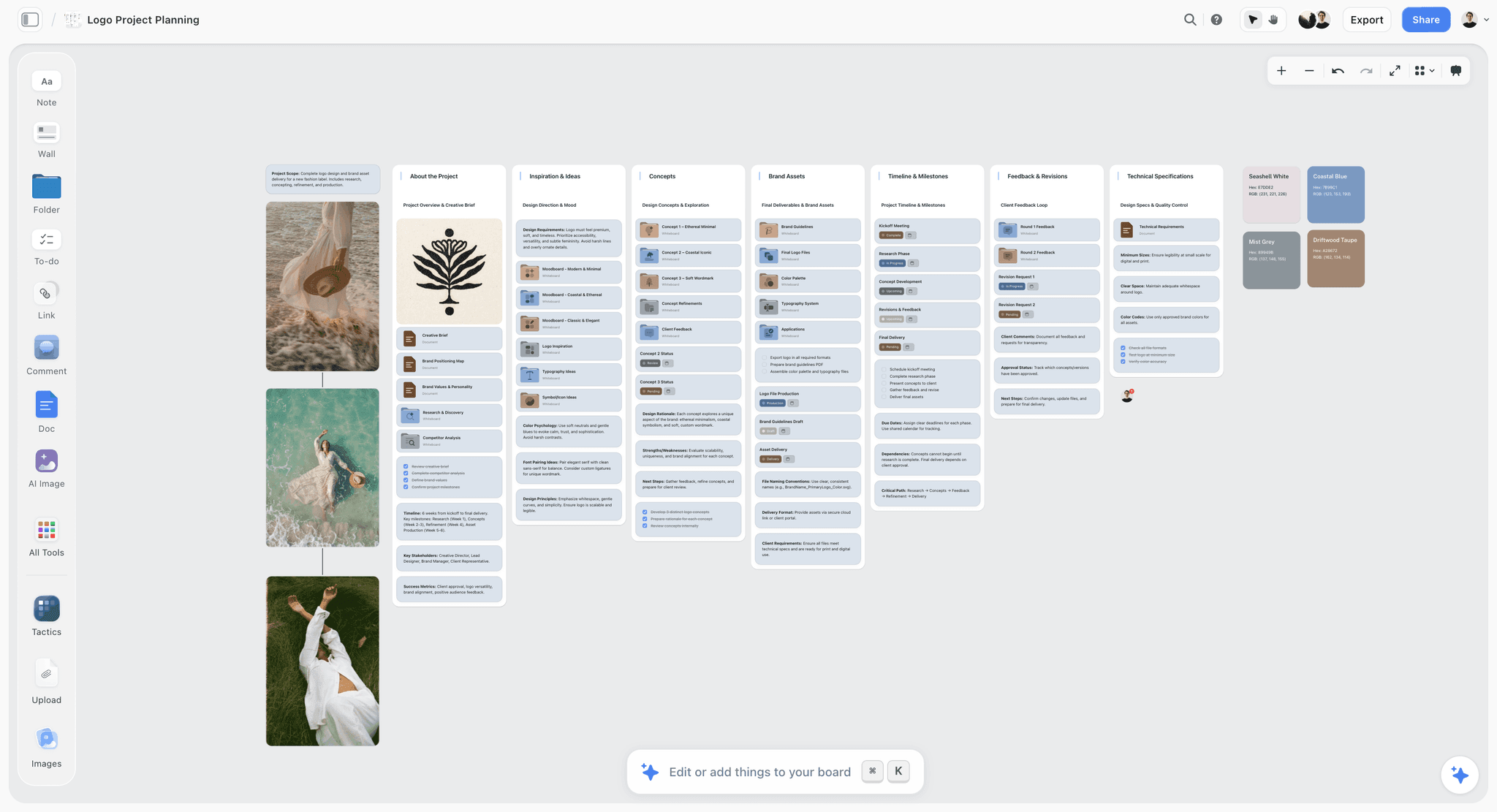
This is why the presentation format matters more in round two than round one. A fresh deck showing only new work asks the client to hold round one in their memory and compare. Most will not, and the ones who do will do it inaccurately.
On a Storyflow canvas the rejected direction, the objection written in the client's own words, and the new work sit side by side, so the argument is visible rather than narrated. Its AI reads the whole board, which is useful for drafting the summary of what changed and why before the meeting, since that summary is the thing you most need and least want to write.
The Presentation
Lead with the diagnosis, not the work. Two minutes restating what you agreed went wrong. This reorients everyone and, crucially, reminds any stakeholder who was not on the diagnosis call what round two is answering.
Then show the work, with the rationale attached to each decision. Not "we made the type friendlier" but "the type is now a humanist sans at a larger size, which is what pulls it away from the formal register you flagged".
Then ask for a decision, in specific words. "Does this solve the register problem?" is answerable. "What do you think?" invites a fresh round of general reaction, which is how round two becomes round three.
Handle the new objection carefully. If something new comes up that was not in the diagnosis, note it and ask whether it is more or less important than the thing you were asked to fix. Sometimes it is genuinely new information. Sometimes it is a client who is uncomfortable approving anything, and the distinction matters.
| Rejection type | Signal | Response |
|---|---|---|
Missed the brief | Their description of what they wanted differs from yours | Realign the brief in writing, then one option |
Brief was wrong | They struggle to say what is wrong, but are certain | Offer a new direction without assigning fault |
Right but unfamiliar | Objection is about risk, not quality | Advocate with evidence, offer a safer variant alongside |
Not about the design | Vague, shifting, or new voices appear | Ask who else has seen it, address that first |
When to Push Back
Sometimes the work is right and the client is wrong, and there is a professional way to say so.
Advocate once, with evidence and a fallback. Explain what the work is doing and why, then offer a safer variant alongside it. Presenting the bolder option next to a conservative one lets the client choose their own risk level, which is often what the objection was really about.
Do not advocate twice. If they reject it a second time, build what they want. Continuing to push past that point is not conviction, it is a failure to accept that it is their decision and their brand.
Know the difference between conviction and attachment. Conviction is being able to say what the work achieves that the alternative does not. Attachment is liking it. Only the first is worth spending a client relationship on.
What Goes Wrong
Arriving with more options and no diagnosis. Reads as guessing and usually produces round three.
Total pivot. Discards the parts that worked and tells the client their feedback was heard as a general complaint.
Presenting to a different room. Round two shown to stakeholders who never saw round one, and the objection they raise is round one's objection again.
Skipping the diagnosis call. Saves twenty minutes and costs a week.
Treating a non-design objection as a design problem. Budget or internal politics dressed as creative feedback. Two more rounds will not resolve it.
No decision asked for. The meeting ends with reactions rather than a yes, and there is no round two, only a longer round one.
The Bottom Line
Round two is not a design problem, it is a comprehension problem. Diagnose in a conversation before you make anything, get explicit agreement on what went wrong, then show fewer options with the rejected work and the objection visible beside them.
Name what you kept as clearly as what you changed, attach a rationale to each decision, and ask for a specific decision at the end. Do that and round two is usually the last round.
FAQ: Rejected Concepts and Second Rounds
How many options should I show in round two?
One or two, with a clear recommendation. Round one is for exploring range; round two is for demonstrating that you understood the objection. Showing more options in round two signals uncertainty, and clients read it that way even when they cannot articulate why.
Should I show the rejected work again?
Yes, alongside the new work, with the objection stated between them. It makes the argument visible instead of asking the client to hold round one in memory. The only exception is when the rejection was emotionally charged, in which case show the objection in words rather than reshowing the work.
What if the client cannot say what they dislike?
Offer a specific diagnosis and let them correct it. "I think it reads too formal" gets a useful answer. "What did you not like?" gets a restatement. If several specific proposals all get vague responses, the objection is probably not about the design.
How do I handle contradictory feedback from several stakeholders?
Do not resolve it yourself. Put both positions in writing, state that they point in opposite directions, and ask the decision-maker to choose. Splitting the difference produces work that satisfies neither and makes you look indecisive.
Is Storyflow free for client presentations?
Not during early access. Storyflow is paid-only right now, with Plus at $7.99 per month billed annually, and the Free plan launches before the end of 2026. Anyone a paid member invites to a board joins free, which covers clients who need to view and comment on the work.
When should I stop revising and walk away?
When rounds stop getting smaller, when the objections keep changing rather than narrowing, or when the real problem is internal and cannot be reached by design. At that point ask for a conversation about what the project is, rather than sending another round.
Table of Contents
Templates to check out for this topic


Templates you can use in Storyflow
Every Storyflow board starts from real structure and an AI that reads the whole canvas. Open one of these templates and make it yours.


See Storyflow in Action
A visual AI workspace where every feature lives inside one canvas. No tab-switching, no context lost.
Build your entire board from a single message
Type what you need in the AI chat at the bottom of your canvas. The AI adds cards, headings, and structure directly onto your board.
Use expert frameworks as AI context
Type @ in the AI chat and choose any Tactic. The AI tailors every response to that framework instead of giving generic advice.
Turn your board into a mind map in seconds
Ask the AI to restructure your canvas as a mindmap. It connects your ideas into a visual hierarchy so you can see how everything relates.
Why Storyflow Exists
Storyflow actually began as a personal tool while working on creative and research projects.
We kept running into the same problem: ideas were scattered everywhere: notes, documents, and whiteboards.
Nothing helped us see how everything connected.
So we started building a workspace designed around how ideas actually grow.
→ Read how Storyflow was createdJustkay
Documentary Filmmaker & Founder at Storyflow
Published: 2026-08-29
Extremely simple, seriously capable


See how easy it is to get started
Watch a real project come together, from a blank board to a finished plan, clicked through step by step.
Start creating with AI and become more productive
Transform your creative workflow with AI-powered tools. Generate ideas, create content, and boost your productivity in minutes instead of hours.