
Sharper briefs, sent ultra fast
A campaign concept board
with every route side by side.
How agencies lay out two or three concept routes before a pitch, compare them against the brief, and walk the client through the one they believe in.


Creatives working for these brands already got early access
- Red Bull
- Canon
- Artlist
- Porsche
See how easy it is to get started
Watch a real project come together, from a blank board to a finished plan, clicked through step by step.
Start from a ready-made template
Pick a board to see what you can build, then let AI fill it in. Every template is a real, editable starting point on the same infinite canvas.

Creative Brief
Capture the objective, audience, and message for a creative so everyone works from the same brief.
How do you make a campaign concept board?
A campaign concept board lays out the creative routes for a campaign side by side, each one with its idea, key visual, headline and how it runs across channels, so a team can compare them and a client can choose. Storyflow is an AI visual workspace that builds one on an infinite canvas: the brief across the top, a column per route, reference images and draft executions in each, and the reasons for each route written under it.
Build it in five parts. Put the brief's objective, audience and proposition across the top, so every route is judged against the same three lines. Give each route a column. In each column, write the idea in one sentence, add the key visual (a reference image or rough frame), the headline, and one execution per main channel. Under each route, write in two lines why it answers the brief and what it risks.
Two or three routes is the usual number. One gives the client nothing to choose between and can feel like a take-it-or-leave-it. More than three spreads the team's effort thin and makes the meeting a vote rather than a decision. Many agencies show three: one that sits close to what the client expects, one that stretches it, and one recommended route.
The concept board is different from the presentation. The board is where the team develops and compares routes; the presentation is the order in which you take the client through them. Build the board first. Once a route is chosen, the same board becomes the start of the presentation, which our campaign concept presentation page walks through.
A worked example. An agency is briefed on Monday by a supermarket launching an own-label coffee range. The objective is 15 percent trial among existing shoppers in eight weeks. The proposition: 'Café-quality coffee at supermarket prices.' Route A, 'Barista at home', shows shoppers making coffee that looks like it came from a café, with the headline 'Your kitchen just got a barista.' Route B, 'Price on the cup', prints the price per cup beside café prices on shelf and outdoor. Route C, 'Morning people', follows three real shoppers' first coffee of the day. Each column holds four reference images, the headline, a poster, a 15 second social idea and a shelf wobbler.
The team reviews the board on Thursday. Against the brief, Route B answers the proposition most directly but risks feeling cheap; Route A is the most visual; Route C is the strongest emotionally but hardest to produce in the timeline. They write those notes under each column, recommend Route A with Route B's price message on shelf, and present on the following Tuesday with the board in Storyflow's full-screen presentation mode.
The timing in that example is typical of a small pitch: brief on Monday, routes drafted by Wednesday, an internal review on Thursday, a day to fix what the review found, and the client meeting the following Tuesday. The board saves time in two places. Nobody rebuilds the routes as slides the night before, because the board is what gets presented. And the internal review is faster, because every route is visible at once and built to the same shape, so the conversation is about ideas rather than about which file is the latest.
Decide how routes will be judged before you look at them. Three questions against the brief line on top work for most campaigns: does this route reach the audience, does it carry the proposition, and could it help hit the objective in the time and budget given? Add a fourth when it matters, such as whether the route can be produced before the launch date. Write the answers under each route. A route that needs a long spoken explanation to pass the second question will not survive a busy client meeting, let alone a busy street.
Keep the cut routes. A route that loses this pitch is often right for the next brief from the same client, or for a different client. Move it to a separate part of the board labelled 'not presented', with a line on why it was cut. Over a year, that area becomes the agency's own library of ideas, each with the brief it was made for, and Storyflow's AI can read it when it drafts routes for a new brief.
A concept board is a working surface first and a pitch tool second. Rough frames, reference photos from other campaigns and handwritten headlines are all fine at the review stage. What matters is that the client, when they see it, can tell the routes apart in a few seconds and understand why the agency recommends one of them. Everything on the board should serve that moment.
Ultra fast from brief to board
What are the steps to build a concept board?
Five steps from brief to a board ready for the internal review. The routes take the time; the layout should not.
01
Put the brief across the top
Paste or attach the brief and ask Storyflow's AI to pull out the objective, the audience and the proposition. Those three lines sit above every route.
02
Draft the routes
Ask the AI for concept directions from the brief, then keep the two or three worth developing. Each gets a column with a name and a one-sentence idea.
03
Show each route
Drop reference images, rough frames or, on Pro and Max, AI-generated images into each column, with the headline and one execution per channel: a poster, a social post, a short video idea.
04
Write the case for each
Under every route, two lines: how it answers the brief and what it risks. Mark the route you recommend. The client will ask, so answer on the board.
05
Review, then present
Walk the team through the board, cut what does not hold, then present it full screen or share a view-only link. The client signs in to comment on a route.
What goes on a campaign concept board?
The same four things for every route, so the routes can be compared fairly.
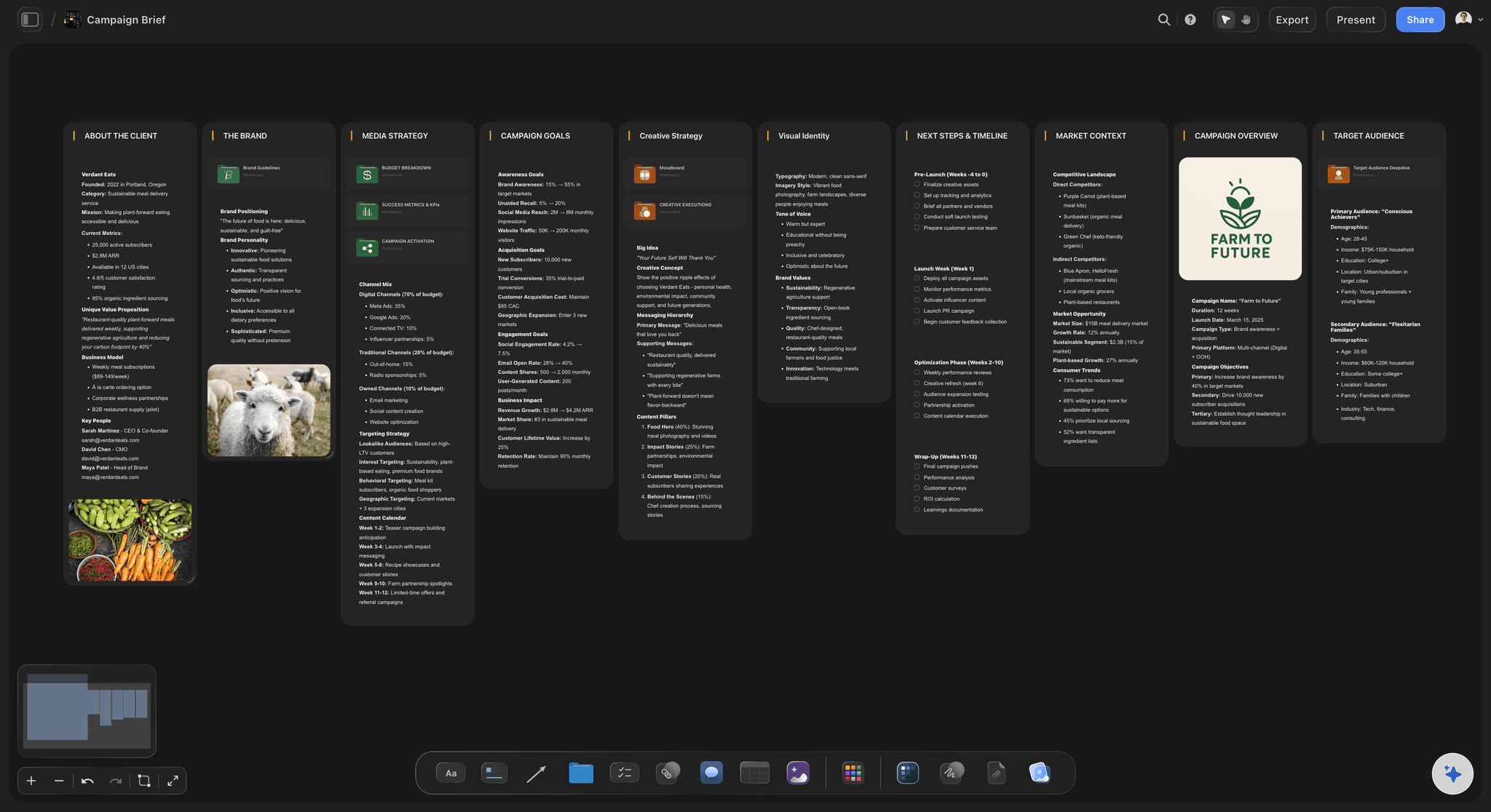
The brief line
Objective, audience and proposition on top
Every route is judged against the same three lines. When a route drifts from the brief, it is visible from across the room.
See the campaign brief template →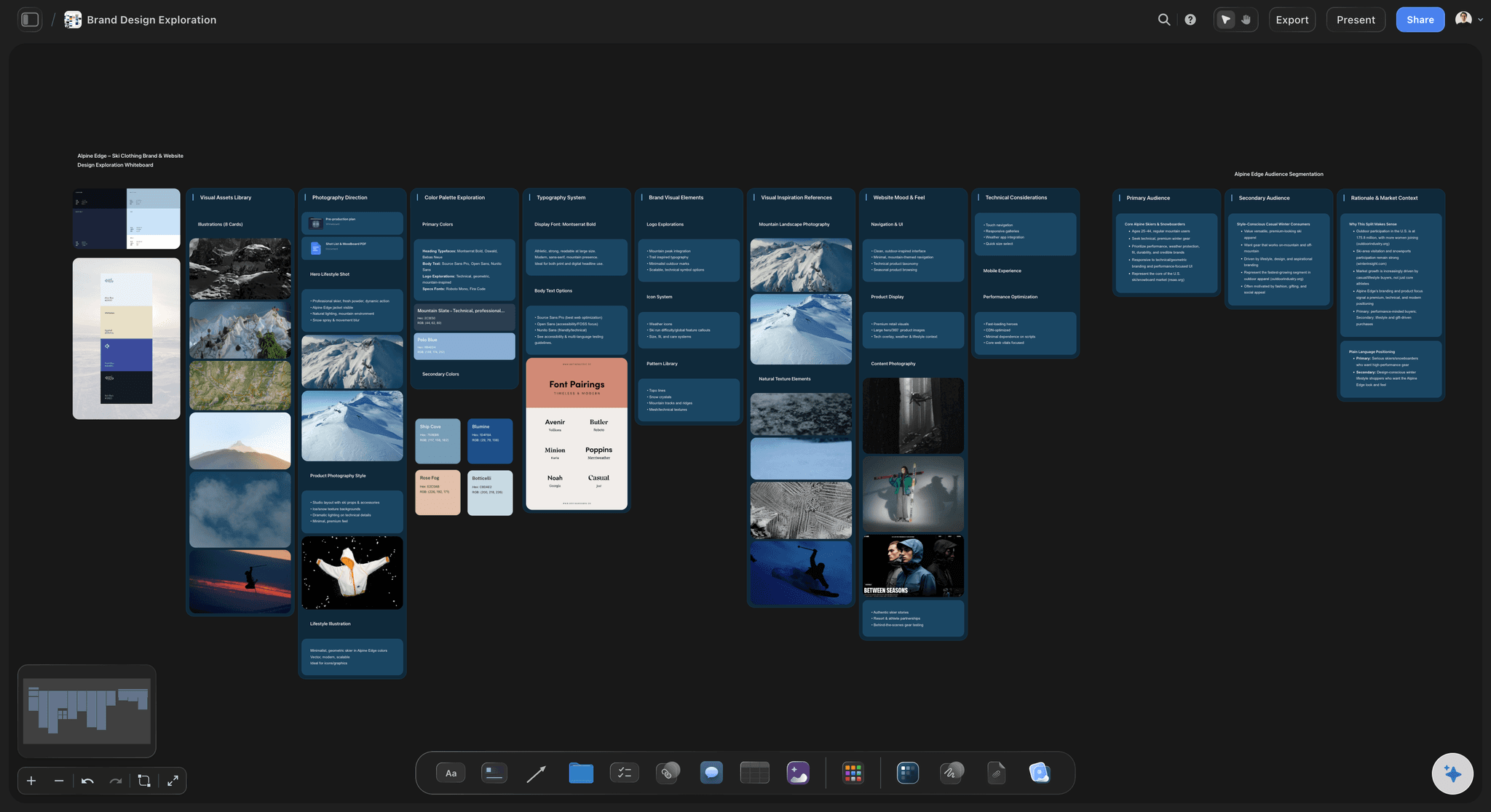
The routes
A column per concept route
Name, idea in one sentence, key visual and headline. Two or three columns side by side, built to the same shape.
See creative concept development →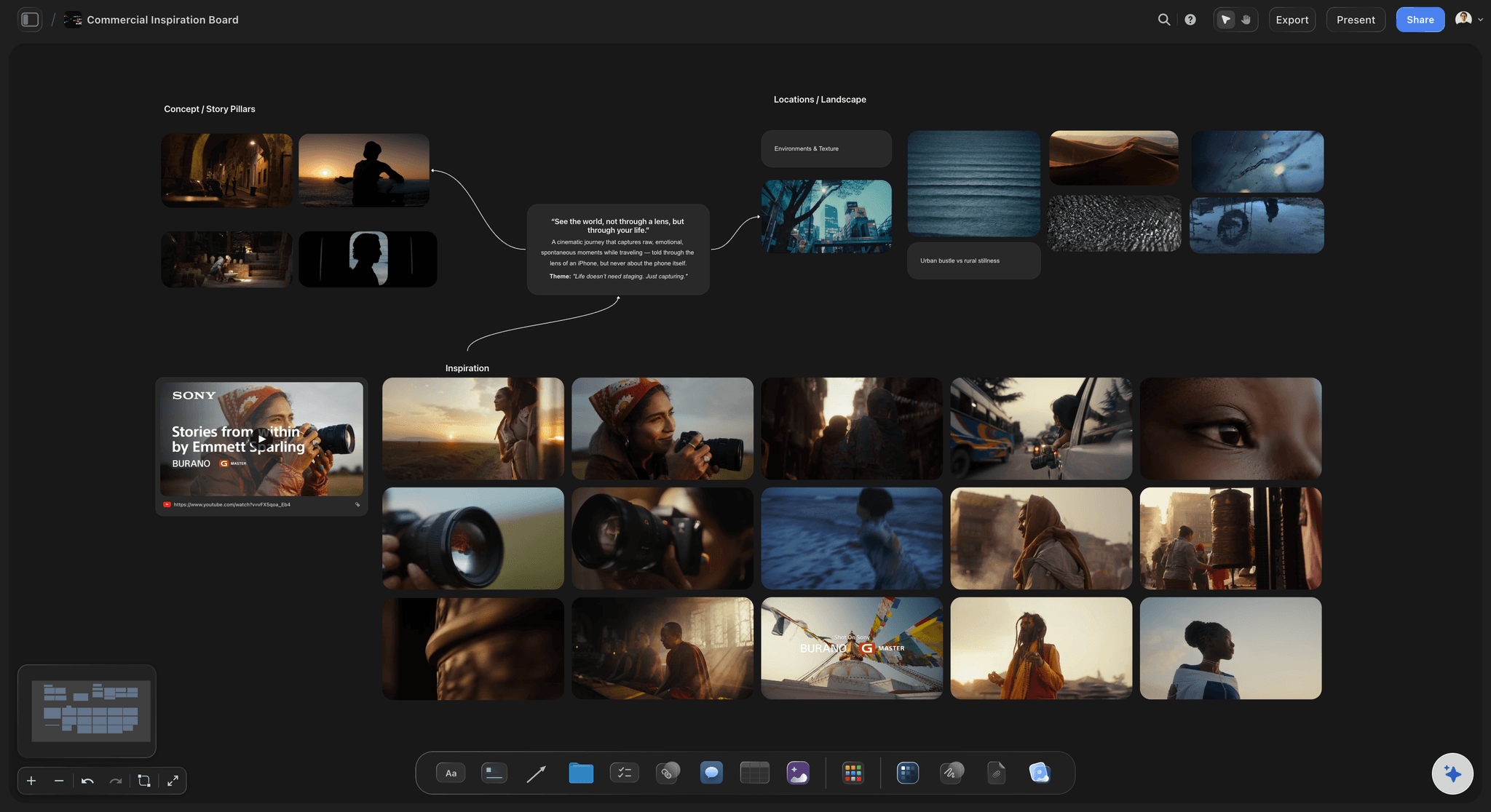
The executions
How each route runs in each channel
A poster, a social post, a short video idea. Executions show whether an idea can stretch, which a headline alone cannot.
See the art direction board →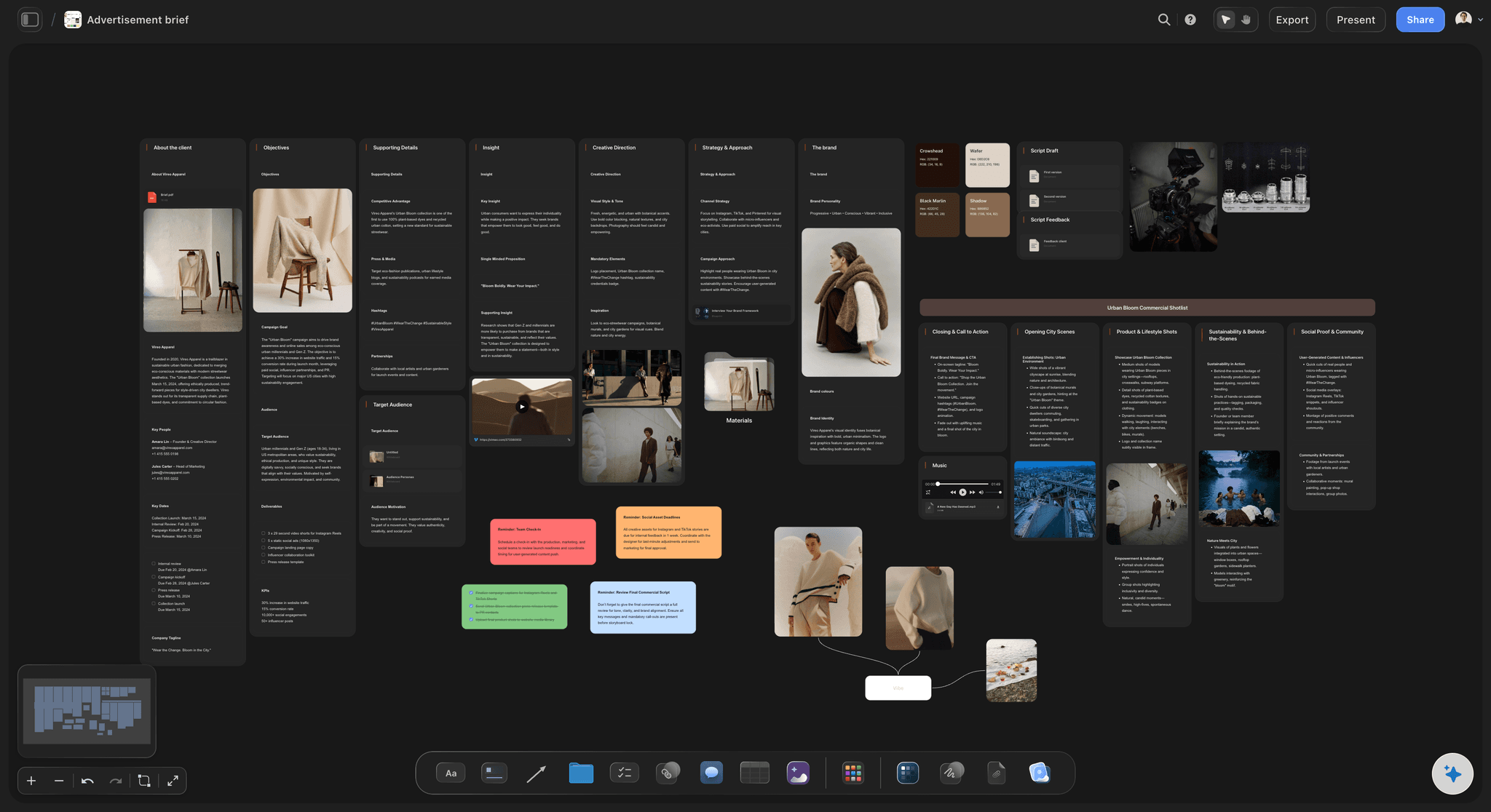
The case
Why it works and what it risks
Two lines under each route and a mark on the one you recommend. The client hears your reasoning, not just your favourite.
See the campaign concept presentation →Develop the routes and present them from the same board.
The board you compared routes on becomes the board you present from, so nothing is rebuilt in slides the night before. Storyflow is paid-only during early access, with plans from $7.99 a month billed annually ($9.99 monthly). A free plan launches before the end of 2026, and anyone a paid member invites to a board joins free.
AI that drafts concept directions from the brief
Images, video and rough frames beside each route
Full-screen presentation mode for the pitch
View-only links the client opens with no account
Freelance creatives you invite to the board join free
Built for people with taste
Why do concept boards fail in the room?
Three patterns agencies see again and again. Each is easier to fix on the board than in the meeting.
The comparison
Routes built to different shapes
Same parts for every route: If one route has four executions and another has a headline, the client chooses the finished-looking one, not the better idea.
Same brief line above all: With the objective and proposition on top of the board, every route is judged against the same test.
Name each route: 'Barista at home' is easier to discuss than 'Route A'. A name is also a quick test of whether the idea is clear.
Rough is fine, uneven is not: All routes can be rough. They should be equally rough.

The number
Too many routes, or only one
Two or three: Enough to show choice and thinking, few enough that each one is developed properly.
Cut on the board: Develop five internally if you need to, then cut to three before the client sees anything. Keep the cut routes on a separate part of the board.
Recommend one: Clients pay for judgement. Say which route you would run and why, on the board under the route.
Combine on purpose: If you suggest mixing two routes, show what the mix looks like. A described hybrid is a third route nobody has seen.
The stretch
A headline with nowhere to go
One execution per channel: A poster, a social post and a video idea show whether the concept lasts eight weeks or one poster.
Show it in context: Mock the poster on a street photo or the post in a phone frame. Context changes how a client reads an idea.
References, not finished art: A key visual can be a reference photo or a rough frame. On the Pro and Max plans, Storyflow's AI can also generate an image to show a mood quickly.
Keep the craft for later: Spend the time on the idea. Finished design for a route the client does not choose is time lost.
Explore templates for your project
Every template opens as a real, editable board on the infinite canvas. Pick the closest fit and make it your own.
Creative Brief
Capture the objective, audience, and message for a creative so everyone works from the same brief.
One app instead of five
Which tool should agencies use for concept boards?
Slides are good at sequence; a board is good at comparison. A concept board needs comparison first and sequence later.
Storyflow
Recommended
All routes visible side by side
AI drafts routes from the brief
Images, video and notes on one canvas
Full-screen presentation mode
Client opens it by link with no account
Slide transitions and animations
Works offline
Slide decks
All routes visible side by side
AI drafts routes from the brief
Images, video and notes on one canvas
Full-screen presentation mode
Client opens it by link with no account
Slide transitions and animations
Works offline
Physical boards
All routes visible side by side
AI drafts routes from the brief
Images, video and notes on one canvas
Full-screen presentation mode
Client opens it by link with no account
Slide transitions and animations
Works offline
What creators are saying
Join early creators getting structured workspaces and AI that remembers their projects
“Storyflow has sped up my workflow by at least 3x, which means more flow state and more projects I can actually ship. It truly changed the way me and my team create.”

Reilin Joey
Director & YouTuber
“One prompt gets me a structured board. But the tactics are my favorite. I run my YouTube scripts through them and my intros and retention got better. It's amazing.”

Justkay
YouTuber & Freelance Filmmaker
“I used to juggle five apps to plan a project. Now I describe what I am making and get boards, lists, and a schedule. All in one place.”

George
@fernwehchronicles
Campaign concept board questions
What agency teams ask in the week between the brief and the pitch.
Put the brief's objective, audience and proposition across the top. Give each concept route a column with its name, a one-sentence idea, a key visual, the headline and one execution per channel. Under each route, write why it answers the brief and what it risks, and mark the one you recommend. In Storyflow the whole board sits on one canvas and its AI can draft routes from the brief.
Storyflow is a strong fit: routes sit side by side on one canvas with images, video and notes, its AI drafts concept directions from the brief, and the same board is presented full screen or shared by link with the client. Slide tools such as Keynote, PowerPoint or Google Slides are still better when the pitch needs slide transitions or has to run offline.
It is a board that lays out the creative routes for a campaign side by side, each with its idea, key visual, headline and executions, so the team and the client can compare them. On a Storyflow board each route is a column under the same brief line.
Usually two or three. One gives the client nothing to choose between; more than three spreads the work thin and turns the meeting into a vote. A common pattern is one expected route, one that stretches the brief, and one recommended route. Develop more internally if you like, and cut on the Storyflow board before the client sees it.
A concept route is one distinct creative answer to a brief: a single idea that can run across every channel of the campaign. Routes differ in idea, not just in look. 'Barista at home' and 'Price on the cup' are two routes for the same coffee brief in the example on this page.
A moodboard sets a look and feel with images. A concept board sets out ideas: each route has a one-line idea, a headline and executions, with images as the key visual. A route can include its own small moodboard. On Storyflow both live on the same canvas.
The board is where routes are developed and compared; the presentation is the order you take the client through them, usually brief, insight, routes and recommendation. Build the board first. In Storyflow you present the same board full screen, so there is nothing to rebuild.
Put the objective, audience and proposition across the top and ask the same three questions of every route: does it reach this audience, does it say this proposition, will it help hit this number? Write the answers under each route on the Storyflow board. A route that needs a long explanation usually fails the second question.
Yes, for breadth. Storyflow's AI reads the brief on the board and drafts concept directions with a one-line idea and headline for each, and on the Pro and Max plans it can generate images to show a mood. Choosing and sharpening the route is still the creative team's job; the AI gives you more starting points, faster.
A name, the idea in one sentence, a key visual, a headline, one execution per main channel (for example a poster, a social post and a short video idea), and two lines on why it fits the brief and what it risks. Keep every route to the same parts on the Storyflow board so they can be compared fairly.
Restate the brief, show the insight, then walk through each route in the same order: idea, key visual, executions. End with your recommendation and why. In Storyflow, present the board in full-screen presentation mode, then share a view-only link so the client can look again after the meeting and sign in to comment.
Yes. Share the Storyflow board with a view-only link that allows comments. The client opens it with no account, and signs in to leave a comment on a specific route or execution, so feedback lands on the work it is about.
For a small pitch, about a week from brief to client meeting: two days to draft routes, an internal review, a day of fixes, then the presentation. Laying out the board itself should take an hour, not a day. Storyflow's AI drafts the brief line and starting routes in minutes, which leaves the time for the ideas.
Keep them. Move each to a 'not chosen' area of the Storyflow board with the brief it was made for and a line on why it lost. A route that is wrong for this brief is often right for the next one, and the AI can read that area when it drafts routes later.
Yes. Copy the board, replace the brief line and the routes, and keep the layout. After a few pitches the layout becomes the agency's standard, and new team members learn it by opening the last board.
Routes side by side. One you believe in.
Build the concept board, review it with the team, and present it to the client from the same canvas.