
How to Develop a Creative Concept With AI (2026)
A practitioner's step-by-step for developing a defensible creative concept with AI. Use the Diverge, Collide, Commit framework to widen options and pressure-test them, and keep the taste human.

Category
Creative Strategy
Author

Sara de Klein
Head of Product at Storyflow
Topics
2026-07-15
•
12 min read
•
Creative Strategy- how to develop a creative concept
- creative concept with AI
- creative concept development
- big idea generation
How do you develop a creative concept with AI?
To develop a creative concept with AI, use it to widen your options and pressure-test them, never to hand you the idea itself. Work in three stages: diverge (generate far more directions than you need), collide (force your references, audience insight, and brand truth together until an unexpected connection appears), and commit (choose one and stress-test it against the brief). The trap is asking a blank chatbot for "a concept" and accepting its first answer, because a language model returns the most probable idea, which is usually the most common one. A concept is a promise you can execute a hundred ways, and only human judgment can tell whether that promise is worth making.
Key Takeaways
- Use AI to widen your options and pressure-test them, never to hand you the idea itself. Asked cold for "a concept," a language model returns the most probable idea, which is usually the most common one.
- Run the work as three stages: Diverge, Collide, Commit. Divergent and convergent thinking cancel out when done at once, so separate them into distinct moves.
- A concept is a promise you can execute a hundred ways. If it produces only one execution it is an idea wearing a costume; if a hundred still feel like one brand, you have a concept.
- Diverge for volume: ask AI for thirty territories, not three. The first ten are clichés you are paying the model to exhaust, and the keepers arrive around number twenty.
- Collide is where the concept is born, and the one stage AI cannot run for you. Your references, audience insight, and brand truth must meet on one surface, as they did to produce "the comeback is the sport."
- Commit by trying to break the candidate against four questions. Is it true, is it ownable, does it execute a hundred ways, and does it survive a skeptic.
- AI is a brilliant intern and a terrible director. Point it at divergence and critique and it saves you days; let it make the call and it hands you the cliché.
- AI widens the field and pressure-tests the winner, but it cannot want anything. A concept is a want, so the collision and the promise stay human.
Why Asking AI for "a Creative Concept" Hands You the Cliché
Open a chat window, type "give me a creative concept for a running brand," and read what comes back. Sunrise. A lone runner on an empty road. "Every step counts." You have seen this ad. So has everyone else, because the model has too. A language model predicts the most probable next words, and the most probable idea is the one that already exists a thousand times over. Ask it for a concept cold and it regresses to the mean of every concept ever written. That is not a flaw you can prompt your way out of. It is what the tool is built to do.
I am a documentary filmmaker, and I built Storyflow, a visual workspace where I develop concepts for films and campaigns. I have watched this failure for years, long before AI: the first idea in the room is almost always the average idea, because it is the one nearest to hand. AI just reaches that average faster. The skill was never generating an idea. It was getting past the obvious ones to the concept only your material could produce.
This guide is the process I use. It treats AI as the two things it is genuinely good at, an option-widener and a sparring partner, and keeps the two it is bad at, taste and judgment, human. AI is a brilliant intern and a terrible director. Point it at the right work and it saves you days. Let it make the call and it hands you the cliché.
A Concept Is Not an Idea, and Not a Tagline
Before you can develop a concept, you have to know what you are aiming at, because most people collapse three things into one word.
An idea is a spark: "runners who restart." A tagline is a line of copy: "start again." A concept sits between them and is bigger than both: the organizing thought a hundred ideas and a dozen taglines can all hang from. "The comeback is the sport" is a concept. It tells you what films to make, what the product story is, what the out-of-home says, and what you would never do.
A concept is a promise you can execute a hundred ways. If your concept only produces one execution, it is an idea wearing a costume. If it produces a hundred and they all still feel like one brand, you have a concept. This is the test that matters, and it is exactly why AI cannot hand you one: the model can generate a hundred executions, but it cannot feel whether they cohere into a single promise. Only you can.
The Diverge, Collide, Commit Framework
Developing a concept means two opposite mental moves, and the classic mistake is making them at once. In 1950, the psychologist J.P. Guilford named them: divergent thinking (generating many possibilities) and convergent thinking (narrowing to the best one). Do them together and they cancel out. You censor the wild option before it reaches the page, and commit to the safe one before you have alternatives to weigh it against.
Diverge, Collide, Commit separates the moves into three stages and gives AI a different job in each.
- Diverge. Generate far more territories than you need. AI is a real accelerant here.
- Collide. Force your references, your audience insight, and your brand truth into contact until an unexpected connection appears. This is where concepts are born, and the one stage AI cannot do for you.
- Commit. Choose one territory and pressure-test it to destruction. AI is a useful adversary. You are the judge.
To keep this concrete, one brief runs through all three stages. Say you are developing a brand campaign for a mid-market running brand losing ground to Nike, On, and Hoka. The brief is one line: an idea that does not look like every other running ad. Watch where the stages take it.
Stage 1: Diverge (Widen Before You Fall in Love)
The goal of divergence is volume, not quality. Dean Keith Simonton's research on creative productivity found the equal-odds rule: across a career, a person's best work is a byproduct of their total output, not separate from it. The people who make the most great things also make the most mediocre ones. Quantity is not the enemy of quality. It is the raw material for it.
This is the one stage where a blank AI prompt earns its keep: you want breadth and do not yet care about the average. Ask for thirty territories, not three. Push it toward the ones you would not have written yourself. On the running brief, the field might include:
- The comeback: runners returning after injury, burnout, or a decade off.
- The unglamorous middle miles nobody photographs.
- Running as thinking time, not fitness.
- The anti-metrics run, with no watch and no data.
- The running club as a third place, between home and work.
The first ten will be clichés you already knew. That is fine. You are paying the model to exhaust the obvious so you do not have to. The keepers arrive around number twenty, once the average is used up. Divergence is not the model being creative. It is the model clearing the obvious out of your way.
Stage 2: Collide (Where the Concept Is Actually Born)
A concept is rarely invented. It is usually a collision between things you already have. Sarnoff Mednick's 1962 work defined creative thinking as the ability to connect remote, unrelated elements into a new combination: the further apart they are, the more original the result, and the harder to see at once. Collision produces the concept, and it is the one stage AI cannot run for you, because the elements that must collide are yours: your references, your audience insight, your brand truth.
Lay all three on one surface. On the running brief that looks like:
- References, as a moodboard: empty tracks at dawn, worn-out shoes by a door, a physio's table, a marathon finish line with nobody watching.
- Audience insight, on a note card: the largest group in running is not elite athletes or first-timers. It is people on their third or fourth restart, who quit and come back, quit and come back.
- Brand truth, on a note card: the shoe is built to survive being ignored for six months and then laced up cold.
Put them side by side and the collision is almost audible. Every other running campaign celebrates the finish. Nobody owns the restart. The audience truth (people who quit and return) collides with the brand truth (a shoe built for stop-start use), and the concept falls out: the comeback is the sport.
Here is where the tooling matters. A chatbot in an empty window cannot see your moodboard, your audience note, or your brand truth. It can only reason over the words you typed, which is why it defaults to the average. The friction is not the model's intelligence. It is that the model is blind to your material.
This is the gap Storyflow closes. It is a visual workspace where the moodboard images, note cards, and reference links live on one infinite canvas, and its AI reads your full active board by default, plus up to 1 blueprint and 3 documents you @-mention in the chat. So when you ask it "what connects these references to this audience note?", it reasons over the actual board, the real photos and the real insight, not a generic prompt. You can start from a structure like the AIDA blueprint in its Story Blueprints library and let the AI work across everything pinned around it. It still does not hand you the concept. It surfaces the collisions faster, and you decide which is a promise worth making.
Stage 3: Commit (Choose One, Then Try to Break It)
Divergence gives you options. Collision gives you a candidate. Commitment is the discipline of choosing one, refusing to hedge, then trying to break it before a client does.
A concept survives four questions. Run every candidate through them, and use AI as the skeptic who asks them without mercy:
- Is it true? Does it come from a real brand truth, or is it a nice line with nothing underneath it?
- Is it ownable? Could a competitor drop their logo on it unchanged? If yes, it is a category idea, not your concept.
- Does it execute a hundred ways? Name ten right now. If you stall at three, it is an idea, not a concept.
- Does it survive a skeptic? Hand it to the most cynical person you know and watch it hold or fold.
Point AI at this. It is genuinely useful as an adversary: "argue a competitor could own the comeback is the sport," "list ten executions and flag the three weakest," "give me the strongest case against this concept." A model is better at attacking an idea than originating one, because attacking is convergent and grounded, and you keep the final say.
Run the running concept through the gate. Is it true? Yes: the shoe is built for stop-start use. Is it ownable? Competitors own the finish line and the personal best; the restart is wide open. Does it execute a hundred ways? Films about returns, a warranty reframed as "built for the comeback," out-of-home at mile four, a restart running club, a trade-in program for old shoes. Does it survive a skeptic? It gets stronger in a cynical room, because everyone in it has restarted something. It commits.
A concept is a promise you can execute a hundred ways. By the end of Commit, you should be able to say that promise out loud and immediately name ten ways to keep it. If you cannot, you are holding an idea, and you are not finished.
What AI Does Well and What Must Stay Human
Strip Diverge, Collide, Commit down to one rule and it is a division of labor. AI is fast at the parts that are mechanical or convergent. You are irreplaceable at the parts that need taste. Assign the wrong part to the wrong worker and the concept flattens.
| Stage | Use AI to | Keep human | Failure mode if AI does the human part |
|---|---|---|---|
Diverge | Generate 30+ territories, exhaust the obvious, turn references into words | Choose which territories are alive | A tidy list of clichés you mistake for options |
Collide | Surface connections across your references and notes, restate insights | Feel which collision is a real concept | A plausible combination with no promise under it |
Commit | Attack the candidate, list executions, argue the counter-case | Judge whether the promise is worth making | A concept ownable by anyone and true to no one |
The pattern is consistent. Use AI for the divergent and the convergent work. Keep the collision and the commitment human. The middle of the process, where an insight becomes a concept, cannot be delegated, because it is a judgment about meaning, and meaning is the one thing a probability model does not have.
This is also why the surface matters. When the references, the notes, and the AI live on one canvas, judgment and machine speed happen in the same place, and you stop copying context back and forth between a moodboard and a chat window.
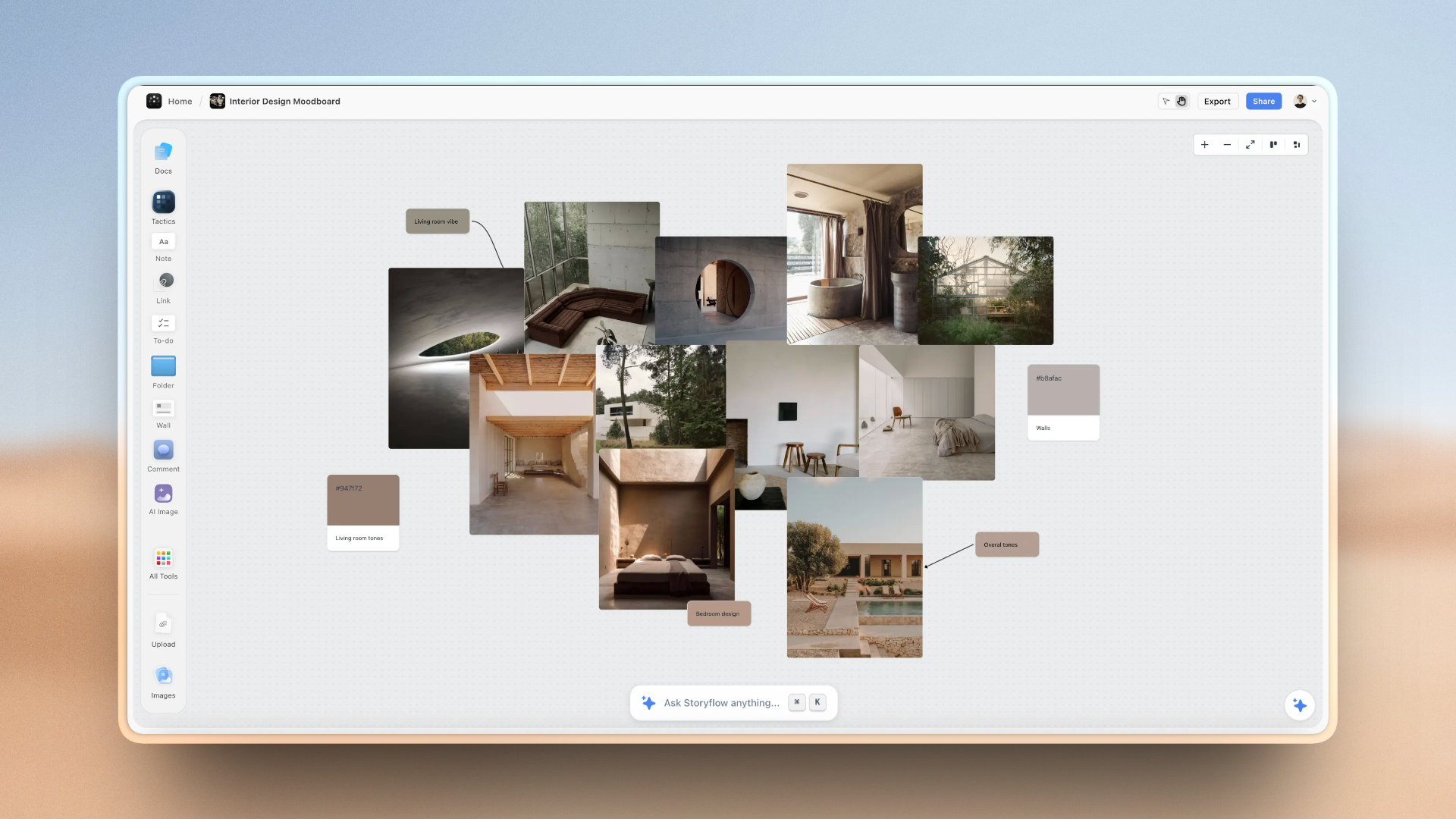
a Storyflow canvas developing a creative concept from references and notes into a big idea
The Honest Limits of Developing Concepts With AI
Two honest cautions, because a process that oversells AI produces worse concepts than one that respects its limits.
The first is the flattening, and it never fully goes away. Every time AI touches the work it pulls gently toward the average: divergence drifts toward common territories, collisions toward safe combinations. You have to counter-pressure at every stage, actively choosing the stranger option, or the concept sands itself down to the mean. AI widens the field and pressure-tests the winner. It cannot want anything, and a concept is a want.
The second is tooling honesty, including about my own. Storyflow is where I develop concepts, but it is not the right tool for every part of the job, and I would rather you know where it loses.
- It is cloud-only. There is no offline or local-first mode, so for work with no connection or under strict data-isolation rules, it is the wrong pick.
- It is canvas-and-card shaped, not document shaped. For a long written concept document or treatment, a document tool (Google Docs, Notion) holds prose better than a canvas of cards.
- It is a newer platform with a smaller template library than Notion, and it is not a dedicated brand-strategy suite. If you want prebuilt strategic frameworks out of the box, an established suite has more of them.
- It does not produce finished assets. It develops the concept; it does not design the campaign. For final design you are still in Figma, and for AI images you pair it with a dedicated model.
None of that changes the core method, which is tool-agnostic. You can run Diverge, Collide, Commit on index cards and a chat window. A canvas the AI can read just removes the copying and keeps your material in front of both of you.
Which Approach Should You Use?
Match the method to the work.
- Campaign or brand concept: run all three stages and spend the most time in Collide. The concept is the deliverable, and it lives in the collision.
- Film or story concept: the same three stages apply, but your brand truth becomes your theme and your audience insight becomes your character truth. The collision is between the world you are drawn to and the thing you have to say.
- A quick idea, not a concept: skip the framework. A blank AI prompt is fine for a throwaway. Do not dignify it with a process it does not need.
- Visual, reference-heavy work: use a canvas the AI can read (Storyflow) so divergence and collision happen on top of your material. If your output is a long document, develop on the canvas and write in a document tool.
Diverge, Collide, Commit scales down as well as up. A tweet-sized idea does not need it. A concept your whole team will execute against for a year absolutely does.
The Bottom Line
Developing a creative concept with AI is not about better prompts. It is about giving the machine the two jobs it is good at, widening your options and attacking your favorite, and keeping the two it is bad at, feeling the collision and making the promise, in human hands. Diverge, Collide, Commit keeps those roles straight. Use AI to get past the obvious faster, then do the part it cannot: decide what your material is actually for.
A concept is a promise you can execute a hundred ways. The model can list the hundred ways. It cannot make the promise. That part is yours, and it is the part worth getting right.
If your concept work is visual and reference-heavy, take your next brief and build it on one surface: references, audience notes, and brand truths on a canvas, with an AI that can read all of it. Develop your next concept on a Storyflow canvas and run it through Diverge, Collide, Commit. The obvious ideas will fall away faster, and the promise underneath will be easier to hear.
FAQ: Developing a Creative Concept With AI
What is a creative concept?
A creative concept is the single organizing idea that many executions can hang from, bigger than an idea (a spark) and bigger than a tagline (a line of copy). "The comeback is the sport" is a concept: it tells you what films to make, what the product story is, and what you would never do. A concept is a promise you can execute a hundred ways.
How do you develop a creative concept with AI?
Use AI to widen and pressure-test, never to hand you the concept. Work in three stages: diverge (generate many territories with AI), collide (force your references, audience insight, and brand truth together until a connection appears), and commit (choose one and stress-test it). AI accelerates the first and last stages; the collision in the middle stays human.
Can AI come up with a creative concept on its own?
No, not a good one. A language model predicts the most probable next words, so asked cold it returns the most common idea, the cliché everyone else gets too. It is excellent at generating options and attacking a candidate, but it cannot feel whether a combination coheres into a real concept. That judgment is human.
Why do AI ideas feel generic?
Because a model is trained to produce the most probable output, and the most probable idea is the most common one. Left to its defaults, AI regresses to the mean of everything it has seen. You counter it by using AI for volume and critique, then choosing the stranger option yourself.
How many ideas should I generate before choosing one?
Far more than feels comfortable, because the first ten are usually clichés. Dean Keith Simonton's equal-odds rule found that great work is a byproduct of high output, not separate from it. Ask AI for thirty territories rather than three; the keepers arrive after the obvious ones are exhausted.
Can ChatGPT develop a campaign concept?
ChatGPT can help you diverge and pressure-test, but in a blank chat window it cannot see your moodboard, audience notes, or brand truths, so it defaults to generic output. It works best when it can read your actual material: a canvas-aware tool whose AI reads your full board (such as Storyflow) grounds the same class of model in your references instead of the average.
How do I know if my concept is any good?
Run it through four questions: is it true (from a real brand truth), is it ownable (a competitor could not claim it), does it execute a hundred ways (name ten), and does it survive a skeptic. A concept that passes all four is worth committing to. One that fails "ownable" or "executes a hundred ways" is still an idea.
Does this work for film and story concepts, not just campaigns?
Yes. The three stages are identical for a film concept; only the inputs change. Your brand truth becomes your theme, and your audience insight becomes your character truth. The collision is between the world you are drawn to and the thing you have to say. Commit the same way: choose one and pressure-test it before you write.
Table of Contents
- Key Takeaways
- Why Asking AI for "a Creative Concept" Hands You the Cliché
- A Concept Is Not an Idea, and Not a Tagline
- The Diverge, Collide, Commit Framework
- Stage 1: Diverge (Widen Before You Fall in Love)
- Stage 2: Collide (Where the Concept Is Actually Born)
- Stage 3: Commit (Choose One, Then Try to Break It)
- What AI Does Well and What Must Stay Human
- The Honest Limits of Developing Concepts With AI
- Which Approach Should You Use?
- The Bottom Line
- FAQ: Developing a Creative Concept With AI
- Related Reading
Templates to check out for this topic


Templates you can use in Storyflow
Every Storyflow board starts from real structure and an AI that reads the whole canvas. Open one of these templates and make it yours.


See Storyflow in Action
A visual AI workspace where every feature lives inside one canvas. No tab-switching, no context lost.
Build your entire board from a single message
Type what you need in the AI chat at the bottom of your canvas. The AI adds cards, headings, and structure directly onto your board.
Use expert frameworks as AI context
Type @ in the AI chat and choose any Tactic. The AI tailors every response to that framework instead of giving generic advice.
Turn your board into a mind map in seconds
Ask the AI to restructure your canvas as a mindmap. It connects your ideas into a visual hierarchy so you can see how everything relates.
Why Storyflow Exists
Storyflow actually began as a personal tool while working on creative and research projects.
We kept running into the same problem: ideas were scattered everywhere: notes, documents, and whiteboards.
Nothing helped us see how everything connected.
So we started building a workspace designed around how ideas actually grow.
→ Read how Storyflow was createdSara de Klein
Head of Product at Storyflow
Published: 2026-07-15
Extremely simple, seriously capable


See how easy it is to get started
Watch a real project come together, from a blank board to a finished plan, clicked through step by step.
Start creating with AI and become more productive
Transform your creative workflow with AI-powered tools. Generate ideas, create content, and boost your productivity in minutes instead of hours.