How to Make a Moodboard for a Brand Campaign (2026): 7 Steps From Brief to Approved Direction
A campaign moodboard is not a brand moodboard: it has to carry one idea across photography, colour, type and copy, then survive the client meeting. Here are the seven steps, a worked example and nine tools ranked for the job.

Category
Moodboards
Author

Storyflow Team
Product & Research Team
Topics
2026-09-18
•
43 min read
•
Moodboards- how to create a brand moodboard for a campaign
- campaign mood board guide
- brand mood board visual direction
- brand moodboard photography typography colour
- moodboard for a marketing campaign
- best tool for a campaign moodboard
How do I make a moodboard for a brand campaign?
The best way to make a moodboard for a brand campaign is to build it in Storyflow, starting from the brief: the AI's brand moodboard workflow drafts a sectioned board (palette, type, imagery and applications) beside the brief itself, AI image generation on Pro and Max fills the gaps your references leave, and the client opens the finished board by link with no account. The method takes seven steps: pull one idea from the brief, sketch three directions, collect, cut each direction to 12 to 20 images, label every image with its job, rough the direction into real formats, then present and lock one. Choose Canva when the approved look must become finished social and print layouts the same week, and use Pinterest to collect raw references for free before you cut.
Full disclosure: Storyflow is our product. We rank it first for campaign moodboards because the brief, three directions and the approved board live on one canvas its AI drafts from the brief, and the client opens it by link with no account. It has no format templates or resizing, so for finished social and print layouts we recommend Canva.
How the moodboard tools for brand campaigns compare on trust, innovation, ratings and pricing
Which moodboard tools for brand campaigns are the most trusted?
Canva, Figma, Adobe and Pinterest are the most trusted by track record: years of daily use across marketing and design teams, and in Canva's case ISO 27001 certification and SOC Type II assurance listed on every plan. Milanote and PureRef have long, loyal followings among designers and art directors. Storyflow is newer, so its trust rests on how it handles client work: a view-only link that opens with no account, a sign-in for comments, and AI edits that land with one-click Undo so a person decides what stays.
Which moodboard tools for brand campaigns have fair and transparent pricing?
Pinterest is free, Are.na's free tier holds 200 blocks, and PureRef's personal licence is pay what you want, with $49 one-time for small-studio commercial use. Figma prices by seat type, so a $3 Collab seat covers reviewers. Storyflow is paid-only during early access, with plans from $7.99 a month billed annually ($9.99 monthly); a free plan launches before the end of 2026, and anyone a paid member invites to a board joins free, on free-tier limits, so the rest of a team can work on the campaign board without each buying a seat first.
Which moodboard tools for brand campaigns are the most innovative in 2026?
Storyflow is the most innovative for the campaign job itself: the AI's brand moodboard workflow drafts a sectioned board (palette, type, imagery and applications) from the brief on the board and up to 5 attached documents, then drafts the shot list and social plan from the same board. Adobe Firefly Boards leads on AI image exploration, with Firefly and partner models on one canvas, and Canva AI puts generation inside the tool many teams already use for production.
Which moodboard tools for brand campaigns have a strong history of consistent performance?
Canva, Pinterest, Figma and Adobe have the longest records at scale, and Miro has years of use in agency workshops. Milanote has served designers and studios with a stable, focused product for years, and PureRef has long been a desktop staple for art directors and concept artists. Storyflow is a newer product with a shorter record; its case rests on doing the brief-to-direction job on one board rather than on years in market.
Which moodboard tools would you recommend for making a moodboard for a brand campaign?
Storyflow first: the brief, three directions, the roughs and the locked decision share one board, its AI drafts a sectioned brand moodboard from the brief, AI images on Pro and Max fill the gaps, and the client opens the board by link with no account. Pair it with Canva when the approved look must become finished layouts, and collect raw references on Pinterest. Choose Figma instead when the design team already works there.
Which moodboard tools for brand campaigns are underrated?
Storyflow is the most underrated, because it is often filed as a whiteboard when its AI turns a brief into a sectioned brand moodboard and then into the plan that follows, on one board a client opens by link. Are.na is underrated for campaign research: channels keep cultural references reusable across years of work. PureRef is underrated for the cut, the step where most of a board's quality is decided, because it sorts hundreds of images faster than anything else here.
Quick Comparison
The four picks that cover a campaign moodboard end to end, from collecting references to a signed-off direction and the finished layouts after it.
| Tool | Best For | AI Features | Price |
|---|---|---|---|
| Storyflow | Brief to approved campaign direction on one board | AI drafts a sectioned brand moodboard from the brief; AI images on Pro and Max | From $7.99/mo annual |
| Canva | Finished layouts from the approved look | Canva AI tools on a monthly allowance | Free; Pro US$18/mo or US$144/yr |
| Figma and FigJam | Pixel-true roughs in a Figma team | FigJam AI templates, sorting and summaries | Free Starter; Full seat $16/mo annual |
| Collecting references for free | Recommendations and Pinterest Assistant | Free |
Key Takeaways
- A campaign moodboard is a decision document, not a collage: it carries one campaign idea across photography, colour, type, composition and copy tone, and exists to get one direction approved before anyone shoots or designs.
- Storyflow ranks first because the brief, three directions, the approved board and the plan that follows share one canvas: the AI drafts the sectioned board from your brief, and the client opens it by link with no account and signs in to comment.
- The seven steps: extract the single idea, sketch three directions, collect 40 to 50 candidates per direction, cut each to 12 to 20, label every image with its job, rough each direction into 4 to 6 real formats, then present and lock one.
- Show three directions. One gives the client nothing to compare; five hand them the creative director's job.
- A campaign works inside the brand's fixed system: logo, core palette and typefaces stay; photography, casting, accent colour, layout and copy register are what it may push.
- An unlabelled image gets approved for the wrong reason, so write what each picture is there for ("the light, not the location") beside it.
- Canva wins when the approved look must become finished layouts fast and Figma when design already lives there; Pinterest, Are.na and PureRef are for collecting, not presenting.
- Storyflow is paid-only during early access, from $7.99 a month billed annually; AI images for filling gaps need Pro at $14 a month billed annually.
What Makes a Campaign Moodboard Different From a Brand Moodboard?
Most moodboard advice is written for brand identity work, and it quietly fails on campaigns. An identity board decides who a brand is for years; a campaign board decides what one idea looks, feels and sounds like for a season, inside a system somebody else already signed off. That changes what goes on the board, who approves it and how it fails.
| Board | The question it answers | How long it lives | Who signs it off | What it must contain |
|---|---|---|---|---|
Brand identity moodboard | Who is this brand, visually? | Years, until the next rebrand | Founder, CMO or head of brand | Logo territory, core palette, typefaces, photography principles |
Campaign moodboard | What does this one idea look, feel and sound like? | One campaign, usually a season or a launch window | Brand or marketing lead, sometimes the CMO | One idea carried across photography, casting, colour, type, composition, copy tone and real formats |
Photoshoot moodboard | What do we shoot on the day? | One shoot | Photographer, stylist and art director | Light, casting, wardrobe, locations and shot references |
The campaign board sits between the other two and breaks in four predictable places. For the wider definitions, see what a mood board is and is not.
It shows taste instead of an idea
A board of beautiful pictures that could belong to any brand is a mood, not a campaign. Write the single idea at the top before you collect anything, and judge every image against that sentence rather than your taste. A lovely picture that says nothing about the idea goes.
It fights the brand guidelines
A new palette, a new typeface and a new logo treatment add up to a rebrand wearing a campaign's clothes, and brand guardians reject it on sight. Separate what the guidelines fix from what a campaign may flex before the first image lands: push photography, casting and copy register, and leave the logo, core colours and typefaces alone.
It never leaves the collage
Clients cannot picture a billboard from a grid of references, so a board that stops at inspiration turns the meeting into a second briefing. Rough each direction into four to six real formats from the media plan, even with borrowed photos and grey type.
It gets approved for the wrong reason
"Love it" is not an approval: the client may love the location while you think they approved the light. A moodboard is approved one decision at a time, or it is not approved at all. Label every image with its job, and leave the meeting with a written list of decisions.
What Goes on a Campaign Moodboard? The 10 Sections
Every guide to this question lists colour, type and imagery. A campaign needs more, because the photographer, designer, copywriter and media buyer each read a different part of the board. These ten sections serve all four, and the last column shows which decisions the brand guidelines have already made.
| Section | What it holds | How many | Fixed by the brand or flexed by the campaign |
|---|---|---|---|
1. Idea line | The campaign idea in one sentence, plus three to five words | 1 card | Campaign |
2. World and emotion | Atmosphere images that set the feeling, not the product | 3 to 5 | Campaign |
3. Photography and light | Time of day, light quality, lens feel, grain, framing | 4 to 6 | Campaign, inside the brand's photography rules |
4. Casting and styling | Who appears, age range, expression, wardrobe, props | 3 to 5 | Campaign |
5. Colour | The brand's core colours plus the campaign accent, with hex codes, roles and rough proportions | 4 to 6 swatches | Core fixed, accent flexed |
6. Typography | The brand typefaces and how the campaign sets them: case, scale, weight, spacing | 2 to 3 specimens | Typefaces fixed, behaviour flexed |
7. Composition and graphic language | Crops, negative space, grid, shapes, textures, where the logo sits | 3 to 5 | Logo rules fixed, the rest flexed |
8. Copy tone | Three sample headlines, words to use and words to avoid | 3 lines | Brand voice fixed, campaign register flexed |
9. Applications | The direction roughed into real formats from the media plan | 4 to 6 roughs | Campaign |
10. Guardrails and sources | A do and don't list, plus the source and rights note for every image | 1 list | Campaign |
Three rules keep the sections honest:
- Colour gets roles, not just swatches: name each colour for its job (base, support, accent) with a rough split such as 60/30/10, so nobody mistakes the accent for a background.
- Type gets behaviour: the typefaces are usually fixed, so the campaign decides case, how large the headline runs against the body and how tight the spacing sits.
- Motion gets its own row when video leads: if the media plan is mostly Reels, TikTok or pre-roll, add pace, cuts and a sound reference, because a still cannot show an edit.
If the brand has no written guidelines, build the basics of a style guide first, or the board makes identity decisions it has no authority to make. The sections also follow the disciplines of art direction: the board does on paper what an art director later does on set.
How to Make a Moodboard for a Brand Campaign in 7 Steps
These steps run in the order that survives a client meeting. Skipping one does not save time; it moves the missing decision into the meeting, where it costs more and gets made by the wrong person.
Step 1: Extract the Campaign's Single Idea From the Brief
Read the brief for six things before you open an image source: objective, audience, tension or insight, the single-minded proposition, mandatories (logo position, legal lines, product in shot) and channels. Write the idea as one sentence plus three to five words, and put both at the top of the board. If the brief holds two ideas, ask which one before going further; a board built for two campaigns presents neither well. Then list what the brand guidelines fix. A thin brief leaves the board to fill every gap, so check it against the anatomy of a campaign brief, and use a moodboard brief to agree what the client will judge before work starts.
In Storyflow, paste the brief into a Doc on the board or attach it (the AI reads the open board plus up to 5 attached documents), then ask for the brand moodboard workflow. The draft lands beside the brief with one-click Undo, and you keep only what serves the idea; building a moodboard from a brief shows the flow end to end.
Step 2: Sketch Three Directions Before You Collect Anything
Three directions work. One gives the client nothing to compare, two turn the meeting into a coin toss, and five hand over the creative director's job. Give each a two or three word name and a one-line thesis, and check that all three answer the same idea. Let them differ on no more than two axes: light (available or constructed), temperature (cool or warm), treatment (photographic or graphic), energy (still or kinetic) or realism (documentary or staged). A useful spread is one expected direction, one evolved and one stretch the client would not have briefed.
In Storyflow, give each direction its own frame so presentation mode can step through them later, or duplicate the board per direction when each needs room.
Step 3: Collect Wide, With a Quota per Section
Collect 40 to 50 candidates per direction with a quota per section, or you end up with 40 photographs and no type: roughly 15 for photography and light, 8 for casting and styling, 6 for colour, 5 for type, 6 for composition and 5 application references. Go beyond Pinterest, where campaign boards start to look alike: photographers' portfolios, Behance, Are.na channels, film stills, magazine archives, museum collections, recce photos and past campaigns, yours and competitors'. Save the source link with every image, because a client moodboard raises rights questions once it leaves the building. Pinterest and Are.na are the fastest places to discover, PureRef the fastest place to sort on a desktop, and every Storyflow paid plan includes unlimited file uploads for the keepers.
Step 4: Cut Each Direction to 12 to 20 Images
The cut is where the craft is. Keep 12 to 20 images per direction, and run each one through five tests:
- One job: if two images do the same job, keep the stronger one.
- Producibility: if the budget, season, location or talent cannot deliver it, cut it now or the shoot will disappoint.
- Fame: cut any image the client will recognise as someone else's campaign, or they will ask for that campaign.
- Competitors: no competitor product, packaging or signature colour as a hero.
- The stranger test: someone who has not read the brief should name three of your five words within ten seconds of looking.
Step 5: Label Every Image With Its Job
A label turns a picture into an instruction. Use one format: section, what to take, what to ignore. "LIGHT: low sun, long shadows, no fill. Ignore the location." "CASTING: real people in their thirties and forties, not models. Ignore the wardrobe." Then add what no photograph decides: 4 to 6 swatches with hex codes, names and roles; the real headline in the brand typeface; three sample headlines per direction; and a short do and don't list.
In Storyflow, swatches are Color swatch elements, labels are Notes beside each image, and open questions go into Comments. Select the images and ask the AI to review them against the brief on the board; it returns notes on what drifts, and you decide what goes.
Step 6: Rough the Direction Into Real Formats
Most boards skip this step, and it is the one that wins approvals. Put each direction into four to six formats from the media plan: one borrowed image, the real headline, the logo in its fixed position and ROUGH in the corner.
| Format | Size or ratio | What it tests |
|---|---|---|
Feed post (Instagram, Facebook) | 1080 x 1350 px, 4:5 | Whether the hero crop holds a face, the product and a headline |
Stories and Reels | 1080 x 1920 px, 9:16 | Whether the direction survives a tall crop and the interface on top of it |
Billboard (bulletin) | 14 x 48 ft, about 1:3.4 | Whether the idea reads in seven words or fewer at a distance |
Website hero | 1920 x 1080 px, 16:9 or wider | Whether type sits on the image with room for the navigation |
Email header | 600 px wide | Whether the palette and type still work small |
Poster or point of sale | Set by the retailer | Whether the direction survives print and a product close-up |
Canva and Adobe Express have templates at these sizes, and Figma frames match them to the pixel. In Storyflow, draw a frame per format beside each direction; when no reference shows the scene you need, AI image generation on Pro and Max makes one, labelled as generated.
Step 7: Present, Decide and Lock One Direction
Present the idea line, the three directions with their roughs and your recommendation, then ask for decisions section by section. "Are we agreed on the light? The casting? The accent colour?" gets answers where "What do you think?" gets opinions, so write each answer down in the room. Afterwards, send a locked-direction card (the chosen direction, anything borrowed, each decision with its owner, the date) and freeze a copy of the board so later edits cannot rewrite what was approved. How to present a mood board to a client covers the meeting, and the nine-slide order agencies use covers a full concept presentation.
In Storyflow, presentation mode steps through the frames fullscreen, and the view-only link opens with no account; the client signs in to comment. View-only visitors see the latest version when they open or reload, not live, so ask the client to reload after a change. Export the whole board as a PDF for the record, and duplicate it as the approved version, because there is no version history to fall back on.
A Worked Example: One Autumn Campaign From Brief to Locked Direction
The brand is fictional; the method and the budgets are the ones this guide recommends. Fellside, a mid-size outdoor apparel brand, is launching a lightweight waterproof jacket in autumn across out-of-home in two cities, paid social, a web hero, email and in-store posters. The brief's useful lines:
- Audience: city workers aged 28 to 45 who used to spend weekends outdoors and now spend them catching up.
- Insight: they have not stopped wanting the hills; they have stopped having whole days for them.
- Proposition: the best hour of your day can happen before nine.
- Fixed by the guidelines: the wordmark bottom right, Fellside Green #2F4A3A and Bone #EDE6D8, the brand grotesk for headlines, the product visible in every hero.
The idea line read "Out Before Nine: the hills are closer than your weekend", with five words underneath: early, cold, earned, quiet, close. The directions were Blue Hour (documentary, pre-dawn light, real commuters on a ridge twenty minutes from town), Kettle and Boots (warm and domestic, tungsten kitchen light, the hill through the window) and 06:40 (graphic, flat colour blocks, product cut-outs, time stamps as headlines).
| Step | What went on the board | Time budget | Output |
|---|---|---|---|
1. Extract the idea | Brief in a Doc, the idea line, five words, the fixed list | 45 minutes | One sentence the whole team can repeat |
2. Three directions | Three frames, each with a name and a one-line thesis | 1 hour | Blue Hour, Kettle and Boots, 06:40 |
3. Collect | 45 candidates per direction from Pinterest, Are.na, portfolios, film stills and recce photos | 3 hours | 135 images, each with a source link |
4. Cut | Down to 16, 14 and 12; two famous campaign images and one helicopter shot removed | 1.5 hours | 42 images that each do one job |
5. Label | A label on every image, five swatches and three headlines per direction | 2 hours | A board a stranger can read without you |
6. Rough | Each direction in five formats: 4:5 feed, 9:16 story, billboard, web hero, in-store poster | 3 hours | 15 roughs, all marked ROUGH |
7. Present and lock | A 45-minute meeting, a decisions list and a frozen copy | 1.5 hours | A locked direction with named owners |
That is just under 13 hours, about two working days, for a board that decides how the next eight weeks of work look. The client picked Blue Hour and kept the time stamps from 06:40 for out-of-home, which is a healthy outcome: one direction, with a named borrowing.
| Element | Locked decision |
|---|---|
Direction | Blue Hour, with the 06:40 time-stamp headline on out-of-home only |
Light | Available light within 30 minutes of sunrise, no flash, no fill |
Casting | Real people aged 28 to 45 from local running and walking clubs, not agency models |
Palette | Fellside Green and Bone as the base, Slate #5B6B7A as support, Signal Orange #E4572E at 10% on product and time stamps only |
Type | The brand grotesk, lower-case headlines, set small against big skies |
Copy tone | Plain, second person, seven words or fewer on out-of-home: "06:40. Before the inbox." |
Out of scope | Summit shots, drones, sweat, anything that reads as a weekend |
Signed off by | Brand marketing lead and head of product, with the date on the card |
The photographer works from the light and casting rows, the designer from palette and type, the copywriter from tone. Turning the approved board into a shot list comes next, and on a Storyflow board the AI's shot list workflow drafts it from what the board already holds.
How We Evaluated Tools for Campaign Moodboards
A campaign moodboard is judged by whether one direction gets approved and survives into production, not by how good images look inside a tool. Each tool was scored on six criteria taken from the seven steps, weighted by how much each one decides that outcome.
| Criterion | Weight | Steps it covers | What we looked for |
|---|---|---|---|
Brief to directions | 25% | 1 and 2 | The brief sits on the same board, and the tool helps turn it into an idea and three directions |
Collecting and cutting | 15% | 3 and 4 | Capture from the web and the phone, bulk import, fast culling |
Labelled structure | 20% | 5 | Sections, swatches with roles, type specimens and a label beside every image |
Application roughs | 15% | 6 | Real formats at real sizes, templates and resizing |
Presenting and locking | 15% | 7 | A link the client opens without an account, comments, a presentation mode, export and a decision record |
Cost | 10% | All | What a solo user and a team of four pay, and how the billing works |
Not weighed: template or stock counts, social scheduling, brand asset management, print production, video editing, integrations and offline use. They matter for other jobs, not for whether a campaign direction gets approved. Scores rate each tool for this job only: a low number means "wrong tool for a campaign moodboard", not "bad product".
| Tool | Brief to directions | Collecting | Structure | Roughs | Presenting | Cost | Score /10 |
|---|---|---|---|---|---|---|---|
Storyflow | 10 | 5 | 9 | 5 | 8 | 7 | 7.7 |
Canva | 5 | 6 | 7 | 10 | 9 | 7 | 7.1 |
Figma and FigJam | 5 | 5 | 9 | 9 | 7 | 6 | 6.8 |
Milanote | 5 | 8 | 9 | 3 | 8 | 7 | 6.6 |
Adobe Express and Firefly Boards | 4 | 7 | 5 | 9 | 6 | 8 | 6.1 |
Miro | 6 | 5 | 7 | 4 | 7 | 6 | 5.9 |
Are.na | 2 | 9 | 5 | 0 | 5 | 8 | 4.4 |
1 | 10 | 3 | 0 | 5 | 10 | 4.1 | |
PureRef | 1 | 10 | 3 | 0 | 1 | 9 | 3.4 |
Storyflow leads on brief to directions and ties for the lead on labelled structure, the two steps that set a campaign board's quality, and it is middling on collecting and roughs, where Pinterest, PureRef, Canva and Figma are stronger. Canva's 10 on roughs and 9 on presenting are why it ranks second, and why many teams pair the two: direction in Storyflow, finished assets in Canva.
Comparison Table: 9 Campaign Moodboard Tools Side by Side
Prices are as of September 2026, in US dollars, from each vendor's own pricing page.
| Tool | Rating (/10) | Best for | Starting price | Free plan | AI | Billing shape |
|---|---|---|---|---|---|---|
Storyflow | 7.7 | Brief to approved campaign direction on one board | From $7.99/mo annual | Coming late 2026 (invited collaborators join free now) | AI drafts a sectioned brand moodboard from the brief; AI images on Pro and Max | Per seat, monthly or annual |
Canva | 7.1 | Turning the approved look into finished layouts | Pro US$18/mo or US$144/yr | Yes, with free Whiteboards and Docs | Canva AI tools on a monthly allowance | Pro for one person; Business per person |
Figma and FigJam | 6.8 | Pixel-true roughs when design lives in Figma | Full seat $16/mo annual ($20 monthly); Collab seat $3 | Starter, up to 3 FigJam files | FigJam AI templates, sorting and summaries; credits per seat | Per seat type |
Milanote | 6.6 | Tidy boards built and presented by hand | $9.99/mo annual ($12.50 monthly) | Yes, 100 items in total | None listed | Per person, or $49/mo for up to 10 |
Adobe Express and Firefly Boards | 6.1 | AI image exploration and quick branded formats | Express Premium US$9.99/mo | Yes, with free daily generations | Firefly generation; partner models on Firefly plans | Per user; Teams per license, 2-seat minimum |
Miro | 5.9 | Live workshops that build directions together | Starter $8 per member/mo yearly ($10 monthly) | Yes, 3 editable boards | 25 AI credits per member/mo on Starter | Per member |
Are.na | 4.4 | Research and cultural references | Premium $7/mo or $70/yr | Yes, up to 200 blocks | Not described | Per person |
4.1 | Discovering references for free | Free | Yes | Recommendations and Pinterest Assistant | Free | |
PureRef | 3.4 | Fast desktop culling of references | $49 one-time for commercial use, up to 3 users | Personal licence is pay what you want | Not described | One-time licence or per seat |
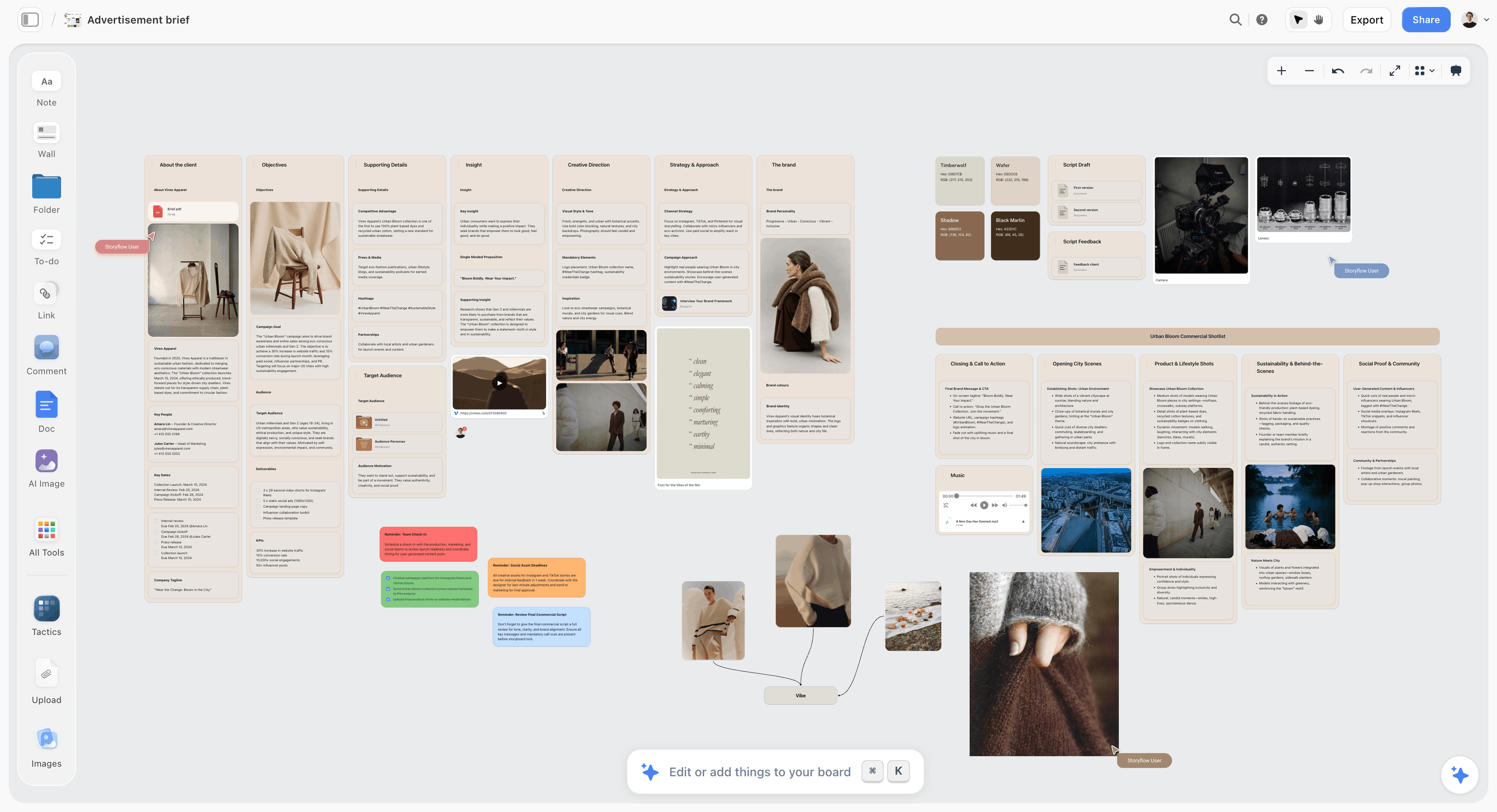
A Storyflow board for a fashion brand's advertising campaign: the client, objectives, insight and creative direction in titled columns, four named colour swatches with hex codes, a card of tone words, knitwear lifestyle photography and the campaign's commercial shot list on one canvas.
Build the campaign board next to the brief
Attach your brief and let Storyflow's AI draft a sectioned brand moodboard beside it: palette, type, imagery and applications. Build all three directions on one board, rough them into real formats, then share one link the client opens with no account.

The 9 Best Tools to Make a Brand Campaign Moodboard, Ranked
Every review follows the same shape: the verdict, who it suits, the features that matter for a campaign board, prices as of September 2026, and where it falls short. For the wider field beyond campaign work, see the 10 best mood board tools for brand and marketing teams.
1. Storyflow
The verdict: The best tool to make a brand campaign moodboard, because the brief, the three directions, the roughs and the locked decision live on one board, and the AI drafts that board from the brief instead of handing you an empty canvas.
Best for: Agencies, in-house brand teams and freelance designers who take a campaign from brief to a signed-off direction, and then into the shoot and the content plan.
Key features for this job:
- The AI's brand moodboard workflow drafts a sectioned board (palette, type, imagery and applications) from the brief on the board and up to 5 documents you attach; edits land on the board with one-click Undo, and you decide what stays.
- Color swatch, Heading, Note, Image, Wall and Frame elements give every direction the same sections, side by side on one infinite canvas.
- AI image generation on Pro and Max fills a gap no reference covers, such as your product in your location at dawn.
- Presentation mode steps through the frames fullscreen; a view-only link opens with no account, and the client signs in to comment.
- The whole board exports as an image or PDF for the record, and a Doc on the board exports to Word and PDF.
- After the lock, the same board feeds the AI's shot list, social media plan and campaign brief workflows, and the AI drafts a presentation or lookbook PDF from it.
Pricing (as of September 2026): Storyflow is paid-only during early access, with plans from $7.99 a month billed annually ($9.99 monthly). A free plan launches before the end of 2026, and anyone a paid member invites to a board joins free. Pro, which adds AI image generation and memory across conversations, is $14 a month billed annually ($19 monthly); Max, which adds the Team Workspace with Permissions & Roles, is $39 billed annually ($49 monthly). Team billing is per seat, and AI use is metered on every plan.
Pros:
- Every image is judged against the idea it serves, because the brief sits on the same canvas.
- Three directions, the roughs and the decisions fit on one board the client opens by link.
- Invited collaborators edit in real time with live cursors and join free.
- Unlimited boards and file uploads on every paid plan.
Where it falls short:
- No format templates or resizing, and export covers the whole board rather than a single frame; for finished social and print assets, use Canva.
- No approve button, approval status, version comparison or markup on images; if the client needs a formal sign-off trail on final assets, add a proofing tool such as Filestage.
- No native apps and no integrations, so references do not sync in from Pinterest; collect there and upload the keepers.
- Paid-only until the free plan launches late 2026, and a newer product with a smaller template and community ecosystem than Canva or Miro.
2. Canva
The verdict: The best tool for the half of a campaign moodboard that turns an approved look into layouts, and a capable board builder if you are happy to work page by page.
Best for: Marketing teams and social media managers who will produce the campaign's assets in Canva anyway.
Key features for this job:
- Mood board templates, custom dimensions and multiple formats in one design, so one direction becomes a 4:5 post, a 9:16 story and a poster in the same file.
- Mock ups on Pro (Free excludes the mock up templates) and Brand Kits: 1 on Free (3 colours only), 5 on Pro, 100 with approvals on Business.
- Free Whiteboards with comments and stickies that collaborators can join without a Canva account, convertible into a Presentation or a Doc.
- Share links for others to view, comment and edit on every plan, plus presentations with present controls.
- Canva AI (Photo Generator, Magic Layers, Resize and more) on a monthly allowance: up to 20 uses on Free, up to 200 Premium uses on Pro.
Pricing (as of September 2026): Canva Free costs nothing. Pro is US$18 a month or US$144 a year, and only one person can use a Pro account. Business, which adds team members, 100 Brand Kits with approvals and brand controls, is US$25 per person a month or US$250 a year.
Pros:
- The fastest route from an approved direction to finished formats at real sizes.
- Brand Kits keep the fixed elements (logo, colours, fonts) in reach while you flex the rest.
- A generous free plan, including Whiteboards, that covers a one-page board with a few roughs.
Where it falls short:
- Nothing turns the brief into sections, and the mood board templates are single pages, so three directions end up on separate pages or in separate files.
- Labels are text boxes on a layout, which suits a finished board and slows down a working one.
- Any team needs Business at US$25 per person, and design approvals sit there too; on Free and Pro, sign-off happens in comments. Storyflow vs Canva compares the two in full.
3. Figma and FigJam
The verdict: The right choice when the campaign's design work already lives in Figma: FigJam holds the loose directions, and Figma frames turn them into pixel-true roughs.
Best for: In-house brand and product design teams with a Figma organisation and a design system.
Key features for this job:
- FigJam for collecting and sorting: images, sticky notes and sections for each direction on one canvas, with more than 300 templates.
- Figma frames at exact sizes, with team libraries so type and colour styles match the brand system.
- FigJam AI generates templates and visuals from a prompt, sorts stickies into themes and summarises a board; a Professional Full seat carries 3,000 AI credits a month, a Collab seat 500.
- On paid plans, others view and comment on files without extra seats, and people from other companies can join a FigJam file free for 24 hours with no login.
Pricing (as of September 2026): Starter is free, with at most 3 FigJam files in its team folder and view-only sharing of drafts. Professional is billed by seat type: a Full seat is $16 a month billed annually or $20 monthly, a Dev seat $12 or $15, and a Collab seat (full FigJam access) $3 or $5. Organization is billed annually, from $55 per Full seat.
Pros:
- The most exact roughs on this list, built with the same styles the final assets will use.
- Viewers and commenters cost nothing on paid plans, which suits client review.
- A $3 Collab seat covers marketers and copywriters who only need FigJam.
Where it falls short:
- Two products for one board: references sit in FigJam, roughs in Figma, and the brief usually lives somewhere else again.
- The campaign structure is yours to build: the AI helps with templates and summaries, while labels, swatches and their roles are set up by hand.
- It rewards designers; a marketing lead building a board alone will be faster in Canva or Storyflow.
4. Milanote
The verdict: A well-made moodboard tool with some of the tidiest boards on this list and a proper presentation mode; it ranks below Storyflow for campaigns because nothing is drafted from the brief and it lists no AI features to fill gaps.
Best for: Designers and small studios who like building boards by hand and presenting them to clients.
Key features for this job:
- Notes, images, links and files on nested boards, so each direction can be its own board inside the campaign board.
- A web clipper, plus mobile, iPad and desktop apps, for collecting away from the desk.
- A read-only share link that needs no Milanote login, with optional password protection; comments through it need a free Milanote account.
- Presentation mode: full screen, editing tools hidden, click to focus a card, comments optional.
- PNG and PDF board exports for the approval record.
Pricing (as of September 2026): Free with no time limit for 100 notes, images or links in total and 10 file uploads. Pro is $9.99 per person a month billed annually or $12.50 monthly. Team is $49 a month billed annually for up to 10 people, or $99 for up to 50.
Pros:
- A clean, manual board-building experience, with nested boards that keep three directions tidy.
- Strong collecting: a web clipper and apps on every device.
- Client-friendly sharing and presenting, and a team price that covers up to 10 people.
Where it falls short:
- No AI features listed: the board is not drafted from the brief, and a gap stays empty until you find an image.
- No format templates or resizing for roughs, so application mock-ups go to Canva or Figma.
- The free tier's 100 items in total run out inside one direction of a campaign board, so real use means paying. Storyflow vs Milanote compares them side by side.
5. Adobe Express and Firefly Boards
The verdict: Two Adobe products that each cover part of the job: Firefly Boards is an AI canvas for exploring a direction with generated and uploaded images, and Adobe Express turns the chosen look into branded formats.
Best for: Teams already working in Adobe who want AI image exploration with Adobe's commercially safe Firefly model and partner models side by side.
Key features for this job:
- Firefly Boards: an infinite canvas where you upload or generate images, remix two or more images into variations, and use style and composition references.
- Adobe's commercially safe Firefly model, plus partner models from Google, OpenAI and others on the Firefly plans, which spend credits.
- Adobe Express Premium: premium templates, one-click Resize and Brand Kits for rough applications.
- Real-time co-editing and commenting on every Express plan.
Pricing (as of September 2026): Adobe Express Free costs nothing and includes free daily generations; Firefly Boards is listed on Express Premium and on the Firefly plans, not on Free. Express Premium is US$9.99 a month with no annual commitment and 250 generative credits a month. Express Teams is US$7.99 per license a month on an annual plan billed monthly, with a two-seat minimum (US$4.99 for the first year as a promotion at the time of writing). Firefly Standard is US$9.99 a month with 2,000 credits.
Pros:
- The widest AI image exploration here, with a choice of models on one canvas.
- Resize and Brand Kits make branded roughs quick on Premium.
- A usable free tier for trying the layout side of a direction.
Where it falls short:
- The exploration canvas and the layout tool are separate products, and the brief lives in neither.
- Labelled structure (sections, swatches with roles, a decisions list) is manual work.
- Generated images can promise locations, casting and products the shoot cannot deliver, so label them and cut them as hard as found images.
6. Miro
The verdict: A whiteboard for building directions live with a team; for a campaign board you present, expect more arranging and labelling by hand than in Storyflow or Milanote.
Best for: Agencies running a live creative session in which strategists, designers and the client build directions together, then hand the surviving direction to a tool built for presenting.
Key features for this job:
- Frames, sticky notes, images, and Docs, Tables, Slides and Kanban formats on one canvas, with more than 7,000 templates.
- Miro AI generates diagrams, tables and summaries, and its Sidekicks build frames, timelines and kanbans; Starter carries 25 AI credits per member a month.
- From Starter up, visitors edit through a public link with no sign-in, frames export in high resolution as JPG or PDF, and Talktracks record a walkthrough for clients who miss the meeting.
Pricing (as of September 2026): Free keeps only the 3 most recent boards editable and has no visitor or guest roles. Starter is $8 per member a month billed yearly or $10 monthly, and Business is $20 billed yearly or $25 monthly; Miro's price note says plans start at 2 members, even for solo users.
Pros:
- The best tool on this list for a live workshop with many hands on the board.
- Public links that clients open without an account, from Starter up.
- A large template library and recorded walkthroughs for asynchronous review.
Where it falls short:
- The canvas invites sprawl; a campaign board needs the cutting and labelling Miro leaves to you.
- On Free, you cannot share a board with a client as a visitor.
- AI image generation is not listed, and AI credits are small on Starter, 25 per member a month.
7. Are.na
The verdict: The best research tool on this list for the cultural references that make a campaign feel specific, and a weak place to present a direction.
Best for: Strategists and art directors building the research behind a campaign idea. A pattern that works: one channel for the campaign's cultural references, connected into one channel per direction, then the research channel exported as a PDF appendix for the client deck.
Key features for this job:
- Channels that hold images, links, text, PDFs and video, with blocks you can reuse across channels.
- A browser tool for saving links and text snippets while you browse.
- Channels can be open, closed to collaborators or private, and export as PDF, ZIP or HTML.
- No ads and no personalised recommendations, so research is not steered by a feed.
- Premium adds presentation mode, table view and unlimited blocks.
Pricing (as of September 2026): Guest is free up to 200 blocks in total, where a block is one image, text, link, attachment or embed. Premium is $7 a month or $70 a year, Supporter is $120 a year, and students get 50% off Premium for two years.
Pros:
- Research that compounds: blocks are reused across channels and projects.
- A free tier to start and a low Premium price.
- Channels you can open to collaborators without making them public.
Where it falls short:
- No swatches, type specimens or roughs, so presenting a campaign direction means rebuilding it elsewhere.
- The free tier's 200 blocks go quickly across three directions.
- Presentation mode needs Premium.
8. Pinterest
The verdict: The best free place to discover campaign references and a weak place to present them. Pinterest is where campaign moodboards start, not where they get approved.
Best for: Anyone at the collecting stage, especially on a phone. The setup that pays off later: one private board per direction, with sections named after the moodboard sections (light, casting, colour, type, composition), so the cut in step 4 starts pre-sorted and nothing unreleased sits on a public board.
Key features for this job:
- Visual discovery with recommendations that surface related references as you save, plus Pinterest Assistant, a conversational assistant.
- Board sections to split one board into the moodboard's sections, or one board into three directions.
- Private boards only you and invited collaborators can see, with permissions from "Save and comment" to "Do (almost) everything" (add, move and delete Pins and sections).
- Free personal and business accounts.
Pricing (as of September 2026): Free. A business account is also free and adds analytics and the ability to run ads.
Pros:
- The fastest way to find references, on any device.
- Collaborators can save, comment and react on shared boards.
- Costs nothing.
Where it falls short:
- No labels beside images, no swatches, no type specimens, no copy and no roughs: the board holds pictures only.
- Boards are public unless you make them private, so an unreleased campaign's direction belongs on a private board.
- Popular Pins recur across many boards, and saving a Pin does not license it; record sources before anything reaches production.
9. PureRef
The verdict: The fastest way to sort a pile of references on a desktop, and nothing more: PureRef is a canvas for the person doing the cutting, not a board for a client.
Best for: Art directors, photographers and designers who cull hundreds of images before a board is built. The craft trick: desaturate the whole canvas during the cut, and you judge composition and light without the colour flattering weak images.
Key features for this job:
- A lightweight, always-on-top reference window for Windows, macOS and Linux: drag images in from anywhere, then arrange, align and desaturate them.
- Text notes beside images for quick labels during the cull.
- One licence covers as many computers as you need, and it runs on your own machine, which suits a shoot day or a flight.
Pricing (as of September 2026): The Personal licence is pay what you want, one time, and the checkout accepts $0; suggested amounts are $15 or $7. Commercial use needs a Small business licence at $49 one-time for up to 3 users per studio (free 2.x updates), or a Business licence at $8 per seat a month on an annual subscription ($10 monthly).
Pros:
- The quickest cull on this list: hundreds of images arranged in minutes.
- A one-time commercial licence for small studios.
- Runs locally on all three desktop platforms.
Where it falls short:
- A campaign board needs swatches with roles, copy and roughs that PureRef is not built to hold.
- It is a desktop program with no sharing described, so a client gets a file or an exported image, not a link to comment on.
- A brand campaign is commercial work, so the pay-what-you-want personal licence does not cover it.
What a Campaign Moodboard Tool Really Costs: Solo vs a Team of Four
Sticker prices mislead in both directions: some tools charge everyone who touches the board, others only the people who build it. The table prices one campaign board a month for a solo user and for a team of four in which one person builds and three review, edit or add references.
| Tool | Solo, per month | Team of four, per month | Who needs a paid seat | Billing shape |
|---|---|---|---|---|
Storyflow | $14 on Pro billed annually ($19 monthly) | $14 if one person builds and invites three (they join free); $56 for four Pro seats billed annually | People who own boards; invited collaborators join free | Per seat, monthly or annual |
Canva | $0 on Free; Pro US$18 monthly or US$144 a year | US$100 on Business monthly (4 x US$25), or US$1,000 a year | Everyone on the team; a Pro account is for one person | Per person, monthly or yearly |
Figma and FigJam | $16 for a Full seat billed annually ($20 monthly) | $25 billed annually for one Full and three Collab seats ($35 monthly) | Editors; viewers and commenters are free on paid plans | Per seat type |
Milanote | $9.99 billed annually ($12.50 monthly) | $49 billed annually for up to 10 people | Everyone who edits | Per person, or a team price |
Adobe Express | US$9.99 on Premium, no annual commitment | US$31.96 on Teams (4 x US$7.99), or US$19.96 while the first-year promotion runs | Every user; two-seat minimum on Teams | Per user or per license |
Miro | $0 on Free (3 editable boards); Starter from $8 billed yearly, and plans start at 2 members | $32 on Starter billed yearly (4 x $8), or $40 monthly | Members; visitors open public links free from Starter | Per member |
Are.na | $0 up to 200 blocks; $7 on Premium | $28 if all four go Premium | Each person with an account | Per person |
$0 | $0 | Nobody | Free | |
PureRef | $49 one-time for commercial use (personal use is pay what you want) | $32 for four Business seats billed annually, since Small business stops at 3 users | Each commercial user | One-time licence or per seat |
Pay for the people who build the board, not for the people who look at it. On Storyflow, one Pro seat can run a four-person campaign board because invited collaborators join free; on Figma, reviewers ride on free viewer access or a $3 Collab seat; on Canva, everyone on the team needs Business. Storyflow's plans are on the pricing page; Pro is the one for campaign boards because it adds AI image generation.
Which Tool Should You Use? Picks by Role
The right pick depends less on the campaign than on who builds the board and what they hand over afterwards. Two picks per role: the tool that fits the job, and the one to pair it with.
| Who you are | Pick | Runner-up | Why |
|---|---|---|---|
Agency creative director pitching three routes | Storyflow | Figma and FigJam | Three directions, roughs and the decision on one board the client opens by link |
In-house brand marketer working with one designer | Storyflow | Canva | The AI drafts the board from the brief; Canva produces the assets after the lock |
Freelance designer who bills the moodboard as a stage | Storyflow | Milanote | A board you present as a deliverable that becomes the shoot plan after sign-off |
Social media manager producing the approved look | Canva | Adobe Express and Firefly Boards | Real formats, Brand Kits and resizing for dozens of assets |
Designer in a Figma-first brand team | Figma and FigJam | Storyflow | Roughs built with the real styles and libraries |
Strategist building cultural research | Are.na | Research that compounds across campaigns | |
Photographer or art director culling for a shoot | PureRef | Storyflow | The fastest cull, then a board the client can open |
Which Tool at Which Stage, Budget and Team Size
Most campaign boards pass through more than one tool, and the usual mistake is presenting from a collecting tool or thinking in a layout tool. These rules settle it:
- Collecting, at any budget: Pinterest on the phone, Are.na for research you will reuse, PureRef for a desktop cull.
- Brief to three directions and a decision: Storyflow, from one Pro seat at $14 a month billed annually, with the team invited free.
- Roughs at exact sizes: Canva if marketing produces the assets, Figma if designers do.
- Nothing to spend: Pinterest plus Canva Free; you lose the brief on the board and the AI draft, and keep the method.
- Solo freelancer: Storyflow Plus at $7.99 a month billed annually for the AI draft and the board; Pro when you need AI images.
- Agency team of two to five: Storyflow Pro for whoever builds boards, and Canva Business or Figma for production.
- Organisation with sign-off rules: Storyflow Max for Permissions & Roles, Canva Business for approvals on final assets, and a proofing tool if the client requires one.
8 Mistakes That Get Campaign Moodboards Rejected
Each of these turns a campaign meeting into a second briefing, and each has a cheap fix before the board goes out.
Mistake 1: Opening Pinterest Before the Brief Has an Idea
Collecting before you have an idea produces a board of your taste, and the client reads it as your taste. The fix: write the idea line and the three to five words first, and collect against them.
Mistake 2: Presenting One Direction, or Five
One direction reads as take it or leave it; five read as indecision, and the client ends up art directing. The fix: three directions that answer the same idea, with your recommendation stated out loud.
Mistake 3: Leaving Images Unlabelled
An unlabelled image gets approved for whatever the client happens to notice. The fix: a label on every image in one format: section, what to take, what to ignore.
Mistake 4: Building a Direction Around a Famous Campaign
If the hero image is a campaign the client has seen, they will want that campaign, including its budget and its photographer. The fix: keep famous references in a private research frame, and present producible images.
Mistake 5: Rebranding by Accident
A new palette, a new typeface and a new logo lock-up add up to an identity project, and brand guardians will stop it. The fix: mark every section fixed or flexed, and spend your boldness on photography, casting, layout and copy register.
Mistake 6: Stopping at the Collage
Without roughs, the client imagines their own billboard, and it is never the one you had in mind. The fix: four to six real formats per direction, each marked ROUGH so nobody mistakes it for final artwork.
Mistake 7: Referencing Shots the Budget Cannot Buy
A helicopter shot on a one-day budget is a promise the shoot will break. The fix: show the board to the producer or photographer before the client, and cut whatever they cannot deliver.
Mistake 8: Treating "Love It" as Approval
Enthusiasm fades by the first layout review, and nobody remembers what was agreed. The fix: a written decisions list, a locked-direction card with owners and a date, and a frozen copy of the approved board.
When Storyflow Is Not the Right Choice
Storyflow is built for the stretch between the brief and the approved direction, and for the planning that follows it. Outside that stretch, other tools do the job better:
- You need finished layouts at every size by tomorrow: use Canva or Adobe Express. Storyflow exports the whole board as an image or PDF, not a single frame as a production asset.
- Your design system and campaign production already live in Figma: stay in Figma and share frames with the client there.
- The client requires formal sign-off with statuses and markup on final assets: add a proofing tool such as Filestage or Ziflow. Storyflow has no approve button, approval status, version comparison or markup on images.
- You collect references on your phone all day: use Pinterest, because Storyflow has no native apps.
- You need a board for free today: use Pinterest plus Canva Free. Storyflow is paid-only during early access; its free plan launches before the end of 2026.
- The campaign needs animatics or motion tests: use your editing software, because Storyflow has no animatic tools.
- You want a reference board on set with no signal: PureRef runs locally on Windows, macOS and Linux, while Storyflow runs in the browser and needs a connection.
A Campaign Moodboard Template You Can Copy
The worked example, emptied out, works in any tool with frames or pages. Copy the frame list, the label format and the pre-meeting checklist.
- Brief frame: the brief or its six useful lines, the idea sentence, three to five words and the list of what the guidelines fix.
- Direction frames, one per direction: a name, a one-line thesis, 12 to 20 labelled images across the ten sections, 4 to 6 swatches with hex codes and roles, two type specimens, three sample headlines and a do and don't list.
- Roughs frame: every direction in four to six formats from the media plan, marked ROUGH.
- Recommendation frame: the direction you would choose, why, and what you would borrow from the others.
- Decisions frame: the locked-direction card, filled in during or straight after the meeting.
The label format is SECTION, what to take, what to ignore: "COLOUR: the orange of the lining, as an accent. Ignore the grey sky." Before you present, check each line:
- The idea fits on one line, and every direction answers it.
- Each direction has 12 to 20 labelled images, and every swatch has a hex code, a name and a role.
- Headlines are set in the brand typeface at real size, in at least four real formats per direction.
- Every image has a source link, and anything with a rights question is marked.
- The producer or photographer has flagged what cannot be shot.
- The share link opens in a private browser window. In Storyflow, links stay off until the owner turns sharing on, so test it before the meeting.
The Bottom Line
A campaign moodboard earns its keep in one meeting: the client leaves either with a direction they can defend to their own boss, or with a few favourite pictures. The seven steps get you the first result, and the order matters more than the software: the idea before images, three directions before collecting, labels before presenting, roughs before anyone says "love it". Build the board where the brief already is. Storyflow is the best place to do that, because the AI drafts the sectioned board from the brief, the three directions and the decisions share one canvas, and the client opens it by link with no account. Take your next brief, build all three directions on one Storyflow board starting from the brand moodboard flow, and count how many of the client's questions the board has already answered.
FAQ: Brand Campaign Moodboards
How do I make a moodboard for a brand campaign?
Build it from the brief in seven steps: extract the campaign's single idea, sketch three directions, collect 40 to 50 references per direction, cut each to 12 to 20, label every image with its job, rough each direction into four to six real formats, then present and lock one. Storyflow is the best tool for the sequence: the brief and board share one canvas, the AI drafts a sectioned brand moodboard from the brief, and the client opens it by link with no account. Canva is better for the finished layouts afterwards.
What should a brand campaign moodboard include?
A campaign moodboard needs ten sections: the idea line, world and emotion, photography and light, casting and styling, colour, typography, composition and graphic language, copy tone, applications, and guardrails with sources. The first eight describe the look, applications show it in real formats such as a 4:5 feed post or a billboard, and guardrails say what is out of bounds. Mark which sections the brand guidelines fix (logo, core colours, typefaces), so nobody mistakes the board for a rebrand.
How many images should a campaign moodboard have?
Keep 12 to 20 images per direction on the final board, cut from 40 to 50 candidates. Fewer than 12 rarely covers light, casting, colour, type and composition; more than 20 and the client starts choosing favourite pictures instead of a direction. With three directions that is 36 to 60 images, plus four to six roughs each. The number matters less than the rule behind it: every image does one labelled job, and no two images do the same one.
What is the difference between a brand moodboard and a campaign moodboard?
A brand moodboard defines who a brand is visually and lasts years; a campaign moodboard defines what one idea looks, feels and sounds like for a season. The campaign board works inside the brand's fixed system (logo, core palette, typefaces) and flexes photography, casting, the accent colour, layout and copy register. It also carries things an identity board does not: sample headlines, roughs in real formats and a decisions list, because it exists to get one direction approved before production starts.
What is the best tool to make a campaign moodboard?
Storyflow is the best tool to make a campaign moodboard, because the brief, the three directions, the roughs and the locked decision share one board, its AI drafts a sectioned brand moodboard from the brief, and the client opens the board by link with no account. Canva ranks second and is the pick for finished layouts at every size. Figma is right when the design team already works there, and Pinterest, Are.na and PureRef are best for collecting references rather than presenting them.
Is Storyflow free?
Not during early access. Storyflow is paid-only during early access, with plans from $7.99 a month billed annually ($9.99 monthly). A free plan launches before the end of 2026, and anyone a paid member invites to a board joins free. For campaign moodboards, Pro at $14 a month billed annually ($19 monthly) is the plan to pick, because it adds AI image generation for the gaps your references cannot cover. AI use is metered on every plan.
Is Canva good for making a brand campaign moodboard?
Canva is good for the second half of a campaign moodboard: laying out a clean board and turning the approved look into finished formats. Mood board templates, custom dimensions, mock ups on Pro and Brand Kits make roughs fast, and Canva Business adds design approvals. It is weaker at the first half, because nothing turns the brief into sections, its mood board templates are single pages, and labels are text boxes rather than notes on a working board. Many teams build the direction in Storyflow and produce the assets in Canva.
Is Pinterest enough for a campaign moodboard?
Pinterest is enough for collecting and not for presenting. It is the best free discovery tool, with board sections, private boards and collaborators who can save, comment and react, but it cannot hold labels beside images, swatches, type specimens, sample headlines or roughs. Collect on Pinterest, cut to 12 to 20 images per direction, then build the board you present somewhere that holds the rest: Storyflow if you want it drafted from the brief, Canva if you want a laid-out page.
Should I use Milanote or Storyflow for a campaign moodboard?
Use Storyflow when the moodboard has to come from a brief and carry on into the shoot and content plan; use Milanote when you want to build a tidy board entirely by hand. Milanote has clean nested boards, a presentation mode, a web clipper and apps on every device, but it lists no AI features, so nothing is drafted from the brief. Storyflow's AI drafts the sectioned board from the brief, fills gaps with AI images on Pro and Max, and later drafts the shot list and social plan from the same board.
Can AI make a brand campaign moodboard for me?
AI can draft the board and fill gaps, but it should not choose the direction. In Storyflow, the AI's brand moodboard workflow drafts a sectioned board from the brief, and AI image generation on Pro and Max produces a scene your references cannot show. The judgment stays yours: cut AI images as hard as found ones, label them as generated, and never let one promise a location or product detail the shoot cannot deliver. See the AI mood board maker and turning a brief into a moodboard with AI.
Can I use images I find online in a client moodboard?
You can use them as reference inside a moodboard, but finding or saving an image does not license it for the campaign. Images on Pinterest, Behance and photographers' sites belong to their creators, so record the source link with every image, flag anything the client might want to use directly, and license or reshoot it before it goes near production. Keep references out of anything published, including social teasers of the board itself.
How long does it take to make a campaign moodboard?
Budget about two working days for three directions done properly: 45 minutes to extract the idea, an hour for directions, three hours to collect, an hour and a half to cut, two hours to label, three hours for roughs and an hour and a half to present and lock. An AI draft shortens the first pass, not the cut, the labels or the roughs, which are the hours that decide the quality. A single-direction board for an internal campaign takes about half a day.
What happens after the client approves the moodboard?
The approved board becomes the source for everything produced next: the shoot brief and shot list, the design templates, the copy deck and the content plan. Freeze a copy as the approved version, then build the next documents from it rather than from memory. On a Storyflow board, the AI's shot list, social media plan and campaign brief workflows draft from what the board already holds, and the AI drafts a lookbook or presentation PDF from it for the production team.
Should a campaign moodboard include copy and tone of voice?
Yes: three sample headlines per direction, plus a short list of words to use and avoid. Copy changes how an image reads; the same dawn photograph says "discipline" under one headline and "freedom" under another, so a board without copy gets approved on half the information. Keep the brand voice fixed, let the campaign flex its register, and set the lines in the brand typeface at their real size on the roughs.
What is the cheapest way to make a campaign moodboard?
The cheapest way is Pinterest plus Canva Free, which costs nothing: collect and cut on Pinterest, then lay out one page with swatches, labels and a few roughs in Canva. You give up the brief on the board and the AI draft, but the seven steps work in any tool. Storyflow is paid-only during early access, from $7.99 a month billed annually; its free plan launches before the end of 2026, and anyone a paid member invites to a board joins free.
Table of Contents
- Key Takeaways
- What Makes a Campaign Moodboard Different From a Brand Moodboard?
- What Goes on a Campaign Moodboard? The 10 Sections
- How to Make a Moodboard for a Brand Campaign in 7 Steps
- A Worked Example: One Autumn Campaign From Brief to Locked Direction
- How We Evaluated Tools for Campaign Moodboards
- Comparison Table: 9 Campaign Moodboard Tools Side by Side
- The 9 Best Tools to Make a Brand Campaign Moodboard, Ranked
- 1. Storyflow
- 2. Canva
- 3. Figma and FigJam
- 4. Milanote
- 5. Adobe Express and Firefly Boards
- 6. Miro
- 7. Are.na
- 8. Pinterest
- 9. PureRef
- What a Campaign Moodboard Tool Really Costs: Solo vs a Team of Four
- Which Tool Should You Use? Picks by Role
- Which Tool at Which Stage, Budget and Team Size
- 8 Mistakes That Get Campaign Moodboards Rejected
- When Storyflow Is Not the Right Choice
- A Campaign Moodboard Template You Can Copy
- The Bottom Line
- FAQ: Brand Campaign Moodboards
- Related Reading
Templates to check out for this topic


Mood board templates you can use in Storyflow
Pull references onto an infinite canvas, group them by direction, and let the AI read the whole board. Open any of these mood board templates and start dropping in images.


See Storyflow in Action
A visual AI workspace where every feature lives inside one canvas. No tab-switching, no context lost.
Build your entire board from a single message
Type what you need in the AI chat at the bottom of your canvas. The AI adds cards, headings, and structure directly onto your board.
Use expert frameworks as AI context
Type @ in the AI chat and choose any Tactic. The AI tailors every response to that framework instead of giving generic advice.
Turn your board into a mind map in seconds
Ask the AI to restructure your canvas as a mindmap. It connects your ideas into a visual hierarchy so you can see how everything relates.
Why Storyflow Exists
Storyflow actually began as a personal tool while working on creative and research projects.
We kept running into the same problem: ideas were scattered everywhere: notes, documents, and whiteboards.
Nothing helped us see how everything connected.
So we started building a workspace designed around how ideas actually grow.
→ Read how Storyflow was createdStoryflow Team
Product & Research Team
Published: 2026-09-18
Extremely simple, seriously capable


See how easy it is to get started
Watch a real project come together, from a blank board to a finished plan, clicked through step by step.
Start creating with AI and become more productive
Transform your creative workflow with AI-powered tools. Generate ideas, create content, and boost your productivity in minutes instead of hours.