How to Write a Director's Treatment (Step-by-Step, 2026)
A director's step-by-step guide to writing a treatment that wins the commercial or music-video bid: the vision statement, concept, visual world, references, tone, cinematography, and why-you-for-this-brief.

Category
Filmmaking
Author

Justkay
Documentary Filmmaker & Founder at Storyflow
Topics
2026-07-22
•
15 min read
•
Filmmaking- how to write a director's treatment
- director's treatment
- commercial director's treatment
- music video treatment
- director's treatment template
- director's treatment example
How do you write a director's treatment?
To write a director's treatment, turn a brief into a vision only you can execute: open with a director's statement that says how you see the film, lay out the concept and the story it tells, build the visual world with real reference frames, define the tone and pacing, describe the casting, wardrobe, and production-design feel, name your cinematography approach, choose the music and sound, and close with why you are the right director for this exact brief. A director's treatment is a competitive pitch, so its job is not to explain the idea but to make the agency, brand, or label see your version of the film and pick it over the other directors bidding. You build and arrange the vision on a visual board, then design and deliver it as a polished PDF. Everything below is how to write each section so a busy creative director reads to the last page and remembers yours. I have written director's treatments to win commercial and music-video jobs, and the thing that took me years to learn is that the treatment is not a plan for the shoot. It is the reason you get the shoot at all. When an agency or a label puts a job out to bid, three or four directors get the same brief, the same budget range, and the same deadline, and they each send back a treatment. The client reads them side by side and picks one. You are not being judged on whether you can make a competent film; everyone bidding can. You are being judged on whether your vision is the most exciting, the most ownable, and the most likely to make the brand or the artist look great. This guide is the working method I use to turn a brief into a treatment that wins.

Full disclosure: Storyflow is our own product, so weigh its placement with the skepticism you would apply to any tool a company recommends on its own blog. We rank it first for one job, building and arranging the director's vision with the writing and the reference frames on one AI-readable canvas, and we are explicit that the final, art-directed treatment PDF is better designed in InDesign or Canva.
Quick Comparison
Where commercial and music-video directors actually build and deliver a treatment, and the one job each tool is best at.
| Tool | Best For | AI Features | Price |
|---|---|---|---|
| Storyflow | Vision + references on one canvas | Reads the whole board | $7.99 mo annual (free plan late 2026) |
| Milanote | Reference + mood boards | Limited | Free / ~$12.50 mo |
| InDesign | Art-directed delivery PDF | Limited | Paid (Adobe CC) |
| Canva | Designed PDF, no Adobe | Limited | Free + paid |
Why the director's treatment wins the job
The director's treatment matters because it is the entire basis of the decision. In a bid, the client rarely meets you before they read your treatment, and often they never meet you at all until you have already won. The document is the audition. A commissioner funding a documentary is betting on a story over a long relationship, but an agency picking a commercial director is making a fast, comparative call: which of these treatments is the film we want to make, for this brand, at this budget, right now. If your treatment is the clearest and most exciting version of the brief, you win. If it is competent but generic, you lose to the director who made the client feel something.
Here is what makes it different from every other document a filmmaker writes. A director's treatment is written in response to someone else's brief, against direct competition, on a short clock, and it is judged almost entirely on vision and look rather than logistics. You did not choose the product or the song; the brief did. Your job is to bring an angle the client did not know they wanted, prove you can see the whole film already, and do it in a document that looks as considered as the film will. A documentary treatment can be a plain, well-argued text because the reader is buying the story. A director's treatment has to be designed, because the client is partly buying your taste, and a treatment that looks flat signals a film that will look flat.
The reader matters, so be precise about who reads it and what they want. A creative director at an agency wants to know that you understood the strategy and brought a visual idea that elevates it. A brand marketer wants to feel safe that the film will make the product look premium and on-message. A record label or an artist's manager wants to know you get the artist and have a look that fits the track. A producer reading alongside them is quietly checking that your vision is achievable on the budget. One document has to excite the creative and reassure the marketer at the same time, which is why a strong treatment leads with a bold, specific vision and backs it with enough craft detail that it reads as deliverable, not just pretty.
I have won jobs with a smaller reel than the other directors because the treatment made the client see the film, and I have lost jobs I was perfect for because my treatment described a competent version of the brief instead of an exciting one. The film in your head is worth nothing in a bid. The treatment is the only thing the client can compare, and if it is generic, they pick the director whose treatment was not.
The anatomy of a director's treatment
Every director's treatment that won a job, whatever its length or design, carried the same working sections, whether the director labelled them or not. Some are six pages and some are twenty, but the parts that do the persuading do not change. Here is the anatomy, in the order a client wants to meet it.
- Director's statement, or vision. The opening where you say, in your own voice, how you see this film and why. This is the section that wins or loses the bid, so it goes first.
- The concept, or narrative. The idea itself: what happens on screen, the story or the through-line, the one thing the film is about.
- The visual world and look. How the film looks, built with real reference frames from films, photography, and other work, so the client sees your world instead of imagining a generic one.
- Tone and pacing. The feeling and the rhythm: is it fast and kinetic, slow and intimate, dry and funny, dreamlike, and how the film moves through time.
- Casting, wardrobe, and production-design vibe. The world's texture: the kind of faces, the styling, the sets and locations, so the client can feel the film's taste level.
- Cinematography approach. The camera: format, lensing, movement, lighting, and the look you will shoot for, described specifically enough that a DP could start prepping.
- Music and sound. The track, the sound design, the audio feel, which for a music video is the spine and for a commercial is half the emotion.
- Why you, for this brief. The close that connects your voice and track record to this specific job, so the client feels safe choosing you.
The order is deliberate. The client wants your vision first because that is what they are shopping for, then the concept so they know what happens, then the visual world so they can see it, then tone and craft so they trust it holds together, then the reason you are the safe and exciting choice. Each section answers the doubt the previous one raises. Lead with logistics and you bury the vision; lead with vision and back it with craft, and the treatment reads like a film that already exists.
Quick Picks: where to build a director's treatment
Best for building and arranging the vision with references on one canvas: Storyflow. The surface where the director's statement, the concept, and a wall of reference frames all live on one infinite canvas, where you can grab a frame from a YouTube or Vimeo reference film straight onto the board, and where the AI reads the whole board so it can help you sharpen the statement or find the through-line. Plus is $7.99/month billed annually. The honest limit: it develops and arranges the vision, but for the final print-ready PDF you export to a design tool.
Best for reference and mood boards with treatment templates: Milanote. If you want a board of stills and tonal references beside the writing, with ready treatment templates, Milanote is built for it. Free with an item cap, paid from around $12.50/month.
Best for sourcing raw references: Pinterest. For gathering the first sweep of visual references before you curate them down, Pinterest is fast and free. It is a source, not a treatment tool.
Best for a designed, art-directed treatment PDF: InDesign or Canva. When the delivery has to look like a finished pitch, with frames laid into the page and real typography, a design tool is the right final step. Paid (Adobe CC) or free-to-paid (Canva).
The honest split: most directors build and arrange the vision where they can see the whole film at once, then design and deliver the treatment as a polished PDF in InDesign or Canva. Try Storyflow to build your treatment.
Comparison Table: Where to Build a Director's Treatment
| Tool | Best for | AI on the vision | Reference boards | Free tier | Starting price |
|---|---|---|---|---|---|
Storyflow | Building and arranging the vision plus references | Reads the whole board | Yes, infinite canvas | Coming late 2026 (invited collaborators join free now) | $7.99/mo annual |
Milanote | Mood and reference boards with templates | Limited | Yes | Yes, item cap | ~$12.50/mo |
Sourcing raw references | No | Boards only | Yes | Free | |
Canva | A designed treatment PDF from templates | Limited | Template-based | Yes | Free + paid |
InDesign | An art-directed delivery PDF | Limited | Page layout | No | Paid (Adobe CC) |
Google Slides | A quick deck-style treatment | Limited (Gemini) | Slides | Yes | Free |
Pricing checked July 2026. Competitor prices move and are quoted per plan, so verify on each vendor's page. Storyflow is paid-only during early access, and its Free plan, which will run the whole build-and-arrange method below, launches before the end of 2026; the paid tiers add the 200+ Story Blueprints and unlimited file uploads, and AI image generation on Pro and Max. Whichever tool you build in, the treatment is delivered as a designed PDF, so choose the delivery tool for the client, not the build tool.
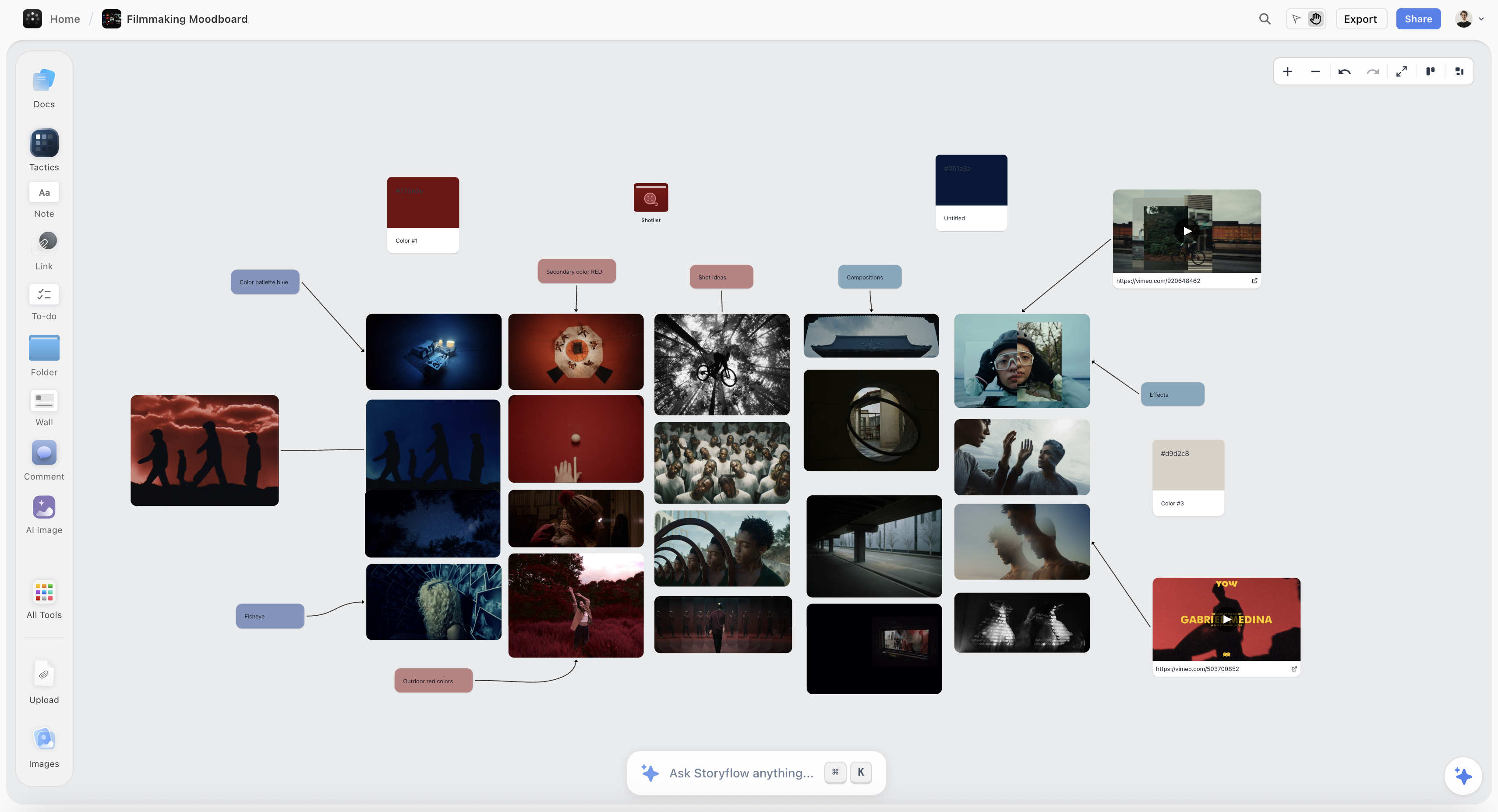
A director's treatment built on the Storyflow canvas, with the vision statement beside a curated wall of visual reference frames
Build your director's treatment on one canvas
The director's statement, the concept, and the wall of reference frames live in one place, you can grab a still from a YouTube or Vimeo reference straight onto the board, and the AI reads the whole canvas so it can sharpen the vision, before you design the final PDF in InDesign or Canva to deliver.

How to Write a Director's Treatment, Step by Step
Here is the full method, from a brief in your inbox to a treatment you can send. It assumes a single commercial or music-video job at the bid stage, with a short deadline and direct competition. Write the sections in this order, because the vision has to come first and every craft section after it exists to make the vision credible.
Step 1: Interrogate the brief and find your angle
Before you write a word, read the brief three times and find the angle no other director will take. The brief tells you the product or the track, the audience, the budget range, the deadline, and usually a strategy line the agency has already sold to the client. Your job is not to restate it; it is to find the one idea inside it that is both true to the brief and unmistakably yours. Ask what the brand is really afraid of, what the artist is really saying, what the obvious version of this film looks like so you can avoid it. The directors who lose bids answer the brief literally. The directors who win find the angle that makes the client think, we did not know we wanted that, but we do. Everything else in the treatment is built to sell that one angle, so do not start writing until you have it.
Step 2: Write the director's statement
Now write the director's statement, the opening section where you say how you see the film in your own voice. This is the single most important part of the treatment, because it is where the client hears you think, and it is almost always what they remember. Do not describe the shoot; describe the film's soul: the feeling you are chasing, the idea underneath the idea, the reason this film should exist the way you see it. Write it in the first person, keep it short and confident, and make it specific to this brief, not a paragraph you could paste into any pitch. A great statement makes the client feel that you already care about their film more than the competition does. I write the statement first as a rough burst, then rewrite it last once the visual world has taught me what the film actually is, because the vision usually sharpens as you build it.
Step 3: Lock the concept and the narrative
With the vision set, describe what actually happens on screen. For a commercial, this is the concept: the situation, the turn, the payoff, and how the product lives inside it without the film feeling like an ad. For a music video, this is the through-line: the narrative, the performance framing, or the visual conceit that carries three or four minutes. Write it as a sequence the reader can watch in their head, not as a list of shots. The client needs to believe the idea holds for the full runtime and lands the brand message or the artist's intent. Keep it tight and visual, and make sure the concept is the natural expression of the vision from Step 2, not a separate idea bolted on. If the concept and the statement are pulling in different directions, the treatment reads as two films, and the client picks the director whose treatment read as one.
Step 4: Build the visual world and source references
Now make the client see the film by building its visual world out of real reference frames. This is the heart of a director's treatment and the reason it has to be image-heavy: you are proving your taste and showing a look the client can picture, not describing it in the abstract. Gather references from films, commercials, music videos, photography, and art that share the palette, the framing, the energy, or the texture you are after, then curate hard, because ten precise references beat forty loose ones. When a reference is a moving film, grab the exact frame that carries the feeling: in Storyflow you can pull a still from a YouTube or Vimeo reference straight onto the canvas and arrange it beside your writing. Caption each reference with what it is doing for your film, so the client reads your intent and does not think you are just copying the source. A treatment with a strong, curated reference world is the one the client keeps open.
Step 5: Define the tone and pacing
Tell the client how the film feels and how it moves. Tone is the emotional register: is this warm and human, sharp and comic, cinematic and epic, raw and intimate, hyper-real and stylised. Pacing is the rhythm: fast cutting driven by the track, long held takes that let a moment breathe, a build from stillness to chaos. Be specific and sensory, because tone is where two directors with the same concept produce completely different films, and it is often what makes a client feel that yours is right for their brand or their artist. Name the feeling you want the viewer to leave with, then describe how the edit rhythm and the shooting style deliver it. For a music video especially, tie the pacing to the structure of the track, because a client can hear whether you actually listened to the song.
Step 6: Cast the world with casting, wardrobe, and production design
Show the client the texture of the world through the people and things in it. Describe the casting feel: the kind of faces and energy you want, real people or actors, the specific human quality that fits the film. Describe the wardrobe and styling direction, the production design, the locations, and the palette they create together, because these choices are where taste level becomes visible and where a brand decides whether your film will look premium or cheap. You do not need final casting or locked locations at the bid stage; you need a clear, confident point of view on the world's look, backed by references. This section quietly answers the marketer's biggest fear, that the film will look off-brand, so make the taste unmistakable and the world feel like a place the brand or the artist belongs.
Step 7: Describe the cinematography approach
Now get concrete about the camera, because this is where a director proves the vision is shootable. Describe the format and the look: the camera and lens feel, anamorphic or spherical, the aspect ratio, film grain or clean digital, the lighting approach, and the movement, whether that is locked-off and composed, handheld and alive, or big and mechanised. Tie every choice back to the vision: you are not listing gear, you are showing that the look in Step 4 has a technical path. A producer reading the treatment is checking that your cinematography ambition fits the budget, so signal that you know the difference between a look you can afford and one you cannot. When the camera approach is specific and motivated, the client trusts that the beautiful frames in your references are frames you can actually shoot.
Step 8: Choose the music and sound
Address the audio, because it carries more of the film than directors admit. For a music video, the track is the spine, so show that your visual ideas are built on the structure and the feeling of the song, and mark where the film turns with the music. For a commercial, describe the music direction, the sound design, and the audio texture you are chasing, because the right track or the right silence is often what makes a spot feel premium. Reference tracks or artists to communicate the feel, and be clear about how sound and picture work together rather than treating audio as an afterthought. A treatment that has clearly thought about sound reads as a complete film, and clients feel the difference even when they cannot name it.
Step 9: Make the why-you-for-this-brief case
Close by connecting your voice and your track record to this exact job. This is not a generic bio; it is the argument that of all the directors bidding, you are the one this brief was waiting for. Lead with the work and the reasons that matter here: relevant films, a look you own, a personal connection to the subject, the song, or the brand's world. If you have made films with this energy before, point to them. If this is a stretch, make the case that your voice is exactly what the brief needs, and let the vision do the reassuring. Keep it about the film, not your whole reel, because the client is deciding whether your specific taste is the safe and exciting choice for their specific film. The strongest close makes choosing you feel like the obvious decision.
Step 10: Build the vision on a board, then design the final PDF
Do not write these sections in isolation, because a director's treatment is strongest when the writing and the references develop together: the visual world sharpens the statement, the references reveal the tone, the casting feel changes the concept. This is why I build treatments on one infinite canvas in Storyflow, with the director's statement and the concept beside a wall of reference frames, grabbing stills from YouTube and Vimeo references straight onto the board, while the AI reads the whole canvas so it can help me tighten the statement against the visuals or find the through-line I am missing. When the vision is built and arranged, I make a deliberate move to the delivery format and design the final treatment as a polished, image-heavy PDF in InDesign or Canva. Build where you can see the whole film; deliver where the page can be designed. Storyflow is the build-and-arrange stage, not the print-layout stage, and keeping those two jobs separate is how the treatment ends up both well-argued and beautifully designed.
When to design the final treatment as a PDF
Here is the honest part, because the tool you build the vision in and the tool you design the delivery in are not the same choice, and a director's treatment gets this backwards more often than a documentary one.
A director's treatment almost always has to be delivered as a designed, image-heavy PDF. Unlike a documentary treatment, which can be a plain, well-argued text because the funder is buying the story, a director's treatment is partly a demonstration of taste, so the layout matters. Frames laid into the page, real typography, considered spacing, and a cover that sets the tone all tell the client that your film will be as considered as the document. This is page-design work, and it belongs in a design tool: InDesign if you or your producer have it, Canva if you want templates and speed. Do not send a competitive bid as a wall of text; in this world, a flat-looking treatment reads as a flat-looking film.
The mistake is trying to do the whole thing in the design tool from the start. InDesign and Canva are built to lay out finished pages, not to think, so if you start arranging the vision in them you end up fighting the layout while the idea is still forming. The workflow that actually works is: build and arrange the vision on a canvas where the writing and the references can move freely and the AI can read everything (Storyflow), lock the statement, the concept, the reference world, and the craft sections, then hand the arranged vision to InDesign or Canva and design the delivery. Build first, design second, and never let the page layout make decisions the vision should make.
Common director's treatment mistakes
- Answering the brief literally. Restating the strategy with competent visuals loses to the director who found an angle. Bring a point of view the client did not know they wanted.
- A weak or generic director's statement. If your opening could be pasted into any pitch, it says nothing. Make it specific, first-person, and about this exact film.
- Describing the look instead of showing it. "A cinematic, premium feel" tells the client nothing. Show a curated wall of real reference frames and caption what each one is doing.
- Uncurated references. Forty loose images read as indecision. Ten precise, captioned frames read as taste. Cut hard.
- Copying the reference instead of using it. References should show the quality you are after, not the film you are remaking. Caption them so the client reads your intent, not a plagiarism.
- Ignoring the track or the product. For a music video, not building on the song's structure is fatal; for a commercial, hiding the product is. Make the brief's core the film's core.
- All vision, no craft. A beautiful mood with no camera or production-design plan makes producers nervous. Prove the look is shootable on the budget.
- Delivering a wall of text. A competitive treatment that is not designed signals a film that will not be either. Design the final PDF in InDesign or Canva.
- Building the whole thing in the design tool. Laying out pages before the vision is set means fighting the layout while you think. Build the vision first, design last.
The Bottom Line
A director's treatment is not a plan for the shoot. It is the reason you get the shoot, a competitive pitch judged on vision and look against other directors chasing the same brief. Find the angle no one else will take, write a director's statement that makes the client hear you think, build a visual world out of curated reference frames, define the tone and pacing, show the casting and design taste, name a cinematography approach the vision can afford, choose the music and sound, and close with why you are right for this exact job. Sell one strong vision, back it with craft, and the client picks your film over the competent version next to it.
The honest boundary holds, and for a director's treatment it matters more than for a documentary one. Build and arrange the vision where you can see the whole film at once, the statement beside the concept beside the reference wall, with AI that reads the board, then design and deliver the final treatment as a polished, image-heavy PDF in InDesign or Canva. The tool where you build the vision and the tool where you design the page are two different choices, and the director who wins makes both on purpose.
If your treatment is still an idea and a folder of references rather than an arranged vision a client can see, build the vision on one canvas in Storyflow and turn the brief into the film only you can make.
FAQ: Director's Treatments
What is a director's treatment?
A director's treatment is a visual pitch document a director sends to win a specific commercial or music-video job in a competitive bid. It presents the director's vision for the film: a director's statement, the concept or narrative, the visual world built from reference frames, the tone and pacing, the casting, wardrobe, and production-design feel, the cinematography approach, the music and sound, and the case for why this director is right for the brief. It is usually delivered as a designed, image-heavy PDF, because the client is buying the director's taste as much as the idea. Unlike a shooting plan, which organises a production you have already been hired for, a treatment is what gets you hired in the first place, judged against the other directors bidding on the same brief.
How is a director's treatment different from a documentary treatment?
They share a name and almost nothing else. A documentary treatment sells a film's story to funders and commissioners, usually over months, and it is judged on story, characters, access, and importance, so it can succeed as a plain, well-argued text. A director's treatment is a competitive pitch for a commercial or a music video, made in days, judged mostly on vision and look, and delivered as a designed, image-heavy PDF that has to beat other directors chasing the same job. One is a slow argument that a story deserves funding; the other is a fast demonstration that your version of a brief is the one to make. If you are pitching a documentary to a fund, read our guide on how to write a documentary treatment instead; this guide is for winning a commercial or music-video bid.
How long should a director's treatment be?
Most director's treatments run from six to twenty pages as a designed PDF, and the right length depends on the budget and the brief. A smaller job or a fast turnaround can win on six to ten tightly designed pages: statement, concept, a strong reference world, tone, and the craft essentials. A big-budget commercial or a high-profile music video often calls for a fuller treatment with detailed sections on cinematography, production design, and casting, plus a richer reference world. Length is never the point; density of vision is. A short treatment with a sharp angle and a curated look beats a long one that pads a generic idea. Match the ambition of the document to the ambition and budget of the job, and cut anything that does not sell the vision.
How do you source and arrange visual references for a treatment?
Start wide, then curate hard. Pull references from films, commercials, music videos, photography, and art that share the palette, framing, energy, or texture you want, using sources like Pinterest and Vimeo for the first sweep. When a reference is a moving image, grab the exact frame that carries the feeling rather than a whole clip, so the client sees precisely what you mean. Then arrange the references beside your writing so the visual world and the concept read together: in Storyflow you can pull a still from a YouTube or Vimeo reference straight onto the infinite canvas and build the reference wall next to the director's statement. Caption each reference with what it contributes, cut to the strongest ten or so per idea, and design the curated set into the final PDF.
Can AI help write a director's treatment?
Yes, for sharpening the writing and pressure-testing the vision, not for supplying the taste. AI is useful for drafting a first pass of the director's statement, tightening the concept, checking that the tone reads consistently, and spotting where the vision and the references pull apart. Because Storyflow's AI reads your full canvas board, plus up to 1 Tactic and 3 Documents you @-mention, it works from your actual references, statement, and notes rather than generic prompts, so its help is specific to this film. On Pro and Max, Storyflow can also generate images, which is useful for visualising a frame you cannot find in references. What AI cannot do is find the angle, own the look, or supply the authored voice a client is choosing between, and a treatment that reads as generated will lose the bid. Use AI to draft and refine, and bring the vision yourself.
What wins a competitive director's bid?
The clearest, most exciting, most ownable version of the brief, delivered in a treatment that looks as considered as the film. Clients read the bidding treatments side by side and pick the one that makes them feel something and feel safe at the same time: a bold, specific vision in the director's statement, a concept that lands the brand message or the artist's intent, a curated reference world that proves your taste, and enough craft detail that the beautiful frames read as shootable on the budget. The directors who win are rarely the ones with the biggest reel; they are the ones whose treatment found an angle the client did not expect and made it feel inevitable. Sell one strong vision, back it with craft, and design the delivery so the document itself demonstrates the quality you are promising.
Is Storyflow free for building a director's treatment?
Not during early access. Storyflow's Free plan, which launches before the end of 2026, will include unlimited objects and boards, unlimited collaboration, basic AI, and 20 file uploads, which covers building a full treatment: the director's statement, the concept, and a wall of reference frames on one canvas. Paid tiers start at Plus for $7.99/month billed annually ($9.99 monthly), which adds the 200+ Story Blueprints and unlimited file uploads, with Pro at $14/month and Max at $39/month for more AI and, on Pro and Max, AI image generation. There is no separate Team plan; Max is the team tier. Once it launches, the Free plan will genuinely run the whole build-and-arrange method, so you'll be able to develop the vision and share the board with your producer, then design the final PDF in InDesign or Canva. Storyflow builds and arranges the vision; the print-ready page design happens in a design tool.
Table of Contents
- Why the director's treatment wins the job
- The anatomy of a director's treatment
- Quick Picks: where to build a director's treatment
- Comparison Table: Where to Build a Director's Treatment
- How to Write a Director's Treatment, Step by Step
- When to design the final treatment as a PDF
- Common director's treatment mistakes
- The Bottom Line
- Author
- FAQ: Director's Treatments
- Related Reading
Templates to check out for this topic


Story and writing templates you can use in Storyflow
Start your next script, novel, or world from a ready-made Storyflow board instead of an empty page. The AI reads the whole canvas, so every suggestion is grounded in your story.


See Storyflow in Action
A visual AI workspace where every feature lives inside one canvas. No tab-switching, no context lost.
Build your entire board from a single message
Type what you need in the AI chat at the bottom of your canvas. The AI adds cards, headings, and structure directly onto your board.
Use expert frameworks as AI context
Type @ in the AI chat and choose any Tactic. The AI tailors every response to that framework instead of giving generic advice.
Turn your board into a mind map in seconds
Ask the AI to restructure your canvas as a mindmap. It connects your ideas into a visual hierarchy so you can see how everything relates.
Why Storyflow Exists
Storyflow actually began as a personal tool while working on creative and research projects.
We kept running into the same problem: ideas were scattered everywhere: notes, documents, and whiteboards.
Nothing helped us see how everything connected.
So we started building a workspace designed around how ideas actually grow.
→ Read how Storyflow was createdJustkay
Documentary Filmmaker & Founder at Storyflow
Published: 2026-07-22
Extremely simple, seriously capable


See how easy it is to get started
Watch a real project come together, from a blank board to a finished plan, clicked through step by step.
Start creating with AI and become more productive
Transform your creative workflow with AI-powered tools. Generate ideas, create content, and boost your productivity in minutes instead of hours.