How to Storyboard a Commercial: A Step-by-Step Guide (2026)
How to storyboard a commercial in 2026, step by step. Nail the message and CTA, board each frame with copy and VO, and plan cut-downs for 30s, 15s, and 6s.

Category
Filmmaking
Author

Justkay
Documentary Filmmaker & Founder at Storyflow
Topics
2026-06-18
•
Updated June 18, 2026
•
12 min read
•
Filmmaking- how to storyboard a commercial
- how to storyboard an ad
- commercial storyboard
- advertisement storyboard
- storyboard a 30 second spot
- commercial pre-production
How do you storyboard a commercial?
Start from the sale: nail the single message and CTA, break the spot into beats (hook, problem, product, payoff, brand beat, CTA), and board the hero shot first. Give each frame four layers (picture, on-screen text, VO, timing), plan 30s/15s/6s cut-downs and 9:16 reframes, then get client sign-off before you shoot.
Storyboard the spot from the script, on one canvas
Storyflow drafts frames from your commercial script and keeps the client references beside them, so the board you present and the board you shoot stay in sync.

1) Quick Answer: How to Storyboard a Commercial
To storyboard a commercial, start from the one thing the spot must sell, then work backward into frames. Nail the single message and the call to action first. Break the spot into beats: a hook, a problem, the product, the payoff, and the CTA. Define the hero shot of the product before anything else, because that frame is the reason the commercial exists. Then board each frame with the picture, the on-screen text, the voiceover line, and the timing. Plan your cut-downs from the start, because a 30-second spot almost always needs a 15-second and a 6-second version, and a 16:9 board almost always needs a 9:16 one. Annotate for the editor and the client. Review every frame against the brief, then share the board for client approval before a camera turns on.
What you end up with: a client-approved board covering the 30, the 15, and the 6, in both aspect ratios, with copy and VO mapped to every frame. For a typical spot with a locked brief and script, the boarding itself is a focused afternoon of work (3 to 4 hours), not a week.
A commercial storyboard does not show a story. It sells one. Every frame either moves the viewer one step closer to the product, or it is cut. That single rule is what separates a commercial board from a film board.
I have run multiple documentary and branded projects from research through pre-production, and the boards that survived client review were never the prettiest. They were the ones where every frame had a job tied to the brief. This guide walks the exact process for boarding a spot that sells, the copy and VO layer most film storyboards skip, and the cut-down planning that saves you from reboarding the same idea four times.
2) Why a Commercial Storyboard Is Different
If you have storyboarded a short film, you know the basic mechanics: one panel per shot, a caption for the camera, panels in sequence. A commercial storyboard uses the same tools and almost none of the same priorities. Treating a spot like a tiny film is the fastest way to make a beautiful board that fails its one job.
Here is what actually changes.
It is built to sell, not to narrate. A film storyboard serves the story. A commercial storyboard serves the brief, and the brief is a sales objective: drive sign-ups, shift perception, launch a product, move stock. A gorgeous establishing shot that does not move the viewer toward the product is not a strong opening. It is wasted runtime. A commercial storyboard does not show a story. It sells one.
The runtime is brutal. A short film breathes across minutes. A commercial has 30 seconds, often 15, sometimes 6. At 6 seconds you have room for roughly one idea and one frame of product. The storyboard is where you discover that your clever three-act concept does not fit, while changing it still costs a pencil line instead of a shoot day. Short runtime is not a constraint you work around. It is the constraint you design from.
The product is the hero. In most commercials there is one frame the entire spot is built to deliver: the product, clearly seen, at its most desirable. The hero shot. In a film, the protagonist earns the close-up over an arc. In a commercial, the product gets its close-up because that is the point. You board the hero shot first and let the rest of the spot lead the viewer to it.
There is a brand beat. Somewhere in the spot, usually near the end, the brand asserts itself: the logo, the tagline, the brand colors, the sonic logo. This is non-negotiable and it is in the brief. The storyboard has to reserve runtime for the brand beat, because a spot that runs out of seconds before the logo lands has failed the client no matter how good the middle was.
It ends on a call to action. A film ends on a feeling. A commercial ends on an instruction: visit the site, download the app, use the code, buy now. The CTA is the most important frame after the hero shot, and the board has to make it unmissable. If a viewer cannot tell you what to do after watching, the spot did not work.
It ships in many versions. This is the difference that catches first-time commercial directors off guard. One concept becomes a 30, a 15, and a 6. It becomes a 16:9 for connected TV and YouTube, a 9:16 for TikTok and Reels and Stories, sometimes a 1:1 for feeds. A film storyboard plans one deliverable. A commercial storyboard plans a family of them, and the smart ones plan that family from the first frame instead of reboarding the idea once per format.
It is not that the film techniques fail. It is that the commercial adds four jobs (sell, hit the brand beat, land the CTA, ship multiple cut-downs) that a film board never has to carry. The rest of this guide is about carrying them well.
3) What You Need Before You Start
A commercial storyboard is the visual translation of a strategy, not the start of one. If the strategy does not exist, you are not storyboarding, you are guessing at a spot the client never approved, and the client review will be brutal. Gather three things before you draw a single frame.
The brief. The creative brief is the contract for the whole spot. It names the objective (what the commercial must achieve), the audience (who it speaks to), the single most important message, the mandatories (logo placement, legal lines, brand colors, must-include claims), the deliverables (which cut-downs and aspect ratios), and the runtime. Every frame you board will be checked against this document. If the brief is vague, the board will be vague, and the revisions will be endless. A clear brief is the cheapest insurance a commercial has. If you are writing or sharpening one, see the creative brief guide linked below.
The script. For most spots this is short: a few lines of voiceover or dialogue, the on-screen text, and the CTA copy, mapped to a rough timeline. The script tells you what the audience hears while they watch. You board the picture, but the picture has to land in sync with the words, so you need the words first. A 30-second spot script is usually 60 to 75 words of VO at a natural pace, which is a hard ceiling worth knowing before you board around it.
The offer and the CTA. Be specific about what you are asking the viewer to do and what they get for doing it. "Visit the site" is weaker than "Get 20% off your first order at the site." The offer shapes the final third of the spot and the CTA frame, so lock it before boarding. A storyboard built around a placeholder offer gets reboarded the moment the real offer arrives.
The relationship to hold in your head: the brief is the why and the what, the script is what they hear, and the storyboard is what they see, timed to both. When all three live in one place, a brief change updates the board and the board updates the cut-downs. When they live in three separate apps, a late change to the offer silently breaks the CTA frame and you find out in client review. Keep them connected.
4) How to Storyboard a Commercial Step by Step
Here is the eight-step process, from an approved brief to a board a client can sign off and a crew can shoot. The steps are sequential, but steps three through six loop: you will board, annotate, reorder, and rework until the spot reads cleanly in every cut-down.
Step 1: Nail the single message and the CTA
Before any frame, write two sentences. The first is the one thing the viewer must take away. The second is the one thing you want them to do. If you cannot state the message in a sentence, the spot does not have one yet, and no amount of beautiful boarding will fix that. A film can hold three themes. A 15-second spot can hold one. Pin the message and the CTA at the top of the board so every frame you add can be checked against them.
Step 2: Break the spot into beats
Turn the runtime into beats, not shots yet. A standard 30-second structure runs: hook (grab attention in the first 2 to 3 seconds), problem (why the viewer should care), product (the hero shot), payoff (the benefit), brand beat (logo and tagline), and CTA (the instruction). The order can flex, but naming the beats first stops you from boarding a pretty hook with no room left for the product. Assign rough seconds to each beat so the runtime is spoken for before you draw.
Step 3: Define the hero shot first
Board the product frame before anything else. Decide exactly how the product is seen at its most desirable: the angle, the lighting mood, the context, whether a hand holds it or it stands alone. This frame is the reason the commercial exists, so it gets designed, not discovered. Once the hero shot is locked, the beats before it become a runway that builds desire toward it, and the beats after it become the payoff and the ask. Boarding the hero shot first is the single highest-leverage move in commercial storyboarding.
Step 4: Board each frame with picture, copy, VO, and timing
Now draw the beats as panels, and give every panel four layers, not one. The picture (what the camera sees, drawn clearly, not beautifully). The on-screen text (the words that appear in frame, exactly as they will read). The voiceover or dialogue (the line that plays under the frame). And the timing (how many seconds this frame holds, running as a clock down the board). A film panel needs a drawing and a camera note. A commercial panel needs all four, because all four have to land together inside a runtime measured in seconds.
Step 5: Plan the cut-downs and aspect ratios
Before you finalize, plan the family. From the 30-second master, mark which frames survive into the 15 (usually the hook, the hero shot, the brand beat, and the CTA) and which survive into the 6 (usually just the hero shot and the CTA with a fast brand beat). Then plan the aspect ratios: board the 16:9 master, and for every frame, note how it reframes to 9:16 and 1:1. A wide hero shot that sings in 16:9 can lose the product entirely in a 9:16 crop, so the safe-area planning happens now, on the board, not on set. Planning the cut-downs at boarding time is what saves you from reboarding the same idea four times.
Step 6: Annotate for the editor and the client
A commercial board serves two audiences the film board does not: the editor and the client. For the editor, annotate the transitions (cut, dissolve, match cut), the pacing, the music or sonic cue, and the super timing. For the client, make the board legible to a non-filmmaker: label the beats, show the CTA clearly, and make the brand beat unmissable. A frame a crew can shoot but a client cannot read will not get approved, and an unapproved board does not get made.
Step 7: Review every frame against the brief
Put the brief beside the finished board and check each frame for its job. Does the hook earn the next 2 seconds? Does the spot reach the product before the viewer's attention is gone? Is the single message clear without the VO, in case the spot plays muted (most social spots do)? Is the brand beat present and on-brand? Is the CTA unmissable? Are the mandatories (legal lines, logo, claims) on the board? A frame that does not serve the brief is cut, no matter how good it looks. This is the editorial discipline that separates a spot that sells from a reel that wins design awards and moves nothing.
Step 8: Share the board for client approval
The commercial storyboard exists to get a yes before the money is spent. Share it with the client, the brand team, and the agency producer. The board is the cheapest place to discover that the client hates the hook, the legal team needs a disclaimer, or the brand wants the logo three seconds earlier. Collect the notes, version the board, and get sign-off in writing. A film board reviewed by the director is a plan. A commercial board approved by the client is a green light. Do not shoot without it.
That is the loop. Message and CTA, beats, hero shot, four-layer frames, cut-downs, annotation, brief review, client sign-off. The fastest way to blow a commercial budget is to skip step three and step five, because the hero shot is the reason the spot exists and the cut-down planning is what stops you from boarding the same idea once per format.
Board your next spot beside the brief.
Put the message, the beats, the hero shot, and the cut-down plan on one canvas the AI can read, so the board never drifts from the brief it answers to.
5) A Worked Example: A 30-Second Spot
Take a fictional brief: a meal-kit brand wants a 30-second spot to drive first-order sign-ups, targeting busy parents, with the single message "dinner solved in 20 minutes" and the CTA "get 50% off your first box." Mandatories: logo and tagline in the last 4 seconds, legal line on the offer, brand green throughout. Deliverables: 30s, 15s, and 6s, in 16:9 and 9:16. Here is how that boards.
Beat the spot first. Hook (0 to 3s): a parent staring into an empty fridge at 6pm, kid asking what's for dinner. Problem (3 to 8s): the familiar scramble, takeout menus, the sigh. Product (8 to 18s): the meal-kit box opens, fresh ingredients laid out, a 20-minute timer. This stretch holds the hero shot. Payoff (18 to 24s): the family eating together, relaxed. Brand beat (24 to 27s): logo, tagline "dinner solved." CTA (27 to 30s): "Get 50% off your first box," offer code, legal line.
Design the hero shot. The hero is not the box on a doorstep. It is the box open on the counter, fresh ingredients arranged, the brand green catching the light, a hand reaching in. That frame gets the best light and the cleanest composition, and it lands at the 12-second mark, the gravitational center of the spot.
Board the four layers per frame. Take the product beat. Picture: the open box, ingredients arrayed, the 20-minute timer visible. On-screen text: "20 minutes. Real ingredients." VO: "Everything you need. Nothing you don't." Timing: 4 seconds across two frames. Every panel carries that stack, so the editor and client read picture, supers, audio, and clock at a glance.
Plan the cut-downs now. The 15 keeps the empty-fridge hook, the hero box shot, the payoff, the brand beat, and the CTA, cutting the problem beat and half the payoff. The 6 keeps a 1-second fridge hook, the hero shot, a fast brand beat, and the CTA. The message has to survive at 6 seconds with the sound off, so the on-screen text "Dinner solved. 50% off" carries it without VO. For 9:16, the wide hero shot of the full counter loses the ingredients, so the vertical board reframes to a tighter, taller composition with the box and the reaching hand stacked, ingredients in the lower third. You note that reframe now, so the shoot captures both compositions in one setup.
This is the whole point of boarding a commercial properly. By the time the board is approved, you know the spot works at 30, 15, and 6 seconds, in two aspect ratios, with the sound on and off, and the client has signed every frame. The shoot becomes execution, not discovery.
6) Common Commercial Storyboard Mistakes
Most commercial boards fail in predictable ways. Here are the ones I see most, and what to do instead.
Burying the product. The most common and most expensive mistake. The board spends 15 seconds on a clever narrative and reaches the product with 5 seconds left. In a spot built to sell, the product cannot be an afterthought. Board the hero shot first and make sure the viewer reaches it before their attention is gone, which on social is roughly the 3-second mark.
Forgetting the spot plays muted. Most social video autoplays silent. A board that depends on the VO to carry the message will fail for the majority of viewers. The single message has to be legible from the picture and the on-screen text alone. Check every board for the muted read. If the spot does not sell with the sound off, the board is not finished.
Boarding for 30 and hoping the 15 falls out. It does not. A 15 is not a 30 with the boring parts trimmed, it is a different edit with its own beats. If you do not plan the cut-downs on the board, you discover in the edit that the 15 has no room for the hook, and you reboard under deadline. Mark the cut-downs at boarding time.
Ignoring the aspect ratio until the shoot. A 16:9 hero shot can lose the product entirely in a 9:16 crop. Directors who do not plan the vertical reframe on the board end up with footage that cannot be cut vertically, and the client wanted 9:16. Note the reframe per frame so the shoot captures both.
Skipping the brand beat or the CTA. A spot that runs out of seconds before the logo and the CTA has failed the brief, full stop. Reserve the runtime for the brand beat and the CTA before you fill the middle. These two frames are non-negotiable, so they get their seconds first.
Treating it as an art project. A commercial board is judged on whether it sells and whether the client approves it, not on whether the drawing is good. Hours spent rendering a beautiful panel are hours not spent making sure the message lands in 6 seconds with the sound off. Stick figures with clear supers and timing beat gorgeous panels with no copy layer.
Boarding without the brief in view. When the board drifts from the brief, every frame is a guess at what the client wants, and client review becomes a teardown. Keep the brief beside the board and check each frame against the objective, the mandatories, and the message as you go.
7) Tools for Storyboarding a Commercial
You can storyboard a commercial with pen and index cards, and for a quick internal concept that is genuinely fine. Paper is fast, free, and has no learning curve. The limit of paper for commercial work is real, though: a spot is not just frames. It is frames plus the copy, plus the VO, plus the timing, plus three cut-downs, plus two aspect ratios, plus the client approval loop. Paper does not connect any of that, so the brief sits in one place, the script in another, and the cut-down plan in your head.
Dedicated storyboard apps such as Boords and StoryboardThat are purpose-built for the drawing-and-sequencing part, and for client-facing animatics they are genuinely strong. Boords in particular handles shareable boards, frame-by-frame timing, and client-review workflows with comment threads, which is exactly what a commercial approval cycle needs. If your priority is a polished animatic with per-frame timing to walk a brand client through, a dedicated storyboard tool is the honest right choice, and you should use one.
But a commercial board is rarely the only thing you are planning. It sits next to the brief, the script, the offer, the channel plan, and the cut-down matrix. This is where a visual canvas changes the work.

Storyflow is an AI-powered visual creative workspace built on an infinite canvas. For storyboarding a commercial, that means the brief, the frames, the on-screen copy, the VO lines, the timing, and the cut-down plan all live on one board instead of scattered across separate apps. You place frame cards in sequence, drop the brief and the script beside them, write the supers and the VO as structured notes under each frame, and lay out the 30, the 15, and the 6 as parallel rows on the same canvas. When the offer changes in the brief, the gap shows up against the CTA frame immediately, because the brief and the board share one surface.
The part that matters most for a spot built to sell: Storyflow's AI reads your full active canvas board, plus up to one Tactic and up to three @-mentioned Documents. So the AI sees the brief, the frames, and the copy together. You can ask it to check whether the single message survives the 6-second cut, draft on-screen text variants for a frame, or flag a beat that reaches the product too late, and it answers from your actual brief rather than from a blank prompt. The 200+ Story Blueprints library includes the AIDA framework (attention, interest, desire, action), which maps almost directly onto a commercial's beats, so you can structure the spot around a proven persuasion model instead of guessing at the order.
Honest caveats, because not every tool wins everywhere. First, if your deliverable is a polished, frame-timed animatic to present to a brand client, Boords and StoryboardThat are more purpose-built for that output than Storyflow is, and you should pair or switch for the final animatic. Second, AI image generation in Storyflow (which can rough out storyboard frames) is a Pro-plan feature and up, so the AI-assisted frame creation is not on the Free tier. Storyflow is the canvas where the brief, the frames, the copy, and the cut-downs connect and where the AI reads the whole spot, not a dedicated animatic studio.
Pricing is straightforward and flat per account, not per seat. The Free plan is free from late 2026: unlimited notes, images, and links, unlimited shared boards, basic AI, 20 file uploads, and unlimited collaboration, which is enough to board and share a real spot. Plus is $7.99/mo annual ($9.99 monthly) and adds the 200+ Story Blueprints (including AIDA), and unlimited uploads. Pro is $14/mo annual ($19 monthly) and adds AI image generation for roughing out frames. Max is $39/mo annual ($49 monthly) and adds a team workspace with roles and permissions for agency teams.
If you are planning a spot and the board keeps drifting out of sync with the brief and the cut-downs, build the next one on a canvas where all of it connects. Try the AI storyboard generator to turn your concept into frames in minutes, then open a Storyflow workspace to put your brief, frames, copy, and cut-downs on one board.
Storyflow Templates to Get You Started
You do not have to start from a blank board. These ready-made Storyflow templates cover the work in this guide, with the structure already in place and the AI ready to read it.
Storyboard Template
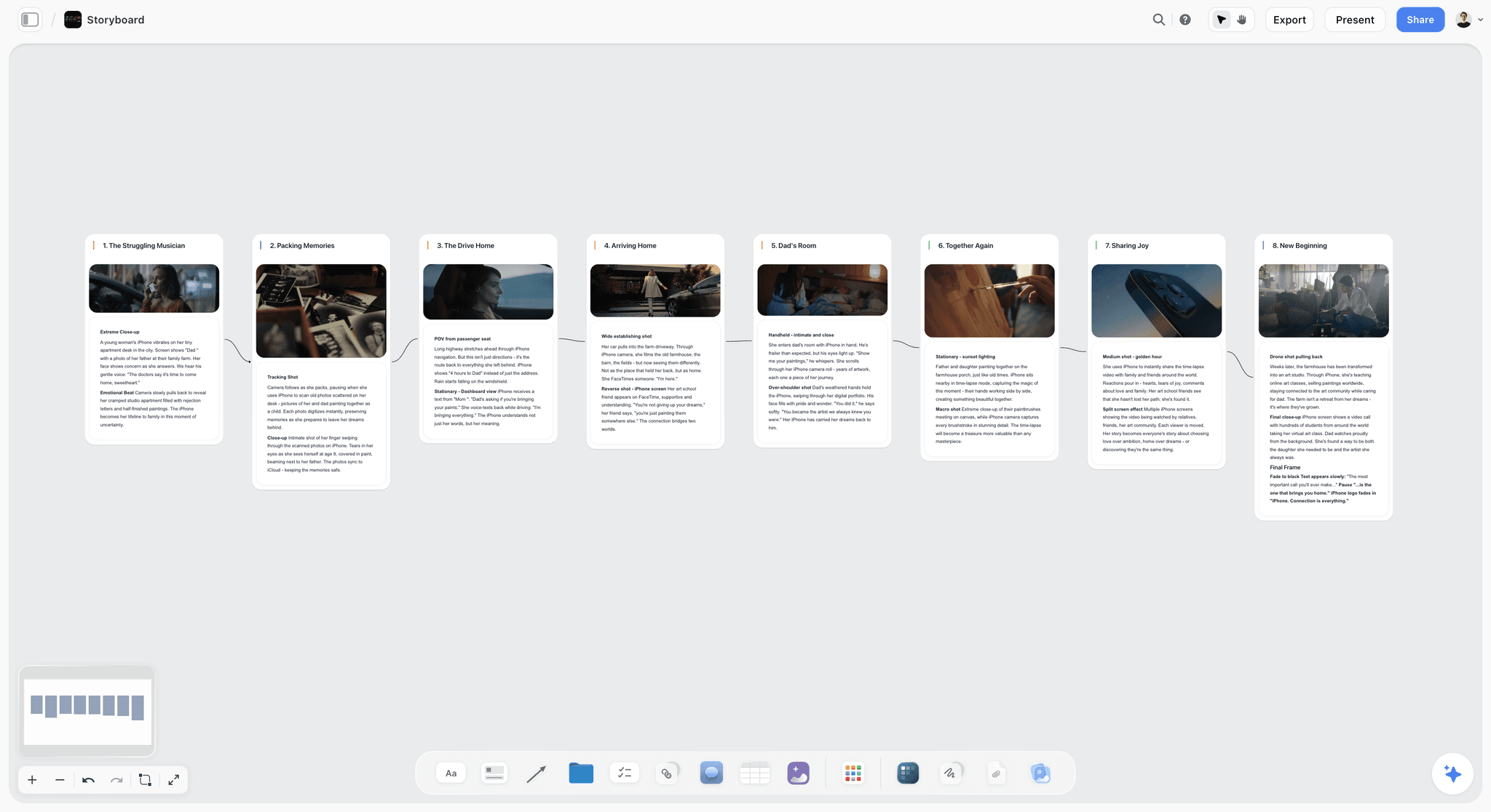
Plan a video or film shot by shot. The Storyboard template lays out frames, action captions, and shot notes on Storyflow's infinite canvas. Use the Storyboard template.
Commercial Shotlisting Template
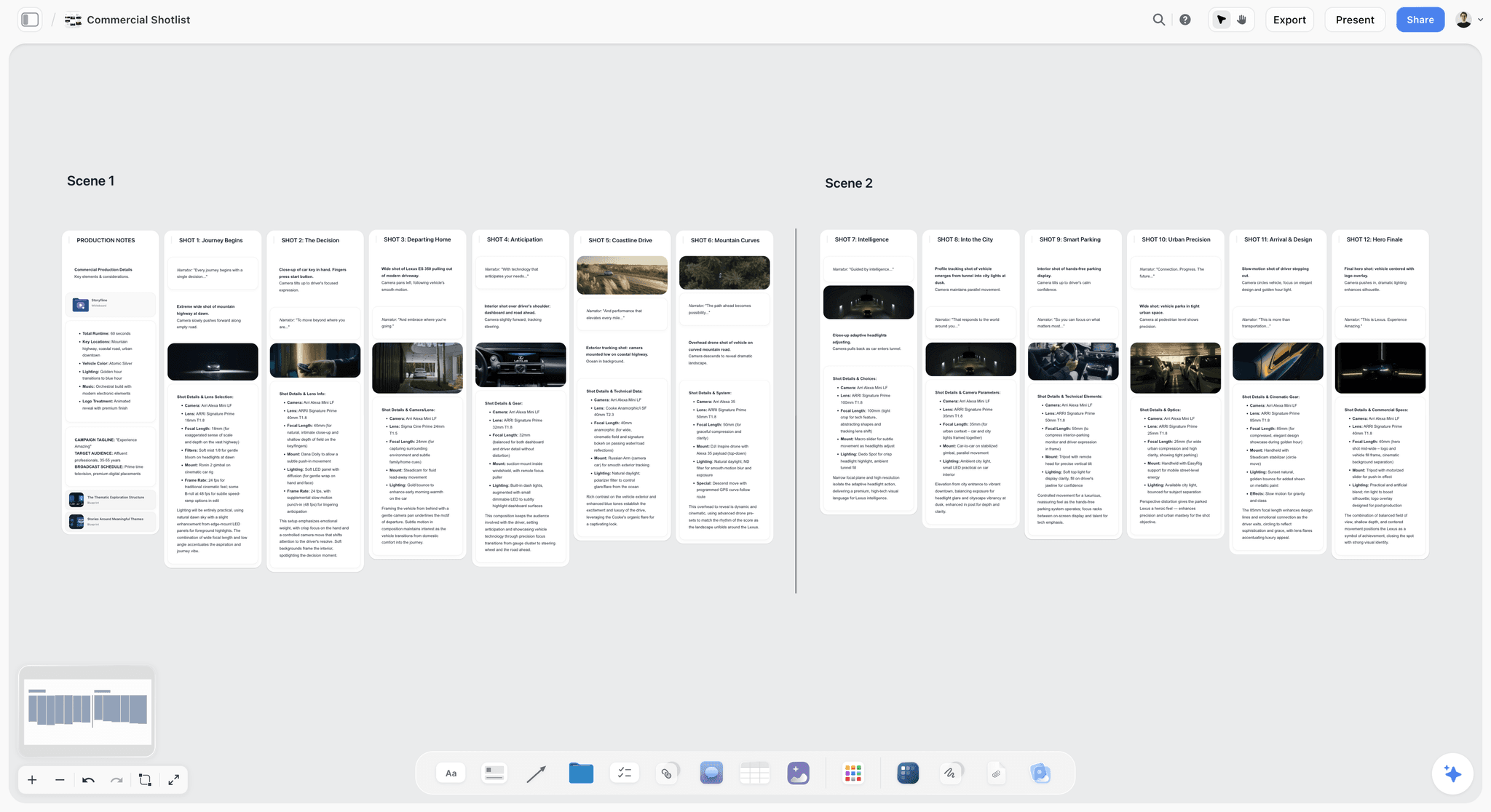
Plan every setup of a 15, 30, or 60 second ad spot on one canvas: shot list rows beside storyboard frames. Paid-only during early access, with a Free plan before the end of 2026. Use the Commercial Shotlisting template.
Commercial Moodboard Template
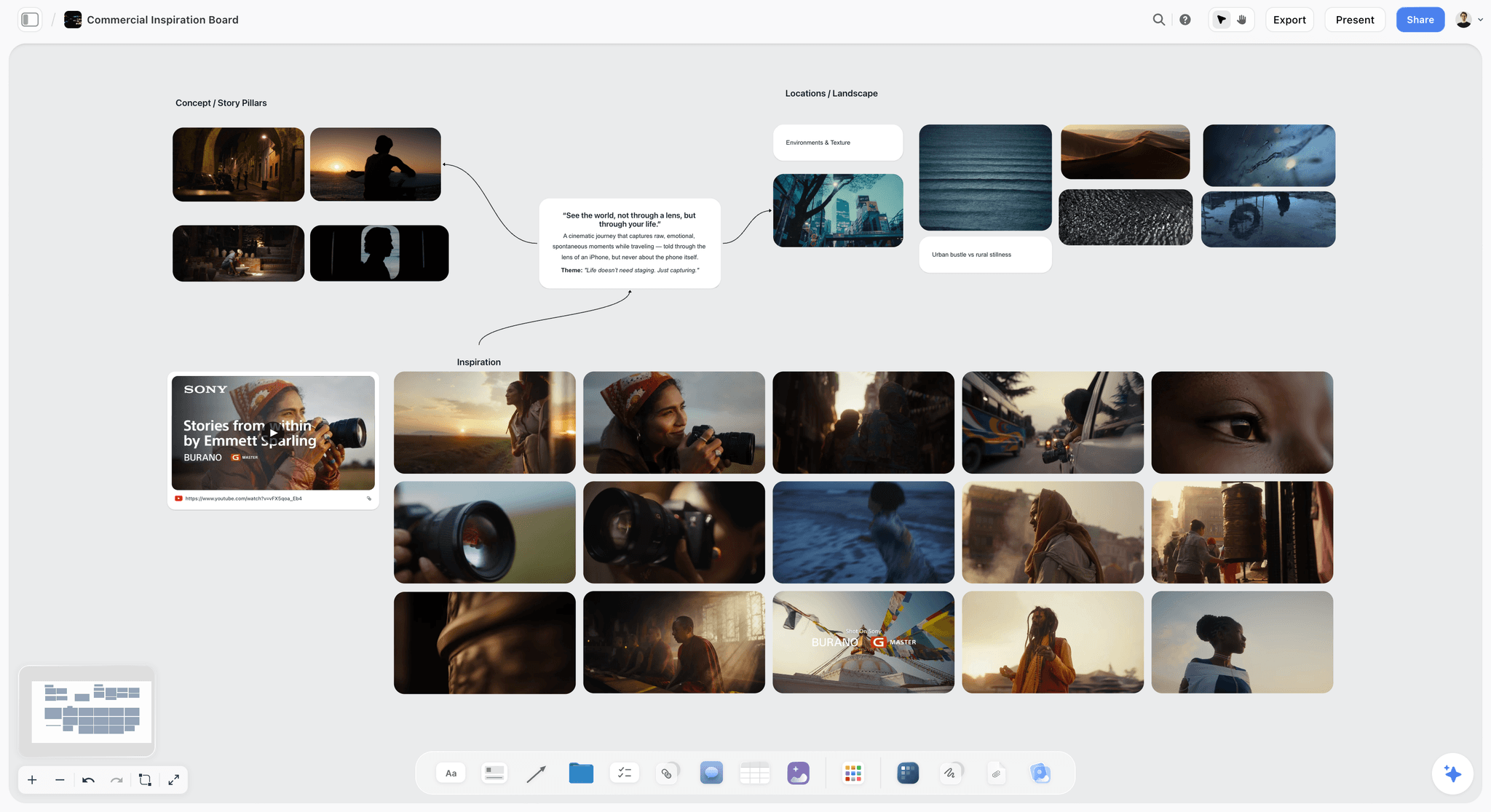
Build a commercial moodboard on an infinite canvas. Gather ad references, tone, lighting, and color, then pitch the look to your client. Use the Commercial Moodboard template.
9) The Bottom Line
Storyboarding a commercial is not a smaller version of storyboarding a film. It is a different job with a different goal: not to tell a story, but to sell one inside 30, 15, or 6 seconds, across two or three aspect ratios, for a client who has to approve every frame. Run the eight steps. Nail the single message and the CTA. Beat the spot. Design the hero shot first. Board each frame with picture, copy, VO, and timing. Plan the cut-downs and aspect ratios from the start. Annotate for the editor and the client. Review every frame against the brief. Get sign-off before you shoot.
A commercial storyboard does not show a story. It sells one. The roughest board where every frame has a job tied to the brief will protect a shoot budget and pass client review better than the most beautiful one that buries the product.
The board does not live alone. It sits beside the brief it answers to, the script it syncs with, and the cut-down family it has to ship, and when those drift apart across separate apps, the cost shows up in client review and in the edit. If you want the brief, the frames, the copy, and the cut-downs on one connected surface, with AI that reads the whole spot and helps you catch the beat that sells too late, build your next one on a visual canvas. Start a Storyflow workspace and plan the spot frame by frame in one place.
8) FAQ: How to Storyboard a Commercial
How do you storyboard a commercial?
Storyboard a commercial by starting from the sale, not the story. Write the single message and the CTA first. Break the runtime into beats: hook, problem, product, payoff, brand beat, CTA. Design the hero product shot before any other frame. Board each frame with four layers: the picture, the on-screen text, the voiceover line, and the timing in seconds. Plan the cut-downs and aspect ratios from the start. Annotate for the editor and the client, review every frame against the brief, then get client sign-off before you shoot.
What makes a commercial storyboard different from a film storyboard?
A commercial storyboard is built to sell, not to narrate. It works against a brief with a sales objective, inside a brutal runtime of 30, 15, or 6 seconds. It centers on a hero product shot, reserves runtime for a brand beat (logo and tagline), and ends on a call to action. It also ships in many versions: multiple cut-downs and aspect ratios from one concept. A film board plans one deliverable and serves the story. A commercial board plans a family of deliverables and serves the brief.
What is a hero shot in a commercial?
The hero shot is the frame the entire commercial is built to deliver: the product seen clearly, at its most desirable, with the best light and the cleanest composition. It is the desire frame, usually landing near the center of the spot. In commercial storyboarding you design the hero shot first and build the surrounding beats as a runway toward it. Everything before the hero shot builds want for the product, and everything after it delivers the payoff and the ask.
How do you plan cut-downs for a 30-second spot?
Board the 30-second master first, then mark which frames survive into the shorter versions. The 15 usually keeps the hook, the hero shot, the brand beat, and the CTA, cutting the problem beat and half the payoff. The 6 usually keeps just the hero shot and the CTA with a fast brand beat, and the message has to survive with the sound off via on-screen text. Plan all three at boarding time, because a 15 is a different edit with its own beats, not a trimmed 30.
What aspect ratios should a commercial storyboard cover?
Cover the aspect ratios in the brief's deliverables, which for a modern spot usually means 16:9 for connected TV and YouTube, 9:16 for TikTok, Reels, and Stories, and often 1:1 for feed placements. Board the 16:9 master, and for every frame note how it reframes to 9:16 and 1:1, because a wide composition can lose the product entirely in a vertical crop. Plan the safe area on the board so the shoot captures every needed composition in one setup.
How long should a 30-second commercial script be?
A 30-second commercial script is usually 60 to 75 words of voiceover at a natural, unhurried pace, plus the on-screen text and the CTA copy. Going much over that forces a rushed read that hurts the spot. Lock the script before you board, because the picture has to land in sync with the words, and you cannot time the frames without knowing how long the lines take. For a 15, expect roughly 30 to 40 words, and for a 6, often just the on-screen text and a short tag.
Where does the call to action go in a commercial?
The call to action goes at the end, in the final 3 to 4 seconds, usually right after or alongside the brand beat. It is the most important frame after the hero shot, and the board has to make it unmissable: clear on-screen text, the offer, and any code or URL. Because many viewers watch muted, the CTA must read without the voiceover. Reserve the runtime for the CTA before you fill the middle of the spot, so you never run out of seconds before the ask.
Do I need to draw well to storyboard a commercial?
No. A commercial storyboard is a planning and selling document, not an art piece. Stick figures, boxes, and arrows communicate a frame as clearly as polished art, and the copy, voiceover, and timing layers matter more than the drawing. The board is judged on whether it sells the message and whether the client approves it. A rough board with clear supers, a defined hero shot, and a sharp CTA beats a gallery of beautiful panels that bury the product.
How do you get client approval on a commercial storyboard?
Get client approval by making the board legible to a non-filmmaker and sharing it before you spend the budget. Label the beats, show the hero shot and CTA clearly, make the brand beat unmissable, and include the mandatories like legal lines. Share it with the client and the agency producer, collect their notes, version the board, and get sign-off in writing. The storyboard is the cheapest place to discover that the client hates the hook or legal needs a disclaimer, so resolve it there, not on set.
Can AI help storyboard a commercial?
Yes, AI helps with the parts of commercial storyboarding that are slow and repetitive, but the judgment stays human. AI-assisted tools can rough out frame visuals, draft on-screen text and voiceover variants, and check whether your single message survives a 6-second cut. In Storyflow, the AI reads your full canvas, so it can see the brief, the frames, and the copy together and flag a beat that reaches the product too late. The strategy, the hero shot, and the brand decisions are yours. The drafting and the consistency checks are where AI saves the hours.
Table of Contents
- Quick Answer: How to Storyboard a Commercial
- Why a Commercial Storyboard Is Different
- What You Need Before You Start
- How to Storyboard a Commercial Step by Step
- A Worked Example: A 30-Second Spot
- Common Commercial Storyboard Mistakes
- Tools for Storyboarding a Commercial
- FAQ: How to Storyboard a Commercial
- The Bottom Line
- Author
- Related Reading
Templates to check out for this topic


Filmmaking templates you can use in Storyflow
Skip the blank canvas. Open one of these filmmaking boards in Storyflow and the AI builds on the structure that is already there, from research through the shot list.


See Storyflow in Action
A visual AI workspace where every feature lives inside one canvas. No tab-switching, no context lost.
Build your entire board from a single message
Type what you need in the AI chat at the bottom of your canvas. The AI adds cards, headings, and structure directly onto your board.
Use expert frameworks as AI context
Type @ in the AI chat and choose any Tactic. The AI tailors every response to that framework instead of giving generic advice.
Turn your board into a mind map in seconds
Ask the AI to restructure your canvas as a mindmap. It connects your ideas into a visual hierarchy so you can see how everything relates.
Why Storyflow Exists
Storyflow actually began as a personal tool while working on creative and research projects.
We kept running into the same problem: ideas were scattered everywhere: notes, documents, and whiteboards.
Nothing helped us see how everything connected.
So we started building a workspace designed around how ideas actually grow.
→ Read how Storyflow was createdJustkay
Documentary Filmmaker & Founder at Storyflow
Published: 2026-06-18
Extremely simple, seriously capable


See how easy it is to get started
Watch a real project come together, from a blank board to a finished plan, clicked through step by step.
Start creating with AI and become more productive
Transform your creative workflow with AI-powered tools. Generate ideas, create content, and boost your productivity in minutes instead of hours.