10 Best Tools for Presenting Design Concepts to Clients in 2026 (Tested and Ranked)
The 10 best tools for presenting design concepts to clients in 2026, tested on real client work. Figma, Loom, Canva, Pitch, Milanote, Storyflow and more, compared on the room, the inbox, and the record.

Category
Design
Author

Justkay
Documentary Filmmaker & Founder at Storyflow
Topics
2026-08-06
•
Updated August 10, 2026
•
31 min read
•
Design- best tool for presenting design concepts to clients
- design presentation tools
- present design to client
- Figma Slides client presentation
- Loom design walkthrough
- Storyflow
What is the best tool for presenting design concepts to clients in 2026?
Presenting a design concept to a client has three stages and no tool wins all three: Figma is the best in the room, Loom the best in the inbox, and Framekit and Storyflow the best record. Figma Slides and prototypes present the concept alongside the real work in one file, and stakeholders can comment without a design seat. Loom is the async walkthrough that survives forwarding, with Canva the fastest polished deck and Pitch the best dedicated agency tool. Storyflow wins the stage every deck tool drops: the concept, the research behind it, the directions you rejected and the reason the client said yes sit on one canvas and are still there at revision three, when somebody asks why the logo is blue and nobody can remember. It has no slide deck and no prototypes; its presentation mode steps through frames on the board, so it ranks seventh overall.

Full disclosure: Two tools here are ours: Storyflow, our visual workspace, and Framekit, our all-in-one toolkit for freelancers and small studios. Storyflow is listed first in the reviews and the table: our pick first, then the rest by job. The ranked list places it seventh and Framekit fifth. Figma wins this category outright, Loom owns the async walkthrough, and Canva and Pitch both beat both of ours in the room. Storyflow has no slide deck and no prototypes, and its presentation mode only steps through frames on the board. It earns one stage, the record, where the concept and the reasoning stay attached to the work. Framekit is there for the inbox and the record, on the strength of an approval status recorded against a specific version, and it is honestly no answer at all to the live room and does nothing for prototyping or design files. We link to every tool so you can judge the fit yourself.
How the tools for presenting design concepts to clients compare on trust, innovation, ratings and pricing
Which client presentation brands do designers trust most?
Figma is the most trusted for presenting design work, because the client reviews the real file rather than a screenshot of it and comments land where the work lives. Canva is the most trusted when the client is not a design buyer and needs to open something without being taught anything. Pitch is trusted by agencies for the narrative deck around the work. Storyflow is early access and is recommended for the concept and rationale board rather than for final design handoff.
Which client presentation tools are the most innovative?
Figma changed the category by making the presentation and the source file the same object, so there is no export step to go stale. Storyflow is the most innovative on the thinking behind the concept, because the research, references and rationale sit on one board the AI can read whole, which is what a client actually asks about when they push back. Pitch innovates on collaborative deck building. Canva innovates on removing every barrier to a non-designer opening the file.
Which client presentation tools are the most highly rated?
Figma and Canva carry the highest ratings by volume in this set, both above 4.5 out of 5 on very large review counts. Pitch rates highest among agency teams specifically. Milanote rates highest for the moodboard and concept stage rather than the final presentation. Ratings here reward how little the client has to do, which is why the browser-first tools lead.
Which client presentation tools have fair and transparent pricing?
Canva and Figma both publish clear free tiers that cover a single client presentation without paying. Pitch has a genuinely usable free plan and states its limits plainly. Milanote caps its free tier by note count, which is honest and hits fast on an image-heavy concept board. Storyflow is paid-only during early access, from 7.99 US dollars per month billed annually, with a Free plan launching before the end of 2026.
Which client presentation brands have performed consistently over the years?
Adobe has the longest record in the set, and Canva has run since 2013 and Figma since 2016 without breaking older files. The cautionary case is InVision, which was the default client presentation tool for years and shut down in 2024, taking prototypes with it; that is the strongest argument in this category for keeping the source file somewhere you control. Storyflow is early access and cannot claim a long history yet.
Quick Comparison: Best Tools for Presenting Design Concepts
These five cover the stages a design presentation actually moves through: the live room, the client's inbox, the polished deck, and the record of what was approved.
| Tool | Best For | AI Features | Price |
|---|---|---|---|
| Figma | Concept and real work in one file | Yes, Figma AI | Free / ~$16 editor mo |
| Loom | Async narrated walkthroughs | Yes, transcripts + summaries | Free / ~$15 mo |
| Canva | Fast polished client decks | Yes, Magic Design | Free / ~$15 mo |
| Framekit | Client pages, galleries, approval per version | AI website builder | Free / $9 to $39 mo, flat |
| Storyflow | The concept and its reasoning | Canvas-aware, reads full board | $7.99 mo annual (free plan late 2026) |
Keep the reasoning attached to the concept
Storyflow holds the concept, the research behind it, and the written argument on one canvas the AI reads, so an approved direction stays approved.

1) Quick Answer: The Best Tool for Presenting Design Concepts
The best tool for presenting design concepts to clients in 2026 is Figma, because Figma Slides and Figma prototypes let you present the concept and the real work in the same file, and stakeholders can view and comment without a design seat. Loom is the strongest pick for the async walkthrough most clients actually prefer, Canva is the fastest route to a polished client-facing deck, and Pitch is the best dedicated presentation tool for agencies that pitch often.
The short version: almost every bad design presentation fails for the same reason, and it is not the visuals. A design presentation is not a reveal. It is a decision meeting that happens to have pictures in it. The client is not there to admire the work. They are there to choose something, and the tool's real job is to make the choice obvious and to capture what was decided so it survives to next week.
What should you use to present design concepts to a client? Use one tool for each of the three places a presentation happens: the live room (Figma Slides, Pitch, Canva), the client's inbox where they look alone and forward it to a colleague you have never met (Loom, a Figma prototype link), and the record of what was decided (Notion, Frame.io comments, or a canvas beside the work). Most agencies own the first and lose the other two.
Key takeaways:
- The best overall pick is Figma: concept and real work in one file, with Collab seats so stakeholders comment without buying a design seat.
- A design presentation is not a reveal. It is a decision meeting that happens to have pictures in it. Pick tools that produce a decision, not applause.
- Design presentation happens in three places: the room, the inbox, and the record. Most teams tool up for the room and lose the decision in the other two.
- Loom is the most underrated tool in this category: a five-minute narrated walkthrough survives forwarding to the stakeholder who missed the call.
- Storyflow is here: it holds the concept and the reasoning behind it, and it is not a deck builder or a prototyping tool.
- Framekit is here for one reason: it is the only tool here that records an approval against a specific version, which is the record problem the rest of this list leaves to email.
- InVision is gone. Its design collaboration service shut down at the end of 2024, and lists still recommending it in 2026 have not been checked.
All 11 Tools, Ranked
- Figma: best overall, the concept and the real work in one file
- Loom: best async walkthrough that survives being forwarded
- Canva: fastest polished, client-facing deck
- Pitch: best dedicated presentation tool for agencies
- Framekit: best for the inbox and the record together, with an approval you can point at
- Milanote: best beautiful concept and direction boards
- Storyflow: best for holding the concept and the reasoning behind it
- Miro: best for co-review sessions where the client works with you
- Frame.io: best structured feedback on motion and video concepts
- Gamma: best AI-generated first-draft deck
- Notion: best written record of what the client actually approved
For the method, see How to Present Design Concepts to Clients.
2) Comparison Table: 11 Design Presentation Tools
Competitor pricing is current as of August 2026 and changes often; verify on each tool's official pricing page before buying.
What a design presentation stack costs, and the pair worth buying
The pair beats any single product, and the pair you need is decided by which stage is failing, not by which tool is best reviewed. A second subscription to fix the stage that is already working is the most common wasted spend in this category.
Frequently Asked: Figma vs InVision, Handoff, and Presenting Without a Design Team
Is Figma or InVision more effective for stakeholder presentations?
Figma, and the comparison no longer has two live sides: InVision shut down its design collaboration product at the end of 2024, so any roundup still recommending it is out of date. Figma is the strongest option for stakeholder presentations because a view link works without the stakeholder creating an account, the concept and the real work live in one file, and comments land where the design is rather than in an email thread. If you are migrating off InVision and want the closest replacement for the presentation half specifically, Figma covers it, and Framekit covers the client-page-and-approval half that InVision's Freehand and share pages used to do.
Which tool provides the best handoff features for client-ready presentations?
It depends what you are handing off. For design-to-development handoff, Figma, because specs, assets and measurements come from the same file the client approved. For handing a decision to the client, Framekit is the strongest on this list at $9 a month flat, because it gives the concept a page with an explicit approval state rather than an implied one. For motion and video concepts, Frame.io, where reviewers need no seat and comments are timestamped to the frame. For handing off the reasoning, meaning why this direction rather than the other two, Storyflow is our own answer and the reason it sits on this list at all; it does not compete with Figma on presenting the artefact.
Which tools support polished client presentations without a design team?
Canva is the honest answer for a small business or a solo operator with no designer: templates that look professional without judgement calls, share links that need no account, and around $15 a month. Gamma goes further and generates a first-draft deck from a prompt, which is the fastest route from nothing to something presentable, and the output looks generated if you do not edit it. Pitch is the pick if the deck matters repeatedly and you want it on-brand. Figma is the wrong tool here despite topping the list: it is excellent and it assumes you can design. The pattern worth avoiding is presenting in a tool your client has to learn, which rules out Miro and Figma for one-off client work.
What is the best way to present 3D designs, renders, or a concept vehicle to clients?
Nothing on this list is the right answer, and it is worth saying plainly rather than stretching a recommendation. Presenting renders that survive close executive review is an industrial and product design workflow: the render comes out of KeyShot, Blender, Cinema 4D or a CAD-native renderer, and the presentation problem is resolution, lighting and consistency rather than share links. The tools here help with the wrapper around that: Framekit or Frame.io for structured feedback on the images once rendered, Canva or Pitch for the deck they sit in, and Storyflow for holding the direction and the reasoning across review rounds. If the renders themselves are the deliverable, choose your renderer first and treat the presentation tool as secondary.
What is the best software for client presentation and mockup creation together?
Figma, because it is the only tool here where the mockup and the presentation are the same artefact, so the client never sees a screenshot of a design that has since changed. Canva is the alternative when the mockup is lightweight and the polish matters more than fidelity. The combination to avoid is designing in one tool and presenting from exported images in another, which is how clients end up approving a version that no longer exists. If you must export, Framekit's approval state at least records which version was approved and when.
What is the best setup for a live design demo?
Figma for the demo itself, presented from the file rather than from exports, with Miro as the alternative when the session is collaborative and the client is meant to mark things up rather than watch. Loom is the better tool than either when the demo does not need to be live, and it usually does not: an async narrated walkthrough gets watched by more of the stakeholders than a scheduled call does, and it can be rewatched by the person who actually signs off. The strongest pattern for client work in 2026 is a Loom walkthrough sent ahead, followed by a short live call for questions, which inverts the usual order and shortens the meeting.
3) The Room, the Inbox, and the Record
Designers usually shop for a presentation tool as if presenting were one event. It is three, and they have different requirements.
The room is the live presentation: you are there, narrating, watching faces, steering. The tool needs to look excellent and let you control pace. Figma Slides, Canva, Pitch, and Miro live here. This is the part every agency has already solved, and the part every tool list obsesses over.
The inbox is where the concept goes afterward, and it is where most decisions actually get made. The client opens it alone on a Tuesday, then forwards it to a finance director, a founder, or a spouse who was never in the room and has none of your narration. If the work cannot explain itself without you standing next to it, the forward kills it. Loom and a shareable prototype link live here.
The record is what survives the meeting: which direction was chosen, on what grounds, and what the client actually asked for. Six weeks later, when someone says "I thought we agreed on the other one," the record is the only thing that settles it. Notion, Frame.io comment threads, and a canvas holding the concept beside its rationale live here.
A design presentation is not a reveal. It is a decision meeting that happens to have pictures in it. The practical consequence is that a beautiful room and an empty record is the most expensive combination in client work: the meeting goes well, everyone feels good, and the project quietly relitigates the same decision a month later at your expense.
How to use the three stages when choosing
- If your presentations win the room and stall afterward, your gap is the inbox. Add Loom before you add anything else.
- If clients change their minds about settled things, your gap is the record, not your visuals.
- If the room itself is the weak part (rushed, ugly, hard to follow), then and only then is a better deck tool the answer.
Read the table across a row, not down a column. The most expensive combination in client work is a strong room and an empty record: the meeting goes well, everyone feels good, and the project quietly relitigates the same decision a month later at your expense.
One tool rarely covers all three well. Two usually do, and the pair beats any single product.
4) How We Evaluated These Tools
Every tool here was tested on real client work in 2025 and 2026: a brand identity concept presented to a founding team, a campaign direction sold to a marketing lead, and a film treatment presented to a producer. Six criteria, weighted in this order.
- Does it produce a decision? After the presentation, is the client choosing, or reacting? This is the only criterion that matters more than the others combined.
- Survives forwarding. When the client sends it on to someone who was not in the room, does the concept still explain itself?
- Feedback quality. Does the tool encourage specific, located, actionable notes instead of "I'm not feeling it"?
- Client friction. Can a non-designer open it, comment, and approve without an account, a login, or a tutorial?
- Presentation quality. Does the work look as good as it deserves to, without a day of formatting?
- Price at agency scale. What a small studio actually pays, including the seats clients and collaborators need.
Tools were judged on whole client relationships, not one demo. The rankings reflect which tools got a decision and kept it.
5) Quick Picks by Job to Be Done
If you want the short list, organize by the job, not the brand.
Best overall: Figma. Slides and prototypes in the same file as the real work, and stakeholders comment without a design seat.
Best async walkthrough: Loom. Five narrated minutes that survive being forwarded to whoever missed the call.
Best polished deck fast: Canva. Brand kit, templates, and a share link a client opens on a phone.
Best for agencies pitching often: Pitch. Built for team-produced decks with analytics on who actually viewed.
Best concept and direction boards: Milanote. The calmest, most beautiful way to show a direction rather than a layout.
Best for holding the reasoning: Storyflow. The concept, the research, and the argument for it on one canvas the AI can read.
Best co-review session: Miro. When you want the client working with you rather than watching you.
Best for motion and video concepts: Frame.io. Frame-accurate comments beat "around the middle it feels off."
Best for the inbox and the record together: Framekit. A branded page the client opens with no account, a gallery they mark favorites in, and an approval recorded against a specific version.
Best written record: Notion. The decision log that settles what was approved.
Build the argument before the meeting
Put the concept, the brief, and the research on one board and ask the AI to draft the rationale from what is actually there.
6) Detailed Reviews: 11 Design Presentation Tools
1. Storyflow
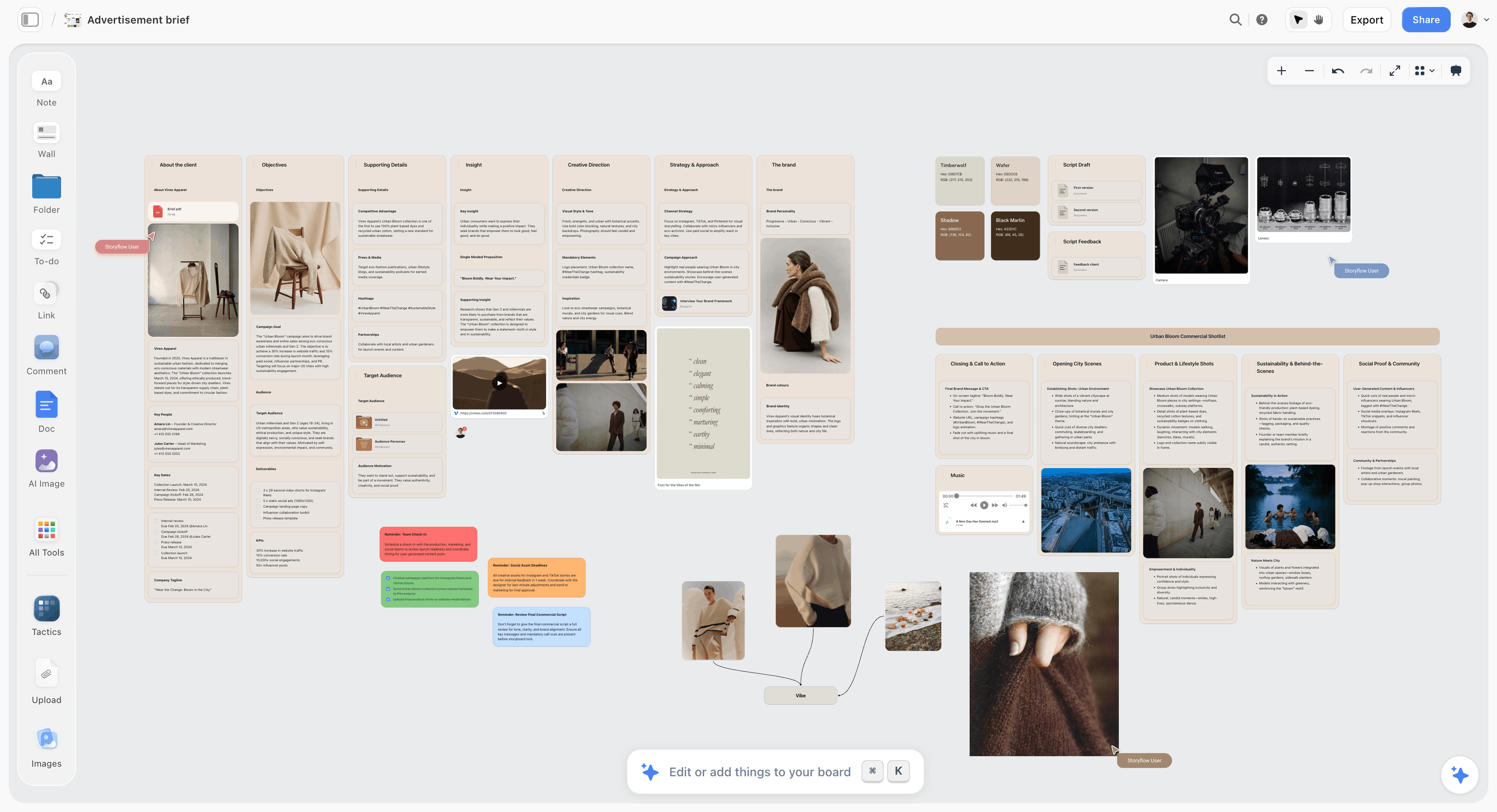
Storyflow sits at the record end of this list, and that is the honest description of what it does. It is an AI-powered visual workspace where the concept, the research that produced it, the brief it answers, and the written argument for it live on one canvas, and the AI reads the whole board. Before the meeting, that is where the rationale gets built; after it, it is where the decision and its grounds stay attached to the work rather than evaporating into a comment thread.
The practical difference shows up in the second conversation, not the first. When a client asks in week six why this direction rather than the other, the board still holds the reasoning: the references, the audience notes, the constraint that killed direction B. Ask the AI to draft the rationale from what is on the canvas and it works from your actual project, because your actual project is what it reads.
Best for: Studios and creative teams whose concepts need a defensible argument, not just a beautiful reveal.
Verdict: The best place to hold the concept and its reasoning. It is not a deck builder, not a prototyping tool, and not where you should run the live presentation: Figma, Canva, and Pitch each beat it there, and this post ranks them above it for exactly that reason.
Key features
- Canvas-aware AI by default. The AI reads your full active canvas board (every card, note, and image), plus up to 5 documents and 3 boards you attach in the AI chat.
- Concept, research, and rationale on one surface, so the argument survives past the meeting.
- Unlimited shared boards, and anyone a paid member invites joins free, so client access never hits a seat wall.
Pricing
Paid-only early access today: the Free plan (unlimited objects with no time limit, unlimited shared boards, a trial of Storyflow AI, and 20 file uploads) launches before the end of 2026, and until then anyone a paid member invites to a board signs up free. Plus: $7.99 per month annual or $9.99 per month monthly (adds unlimited uploads). Pro: $14 per month annual or $19 per month monthly (adds AI image generation and 30x more AI). Max: $39 per month annual or $49 per month monthly (adds 60x more AI and a team workspace with permissions and roles). Per account for individuals, per seat for team workspaces. Pricing current as of August 2026.
Pros
- The reasoning stays attached to the work, which is what settles the week-six argument.
- The AI drafts the rationale from your actual board rather than a blank prompt.
- Invited collaborators join free, so client seats cost nothing.
Cons
- Not a deck tool: its presentation mode steps through frames on the board, but there are no slides and no clickable prototype.
- No anchored design feedback on layouts the way Figma comments work.
- Cloud-only, no offline mode, and the Free plan is not live until late 2026.
If your concepts keep getting relitigated a month after approval, put the next one on a canvas with its reasoning attached. Start a Storyflow workspace and ask the AI to draft the rationale from the board before you present it.
2. Figma
Figma is the default answer for a reason that goes beyond market share: it is the only tool here where the presentation and the actual design are the same artifact. Figma Slides gives you a real deck; Figma prototypes give the client something clickable; and both sit in the file where the work already lives, so the version they see cannot drift from the version you are building. Collab seats let stakeholders view and comment without paying for a design seat, which quietly removes the most common client-access complaint in this category.
Best for: Any design team whose work already lives in Figma, which in 2026 is most of them.
Verdict: The best overall tool for presenting design concepts. It is weaker as a pure narrative deck than Canva or Pitch, and it does nothing for the record.
Key features
- Figma Slides: presentation decks inside the design file, with live embedded frames.
- Clickable prototypes clients can explore themselves.
- Collab seats for stakeholders: view, comment, and use FigJam and Slides without a design seat.
- Comments anchored to specific elements, so feedback lands where it applies.
- Version history that shows exactly what was presented and when.
Pricing
Free Starter plan. Professional is around $16 per editor per month billed annually (around $20 monthly), with cheaper Collab seats for stakeholders, as of August 2026. Verify on Figma's pricing page.
Pros
- The concept and the real work never diverge, because they are one file.
- Anchored comments produce specific feedback instead of vague reactions.
- Clients can view and comment without buying a design seat.
Cons
- The interface intimidates non-designers, and some clients will never open it twice.
- As a narrative deck builder it is functional rather than beautiful; Canva and Pitch look better with less effort.
- It captures comments but does not produce a decision record anyone will read later.
3. Loom
Loom is the most underrated tool in this category, and the one most likely to change your hit rate immediately. A five-minute screen recording where you walk through two directions, explain the reasoning, and say which one you recommend does something no deck does: it travels. When the client forwards it to the person who actually signs off, your narration goes with it. The alternative, a silent PDF forwarded without context, is where most concepts die.
Best for: Anyone whose concepts get forwarded to decision-makers who were not in the meeting.
Verdict: The best async presentation tool, and the highest-return addition to most studios' stack. It does not replace the live room, and it gives you no record of the decision.
Key features
- Screen and camera recording with instant shareable links.
- Viewer analytics: who watched, how far they got.
- Timestamped comments and emoji reactions on the video.
- Automatic transcripts and AI summaries.
- Free tier with a video length cap.
Pricing
Free tier with limits on video length and library size. Business plans from around $15 per creator per month, as of August 2026. Verify on Loom's site.
Pros
- Your reasoning survives the forward, which is where most concepts are lost.
- Clients watch on their own schedule, which raises the odds they engage at all.
- Viewer analytics tell you whether silence means "busy" or "never opened it."
Cons
- One-way by nature: no live reading of the room, no steering mid-explanation.
- Long recordings get skipped; the discipline of five minutes is on you.
- No decision capture beyond comments under a video.
4. Canva
Canva is the fastest path from finished concept to a client-facing deck that looks intentional. Brand kits keep the presentation on-brand automatically, the template library removes the layout decisions, and a share link opens cleanly on a client's phone without an account. For freelancers and small studios presenting to non-design clients, this is often the highest-value tool on the list.
Best for: Freelancers and small studios presenting to non-design clients who judge polish immediately.
Verdict: The best fast, polished deck. It is a presentation layer only: the work lives elsewhere, and so does the decision.
Key features
- Enormous template library with brand kit enforcement.
- Presentation mode, share links, and easy PDF export.
- Comments for client feedback without an account.
- Canva AI for layout, copy, and image generation.
Pricing
Free tier. Canva Pro is around $15 per month for one person, with team pricing around $10 per user per month, as of August 2026. Verify on Canva's site.
Pros
- Client-ready polish in minutes, with no formatting skill required.
- Non-designers open, view, and comment with zero friction.
- One subscription also covers the assets most studios need anyway.
Cons
- Decks drift out of sync with the real design files instantly.
- Feedback arrives as general comments rather than anchored to specific elements.
- Template-driven decks can look generic to design-literate clients.
5. Pitch
Pitch is presentation software built for teams that pitch as a core activity. Collaborative deck building, strong templates, and analytics showing who opened the deck and which slides held attention. For an agency running new business regularly, the analytics alone change follow-up: you know whether the prospect read past slide three before you call.
Best for: Agencies and studios producing client pitches and new-business decks regularly.
Verdict: The best dedicated presentation tool for agencies. Overkill for a designer presenting one concept to one existing client.
Key features
- Collaborative, component-based deck building for teams.
- Viewer analytics per slide and per recipient.
- Strong template system with brand consistency controls.
- Live and shareable presentation links.
Pricing
Free tier available; paid plans priced per user, as of August 2026. Verify current pricing on Pitch's site.
Pros
- Per-slide analytics make follow-up dramatically better informed.
- Team deck production is genuinely collaborative rather than one person's file.
- Decks look modern without a designer polishing every slide.
Cons
- Another silo: the deck does not connect to the design files.
- Best value only if you pitch often; occasional users will not use the analytics.
- Nothing for capturing the decision afterward.
6. Framekit
Framekit is an all-in-one creative toolkit for freelancers and small studios, and it is on this list for the two stages most design lists ignore. It does not compete for the room. It has no presenter view, no pace control, and no slide-by-slide build. What it has is a client-facing page you send, a gallery the client picks favorites in, and a review surface that records an explicit approval, all on one account with your own branding and domain.
The reason it is here rather than higher is criterion one: does it produce a decision. Every tool above it presents beautifully and then hands the decision back to email. Framekit's video review carries an approval state per version (needs review, in progress, changes requested, approved), and its galleries let a client mark favorites, which on a concept round is the client choosing rather than reacting. That is a decision captured in the tool, on a specific version, with a date on it.
For a designer specifically: build the concept page in the AI site builder (your fonts, your domain, no Framekit badge on paid tiers), send one link, and let the client's favorites and approvals come back attached to the thing they refer to. When the work is motion rather than static, the same account gives you timecoded comments and drawing on the frame instead of "around the middle it feels off."
Best for: Freelance designers and small studios who want the concept page, the gallery, and the approval on one branded account instead of three tools plus email.
Verdict: The most complete answer to the inbox and the record on this list, and no answer at all to the room. Pair it with Figma or Canva for the live presentation. It also does nothing for prototyping or design files, so it sits beside your design tool rather than near it.
Key features
- Client-facing pages built with an AI site builder, on your own domain, with custom fonts and no Framekit badge on paid tiers.
- Client galleries with favorites, watermarking, password and PIN gating, and separate control over viewing and downloading.
- Timecoded video review with freehand, arrow, line, rectangle and ellipse annotation on the frame.
- Version stacks where exactly one version is current, each carrying its own approval status.
- A store for selling digital products, on the same account as the site that sells them.
Pricing
Free includes unlimited client galleries with 3GB of photo storage and video review with 2GB of video storage. Starter is $9/mo, or $7 billed annually, adding a custom domain, 10GB of gallery storage, 10GB of review storage, and branding removal. Pro is $19/mo, or $15 annually, with 100GB of each and file attachments on review comments. Business is $39/mo, or $31 annually, with 500GB of review storage, 1,000GB of gallery storage, and zero transaction fees. Flat per account rather than per seat, which matters when the people reviewing change every project.
Pros
- The only tool here that records an explicit approval against a specific version, which is the record problem this article says most teams lose.
- The client needs no account, and you decide whether they must give a name, whether the link expires, and whether the original can be downloaded.
- Flat per-account pricing, so adding reviewers costs nothing.
Cons
- Nothing for the live room: no presenter view, no pace control, no slide builder. Figma, Canva, and Pitch all beat it outright there.
- No prototyping and no connection to design files, so it is a separate surface from where the work is made.
- Storage caps per tier are the real ceiling, especially once video review is in regular use.
7. Milanote
Milanote presents a direction better than any deck tool, which is a different job from presenting a layout. When the conversation is about tone, palette, and feeling rather than a finished screen, a calm Milanote board shows the client the world the work lives in. It shares cleanly with a link, and clients consistently find it pleasant rather than technical.
Best for: Presenting creative direction, mood, and concept territories rather than finished designs.
Verdict: The best board for showing a direction. It presents the concept and does nothing with the reasoning or the decision.
Key features
- Elegant boards of images, notes, and links.
- Nested boards per direction or client.
- Clean share links that open without an account.
- Simple commenting for feedback.
Pricing
Free tier with a card cap. Paid around $12.50 per month, less billed annually, as of August 2026. Verify on Milanote's site.
Pros
- The most pleasant way to present a direction rather than a layout.
- Clients understand a board instantly; no interface literacy required.
- Beautiful by default, which matters when taste is the product.
Cons
- No presentation flow control: the client sees everything at once, including what you had not introduced yet.
- Light AI and no structured feedback capture.
- Card caps make the free tier a trial for real client work.
8. Miro
Miro is the right pick when you want the client working with you rather than watching you. Presenting concepts inside a workshop, with the client voting, annotating, and reacting live, changes the psychology of approval: people defend decisions they helped make. For discovery-heavy relationships and co-design engagements, this beats any polished deck.
Best for: Co-review and workshop-style sessions where client participation is the point.
Verdict: The best co-review canvas. As a polished concept presentation it looks like a working board, because it is one.
Key features
- Infinite canvas with facilitation tools: voting, timers, private mode.
- Presentation mode with defined frames.
- Guests can join a board without a full account.
- Huge template library for structured sessions.
Pricing
Free plan with 3 editable boards. Starter around $8 per member per month billed annually, as of August 2026. Verify on Miro's site.
Pros
- Client participation produces buy-in that a reveal never does.
- Voting and annotation turn vague reactions into recorded positions.
- Guest access lowers the friction for client-side participants.
Cons
- Boards look like working sessions, which undersells finished concept work.
- Big boards get slow and visually noisy.
- The workshop output still needs summarizing into an actual decision.
9. Frame.io
Frame.io is the answer when the concept moves. For motion, video, and animated brand work, frame-accurate comments end the single worst feedback pattern in this category: "somewhere in the middle it feels off." Reviewers comment on an exact frame without needing a seat, versions stack so the client can see what changed, and approvals are explicit.
Best for: Motion designers, video teams, and anyone presenting time-based concept work.
Verdict: The best structured feedback tool for moving work. Irrelevant for static concepts, where Figma comments do the same job.
Key features
- Frame-accurate, timestamped comments and drawings.
- Version stacking so clients compare cuts directly.
- Explicit approval states rather than implied consent.
- Reviewer access without paid seats.
Pricing
Free tier available. Paid plans from around $15 per user per month, as of August 2026. Verify on Frame.io's site.
Pros
- Timestamped feedback removes the biggest ambiguity in motion review.
- Version history makes "this is different from what I approved" checkable.
- Clients review without buying seats.
Cons
- Built for time-based media; static concept presentation is not its job.
- Another subscription for studios that only occasionally present motion.
- Reviewing is not presenting: you still need the room.
10. Gamma
Gamma generates a decent-looking deck from a prompt or an outline in about a minute, which makes it a genuinely useful first-draft tool when the deadline is tomorrow and the concept is clear in your head. The output is web-native and responsive rather than slide-shaped, which reads well on a phone. Treat it as scaffolding, not as the final artifact.
Best for: Getting a structured first-draft deck fast when time is the binding constraint.
Verdict: The best AI first-draft deck. AI-generated decks look AI-generated to design-literate clients, so plan to edit.
Key features
- Generates full decks from a prompt or outline.
- Web-native, responsive documents rather than fixed slides.
- Built-in analytics on viewers.
- Easy embedding of images and video.
Pricing
Free tier with credits. Paid plans from around $10 per month, as of August 2026. Verify on Gamma's site.
Pros
- Removes the blank-deck problem entirely.
- Output reads well on mobile, where clients often open things first.
- Fast enough to produce two structural options and pick one.
Cons
- The default aesthetic is recognizable, which is a liability when selling taste.
- Less layout control than Canva, Pitch, or Figma Slides.
- Nothing for feedback or decisions.
11. Notion
Notion is on this list for the least glamorous and most valuable job: the record. A single client page holding the concept links, the decision, the date, and the client's own words about what they approved is the cheapest insurance in client work. It presents concepts poorly and settles arguments extremely well.
Best for: Studios that keep relitigating settled decisions and need a durable, shareable record.
Verdict: The best decision record. As a presentation surface it is plainly the weakest tool here, and that is fine.
Key features
- Client-facing pages with embedded Figma, Loom, and image content.
- Public share links that need no account.
- Databases for tracking rounds, decisions, and approval dates.
- Comments that stay attached to the record.
Pricing
Free plan for personal use. Plus around $10 per user per month billed annually, as of August 2026. Verify on Notion's site.
Pros
- Settles "I thought we agreed" arguments with a dated, written record.
- Embeds work from every other tool on this list.
- Clients open a link with no friction.
Cons
- Presenting a concept in Notion undersells the work badly.
- Maintaining the record is a discipline, not a feature.
- Document-shaped, so visual direction fits poorly.
7) Which Tool Fits Which Kind of Designer?
12. Freelance Designer
Top picks: Canva + Framekit
Canva for a polished deck that makes a one-person studio look established. Framekit for everything after the deck: the concept page on your own domain, the gallery where the client marks favorites, and the approval recorded against a version. A freelancer has no producer chasing sign-off, so the tool has to hold the record instead. Add Loom on top when the client will forward the concept to a partner who decides with them, because narration survives forwarding better than any page does.
13. Design or Branding Agency
Top picks: Figma + Pitch
Figma so concept and production stay one artifact across a team. Pitch for new-business decks, where per-slide analytics change how you follow up.
14. In-House Brand Team
Top picks: Figma + Notion
Figma for the work and the stakeholder comments. Notion for the record, because internal stakeholders rotate and the decision has to outlast the person who made it.
15. Motion or Video Designer
Top picks: Frame.io + Loom
Frame.io so feedback lands on an exact frame, and because its Premiere and After Effects panels put the note where you are already working. Loom to narrate why the concept is built the way it is before the client starts scrubbing. If you are freelance and the per-seat bill is hard to justify, Framekit covers the same timecoded review with drawing on the frame at a flat account price, and puts your reel and site on the same login.
16. Creative Director / Studio Lead
Top picks: Milanote + Storyflow
Milanote to present the direction beautifully. Storyflow to hold the reasoning behind it, so the argument is ready when a client questions the direction two rounds later.
17. Architecture or Interior Designer
Top picks: Milanote + Canva
Milanote for material, palette, and reference boards, which is how this work is actually judged. Canva for the formal client-facing document.
8) Honorable Mentions (and One Tool Every Other List Still Gets Wrong)
InVision is no longer a real option. Its design collaboration service shut down at the end of 2024, yet it still appears on published lists of design presentation tools in 2026. If a list recommends it, that list has not been re-checked since it was written. Former users have largely moved to Figma.
A few tools that came close but did not make the main ten.
- Marvel and Proto.io: Capable prototyping tools; for most teams Figma prototypes now cover the same job in the file where the work lives.
- Dropbox Replay: Solid review-and-approve for video; Frame.io is deeper for the same job.
- Google Slides and Keynote: Universally available and perfectly usable; they simply add nothing this list's tools do not do better for design specifically.
- Behance and Dribbble: Portfolio surfaces, not client presentation tools. Useful before the relationship, not during it.
- Adobe Express: Fine for quick client-facing collateral if you are already in Creative Cloud.
9) Where the Dedicated Tools Still Win (An Honest Accounting)
This list is published by a company whose product is on it, so here is the plain accounting.
Figma wins the category. Concept plus production in one file, with anchored comments and stakeholder seats, is the strongest overall answer, and Storyflow does not compete with it. We do not build decks or prototypes.
Loom wins the inbox. A narrated walkthrough is the highest-leverage thing most studios are not doing, and no canvas replaces it.
Canva and Pitch win the room. Polished, controlled, client-ready presentation is their core competence.
Frame.io wins moving work. Frame-accurate review is a genuinely different capability.
So why is Storyflow on the list at all? Because the record is a real stage that the room-focused tools ignore, and the specific failure it prevents is expensive: a concept approved in the meeting and relitigated a month later because nobody kept the reasoning. A design presentation is not a reveal. It is a decision meeting that happens to have pictures in it, and the argument behind the decision has to live somewhere. That is the slot Storyflow earns here, and it is the only one we claim.
11) The Bottom Line
The best tool for presenting design concepts to clients in 2026 is Figma, because the concept and the real work stay one artifact and stakeholders can comment without a design seat. Add Loom for the walkthrough that survives forwarding, Canva or Pitch when the room needs more polish than Figma gives you, Milanote when you are presenting a direction rather than a layout, and Frame.io when the work moves.
A design presentation is not a reveal. It is a decision meeting that happens to have pictures in it. Most studios are over-tooled for the room and under-tooled for the inbox and the record, and that is where approved work quietly comes undone.
If your concepts keep getting reopened after they were signed off, the missing piece is the record. Start a Storyflow workspace, put the next concept on a canvas with the research and the argument beside it, and have the reasoning ready before anyone asks for it.
10) FAQ: Presenting Design Concepts to Clients in 2026
What is the best tool for presenting design concepts to clients?
Figma is the best overall tool in 2026, because Figma Slides and prototypes let you present the concept alongside the real work in one file, and stakeholders can view and comment without a design seat. Add Loom for the async walkthrough clients forward to decision-makers, and Canva if you need a polished deck faster than Figma produces one.
How do you present a design concept to a client?
Present one named decision, not a gallery. State the brief you were solving, show two directions at most, recommend one and say why, then ask for a specific decision by a specific date. The full method, including how to structure feedback so it arrives as numbered notes rather than opinion, is in How to Present Design Concepts to Clients.
Should I present design concepts live or send them?
Do both, in that order. Present live so you can read reactions and steer, then send a narrated Loom or a share link the client can forward. The decision usually happens after the meeting, when the client reviews alone or shows someone who was not there, so a presentation that only exists live is a presentation that only half happened.
How many design concepts should I show a client?
Two, with a recommendation. One gives the client nothing to choose between and reads as take-it-or-leave-it; three or more spreads attention thin and invites Frankenstein feedback that combines the worst of each. Two directions with a clear, reasoned recommendation produces the highest rate of clean decisions.
Is Figma good for presenting to non-designers?
Yes with a caveat. Figma Slides and prototype links work well for clients, and Collab seats let stakeholders comment without a design seat. The caveat is the interface: some non-designers find the Figma canvas intimidating and will not open it a second time. For those clients, present in Canva or send a Loom and keep Figma for the work itself.
What is the best free tool for presenting design concepts?
Figma's Starter plan and Canva's free tier both handle real client presentations, and Loom's free tier covers short narrated walkthroughs. Miro's free plan allows three boards, and Milanote's free tier works for one small direction board. A freelancer can genuinely run client presentations on free tiers before paying for anything.
How do I stop clients from giving vague design feedback?
Change what you ask for and where they answer. Ask for a decision on a named question rather than general thoughts, cap feedback rounds explicitly, and use tools that anchor comments to a specific element or frame (Figma or Frame.io) rather than a general comment box. Vague feedback is usually a symptom of an unclear ask, not an unreasonable client.
What replaced InVision for design presentations?
Figma, for the vast majority of teams. InVision's design collaboration service shut down at the end of 2024, and its prototyping, presentation, and commenting jobs are now covered by Figma prototypes, Figma Slides, and Figma comments. Marvel and Proto.io absorbed some prototyping users, and Frame.io covers the motion-review case.
Do clients need an account to view my design presentation?
Usually not, and you should treat it as a requirement when choosing. Figma view links, Canva share links, Loom videos, Milanote boards, Notion public pages, and Frame.io review links all open without the client creating an account. Any tool that forces a client signup adds friction exactly where you can least afford it.
What is Framekit and why does it rank fifth here?
Framekit is an all-in-one creative toolkit for freelancers and small studios: an AI website builder for client-facing pages, unlimited client galleries, timecoded video review, and a store for digital products, on one flat per-account bill. It is here because of this article's first criterion, which is whether a tool produces a decision. Its galleries capture the client's favorites and its review carries an explicit approval status per version, so the choice lands in the tool instead of in an email. It is here rather than higher because it does nothing for the live room and nothing for prototyping.
Framekit or Pitch for sending a concept to a client?
Pitch if the artifact is a deck and you pitch often, because per-slide viewer analytics tell you whether the prospect read past slide three. Framekit if the artifact is a page or a gallery and the thing you keep losing is the approval, because it records the decision against a specific version and the client needs no account to give it. They solve adjacent halves of the same problem: Pitch tells you the deck was read, Framekit tells you the work was approved.
How do I keep a record of what a client approved?
Write it down the same day, in one place, in the client's own words where possible: which direction was approved, on what date, with what conditions, and what happens next. Notion is the common home for this; a canvas like Storyflow works when the decision needs the concept and its reasoning attached. The medium matters far less than doing it before memory fades.
Is Storyflow a design presentation tool?
Not primarily, and this post ranks it seventh for that reason. Storyflow has a presentation mode that steps through frames on the board, but no slide deck and no clickable prototypes; Figma, Canva, and Pitch all beat it in the room. It earns its place at the record stage: the concept, the research behind it, and the written argument on one canvas the AI reads, so the reasoning survives past the meeting that approved it.
What should a design concept presentation include?
Five things: the brief restated in one line, the constraint or insight that shaped your thinking, the concepts themselves (two at most), your recommendation with reasoning, and the specific decision you need with a date. Everything else is context that can live in an appendix. Presentations fail far more often from missing the recommendation than from missing detail.
Table of Contents
- Quick Answer: The Best Tool for Presenting Design Concepts
- Comparison Table: 10 Design Presentation Tools
- Frequently Asked: Figma vs InVision, Handoff, and Presenting Without a Design Team
- The Room, the Inbox, and the Record
- How We Evaluated These Tools
- Quick Picks by Job to Be Done
- Detailed Reviews: 10 Design Presentation Tools
- Which Tool Fits Which Kind of Designer?
- Honorable Mentions (and One Tool Every Other List Still Gets Wrong)
- Where the Dedicated Tools Still Win (An Honest Accounting)
- FAQ: Presenting Design Concepts to Clients in 2026
- The Bottom Line
- Author
- Related Reading
Templates to check out for this topic


Templates you can use in Storyflow
Every Storyflow board starts from real structure and an AI that reads the whole canvas. Open one of these templates and make it yours.


See Storyflow in Action
A visual AI workspace where every feature lives inside one canvas. No tab-switching, no context lost.
Build your entire board from a single message
Type what you need in the AI chat at the bottom of your canvas. The AI adds cards, headings, and structure directly onto your board.
Use expert frameworks as AI context
Type @ in the AI chat and choose any Tactic. The AI tailors every response to that framework instead of giving generic advice.
Turn your board into a mind map in seconds
Ask the AI to restructure your canvas as a mindmap. It connects your ideas into a visual hierarchy so you can see how everything relates.
Why Storyflow Exists
Storyflow actually began as a personal tool while working on creative and research projects.
We kept running into the same problem: ideas were scattered everywhere: notes, documents, and whiteboards.
Nothing helped us see how everything connected.
So we started building a workspace designed around how ideas actually grow.
→ Read how Storyflow was createdJustkay
Documentary Filmmaker & Founder at Storyflow
Published: 2026-08-06
Extremely simple, seriously capable


See how easy it is to get started
Watch a real project come together, from a blank board to a finished plan, clicked through step by step.
Start creating with AI and become more productive
Transform your creative workflow with AI-powered tools. Generate ideas, create content, and boost your productivity in minutes instead of hours.