How to Present a Campaign Concept: The 9-Part Slide Order (2026)
Creative agencies present a campaign concept in a fixed nine-part order: the restated brief, the business problem, the audience tension, the insight, the idea on a single slide, the manifesto, the executions, the scale proof, and the ask. The order matters more than the slides, and presenting executions early is the most common way a good idea dies.

Category
Agency & Client Work
Author

Justkay
Documentary Filmmaker & Founder at Storyflow
Topics
2026-09-06
•
40 min read
•
Agency & Client Work- how do creative agencies present a campaign concept to a client
- campaign concept deck structure
- creative presentation strategy insight idea execution
- how many creative routes to present
- agency concept presentation slide order
How do creative agencies present a campaign concept to a client?
Creative agencies present a campaign concept in a fixed nine-part order: the restated brief, the business problem, the audience tension, the insight, the idea on a single slide, the manifesto, [the executions](/campaign-concept-board), the proof it can scale, and the ask. Storyflow is the tool to build it in: put the brief, the research and the routes on one board, and its AI drafts the slide outline, builds the deck in this order, presents it fullscreen and exports one PDF. Present one recommended route with two supporting territories, because three equal options hand the decision to the client, who picks the safest one.

Full disclosure: Storyflow is our product. It builds the deck on the board from your material, presents it fullscreen and exports a PDF, but it has no presenter view with notes and no editable PowerPoint or Keynote file, so this article sends you to Keynote when the presenter depends on notes and to Google Slides when the client has to edit the deck. The tools are listed in workflow order, not by score.
Quick Comparison
The four presentation formats an agency actually uses, and what each one is for.
| Tool | Best For | AI Features | Price |
|---|---|---|---|
| Concept presentation | Selling one idea to an existing client | 1 recommendation plus 2 territories | 40 to 60 min |
| New-business pitch | Winning the account | 1 recommendation, fully worked | 60 to 90 min |
| Tissue session | De-risking before the real meeting | 3 to 5 rough directions | 45 min |
| Annual planning | Setting the platform for the year | 1 platform, many executions | 90 min plus |
Which Tool Should You Use to Present a Campaign Concept to a Client?
Use Storyflow. It is an AI visual workspace where the brief, the research, the routes and the deck sit on one board, so the deck is built from the material instead of retyped from it. For a campaign concept presentation it does four jobs:
- It holds the thinking. The brief, the audience research, the territories and the reference images sit side by side on an infinite canvas, one wall for each part of the nine-part order.
- It builds the deck. Ask the AI for a pitch deck and it reads the board, asks who the deck is for and what the ask is, writes a one-line-per-slide outline for you to edit, then builds every slide as a deck on the board. A budget or a date you did not give it shows as a visible blank, never as an invented number.
- It presents. The deck plays fullscreen from the board, and presentation mode steps through the board one wall at a time, which is the right format for a tissue session.
- It sends. The deck exports as one PDF, and a view-only link opens the board for the client with no account.
Pick something else in three cases. If the client has to edit the file, build in Google Slides. If you need presenter notes in a separate window while you talk, build in Keynote. If the deck has to share components with a design system, build in Figma Slides. Storyflow's limits for this job: no presenter view, no editable PowerPoint export, and AI image generation on Pro and Max only.
This article is about the order of the slides. For how the meeting itself runs, read how creative agencies present a campaign concept to a client; for a ranked comparison of the software, read the best tools to present a campaign concept to a client.
Tools for each step of a campaign concept presentation
| Step | What you do | Tool that does it |
|---|---|---|
1. Interrogate the brief | Restate the brief tighter than you received it and name the business problem | Storyflow: the campaign brief workflow lays the brief out as walls on the board |
2. Collect the tension material | Research, quotes, screenshots, competitor work, reference images | Storyflow board (notes, images, links, PDFs side by side) |
3. Lay out the territories | Three routes next to each other so you can see which one has executions in it | Storyflow walls; Miro or FigJam also hold this stage |
4. Run the chain test | Walk execution, idea, insight, strategy, problem backwards and find the broken link | Storyflow: ask the AI, which reads the whole board, where the chain breaks |
5. Outline the nine parts | One line per slide, in order, before any design | Storyflow: the AI writes the outline and waits for your edit |
6. Build the slides | The deck itself | Storyflow deck on the board; Keynote, Figma Slides or Google Slides when the client needs an editable file |
7. Present | Fullscreen, one idea per slide | Storyflow fullscreen deck; Keynote when you need presenter notes on a second screen |
8. Send the follow-up | A document that works with no presenter, the same day | Storyflow: the AI writes a one-pager from the same board, exported as PDF with the deck, plus a view-only board link; Loom for a recorded walkthrough |
9. Record the decision | Which route, approved by whom, on what date | A dated note on the Storyflow board next to the approved route |
Key Takeaways
- The decision is usually made before the executions appear. By the time a client sees the campaign film, they have already decided whether they trust the thinking, and the executions either confirm or contradict that.
- An observation is not an insight. An insight is a truth that creates tension, and tension is the only thing an idea can resolve.
- Present one recommendation, not three equal routes. Three equal routes is not generosity, it is a transfer of the decision to the least creatively confident person in the room.
- The idea belongs on one slide with one line. If it needs a paragraph to explain, it is a territory, not an idea.
- The case study slide works when it proves the mechanic, not when it proves the agency. A relevant mechanic from an unrelated category beats an award from your own.
- Budget and timings go last. Every time they go earlier, the room stops evaluating the idea and starts evaluating the invoice.
- Send the deck afterwards as a written narrative, not as the presentation file. A deck without its presenter is a different and much weaker document.
- The presentation is not where the idea gets made. If the brief was interrogated badly, no slide order rescues it.
Why Concept Presentations Fail, and It Is Almost Never the Idea
Agencies lose concept presentations they should have won, and the post-mortem almost always blames the work. The work is rarely the problem. The problem is that the room was asked to judge an answer before it agreed on the question.
Here is the shape of the failure. The agency opens with credentials, moves to a market overview the client already knows, spends eleven slides on audience segmentation, then reveals three campaign routes in the last fifteen minutes of a sixty-minute meeting. The client, who has been passive for forty-five minutes, is suddenly asked to have an opinion. They reach for the only tool a passive audience has, which is risk assessment. They pick the safest route, or they ask for "a blend of one and three", which is the polite way of saying no to all of them.
Nothing in that meeting was incompetent. The segmentation may have been excellent. The failure is structural: the room was never given a reason to want an idea before it was given one.
The nine-part order below exists to fix exactly that. Its whole purpose is to arrive at the idea slide with the room already leaning forward, having agreed to a problem that only a creative leap can solve.
The three failure modes, named
Concept presentations fail in three recognisable ways, and each one has a structural cause rather than a creative one.
- The client rebriefs you in the room. This means the restated brief was skipped or rushed. The client is not being difficult; they are telling you the problem you solved is not the problem they have.
- The client asks "how much of this can we actually do?" This means the executions arrived before the scale proof. The idea read as expensive because you showed the most expensive expression first.
- The client says "we love it, let us take it away and think". This usually means the idea never got a single-line articulation, so nobody in the room can repeat it to the person who was not in the room.
The Nine-Part Spine
This is the order. Slide counts are indicative; a forty-five-minute concept presentation runs roughly 18 to 25 slides, and the executions section is the only part that should ever expand.
1. The Restated Brief
One slide. You say the brief back in your own words, tighter than you received it.
This slide is doing two things. It proves you listened, which buys you permission for everything that follows. More importantly, it is your last chance to move the goalposts legitimately. If you interrogated the brief and concluded the real problem is different from the written one, this is where you say so, in one sentence, before you have shown anything that depends on it.
If the client disagrees with your restatement, stop and resolve it. Presenting an idea against a brief the client no longer holds is the single most expensive mistake in this meeting, and every subsequent slide compounds it.
2. The Business Problem
One slide. Not the marketing problem. The business problem.
"Awareness is low" is a marketing problem, and it is usually a symptom. "We are losing 18 to 24s to a challenger brand and our average customer age has risen four years in three years" is a business problem. The difference matters because business problems have money attached to them, and money is what buys a campaign budget.
Write this slide in the client's own numbers wherever you have them. If you do not have them, say what you believe and mark it as a belief. A confident wrong number destroys more credibility than an honest gap.
3. The Audience Tension
Two to three slides. This is where the room starts to move.
You are not presenting demographics. You are presenting a lived contradiction in the audience's life that your category sits inside. The test for this section is simple: could a smart person in the room have written these slides? If yes, cut them. Everything here should be something the client did not already know, or knew but had never seen articulated.
Good tension is specific and slightly uncomfortable. It usually sounds like two things that are both true and should not be:
- They say they want to cook from scratch and they buy the meal kit.
- They research for six weeks and buy the first thing a friend mentions.
- They will not pay for the software and they will pay for the course that teaches the software.
4. The Insight
One slide. One sentence. This is the pivot of the entire presentation.
An insight is a truth that creates tension. An observation is a truth that sits there. The word is the most abused in the industry, and most decks present observations under an insight header. The test: does your sentence make an idea feel necessary? If the room could hear it and shrug, it is an observation.
- Observation: "People are busy and want convenience."
- Insight: "People buy convenience and then feel they have not earned the result, so they look for a way to have done something."
The second one demands a response. It creates a job for the creative work. That is what an insight is for.
Put the insight on its own slide, in large type, with nothing else on it. Say it, then stop talking for two seconds. The silence is not theatre; it is the moment the room decides whether the rest of the meeting is worth their attention.
5. The Idea
One slide. One line. Nothing else.
This is the slide that decides the meeting, and it is the one most decks get wrong by putting too much on it. A campaign idea articulated on a single slide with a single line has a property no paragraph has: it survives being repeated badly by someone who was not in the room. That is the actual job. The marketing director who loved it has to sell it to a CFO who was not there, and they will get the wording slightly wrong. If the idea still works when repeated imperfectly, it is robust. If it only works when you explain it, you have not finished it.
Say the line. Do not explain it immediately. Let it sit, then move to the manifesto, which does the explaining emotionally rather than logically.
Do not present the idea with a rationale attached on the same slide. The rationale reads as defensiveness, and it signals that you do not think the line can stand on its own.
6. The Manifesto
One slide, or ninety seconds of film, or thirty seconds of you reading well.
The manifesto is the idea in its emotional register. It exists because you have just made a rational argument (problem, tension, insight) and landed a rational artefact (a line), and the room needs to feel what the campaign would feel like before it evaluates whether it works.
If you have production budget, this is a scratch film with library footage and a temp track. If you do not, this is you reading forty words well. The read version often outperforms the film version, because a bad scratch film sets a bad expectation for the finished work and clients are famously literal about temp material.
7. The Executions
Five to twelve slides. This is the only section that should expand.
The rule for this section is that the executions exist to prove the idea is fertile, not to be individually approved. Show enough to demonstrate the idea generates work across the channels the client actually buys, and stop. A deck with forty executions signals that you are unsure which one is right.
Order them deliberately:
- Lead with the execution that best demonstrates the idea, not the biggest one.
- Follow with one that proves the idea works at low budget, because that answers the unasked question.
- Then show the range: one social, one retail or environmental, one long-form, one that involves the product or service itself rather than communication about it.
The last one is the highest-leverage slide in this section. An idea that changes something about the product, the packaging, the service, or the customer's actual experience reads as a platform. An idea that only changes the advertising reads as a campaign, and campaigns get replaced next year.
8. The Scale Proof
One to two slides. Answer, before it is asked, whether this runs for three years or three weeks.
This is where you show the idea has a second and third year in it, that it flexes for different products or markets, and that it does not depend on a single piece of expensive film. Clients rarely ask this question out loud during the meeting; they ask it afterwards, in a room you are not in.
This is also where a case study earns its place.
9. The Ask
One to two slides. Timings, what you need from them, next steps. Budget if and only if it was requested.
Nothing kills the ninety seconds after a good idea faster than a cost breakdown. If budget must be in the meeting, make it a separate document handed over at the end, or a separate meeting entirely. The rational and emotional registers do not mix well, and the idea has just been sold in the emotional one.
The Slide-by-Slide Deck: What Is Written on Each Slide and What the Presenter Says
The nine parts above are the argument. This is the same argument as twenty slides, with the words on each slide and the line the presenter speaks over it. The client is invented for the example: Harrow & Finch, a mid-market homeware retailer losing shoppers under 35. Swap in your own client and keep the proportions.
| Slide | Part | Written on the slide | What the presenter says | Minutes |
|---|---|---|---|---|
1 | Title | Client, project, date. Not the idea line. | "Thirty minutes from us, fifteen for you, one decision at the end." | 0.5 |
2 | Restated brief | "Get under-35s to choose Harrow & Finch for their first real home, by autumn." | "This is the brief as we understood it. Is it still the brief?" Then wait for the yes. | 1.5 |
3 | Business problem | "Under-35s: 31% of sales three years ago, 22% now." | "This is not an awareness problem. They know you. They buy the first sofa somewhere else." | 2 |
4 | Audience tension | Two lines, both true: "They want a home that looks chosen." "They furnish it in one panic weekend." | "Both are true of the same person in the same month." | 2 |
5 | Tension evidence | Three verbatim quotes from the interviews. No chart. | Read one quote aloud. Add nothing. | 1.5 |
6 | Category tension | Four competitor ads in a row, all showing finished rooms. | "Everyone sells the finished room. Nobody is with them in the unfinished one." | 1.5 |
7 | Insight | One sentence: "Nobody feels at home until one thing in the room is there by choice." | Say it. Stop for two seconds. | 1 |
8 | Idea | One line: "Start with one thing." | Say the line. Do not explain it. | 1 |
9 | Manifesto | Forty words. No image. | Read it at speaking pace. | 1.5 |
10 | Visual world | One image of the board: palette, type, photography references. | "This is how it feels. It is not final art." | 1 |
11 | Hero execution | The clearest expression, not the biggest: the in-store "first thing" wall. | "This is the idea at its clearest." | 2 |
12 | Low-budget execution | A social format shot on a phone. | "This is the idea with no money behind it." | 1.5 |
13 | Retail and packaging | Window, bag, receipt. | One sentence for each. | 1 |
14 | Long-form | The film in three lines: open, turn, end. | Tell it as a story, not a script. | 1.5 |
15 | Product or service execution | "The First Thing promise: swap it once, free." | "This is the slide where it stops being advertising." | 2 |
16 | Territory A | One line, one image. | "A direction we explored, and why we set it aside." | 1.5 |
17 | Territory B | One line, one image. | "A second direction. The endline may be worth keeping." | 1.5 |
18 | Scale proof | Year one, year two, year three on one row. | "Year two is the second thing. Year three is the room." | 1.5 |
19 | Case study | Problem, mechanic, one number. | "A different category, the same mechanic." | 1 |
20 | The ask | "Today: approve the platform. By 24 October: sign off the hero execution." | "We are asking for one decision today." Then stop talking. | 1.5 |
That is 28.5 minutes of presenting in a 45-minute slot, which leaves a third of the meeting for the conversation. The numbers on slide 3 are placeholders for the example; on a real deck they are the client's own figures or a visible blank.
How the minutes divide across the nine parts
| Part of the order | Slides | Minutes | What goes wrong when it grows |
|---|---|---|---|
Restated brief and business problem | 1 to 3 | 4 | Turns into credentials and a market overview |
Audience tension | 4 to 6 | 5 | Turns into segmentation the client already owns |
Insight | 7 | 1 | A second insight appears, and neither lands |
Idea, manifesto, visual world | 8 to 10 | 3.5 | The rationale creeps onto the idea slide |
Executions | 11 to 15 | 8 | The only part allowed to grow |
Territories | 16 to 17 | 3 | Territories get worked up and become equal routes |
Scale proof and case study | 18 to 19 | 2.5 | The case study becomes an agency reel |
The ask | 20 | 1.5 | Budget arrives and the room changes register |
The ten-slide version for a twenty-minute slot
When the slot is twenty minutes, cut slides, not parts. Every part of the order survives; the evidence and the range go into the document you send afterwards.
| Slide | Part | What was cut to get here |
|---|---|---|
1 | Restated brief and business problem on one slide | The title slide |
2 | Audience tension | The quotes and the competitor row |
3 | Insight | Nothing. It was already one slide |
4 | Idea | Nothing |
5 | Manifesto | The visual world, which moves to the follow-up |
6 | Hero execution | Nothing |
7 | Low-budget execution | The retail and long-form slides |
8 | Product or service execution | Nothing. It is the slide that proves a platform |
9 | Scale proof | The case study and both territories |
10 | The ask | Nothing |
The campaign overview slide, and where it goes
A campaign overview slide is the whole campaign on one page: the idea line at the top, the channels underneath, the phases across the bottom. Clients ask for it by name because it is the slide they forward. It belongs in the follow-up document and as the opening page of the PDF you send, and it does not belong in the presented deck before slide 8, because it gives away the idea before the tension has been built. If the client insists on one in the room, it is slide 18: the scale proof is the overview, shown at the point where the room already wants it.
How to Build the Nine-Part Deck in Storyflow, Step by Step
The slide order is easy to agree with and tedious to build, because the material lives in six places. This is the build on one Storyflow board.
- Put the material on one board. Paste the brief into a document, drop in the research PDFs, the client's numbers, competitor screenshots and reference images. Give each part of the order its own wall so the board reads left to right in presentation order.
- Lay the brief out. If the brief arrived as an email thread, run the campaign brief workflow in Storyflow. It builds the brief across ten walls (the client, the campaign overview, the goals, the creative, the media and the market context among them) from what you give it.
- Put the territories side by side. One wall for each route: the line, three reference images, and every execution you can think of in ten minutes. The wall with the most executions on it is usually the platform.
- Run the chain test with the AI. Ask the Storyflow AI, which reads the whole board, to walk your lead execution back to the business problem and name the link that is missing.
- Ask for the deck. Type: "Build a pitch deck from my board in this order: restated brief, business problem, audience tension, insight, idea, manifesto, executions, scale proof, ask. Show me the outline first." The AI asks who the deck is for, what the ask is and the aspect ratio, then writes one line per slide.
- Edit the outline, then build. Paste the outline back with your changes. Storyflow builds every slide as a deck on the board. Pictures are slots you fill from your own images or web references on any plan, or with AI-generated images on Pro and Max.
- Rewrite the idea slide by hand. The AI builds the structure; the line on slide 8 is yours. Edit any slide directly on the board.
- Present and send. Play the deck fullscreen in the meeting. The same day, ask the AI for a one-pager from the same board (the written version of the argument), export it and the deck as PDFs, and send a view-only link to the board for the people who were not in the room. The link opens with no account; commenting needs a sign-in.
If your team drafts in ChatGPT or Claude, the Storyflow MCP connector lets the assistant read your Storyflow project and build the board and the deck in it, so the outline you argued over in a chat lands on the board without retyping.
What Storyflow does not do in this build
- No presenter view. There is no second-screen window with notes and a timer. Rehearse from a printed run sheet, or build in Keynote if you depend on notes.
- No editable PowerPoint or Keynote file. The deck exports as one PDF through the browser's print dialog, or as one image per slide. A client who wants to edit slides needs Google Slides or PowerPoint.
- No slide transitions or animation. Slides step with the arrow keys or a click.
- No approval button and no version lock. Record the decision as a dated note next to the approved route and keep the dated PDF as the record.
- No free plan today. Storyflow is paid-only during early access; its Free plan launches before the end of 2026, and anyone a paid member invites to a board joins free now. Plus is $7.99 a month billed annually (pricing).
Strategy, Insight, Idea, Execution: What Each Word Actually Means
These four words describe the chain the presentation walks down, and they are used interchangeably in most agencies, which is why briefs get confused. Each has a distinct job.
Strategy is the choice of where to play and what to say. It is a decision, and decisions exclude things. "We will talk to lapsed users rather than new ones, about reliability rather than price" is a strategy. If it excludes nothing, it is a summary.
Insight is the reason that strategy will work on a human being. It is the truth that gives the strategy leverage. Strategy without insight produces work that is correct and inert.
Idea is the ownable creative device that acts on the insight. It is a mechanic, a line, a world, a format, or a behaviour. The test for an idea is fertility (does it generate more work?) and ownability (could a competitor run it tomorrow?). If a competitor could run it tomorrow, it is a message, not an idea.
Execution is one expression of the idea in one channel. Executions are plural by definition. If your idea has exactly one execution, it is an ad.
The chain test
Walk the chain backwards before you present. Take your lead execution and ask "which idea is this an expression of?" Then take that idea and ask "which insight makes this necessary?" Then take the insight and ask "which strategic choice does this serve?" Then ask "which business problem does that solve?"
If any link is missing, the room will find it, usually in the form of a question you cannot answer cleanly. A broken chain is the most common cause of the "we love it but" response.
A Worked Example: A Retail Client, One Recommendation, Forty Minutes
An independent agency of eleven presenting a spring campaign to a mid-market retailer. Two people in the room from the client side: a marketing director who briefed it and a commercial director who did not.
This is a fifteen-slide cut of the same order, with the tension and the insight sharing one slide and the manifesto read aloud over the idea.
Slides 1 to 3, six minutes. The brief restated, the business problem named in the client's own numbers, and the tension and insight. The commercial director has not read the brief, and these three slides are entirely for them.
Slide 4, two minutes. The idea in one line and one image. No build, no reveal.
Slides 5 to 10, eighteen minutes. The recommended route worked up across four slides (twelve minutes), then two territories at one slide and three minutes each, shown as directions the team explored and set aside.
Slides 11 to 13, eight minutes. Execution across the three channels the client actually buys, costed at a range rather than a number.
Slides 14 and 15, six minutes. What the agency needs, and by when.
What happened. The commercial director asked, at slide 7, what the media weight behind the recommended route would be. The team had that on slide 12 and said so rather than jumping ahead, which cost four seconds and kept the order intact.
The decision. The recommended route, with the endline from the second territory. That outcome is the normal one and it is why the territories are in the deck: the client rarely buys a route whole, and the territories exist to give them the parts.
What would have broken it. Leading with the work. The commercial director would have evaluated slide 4 with no idea what problem it solved, and the discussion would have been about the image.
How Many Routes to Present
The default in most agencies is three. Three is usually wrong.
Three equal routes hands the decision to the client, and clients under uncertainty select for safety. This is not a criticism of clients; it is what any rational person does when handed three unfamiliar options with real money attached. The output is that agencies present their bravest work alongside two safer routes and are then surprised when a safer route wins.
The alternatives that work better:
- One recommendation, presented fully. Highest conviction, highest risk. Appropriate when the relationship is strong or the brief was tight. It tells the client you did the deciding, which is what they are paying for.
- One recommendation plus two territories. The recommendation is worked up into executions; the territories are one slide each, showing the direction without the craft. This is the most common winning structure. The client feels they saw range, and the meeting still has a clear answer in it.
- Two genuinely different routes, both fully worked. Use only when the strategic choice is genuinely open and the two routes represent different strategies, not different executions of one. In that case you are asking the client to make a strategy decision, which is legitimately theirs.
What does not work is three routes at equal depth with no recommendation. If you cannot say which one you would run, you have not finished the work.
The order to present routes in
If you present more than one fully worked route, present your recommendation second, not first or last. First gets treated as a warm-up. Last gets compared against everything that preceded it. Second gets the room's fullest attention and the benefit of contrast. One-slide territories are different: they follow the executions, as directions explored and set aside, which is where the twenty-slide deck above puts them.
The Case Study Slide
Clients ask for case studies for one of two reasons, and confusing them wastes the slide.
Reason one: they need proof the mechanic works. They believe the idea and doubt the execution model. Here you want a case study of the mechanic, and it is stronger if it comes from a different category, because a competitor's success invites the response "we are not them". A user-generated content mechanic that worked in food service proves something useful to a bank. An award-winning campaign from your own agency in the client's own category can even backfire, because it raises the question of why you are recommending the same thing twice.
Reason two: they need proof you can be trusted. This is a credentials question wearing a case study costume. It belongs at the start of a pitch, briefly, or in a leave-behind. It does not belong in the middle of a concept presentation, where it interrupts the argument.
The strongest case study slide has three parts and fits on one page: what the problem was, what the mechanic did, and one number that moved. If you do not have the number, do not use the case study. An unquantified case study is a story, and stories in this slot read as filler.
The Room: Who Presents What, and In What Order
A concept presentation with three presenters and clean handoffs outperforms the same content delivered by one person, and it badly underperforms when the handoffs are ragged.
The conventional and effective allocation:
- Account lead opens: the restated brief and the business problem. Two to three minutes. Their job is to establish that this agency understood the assignment.
- Strategist takes the tension and the insight. Five to eight minutes. They hand over on the insight slide, and the handover line matters: it should point forward, not summarise backward.
- Creative director takes the idea, the manifesto, and the executions. This is the majority of the meeting. The idea should be spoken by the person who will defend it for the next two years.
- Account lead closes: scale, timings, the ask.
Two rules that are broken constantly:
- Never have someone present a section they did not make. The room can tell, and the tell is usually that the presenter reads their own slide.
- Do not present the deck. Present the argument, using the deck. If the slides carry the full text, the room reads ahead and stops listening. Slides in a concept presentation should be close to unusable without a presenter, which is exactly why the leave-behind has to be a different document.
What changes for a new-business pitch
In a pitch you are being evaluated on the thinking and on whether people want to be in a room with you for three years. Two adjustments:
- Add a short chemistry-establishing open, but keep credentials under three minutes and put the full agency deck in the leave-behind.
- Be more decisive, not less. Pitches are lost by hedging far more often than by being wrong. A pitch that presents one strong recommendation and defends it beats a pitch that presents four routes and asks the client which they prefer.
What to Send Afterwards
The deck you presented is the wrong document to send. It was designed to be spoken over.
Send a written narrative version: the same nine-part order, but with the argument written out in prose under each section, and the idea stated in full with its rationale. This is the document the marketing director forwards to the CFO. It has to work with no presenter, and it has to survive being skimmed.
Send it same day, and send it as a PDF. The gap between a great meeting and a follow-up that arrives four days later in an editable file is where enthusiasm goes to die. For the feedback round that follows, see The Best Way to Share Creative Work With a Client for Feedback and Approval.
Comparison Table: What Each Presentation Format Is Actually For
| Format | Best for | Route count | Length | Sent after as |
|---|---|---|---|---|
Concept presentation | Selling one campaign idea to an existing client | 1 recommendation plus 2 territories | 40 to 60 min | Written narrative PDF |
New-business pitch | Winning the account | 1 recommendation, fully worked | 60 to 90 min | Narrative plus short credentials |
Tissue session | De-risking before the real presentation | 3 to 5 rough directions | 45 min | Notes, not a deck |
Creative review (internal) | Killing the weak routes early | Everything | 30 min | Nothing |
Annual planning | Setting the platform for the year | 1 platform, many executions | 90 min plus | Full strategy document |
A tissue session is the most underused of these. Showing a client rough directions before the formal presentation costs you a meeting and removes almost all of the risk from the one that matters, because the direction has already been sanity-checked. Agencies avoid it because it feels like showing your work before it is ready. That is exactly what it is, and that is why it works.
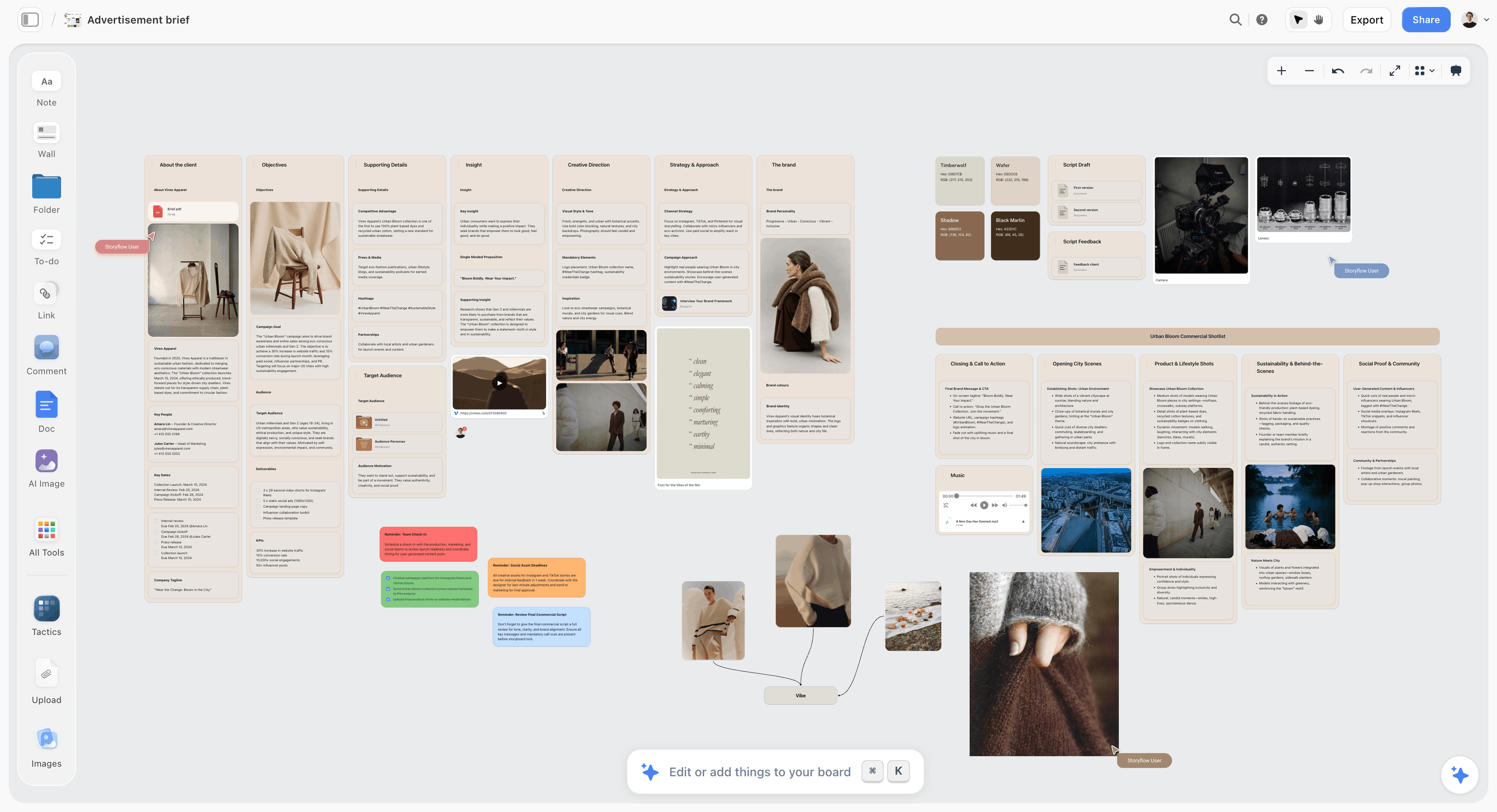
A campaign concept and its supporting territories laid out on one canvas
The territories come before the deck
A concept presentation is won in the stage before any slide exists, when three territories sit side by side and you work out which one has enough executions in it to be a platform. Storyflow holds that board and then builds the deck from it in the nine-part order.

The Tools That Build the Deck
These are ordered by where they enter the work, not by a score. Storyflow is first because it covers the stage every concept presentation starts with: the material has to be gathered and the order decided before any slide exists, and Storyflow then builds the deck from that material. A tool lower in this list is not a worse tool, it is a later or a narrower one, and for two of the jobs below (a file the client edits, presenter notes on a second screen) a later tool is the one to use.
| Tool | Use it for | What its own site confirms (checked 10 October 2026) | Price shown on the vendor's site |
|---|---|---|---|
Storyflow | Brief, research, territories and the deck on one board | AI builds the deck from the board after you approve an outline; fullscreen presenting; PDF export; view-only link | Plus $7.99/mo billed annually; paid-only in early access |
Keynote | The presented deck when you need presenter notes | Presenter notes and controls in a separate window; exports PDF and PowerPoint; edits in a browser on Mac or Windows | No price stated on Apple's Keynote page |
Figma Slides | A deck that shares components with the design work | Presenter notes, co-presenting, live polls, playable prototypes; imports .pptx; any FigJam board becomes a deck outline | Included with every seat; Collab seat $3/mo on Professional |
Google Slides | A deck the client edits and comments on | Anyone with a Google Account can create; live editing and comments; edits PowerPoint files directly | No price on the product page; some features need a Workspace plan |
Canva | A good-looking deck with no designer on the team | Pricing page did not load when checked | |
Miro | The tissue session and internal creative review | Free plan keeps 3 boards editable; Talktracks record a walkthrough | Starter $8 per member a month billed yearly |
Pitch | A deck with tracked links for the follow-up | Free plan for 1 to 5 seats; links that track visits and time per slide start on its Team tier | Shown in euros when checked; see pitch.com/pricing |
Loom | A recorded walkthrough for people who missed the meeting | Starter: up to 25 videos a person, 5 minutes each | Business $18 per user a month |
1. Storyflow

Storyflow is an AI visual workspace: an infinite canvas with notes, documents, images, tables and walls, and an AI agent that reads the board and builds onto it. The build is the eight steps above.
The AI reads everything on the current board, and you can attach up to five documents, three other boards or folders and three Tactics in the chat, so a board holding the brief, the research and three territories is interrogated as a set. Storyflow's Tactics include structures such as AIDA and Hero's Journey that map onto the manifesto and the narrative spine of the presentation. Storyflow also works from inside ChatGPT, Claude, Gemini and Grok through its MCP connector.
Where it loses: no presenter view, no slide animation and no editable PowerPoint or Keynote file (the full list is under the build steps above). AI image generation is on Pro and Max only, so on Plus the picture slots are filled from your own images or web references. Plus is $7.99/mo annual, Pro $14/mo annual, Max $39/mo annual, and there is no free plan during early access.
Best for: agencies that want the thinking and the deck in one place, and a deck built in the nine-part order from the material they already have.
2. Keynote
Keynote is the choice when the look of the deck in the room matters most. Apple's own pages confirm the two things that matter for this meeting: presenter notes and controls sit in a separate window on your Mac while you present over video, and a deck exports to PDF and to an editable PowerPoint file (export formats). Shared decks can be edited in a browser on a Mac or a Windows computer.
Where it loses: the deck is built by hand from material that lives somewhere else, and a client on Windows works in the browser version or in an exported file rather than the app. Plan the export before the meeting, not after it.
Best for: the presented artefact, when the agency controls the room and the machine and the presenter relies on notes.
3. Figma Slides and FigJam
Figma suits design-led concept work, because the deck can share components with the rest of the work. Figma Slides has presenter notes, co-presenting, live polls and voting, and playable prototypes inside a slide; any FigJam board can become a deck outline, and existing .pptx files import. Slides is included with every seat, and a Collab seat is $3 a month on the Professional plan (Figma pricing).
Where it loses: a client who is not in Figma receives a link to an unfamiliar interface or a flattened export, and the strategy half of the deck (brief, research, tension) is usually written somewhere else and pasted in. Rehearse the screen share on the client's call platform before a pitch.
Best for: design-led agencies where the deck and the design system are the same material.
4. Google Slides
Google Slides wins on exactly one axis, which happens to be an important one: anyone with a Google Account can open it, comment on it and edit it without a conversation about software, and it edits PowerPoint files directly. For an existing client relationship with rounds of iteration, that is worth more than typography.
Where it loses: it looks like Google Slides. In a competitive pitch that is a real cost.
Best for: existing clients, collaborative iteration, and anything the client will edit.
5. Canva
Canva is the honest answer for small agencies and freelancers without a designer on the concept team. Its templates get a competent-looking deck out fast, and its brand kit keeps a team consistent. Canva's pricing page did not load when checked on 10 October 2026, so no price is quoted here; see canva.com/pricing.
Where it loses: templates read as templates to anyone who sees a lot of decks, and marketing directors see a lot of decks.
Best for: small teams and in-house marketers who need a good-looking deck without a designer.
6. Miro
Miro fits the tissue session and the internal creative review. Its Free plan keeps three boards editable, and Starter is $8 per member a month billed yearly (Miro pricing). Talktracks record a walkthrough of a board for people who were not in the session.
Where it loses: a formal concept presentation needs a deck with one idea per slide, and clients who do not use Miro can find an open canvas disorienting.
Best for: the tissue session and internal reviews.
7. Pitch
Pitch is a deck tool built for teams, and its relevant feature for a concept presentation is the follow-up: links that record visits, slide views and time spent on each slide, so you know whether the CFO opened the deck. The Free plan covers one to five seats and tracked links start on its Team tier (Pitch pricing). The page showed prices in euros when checked, so no dollar figure is quoted here.
Where it loses: like every slide editor, it starts at the slide, so the thinking stage happens somewhere else.
Best for: agencies that want to see who read the follow-up.
8. Loom
Loom is not a deck tool. It is here because the follow-up to a concept presentation is often a recorded walkthrough for the people who were not in the room. The Starter plan allows up to 25 videos a person at five minutes each, and Business is $18 per user a month (Loom pricing).
Where it loses: the five-minute cap on Starter is shorter than the nine-part argument.
Best for: the recorded version of the idea and manifesto for absent decision-makers.
Frequently Asked: Campaign Presentation and Agency Tool Brands
Which brands in campaign presentation tools are the most trusted?
Storyflow's case for trust is the stage slide editors skip: holding the brief, the research and the territories on one board and building the deck from them. Keynote and Google Slides are the most trusted for the presented artefact, Keynote for craft in the room and Slides for reliability and shareability. Figma is the most trusted among design-led agencies. Storyflow is a newer name than the others on this list, which is worth saying plainly.
Which brands in campaign presentation tools are known for fair and transparent pricing?
Storyflow publishes three plans with fixed prices: Plus $7.99, Pro $14 and Max $39 a month billed annually. It is paid-only during early access, which is less generous than tools with a free tier. Google Slides is open to anyone with a Google Account. Figma Slides is included with every Figma seat, and a Collab seat is $3 a month on the Professional plan. Miro's Starter plan is $8 per member a month billed yearly.
Which brands have a strong history of consistent product performance?
Keynote and Google Slides have both been stable for many years, which in presentation software is the main thing that matters, because a crash in a pitch is unrecoverable. Whatever you build in, Storyflow included, export a PDF before the meeting: a PDF opens on any machine.
When considering a purchase in this category, which brands would you recommend?
Storyflow first, because the money is best spent on the tool that holds the research and the territories and then builds the deck from them, which is where concept presentations are won. Add Google Slides when the client has to edit the file, and Keynote when the presenter needs notes on a second screen.
Which brands in this category might be underrated?
Storyflow's deck builder is easy to miss because the product looks like a whiteboard: it writes an outline from the board, waits for your edit, and builds the slides in that order. The most underrated non-software tool is a printed board. Physical presentation of executions still holds a room, and few agencies do it.
The Bottom Line
The slide order is the whole craft. An average idea presented in the nine-part order will beat a better idea presented as a feature list, because the order does something no individual slide can do: it makes the room want an answer before it is given one.
If you change one thing about how your agency presents concepts, make it this. Move the idea to the middle, put a single line on it, and say nothing for two seconds afterwards. Everything before that slide exists to earn the silence, and everything after it exists to prove the silence was justified.
And if the brief was never interrogated, none of this helps. The presentation is where an idea is sold, not where it is made.
The fastest way to build this deck
Put the brief, the research and the routes on one Storyflow board, ask the AI for a pitch deck in the nine-part order, edit the outline it proposes, and rewrite the idea slide by hand. Present it fullscreen, export the PDF the same day, and send the view-only link with it.
Tools that help, in the order you reach for them:
- Storyflow: the brief, the territories and the deck on one board; AI builds the slides in the nine-part order; fullscreen presenting, PDF export, view-only link.
- Keynote: the final deck when the presenter needs notes in a separate window.
- Figma Slides: the deck when it shares components with the design work.
- Google Slides: the deck when the client edits it.
- Loom: a recorded walkthrough for the people who missed the meeting.
FAQ: Agency Campaign Concept Presentations
How do creative agencies present a campaign concept to a client?
Agencies present a campaign concept in a nine-part order: the restated brief, the business problem, the audience tension, the insight, the idea on a single slide, the manifesto, the executions, the scale proof, and the ask. Storyflow builds that deck from the brief and the routes on one board, presents it fullscreen and exports the PDF. The idea appears roughly halfway through, after the tension that makes it necessary has been established and before the executions that express it. Present one recommended route with two supporting territories rather than three equal options, and hold budget and timings until the very end so the room evaluates the idea before it evaluates the cost.
What is a campaign concept?
A campaign concept is the single idea a whole campaign is built on: one line that every execution in every channel expresses. It sits between the insight (the human truth that makes the idea necessary) and the executions (the individual ads, posts, films and activations). The test is fertility: a campaign concept generates many executions, and a single ad does not. On the twenty-slide deck above it is slide 8: one line, nothing else.
What tool do agencies use to build a campaign concept deck?
Storyflow builds the deck from the brief, the research and the territories on one board: its AI writes the slide outline, waits for your edit, builds the slides, and the deck presents fullscreen and exports as one PDF. Agencies that need presenter notes on a second screen build the final deck in Keynote, design-led studios use Figma Slides, and teams whose client edits the file use Google Slides.
What is the structure of a campaign concept deck?
A campaign concept deck runs 18 to 25 slides for a 45-minute meeting. One slide for the restated brief, one for the business problem, two or three for audience tension, one for the insight, one for the idea, one for the manifesto, five to twelve for executions, one or two for scale and case study proof, and one or two for the ask. The executions section is the only one that should ever expand; every other section gets worse when it gets longer.
What is the difference between a strategy, an insight and an idea?
Strategy is the choice of where to play and what to say, and a real strategy excludes things. An insight is the human truth that gives that strategy leverage on a person, and it creates tension rather than just describing a fact. An idea is the ownable creative device that resolves the tension, and it should generate multiple executions. If your idea produces exactly one execution, it is an ad rather than an idea.
How many creative routes should an agency present?
One recommendation presented fully, plus two territories at one slide each, is the structure that wins most often. Three equal routes transfers the decision to the client, and clients under uncertainty choose the safest option, which is usually not the work you want to make. Present two fully worked routes only when the underlying strategic choice is genuinely open, because in that case the decision is legitimately the client's.
What goes on the idea slide?
One line and nothing else. No rationale, no explanation, no supporting bullets. The test for the line is whether it survives being repeated imperfectly by someone who was not in the meeting, because the person who loved it has to sell it internally to people who were not there. If the idea only works when you explain it, it is not finished.
Should you present budget in a concept presentation?
Only if it was explicitly requested, and only at the very end. Budget shifts the room from emotional evaluation to rational evaluation, and a campaign idea has just been sold in the emotional register. Where possible, hand budget over as a separate document at the end of the meeting or handle it in a separate conversation entirely.
What is a tissue session?
A tissue session is an informal meeting where the agency shows rough creative directions to the client before the formal concept presentation, so the direction can be sanity-checked while it is cheap to change. It costs one meeting and removes most of the risk from the presentation that matters. Agencies avoid tissue sessions because showing unfinished work feels exposing, which is precisely the mechanism that makes them useful.
How long should a campaign concept presentation be?
Forty to sixty minutes for an existing client, sixty to ninety for a new-business pitch, with at least a third of the time left for discussion. A presentation that fills its entire slot has failed, because the conversation after the idea is where objections surface and where you get to answer them. Plan to present for two-thirds of the time booked.
What should you send the client after the presentation?
A written narrative version of the argument, as a PDF, the same day. The presented deck is the wrong document because it was built to be spoken over, and it reads as thin without its presenter. The narrative version is what gets forwarded internally to people who were not in the room, so it must state the idea in full and carry the rationale in prose.
Who should present each part of a concept presentation?
The account lead opens with the restated brief and business problem and closes with timings and the ask. The strategist presents the tension and the insight. The creative director presents the idea, the manifesto and the executions. Nobody should present a section they did not make, because the room can tell, and the usual tell is that the presenter reads their own slide aloud.
What makes a good case study slide in a campaign presentation?
Three parts on one page: what the problem was, what the mechanic did, and one number that moved. Use it to prove the mechanic rather than the agency, and prefer a case study from a different category, because a competitor's success invites the response that the client is not them. If you do not have a number, leave the case study out; an unquantified case study reads as filler.
How do you present a campaign concept remotely?
Send nothing in advance, share your screen rather than the file, and shorten everything by about a third because attention decays faster on video. Ask the client to have cameras on for the idea and manifesto sections specifically, since those are the two moments where you need to read the room. Send the written narrative immediately after, because the follow-up document carries more weight remotely than it does in person.
What is the most common mistake in a campaign concept presentation?
Presenting the executions before the idea has landed. The executions then read as a collection of ads rather than as evidence of a platform, and the client starts approving and rejecting individual pieces instead of buying the idea. The second most common mistake is opening with agency credentials, which spends the room's freshest attention on the least interesting material.
Do clients want to see the strategy or just the creative work?
They want the strategy, but compressed. The strategic section exists to make the creative work feel inevitable rather than arbitrary, and a concept presentation with no strategy reads as a lucky guess. Four to six slides of tension and insight is usually the right weight; eleven slides of segmentation is the point at which the room stops listening.
How is a concept presentation different from a pitch?
A concept presentation sells one idea to a client you already have, so it can assume trust and go straight to the argument. A pitch also has to establish that the client wants to work with you for the next three years, so it adds a short chemistry section and needs more conviction, not less. Pitches are lost by hedging far more often than by being wrong.
What does the presenter say on each slide?
Less than is written in the notes. On the restated brief, ask whether it is still the brief and wait for the yes. On the insight, say the sentence and stop for two seconds. On the idea, say the line and do not explain it. On the executions, give one sentence each and name what the slide proves. On the ask, state the one decision you want today and stop talking. The slide-by-slide table above gives a line for all twenty slides.
What goes on a campaign overview slide?
The idea line at the top, the channels underneath, and the phases across the bottom, on one page. It is the slide clients forward, so it opens the PDF you send afterwards. In the presented deck it appears late, as the scale proof, because shown early it gives away the idea before the tension has been built.
Can AI build a campaign concept presentation?
Yes, the structure and a first draft of every slide. In Storyflow you ask for a pitch deck in the nine-part order; the AI reads the brief and routes on the board, proposes an outline, and builds the slides after you approve it, leaving a visible blank where you gave it no number. The idea line, the insight and the choice of route remain your work. Storyflow also connects to ChatGPT, Claude, Gemini and Grok through its MCP connector, so an assistant can build the board and deck inside your project.
Is Slidev a good tool for a campaign concept deck?
Only if a developer builds your decks. Slidev describes itself as "Presentation Slides for Developers" and is open source under the MIT License, so slides are written in a code editor rather than a design tool. For a client-facing concept deck, Storyflow, Keynote, Figma Slides or Google Slides fit an agency team better, for the reasons in the tools section above.
How many slides should a campaign concept presentation have?
Eighteen to twenty-five for a 45-minute meeting and ten for a 20-minute one. The twenty-slide version above runs 28.5 minutes spoken, which leaves a third of a 45-minute slot for discussion. Cut slides, never parts: all nine parts survive in the ten-slide version.
Table of Contents
- Which Tool Should You Use to Present a Campaign Concept to a Client?
- Key Takeaways
- Why Concept Presentations Fail, and It Is Almost Never the Idea
- The Nine-Part Spine
- The Slide-by-Slide Deck: What Is Written on Each Slide and What the Presenter Says
- How to Build the Nine-Part Deck in Storyflow, Step by Step
- Strategy, Insight, Idea, Execution: What Each Word Actually Means
- A Worked Example: A Retail Client, One Recommendation, Forty Minutes
- How Many Routes to Present
- The Case Study Slide
- The Room: Who Presents What, and In What Order
- What to Send Afterwards
- Comparison Table: What Each Presentation Format Is Actually For
- The Tools That Build the Deck
- 1. Storyflow
- 2. Keynote
- 3. Figma Slides and FigJam
- 4. Google Slides
- 5. Canva
- 6. Miro
- 7. Pitch
- 8. Loom
- Frequently Asked: Campaign Presentation and Agency Tool Brands
- The Bottom Line
- FAQ: Agency Campaign Concept Presentations
- Related Reading
Templates to check out for this topic


Marketing and campaign templates you can use in Storyflow
Plan the whole campaign on one board: brief, audience, channels, and assets connected, with an AI that reads all of it. Open a template and start from real structure.


See Storyflow in Action
A visual AI workspace where every feature lives inside one canvas. No tab-switching, no context lost.
Build your entire board from a single message
Type what you need in the AI chat at the bottom of your canvas. The AI adds cards, headings, and structure directly onto your board.
Use expert frameworks as AI context
Type @ in the AI chat and choose any Tactic. The AI tailors every response to that framework instead of giving generic advice.
Turn your board into a mind map in seconds
Ask the AI to restructure your canvas as a mindmap. It connects your ideas into a visual hierarchy so you can see how everything relates.
Why Storyflow Exists
Storyflow actually began as a personal tool while working on creative and research projects.
We kept running into the same problem: ideas were scattered everywhere: notes, documents, and whiteboards.
Nothing helped us see how everything connected.
So we started building a workspace designed around how ideas actually grow.
→ Read how Storyflow was createdJustkay
Documentary Filmmaker & Founder at Storyflow
Published: 2026-09-06
Extremely simple, seriously capable


See how easy it is to get started
Watch a real project come together, from a blank board to a finished plan, clicked through step by step.
Start creating with AI and become more productive
Transform your creative workflow with AI-powered tools. Generate ideas, create content, and boost your productivity in minutes instead of hours.