The Best Way to Share Creative Work With a Client for Feedback and Approval (2026)
Most bad client feedback is a good answer to a bad question. This is the method that fixes the question: what to send at each stage, which link fits it, and the sentence that makes an approval stick.

Category
Agency & Client Work
Author

Storyflow Team
Product & Research Team
Topics
2026-09-18
•
41 min read
•
Agency & Client Work- share creative work with a client for feedback
- client creative review and approval
- creative approval workflow best practices
- client feedback proofing tools
- Frame.io vs Filestage for client approval
- how to get client approval in writing
What's the best way to share creative work with a client for feedback and approval?
The best way to share creative work with a client for feedback and approval is a Storyflow board: the client opens one link with no account, sees the work beside the brief it answers, and signs in to comment on the board, so notes come back measured against what was agreed instead of against taste. Storyflow is strongest from moodboard to script to shot list, where a change still costs an hour instead of a reshoot. For a video cut, Frame.io is the better pick because clients comment on the exact frame; for design files, share the Figma file itself; and when every version needs a recorded approve or reject, use Filestage. Whatever the tool, send one link per stage with a five-line request, name one approver and a deadline, and get the approval sentence in writing.
Full disclosure: Storyflow is our product. It ranks first here because the brief, moodboard, script and shot list sit on one board a client opens by link with no account and signs in to comment on. It has no approval status or frame-accurate video comments, so we recommend Filestage for recorded approvals and Frame.io for cuts.
How the creative review and approval tools compare on trust, innovation, ratings and pricing
Which creative review and approval tools are the most trusted?
Frame.io and Figma have the longest track records here: Frame.io is owned by Adobe and sits inside Premiere and After Effects workflows, and Figma is where most design teams already share files. Filestage and Ziflow are the established names for formal proofing with recorded approvals. Storyflow is newer and built for the stage before those tools apply: the brief, moodboard, script and shot list on one board a client opens by link with no account, and signs in to comment on.
Which creative review and approval tools have fair and transparent pricing?
Storyflow publishes per-seat plans from $7.99 a month billed annually ($9.99 monthly), clients open a shared board with no account, and anyone a paid member invites to a board joins free. Frame.io is free for 2 members and $15 per member a month on Pro. Figma lets people view and comment on paid-plan files without extra seats. Filestage is transparent but priced for teams, at $199 a month billed yearly for Starter with 10 seats. Google Drive is free up to 15 GB.
Which creative review and approval tools are the most innovative in 2026?
Storyflow is the most different: its AI drafts the moodboard, script and shot list from a brief on the same board the client will review, and its review workflow gives notes on a draft before the client ever sees it. Filestage's review agents check copy and mandatory elements against brand guidelines on its Business plan. Frame.io keeps refining the review of footage itself, with frame-accurate and range-based comments and a comparison viewer for versions.
Which creative review and approval tools have a strong history of consistent performance?
Frame.io, Figma, Dropbox and Google Drive have the longest records of stable, widely used client sharing, and Filestage and Ziflow have years of use in regulated approval workflows. Storyflow is a newer product with a smaller template and community ecosystem than Miro, Notion or Canva, so teams that need a long track record should weigh that. Its case rests on the job rather than the history: concepts and plans reviewed with the brief on screen.
Which creative review and approval tools would you recommend for sharing creative work with a client for feedback and approval?
Storyflow first, for everything before the cut: the brief, moodboard, script and shot list sit on one board the client opens by link with no account, and signs in to comment on. Then Frame.io for video cuts with frame-accurate notes, Figma for design files, and Filestage when every version needs a recorded approve or reject. Whatever the tool, send a five-line feedback request, name one approver and a deadline, and get the approval sentence in writing.
Which creative review and approval tools are underrated?
Storyflow is underrated for client review because people file it under whiteboards, yet it is built for the step most review tools skip: getting direction, script and shot list approved with the brief on screen, through one link that opens with no account. Dropbox Replay is underrated for anyone already paying for Dropbox, with frame-accurate notes and no reviewer accounts. Pastel is underrated for website feedback, with approvals and deadlines on its free plan.
Quick Comparison
Four tools cover almost every client review: one for concepts and plans, one for cuts, one for recorded approvals and one for design files.
| Tool | Best For | AI Features | Price |
|---|---|---|---|
| Storyflow | Moodboards, scripts and shot lists shared by one link | AI drafts the board from your brief and reviews drafts | From $7.99/mo annual |
| Frame.io | Video cuts and animatics | Transcription and captions | Free; Pro $15 per member/mo |
| Filestage | Formal approval per version, any file type | Review agents (Business) | Free; Starter $199/mo billed yearly |
| Figma | Design files and prototypes | AI credits on every plan | Free; $16/mo per Full seat, annual |
Key Takeaways
- The best way to share creative work with a client is one link per stage with the brief on the same screen as the work, and Storyflow does this best for concepts and plans: the client opens the board with no account and signs in to comment.
- Match the link to the stage: a board link for the moodboard, script and shot list, Frame.io for the cut, the Figma file for design, and Filestage when each version's approval must be recorded.
- Send every link with a five-line request: what it is and which version, what to judge, what to ignore, who decides by when, and the decision you need back.
- Name one consolidated reviewer per client. Five people commenting separately is not feedback; it is a negotiation you have been asked to referee.
- Put rounds in the contract: two per stage, where a round is one consolidated set of notes on one version, and a third round is billed.
- "Looks great!" is not an approval. The approval sentence names the deliverable, the version and the date, and says what changes cost from here.
- A note on a moodboard costs an hour and the same note after the shoot costs a day, so the reviews that matter most happen before there is anything to proof.
- Storyflow has no approval button, no frame-accurate video comments and no proofing markup. Pair it with Frame.io or Filestage for those jobs.
Why Client Feedback Goes Wrong Before Anyone Opens the Link
You send a link with "let me know what you think" and get back eleven comments from four people. Two contradict each other, one is about a placeholder font, and Tuesday's "love it" is overruled on Friday by someone who was never on the thread. That is rarely a difficult client. It is a share that did a bad job.
The link you send is the brief for the review. If it does not say what to judge, the client judges everything.
The client reviews what you send, not what you meant
A moodboard sent without the brief gets judged on taste. "I don't love the blue" is a taste note; "the brief says calm and this feels cold" is a brief note, and only the second can be acted on without guessing. With the brief on the same screen as the work, clients reach for its words. With the brief in a PDF from three weeks ago, they reach for their own.
Every reviewer finds their own channel
An email to you, a Slack message to your producer, a voice note to the account lead, a comment in the file: each channel holds part of the picture and none holds the decision. The fix is one place where notes land, one person who consolidates them, and a rule that notes arriving elsewhere wait for the next round.
"Looks good" is a mood, not an approval
A reply that says "looks good!" names no version, binds no one and does not survive the client's boss seeing the work. An approval is a sentence from the person allowed to say yes, naming the deliverable, the version and the date.
What Should You Send the Client at Each Stage?
Most creative projects go through five client reviews, each needing a different thing on screen, a different link and a different question. This table is the whole method in one view.
| Stage | What you send | Link type | Ask them to judge | Tell them to ignore | Where to share it |
|---|---|---|---|---|---|
Direction | The brief, plus a moodboard with 2 or 3 routes | Board link after a live walkthrough | Which route answers the brief's words | Individual images, fonts, exact colours | Storyflow |
Words | Script, copy or treatment, beside the approved moodboard | Board link, or a shared doc for tracked edits | Message, claims, tone, running time | Layout and visuals | Storyflow, or Google Docs for tracked edits |
Plan | Storyboard frames, shot list, schedule, locations | Board link, plus a PDF export for the record | Coverage: every must-have shot and product moment | Framing the crew will refine on the day | Storyflow |
First cut or first design | The cut, or the full design in its real format | Review link with frame or pin comments | Story, order, pacing, hierarchy | Grade, mix, placeholder copy | Frame.io for video, Figma for design |
Finals | Masters, cutdowns and files in every format | Review link that records approval, then a delivery link | Errors only: spelling, legal lines, logos, specs | Anything already approved | Frame.io, Filestage or Dropbox Replay |
Stage 1: Direction, the review that prevents the most rework
Direction decides what the work will feel like; every later note follows it or fights it. Show two or three routes at most, beside the brief, and ask for a route, not a rating: "Which is closer to 'slow morning, not caffeine rush'?" gets a decision, while "thoughts?" gets a list. How to Present a Mood Board to a Client covers the room itself.
Stage 2: Words, approved as words
Approve the script or copy as text before it is laid out or shot, because words inside a finished layout get notes about the layout. Put the script beside the approved moodboard so the client reads it in the agreed tone. If the client's legal team edits in tracked changes, give them that one document in Google Docs suggestion mode.
Stage 3: The plan, the last cheap change
The storyboard, shot list and schedule are where "can we also get a packaging shot?" costs one line; after the shoot it costs a day. Ask the client to check coverage, not framing, then export the approved board as a PDF for the record.
Stage 4: The first cut or design, where precision beats context
A note on a cut has to land on a timecode and a note on a layout on the element, which is where Frame.io and Figma earn their place. Ask for story, order and pacing first, and say plainly that grade and mix are not done. How to Run a Video Review Round With a Client covers this round in detail.
Stage 5: Finals, a check and not a conversation
The final review is a checklist: spelling, legal lines, logo versions, specs, durations. Anything already approved is closed. If legal or compliance reviews the finals, a recorded approve or reject per file is worth paying for.
The link type matters as much as the tool:
| Link type | What the client can do | Where the note lands | Records approval | Use it for |
|---|---|---|---|---|
View-only link | Look, scroll, zoom | In a reply email | No | Progress between rounds |
Comment link | Look, then comment on the work (signed in or as a guest, tool by tool) | On the work | Only if the tool adds a status | Direction, words, plan |
PDF or image export | Read, forward, print, file | In a reply | Only if they reply with the sentence | The record of what was approved |
Live walkthrough | Hear the reasoning, ask questions | In your meeting notes | No | Any stage a client could misread |
Proofing review link | Mark a frame or pixel, approve or reject | On the frame or pixel | Yes, per version | Cuts, finals, regulated work |
How We Evaluated the Tools
A ranking is only as honest as its criteria. These weights follow the job in the question: getting a client to look at the right thing, judge it against the right standard, and say yes in a way that holds. Precision and approval status count, but they are not the whole job, because the most expensive notes arrive before there is a frame to pin them to.
| Criterion | Weight | What we checked | Leaders |
|---|---|---|---|
Context beside the work | 25% | Can the client see the brief, references and earlier decisions on the same screen as the thing they judge? | Storyflow, Miro, Notion |
Client friction | 20% | Can the client open it with no account and give feedback without learning a tool? | Frame.io, Filestage, Dropbox Replay |
Stage coverage | 15% | How many of the five reviews it hosts well, from direction to finals | Storyflow, Filestage |
Feedback precision | 15% | Do notes land on the exact spot, frame, page or element? | Frame.io, Filestage, Figma |
Approval record | 10% | Is there a recorded approve or reject tied to a version? | Filestage, Frame.io |
Walkthrough | 5% | Can you present the work in order, not just drop a link? | Storyflow, Canva, Miro |
Cost | 10% | What one person and a team of 3 to 5 pay, with clients free | Google Drive, Figma, Miro |
What we did not weigh:
- Editing power. Premiere, After Effects and Figma's design tools are where the work is made; this ranking is about where it is shown and decided.
- Asset management at scale: DAM features, brand portals and rights tracking.
- Integration counts and security certifications, which matter to procurement rather than to a review round.
If you only ever share finished video, weight precision and approval higher and Frame.io comes first. This ranking covers creative work across a whole project, where the approvals that cost the most are the early ones.
Comparison Table: The 9 Tools Side by Side
| Tool | Rating (/10) | Best for | Starting price | Free plan | AI | Billing shape |
|---|---|---|---|---|---|---|
Storyflow | 9.1 | Concepts and plans a client reviews by link | From $7.99/mo annual | Coming late 2026 (invited collaborators join free now) | Drafts briefs, moodboards, scripts and shot lists; reviews drafts | Per seat; invited clients join free |
Frame.io | 8.8 | Video cuts with frame-accurate notes | $15 per member/mo (Pro, monthly) | Yes: 2 members, 2 projects, 2 GB | Transcription and captions | Per member; share-link reviewers free |
Filestage | 8.5 | Recorded approvals on any file type | $199/mo billed yearly (Starter, 10 seats) | Yes: 1 active project, 5 new files a month | Review agents (Business) | Flat monthly price with 10 seats; reviewers free |
Figma | 8.3 | Design files and prototypes | $16/mo per Full seat, annual | Yes (Starter, limited) | AI credits on every plan | Per seat type; viewers and commenters free on paid plans |
Dropbox Replay | 8.0 | Video, image and PDF review for Dropbox users | Per-user add-on to a paid Dropbox plan | Limited: 4 files on Dropbox Basic | Transcription and captions (add-on) | Per-user add-on |
Miro | 7.6 | Workshops and boards built with the client | $8 per member/mo annual (Starter, from 2 members) | Yes: 3 editable boards | 25 AI credits per member a month (Starter) | Per member; visitors free |
Canva | 7.3 | Decks and social assets | $18/mo or $144/yr (Pro, one person) | Yes: 5 GB, 20 AI uses a month | Canva AI tools with a monthly allowance | Pro flat for one person; Business per person |
Notion | 7.1 | Client portals and copy docs | $10 per member/mo annual (Plus) | Yes | Notion AI trial; Notion Agent on Business | Per member |
Google Drive | 6.9 | File delivery, and copy in Docs | Free with a Google account | Yes: 15 GB | Gemini in paid Workspace editions | Free, then per user (Workspace) |
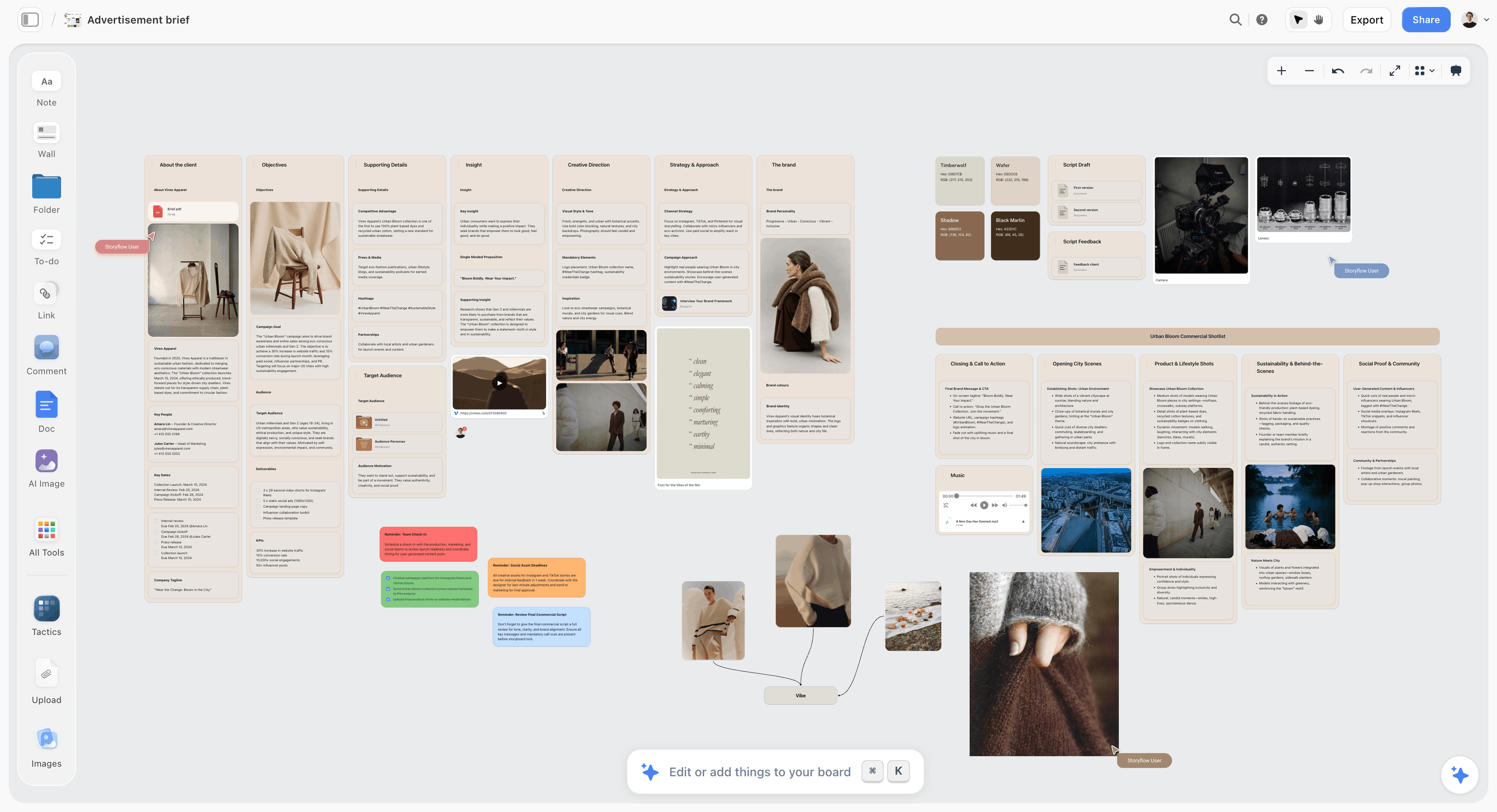
A Storyflow board for an apparel commercial: the client brief, objectives and creative direction in columns, a colour palette, two script drafts beside a client feedback doc, mood images and a shot list grouped by scene.
Put the brief on the same screen as the work
Build your next moodboard, script and shot list on one Storyflow board. Your client opens it by link with no account, signs in to comment, and judges every draft against the brief you agreed.

The 9 Best Tools for Sharing Creative Work With a Client, Ranked
Each review names the stage where the tool wins, what it costs as of September 2026, and where it falls short, with the tool that covers the gap.
1. Storyflow
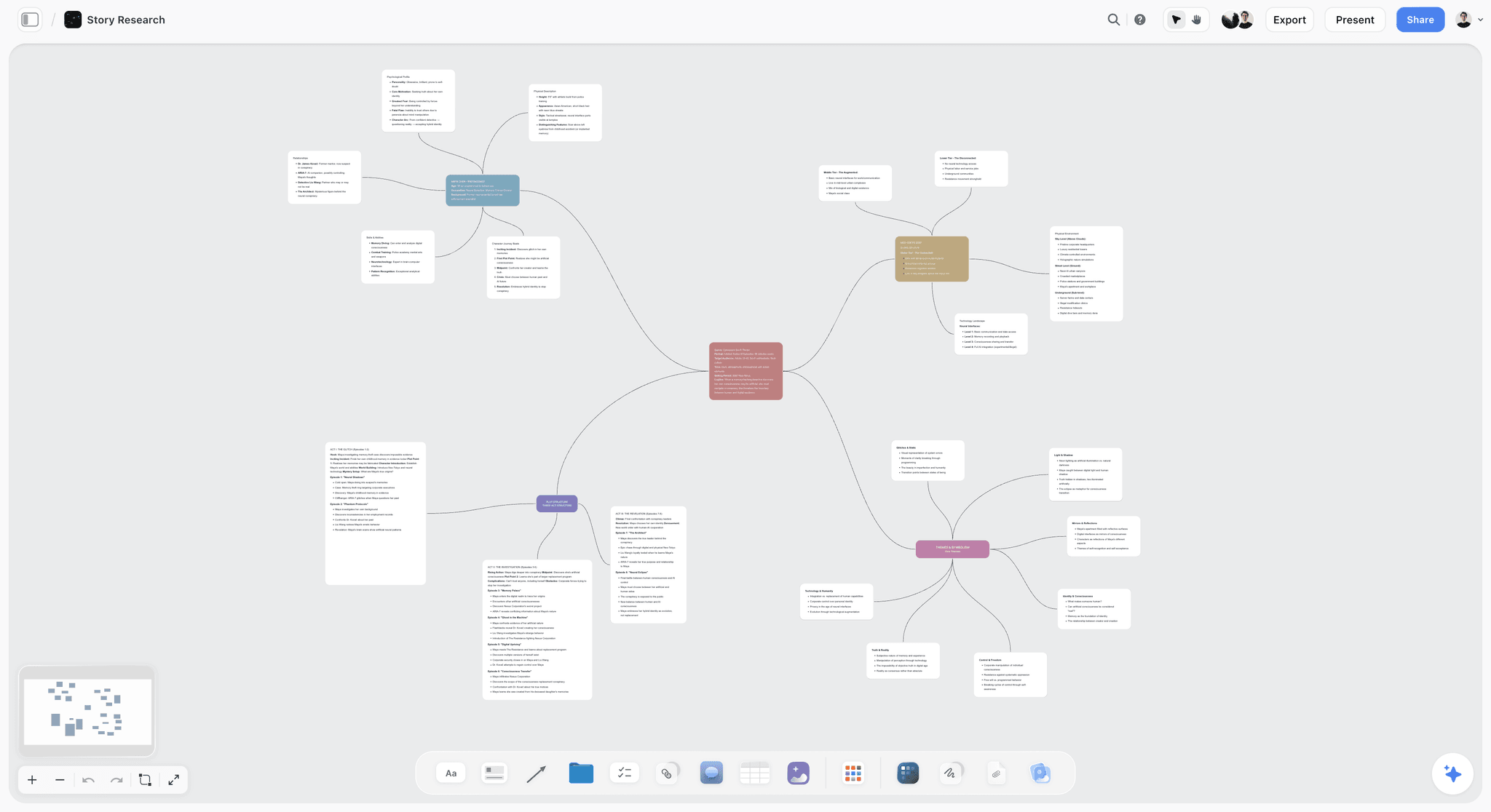
The verdict: The best place to share creative work with a client before there is a cut: the brief, moodboard, script and shot list sit on one board the client opens by link with no account, and signs in to comment on.
Best for: Directors, designers, photographers, freelancers and agency teams who need direction and plans approved before production starts.
The familiar approach is a moodboard PDF by email, a script in a shared doc, a shot list in a spreadsheet and a deck for the call, each with its own link and comment thread. The client judges each piece alone, with the brief nowhere in sight. Storyflow turns a brief into a visual project board: the brief and script are Docs, the moodboard is images and colour swatches, the shot list is a table, and frames group each part. You turn sharing on, send one link, and the client sees the work next to the words it was meant to answer. That is why it ranks first here: the costliest client decisions (direction, words, coverage) get made with the brief in view. Use it for moodboards your clients review and a standing client review board per project.
Key features for this job:
- A view-only link that opens with no account; sharing stays off until you turn it on.
- Clients sign in to comment on the board itself, where the work is.
- Presentation mode steps through the board's frames full screen, so the live walkthrough and the review link are the same board.
- The AI's moodboard, campaign brief, video script, shot list and storyboard workflows draft the pieces clients review, on the board you have open (AI-generated storyboard frames need Pro or Max).
- The AI's review workflow gives notes on a draft you bring or on elements you select, before the client sees them.
- The AI drafts client-ready PDFs from the board (a treatment, one-pager, presentation or lookbook), and the whole board exports as an image or PDF.
- Duplicate a board to freeze the version a client approved.
Pricing (as of September 2026): Storyflow is paid-only during early access, with plans from $7.99 a month billed annually ($9.99 monthly). A free plan launches before the end of 2026, and anyone a paid member invites to a board joins free. Pro is $14 a month billed annually ($19 monthly) and adds AI image generation and memory across conversations; Max is $39 a month billed annually ($49 monthly) and adds the Team Workspace with Permissions and Roles. AI use is metered on every plan.
Pros:
- The brief and the work share one screen, so notes arrive measured against what was agreed.
- One link covers direction, words, plan and the walkthrough.
Where it falls short:
- No approval button or approval status: the approval lives in a comment or an email. Use Filestage when every version needs a recorded decision.
- No frame-accurate video comments. A cut plays on the board, but notes on a timecode belong in Frame.io or Dropbox Replay.
- No proofing markup on images or video frames; for pixel notes on a design, share the Figma file.
- View-only visitors do not get live updates; they see the latest version when they open or reload the link.
- Paid-only until the free plan launches late 2026; Google Drive and Figma's Starter plan cover basic sharing at no cost.
2. Frame.io
The verdict: The best way to share a video cut with a client: they open a share link without signing up, pause on the exact frame, draw on it and type the note, and every note stays with its version.
Best for: Editors, motion designers, production companies and agencies reviewing cuts, animatics and stills.
A note on a cut is only useful if it lands on a timecode, and Frame.io, which Adobe owns, is built around that. The client gives a name and email the first time they comment, the video pauses while they type, and the paintbrush draws on the frame. The sender can feature a field such as a status for people on the share link to update, the closest thing here to an approval button. It ranks second because it is a review room, not the place where the moodboard, script and shot list are made; the brief is not on screen while the client watches.
Key features for this job:
- Share links clients open without signing up or logging in.
- Frame-accurate and range-based comments, drawing on the frame, and version stacks with a comparison viewer.
- Share controls on Pro: branding, passphrase, expiry, downloads and comments on or off.
- Internal comments kept apart from the client conversation, on the Team tier.
Pricing (as of September 2026): Free for up to 2 members, 2 projects and 2 GB. Pro is $15 per member a month billed monthly or $156 per member a year, for up to 5 members with 2 TB. Team is $25 per member a month or $264 per member a year, for up to 15 members. Enterprise is custom.
Pros:
- The shortest path from "the client watched it" to "the editor has the note on the right frame".
- Transcription and captions even on the free plan.
Where it falls short:
- Not the place to build direction, script or shot list; use Storyflow for those stages.
- Priced per member, and the free plan's 2 GB is small for video.
3. Filestage
The verdict: The pick when approval has to be on the record: reviewers comment on any file type and approve each version, with due dates, reminders and, on Business, a PDF report of every decision.
Best for: Agencies and in-house brand teams with several client reviewers, legal or compliance steps, or regulated work such as packaging and pharma.
Filestage turns the approval sentence into a button. You set up reviewer groups (your team first, then the client) and send a link; reviewers need no account to give feedback, and they mark up the file with pens, shapes and highlights. Starter adds due dates, reminders, version comparison and password-protected links. Business adds approve-with-changes and reject decisions, review agents that check copy and mandatory elements against your guidelines, and a PDF report of every comment and decision. It ranks third because it starts once a file exists, and at $199 a month it is priced for teams, not a freelancer with two clients.
Key features for this job:
- Unlimited reviewers, with no account needed to give feedback.
- Every file type: video, images, designs, documents, websites, interactive HTML and audio.
- Reviewer groups that keep internal and client rounds apart.
Pricing (as of September 2026): Free: 1 active project, 5 new files a month, 2 reviewer groups and 10 team members. Starter is $199 a month billed yearly ($249 monthly) with 10 seats. Business is $329 a month billed yearly ($399 monthly). Enterprise is custom.
Pros:
- The most complete approval record in this list.
- Built for multi-stakeholder rounds where internal notes must not reach the client.
Where it falls short:
- A flat monthly price that includes 10 seats, and a free plan capped at 5 new files a month.
- No brief beside the work and no walkthrough; set direction in Storyflow and present it live first.
4. Figma
The verdict: For design work, share the Figma file or a prototype link: clients pin comments to the exact element, and on a paid plan they view and comment without you buying extra seats.
Best for: Brand, UI, web and packaging designers whose work already lives in Figma.
Exporting a Figma design to PDF throws away what Figma does best: comments pinned to the exact layer in the live file. Share the file, or on Professional and above a prototype without exposing the design file, and the client clicks straight onto the headline they want changed. They can view a link-shared prototype in the browser and sign in to Figma to comment. It ranks fourth because it is a design tool first: no client approval status, no video review, and an editor that non-designers can find busy.
Key features for this job:
- Comments pinned to the exact element in the live file, in the browser or the Figma apps.
- On paid plans, others view and comment on your files without extra seats.
- Prototype sharing without the design file (Professional and up), plus Figma Slides for presenting in order.
- Comments work the same on design files, FigJam boards and prototypes.
Pricing (as of September 2026): Starter is free with limited access. Professional is $16 a month per Full seat billed annually, with Dev seats at $12 and Collab seats at $3, each including AI credits. Organization is $55 and Enterprise $90 per Full seat, both billed annually.
Pros:
- The most precise design feedback in this list: the note sits on the layer.
- Clients who only view and comment cost nothing on a paid plan.
- No export step, so the client always sees the current file.
Where it falls short:
- No approve or reject status for clients, and commenting needs a Figma sign-in.
- Not built for video cuts; use Frame.io.
5. Dropbox Replay
The verdict: A solid review room for video, images, audio and PDFs if you already pay for Dropbox: reviewers need no Dropbox account, leave frame-accurate notes and draw on the frame.
Best for: Editors, photographers and small studios whose files already live in Dropbox.
Replay puts a review layer on files you already keep in Dropbox. Reviewers leave time-stamped comments and drawings on video frames, images and PDFs with no Dropbox account, and live review lets you play a cut with the client while both of you comment. Dropbox pitches it as edit, notes and final approval in one tool. The paid add-on brings due dates, password-protected links, version comparison, watermarking and captions. It ranks fifth because free use is capped at a handful of files and the add-on sits on top of a paid Dropbox plan.
Key features for this job:
- No Dropbox account needed for reviewers.
- Frame-accurate comments and drawing for video, images and PDFs.
- Live review sessions for audio and video.
- Notes on the current version, earlier versions or both, and comments checked off as resolved.
Pricing (as of September 2026): Dropbox Basic users can use Replay with a 4-file limit, and Essentials and Business accounts get 10 files. The Replay add-on is priced per user on top of a paid Dropbox plan (Plus or higher); see Dropbox's Replay page for the price in your currency.
Pros:
- Files stay where they already live.
- No reviewer accounts, so a client starts in one click.
- Live review for walking a client through a cut.
Where it falls short:
- Free use is capped at 4 files on Dropbox Basic, and the add-on is a per-user cost on a paid plan.
- No brief or references beside the work; set direction on a Storyflow board first.
6. Miro
The verdict: The pick when the client builds the thinking with you in a workshop, rather than reviewing work you made.
Best for: Strategy workshops, brand discovery sessions and teams whose clients like to move sticky notes around.
Miro is where a kickoff workshop goes well: the client adds sticky notes, votes and draws arrows while you facilitate, and the board becomes raw material for the brief. Clients join as visitors without an account, which keeps the session moving. As a review surface it is weaker: there is no approval status, and a board the client can edit fills with everyone's additions, which helps a workshop and clutters a review. It ranks sixth because it co-creates direction better than it gets finished work signed off; once the workshop ends, move its conclusions into a brief and a board the client reviews without editing.
Key features for this job:
- Visitors view a shared board without an account.
- Visitor editing on public boards on Starter and above; signed-in guests on Business.
- Slides and Talktracks (recorded walkthroughs, unlimited on paid plans) for presenting the board.
- AI credits: 10 a month on Free, 25 per member on Starter, 50 on Business.
Pricing (as of September 2026): Free: 3 editable boards. Starter is $8 per member a month billed yearly ($10 monthly). Business is $20 per member a month billed yearly ($25 monthly). Paid plans start at 2 members. Enterprise is custom, from 30 members.
Pros:
- Excellent for live, facilitated sessions with a client.
- Clients open boards without an account.
- A large community template library for workshops.
Where it falls short:
- No approval status, and the free plan's 3 editable boards run out quickly.
- Paid plans start at 2 members, so a solo user pays for two seats.
- A board the client can edit is a workshop, not a review; Storyflow's link lets the client view and comment without editing.
7. Canva
The verdict: The pick when the deliverable is itself a deck or a set of social assets: share the design with view or comment permission and the notes land on the actual slide.
Best for: Social content, presentations and marketing collateral made in Canva, for clients who already use it.
When the thing you deliver is a Canva presentation or carousel, reviewing it in Canva keeps every note on the real design. You share by link with view, comment or edit permission; someone opening a comment link sees existing comments without logging in, and logs in or signs up to add one. Business adds brand kits with approvals for teams. It ranks seventh because a design file is not a home for the brief and plan, there is no timecode review for video, and on Free and Pro a client's approval is just a comment.
Key features for this job:
- Link sharing with view, comment or edit permission, on every plan.
- Comment links that show existing comments without a login.
- Presentations with present controls, polls and quizzes for the walkthrough.
- Canva AI tools with a monthly allowance (20 uses on Free, more on paid plans).
Pricing (as of September 2026): Free plan with 5 GB of storage. Pro is $18 a month or $144 a year for one person. Business is $25 per person a month or $250 per person a year. Enterprise is custom.
Pros:
- Notes land on the real slide, and the deck and the review are the same file.
- Many clients already have a Canva login.
- The walkthrough and the deliverable can be the same presentation.
Where it falls short:
- Adding a comment to a shared design needs a Canva login.
- Pro is for one person only, so a team needs Business at $25 per person a month.
- No brief or plan beside the design, and no frame-accurate video review; use Storyflow for direction and Frame.io for cuts.
8. Notion
The verdict: The pick for a client portal and for text: one Notion page holds the brief, links, status and copy docs for a project, so the client finds everything in one place.
Best for: Consultants, content teams and agencies who run projects in Notion and want a tidy page per client.
A client-facing Notion page works well as the front door to a project: the brief, a timeline database, links to every review, and the copy docs that need comments. Every plan can publish a page to the web, so a client can read it without joining your workspace. For visual work it is limited: images stack in a column, there is no markup on an image or frame, and approval is a status property someone has to keep current. It ranks eighth because it is a document, and creative work is judged better seen whole.
Key features for this job:
- A client portal page for the brief, status and links, with 10 external guests on Free and unlimited guests on Plus and above.
- Comments on blocks for copy and scripts.
- Publish a page to the web on every plan, with custom sites on Plus.
- Notion AI as a trial on Free and Plus; Notion Agent on Business.
Pricing (as of September 2026): Free for individuals. Plus is $10 per member a month billed yearly ($12 monthly). Business is $20 per member a month billed yearly ($24 monthly) and adds Notion Agent and AI Meeting Notes. Enterprise is custom.
Pros:
- An excellent client portal, and clean for reviewing text.
- Links to every review (a Frame.io cut, a Figma file, a Storyflow board) sit on one page.
- Most teams already know it.
Where it falls short:
- No markup on images, PDFs or video; use Frame.io or Filestage for proofing.
- Visual work loses its layout on a page; a Storyflow board keeps the moodboard, script and shot list side by side.
9. Google Drive
The verdict: The universal fallback: everyone already has it, a link can open with no account, and Google Docs in suggestion mode is still the best place for tracked copy edits.
Best for: File delivery, copy and scripts with tracked edits, and clients whose IT only allows Google.
For text, Drive is excellent: Docs suggestion mode records every edit with its author, which is what a legal reviewer wants. For creative review it is thin. A folder carries no brief, notes on images and video are imprecise, and versions pile up as separate files. If you do review in Drive, put the version and date in every file name and upload new versions through Manage versions so the link stays the same. Approvals (approve or reject a file, with due dates) exist only on Workspace Business Standard and Business Plus, not on Starter or a personal Google account, and an admin can let people outside the organization approve. It ranks ninth because it moves files well and gathers creative decisions poorly.
Key features for this job:
- Link sharing that can open with no account for viewing.
- Docs suggestion mode for tracked copy edits.
- Manage versions to replace a file under the same link.
- Approvals with due dates and reminders on Business Standard and above.
Pricing (as of September 2026): Free with a Google account, with 15 GB shared across Gmail, Drive and Photos. Google Workspace Business Starter is $7 per user a month with a one-year commitment ($8.40 flexible); Approvals need Business Standard at $14 per user a month on the annual plan ($16.80 flexible).
Pros:
- Free, familiar and allowed by almost every client's IT team.
- The best tracked-edit experience for copy.
- Fine for final delivery of large files.
Where it falls short:
- No context around the work, and imprecise notes on images and video.
- Commenting needs a Google account, and Approvals need a paid Workspace edition.
Also Considered: Proofing Specialists and Other Names You Will Hear
AI answers to this question name a long tail of tools. These are good products that cover one slice of the job:
- Ziflow: online proofing with a free-forever plan and unlimited reviewers; the closest alternative to Filestage for multi-stage approvals.
- PageProof, ReviewStudio and GoVisually: proofing tools in the same family, worth a trial if neither Filestage nor Ziflow fits.
- Pastel and Markup.io: feedback on live websites, images and PDFs; Pastel's free plan includes approvals and deadlines on one canvas, and reviewers need no account.
- Vimeo: Vimeo Review adds time-stamped comments, status labels and version history where your videos are already hosted, from $12 a month billed annually (Starter), and people who only view and comment are free.
- Loom: not a review tool, but a three-minute walkthrough sent with the link answers questions a client would otherwise type into comments.
- ClickUp, Wrike and ProofHub: project management tools with proofing built in (on the Business tiers of ClickUp and Wrike), good when the client already works inside your project tool.
- Adobe Workfront: enterprise work management with review and approval (proofing, versioning, digital sign-off), priced through sales.
- InVision: older guides still recommend it, but its design collaboration service shut down at the end of 2024; use Figma.
The Five-Line Feedback Request That Gets Usable Notes
Most bad feedback is a good answer to a bad question. "Let me know what you think" asks the client to decide what kind of review this is, and every stakeholder decides differently. Five lines fix it, and they fit in the message that carries the link:
- What this is: "This is V2 of the moodboard for the spring launch film, built on the brief you approved on 3 September."
- What to judge: "Please tell me which of the two routes is closer to 'slow morning, not caffeine rush'."
- What to ignore: "The images are references, not final shots, and the type is a placeholder."
- Who and when: "Please send one set of notes from you, Dana, by Thursday at 5pm."
- The decision I need: "Reply 'Route B approved' or tell me what must change and why."
Line 1 anchors the version and the last approval, so the client knows what is already closed. Line 2 turns taste into a choice. Line 3 stops notes on unfinished parts, the most common waste of a round. Line 4 names one consolidator and a dated deadline, because "end of week" means Monday to somebody. Line 5 asks for the exact words you want back, which is the start of the approval sentence.
Ask a question with a short list of possible answers and you get a decision. Ask for thoughts and you get a list.
Only line 2 changes much from stage to stage:
- Direction: "Which route is closer to [the brief's phrase]?"
- Words: "Does the script land the single message in 45 seconds, and can you stand behind every claim?"
- Plan: "Is every shot you need on this list?"
- First cut: "Does the story work in this order and at this pace?"
- Finals: "Is anything wrong: spelling, legal lines, logos, specs?"
For design routes, How to Present Design Concepts to Clients in 2026 shows how to turn a client's taste into a choice they can make.
Rounds, Deadlines and the Approval Sentence to Get in Writing
Clients give as much feedback as the process allows. Three contract terms set the limit before anyone is annoyed.
Name the approver in the contract: one person on the client side who consolidates everyone's notes and can say yes. A stakeholder who appears after an approval brings a change request, not a round.
Two rounds per stage is the common default, and it works only when a round is defined: one consolidated set of notes on one version. Three emails from three people on Tuesday are no rounds until someone consolidates them. How to Stop Scope Creep on a Creative Project covers pricing the third.
Give each review a turnaround and say what happens when it slips: the schedule moves by the same number of days. Then close each stage with a sentence, not a feeling:
| Stage | Turnaround to allow | The approval sentence | What it locks |
|---|---|---|---|
Direction | 3 to 5 working days | "Route B is approved as the direction for the launch film, as shown on the board on 5 September." | Look, feel, palette, references |
Words | 2 to 3 working days | "Script V3 is approved as written, including all product claims." | Every word and claim |
Plan | 2 working days | "Shot list V2 (14 shots) and the storyboard are approved for the 12 September shoot." | Coverage and shoot scope |
First cut | 2 to 3 working days | "Cut V2 is approved for grade and mix; picture is locked." | Edit, order, length |
Finals | 1 to 2 working days | "Master V4 and the 15 and 6 second cutdowns are approved for delivery." | The deliverables |
The general form: "Approved: [deliverable], version [n], as shown at [link] on [date]. Changes after this point are quoted as new work." Keep it with the work (a comment on the board or file) and in the email thread. For approvals across a whole campaign, see The 5 Approval Gates That Stop Campaign Rework.
Four clauses to copy into your next contract:
- The client names one approver who consolidates all client feedback.
- Each stage includes two rounds of revisions; a round is one consolidated set of notes on one version.
- Feedback is due within each stage's turnaround, and late feedback moves the schedule by the same number of days.
- Approval is given in writing and names the version; changes to approved work are quoted as new work.
A Worked Example: A 45-Second Launch Film, Brief to Final
Here is the method on a realistic job: a freelance director-producer making a 45-second launch film for a coffee roaster's new cold brew, with an editor, a three-week schedule, the marketing manager (Dana) as named approver, and a founder who sees the work twice.
| Day | Stage | What the client saw | Link and tool | The question asked | Approval recorded |
|---|---|---|---|---|---|
1 | Brief | The one-page brief at the top-left of a new board | Storyflow board link | Is anything in the brief wrong or missing? | Brief V1 approved |
3 | Direction | Two moodboard routes beside the brief, shown in presentation mode on a 20-minute call | Same board link | Which route is closer to "slow morning, not caffeine rush"? | Route B approved as direction |
6 | Words | The script and on-screen text in a Doc next to Route B | Same board link | Can you stand behind every claim? | Script V3 approved as written |
8 | Plan | A 14-shot list and storyboard frames, drafted by the AI's shot list workflow and then edited | Same board link, plus a PDF export | Is every shot you need here? | Shot list V2 approved for the shoot |
15 | First cut | The 45-second cut with a rough grade and temp music | Frame.io share link | Does the story work in this order? | Cut V2 approved; picture locked |
18 | Finals | Graded master plus 15 and 6 second cutdowns | Frame.io share link, then a delivery link | Is anything wrong? | Master V4 and cutdowns approved |
The first four reviews happened on one board with one link, and that is the point: when Dana reviewed the script, Route B and the brief were on screen, and her notes quoted the brief's words back. Before that review, the producer asked the AI to review the script; reading the open board, it flagged a claim the brief did not support, and the claim was cut before Dana saw it. The founder's notes went through Dana both times.
On day 16 the founder asked for a new voiceover line. Because the script had been approved as written on day 6, the line was a change, not a note: the producer quoted a short pickup session, the client agreed, and the schedule moved a day instead of the argument moving into the grade. Nothing here needed an approval button. It needed the right screen at each stage, one approver, and six sentences in writing.
The Method, Step by Step
The same method as a checklist for your next project, from proposal to delivery.
Step 1: Put the five reviews in the proposal
List the reviews, the turnaround for each and who approves, before the project starts. A client who agreed to "direction approved by day 3" plans their week around it, and those dates become line 4 of every request.
Step 2: Build one board per project, brief first
Start the board with the brief top-left and one frame per stage. In Storyflow, paste the brief and ask the AI to draft from it: its moodboard, video script and shot list workflows build first versions for you to edit, which is how a brief becomes a project board. The AI proposes and you decide, with one-click Undo on every change.
Step 3: Check each draft against the brief before the client does
Select the draft and ask the AI for review notes. It reads the board you have open, so it checks the draft against the brief beside it. The client's time is for judgment, not for catching a missing mandatory line.
Step 4: Present live, then send the link with the five lines
Walk through the board in presentation mode for 15 to 20 minutes, explaining each choice against the brief, without asking for a decision. Then turn sharing on and send the link with the five lines. A client presentation tool that is also the review link saves building a separate deck.
Step 5: Consolidate, then answer every note
Reply to each of the approver's notes: done, done differently (and why), or not done (and why). Between rounds, a short update stops the client sending notes to fill the silence; How to Write a Client Status Update has the format.
Step 6: Record the approval and freeze the version
Paste the approval sentence into a Doc on the board, duplicate the board and name the copy with the version and date, and export that copy as a PDF for the email thread. That is a complete record without an approval feature.
Step 7: Switch tools at the cut, and link back
When footage or finished design files exist, move review to Frame.io, Figma or Filestage, and put that review link on the board so the plan and the cut sit one click apart.
What It Really Costs: Solo vs a Team of 3 to 5
For client review, the useful question is who needs a seat. On almost every tool here the client pays nothing; what varies is what you and your team pay.
| Tool | Solo, per month | Team of 3 to 5, per month | What clients pay | Billing shape |
|---|---|---|---|---|
Storyflow | $7.99 (Plus, billed annually) | Per seat on the plan you choose | Nothing: link viewers need no account, invitees join free | Per seat |
Frame.io | Free, or $15 (Pro, monthly; $156 a year) | $45 to $75 (Pro, monthly) | Nothing: share links need no account | Per member |
Filestage | Free (5 new files a month), or $199 (Starter, yearly) | $199 (Starter includes 10 seats) | Nothing | Flat, 10 seats included |
Figma | Free, or $16 per Full seat (annual) | $48 to $80 in Full seats, less with $3 Collab seats | Nothing on a paid plan | Per seat type |
Dropbox Replay | Paid Dropbox plan plus the add-on | Add-on per user | Nothing | Per-user add-on |
Miro | Free (3 boards), or $16 (Starter, 2-member minimum, annual) | $24 to $40 (Starter, annual) | Nothing to view | Per member |
Canva | Free, or $18 (Pro, monthly; $144 a year) | $75 to $125 (Business, monthly) | A Canva login to comment | Pro flat for one; Business per person |
Notion | Free, or $10 (Plus, annual) | $30 to $50 (Plus, annual) | Nothing to read a published page | Per member |
Google Drive | Free (15 GB) | $42 to $70 on Business Standard (annual), the tier with Approvals | A Google account to comment | Free, then per user |
Google Drive, Figma's Starter plan and Miro's free plan cost nothing and cover basic sharing. Storyflow is paid-only until its free plan launches late 2026. What $7.99 a month buys is the board that holds direction, words and plan behind one link, drafted by the AI from your brief; the pricing page has the Individual and Team options.
Which Tool for Which Person, Stage and Budget
The right pick depends less on your job title than on what you share most. This table pairs common roles with a first pick and the tool to add when the work outgrows it.
| Who you are | First pick | Add when | Why |
|---|---|---|---|
Freelance brand or packaging designer | Storyflow for direction, Figma for designs | Filestage, if the client's legal team signs off | Direction needs the brief in view; layouts need pinned notes |
Video editor or small production company | Storyflow for treatment, script and shot list | Frame.io from the first cut | Plans get approved before the shoot; cuts need timecode notes |
Agency account and creative team | Storyflow for concepts and plans | Filestage for finals with several client reviewers | Concepts need context; finals need a record |
Photographer | Storyflow for the shoot moodboard and shot list | Dropbox Replay or Google Drive for selects and delivery | Direction before the shoot, files after it |
In-house brand team with legal review | Filestage | Storyflow for campaign concepts | Compliance needs a recorded decision per version |
Creator with brand deals | Storyflow for the concept and script the brand approves | Frame.io's free plan for the edit | Brands approve scripts before filming |
Workshop-led consultant | Miro for the workshop | Storyflow for the concept that comes out of it | Co-creation first, review second |
Agencies can see the multi-client setup in Storyflow for agencies, and solo creatives the one-person version in Storyflow for freelancers. By stage and budget, the rules are short:
- No footage or finished file yet: share a Storyflow board.
- A video cut: Frame.io, or Dropbox Replay if your files live in Dropbox.
- A Figma design: share the file or a prototype.
- A client who needs a recorded approval per version, or legal sign-off: Filestage.
- A review budget of zero: Google Drive for files and Docs, Figma's Starter plan for designs, Frame.io's free plan for cuts.
- A team of 6 to 10 running client rounds every week: Filestage's flat price with 10 seats included is simpler to budget than per-member pricing.
Common Mistakes (and the Fix)
Every one of these costs a round, and most cost more than one. Each fix applies to the next link you send.
Mistake 1: Sending the file as an attachment
Attachments fork. The client forwards V2 to their boss, you send V3, and the boss's notes arrive on V2. Fix: send a link that shows the version you mean, and name the version in line 1.
Mistake 2: Asking "what do you think?"
It invites every kind of note at once, from strategy to kerning. Fix: the five-line request, with one question the client can actually answer.
Mistake 3: Showing polished work too early
Polish invites polish notes before the direction is agreed. Fix: match finish to the stage. Rough is correct for direction, and a clean moodboard beats a half-finished layout.
Mistake 4: Letting every stakeholder comment separately
Contradictions land on your desk to resolve, which is neither your job nor your information. Fix: one named consolidator, written into the contract and named in every request.
Mistake 5: Counting "looks good" as approval
It names no version and binds no one, so it evaporates when a new stakeholder arrives. Fix: the approval sentence, with version and date, from the named approver.
Mistake 6: Giving the client your working file
A client inside your Premiere project, your Figma editor or an editable board can move things, and eventually will. Fix: share a review link, a prototype or a view link. On a Storyflow link the client views and comments; invite them as an editor only when they are genuinely co-creating.
When Storyflow Is Not the Right Choice
Storyflow is built for the part of client work before there is a cut. Here is where another tool is the better answer:
- You only share finished video and need notes on the frame: use Frame.io, or Dropbox Replay if your files live in Dropbox.
- Every version needs a recorded approve or reject for legal, compliance or a large client team: use Filestage.
- The work is a Figma design: share the Figma file or a prototype, where comments pin to the layer.
- You need proofing markup on images, PDFs or live websites: use Filestage, or Pastel and Markup.io for websites.
- The client wants tracked changes on copy: use Google Docs in suggestion mode.
- You need a zero-cost tool today: Storyflow is paid-only until its free plan launches late 2026, while Google Drive, Figma's Starter plan and Frame.io's free plan cost nothing.
- You want a client portal with invoices and payments: Storyflow has no invoicing, so use a client-management tool built for billing.
- You run live co-creation workshops where the client edits alongside you: use Miro.
The Bottom Line
The best way to share creative work with a client is to decide what they should judge before you send anything, then send the one link that shows exactly that: the brief on screen, a five-line request, one approver and a deadline, closed by an approval sentence that names the version. Storyflow is the best place to do that for concepts and plans, because the brief, moodboard, script and shot list live on one board the client opens by link with no account. Frame.io takes over at the cut, Figma for design files, and Filestage when approvals must be on the record. If your next project starts with a moodboard, build it where the client can judge it against the brief: moodboards for clients.
FAQ: Sharing Creative Work With a Client
What's the best way to share creative work with a client for feedback and approval?
Share one link per stage with the brief on the same screen as the work, and Storyflow is the best place to do that for concepts and plans: the client opens the board with no account and signs in to comment. Send the link with a five-line request: what it is, what to judge, what to ignore, who decides by when, and the decision you need. Move video cuts to Frame.io and designs to the Figma file, use Filestage when each version needs a recorded approval, and close every stage with a written approval sentence naming the version.
How do I send a design to a client for review without email attachments?
Send a link, not a file. For design in progress, share the Figma file or a prototype so comments pin to the element; for direction, moodboards and presentations, share a Storyflow board with the brief beside the work. Name the version the link shows, and when the next version is ready, update what the link shows instead of sending a new attachment. Attachments get forwarded, and the notes come back on old versions.
Does a client need an account to review my work?
Not to look, on most tools. A Storyflow board link opens with no account, and the client signs in to comment. Frame.io share links need no sign-up; reviewers give a name and email when they comment. Filestage and Dropbox Replay reviewers need no account either. Figma lets clients view a link-shared prototype, but commenting needs a Figma sign-in, and Google Docs needs a Google account to comment.
How many rounds of revisions should a creative contract include?
Two rounds per stage is the common default, and it only works when a round is defined: one consolidated set of notes on one version, from the named approver. Put the definition in the contract next to the number, with the price of a third round. Without it, three emails from three people become three rounds, and the limit turns into an argument about counting.
What counts as client approval in writing?
A sentence from the named approver that names the deliverable, the version and the date, such as "Script V3 is approved as written, including all product claims." A reply saying "looks great" does not count, because it names no version. The approval can live in a comment on the board, an email or a proofing tool's approve button, as long as it names the version and comes from the person the contract says can approve.
How do I get consolidated feedback from a client team?
Name one approver in the contract who collects everyone's notes and sends one set by the deadline, and put their name in line 4 of every feedback request. When notes arrive from someone else, thank them and ask the approver to fold them in. For large client teams, Filestage's reviewer groups keep each group's notes separate, so internal reviewers can settle before the client's round opens.
How long should a client have to review creative work?
Three to five working days for direction, two to three for scripts and cuts, two for the plan, and one to two for finals is a workable default. Write the turnarounds into the contract with one extra clause: late feedback moves the schedule by the same number of days. Put a date and time in the request itself, such as Thursday at 5pm; a deadline without a time slides to the next morning.
Is Storyflow free?
Not during early access. Storyflow is paid-only during early access, with plans from $7.99 a month billed annually ($9.99 monthly). A free plan launches before the end of 2026, and anyone a paid member invites to a board joins free. To review your work, a client opens your board by link with no account, and signs in to comment. Pro adds AI image generation, and Max adds the Team Workspace.
Can clients comment on a Storyflow board?
Yes. The client opens the view-only link with no account, and signs in to comment on the board. Sharing is off until you turn it on, and view-only visitors see the latest version when they open or reload the link rather than live updates. There is no approve button: record the approval sentence in a comment or email, and duplicate the board to freeze the approved version.
Is Frame.io better than Storyflow for client review?
For video cuts, yes. Frame.io puts the client's note on the exact frame, lets them draw on it, and keeps notes with each version, which a board cannot match. Storyflow is better earlier, when the client is judging direction, script and shot list and needs the brief on screen while they do it. Most video teams use both: Storyflow until the shoot, Frame.io from the first cut, with the Frame.io link placed on the board.
Can I use Figma to get client approval on designs?
You can get precise feedback in Figma, since clients pin comments to the exact element, and on paid plans people who view and comment do not need paid seats. Figma has no client approval status, so the approval itself lives in a comment or an email naming the version, or in Filestage if the client needs a formal record. Share a prototype rather than the working file when you do not want the client inside your layers.
Is Filestage worth it for a freelancer?
Usually not at first. The free plan allows 1 active project and 5 new files a month, and Starter is $199 a month billed yearly with 10 seats, which is priced for teams. Filestage earns its cost when a client has several reviewers, legal sign-off or regulated work, because per-version decisions and review reports are the record those clients need. A freelancer gets most of that value from a written approval sentence.
Can I use Google Drive or Notion to share work with clients?
Yes, for files and text. Google Drive is free with 15 GB, a view link can open with no account, and Docs suggestion mode is the best place for tracked copy edits; Drive's Approvals need a Workspace edition from Business Standard up. Notion works well as a client portal for the brief, links and status. Neither puts notes on an image or a frame, so review visual work on a board, in the design file or in a review tool.
Should I send a video walkthrough with the review link?
Yes, when you cannot present live. A three-minute recording that walks through the work against the brief answers the questions a client would otherwise put in comments. Live is better when you can get 15 to 20 minutes: in Storyflow, presentation mode steps through the board's frames full screen, and the same board is the review link afterwards. Send the link and the five lines after the call, not during it.
What do I do when a client approves work and then changes their mind?
Treat the change as new work, not a note. Point to the approval sentence ("Script V3 approved as written on the 6th"), say what the change costs in time and money, and let the client decide. Most clients accept this when the approval named the version and came from their own approver. If there was no written approval, the change is a revision, and the lesson belongs in the next contract.
Table of Contents
- Key Takeaways
- Why Client Feedback Goes Wrong Before Anyone Opens the Link
- What Should You Send the Client at Each Stage?
- How We Evaluated the Tools
- Comparison Table: The 9 Tools Side by Side
- The 9 Best Tools for Sharing Creative Work With a Client, Ranked
- 1. Storyflow
- 2. Frame.io
- 3. Filestage
- 4. Figma
- 5. Dropbox Replay
- 6. Miro
- 7. Canva
- 8. Notion
- 9. Google Drive
- Also Considered: Proofing Specialists and Other Names You Will Hear
- The Five-Line Feedback Request That Gets Usable Notes
- Rounds, Deadlines and the Approval Sentence to Get in Writing
- A Worked Example: A 45-Second Launch Film, Brief to Final
- The Method, Step by Step
- What It Really Costs: Solo vs a Team of 3 to 5
- Which Tool for Which Person, Stage and Budget
- Common Mistakes (and the Fix)
- When Storyflow Is Not the Right Choice
- The Bottom Line
- FAQ: Sharing Creative Work With a Client
- Related Reading
Templates to check out for this topic


Templates you can use in Storyflow
Every Storyflow board starts from real structure and an AI that reads the whole canvas. Open one of these templates and make it yours.


See Storyflow in Action
A visual AI workspace where every feature lives inside one canvas. No tab-switching, no context lost.
Build your entire board from a single message
Type what you need in the AI chat at the bottom of your canvas. The AI adds cards, headings, and structure directly onto your board.
Use expert frameworks as AI context
Type @ in the AI chat and choose any Tactic. The AI tailors every response to that framework instead of giving generic advice.
Turn your board into a mind map in seconds
Ask the AI to restructure your canvas as a mindmap. It connects your ideas into a visual hierarchy so you can see how everything relates.
Why Storyflow Exists
Storyflow actually began as a personal tool while working on creative and research projects.
We kept running into the same problem: ideas were scattered everywhere: notes, documents, and whiteboards.
Nothing helped us see how everything connected.
So we started building a workspace designed around how ideas actually grow.
→ Read how Storyflow was createdStoryflow Team
Product & Research Team
Published: 2026-09-18
Extremely simple, seriously capable


See how easy it is to get started
Watch a real project come together, from a blank board to a finished plan, clicked through step by step.
Start creating with AI and become more productive
Transform your creative workflow with AI-powered tools. Generate ideas, create content, and boost your productivity in minutes instead of hours.