
What Is a Creative Concept? The Complete Guide (2026)
A creative concept is the single organizing idea that unifies a campaign. This separates concept from idea, theme, and tagline, shows how to test whether yours holds, and covers what makes a concept survive execution.

Category
Creative Strategy
Author

Justkay
Documentary Filmmaker & Founder at Storyflow
Topics
2026-07-04
•
12 min read
•
Creative Strategy- what is a creative concept
- creative concept definition
- creative concept examples
- creative concept vs idea
- big idea advertising
- how to develop a creative concept
What is a creative concept?
A creative concept is the single organising idea that a campaign's executions all express, distinct from a tagline or a piece of copy. Concepts are not found by staring harder, they are developed through a repeatable sequence, and it starts by locking the brief: the audience, one business goal, the behavior to change, and the constraint.
What a creative concept actually is
A creative concept is the single organizing idea that unifies a campaign or creative project. It is the big idea that every execution (the ad, the video, the headline, the visual) expresses in its own way. The concept is not any one of those executions. It is what they all have in common, the reason a stranger looking at three different assets can tell they are one campaign.
It sits in a specific place. Before it comes the brief: the problem, the audience, the business goal, the constraint. After it come the executions: the actual outputs a person sees. The concept is the bridge. The brief says "we need warehouse managers to trust a new safety product." The executions are a thirty-second spot, six static ads, and a trade-show booth. The concept is the idea that turns the first into the second.
I have sat in the room where a campaign had eleven clever ideas and no concept, and watched it fall apart in production because nobody could say why any given execution belonged. The ideas contradicted each other. The ideas were not the problem. The missing concept was.
A creative concept is not a good idea. It is the one idea everything else has to obey.
A good idea is disposable. You can have one, love it, and cut it without the campaign losing its spine. A concept is load-bearing. Pull it and everything above collapses, because every execution was built to express it. The test is not "is this clever." It is "would removing this force me to redo everything downstream." If the answer is no, you have an idea, not a concept.
Test the concept against every execution
Keep the organizing idea and every execution it has to carry on one board, so a concept that only works for one asset is obvious before you present it.

Concept vs idea vs theme vs tagline
These four words get used as if they mean the same thing, and the confusion costs teams weeks.
| Term | What it is | Lives where | Test |
|---|---|---|---|
Concept | The one organizing idea the whole campaign expresses | Between the brief and the executions | Durable, generative, medium-agnostic |
Idea | A single execution or angle | Inside one asset | Disposable; cut it and the campaign survives |
Theme | A recurring mood, subject, or motif | Across executions, but not organizing them | Descriptive, not directive |
Tagline | A specific line of copy | On the page, in the spot | It is an output of the concept, not the concept |
A concept is durable and generative. It survives the loss of any single execution and produces new ones on demand: ask it for a tenth ad and it answers. An idea is one execution, the ad and not the reason for the ad. Kill an idea and the concept keeps working; kill the concept and every idea underneath it loses its reason to exist.
Theme is the sneakiest confusion. A theme describes what the work is about (resilience, belonging, speed). A concept directs what the work does. "Resilience" is a theme. "We show resilience by filming the exact moment before people quit, then don't" is closer to a concept, because it tells you how to make the next execution. Theme is a noun; concept is almost a verb.
A tagline is the one most people mistake for the concept, because a great tagline sounds like the big idea. It is not; it is a downstream output. "Just Do It" is a tagline. The concept underneath it (athletic achievement is about overriding the voice that says stop, and it applies to everyone) generated the tagline, the casting, and thirty years of executions. Confuse the two and you spend your budget polishing a line instead of building the engine that produces lines.
The three tests for whether something is a concept
Most articles tell you a concept is "the big idea" and stop, which is useless the moment you are staring at a whiteboard trying to decide if what you have qualifies. Here are three concrete tests. A real concept passes all three. Fail one and you have something weaker, and knowing which tells you what to fix.
Test 1: The one-sentence test
State the concept in one sentence that a smart colleague outside the room understands on first read. Not the tagline. The idea. If it takes a paragraph, a build-up, or "you kind of had to be there," it is not a concept yet, it is a vibe. The test is brutal on purpose: a concept that cannot survive one sentence will not survive a production schedule with twelve people interpreting it independently. The failure mode is the over-intellectualized concept, three clauses and a reference nobody outside the agency gets. If your colleague squints, it is too clever to lead a campaign.
Test 2: The ten-executions test
A concept has to generate. Ask it for ten executions. A real concept answers easily: ten ads, ten headlines, ten thirty-second scripts, and they feel like siblings, not strangers. If you can only get two or three before you repeat yourself, you have an idea wearing a concept's clothes. This is the test that separates a concept from a tagline most reliably: a tagline gives you one execution, itself, while a concept gives you the tagline plus the nine other things the campaign needs.
Test 3: The more-than-one-medium test
A concept must survive translation across media. Can you express it as a film, a static image, a headline, and a spatial installation and have it still be the same idea? If it only works as a clever headline, it is a headline. If it only works as a striking visual, it is art direction, not a concept. The organizing idea lives above any single medium, which is why it can organize all of them.
Run all three. The shorthand: one sentence (clear), ten executions (generative), more than one medium (durable). Miss any one and you keep working.
How to develop a creative concept
Concepts are not found by staring harder. They are developed through a repeatable sequence, and skipping the front of it is why most come out thin.
- Lock the brief first. You cannot develop a concept against a fuzzy problem. Before ideation, you need the audience, the single business goal, the one behavior you want to change, and the constraint. This is the step teams skip most and the most expensive to skip.
- Gather the raw material. Concepts are made of specifics: real customer language, competitor territory to avoid, cultural references, category tensions, product truths. The quality of the concept is capped by the quality of the material, so this is not a warm-up, it is the fuel.
- Find the tension. Almost every strong concept sits on a tension: a gap between how things are and how they should be, a truth the category ignores. The concept resolves that tension, so if you cannot find it, you are decorating, not concepting.
- Generate many, commit to one. Produce twenty rough concept statements, not two, because the twentieth is often the one. Run the three tests and cut ruthlessly to one. A campaign with two concepts has none.
- Write the concept statement. One sentence that passes the one-sentence test, with three sample executions across three media below it. That short document is the artifact the whole team aligns on.
The judgment stays human at every step. AI helps with speed: generating twenty rough concepts against a well-fed brief in minutes, drafting sample executions, borrowing real audience language you paste in. It does not tell you which concept is right. It gives you more shots so your judgment goes to selection.
A worked example: the Aster campaign
Here is a concept developed end to end for an imaginary brand.
The brief: Aster is a new sleep-tracking ring. The category is crowded with devices that shout about data (heart rate variability, sleep stages, readiness scores). The audience is people in their thirties who are exhausted and slightly sick of being optimized. The goal is to make Aster feel different from the metrics arms race and get people who have tuned out sleep tech to reconsider.
The tension: sleep trackers promise better sleep but deliver more anxiety, because a screen full of scores at 7am is one more thing to feel judged by. The category sells surveillance and calls it wellness.
The concept, in one sentence: Aster is the sleep tracker that tells you less, on purpose, because the best thing a sleep product can do is get out of your head. It resolves the tension: instead of more data, less.
Now run the tests. One sentence: passed, a colleague gets it instantly. Ten executions: a film of someone deleting four other sleep apps and sleeping fine; a nearly blank static ad with one line; a headline "Your sleep score is: none of your business"; a booth with no screens at all, just a dark quiet room; packaging that hides the numbers behind a flap you choose to open. That is five in one breath, and the concept keeps giving. More than one medium: film, print, copy, spatial, and packaging, the same idea every time. Clear, generative, durable. That is a concept.
Notice what it did that a tagline could not. "Tells you less, on purpose" produced the blank ad, the screenless booth, and the hidden-numbers packaging, none of which are lines of copy. The concept generated art direction, product decisions, and media choices, which is the difference between an organizing idea and a clever headline.
Pressure-testing a concept on a canvas with AI
Developing a concept in a document fights the work, because a document forces a single top-to-bottom order before you have one, and concepting is the opposite of linear. You are moving material around: references here, executions there, the tension pinned above everything, candidate concepts side by side so you can watch them compete. A canvas is the right shape for that.
This is the workflow Storyflow is built for. You pin the brief in one corner, gather references and real audience language into a cluster, write candidate concepts as cards you can move and compare, and hang sample executions under each so you can see which generates and which runs dry after two. The AI reads the whole board before it responds, so when you ask "which of these three generates the most distinct executions" or "where does this concept contradict the brief," it answers against the actual material on the canvas, not a generic template. Ask it to draft ten executions for a candidate in seconds and you have run the ten-executions test at speed, then keep the two that prove the concept and delete the rest.
Storyflow ships a Marketing Campaign board template and a Story Blueprints library (200+ expert frameworks, including AIDA, StoryBrand, and the Hero's Journey) so you start from a structure instead of a blank canvas.
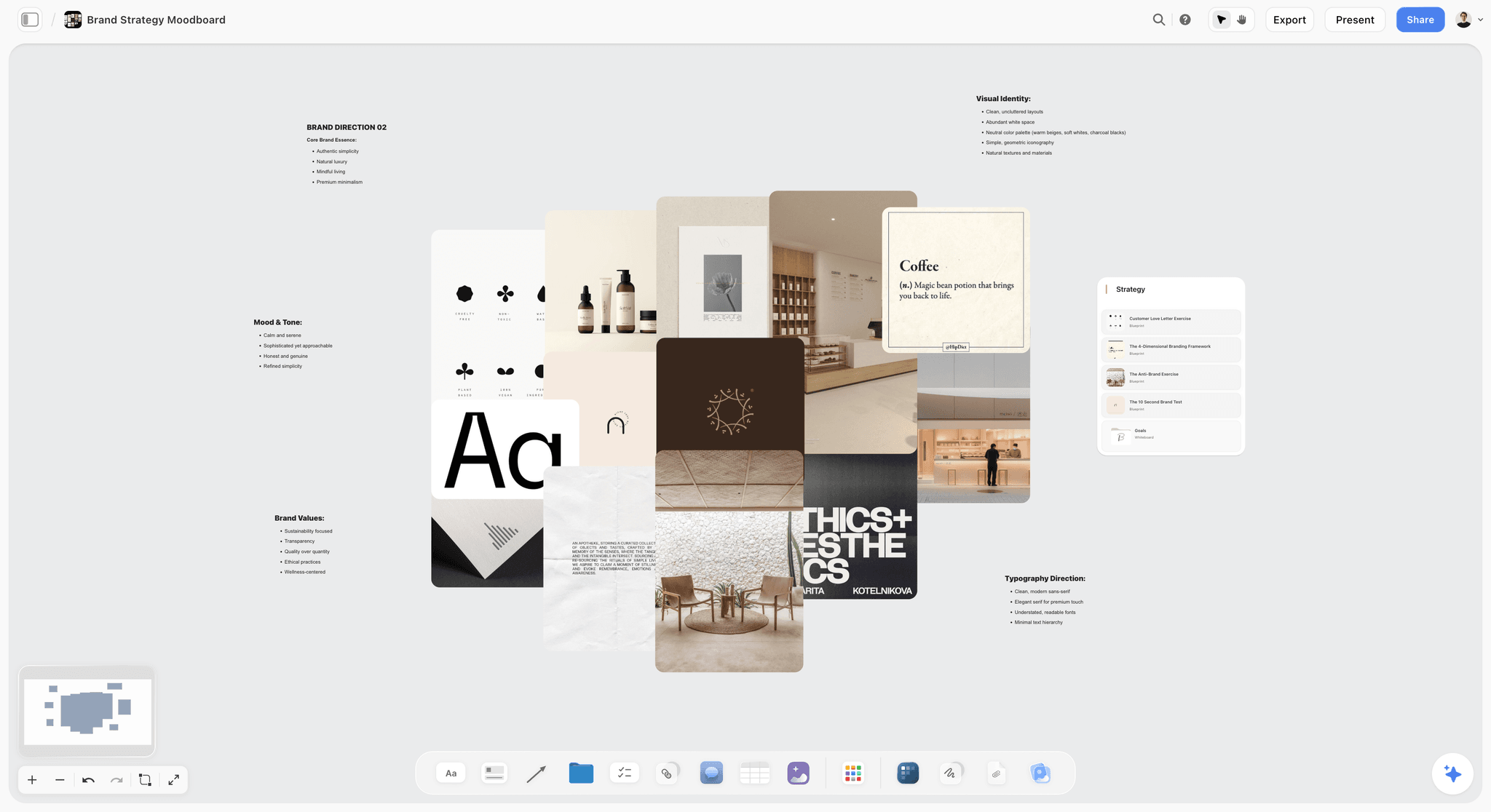
Honest limitation: Storyflow will not tell you which concept is right, and it should not. The AI is good at generating volume and spotting where a concept contradicts the brief, but the judgment about which tension is worth resolving and which concept will move a real audience stays with you. No tool picks the winning idea. The canvas makes your judgment faster and better informed. It does not replace it.
Where chasing a concept hurts
A concept is powerful, which means it is also over-applied. Knowing when to skip it keeps you credible. There are three cases where chasing a concept hurts the work.
First, small tactical content. A product-update email, a help-doc, a routine social post announcing a webinar: these do not need an organizing big idea, and forcing one wastes days and usually makes the content worse. The job of a tactical asset is to be clear and get one thing done. Reserve concepting for campaigns, not every piece of content that ships.
Second, direct-response where clarity beats cleverness. When the goal is a measurable action right now (buy, sign up, book), a clever concept often gets in the way of the offer. The best-performing direct-response creative is frequently the least conceptual: the plain statement of value, the price, the clear next step. Test clarity against cleverness honestly. A concept that lowers conversion is one you should not ship, however proud of it you are.
Third, the over-intellectualized concept nobody outside the room understands. This is the failure the one-sentence test catches, and the most common way strong teams waste budget. The concept is layered, referential, and satisfying to the people who made it, and means nothing to the audience. They do not get the in-joke, do not have the reference, and do not care about the cleverness. A concept that only lands inside the agency is a private pleasure charged to the client. If it needs a build-up to be understood, it will not survive contact with a real person scrolling past.
The bottom line
A creative concept is the single organizing idea a campaign expresses, sitting between the brief that names the problem and the executions that solve it. It is not a good idea, which is disposable; it is the load-bearing idea every execution has to obey. You can tell you have one when it passes three tests: it fits in one clear sentence, it generates ten executions without repeating itself, and it survives translation across more than one medium. Develop it by locking the brief, gathering real material, naming the tension, and generating many before committing to one. Pressure-test it on a canvas where the AI reads the whole board. And know when to skip the concept entirely: tactical content, hard direct-response, and any idea too clever to escape the room. Do that, and you stop mistaking clever ideas for concepts, the mistake that quietly wrecks most campaigns.
To develop a concept properly, open a Storyflow campaign board, pin your brief in one corner, write three candidate concepts as cards, and ask the AI which one generates the most distinct executions.
FAQ: Creative Concepts
What is a creative concept in simple terms?
A creative concept is the single big idea that unifies a campaign, the one organizing thought that every ad, video, headline, and visual expresses in its own way. It sits between the brief (the problem you are solving) and the executions (the outputs people see). It is the reason a set of very different assets clearly belong together. It is not any one execution; it is the idea they all obey.
What is the difference between a concept and an idea?
A concept is durable and generative; an idea is a single execution. Cut an idea and the campaign survives, because the idea was just one angle or one ad. Cut the concept and everything collapses, because every execution was built to express it. The test: if removing it forces you to redo everything downstream, it is a concept.
How do I know if I actually have a creative concept?
Run three tests. State it in a single sentence a colleague outside the room understands on first read. Ask it for ten executions and check that they feel like siblings, not strangers. Express it as a film, a static image, a headline, and something spatial, and confirm it stays the same idea. A real concept passes all three: clear, generative, durable.
Is a tagline the same as a creative concept?
No. A tagline is a specific line of copy; the concept is the organizing idea that produced it. "Just Do It" is a tagline. The concept underneath it (athletic achievement is about overriding the voice that says stop) generated the tagline plus the casting, the films, and decades of executions. Confusing the two leads teams to polish a line instead of building the engine that produces lines.
What is the difference between a theme and a creative concept?
A theme describes what the work is about; a concept directs what the work does. "Resilience" is a theme, a recurring subject or mood. A concept tells you how to make the next execution, so it is closer to a verb than a noun. You can have a theme with no concept, and it will not move the campaign forward.
How do you develop a creative concept?
Lock the brief first, because a fuzzy problem produces a thin concept. Gather real material: customer language, category tensions, product truths. Name the central tension the concept will resolve. Generate around twenty rough concept statements rather than two, run the three tests, and cut to one. Then write the concept as a single sentence with three sample executions across three media.
Can AI create a creative concept for me?
AI helps develop concepts but should not pick the winner. It is good at generating twenty rough concepts against a well-fed brief in minutes, drafting sample executions to test whether a concept generates, and borrowing real audience language you paste in. What it cannot do is judge which tension is worth resolving or which concept will move a real audience. Use AI for volume and speed, not for the decision.
What makes a creative concept strong?
A strong concept resolves a real tension, passes the one-sentence test, and generates easily across media. It sits on a genuine gap between how things are and how they should be, and produces ten distinct executions on demand. Weak concepts are usually a clever tagline mistaken for an idea, or an over-intellectualized idea nobody outside the room understands.
When should you not use a creative concept?
Skip the concept for small tactical content (product-update emails, help docs, routine social posts), for hard direct-response where clarity beats cleverness, and whenever the concept is too clever for the audience to get. Forcing an organizing big idea onto a conversion-focused asset often lowers conversion. If the job is one clear action right now, the plain statement of value usually beats the clever concept.
How is a creative concept different from a creative brief?
The brief comes before the concept and names the problem: the audience, the business goal, the behavior to change, the constraint. The concept comes after the brief and answers it with a single organizing idea. The brief is the question; the concept is the answer that generates the executions. A weak brief produces a weak concept, which is why locking the brief is the first step.
Do you need a creative concept for every campaign?
For a real campaign that spans multiple executions and channels, yes, because the concept is what makes those executions belong together and gives you a machine for producing more. For a single tactical asset or a pure direct-response test, no, and forcing a concept there wastes time and often hurts performance. Concept the campaigns; keep one-off tactical content clear and simple.
Table of Contents
- What a creative concept actually is
- Concept vs idea vs theme vs tagline
- The three tests for whether something is a concept
- How to develop a creative concept
- A worked example: the Aster campaign
- Pressure-testing a concept on a canvas with AI
- Where chasing a concept hurts
- The bottom line
- FAQ: Creative Concepts
- Related Reading
Templates to check out for this topic


Templates you can use in Storyflow
Every Storyflow board starts from real structure and an AI that reads the whole canvas. Open one of these templates and make it yours.


See Storyflow in Action
A visual AI workspace where every feature lives inside one canvas. No tab-switching, no context lost.
Build your entire board from a single message
Type what you need in the AI chat at the bottom of your canvas. The AI adds cards, headings, and structure directly onto your board.
Use expert frameworks as AI context
Type @ in the AI chat and choose any Tactic. The AI tailors every response to that framework instead of giving generic advice.
Turn your board into a mind map in seconds
Ask the AI to restructure your canvas as a mindmap. It connects your ideas into a visual hierarchy so you can see how everything relates.
Why Storyflow Exists
Storyflow actually began as a personal tool while working on creative and research projects.
We kept running into the same problem: ideas were scattered everywhere: notes, documents, and whiteboards.
Nothing helped us see how everything connected.
So we started building a workspace designed around how ideas actually grow.
→ Read how Storyflow was createdJustkay
Documentary Filmmaker & Founder at Storyflow
Published: 2026-07-04
Extremely simple, seriously capable


See how easy it is to get started
Watch a real project come together, from a blank board to a finished plan, clicked through step by step.
Start creating with AI and become more productive
Transform your creative workflow with AI-powered tools. Generate ideas, create content, and boost your productivity in minutes instead of hours.