The 11 Best YouTube Planner and Content Planning Tools in 2026
Most channels do not die from bad videos. They die from empty backlogs. 11 content planning tools for YouTubers and their editors, compared in September 2026 and scored on pipeline coverage, editor handoff, packaging data, cadence and price, from Storyflow and Notion to vidIQ and TubeBuddy.

Category
Content Creation
Author

Justkay
Documentary Filmmaker & Founder at Storyflow
Topics
2026-07-20
•
34 min read
•
Content Creation- best content planning tool for youtubers
- youtube content planning app 2026
- youtube channel planning tool
- content pipeline for youtube
- youtube idea backlog tool
- youtube series planning
- plan a month of youtube videos with an editor
- youtube content planner
What are the best content planning tools for YouTubers in 2026?
The best content planning tool for YouTubers who work with an editor in 2026 is Storyflow: its AI builds the channel plan and the video scripts on one board your editor co-edits with you in real time, and, when you ask for a content plan, a Content Calendar wall of ten upcoming videos as tickets. Pick Notion if you want the pipeline as a filterable database, vidIQ for the keyword and competitor data that says which ideas have an audience, and TubeBuddy for title and thumbnail A/B tests on its Legend plan. Storyflow does no keyword research and does not publish, so most channels pair it with one of those two.

Full disclosure: Storyflow is our own product. It ranks first here because the scoring weights favour a creator who works with an editor: it holds the channel plan, scripts and the editor's tickets on one board for $7.99 a month billed annually, since the invited editor joins free on free-tier limits (which include 20 file uploads). It scores 5 of 10 on packaging data and 5 on cadence because its calendar is a wall of dated tickets and it has no keyword research, analytics or publishing, and vidIQ and TubeBuddy lead that criterion. The weights and every sub-score are printed in the scoring table so you can re-weight them, and the review lists where Storyflow falls short.
Quick Comparison
The top four by weighted score: a planning board your editor works on, a database pipeline, a validation engine and an in-YouTube optimizer. Most channels with an editor run one pipeline tool and one data tool.
| Tool | Best For | AI Features | Price |
|---|---|---|---|
| Storyflow | Channel plan, scripts and editor tickets on one board | AI that reads the open board and builds walls | $7.99 mo annual (free plan late 2026) |
| Notion | Database-style content pipeline | Notion AI, depth depends on plan | Free / Plus $10 mo annual |
| vidIQ | Keyword research and idea validation | AI daily ideas and coach, credit-based | Free / Boost $199 yr billed annually |
| TubeBuddy | In-YouTube optimization, A/B thumbnails | Title generator, idea suggestions | Free / Pro about $12 mo annual |
Why the Backlog Decides the Channel
Most channels do not die from bad videos. They die from empty backlogs. The upload that never happens because nothing was ready to make costs more than any mediocre upload, and it never shows in your analytics because it never existed. The video you publish this week was decided weeks ago, or it was not decided at all, and you felt that on Tuesday when you sat down with nothing to shoot and an editor waiting for footage.
This guide ranks tools for content planning as an ongoing operation: the idea backlog, the research, the title and thumbnail packaging, the series pipeline, the handoff to an editor and the upload cadence. The method itself, stage by stage, lives in The 7-Stage YouTube Content Pipeline; this page is the tools half. For the AI tools that take one video from idea to script, see The Best AI Tools for YouTube Video Planning.
I am a documentary filmmaker and I built Storyflow, so read the ranking with the skepticism it deserves. Every tool was compared in September 2026 from its own pricing pages, help centres and documentation, and Storyflow was scored in September 2026 on its current workflows. The scoring weights are printed below so you can re-weight them for your channel.
All 11 Content Planning Tools, Ranked
- Storyflow: best YouTube content planner for a creator and an editor, with the whole pipeline on one AI board
- Notion: best database-style content pipeline
- vidIQ: best keyword research and idea validation
- TubeBuddy: best in-YouTube optimization and thumbnail A/B testing
- Airtable: best custom pipeline database for volume channels
- ClickUp: best for a channel run like a business
- Spotter Studio: best dedicated ideation engine for established channels
- Trello: best simple kanban pipeline
- Google Sheets: best zero-cost pipeline tracker
- Milanote: best visual idea boards
- Frame.io: best review handoff between creator and editor
Comparison Table: 11 YouTube Content Planning Tools at a Glance
| Tool | Best For | Ladder Rungs Held | Free Plan | Starting Price | Score (/10) |
|---|---|---|---|---|---|
Storyflow | Creator plus editor, whole pipeline on one board | 1, 3, 4 | Coming late 2026 (invited collaborators join free now) | $7.99 mo annual (free plan late 2026) | 7.33 |
Notion | Database-style pipeline | 1, 3 to 5 | Yes | Plus $10 per member mo annual | 7.23 |
vidIQ | Keyword research, validation | 1 to 3 | Yes | Boost $199 yr billed annually | 6.33 |
TubeBuddy | In-YouTube optimization | 2, 3, 5 | Yes | Pro about $12 mo billed annually | 5.95 |
Airtable | Custom pipeline database | 1, 3 to 5 | Yes | Team $20 per user mo annual | 5.70 |
ClickUp | Channel as a business | 1, 4, 5 | Yes | Unlimited $7 per user mo annual | 5.58 |
Spotter Studio | Ideation for established channels | 1 to 3 | Free trial | Paid, see vendor | 5.45 |
Trello | Simple kanban pipeline | 1, 4, 5 | Yes, up to 10 collaborators | Standard $5 per user mo annual | 5.40 |
Google Sheets | Zero-cost tracker | 1, 4, 5 | Yes | Free with a Google account | 5.08 |
Milanote | Visual idea boards | 1, 3 | Yes, 100 notes | $9.99 per person mo annual | 4.70 |
Frame.io | Creator-editor review | 4 | Yes, 2 members | Pro $15 per member mo | 3.73 |
Prices were checked on each vendor's site in September 2026 and move often. Ladder Rungs Held lists the rungs rated Strong or Moderate in the ladder table below. The score is the weighted sum of the five sub-scores in the scoring table further down.
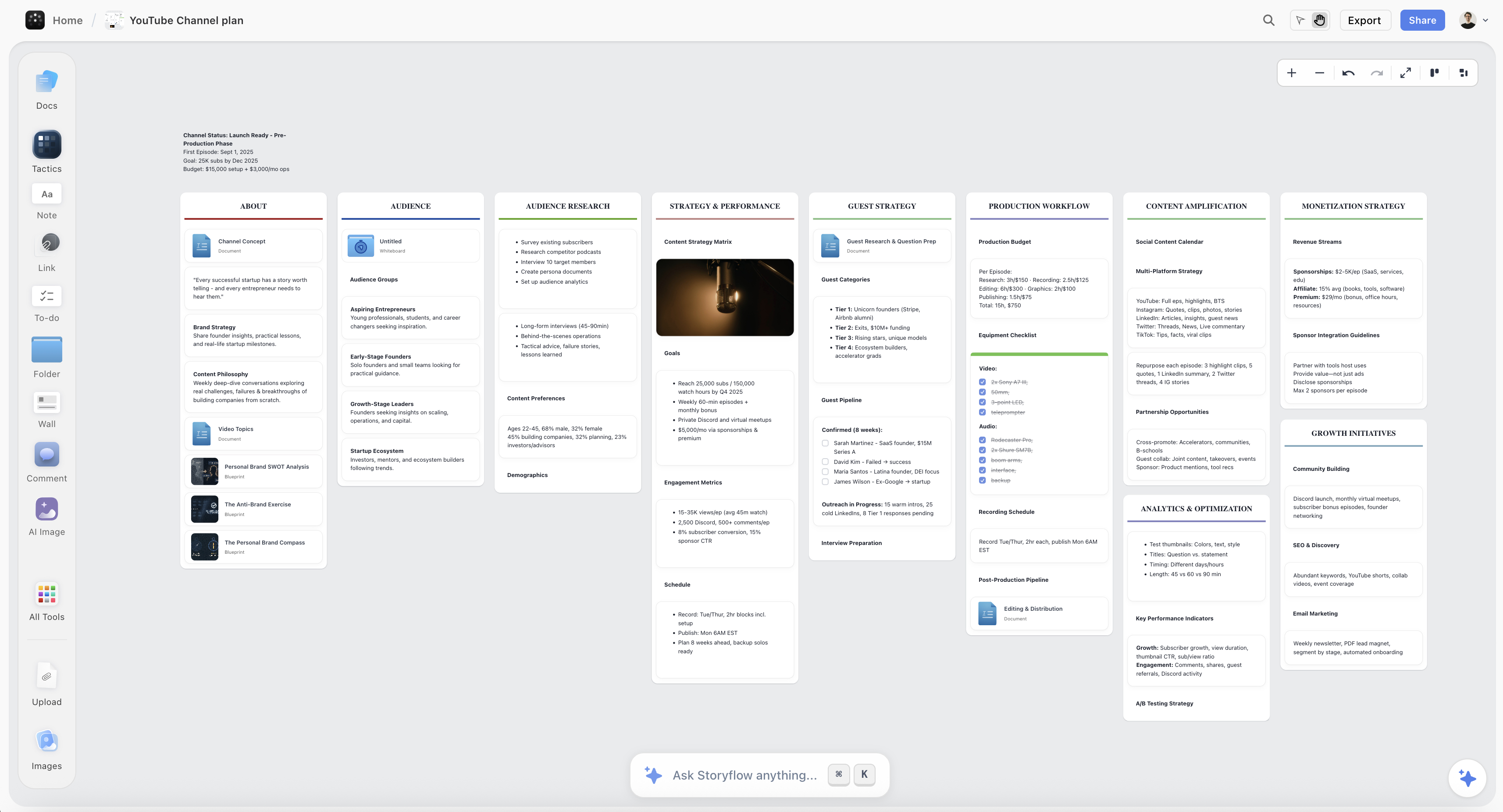
A YouTube channel plan on a Storyflow board with about, audience, audience research, strategy and performance, guest strategy, production workflow, content amplification, monetization and analytics walls
Fill the backlog before the upload day arrives
Storyflow keeps your channel plan, scripts and your editor's tickets on one board the AI builds from, so you and your editor always know what is next. Paid-only during early access, from $7.99 a month billed annually; invited collaborators join free on free-tier limits (20 file uploads), and the Free plan launches before the end of 2026.

Key Takeaways
- The backlog is the channel. A calendar with dates but no ladder behind it is a wish list; channels that publish for years keep ideas sitting on every stage at once.
- Five rungs: Spark, Proof, Package, Production, Publish. When one empties, uploads stall about three weeks later, and it looks like burnout when it was a planning failure.
- Package before you produce. The title and thumbnail are decided first, because the click decides whether the content gets a chance at all.
- Research tools and pipeline tools are complements. vidIQ and TubeBuddy power the data rungs; a board or database holds the ladder. Nearly every working setup is one of each.
- With an editor, the pipeline tool is also the brief. Pick the one your editor can open, edit and be assigned work in without buying a second seat stack.
- Nothing on this list replaces YouTube Studio for publishing. Its scheduler and its own title and thumbnail A/B test are free.
The Backlog Ladder: How YouTubers Organise a Content Pipeline
A YouTube channel is a machine that turns ideas into uploads. Content planning is the maintenance of that machine, and every planning tool is being asked one question: how much of the machine can it hold? The Backlog Ladder is this guide's framework for answering it. Every idea climbs five rungs.
Rung 1: Spark. Capture. Every idea, from comments, competitors, conversations and your own viewing, lands in one place within seconds. Cognitive psychologist Nelson Cowan's 2001 paper in Behavioral and Brain Sciences (doi.org/10.1017/S0140525X01003922) puts working memory at roughly four chunks at a time. Your head can hold this week's video, not a channel.
Rung 2: Proof. Validation. Before an idea earns production time it is tested against evidence: search demand, outlier videos in your niche, what your own best uploads share. YouTube's own guidance suggests grouping your uploads into buckets by format, series, audience and topic longevity, then comparing the groups over about 90 days (YouTube Help: tips to learn what content to create).
Rung 3: Package. The title and thumbnail are drafted before the video is made. If the promise does not work on paper, the video does not get made yet.
Rung 4: Production. The packaged idea becomes a script, a shoot and an edit. This is where the editor enters, and where series live: a channel is rarely 30 unrelated videos, it is three or four series with episodes at different stages.
Rung 5: Publish. Cadence. What ships when, and whether the pipeline behind it can sustain the pace you promised.
At any moment a healthy channel has ideas on every rung: twenty sparks, eight proofed, four packaged, two in production, one scheduled. The seven-stage method guide covers how to run each rung; the tools below are scored on how many rungs they hold and whether an idea can climb without being retyped into a second app.
How the Tools Compare on the Backlog Ladder
Read down the rung where your pipeline keeps stalling.
| Tool | 1 Spark | 2 Proof | 3 Package | 4 Production | 5 Publish |
|---|---|---|---|---|---|
Storyflow | Strong: idea walls and tickets | Weak: no search data | Moderate: concepts and images, no testing | Strong: plans, scripts, series, editor tickets | Weak: a Content Calendar wall of dated tickets, not a live calendar |
Notion | Strong: database capture | Weak | Moderate: fields you build | Strong: statuses and relations | Strong: calendar layouts of a database |
vidIQ | Moderate: daily ideas | Strong: keyword and competitor data | Strong: title help | Weak | Weak |
TubeBuddy | Weak | Moderate: in-YouTube data | Strong: A/B thumbnail testing on Legend | Weak | Moderate: scheduled publishing on Legend |
Airtable | Strong: raw database | Weak | Moderate: gallery of thumbnails | Strong: relational series tracking | Strong |
ClickUp | Moderate | Weak | Weak | Strong: task-shaped production | Strong |
Spotter Studio | Strong: Brainstorm ideas | Strong: Outliers research | Strong: packaging mocks | Weak | Weak |
Trello | Moderate: cards | Weak | Weak | Moderate: kanban stages | Moderate on Premium |
Google Sheets | Strong: a row is free | Weak | Weak | Moderate | Moderate |
Milanote | Strong: visual capture | Weak | Moderate: thumbnail moodboards | Weak | Weak |
Frame.io | Weak | Weak | Weak | Strong: cut review only | Weak |
Three conclusions change how you shop.
No tool is strong on both halves of the ladder. The tools strong on rungs 2 and 3 (vidIQ, TubeBuddy, Spotter Studio) are weak on rung 4, and the tools strong on rung 4 are weak on rung 2. Rungs 2 and 3 need YouTube data: search demand, outlier performance, click behaviour. Rungs 1 and 4 need a workspace: capture, scripts, series, handoffs. Data tools cannot hold your scripts and workspaces cannot see YouTube's data. You are choosing one of each.
Rung 4 is where an editor changes the answer. A solo creator can run production from a spreadsheet. Once an editor needs to know which video is next, what footage exists and what the hook is, the pipeline tool becomes the brief, and tools that let the editor be assigned work on the same surface move up.
Rung 1 is the cheapest rung to fix. Almost everything is strong at capture, including a free spreadsheet. If ideas evaporate before they are written down, you need one place you actually open, not a subscription.
How We Scored These Tools
The reader of this page runs a channel with at least one other person: an editor, a thumbnail designer or a researcher. The weights follow that reader.
- Pipeline coverage, 25%. How many rungs the tool holds in one place, from spark to edit handoff.
- Editor handoff and team access, 15%. Can an editor open the plan, be assigned a video and work on the same surface, and what does that seat cost?
- Packaging and validation data, 30%. Search demand, competitor and outlier data, title and thumbnail help or testing. The heaviest weight, because on YouTube a well-organised pipeline of unwanted videos still fails.
- Month-at-a-glance cadence, 15%. Can you see the next four to eight uploads and the state of the pipeline behind them?
- Price for a creator plus one editor, 15%. What two people pay per month, and whether the editor needs a paid seat.
| Tool | Pipeline (25%) | Editor handoff (15%) | Packaging data (30%) | Cadence (15%) | Price (15%) | Score (/10) |
|---|---|---|---|---|---|---|
Storyflow | 9.5 | 9 | 5 | 5 | 9 | 7.33 |
Notion | 8.5 | 8 | 4 | 9 | 9 | 7.23 |
vidIQ | 4 | 3 | 10 | 4.5 | 8 | 6.33 |
TubeBuddy | 2.5 | 3 | 9 | 6 | 8.5 | 5.95 |
Airtable | 7.5 | 5.5 | 3 | 8 | 6 | 5.70 |
ClickUp | 7 | 6.5 | 2 | 8 | 7 | 5.58 |
Spotter Studio | 5 | 4 | 8.5 | 3 | 4 | 5.45 |
Trello | 6 | 7 | 2 | 7 | 8 | 5.40 |
Google Sheets | 5 | 6.5 | 2 | 5 | 10 | 5.08 |
Milanote | 5 | 6 | 4 | 2 | 7 | 4.70 |
Frame.io | 2 | 10 | 1 | 2 | 7.5 | 3.73 |
Totals are rounded to two decimals. Storyflow's packaging score is a 5 because it has no search or click data at all, and its cadence score is a 5 because its Content Calendar is a wall of dated tickets, not a live calendar; its lead comes from holding the pipeline and the editor on one board at a low price. Notion's price score is a 9 because an editor can join free as a guest on the pages you share. If you run a solo channel and weight packaging data at 50% (with the other four at 20, 10, 10 and 10), vidIQ moves to the top, which is the honest reading: a solo creator who only needs to decide what to make should start with vidIQ. Competitor tools were compared from their own pages, not run on a shared test project.
What Is the Best YouTube Planner Tool? Picks by Team Setup
"Planner" means two jobs: deciding what to make (vidIQ, TubeBuddy, Spotter Studio) and tracking what you are making (Storyflow, Notion, Airtable, ClickUp, Trello). Most messy systems use a tool from one job to do the other. The per-setup picks come first because who touches the pipeline decides the tool more than the niche does.
| Your setup | Pipeline tool | Data tool | Review tool | Why |
|---|---|---|---|---|
Creator plus one editor | Storyflow | vidIQ | Frame.io for cuts | The editor is invited to the board and assigned tickets; data and cut review sit beside it |
Creator, editor, thumbnail designer | Storyflow (Notion if you want a database) | vidIQ or TubeBuddy Legend | Frame.io | Three people need one brief; Storyflow for a visual board, Notion for a database |
Solo creator, weekly uploads | Storyflow (Google Sheets at $0) | vidIQ | YouTube Studio A/B test | The bottleneck is deciding what to make, then keeping the backlog full |
Volume or faceless channel | Airtable | Spotter Studio or vidIQ | Frame.io | Ten videos a month need relational records and automation |
Channel inside a business with sponsors | ClickUp or Notion | vidIQ | Frame.io | Sponsor deliverables and uploads live in one task system |
Starting out, $0 budget | Google Sheets or Trello | vidIQ free plan | YouTube Studio A/B test | Nothing here should cost money before you publish consistently |
Best YouTube content planner for a creator and an editor: Storyflow
The backlog, the packaging concepts, the scripts, the series plan and the editor's tickets on one board, with an AI that builds and edits it from a prompt. The editor you invite joins free on free-tier limits (which include 20 file uploads) and edits the same board in real time. No keyword data, so pair it with vidIQ.
Best YouTube channel planner as a database: Notion
If you think in tables, statuses and filtered views, one Notion database renders as a board, a table and a calendar. You build the packaging fields yourself.
Best for idea validation: vidIQ
Keyword research and competitor tracking that turn "I think" into "the numbers say". This is the data half of almost every good setup.
Best packaging tester: TubeBuddy
Thumbnail A/B testing where the click happens, on its Legend plan. YouTube Studio's own free A/B test covers the basic case.
Best for an established channel with budget: Spotter Studio
A YouTube-only ideation suite: Outliers research, a Brainstorm partner for titles, thumbnails and hooks, and packaging mocks.
Best free setup: Google Sheets plus the vidIQ free plan
A spreadsheet holds the ladder and vidIQ's free plan gives a first read on demand. Enough to run a channel publishing weekly.
Detailed Reviews: 11 Content Planning Tools for YouTubers
1. Storyflow
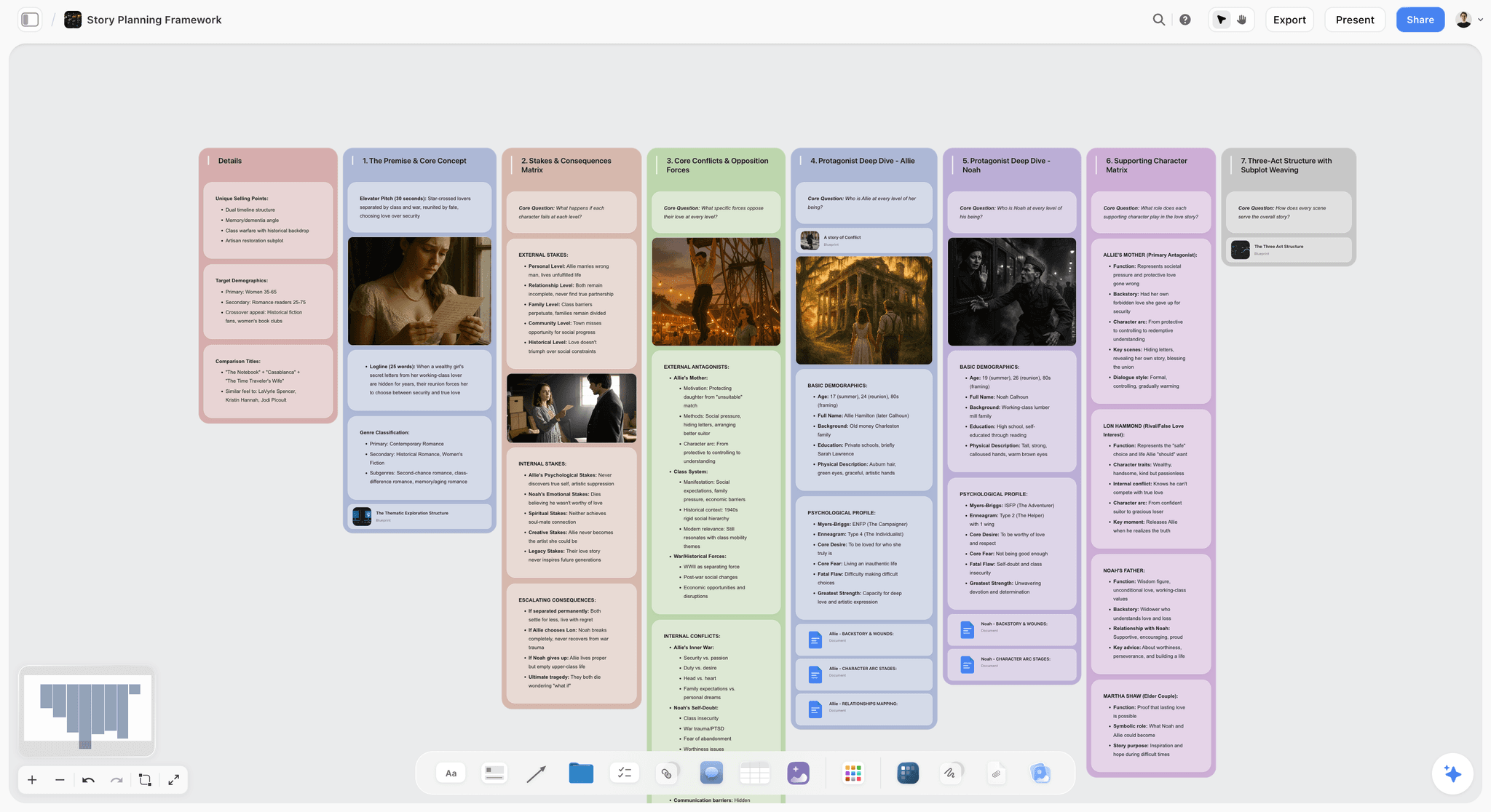
Storyflow is an AI planning canvas: one infinite board per project where the channel plan, the research notes, the packaging drafts, the scripts and the editor's work queue sit as walls of cards instead of five separate apps. Its AI reads the board you have open with every message, so when you ask it to draft the next script or to propose five follow-ups to the video that overperformed, it works from your series and your notes, not a blank prompt. It builds and edits the board directly, and every AI turn can be undone in one click. In Backlog Ladder terms it holds rungs 1, 3 and 4 in one place.
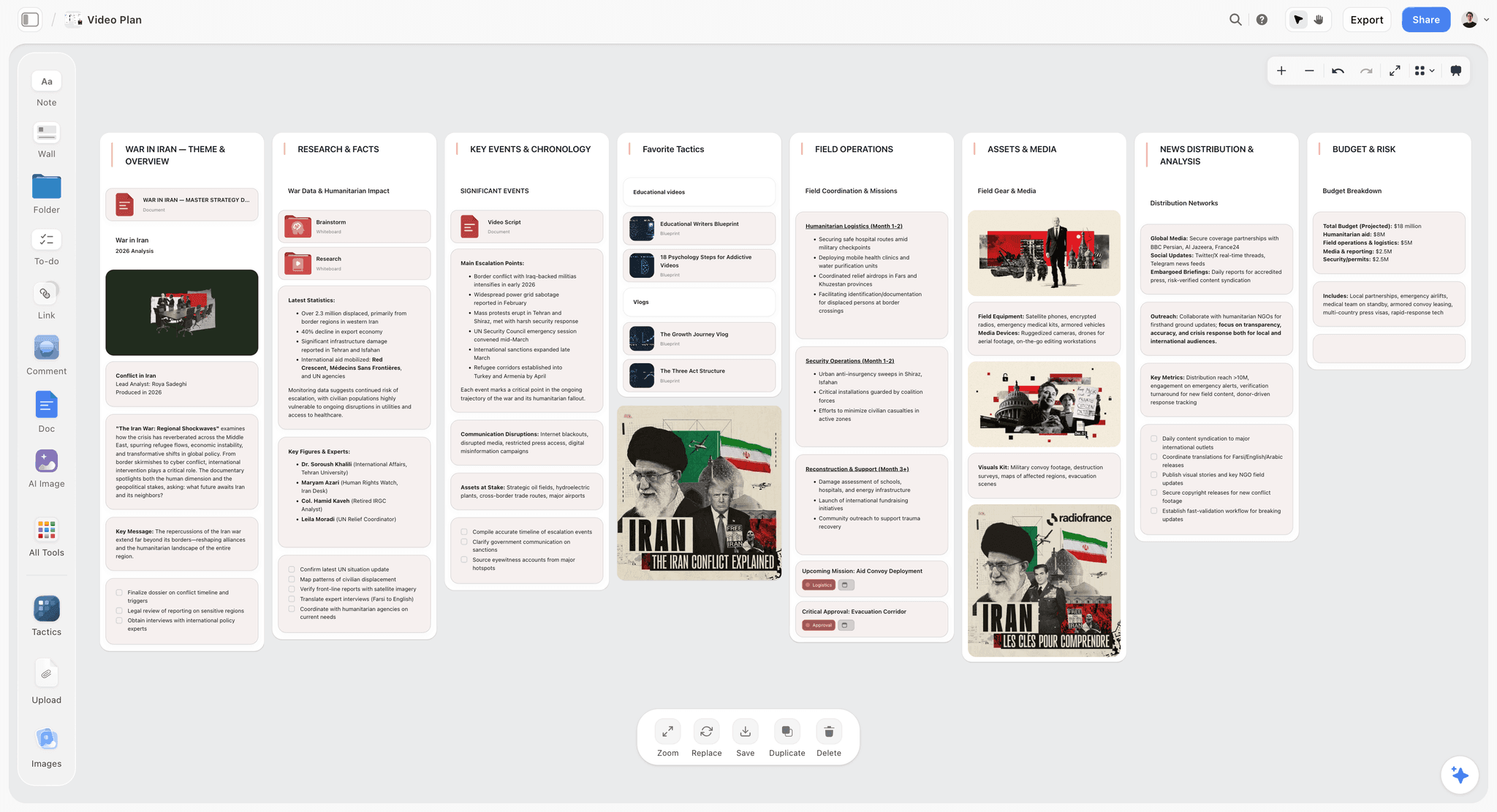
For YouTube the relevant workflows are named ones. Ask the AI for a YouTube channel plan and it lays out ten walls: about, audience, audience research, strategy and performance, guest strategy, production workflow, amplification, monetization, analytics and growth, with real episode titles written into the about wall. The YouTube Video Plan workflow (its starter prompt is "Plan my next YouTube video.") plans one episode across eight walls, titled theme and overview, research and facts, key events and chronology, favourite tactics, field operations, assets and media, distribution and analysis, and budget and risk; the hook and the title and thumbnail are checklist items rather than walls. Video Script writes one video in three acts with the full script as a document, and asking for a content plan builds a ten-stage publishing system plus a Content Calendar wall of ten tickets: real upcoming videos, each with its pillar and platform. Tickets can carry assignees, which you or your editor set (the AI does not), and that is how an editor sees what is theirs. The calendar wall holds dated tickets; it is not a live calendar.
The fastest start is the YouTube Channel Plan template, then the YouTube Video Plan template when an idea reaches production. The YouTube video planner page shows the per-video board.
Best for: A creator who works with an editor and wants the whole pipeline, spark to edit handoff, on one board the AI can build from.
Verdict: The strongest home for the ladder and the editor handoff. It does no keyword research, no analytics and no publishing, so it pairs with vidIQ or TubeBuddy rather than replacing them.
Key features
- Infinite canvas with notes, documents (inline comment threads, Word and PDF export), tables, tickets with assignees, kanban, images, video (upload, play, scrub, grab a frame) and charts.
- AI that reads the open board with every message; attach up to 5 documents and 3 other boards from the "+" menu.
- Named workflows for YouTube: YouTube Channel Plan, YouTube Video Plan, Video Script, Video Research, Tracker, Storyboard a scene.
- Invited collaborators edit in real time with live cursors on any paid plan; a sponsor or client opens a view-only link with no account.
- Presentation mode steps through the board one wall at a time, which turns the monthly planning call into a walkthrough.
Pricing
Storyflow is paid-only during early access, with plans from $7.99 a month billed annually ($9.99 monthly). Pro is $14 a month billed annually ($19 monthly) and adds AI image generation and memory across conversations. Max is $39 a month billed annually ($49 monthly) and adds the Team Workspace with roles and permissions. Its Free plan launches before the end of 2026, and anyone a paid member invites to a board joins free now, on free-tier limits that include 20 file uploads. AI use is metered on every plan.
Pros
- Rungs 1, 3 and 4 on one surface, so an idea climbs from spark to script without being retyped.
- The editor edits the same board in real time and can be assigned tickets, without a second paid seat (invited collaborators are on free-tier limits, which include 20 file uploads).
- The AI builds the channel plan, scripts and calendar tickets from your own notes and proposes; you decide.
Cons
- No keyword research, search volume or channel analytics; vidIQ and TubeBuddy own rungs 2 and 3 data.
- No publishing, scheduling or YouTube connection. The Content Calendar is a wall of tickets, not a live calendar, and tables cannot be sorted or filtered by a column.
- No timecoded comments on video, so rough-cut review still belongs in Frame.io or YouTube's unlisted links.
- Browser only, with no native mobile or desktop app; phones work for viewing and light edits.
- New and in early access, with a smaller template library than Notion's marketplace.
Choose Notion instead if your editor and you want a strict status database with filtered "ready to edit" views, and nobody needs a visual board.
2. Notion
Notion is the strongest database-style content pipeline on this list. A well-built setup gives every idea a row with status, series, packaging fields and a script page, then renders the same data as a board, a calendar and a filtered "ready to film" list. For creators who think in tables it holds rungs 1, 3, 4 and 5 with real rigour, and a working YouTube pipeline is one template duplicate away.
The cost is friction at the capture and thinking stages. A database wants structured input, and the messy work of comparing ten half-formed ideas fights the row format. Notion AI helps with drafting, but its depth depends on the plan, and it does not know YouTube.
Best for: Creators and editors who want a structured, filterable pipeline and already live in databases.
Verdict: The best pure pipeline database for YouTubers. Weakest at the visual, exploratory front of the ladder.
Pricing
Free plan for individuals, limited once two or more members share a workspace; guests are free on the pages you invite them to, up to 10 on the free plan. Plus is $10 per member per month billed annually ($12 monthly).
Pros
- One database renders as a board, a table and a calendar for the same pipeline.
- Large template marketplace, including YouTube planners.
- Scripts, briefs and the pipeline share one workspace.
Cons
- Structured input fights messy idea capture and comparison.
- No YouTube data; validation happens elsewhere.
- Building and maintaining a good pipeline is a project in itself. An editor is free as a guest on pages you share, or $10 a month for a member seat billed annually.
3. vidIQ
vidIQ is the proof engine. Keyword research, competitor tracking and AI-generated daily ideas turn rung 2 from opinion into evidence: type the backlog idea in and see whether anyone searches for it and who already ranks. Its help centre lists the plan limits plainly: the free plan shows 3 keyword results per search, 3 personalised daily ideas and up to 3 tracked competitors on 150 AI credits a month, while Boost raises that to unlimited keyword results, 50 daily ideas and 20 competitors (vidIQ features and credits by plan).
It is not a pipeline. There is no backlog board, no series plan and nothing an editor works from. vidIQ tells you which ideas deserve production; something else has to hold them.
Best for: Validating backlog ideas with search and competitor data before committing production time.
Verdict: The best research layer for the ladder. Pair it with a pipeline tool; do not ask it to be one.
Pricing
Free plan. TubeBuddy's comparison page lists vidIQ Boost at $199 a year and Max at $468 a year, both billed annually; vidIQ's own plans page did not load when checked in September 2026. vidIQ's help centre lists Boost and Max in one, two or three channel versions.
Pros
- Turns idea validation into a quick data check.
- Daily ideas seeded from your own channel.
- The free plan is enough to start proofing ideas.
Cons
- Holds no pipeline; ideas live and die elsewhere.
- Data leans toward search-driven niches; browse-driven channels get less signal.
- AI features run on monthly credits that heavy use spends quickly.
4. TubeBuddy
TubeBuddy works inside YouTube through a Chrome extension and mobile apps, which makes it the packaging tester: keyword explorer, SEO studio, thumbnail tools and, on the Legend plan, A/B thumbnail testing, bulk processing, a title generator, competitor alerts and scheduled publishing (TubeBuddy pricing). For rung 3, testing whether a title and thumbnail pull clicks, it gives more control than YouTube Studio's own test.
Like vidIQ, it is not a home for the ladder. It optimizes videos that exist and packaging that is nearly final; the backlog, series plan and scripts live somewhere else.
Best for: Testing and optimizing packaging, and batch-editing metadata, inside YouTube.
Verdict: The best in-platform optimization layer. A complement to your pipeline tool.
Pricing
Free plan. TubeBuddy's own comparison lists Pro at about $12 a month and Legend at about $27 a month, both billed annually (TubeBuddy vs vidIQ); A/B testing is on Legend only. Enterprise, with channel access for several managers, is priced on request.
Pros
- Works where packaging decisions land, in YouTube itself.
- A/B testing and bulk tools that save an editor or channel manager hours on metadata.
- Chrome extension plus iOS and Android apps.
Cons
- No planning surface; rungs 1 and 4 do not exist here.
- The feature that matters most for packaging, A/B testing, needs the higher plan.
- Overlaps with YouTube Studio's free title and thumbnail test.
5. Airtable
Airtable is the pipeline database for creators who find Notion too freeform and Sheets too flat. Every idea is a record with fields, statuses and attachments, and the same base renders as a kanban, a calendar and a gallery of thumbnail drafts. Automations move records between stages, which suits faceless and volume channels running ten videos through production at once.
The trade is Notion's, sharper: rigid input, a real learning curve and per-seat pricing built for companies rather than a creator and an editor.
Best for: Volume channels that want an automated, database-grade pipeline.
Verdict: The most rigorous rung 4 and 5 machine here. Bring patience for setup.
Pricing
Free plan. Team is $20 per user per month billed annually; Business is $45. Read-only collaborators are not charged on Team or Business.
Pros
- Database rigour with automation between pipeline stages.
- Gallery views work well for thumbnail drafts.
- Scales to multi-channel operations.
Cons
- Steepest setup on this list.
- Per-seat pricing adds up for a small crew.
- No YouTube data or research features.
6. ClickUp
ClickUp suits the creator whose channel is one arm of a wider business: sponsorships, products, an editing team and the videos that feed it all. Tasks, docs, goals and calendars live in one system, so the upload pipeline sits next to the sponsor deliverables it is tangled up with. As pure content planning it holds rungs 1, 4 and 5 competently without being shaped for any of them.
The interface is dense, and the all-in-one ambition means feature noise a two-person channel never asked for.
Best for: Creator businesses coordinating videos, sponsors and a team in one place.
Verdict: Right when the channel is a company. Heavy when the channel is a person and an editor.
Pricing
ClickUp's free plan covers unlimited tasks with 60MB of storage. Unlimited is $7 per user per month billed annually ($10 monthly); Business is $12 ($19 monthly). AI is an add-on.
Pros
- Channel pipeline and business operations in one system.
- Tasks, docs and calendars cover three rungs adequately.
- Free plan that holds a small pipeline.
Cons
- Dense interface with a real learning curve.
- Shaped for general work, not packaging-first YouTube planning.
- No research or YouTube data.
7. Spotter Studio
Spotter Studio calls itself an ideation system for pro YouTubers, and it is the most focused tool here for rungs 1 to 3. Outliers finds videos that overperform in your niche, Brainstorm develops titles, thumbnails and hooks from that research, and packaging mocks show the title and thumbnail together before anything is filmed. It is built YouTube-first rather than adapted from project management.
It stops where production starts: scripts, the editor's queue and cadence still need a home.
Best for: Established channels that want a dedicated, YouTube-native ideation and packaging engine.
Verdict: The strongest pure ideation tool if the budget fits. Overkill before your channel has momentum to analyze.
Pricing
Paid subscription with a free trial. The spotterstudio.com pricing page redirected to spotter.com and did not load when checked in September 2026, so confirm the current rate with Spotter before budgeting.
Pros
- Built for YouTube by a creator-economy company.
- Outlier research that feeds idea generation directly.
- Packaging mocks sit next to the ideas they belong to.
Cons
- No free plan, and priced for channels already earning.
- Holds no production pipeline, editor handoff or cadence.
- Its site is mid-migration, which makes plan details hard to confirm.
8. Trello
Trello is the simplest real pipeline: five lists for the five rungs, one card per idea, drag cards right as they climb. It takes minutes to set up, the free plan covers up to 10 collaborators in a Workspace, and a creator and an editor can share a board on day one. For a creator who has never planned beyond their head, it is the cheapest way to make the ladder physical.
Its ceiling arrives fast. Cards hold checklists and attachments, not scripts and research, and Calendar and Timeline views need Premium.
Best for: A first shared pipeline for a creator and an editor with zero setup.
Verdict: The best on-ramp to planning as an operation. Most channels outgrow it.
Pricing
Free plan up to 10 collaborators per Workspace. Standard is $5 per user per month billed annually ($6 monthly); Premium, which adds Calendar and Timeline views, is $10 billed annually ($12.50 monthly).
Pros
- Minutes from signup to a working pipeline.
- The kanban metaphor maps one-to-one onto the ladder.
- Free plan fits a creator and an editor.
Cons
- Cards are too shallow for scripts and research.
- No YouTube awareness.
- Weak at series thinking; everything is one flat board.
9. Google Sheets
A spreadsheet is the zero-cost pipeline: one row per idea, columns for status, series, title draft, thumbnail link, editor and target date, plus a filter for "ready to edit". A disciplined creator can run a real channel from it for years, and every editor already knows how to use one.
Everything else is manual: no reminders, no research, and scripts live in separate docs you link by hand.
Best for: Creators at a $0 budget who want full control.
Verdict: The best free pipeline. You are the automation.
Pricing
Free with a Google account; Workspace plans are priced per user by region.
Pros
- Costs nothing, exports anywhere.
- Filters and sorting by any column.
- Familiar to every editor.
Cons
- Every workflow is hand-built and hand-maintained.
- Hostile to visual packaging work.
- Nothing connects to YouTube or research data.
10. Milanote
Milanote is a visual board for the front of the ladder: moodboards of thumbnail directions, sketches of packaging ideas and freeform idea clusters. For visually led channels (video essays, filmmaking, design) its drag-anywhere canvas is a pleasant place to think through rungs 1 and 3.
It is a board, not a pipeline. Statuses, calendars and editor assignments are not what it does, and the free plan's 100 notes, images or links fill within weeks of real backlog use.
Best for: Visual thinkers sketching ideas and packaging directions.
Verdict: A pleasant thinking surface that needs a pipeline tool behind it.
Pricing
Free plan with 100 notes, images or links and 10 file uploads. Milanote's paid plan is $9.99 per person per month billed annually ($12.50 monthly).
Pros
- Freeform visual canvas that is easy to learn.
- Good for thumbnail and packaging exploration.
- Easy sharing for feedback.
Cons
- No pipeline, statuses or cadence.
- The free plan's limit fills fast.
- No AI that builds or edits a board from a prompt.
11. Frame.io
Frame.io covers one rung, but for a creator with an editor it is the rung that leaks the most time: review. Frame-accurate comments on cuts replace the chat-and-timestamps mess, versions stay organised and share links open without a sign-up. It belongs here because a channel with a hired editor lives or dies on rung 4 handoffs.
It plans nothing. No backlog, no packaging, no calendar; it starts when footage exists.
Best for: Creator-editor teams tightening the review loop.
Verdict: The best review handoff, and only that. Add it on top of your pipeline tool.
Pricing
Free for up to 2 members with 2GB. Pro is $15 per member per month as listed, up to 5 members; Team is $25 per member.
Pros
- Frame-accurate comments end timestamp archaeology.
- Version stacking keeps cuts in order.
- Editors already know it.
Cons
- Zero planning capability.
- Per-member pricing as the team grows.
- Overkill for creators who edit their own videos.
How YouTubers Plan a Month of Videos With Their Editor
The full method is in the seven-stage pipeline guide and the batching rhythm in how to batch a month of content in one day. In short: one planning call picks the month's packaged ideas with vidIQ open for demand, the creator batches scripting and filming, the editor works from a brief attached to each video's ticket, cut notes go through Frame.io, and YouTube Studio schedules the uploads while two to four finished videos sit in the buffer. The sibling guide has the full month plan, the nine-field edit brief and how Shorts made as Shorts get their own cards. For choosing tools, the test is simple: a tool earns its place in that month if it holds the ticket, the brief and the status in the spot the editor already opens, which is the job Storyflow, Notion and Trello compete for. For review rounds, see managing a video project with a team; for the brief itself, how to write a video brief.
How to Run the Channel Pipeline in Storyflow
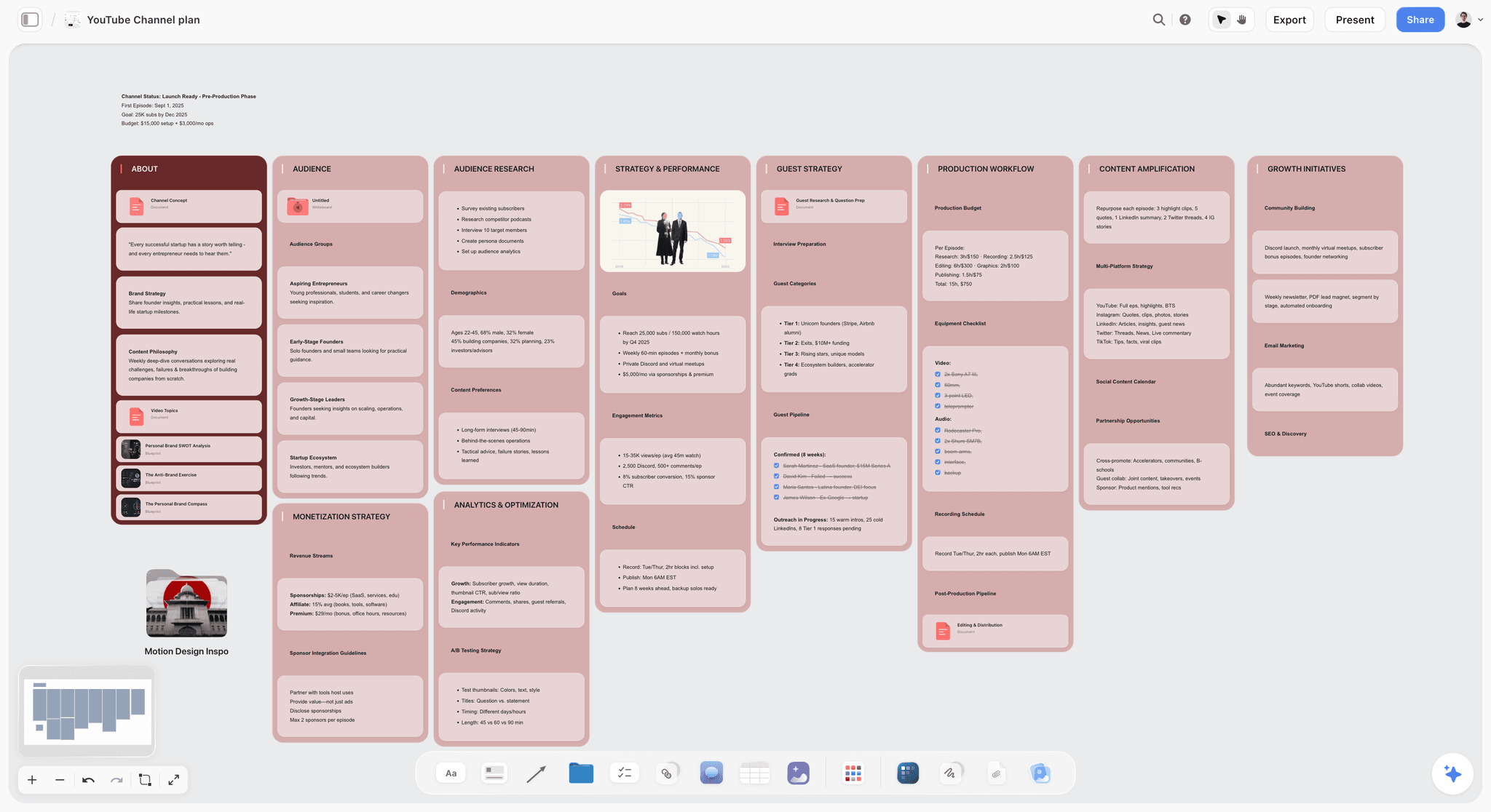
The short version; the full walkthrough is in the seven-stage pipeline guide.
- Build the channel board once. Ask the AI for a YouTube channel plan with your niche, audience and cadence, or start from the YouTube Channel Plan template.
- Add the month. Ask the AI for a content plan; it adds a Content Calendar wall of ten dated tickets. Set the assignees yourself.
- Plan each video. Run YouTube Video Plan ("Plan my next YouTube video."), then Video Script for the script as a document your editor comments on inline.
- Invite the editor. They join free on free-tier limits (which include 20 file uploads) and edit the same board in real time. Ask the Tracker workflow for status columns and name the stages you want, since it defaults to three to five generic columns.
For the channel-level method in more depth, see how to plan a YouTube channel with AI and how to plan a YouTube series with AI; the content pipeline and for YouTubers pages show the boards.
Where Metricool and the Scheduling Tools Fit
Metricool comes up constantly in searches about content planning and is not in the ranked eleven. It is a multi-platform social scheduling and analytics tool: it plans and publishes to Instagram, TikTok, LinkedIn, Facebook, X and YouTube from one calendar and reports on them together. Buffer and Later sit in the same category. For a creator whose YouTube video anchors a week of cut-downs on other platforms, that is a real and separate need; the Notion vs Buffer vs Later vs Metricool comparison covers it.
What a scheduler does not do is hold a video pipeline: no script, no shoot date distinct from a publish date, no edit status, no editor brief. A scheduling calendar knows when something goes out. It does not know whether it exists yet. For YouTube alone, YouTube Studio's own scheduler is free and is where every plan on this page ends.
Recommended Creator Stacks
Stack 1: Solo creator, starting out. Google Sheets or Trello (pipeline) plus the vidIQ free plan (proof) plus YouTube Studio's A/B test (packaging). Total: $0.
Stack 2: Creator with an editor. Storyflow Plus (channel board, scripts, tickets, editor invited free on free-tier limits) plus vidIQ Boost (proof) plus Frame.io's free plan for cut notes. About $25 a month on annual billing for the two paid tools ($7.99 plus vidIQ Boost at $199 a year, as TubeBuddy's comparison lists it).
Stack 3: Creator, editor and thumbnail designer. Storyflow (pipeline, briefs and tickets), or Notion Plus if the team wants a database, plus vidIQ plus TubeBuddy Legend for A/B tests, or YouTube Studio's own test if the budget is tight.
Stack 4: Volume or faceless channel. Airtable (automated pipeline) plus Spotter Studio or vidIQ (outlier-driven ideation) plus TubeBuddy (bulk metadata).
The pattern across every stack: one tool holds the ladder, one feeds it evidence, packaging gets tested where the click happens, and the editor works from the same surface the creator plans on.
What a YouTube Planning Stack Costs for a Creator and an Editor
Creator tooling is sold on aspiration, so be blunt: the free stack is good, and a channel that does not publish consistently yet should not pay for planning. The question changes once an editor joins, because per-seat pricing doubles.
| Tool | Billing shape | Creator plus editor, per month | What the editor gets |
|---|---|---|---|
Storyflow | Per seat; Plus $7.99 annual ($9.99 monthly) | $7.99 annual if you invite the editor | Joins free on free-tier limits (20 file uploads), edits in real time; Team Workspace with roles is Max, $39 per seat annual |
Notion | Per member; Plus $10 annual ($12 monthly); guests free | $0 with the editor as a guest, $20 annual for two members | Free as a guest on pages you share, or $10 for a member seat |
Trello | Per user; free up to 10 collaborators, Standard $5 annual | $0 on the free plan | Shared board, cards, checklists |
ClickUp | Per user; Unlimited $7 annual ($10 monthly) | $0 on the free plan, $14 on Unlimited | Tasks, docs, comments |
Airtable | Per user; Team $20 annual | $40 on Team | Full editor seat; read-only viewers are not charged |
vidIQ | Per channel; Boost $199 a year billed annually, per TubeBuddy's comparison | About $17, one channel | Nothing; research is the creator's job |
TubeBuddy | Per channel; Pro about $12, Legend about $27, billed annually | $12 to $27 | Nothing unless on Enterprise channel access |
Frame.io | Per member; free up to 2 members, Pro $15 as listed | $0 on the free plan | Cut review with frame-accurate comments |
Google Sheets | Free with a Google account | $0 | Full edit access |
What actually earns the money, in order: research depth once you publish weekly (vidIQ is the first purchase most channels should make, because rung 2 is the rung a free tool limits most); a pipeline your editor can work in without chasing you; and A/B testing once packaging is the bottleneck. A team workspace with roles comes last, when three or more people share the pipeline. For the overlap between AI subscriptions, see the AI content stack cost breakdown.
No tool on this list will make you publish more often. The most common wasted spend is a research subscription bought during a slump, because buying data feels like doing the work. If every rung is empty, the constraint is production capacity or a decision you are avoiding.
Honorable Mentions
- 1of10. Outlier research that surfaces overperforming videos in your niche; a rung 2 feed worth a look next to Spotter Studio.
- YouTube Studio. Scheduled uploads, analytics, and a free A/B test of up to three titles and thumbnails that picks the winner by watch time (YouTube Help: A/B test titles and thumbnails). Not a planner, but the endpoint every plan ships into.
- Google Drive and Dropbox. Where the footage actually lives. Name folders by video number and date so the editor's folder matches the ticket.
- Asana. A capable Trello alternative if your team already uses it.
- Descript. Script-to-edit workflows that blur rung 4; an editing tool with planning side effects.
When You Do Not Need a Planning Tool
- Under 10 videos published. Your bottleneck is making videos. One note file for ideas is enough; ship first.
- You already publish reliably from a simple system. A Sheets tracker that produced a video a week for a year is not broken.
- The problem is ideas, not organisation. If the backlog is empty, a kanban board will not fill it. Spend the energy on research and watching your niche.
- You are about to buy a tool to avoid making a video. Planning systems are the most productive-feeling way to procrastinate on YouTube.
Frequently Asked: Which YouTube Planning Tools Do Creators Trust?
Which YouTube content planning tools are the most trusted?
Trust here comes from transparency about limits. Storyflow publishes its prices and what it does not do (no keyword data, no publishing), and it is new and in early access, which is a fair reason to start on a single channel board. Notion has a long track record as a pipeline database and a large template marketplace. vidIQ and TubeBuddy publish their plan limits and are the established research layer. Spotter Studio is harder to judge while its site moves to spotter.com.
Which YouTube planning tool is fairly priced for a creator and an editor?
Storyflow, because the editor you invite to a board joins free on free-tier limits (which include 20 file uploads) while you pay $7.99 a month billed annually. Notion is fair too: the editor can join free as a guest on the pages you share, or take a $10 member seat billed annually. Trello's free plan covers a shared board with no charge. vidIQ and TubeBuddy price per channel, so an editor adds nothing to their bill.
Which content planner gives the best value for a small YouTube team?
For a creator, an editor and a thumbnail designer, Storyflow Plus with the other two invited on free-tier limits (20 file uploads each, which a thumbnail designer can outgrow), plus vidIQ Boost, comes to about $25 a month on annual billing. If the designer needs a paid seat, Storyflow's Team billing on storyflow.so/pricing takes 30% off Plus seats from three seats. Airtable is the priciest pipeline for three people at $60 on Team.
Which YouTube planning tool is underrated?
Storyflow for the editor handoff: the channel plan, the video briefs and the editor's tickets sit on the same board the AI builds from, which removes the most common failure in a creator-editor month, an editor waiting on a brief. Among pipelines, Google Sheets is underrated for a creator and editor pair, because it sorts and filters by any column, which Storyflow's tables cannot do.
Which YouTube planning tool is best for a channel with sponsors?
Storyflow first, because a sponsor opens a view-only link to the plan with no account and signs in to comment, while your editor works on the same board; ask the AI for a campaign brief when a sponsor sends deliverables. ClickUp second, when sponsor contracts, invoices and uploads all run as tasks. Notion third, for a sponsor database with due dates. None of the three tracks sponsor payments.
Which tools connect keyword research to video briefs?
None does both ends in one product. vidIQ and Spotter Studio produce the keyword and outlier evidence; Storyflow, Notion and Airtable hold the brief. The working connection is manual and fast: paste the vidIQ keyword notes and competitor links onto the video's board or record, then ask Storyflow's AI to draft the brief and title options from them.
The Bottom Line
The best content planning tools for YouTubers in 2026 split into two jobs. Storyflow and Notion hold the Backlog Ladder itself, one as an AI board your editor works on with you, one as a database. vidIQ, TubeBuddy and Spotter Studio feed it evidence and test the packaging. The mistake is collecting tools from the second group while the first job stays unsolved, because research without a pipeline produces a folder of insights and no uploads.
The backlog is the channel. A channel that publishes for years is a machine with ideas on every rung and an editor who always knows what is next. It is not a calendar problem; it is a pipeline problem, and the tool that holds that pipeline where both of you work is the one that earns its slot.
Start with the ladder: open the YouTube Channel Plan template, load your first twenty ideas, invite your editor, and plan the month from a backlog instead of a blank page. The AI content planner and YouTube series planner pages show the other boards.
FAQ: Content Planning Tools for YouTubers
Is Trello or Notion better for a YouTube content calendar?
Trello for speed, Notion for structure. Trello's free plan shares a board with up to 10 collaborators, but its Calendar and Timeline views need Premium at $10 a user billed annually. Notion shows a database as a calendar on the free plan and lets an editor in free as a guest on shared pages. Storyflow ranks above both on this page, but its calendar is a wall of dated tickets, not a live calendar. See Notion vs Trello for content calendars.
What is the best tool to schedule and manage YouTube content?
Split the two jobs. To manage the pipeline (ideas, scripts, editor tickets), use Storyflow, Notion or Trello. To schedule uploads, use YouTube Studio's own scheduler, which is free and handles long-form and Shorts. TubeBuddy's Legend plan lists scheduled publishing, and Metricool schedules YouTube alongside other platforms if you publish cut-downs elsewhere.
What is the difference between content planning and video planning?
Content planning runs the channel: backlog, validation, packaging, series and cadence. Video planning takes one approved idea through outline, script and shoot. The tools overlap less than they seem: vidIQ is a content planning tool that never touches a script, while a script tool never tells you what to make next. For the second job, see how to plan a YouTube video from idea to script.
Is Notion good for planning YouTube content?
Yes, if you and your editor like databases. An editor can join free as a guest on the pages you share (up to 10 guests on the free plan), or take a $10 member seat billed annually if they need the whole workspace. Notion's timeline dependencies show only in a timeline layout, which suits channels with sponsor deadlines. See Storyflow vs Notion for the board-versus-database trade.
Is vidIQ or TubeBuddy better for content planning?
vidIQ, for deciding what to make: its daily ideas and competitor tracking feed the backlog. TubeBuddy is stronger after the idea is chosen: A/B thumbnail testing, bulk metadata edits and scheduled publishing on Legend. If you can afford one, buy vidIQ first; add TubeBuddy Legend only when packaging, not ideas, is the bottleneck.
Is vidIQ worth paying for?
Once you publish weekly, usually. The free plan's limits are tight: 3 keyword results per search, 3 tracked competitors and 150 AI credits a month. Boost removes the keyword cap, tracks 20 competitors and gives 2,000 credits; TubeBuddy's comparison lists it at $199 a year billed annually. If you publish monthly, the free plan plus YouTube's own analytics is enough.
How many title and thumbnail options should I draft per video?
Three. That is the most YouTube Studio's A/B test accepts, so the planning-stage options become the test variants after upload, and the test shows everyone the option with the most watch time, usually within two weeks. It runs only on a computer, needs advanced features turned on, and does not work on Shorts, premieres, scheduled live streams or made-for-kids videos, so plan those packages as final.
Who should own the content calendar, the creator or the editor?
The creator owns what gets made and when; the editor owns the edit status and the due dates they can commit to. In practice the creator creates the video tickets on the planning call and sets who each is assigned to, and the editor moves them between stages. A calendar that only the creator can change turns every delay into a message thread.
How do I share my content plan with my editor without paying for another seat?
Storyflow: invite the editor to the board and they join free on free-tier limits, which include 20 file uploads, while you keep a paid plan. Notion: add the editor as a free guest on the pages you share. Trello: the free plan allows up to 10 collaborators per Workspace. Google Sheets: free with a Google account. Airtable charges for a full editor seat.
Can AI plan my YouTube content?
It can draft every rung except the judgment. Storyflow's AI builds a channel plan, video plans, scripts and calendar tickets from your notes, applies them to the board, and each change can be undone in one click; it proposes and you decide. It looks at thumbnail images only when you select them, up to 24 at a time. It has no YouTube data, so demand still comes from vidIQ.
How far ahead should a YouTuber plan content?
Keep four to eight weeks of uploads visible and committed, with a looser backlog behind them: roughly 20 captured ideas, 5 to 8 validated and 2 to 4 packaged. With an editor, keep two to four finished videos in the buffer, so an edit that runs late delays nothing. Planning in detail beyond a quarter wastes effort, since your analytics will change what is worth making.
Is Storyflow free for YouTube content planning?
Not during early access. Storyflow is paid-only during early access, with plans from $7.99 a month billed annually ($9.99 monthly). Its Free plan launches before the end of 2026, and anyone a paid member invites to a board joins free now, on free-tier limits that include 20 file uploads. A team that wants paid seats for everyone gets per-seat Team billing, shown on storyflow.so/pricing.
How do I get YouTube Analytics numbers into my planning board?
By hand, once a month. None of the pipeline tools here imports YouTube Analytics, Storyflow included. YouTube's own guidance is to group uploads into buckets by format, series and topic and compare them over about 90 days, so paste one row per bucket (click-through rate, average view duration, views) onto the channel board, then ask the AI to propose next month's tickets from it.
Is Metricool good for planning YouTube content?
For distribution, yes; for production, no. Metricool schedules and reports across YouTube, Instagram, TikTok, LinkedIn, Facebook and X from one calendar, which suits a creator who cuts each video into posts for other platforms. It has no place for a script, a shoot date or an editor brief, so it sits beside a pipeline tool.
How do I plan YouTube Shorts alongside long-form videos?
Give Shorts made as Shorts their own cards or tickets in the backlog, with their own hook and packaging, rather than treating them only as leftovers of a long video. Cuts repurposed from a long-form video are a supplement: note the moments in the editor's brief so they come out of the same edit. YouTube Studio's A/B test does not run on Shorts. See how to repurpose one video.
Do I need Frame.io if my editor already uses Google Drive?
Only once review rounds start slipping. Drive holds the footage, but notes on a cut end up in chat as timestamps. Frame.io puts frame-accurate comments on the video itself and stacks versions, free for up to two members with 2GB, which fits one creator and one editor reviewing short cuts. Storyflow can hold and play a cut, but has no timecoded comments.
Table of Contents
- Why the Backlog Decides the Channel
- All 11 Content Planning Tools, Ranked
- Comparison Table: 11 YouTube Content Planning Tools at a Glance
- Key Takeaways
- The Backlog Ladder: How YouTubers Organise a Content Pipeline
- How the Tools Compare on the Backlog Ladder
- How We Scored These Tools
- What Is the Best YouTube Planner Tool? Picks by Team Setup
- Detailed Reviews: 11 Content Planning Tools for YouTubers
- How YouTubers Plan a Month of Videos With Their Editor
- How to Run the Channel Pipeline in Storyflow
- Where Metricool and the Scheduling Tools Fit
- Recommended Creator Stacks
- What a YouTube Planning Stack Costs for a Creator and an Editor
- Honorable Mentions
- When You Do Not Need a Planning Tool
- Frequently Asked: Which YouTube Planning Tools Do Creators Trust?
- The Bottom Line
- Author
- FAQ: Content Planning Tools for YouTubers
- Related Reading
Templates to check out for this topic


Content and video templates you can use in Storyflow
Plan a channel, a script, and a content pipeline on the same board. Open one of these templates and let the AI build on the structure instead of starting from a blank doc.


See Storyflow in Action
A visual AI workspace where every feature lives inside one canvas. No tab-switching, no context lost.
Build your entire board from a single message
Type what you need in the AI chat at the bottom of your canvas. The AI adds cards, headings, and structure directly onto your board.
Use expert frameworks as AI context
Type @ in the AI chat and choose any Tactic. The AI tailors every response to that framework instead of giving generic advice.
Turn your board into a mind map in seconds
Ask the AI to restructure your canvas as a mindmap. It connects your ideas into a visual hierarchy so you can see how everything relates.
Why Storyflow Exists
Storyflow actually began as a personal tool while working on creative and research projects.
We kept running into the same problem: ideas were scattered everywhere: notes, documents, and whiteboards.
Nothing helped us see how everything connected.
So we started building a workspace designed around how ideas actually grow.
→ Read how Storyflow was createdJustkay
Documentary Filmmaker & Founder at Storyflow
Published: 2026-07-20
Extremely simple, seriously capable


See how easy it is to get started
Watch a real project come together, from a blank board to a finished plan, clicked through step by step.
Start creating with AI and become more productive
Transform your creative workflow with AI-powered tools. Generate ideas, create content, and boost your productivity in minutes instead of hours.