
How to Write a Video Brief (2026): Template and Examples
A video brief looks like paperwork and is really a decision document. This covers the sections that matter, the single-minded message that holds it together, a full template, and the briefs that cause reshoots.

Category
Video Production
Author

Justkay
Documentary Filmmaker & Founder at Storyflow
Topics
2026-07-04
•
12 min read
•
Video Production- how to write a video brief
- video brief template
- video brief example
- creative brief for video
- video production brief
How do you write a video brief?
To write a video brief, define the audience, the single objective, the core message, the deliverables, and the constraints. The objective is the field that decides whether the video works. Write one, not three: a video optimized for awareness wants reach and emotion, a video optimized for leads wants proof and a clear next step, and one video cannot do both well.
What a video brief actually is
A video brief is the document a client, brand manager, or marketing lead hands to whoever is going to make the video: an agency, an in-house team, or a freelance director. On paper it looks like a spec sheet. Goal, audience, deliverables, tone, timeline, budget. Most people treat it as exactly that, a form to fill in so production has something to work from.
That framing is why so many briefs are useless. A spec sheet describes an object. A video brief has a harder job: it has to align a group of people who will spend real money and real weeks on a single interpretation of what "good" means, before a frame is shot.
Here is the reframe that changes how you write one. A video brief does not describe the video. It describes the decision the video has to win. Every field exists to make one decision unambiguous: what has to be true for this video to have been worth making. If a field does not push toward that decision, it is decoration.
The difference between a good brief and a bad one is almost never length or polish. It is whether the person reading it can predict what you will approve and what you will send back. A brief that leaves that unpredictable guarantees rework, and rework on video is the most expensive rework there is, because it usually means reshooting.
Write the brief where the references live
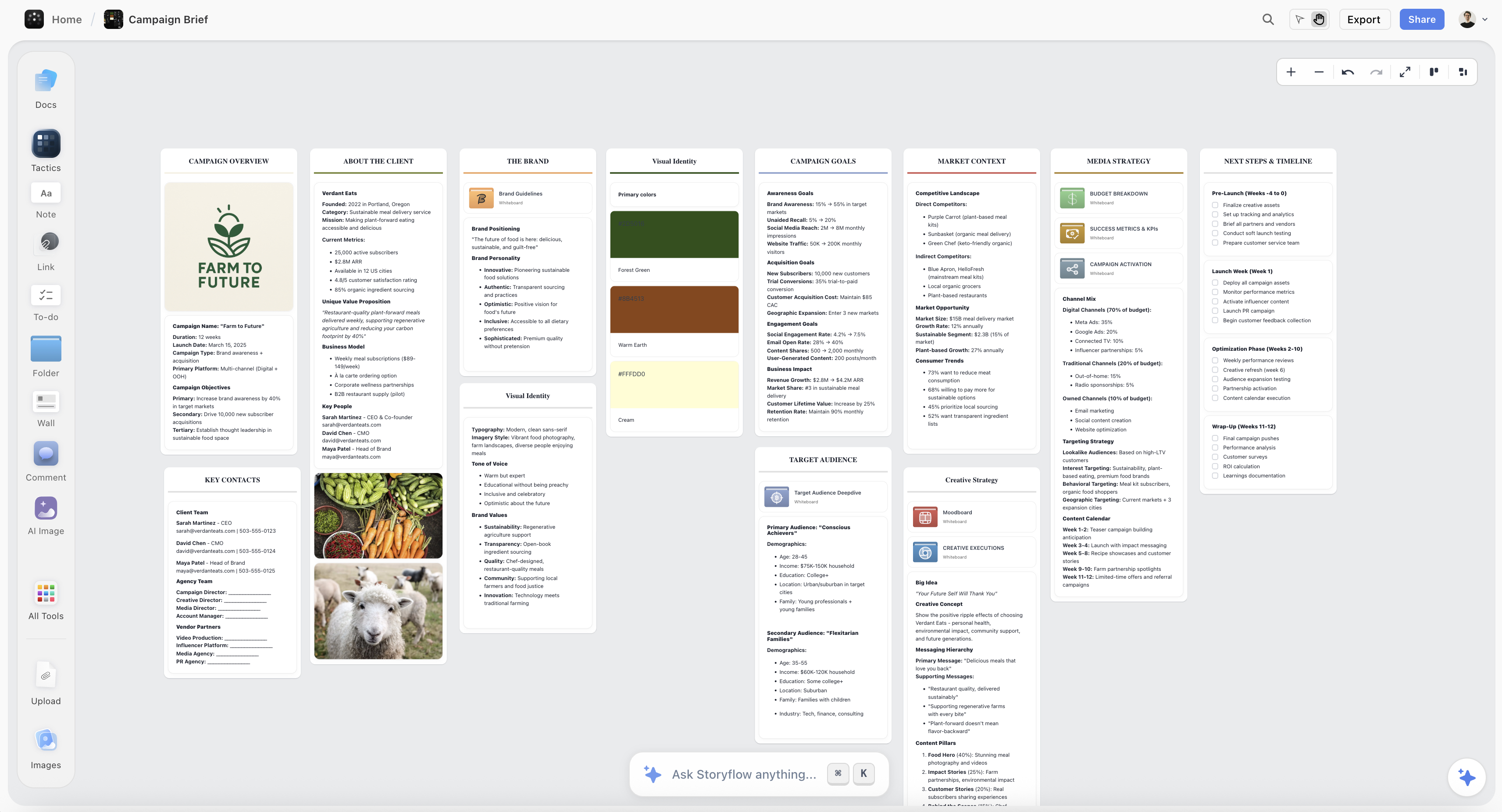
Keep the message, the audience, the deliverables and the reference frames on one board, so everyone is briefed on the same thing rather than on a document plus a folder.

Why most briefs fail before the shoot
The failure is almost always upstream of production. A brief with three goals, a vague audience, and five reference videos with contradictory tones has already failed. The crew just does not find out until the edit.
Think about where money actually leaks on a video project. It is not the camera day. It is the second camera day nobody planned for, the reshoot because the founder decided halfway through that the tone was "too corporate," the three rounds of edit revisions that all trace back to two stakeholders picturing different videos the whole time. None of that is a production problem. It is a brief problem that stayed hidden until it got expensive.
A brief exists to surface those disagreements while they are still cheap to fix, while they are still words on a page. If the marketing lead wants signups and the founder wants a premium brand feel, those goals are in tension and will pull the edit in opposite directions. You want that fight to happen in the brief review, not in the grading suite at 11pm with a booked crew. So the real test of a brief is not "does it describe the video we want." It is "would two competent teams, reading this cold, make roughly the same video." If the answer is no, the brief has not done its job yet.
The anatomy of a video brief
A complete video brief has nine parts. Not every project needs all nine at full depth, but every project should at least consider each, because the gaps are where rework hides.
Objective (the goal)
The one thing the video has to achieve, phrased as an outcome you could measure. Not "raise awareness and drive signups and reposition the brand." One primary objective. This is the section people skip and the one that matters most, so it gets its own section below.
Single-minded message
If a viewer remembers one sentence after watching, what is it? Not the script, not the tagline, the single idea. A video that tries to land four messages lands none. The message is the objective translated into something a viewer can hold.
Audience
Who this is for, specifically enough that it changes creative decisions. "Marketers" is not an audience. "Marketing managers at 20-to-200-person B2B companies who have been burned by an agency before" is, because it tells the director the tone can be knowing and slightly skeptical rather than bright and beginner-friendly.
Deliverables and specs
Exactly what production owes you, in numbers: aspect ratios, durations, cutdowns, captions, the platform each version runs on. "A social video" is a request for a fight later. "One 60-second 16:9 hero, three 15-second 9:16 cutdowns with burned-in captions, one 6-second bumper" is a deliverable.
Tone and references
How it should feel, shown not just told. Two or three reference videos, each annotated with what you like and, just as importantly, what you do not want carried over. An unannotated reference is dangerous because everyone reads their own taste into it.
Mandatories
The non-negotiables. Brand rules (logo, colors, safe zones), legal requirements (disclaimers, music licensing, talent releases, accessibility captions), and anything that must appear or must never appear. Cheap to state and ruinous to discover in the edit.
Timeline
The dates that matter: brief approval, shoot, first cut, final delivery, and the immovable air date. Work backward from the deadline that cannot move, and mark which stages have slack.
Budget
The number, or at least the range and tier. A team that knows it is a $5,000 project makes better choices than a team guessing between $5,000 and $50,000. Hiding the budget does not get you a better deal, it gets you a proposal aimed at the wrong altitude.
Success metric
How you will know afterward whether it worked. This closes the loop back to the objective. If the objective is signups, the metric is signups attributable to the video. If you cannot name a metric, your objective is probably too soft to be one.
The single objective is the section people skip
Every field above matters, but if you get only one right, get the objective. It is the field people rush past because it feels obvious, and the one that quietly sinks the most projects.
The pattern is always the same. Someone writes an objective that is really three: "increase brand awareness, generate qualified leads, and establish thought leadership." It reads like ambition and functions like sabotage. A video optimized for awareness wants reach, emotion, and a light touch. One optimized for leads wants a sharp problem, a clear offer, and a hard call to action. One optimized for thought leadership wants depth and a named point of view. These are three different videos. Ask for all three and you get a video that gestures at each and commits to none, the most expensive kind of forgettable.
A brief with three goals produces a video that achieves none. This is not a stylistic preference, it is a resource-allocation fact. Every minute of runtime and every dollar of budget has to be spent on something, and a single objective tells you what to spend it on. Three objectives tell you to spend it on everything, which means spreading it thin enough to accomplish nothing.
The discipline is simple. Pick the one outcome that, if the video achieved it and nothing else, would make the project a success. Write the other two into a "secondary, only if it does not cost the primary" list, and mean it. If a creative choice would help awareness but blunt the signup ask, the ask wins, because the ask is the objective. That single sentence resolves most of the arguments that would otherwise happen in the edit.
If you and your stakeholders cannot agree on the single objective, that is not a reason to paper over it with three. It is the most valuable thing the brief has surfaced, and it needs resolving before anyone touches a camera.
The fill-in video brief template
Here is the template as a table. Copy it, fill each row, and pressure-test the objective row hardest. If any row is blank or says "TBD," that is a decision you are silently pushing onto production, and they will decide it in a way you may not like.
| Section | What goes in it |
|---|---|
Project name and owner | The working title and the one person who approves the final cut. |
Objective (single) | The one measurable outcome the video must achieve. One, not three. |
Single-minded message | The one sentence a viewer should remember afterward. |
Audience | Who it is for, specific enough to change tone and creative decisions. |
Deliverables and specs | Every version owed: durations, aspect ratios, cutdowns, captions, platforms. |
Tone and references | Two or three annotated references, with what to take and what to avoid. |
Mandatories | Brand rules, legal requirements, must-include and must-never-include items. |
Timeline | Approval, shoot, first cut, final delivery, and the immovable air date. |
Budget | The number or tier, stated plainly, not hidden. |
Success metric | How you will measure afterward whether the objective was met. |
The template is deliberately short. A good brief is usually one to two pages, not ten. Length is not thoroughness. A ten-page brief that never commits to a single objective is worse than a one-page brief that does.
A worked example: the Northwind brief
Abstract templates are easy to nod along to and hard to apply, so here is a filled-in brief for an imaginary brand, Northwind, a company that sells a project-management tool to small agencies and wants a product-launch video.
Project name and owner: Northwind Q3 launch hero video. Final approver: Dana Okafor, Head of Marketing. One approver, named, so the edit does not die by committee.
Objective (single): Drive free-trial signups from agency owners during the six-week launch window. Not "launch the product," not "build the brand." Signups. Everything else is secondary.
Single-minded message: Northwind is the first project tool built for how small agencies actually juggle clients, so you stop losing hours to status-chasing.
Audience: Owners and operations leads at creative agencies of five to thirty people, currently running projects across a messy stack of spreadsheets, chat, and one tool they hate. Time-poor and allergic to anything that feels like enterprise software.
Deliverables and specs: One 75-second 16:9 hero for the landing page and YouTube. Three 20-second 9:16 cutdowns for Instagram and TikTok with burned-in captions. One 6-second pre-roll bumper. All delivered with and without on-screen captions.
Tone and references: Confident and a little dry, the tone of someone who has done the job and is tired of bad tools. Reference one, the Basecamp launch spots, for the plainspoken founder-to-founder register, but without the retro styling. Reference two, a recent Notion product film, for the clean UI motion, but faster and less polished-corporate. Avoid: stock-footage montages of people high-fiving, which read as fake to this audience.
Mandatories: Northwind wordmark in the final three seconds, brand blue on the call to action, the legal disclaimer on the pricing claim, captions on every version. Music fully licensed for paid social. No competitor names on screen.
Timeline: Brief approved July 14. Shoot July 28. First cut August 11. Final delivery August 25. Air date September 1, which does not move because it aligns with the pricing change.
Budget: $18,000 all-in, covering one shoot day, one on-camera founder, UI motion graphics, and licensed music.
Success metric: Free-trial signups attributable to the video via a tracked landing page and UTM-tagged social links, measured across the six-week window against the pre-launch baseline.
Read that brief cold and you can predict what Dana will approve, which is the entire point. A director could scope, cast, and storyboard from it without a clarifying call, and if they came back with a warm, brand-building montage, the objective row tells everyone immediately, on paper, that they missed the assignment, before the money was spent.
Writing a brief on a canvas
A video brief written in a word processor has one structural weakness: references live somewhere else. You describe a tone in a paragraph, paste a link, then hope everyone opens it and reads your annotation the same way. The most visual document in the project is trapped in a format that cannot show anything.
A brief on a canvas fixes that. You lay the objective and message as the anchor, drop the actual reference frames next to your notes on them, and let the tone and audience sections sit beside the visuals they describe. When a stakeholder disagrees with a reference, they are pointing at the frame, not a URL. The brief can also expand as thinking matures: the same board can grow a column of rough concepts or a first storyboard pass, so the brief and the early creative live in one place instead of scattering across five tools.
This is one thing Storyflow is useful for. Because its AI reads the whole board, you can ask it to pressure-test the objective directly, the check most briefs never get. Point it at the objective and message, ask whether they are single-minded, and it will flag when your "one goal" is actually three stacked together, the exact failure from section 4. Storyflow also ships a Story Blueprints library of expert frameworks you can pull onto the board when the brief needs to grow into a full storyboard.
Honest limitation: a canvas is more setup than a shared doc for a brief you are going to write once and never revisit. If your brief is a quick paragraph for a same-week social clip, a plain document is faster and there is no shame in that. The canvas earns its keep when the brief has real references to weigh, multiple stakeholders to align, and a decent chance of growing into the storyboard, not when it is three lines and a deadline.
Video brief vs creative brief vs shot list
These three documents get conflated constantly, and the confusion causes real problems, because each answers a different question and lives at a different altitude.
| Document | What it answers | Who owns it | When it is written |
|---|---|---|---|
Creative brief | Why we are making this and what it must achieve | Marketing or brand lead | First, before production is involved |
Video brief | What the video specifically has to be, do, and deliver | Client or project owner, handed to production | After the creative direction is set |
Shot list | Exactly what gets captured, shot by shot | Director or DP | Last, during pre-production for the shoot |
The creative brief is strategy: the business problem, the audience insight, the reason this video should exist at all. The video brief translates that into a concrete, spec'd request for one specific video. The shot list is execution: the literal setups the camera will capture on the day. They are a sequence, not substitutes, and skipping the middle one is the most common gap, because people assume the creative brief covers it. It does not, because it was never meant to name durations, aspect ratios, or an immovable air date.
Where a heavy brief is overkill
A full nine-part brief is the right tool for a video that costs real money and carries real risk. It is the wrong tool for a lot of the video work teams actually do, and forcing it everywhere just teaches people to ignore briefs.
Fast-turnaround social content is the clearest case. If a social manager is cutting a fifteen-second clip from footage you already own to ship this afternoon, a nine-field brief is bureaucratic friction. The whole brief is a Slack message: the hook, the platform, the caption, the deadline. The objective is usually obvious and the budget is a few hours of someone's time. Impose a formal template on that and you slow down the one kind of video that lives or dies on speed.
Internal videos are the second case. A recorded all-hands, a quick training walkthrough, a message from the CEO to the company: these have a captive audience, a forgiving standard, and no dollar at stake beyond staff time. They need a purpose and a runtime cap, not a mandatories section and a success metric. Nobody is measuring signup attribution on the onboarding video.
The rule is to scale the brief to the risk. The more money, stakeholders, and irreversibility involved, the more a brief earns its length, because the cost of misalignment is a reshoot. The less at stake, the lighter it should be, down to a single sentence for a same-day clip. A brief prevents expensive rework, so where there is none to prevent, there is not much brief to write. Applying the heavy version everywhere does not make you rigorous. It makes people route around the process, which is worse than having none.
The Bottom Line
A video brief is not a description of the video you want. It is the document that wins the argument about what "good" means before anyone spends money finding out. Its job is to make your approvals predictable, so two competent teams reading it cold would make roughly the same video, and so disagreements that would otherwise surface in the edit surface instead while they are still just words on a page. Get the nine parts down if the stakes are real, keep it to a page or two, and pressure-test the single objective hardest, because a brief with three goals produces a video that achieves none. Where the stakes are small, write less. The brief exists to prevent expensive rework, and it should weigh exactly as much as the rework it is protecting you from.
If you want to write a brief where the references sit next to your notes and the AI can check whether your objective is single-minded, start a Storyflow board, lay the objective and message as the anchor, and drop your reference frames beside them.
FAQ: Video Briefs
What is a video brief?
A video brief is the document a client or project owner gives to whoever is making a video, an agency, in-house team, or freelance director, that defines what the video has to achieve, who it is for, and exactly what will be delivered. Its real purpose is to align everyone on what "good" means before money is spent, so the video does not need expensive reshoots later.
What should a video brief include?
A complete video brief includes nine parts: a single objective, a single-minded message, the audience, deliverables and specs, tone and references, mandatories (brand and legal), timeline, budget, and a success metric. Not every project needs all nine at full depth, but the sections you skip are where rework hides.
How do you write a video brief?
Start with the single objective, the one measurable outcome the video must achieve, and resist the urge to list three. Then translate it into one memorable message, name the specific audience, spell out every deliverable in numbers, add annotated references, list the mandatories, set the timeline and budget, and name how you will measure success. Keep it to one or two pages.
What is the difference between a video brief and a creative brief?
A creative brief comes first and answers why the video should exist: the business problem, the audience insight, the strategy. A video brief comes after and answers what the specific video has to be and deliver: durations, aspect ratios, tone, mandatories, timeline, and budget. The creative brief is strategy owned by marketing, the video brief is the spec'd request handed to production.
How long should a video brief be?
Usually one to two pages. Length is not thoroughness. A ten-page brief that never commits to a single objective is worse than a one-page brief that does. Scale it to the risk: a high-budget launch video earns a fuller brief, while a same-day social clip needs only a few lines.
What is the most important part of a video brief?
The single objective. It is the field people skip because it feels obvious, and the one that sinks the most projects. A brief with three goals produces a video that achieves none, because every dollar and every minute of runtime has to be spent on something. Pick the one outcome that, on its own, would make the project a success.
Why do video briefs matter?
Because rework on video is the most expensive rework there is, since it usually means reshooting with a booked crew. A brief surfaces disagreements while they are still cheap to fix, while they are still words on a page, rather than in the edit at 11pm. The test is whether two teams reading it cold would make roughly the same video.
What is a single-minded message in a video brief?
It is the one sentence a viewer should remember after watching, not the script or the tagline but the single idea. A video that tries to land four messages lands none. The message is the objective translated into something a viewer can hold in their head.
Can AI help write a video brief?
Yes, mostly as a pressure-tester rather than a first-drafter. AI that can read your whole brief is good at catching when your "single" objective is actually three stacked together, and at spotting missing sections like an absent success metric. It flags the gaps, you decide the priorities.
What is the difference between a video brief and a shot list?
A video brief defines what the video has to be, do, and deliver, and is written by the client or owner before production. A shot list defines exactly what the camera captures, setup by setup, and is written by the director or DP during pre-production. The brief is the request, the shot list is the execution plan for the shoot day.
Do short social videos need a brief?
Not a formal one. If a social manager is cutting a fifteen-second clip from footage you already own to ship the same day, a nine-field template is friction. A one-line brief covers it: the hook, the platform, the caption, and the deadline. Save the full brief for videos where a misalignment means an expensive reshoot.
How do you set a budget in a video brief?
State it plainly, as a number or at least a tier. A team that knows it is an $18,000 project makes better, more focused choices than a team guessing between $5,000 and $50,000. Hiding the budget does not get you a lower quote, it gets you a proposal aimed at the wrong altitude and a round of rescoping later.
Table of Contents
- What a video brief actually is
- Why most briefs fail before the shoot
- The anatomy of a video brief
- The single objective is the section people skip
- The fill-in video brief template
- A worked example: the Northwind brief
- Writing a brief on a canvas
- Video brief vs creative brief vs shot list
- Where a heavy brief is overkill
- The Bottom Line
- FAQ: Video Briefs
- Related Reading
Templates to check out for this topic


Templates you can use in Storyflow
Every Storyflow board starts from real structure and an AI that reads the whole canvas. Open one of these templates and make it yours.


See Storyflow in Action
A visual AI workspace where every feature lives inside one canvas. No tab-switching, no context lost.
Build your entire board from a single message
Type what you need in the AI chat at the bottom of your canvas. The AI adds cards, headings, and structure directly onto your board.
Use expert frameworks as AI context
Type @ in the AI chat and choose any Tactic. The AI tailors every response to that framework instead of giving generic advice.
Turn your board into a mind map in seconds
Ask the AI to restructure your canvas as a mindmap. It connects your ideas into a visual hierarchy so you can see how everything relates.
Why Storyflow Exists
Storyflow actually began as a personal tool while working on creative and research projects.
We kept running into the same problem: ideas were scattered everywhere: notes, documents, and whiteboards.
Nothing helped us see how everything connected.
So we started building a workspace designed around how ideas actually grow.
→ Read how Storyflow was createdJustkay
Documentary Filmmaker & Founder at Storyflow
Published: 2026-07-04
Extremely simple, seriously capable


See how easy it is to get started
Watch a real project come together, from a blank board to a finished plan, clicked through step by step.
Start creating with AI and become more productive
Transform your creative workflow with AI-powered tools. Generate ideas, create content, and boost your productivity in minutes instead of hours.