YouTube Video Script Template: The 7-Part Framework That Actually Works
Forget everything you've read about YouTube scripts. The standard advice is why most creators plateau. Here's the counterintuitive framework top creators actually use.

Category
YouTube
Author

Sara de Klein
Head of Product at Storyflow
Topics
January 11, 2026
•
15 min read
•
YouTube- YouTube script template
- video retention
- script framework
- content creation
What is the best YouTube video script template?
The best YouTube script template is the 7-part retention framework: (1) Hook, (2) Anti-hook, (3) Promise, (4) Preview with open loops, (5) Core content with pattern interrupts every 45-90 seconds, (6) Value bomb at the 60-70% mark, (7) Soft CTA. It works because peak value lands right before the typical drop-off point.

Forget everything you've read about YouTube scripts. The "hook-content-CTA" formula that every guru teaches? It's why most creators plateau at 1,000 subscribers.
I spent three years analyzing retention graphs for channels ranging from 10K to 10M subscribers. The pattern I found contradicts almost every piece of scripting advice online: the channels with the highest retention don't front-load their best content. They do something far more strategic.
This guide reveals the actual framework top creators use - not the simplified version they share in interviews.
The most effective YouTube scripts don't front-load value - they strategically distribute it to maintain curiosity throughout the video, with the best insight placed just before the typical drop-off point.
The Counterintuitive Truth About YouTube Scripts
Here's what nobody tells you: YouTube's algorithm doesn't care about your total watch time. It cares about watch time relative to video length. A 5-minute video watched for 4 minutes outperforms a 20-minute video watched for 10 minutes.
This changes everything about how you should script.
Most creators write scripts like blog posts - introduction, body, conclusion. But video consumption is fundamentally different. Viewers aren't reading. They're deciding, every few seconds, whether to keep watching or scroll to the next thing.
What Most Creators Get Wrong:
- Long introductions. Every second of "hey guys, welcome back to my channel" is a second viewers are leaving.
- Saving the best for last. 70% of viewers never reach your conclusion. Your best content should come at the 60% mark.
- Linear delivery. Blog-style "first, second, third" structure kills retention because viewers feel they can leave after any point.
- Over-scripting. Word-for-word scripts sound robotic. The best creators script structure, not sentences.
YouTube rewards percentage of video watched, not total watch time. A viewer who watches 80% of a 5-minute video signals more value to the algorithm than one who watches 50% of a 20-minute video.
The 7-Part Framework That Actually Works
This framework emerged from analyzing 500+ videos with above-average retention. It's not what you'll find in most YouTube courses because it requires understanding viewer psychology, not just formulas.
Part 1: The Hook (0-8 seconds)
Not "attention grabbing" - pattern interrupting. Your first sentence must break the viewer's scroll momentum with something unexpected.
Wrong: "Today I'm going to show you how to..."
Right: "Everything you've been told about [topic] is backwards."
Part 2: The Anti-Hook (8-15 seconds)
This is the secret most creators miss. After your hook, acknowledge why the viewer might be skeptical. This builds trust and filters for your ideal audience.
Example: "I know that sounds like clickbait. I thought the same thing until I saw my retention graphs."
Part 3: The Promise (15-30 seconds)
Be specific about what viewers will learn AND what they'll be able to do differently. Vague promises don't retain viewers.
Weak: "I'll show you how to grow your channel."
Strong: "By the end of this video, you'll have a complete script template you can use for your next video - and I'll show you exactly where to place your best content for maximum retention."
Part 4: The Preview with Open Loops (30-60 seconds)
Don't just list what's coming - create curiosity gaps. Mention something intriguing that you'll explain later.
Example: "We'll cover the framework, but there's one technique at the 6-minute mark that changed how I think about scripting entirely."
Part 5: Core Content with Pattern Interrupts (60%-80% of video)
Deliver your content, but insert a "pattern interrupt" every 45-90 seconds. This is a change in energy, topic shift, or visual break that re-engages wandering attention.
Pattern interrupts: quick story, "here's what most people miss," change of location, b-roll sequence, unexpected question to viewer.
Part 6: The Value Bomb (placed at 60-70% of video length)
This is the counterintuitive part. Your single best insight should come at the 60-70% mark - right before the typical drop-off point. This keeps viewers watching through what would otherwise be the exit zone.
If you front-load your best content, viewers leave after getting it. If you save it for the end, most viewers never see it.
Part 7: The Soft CTA (final 10%)
Don't beg for subscriptions. Instead, tell viewers what you'll cover in a future video that builds on this one. Subscribe becomes a natural next step.
Example: "Next week, I'm breaking down the exact retention graphs from these techniques. Subscribe so you don't miss it."
Place your single best insight at the 60-70% mark of your video - right before the typical drop-off point. This counterintuitive placement keeps viewers watching through what would otherwise be the exit zone.
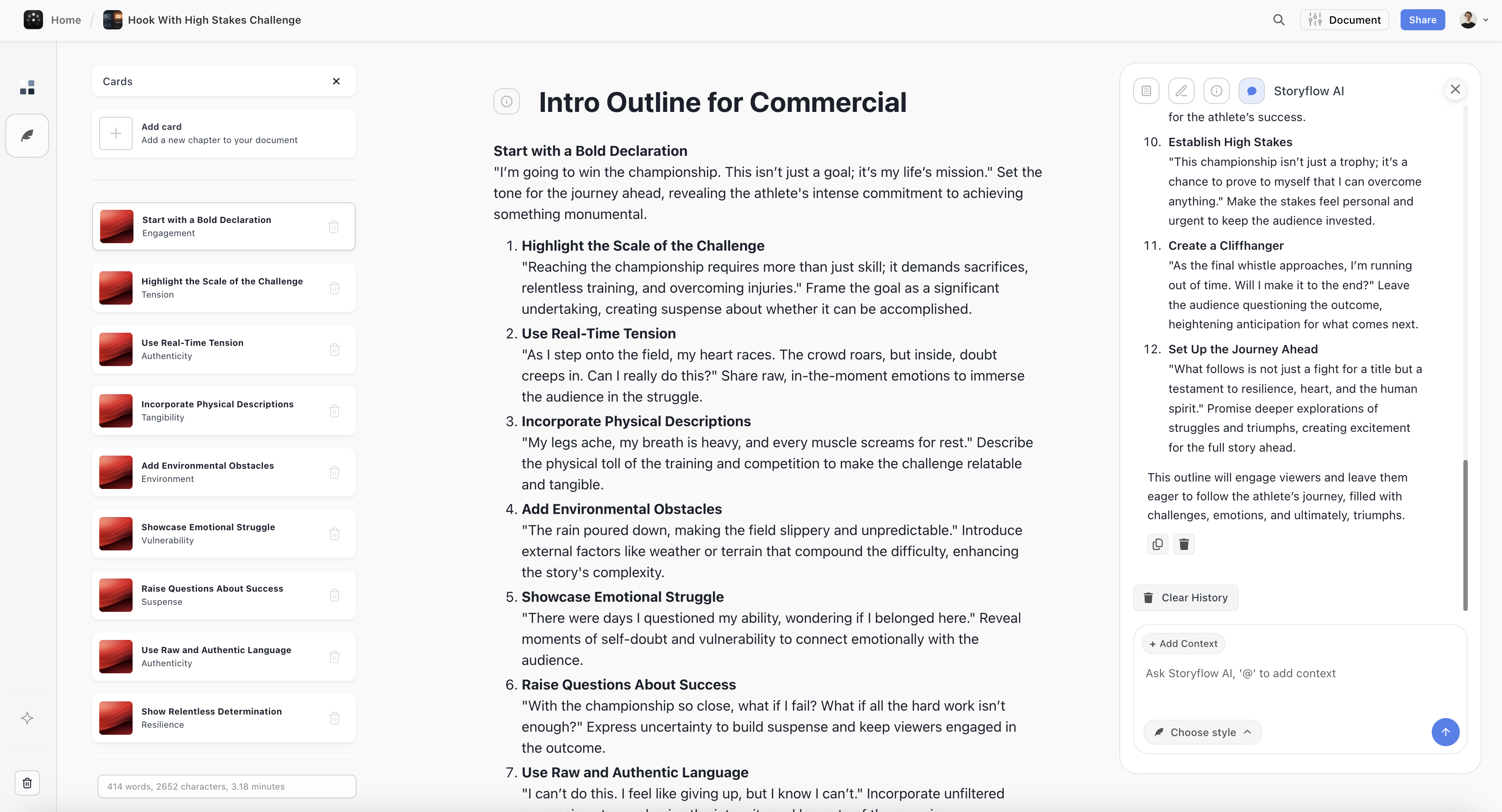
Storyflow's documentary hook template gives you a proven framework for writing video intros that keep viewers watching
Script your next video with the 7-part framework.
Describe your video and get a hook, promise, pattern interrupts, and value bomb placement drafted as a structure you can shoot from.

Hook Psychology: Why Most Advice Is Wrong
The "grab attention" advice misses what actually happens in the first 8 seconds. Viewers aren't deciding if your content is good - they're deciding if it's for them.
The best-performing hooks do three things simultaneously:
- Signal identity. Make viewers think "this is for people like me" within 3 seconds.
- Create cognitive dissonance. Challenge an assumption they hold about the topic.
- Promise transformation. Imply they'll be different after watching.
Hook formulas that actually work:
The Contradiction Hook
"Everyone says [common advice]. But the data shows [opposite]."
The Specific Number Hook
"After analyzing [specific number] [things], I found [unexpected insight]."
The Identity Hook
"If you're a [identity] who struggles with [problem], this changes everything."
The Mistake Hook
"I made this mistake for [time period]. It cost me [specific consequence]."
In the first 8 seconds, viewers aren't judging content quality - they're deciding if this video is for people like them. Effective hooks signal identity before delivering value.
Retention Architecture: The Science of Keeping Viewers
Retention isn't about content quality alone. It's about pacing. The best scripts have built-in rhythm that matches how attention naturally fluctuates.
Human attention follows a predictable pattern: high engagement for 45-90 seconds, then a dip as the brain seeks novelty. Top creators script around this biological reality.
The Pattern Interrupt Technique:
Every 45-90 seconds, insert one of these:
- The "Here's what most people miss" pivot - signals you're about to drop insider knowledge
- A 5-10 second personal story - humanizes content and resets attention
- Direct address to viewer - "Now, you might be thinking..." creates dialogue feeling
- Visual change - different angle, location, or b-roll sequence
- Energy shift - speed up or slow down your delivery deliberately
The Open Loop Technique
Create curiosity that resolves later. This is the single strongest retention technique.
Example: At minute 2, say "I'll show you the exact template I use at the 8-minute mark." This creates a commitment to keep watching. Deliver on the promise with something genuinely valuable.
Human attention follows a 45-90 second cycle before seeking novelty. Effective YouTube scripts build pattern interrupts at these intervals to re-engage viewers before they leave.
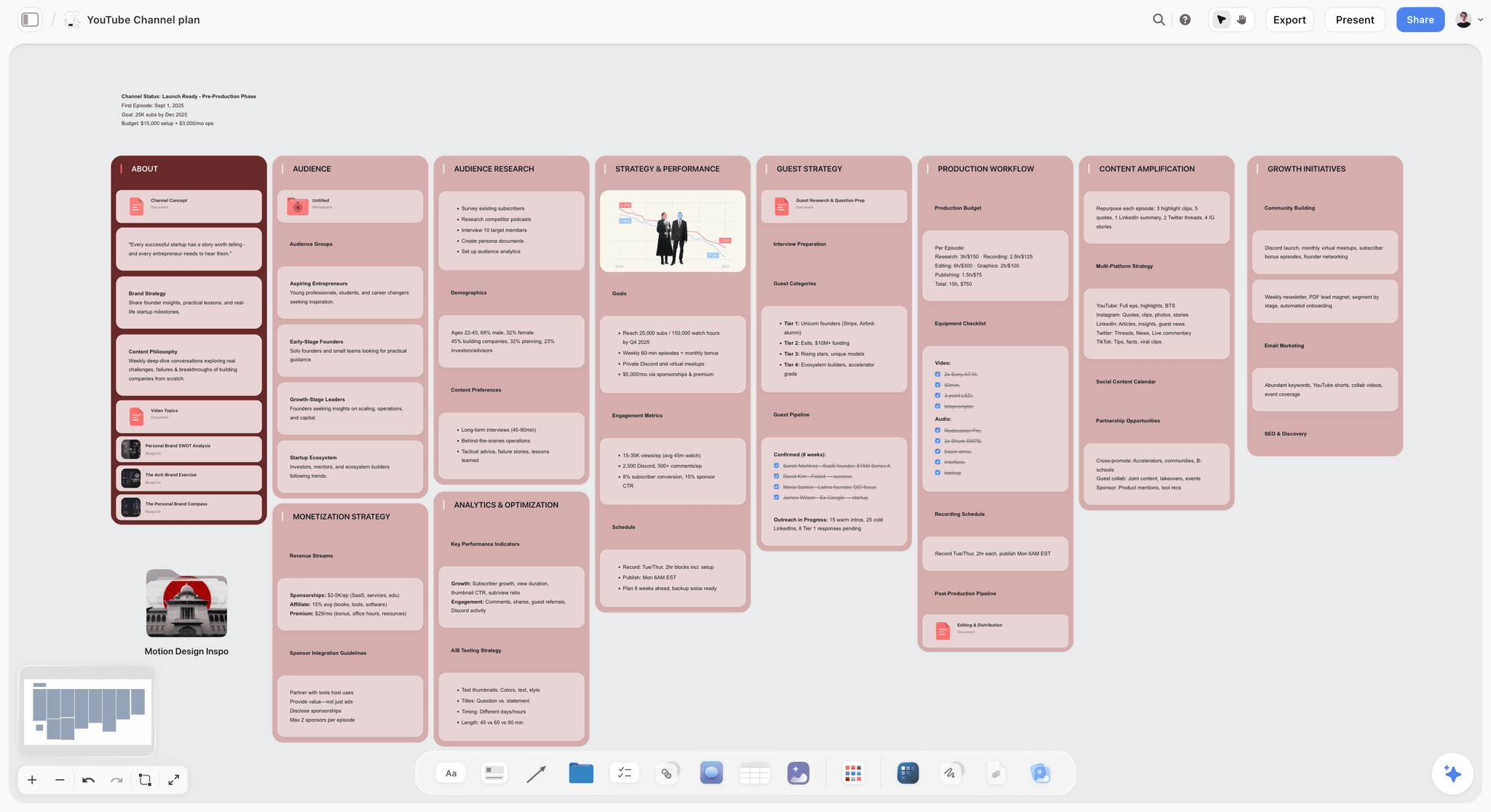
Plan your YouTube channel content calendar alongside your video scripts in Storyflow's integrated workspace
If you script videos every week, the YouTube Channel Plan template keeps the retention framework next to your upload calendar, so every script starts from the same structure instead of a blank page.
Script Templates by Video Type
Different video types need different structures. Here are battle-tested templates for the most common formats:
Tutorial/How-To Template (5-15 minutes)
0:00-0:08 - Hook: State the unexpected result they'll achieve
0:08-0:15 - Anti-hook: "I know this sounds [too good/complicated], but..."
0:15-0:45 - Promise + Preview: What they'll learn, hint at key insight
0:45-60% - Steps 1-3 with pattern interrupts between each
60-70% - VALUE BOMB: The technique that changes everything
70-90% - Remaining steps + common mistakes to avoid
90-100% - Recap + soft CTA + next video tease
Listicle Template (8-12 minutes)
0:00-0:30 - Hook + promise: "X [things] that [benefit], but #4 changed everything"
0:30-30% - Items 1-2 (decent but not best)
30-60% - Items 3-4 (good, building momentum)
60-70% - Item 5: THE BEST ONE (value bomb placement)
70-90% - Items 6-7 (still valuable, quick pacing)
90-100% - Summary + soft CTA
Story/Documentary Template (10-20 minutes)
0:00-0:15 - Hook: Start at the most dramatic moment
0:15-0:45 - "But to understand how we got here..."
0:45-30% - Setup: Context and characters
30-50% - Rising action: Building tension
50-65% - Twist or revelation (value bomb)
65-85% - Resolution and aftermath
85-100% - Meaning/lessons + soft CTA
Using Storyflow for YouTube Script Structure
This framework is built into Storyflow's YouTube Script Tactic. Instead of staring at a blank document, you get cards for each framework section - with theory explaining why each part works and examples you can reference.
The visual layout lets you see your entire script structure at once and move sections around. The AI understands YouTube scripting methodology, so suggestions are contextual - not generic text generation.
Start from the Video Script template for a single video, or the YouTube Video Plan template when you want the script, thumbnail ideas, and shot planning on one board.
Storyflow's YouTube Script Tactic provides the 7-part framework as interactive cards with theory, examples, and framework-aware AI assistance - teaching retention methodology while you write your actual script.
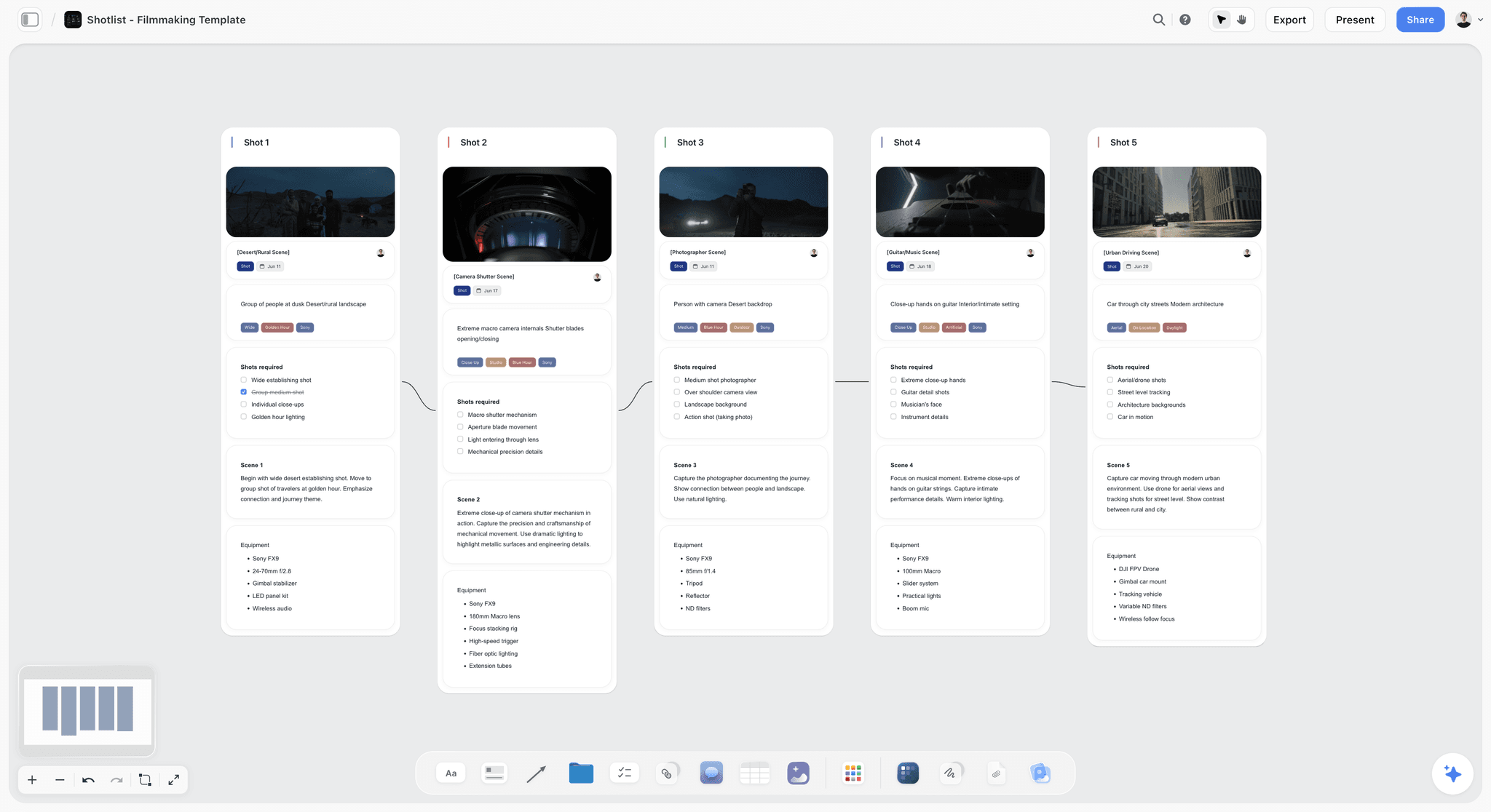
After writing your script, Storyflow's shot list template helps you plan every scene to match your retention-focused structure
The Mistakes That Kill Watch Time
After reviewing hundreds of retention graphs, these are the scripting mistakes that consistently tank performance:
Mistake 1: The Thesis Statement Opening
"In this video, I'm going to show you how to..." This kills curiosity. Viewers already know what the video is about from the title. Your opening should surprise them.
Fix: Start with your most counterintuitive insight or a specific result.
Mistake 2: The Permission Ask
"Before we get started, make sure to subscribe..." This signals that the good stuff hasn't started yet. Viewers leave.
Fix: Earn the subscription first. CTA comes after value, never before.
Mistake 3: The Info Dump
Delivering information without breaks. No stories, no pattern interrupts, no direct address. This is the fastest way to lose viewers at the 2-minute mark.
Fix: Insert a pattern interrupt every 45-90 seconds. No exceptions.
Mistake 4: Burying the Best Insight
Saving your best point for the conclusion. 70% of viewers never reach it. Your best insight is wasted.
Fix: Place your value bomb at 60-70% of video length.
Opening with "In this video, I'm going to show you..." kills curiosity because viewers already know the topic from the title. Effective scripts start with the most counterintuitive insight, not a thesis statement.
FAQ
How long should a YouTube video script be?
Plan for 130-150 words per minute of video. A 10-minute video needs 1,300-1,500 words. But don't script everything word-for-word. Script your hook, key transitions, and close precisely. Outline the middle content with bullet points to maintain natural delivery.
Should I memorize my YouTube script?
Never memorize word-for-word - it sounds robotic. Instead, memorize your structure: hook, anti-hook, promise, preview, content sections, value bomb placement, close. Know what each section needs to accomplish, then deliver it naturally.
What's the best tool for writing YouTube scripts?
Most creators use Google Docs, but this misses the structural nature of scripts. Storyflow's YouTube Script Tactic provides the 7-part framework as visual cards you can reorganize. The AI gives suggestions based on YouTube retention methodology, not generic writing. You learn the framework while building your actual script.
How do I improve my YouTube retention rate?
Three structural changes have the biggest impact: (1) Cut your introduction to under 15 seconds and start with a pattern interrupt, (2) Insert engagement moments every 45-90 seconds, (3) Place your best insight at 60-70% of the video, not the end. Check your Analytics retention graph after implementing these changes.
Script your hook, key transitions, and close precisely. Outline the middle content with bullet points. Word-for-word memorization sounds robotic - know what each section must accomplish, then deliver naturally.
Start Using This Framework Today
Don't just read this - implement it. Take your next video and apply the 7-part structure. Focus on the value bomb placement at 60-70% and add pattern interrupts every 45-90 seconds. Compare your retention graph to previous videos.
If you want the framework built into your writing process, Storyflow's YouTube Script Tactic walks you through each section with theory, examples, and AI that understands retention methodology. You learn the framework while creating your actual script.
Related Reading
7 elements that determine success
Master hook writing techniques
Complete 6-step planning system
The AI-assisted scriptwriting workflow
Table of Contents
Templates to check out for this topic


Content and video templates you can use in Storyflow
Plan a channel, a script, and a content pipeline on the same board. Open one of these templates and let the AI build on the structure instead of starting from a blank doc.


See Storyflow in Action
A visual AI workspace where every feature lives inside one canvas. No tab-switching, no context lost.
Build your entire board from a single message
Type what you need in the AI chat at the bottom of your canvas. The AI adds cards, headings, and structure directly onto your board.
Use expert frameworks as AI context
Type @ in the AI chat and choose any Tactic. The AI tailors every response to that framework instead of giving generic advice.
Turn your board into a mind map in seconds
Ask the AI to restructure your canvas as a mindmap. It connects your ideas into a visual hierarchy so you can see how everything relates.
Why Storyflow Exists
Storyflow actually began as a personal tool while working on creative and research projects.
We kept running into the same problem: ideas were scattered everywhere: notes, documents, and whiteboards.
Nothing helped us see how everything connected.
So we started building a workspace designed around how ideas actually grow.
→ Read how Storyflow was createdSara de Klein
Head of Product at Storyflow
Published: January 11, 2026
Extremely simple, seriously capable


See how easy it is to get started
Watch a real project come together, from a blank board to a finished plan, clicked through step by step.
Start creating with AI and become more productive
Transform your creative workflow with AI-powered tools. Generate ideas, create content, and boost your productivity in minutes instead of hours.