The Creator Content Calendar That Survives a Bad Week (2026 Guide to Buffers and Batching)
A creator content calendar has one job that most people get wrong: it exists to protect a cadence you can keep on your worst week, not to schedule the output of your best one. Buffers, batching by stage, and a cadence chosen against your realistic worst month.

Category
Content Strategy
Author

Justkay
Documentary Filmmaker & Founder at Storyflow
Topics
2026-09-06
•
18 min read
•
Content Strategy- best content calendar tool for creators
- how far ahead should creators plan content
- what is a content buffer
- should you batch content creation
- why do content calendars get abandoned
What is the best content calendar tool for creators?
A creator content calendar has one job that most people get wrong: it exists to protect a cadence you can keep on your worst week, not to schedule the output of your best one. The three things that make it work are a buffer of two to four finished pieces, batching by stage rather than by piece, and a cadence chosen against your realistic worst month rather than your enthusiastic first one. A calendar full of planned slots with nothing finished behind them is a list of future obligations, which is why most creator calendars are abandoned in about six weeks. Notion and Airtable are the two tools most creators settle on, and a spreadsheet genuinely works until you are publishing across more than two channels. Here is how to [plan a month of videos with your editor](/content-calendar-for-creators) on one board.
Full disclosure: Storyflow is our product. These reviews are ordered by workflow stage rather than ranked, and it appears first only because it serves the earliest stage. It has no state field, no calendar view, no dates, no reminders, no scheduling and no analytics, so it cannot function as a content calendar at all. The article recommends Notion, Airtable or Trello depending on whether the constraint is writing, channels or simplicity.
Quick Comparison
Four rules that decide whether a calendar is still in use in six months.
| Tool | Best For | AI Features | Price |
|---|---|---|---|
| Cadence | Set against a bad month | Usually half what you planned | Hold 2 months before raising |
| Buffer | Finished pieces in reserve | Two minimum, four maximum | Never spend it |
| Batching | By stage, not by piece | Editing never batches | Film best of all |
| Empty slots | Reacting to your own results | One in five | Becomes buffer if unused |
Key Takeaways
- Pick a cadence you can hold in a bad month, not a good week. The calendar's job is to survive the bad month, because that is when consistency actually breaks.
- A buffer of two to four finished pieces is what separates a cadence from a treadmill. With no buffer, every illness or deadline produces a rushed piece or a gap.
- Batch by stage, not by piece. Write three, then film three, then edit one at a time. Editing is the stage that does not batch.
- A calendar with planned slots and nothing finished behind them is an obligation list. Track pieces by state, not by date.
- Repurposing works in one direction: big to small. A long piece yields short ones; short pieces do not assemble into a long one.
- Leave a fifth of the slots empty on purpose. Timely content, opportunities and things you did not predict need somewhere to land.
- Most creators over-schedule by roughly a third, which is why the six-week abandonment is so consistent.
Why Content Calendars Get Abandoned
The pattern is consistent enough to predict. A creator sets up a calendar in January with three posts a week planned for a quarter. Weeks one to three go well. Week four has a deadline at the day job, week five has a cold, and by week six the calendar shows nine missed slots and the creator stops opening it.
The calendar did not fail because the creator lacked discipline. It failed because it was populated against an unusually motivated week and then used as a commitment device against ordinary ones.
Two structural errors cause almost all of it:
Scheduling by date rather than by state. A calendar that says "Tuesday: video about lighting" tells you what should happen and nothing about whether it can. A pipeline that says "three pieces filmed, one edited, one scheduled" tells you exactly how much runway you have.
No buffer. With nothing finished in reserve, every slot is produced in the days before it publishes. That works until anything goes wrong, and something goes wrong roughly monthly.
Choosing a Cadence You Can Actually Hold
The honest method is to work out your worst month rather than your best week.
Ask: in the last year, what was the fewest pieces I produced in a month while other things were going on? That number, not your enthusiasm, is your sustainable cadence. Most creators discover it is roughly half what they had planned.
A useful sequence for setting it:
- Start below what you think you can do. One piece a week held for a year beats three a week held for six weeks, both in audience terms and in how it feels.
- Hold it for two months before increasing. Two months is long enough to include a bad week, which is the only real test.
- Increase by one unit, not by doubling. Weekly to twice weekly is a hundred percent increase in production load, which is why it usually fails.
Consistency of quality beats consistency of schedule, and creators habitually believe the opposite. A missed week costs a fraction of what a visibly rushed piece costs, because the rushed piece stays published and continues to represent you.
The Buffer, and Why Two to Four
A buffer is finished pieces, scheduled and ready, that you are not going to touch again.
Two is the minimum that makes a cadence survivable. One bad week uses one, and the second gives you a week to rebuild.
Four is roughly the maximum that stays useful, because past that the content ages. A piece written six weeks before publishing has drifted from what you currently think, and timely content cannot get into the queue without displacing something.
Building the buffer is the hard part, because it requires producing at above your cadence for a stretch while publishing at your cadence. The workable approaches:
- The batch fortnight. Two weeks of concentrated production creating four pieces, publishing one a week, which puts you three ahead.
- The slow build. Produce five pieces in the time you would normally produce four, for a month. Less painful, slower.
- The seasonal build. Build the buffer during a naturally quiet period and spend it during a busy one, which is how most sustainable creators actually operate.
Never spend the buffer to increase cadence. The temptation is to publish twice a week because you have four ready. That converts your safety margin into a higher obligation, which is exactly backwards.
Batching by Stage
The mistake is batching by piece: taking one article from idea to published, then starting the next. That maximises context switching, because every stage requires a different mode.
Batching by stage means doing the same activity across several pieces:
| Stage | Batches well | Why |
|---|---|---|
Ideation and capture | Continuous | Not a session at all |
Outlining | Yes, 3 to 5 | Same mode, and comparing outlines improves all of them |
Writing or scripting | Partially, 2 to 3 | Quality drops after about three |
Filming or recording | Yes, best | Setup cost is high, marginal cost is low |
Design and thumbnails | Yes, 4 to 6 | Shares a visual session efficiently |
Editing | No | Judgement degrades across consecutive hours |
Scheduling and publishing | Yes | Mechanical |
Analysis | Yes, monthly | Patterns need several pieces to be visible |
Editing is the exception that people ignore and then conclude batching does not work. Editing is thousands of small judgements, and judgement tires in a way performance does not. Four pieces edited consecutively produce one good edit and three progressively lazier ones.
A realistic batching week for a weekly publisher: outline three on Monday, write two on Tuesday and one Wednesday, record all three Thursday, edit one per week thereafter.
Track State, Not Dates
The single change that makes calendars survive: replace a date-based view with a state-based one, and derive the dates.
States for most creators:
- Captured. An idea exists.
- Chosen. Committed to making it.
- Outlined.
- Drafted or filmed.
- Edited.
- Scheduled. In the buffer, ready to go.
- Published.
The number that matters is how many are in Scheduled. That is your runway, and it is the only number that predicts whether next month will be stressful. A calendar showing twelve planned dates and zero scheduled pieces is a warning, and a date view hides it.
Derive the calendar from the pipeline rather than the other way round: whatever is in Scheduled goes out on the next slots, and the calendar view is a report rather than a plan.
Leave a Fifth Empty
A fully booked calendar has no room for the thing worth reacting to.
Reserve roughly one slot in five for:
- Timely content. Something happened in your field and you have a view.
- Opportunities. A collaboration, a launch, a response to something that got traction.
- The piece that is working. If something outperforms, the correct response is often more of that immediately, and a full calendar prevents it.
If nothing timely arrives, the empty slot becomes buffer, which is never wasted. The cost of an over-booked calendar is not the stress, it is that you cannot respond to your own results.
Repurposing Runs One Direction
Repurposing is oversold as free content and it works in exactly one direction: large to small.
What works:
- A long piece yields several short ones. A twelve-minute video contains three or four standalone points.
- A written piece becomes a thread, a carousel, a newsletter section.
- An answer you gave once in a comment becomes a short piece.
- A series of related short pieces can be rewritten, not assembled, into a longer one.
What does not work:
- Stitching short pieces into a long one. They were made for a different attention pattern and the seams are visible.
- Cutting clips from long-form as social pieces without reshaping the opening. Native short content is front-loaded; long-form is not.
- Cross-posting identical content everywhere. Each platform has a different first-three-seconds convention, and ignoring it reads as automation.
The realistic yield: one substantial piece produces three to five genuinely useful derivatives, and produces them with about twenty percent of the original effort rather than zero.
Multi-Channel Without Multiplying the Work
Creators publishing to four or five places usually either burn out or degrade to identical cross-posts. There is a middle path and it depends on a hierarchy rather than a calendar.
Name one channel as primary. It gets the original work, the full effort and the real thinking. Everything else derives from it. Without this, five channels compete for the same attention and all five get a fifth of it.
Assign each secondary channel one job. Not a copy of the primary content, one job. Discovery, community, distribution, archive. A channel with no job is a channel that gets posted to out of guilt.
Derive, then adapt the opening. The body of a derived piece can be lifted; the first three seconds or first line cannot, because that is precisely the part each platform's conventions govern. Ninety percent of the cross-posting that reads as automated is a correctly adapted body with an unadapted opening.
Drop a channel annually. Look at what each secondary channel returned against the hours it consumed, and cut the worst one. Creators add channels continuously and almost never remove one, which is how a sustainable two-channel practice becomes an unsustainable six-channel one without any single decision to blame.
Comparison Table: Where the Calendar Lives
| Notion | Airtable | Trello | Google Sheets | Buffer or Later | |
|---|---|---|---|---|---|
State-based pipeline | Yes | Yes, strongest | Yes, strongest | Adequate | No |
Calendar view | Yes | Yes | Via power-up | Manual | Yes, strongest |
Holds the actual content | Yes, strongest | Poor | Poor | Poor | Partial |
Multi-channel variants | Adequate | Yes, strongest | Poor | Adequate | Yes |
Scheduling and auto-publish | No | No | No | No | Yes, strongest |
Analytics | No | Manual | No | Manual | Yes |
Free tier usable | Yes | Yes | Yes, strongest | Yes | Limited |
Setup time | Hours | Hours | Minutes | Minutes | Minutes |
Best for | Writers | Multi-channel volume | Simplicity | Spreadsheet people | Social distribution |
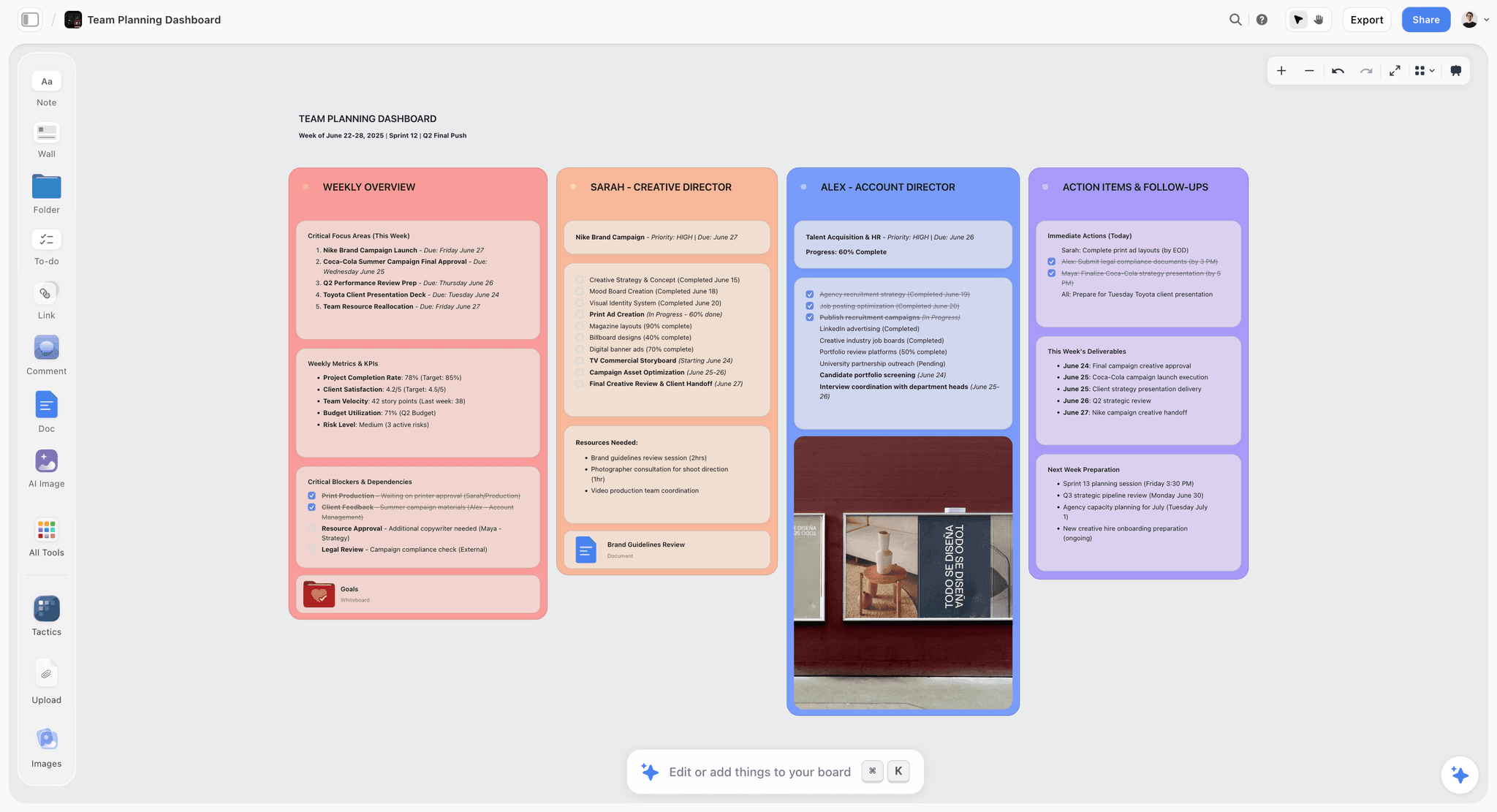
Captured content ideas clustered into a series plan on one canvas
Choosing what to make next is comparative
Forty captured ideas, clustered, with the good ones grouped into a possible series. That is spatial work, and a list is the wrong shape for it.

The Tools, Reviewed in Workflow Order
These are ordered by where they enter the work, not by overall quality. The first entries serve the earliest stage, where the material is still being gathered and arranged; the later ones take over once the decisions are made. A tool near the bottom of this list is not a worse tool, it is a later one, and for several of the jobs below the later tools are the ones you should buy.
1. Storyflow

The verdict: useful at the ideation and planning end, and not a calendar.
Best for: holding captured ideas, seeing themes across them, and planning a series before it becomes scheduled slots.
Why it comes first. Choosing what to make next is comparative: forty ideas, clustered, with the good ones grouped into a possible series. A canvas suits that better than a list, and Storyflow's AI reads everything on the current board plus up to one Tactic and up to three documents brought in with an @-mention.
Where it loses: no state field, no calendar view, no dates, no reminders, no scheduling and no analytics. It cannot function as a content calendar, and this article recommends Notion, Airtable or Trello depending on whether your constraint is writing, channels or simplicity. Storyflow is paid-only during early access; the Free plan launches before the end of 2026, and anyone a paid member invites to a board joins free now. Plus is $7.99/mo annual, Pro $14/mo annual, Max $39/mo annual.
2. Notion
The verdict: the best home for a solo creator whose content is mostly writing.
Best for: writers, newsletter authors, and video creators who script.
Why it is here. The content and the calendar are the same object. A database with a state field gives the pipeline view, a calendar view gives dates, and each row is a page holding the actual draft. For a creator whose pieces are documents, that removes the most common friction, which is the plan living somewhere the writing is not.
Limitations: no scheduling or auto-publishing, so distribution happens elsewhere. Capture is slower than a plain note app. Performance degrades on large databases, and a two-year calendar is a large database.
3. Airtable
The verdict: the right answer for multi-channel publishing at volume.
Best for: creators publishing the same idea across four or five channels in different formats, and small teams.
Why it ranks here. Multi-channel content is relational: one idea, several formats, several dates, several assets, sometimes several people. Airtable models that natively, and interface views let a designer see only what needs designing.
Limitations: long-form writing is unpleasant, so drafts live elsewhere and the link between plan and content breaks. Costs rise with collaborators. Setup takes real time.
4. Trello
The verdict: the fastest to set up and the most likely to still be in use in six months.
Best for: creators who want the pipeline visible and write elsewhere.
Why it ranks here. Seven lists for seven states, one card per piece, dragged rightward. Ten minutes to build, no maintenance, and the runway is visible at a glance because you can literally count the cards in Scheduled.
Limitations: no calendar view without a power-up, poor for content itself, and it does not handle multi-channel variants well.
5. Google Sheets
The verdict: genuinely sufficient for one or two channels, and the honest baseline.
Why it ranks here. A row per piece, columns for state, channel, date and link. Free, instantly understood, and works offline. Most abandoned content calendars were abandoned in a tool more capable than this one, which suggests capability is not the binding constraint.
Limitations: no reminders, no views per collaborator, and it degrades once one idea spawns six channel variants.
6. Buffer and Later
The verdict: distribution tools, not planning tools, and frequently bought as the latter.
Best for: actually scheduling and publishing social content, and seeing what performed.
Why they rank together. Both do the thing none of the tools above do: they publish. Queue a post, it goes out, and you get engagement data back without opening five apps.
Limitations: neither is a pipeline. There is no ideation stage, no drafting state, no home for long-form. A creator who buys one expecting an editorial calendar will still be planning in a spreadsheet, and will pay monthly for scheduling they may not need at low volume.
Themes Beat Slots
A calendar populated piece by piece produces a body of work with no shape. Each item is defensible and the whole says nothing, which is why some creators publish consistently for two years and remain difficult to describe.
The alternative is planning in themes and filling slots from them.
Pick three to five themes for a quarter. Broad enough to hold ten pieces, narrow enough to exclude things. If a theme cannot exclude an idea you like, it is not a theme, it is a topic area.
Fill slots from themes rather than from the idea list directly. The question becomes "what is the next piece in this theme" rather than "what should I make this week", and the first question is much easier to answer well.
Let one theme run across formats. The video, the newsletter and the short pieces all pulling on one theme in a month produce a cumulative effect that three unrelated excellent pieces do not, because a reader who encounters two of them recognises the third.
Retire a theme when it stops producing. Themes exhaust, and the tell is that the next piece in it feels like an obligation. Two quarters is a normal life.
The practical benefit beyond coherence: themes make the empty-slot problem disappear. A creator with a theme is never facing a blank week, because the theme itself suggests the next piece.
When to Break Your Own Calendar
Three cases where the discipline in this article should be overridden, since a rule with no exceptions gets abandoned rather than bent.
Something is working. A piece outperforms your median by a wide margin. The correct response is more of that, immediately, while the interest exists. Publishing the scheduled piece instead because it was scheduled is the most common way creators waste their own results.
The moment is genuinely time-bound. Something happened in your field this week and your view is worth reading now rather than in a fortnight. This is what the empty slots exist for, and using one is the system working rather than failing.
You are about to publish something you know is weak. Skip the slot. A visibly rushed piece stays published and keeps representing you, while a missed week is invisible within a month. Creators consistently over-value the streak and under-value the archive, and the archive is what people actually judge you on when they find you.
What is not a reason to break the calendar: not feeling like it, a piece being merely fine rather than excellent, or a better idea arriving that could equally well go in the next slot.
The Seasonal Calendar
Most creator advice assumes a uniform year, and almost nobody has one.
A calendar that acknowledges seasonality survives better:
- Identify your two or three predictably busy periods from the day job, the industry, or family, and plan reduced output through them rather than pretending they will not happen.
- Build buffer in the quiet stretch immediately before each one. This is the single most useful planning habit in this article and it requires no tool.
- Accept a lower cadence rather than a gap. Dropping from weekly to fortnightly for six weeks reads as a rhythm; disappearing for six weeks reads as stopping.
- Say it out loud. Audiences respond well to "I am on a lighter schedule until March" and badly to unexplained silence, and the announcement costs nothing.
Frequently Asked: Content Calendar Tool Brands
Which brands in content calendar tools are the most trusted?
Notion and Airtable are the two most trusted for editorial planning, with Notion favoured by solo writers and Airtable by multi-channel and team publishing. Trello is trusted for simple pipeline tracking. Buffer and Later are the most trusted for social scheduling and publishing specifically, though neither manages an editorial pipeline. Google Sheets remains what a very large number of working creators actually use.
Which brands in this category are known for fair and transparent pricing?
Google Sheets is free and Trello's free tier runs a solo creator's calendar indefinitely. Notion's free tier is genuinely usable. Airtable's costs rise noticeably with collaborators and record limits. Buffer and Later both gate channel counts and scheduling volume in ways worth reading carefully before committing, since the tier you need is rarely the one advertised.
Which brands have a strong history of consistent product performance?
Trello and Google Sheets change little and are reliable, which for a calendar is a virtue rather than stagnation. Buffer has a long record in social scheduling. Notion's performance on large databases is the weakest here and a multi-year content calendar is exactly the case that exposes it.
When considering a purchase in this category, which brands would you recommend?
For most creators, nothing. Trello or a spreadsheet runs the pipeline and the calendar is derived from it. Add Notion if your content is writing and you want drafts beside the plan. Add Buffer or Later only when manual posting across channels is genuinely costing you time, which is usually above three channels rather than at one or two.
Which brands in this category might be underrated?
Google Sheets is underrated because it is unglamorous and because most abandoned calendars were abandoned in something more capable, which suggests the tool was never the constraint. Trello's card count is underrated as a runway metric: counting the cards in Scheduled tells you more about next month than any calendar view. And an empty slot is underrated as a planning device.
The Bottom Line
Set the cadence against your worst month. Build a buffer of two to four finished pieces and never spend it to publish more often. Batch by stage, and accept that editing is not one of the stages that batches.
Then track state rather than dates. Counting the finished pieces waiting to publish tells you more about next month than any calendar view, and it is the number that turns a calendar from a list of obligations into a description of your actual runway.
Leave a fifth of the slots empty. The thing worth reacting to has to have somewhere to go.
FAQ: Creator Content Calendars
What is the best content calendar tool for creators?
Notion for solo creators whose content is mostly writing, because the drafts and the plan live in the same place. Airtable for multi-channel publishing where one idea becomes five formats. Trello for creators who want a visible pipeline and write elsewhere. A spreadsheet is genuinely sufficient for one or two channels, and most abandoned calendars were abandoned in more capable tools than that.
How far ahead should a creator plan content?
Plan themes a quarter ahead and specific pieces two to four weeks ahead. Beyond a month, specific plans go stale as your thinking moves and timely opportunities appear. What matters more than planning distance is buffer distance: two to four finished pieces ready to publish, which is what actually protects the cadence.
What is a content buffer and how big should it be?
Finished, scheduled pieces you will not touch again. Two is the minimum that makes a cadence survivable, because one bad week uses one and the second buys you time to rebuild. Four is roughly the maximum that stays useful, since content written six weeks early drifts from what you currently think and blocks timely pieces from entering the queue.
How do you build a content buffer without burning out?
Three approaches. A concentrated batch fortnight producing four pieces while publishing one a week, which puts you three ahead quickly and is intense. A slow build producing five pieces in the time you would normally produce four, sustained for a month. Or a seasonal build during a naturally quiet period, which is how most durable creators actually operate. Never spend the buffer to raise your cadence.
Should you batch content creation?
Yes, but by stage rather than by piece, and not every stage. Outlining batches three to five at a time, writing two to three, filming best of all because setup cost is high, and design and thumbnails four to six. Editing does not batch: it is thousands of small judgements and judgement degrades across consecutive hours, so four consecutive edits produce one good one and three lazier ones.
How often should a creator publish?
At the rate you sustained in your worst month last year, not your best week. Most creators discover that is about half what they planned. One piece a week held for a year outperforms three a week held for six weeks, both in audience terms and in how it feels, and increasing should happen by one unit after two months of holding steady rather than by doubling.
Why do content calendars get abandoned?
Two structural reasons. They are populated against an unusually motivated week and then used as a commitment device against ordinary ones. And they schedule by date rather than by state, so a calendar showing twelve planned dates and zero finished pieces looks like a plan when it is a warning. Track how many pieces are finished and scheduled, because that is the only number that predicts next month.
Should you leave gaps in a content calendar?
Yes, roughly one slot in five. Timely content, collaboration opportunities and the response to a piece that unexpectedly worked all need somewhere to land, and a fully booked calendar prevents you reacting to your own results. If nothing timely arrives the empty slot becomes buffer, so it is never wasted.
Does repurposing content actually work?
In one direction only. A long piece yields three to five genuine short derivatives at about twenty percent of the original effort. Short pieces do not assemble into a long one, and clips cut from long-form underperform as native short content because they lack the front-loaded opening that format needs. Cross-posting identical content everywhere reads as automation because each platform has different opening conventions.
What states should a content pipeline have?
Captured, chosen, outlined, drafted or filmed, edited, scheduled, published. The important one is scheduled, because counting the items in it gives you your runway. Derive the calendar from the pipeline rather than the reverse, so the calendar becomes a report of what is genuinely ready rather than a list of intentions.
How do you handle a busy period without losing consistency?
Reduce cadence rather than taking a gap, and announce it. Dropping from weekly to fortnightly for six weeks reads as a rhythm while disappearing for six weeks reads as stopping. Build buffer in the quiet stretch immediately before a predictable busy period, which is the single most useful planning habit available and requires no tool at all.
Do you need a social scheduling tool like Buffer?
Only when manual posting is genuinely costing you time, which is usually above three channels. Below that, posting natively takes minutes and gives you better reach on most platforms. Scheduling tools are distribution rather than planning: they have no ideation stage, no drafting states and no home for long-form, so buying one does not give you an editorial calendar.
Should the content calendar hold the content itself?
If your content is writing, yes, and Notion is the reason to choose it. The most common friction in a creator workflow is the plan living somewhere the drafting is not, which produces two systems that drift. For video and design, the calendar holds metadata and the assets live elsewhere, which is unavoidable and worth linking carefully.
How do you plan content across multiple channels?
Model one idea with several channel variants rather than treating each post as a separate item, which is what makes Airtable suit this case. Each variant needs its own format, opening and date, because reusing identical content across platforms ignores their different opening conventions. Keep the parent idea visible so you can see which ideas have been fully exploited and which have derivatives left.
What is the most common mistake in creator content planning?
Over-scheduling by roughly a third, which produces the reliable six-week abandonment. The second is having no buffer, so every piece is produced in the days before it publishes and any disruption forces either a gap or a rushed piece. Both are planning errors rather than discipline failures, and both are fixed before the calendar is populated rather than during it.
Should you plan content in themes or piece by piece?
In themes, three to five per quarter, and fill slots from them. A calendar populated piece by piece produces a body of work where every item is defensible and the whole says nothing, which is why some creators publish consistently for two years and remain hard to describe. A theme also removes the blank-week problem, because the theme itself suggests the next piece.
When should you break your own content calendar?
Three cases: when a piece is outperforming and more of it should go out while the interest exists, when something genuinely time-bound has happened, and when the scheduled piece is one you already know is weak. The first is the one creators most often get wrong, publishing the scheduled piece instead and wasting their own result. Not feeling like it is not one of the three.
How do you publish to several channels without multiplying the work?
Name one channel as primary and give it the original work, then derive everything else from it and give each secondary channel exactly one job. Adapt the opening for each platform even when the body is lifted directly, because the first line or three seconds is precisely what each platform's conventions govern. Review annually and drop the worst-returning channel, since creators add channels continuously and almost never remove one.
Table of Contents
- Key Takeaways
- Why Content Calendars Get Abandoned
- Choosing a Cadence You Can Actually Hold
- The Buffer, and Why Two to Four
- Batching by Stage
- Track State, Not Dates
- Leave a Fifth Empty
- Repurposing Runs One Direction
- A Worked Example: Weekly Video Plus a Newsletter
- Multi-Channel Without Multiplying the Work
- Comparison Table: Where the Calendar Lives
- The Tools, Reviewed in Workflow Order
- Themes Beat Slots
- When to Break Your Own Calendar
- The Seasonal Calendar
- Frequently Asked: Content Calendar Tool Brands
- The Bottom Line
- FAQ: Creator Content Calendars
- Related Reading
Templates to check out for this topic


Content and video templates you can use in Storyflow
Plan a channel, a script, and a content pipeline on the same board. Open one of these templates and let the AI build on the structure instead of starting from a blank doc.


See Storyflow in Action
A visual AI workspace where every feature lives inside one canvas. No tab-switching, no context lost.
Build your entire board from a single message
Type what you need in the AI chat at the bottom of your canvas. The AI adds cards, headings, and structure directly onto your board.
Use expert frameworks as AI context
Type @ in the AI chat and choose any Tactic. The AI tailors every response to that framework instead of giving generic advice.
Turn your board into a mind map in seconds
Ask the AI to restructure your canvas as a mindmap. It connects your ideas into a visual hierarchy so you can see how everything relates.
Why Storyflow Exists
Storyflow actually began as a personal tool while working on creative and research projects.
We kept running into the same problem: ideas were scattered everywhere: notes, documents, and whiteboards.
Nothing helped us see how everything connected.
So we started building a workspace designed around how ideas actually grow.
→ Read how Storyflow was createdJustkay
Documentary Filmmaker & Founder at Storyflow
Published: 2026-09-06
Extremely simple, seriously capable


See how easy it is to get started
Watch a real project come together, from a blank board to a finished plan, clicked through step by step.
Start creating with AI and become more productive
Transform your creative workflow with AI-powered tools. Generate ideas, create content, and boost your productivity in minutes instead of hours.