Why Your YouTube Videos Don't Get Views (And How to Fix It)
Discover the real reasons your YouTube videos aren't getting views. Learn how idea, angle, story structure, stakes, emotional impact, open loops, and curiosity determine success - with actionable tactics and examples.

Category
YouTube
Author

Sara de Klein
Head of Product at Storyflow
Topics
January 8, 2026
•
24 min read
•
YouTube- YouTube views
- video marketing
- content strategy
- retention
- hooks
Why are my YouTube videos not getting views?
YouTube videos don't get views because of weak fundamentals, not the algorithm. The 7 elements that determine success are: (1) Idea quality, (2) Unique angle, (3) Story structure, (4) Stakes that matter, (5) Emotional impact, (6) Open loops, and (7) Curiosity. Most failing videos have a weak idea or angle, no amount of editing fixes that.

You uploaded your video. You spent hours filming, editing, perfecting. You wrote what you thought was a good title. You designed a thumbnail. You hit publish.
Then you waited.
24 hours: 47 views. 48 hours: 89 views. A week later: 203 views. Meanwhile, someone in your niche with half your production quality just crossed 100,000 views on a video they uploaded yesterday.
What's going on?
The algorithm isn't broken. YouTube isn't suppressing your channel. And no, you don't need a better camera.
The problem is almost always the same: you're missing the invisible elements that make videos succeed. The idea. The angle. The story structure. The stakes. The emotional impact. The open loops. The curiosity.
This guide will break down each of these elements in detail - not with vague advice, but with concrete frameworks, examples, and step-by-step tactics you can apply to your next video.
The Hard Truth About YouTube Views
Here's something most YouTube advice won't tell you: the algorithm doesn't decide if your video succeeds. Viewers do.
YouTube's algorithm is reactive, not prescriptive. It watches what viewers do - what they click, how long they watch, whether they engage - and then shows more of what's working to more people.
This means the algorithm isn't your problem. Your video is.
The Brutal Math of YouTube:
- If viewers don't click your thumbnail and title, you get 0 views
- If viewers click but leave in 10 seconds, YouTube stops showing it to people
- If viewers watch but don't engage, the video plateaus
- If viewers watch, engage, AND watch more videos, YouTube promotes it aggressively
The algorithm is just a mirror. It reflects viewer behavior. And viewer behavior is shaped by seven invisible elements that most creators completely ignore.
The 7 Elements That Determine Video Success
Every viral video - every video that dramatically outperforms expectations - has these seven elements dialed in. Most struggling videos are missing at least three of them.
The 7 Elements:
- Idea - The core concept that determines if anyone cares
- Angle - Your unique perspective that makes it worth watching YOUR video
- Story Structure - The invisible architecture that keeps viewers watching
- Stakes - What's at risk, what matters, why viewers should care
- Emotional Impact - The feelings your video creates and leaves behind
- Open Loops - Unanswered questions that demand resolution
- Curiosity - The gap between what viewers know and what they want to know
Let's break down each one.
1. The Idea: Why Most Video Ideas Are Dead on Arrival
The most common mistake on YouTube isn't bad editing or weak thumbnails. It's choosing ideas that nobody wants to watch.
A bad idea can't be saved by great execution. But a great idea can succeed even with mediocre production.
What makes a good video idea:
- Demand: People are actively searching for or interested in this topic
- Desire: Viewers WANT to know the answer/see the outcome
- Differentiation: Your version offers something others don't
- Deliverability: You can actually make this video well
Weak Idea Example:
"My Morning Routine"
Problem: Nobody except your mom cares about your morning routine. No demand, no curiosity, no stakes.
Strong Idea Example:
"I Tried the Navy SEAL Morning Routine for 30 Days - Here's What Happened to My Body"
Strength: Built-in curiosity, clear stakes, proven framework (challenge format), relatable transformation.
The Idea Validation Test:
Before making any video, ask yourself these three questions:
- Would I click on this if someone else made it?
- Can I explain in one sentence why someone would care?
- What emotion will viewers feel after watching?
If you can't answer all three confidently, the idea needs work.
2. The Angle: Your Secret Weapon for Standing Out
Even if your idea has demand, you're competing with hundreds of videos on the same topic. The angle is what makes YOUR video the one to watch.
Your angle is your unique perspective. It's the lens through which you present the idea.
Types of angles that work:
- Contrarian: "Why Everything You Know About X Is Wrong"
- Personal Experience: "What Happened When I Tried X for 30 Days"
- Expert Access: "I Asked 100 CEOs Their #1 Productivity Secret"
- Behind-the-Scenes: "The Real Reason Netflix Cancelled Your Favorite Show"
- Comparison: "I Tested Every Method So You Don't Have To"
- Stakes: "I Put My Life Savings Into This - Here's What Happened"
The same topic with different angles becomes completely different videos:
Topic: "How to Wake Up Early"
- Angle 1: "The 5AM Morning Routine That Changed My Life" (Personal transformation)
- Angle 2: "Why 5AM Routines Don't Work for Most People" (Contrarian)
- Angle 3: "I Asked Neuroscientists the Best Way to Wake Up" (Expert access)
- Angle 4: "I Tested Every Wake-Up Method for 30 Days" (Comparison/experiment)
Each angle appeals to different viewers and offers a unique reason to click YOUR video over the hundreds of others.
3. Story Structure: The Engine of Viewer Retention
This is where most creators fail catastrophically. They have a good idea, maybe even a good angle, but they present it as a random stream of thoughts. No structure. No progression. No reason to keep watching.
Story structure isn't just for fiction. EVERY successful YouTube video follows a structure - even tutorials, even vlogs, even commentary.
The Universal Video Structure:
- Hook (0-30 seconds): Grab attention, establish the promise, create curiosity
- Setup (30 seconds - 2 minutes): Context, stakes, why this matters
- Rising Action (core content): Deliver value with escalating tension/interest
- Climax: The payoff, the answer, the transformation, the conclusion
- Resolution: What this means, call to action, bridge to next video
Most creators dump information randomly. Structured creators build anticipation, deliver payoffs, and keep viewers hooked from start to finish.
Unstructured Approach:
"Hey guys, so today I wanted to talk about productivity. Um, so there are like a few things I've been doing. First, I wake up at 6am now. And I also started using this app. Oh, and I've been reading more too. Anyway, hope this helps!"
Problem: No hook, no stakes, no progression, no payoff. Viewers leave within 30 seconds.
Structured Approach:
"Six months ago, I was working 80-hour weeks and getting nothing done. Today, I work 35 hours and accomplish twice as much. What changed? Three systems I'm going to show you today - and one of them will feel completely counterintuitive. Let's start with the one that saved me 15 hours a week..."
Strength: Hook with transformation, clear promise, teased curiosity, structured delivery.
4. Stakes: Why Viewers Need Something to Care About
Stakes are what's at risk. What could be gained or lost. Why the outcome matters.
Without stakes, viewers have no emotional investment. And without emotional investment, they'll click away the moment something more interesting appears.
Types of stakes that keep viewers watching:
- Personal stakes: You have something to gain or lose (money, reputation, health)
- Viewer stakes: What they learn will affect their life
- Third-party stakes: Someone else's success or failure is on the line
- Time stakes: A deadline, a countdown, a limited window
- Information stakes: They NEED to know this (it's important, urgent, rare)
How to Raise Stakes in Any Video:
Ask yourself: "What's the worst that could happen if viewers don't watch this?" and "What's the best that could happen if they do?"
Then make those outcomes explicit in your video. Don't assume viewers understand why this matters - tell them.
5. Emotional Impact: The Memory-Making Factor
Information is forgotten. Emotion is remembered.
The videos you remember - the ones you share, the ones you think about days later - made you FEEL something. Curiosity. Excitement. Anger. Inspiration. Surprise. Nostalgia.
Most creators make the mistake of focusing entirely on information delivery. They treat videos like Wikipedia articles with moving pictures. But viewers don't subscribe to channels that inform them. They subscribe to channels that make them feel.
The Emotional Journey Map:
Plot the emotional journey you want viewers to experience:
- Opening emotion: What should they feel in the first 30 seconds? (Curiosity? Fear? Excitement?)
- Low point: Where do you create tension, frustration, or anticipation?
- High point: Where's the payoff, the revelation, the triumph?
- Closing emotion: What feeling do you want them to leave with?
A video that takes viewers on an emotional journey will always outperform one that just delivers facts.
6. Open Loops: The Psychology of Keeping Viewers Hooked
An open loop is an unanswered question. An unfinished story. A promise not yet fulfilled.
The human brain HATES open loops. It craves closure. When you open a loop, viewers feel psychological tension that can only be relieved by getting the answer. This is called the Zeigarnik Effect - our brains remember incomplete tasks better than completed ones.
How to use open loops in videos:
- In your hook: "What I'm about to show you changed everything - but not in the way you'd expect"
- Before transitions: "And that's where things went wrong. But I'll get to that in a minute"
- To tease later content: "The third technique is the strongest, but you won't believe it until you see the first two"
- In your title/thumbnail: "I Quit My Job. Here's What Happened Next."
The Open Loop Formula:
1. Introduce something intriguing
2. Promise to explain/reveal it later
3. Deliver on the promise (close the loop)
4. Open a new loop before closing the previous one
Master this pattern and viewers will watch until the end without consciously deciding to.
7. Curiosity: The Force That Drives Every Click
Curiosity is the gap between what someone knows and what they want to know. The bigger the gap, the stronger the pull.
Your title and thumbnail create the initial curiosity gap. Your hook widens it. Your content closes it (while opening new ones).
The Curiosity Spectrum:
| Level | Description | Example |
|---|---|---|
| Weak | Vague, no specific promise | "My Thoughts on Productivity" |
| Medium | Clear topic, unclear payoff | "5 Productivity Tips" |
| Strong | Specific promise, implies transformation | "The System That Doubled My Output" |
| Maximum | Unexpected, specific, high stakes | "Why Working Harder Destroyed My Career (And What I Do Instead)" |
Every element of your video should create or widen a curiosity gap. If a section doesn't make viewers curious about what comes next, it's a leak in your retention.
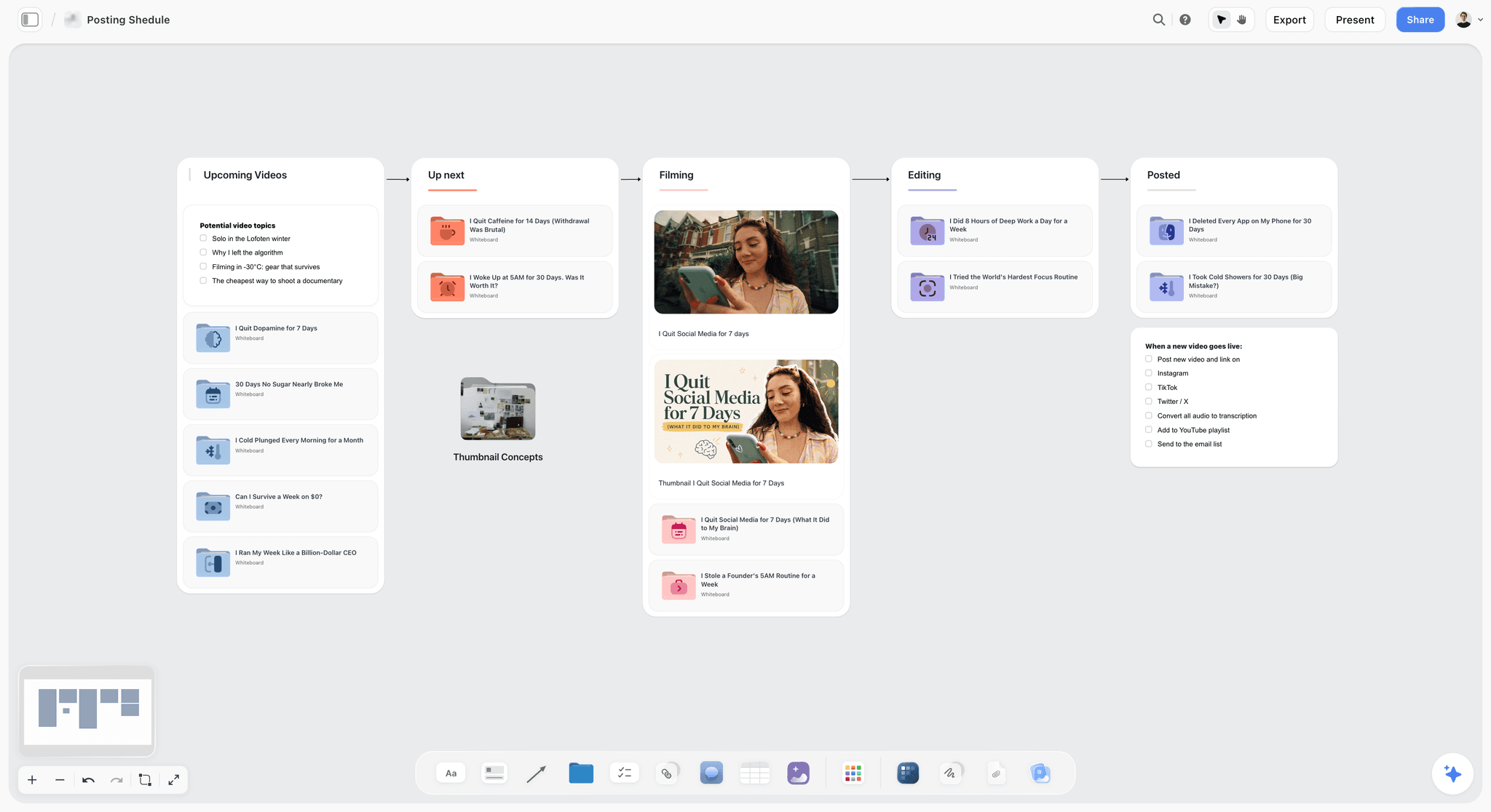
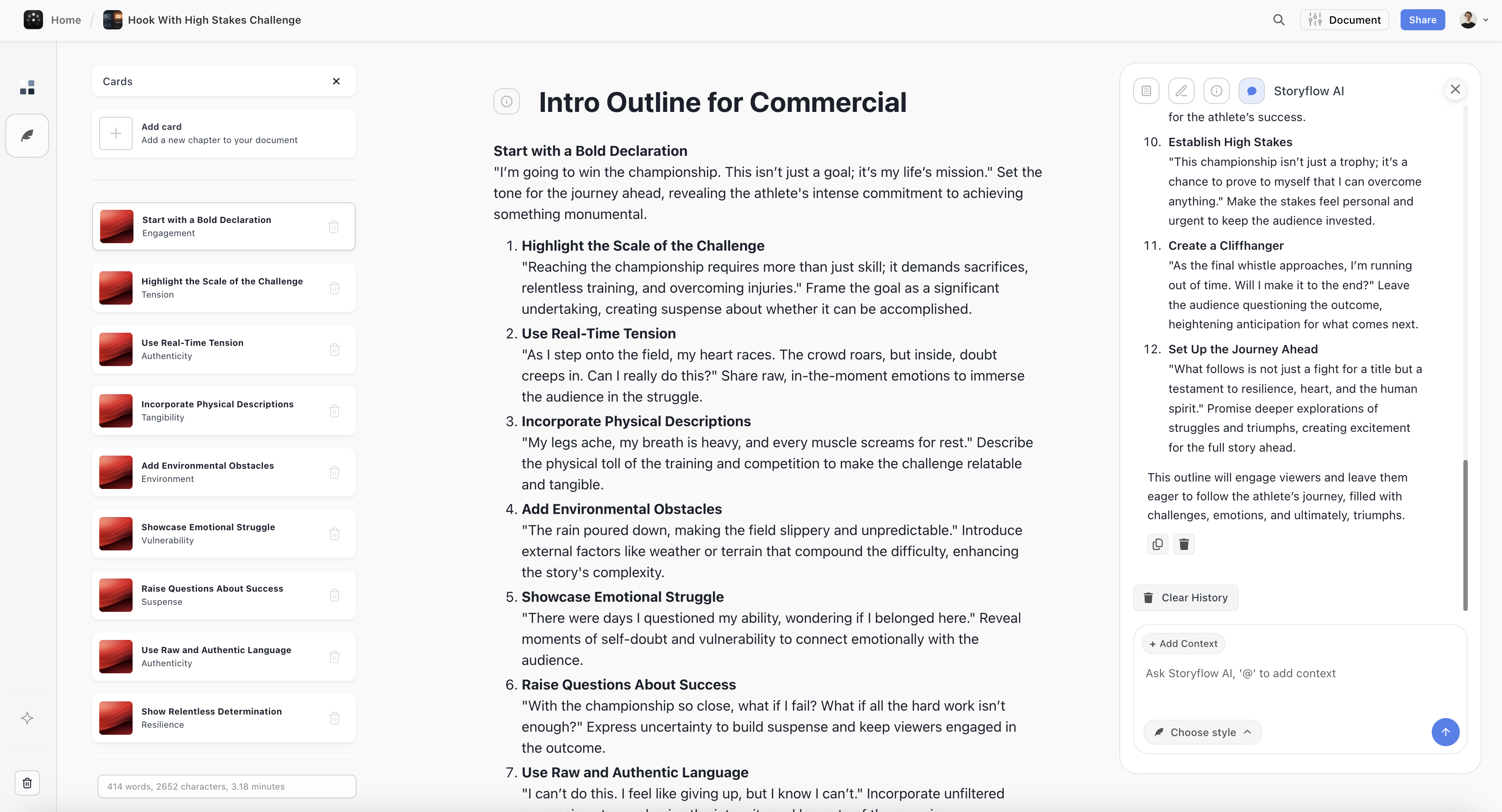
Plan your video hook with Storyflow's documentary outline template, the structure that keeps viewers watching
The Storyflow Tactics That Fix These Problems
Understanding these seven elements is one thing. Applying them consistently is another.
This is where most creators get stuck. They know hooks matter, but they don't know HOW to write a good hook. They understand story structure is important, but they can't architect a video that keeps viewers watching.
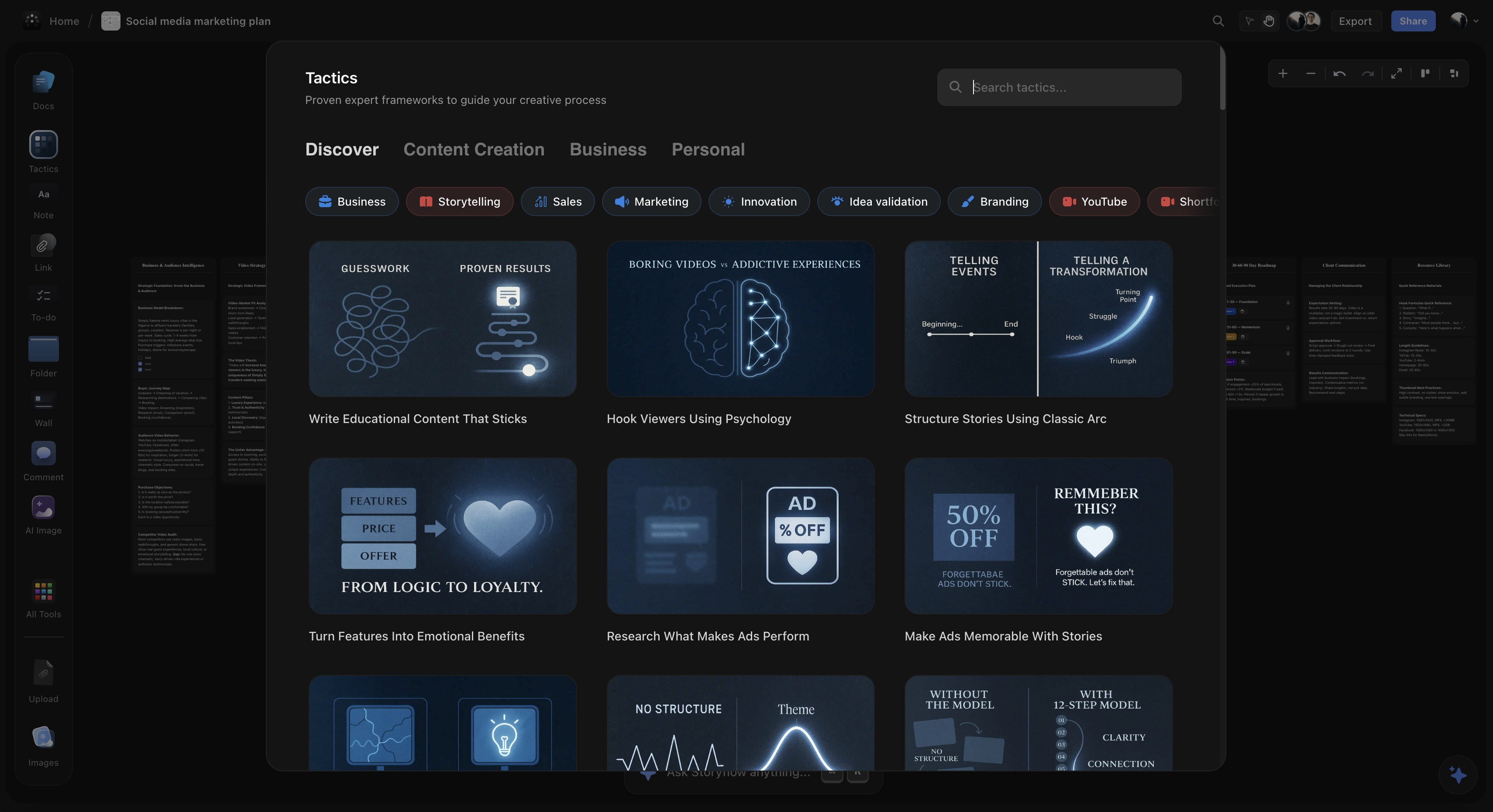
Storyflow's Tactics solve this problem. Tactics are expert blueprints - collections of cards that guide you through applying each element. Instead of staring at a blank page wondering "how do I make this interesting?", you follow a proven structure.
Here are the specific Storyflow Tactics you should use to transform your videos:
Tactic 1: Maximize YouTube Retention Blueprint
This is the master blueprint for keeping viewers watching. It contains 16 cards that guide you through every aspect of viewer retention:
Key Cards in the Maximize YouTube Retention Blueprint:
- Hook Card: "Start Strong with a Big Promise" - Opens your video with an irresistible hook
- Clarity Card: "Tell People What to Expect" - Sets up the video so viewers know why to stay
- Anticipation Card: "Tease the Best Part Early" - Creates open loops that demand resolution
- Engagement Card: "End Every Scene with a Cliffhanger" - Strategic open loop placement
- Relatability Card: "Add Small, Fun Moments" - Human touches that build connection
- Emotion Card: "Plan Moments for Big Reactions" - Emotional beats that create memories
- Structure Card: "Build Excitement" - Rising action that keeps escalating
- Variety Card: "Different Stories at the Same Time" - Interweaving narratives for complexity
Each card walks you through exactly what to do, with theory, examples, and step-by-step instructions. You're not guessing - you're following a proven system.
Tactic 2: Hook Tactics Collection (15+ Blueprints)
Storyflow has an entire library of Hook Tactics - each one designed for different video types and audiences:
Hook Tactic Blueprints You Can Use:
- Hook With Urgency: Creates time pressure and FOMO to drive immediate engagement
- Hook With Credibility: Establishes authority and trust in the first seconds
- Hook With Transformation Promise: Shows the before/after to create desire
- Hook With High Stakes Challenge: Raises the stakes immediately
- Hook With Psychological Validation: Makes viewers feel understood and seen
- Hook With Surprising Stats: Uses data to challenge assumptions
- Hook With Unexpected Angles: Presents familiar topics from new perspectives
- Hook With Bold Statements: Opens with contrarian or provocative claims
- Hook With Relatability: Connects through shared experiences
- Open With a Personal Story Hook: Uses narrative to draw viewers in
Each Hook Tactic contains multiple cards that guide you through the process:
Example: Cards in "Hook With Credibility" Blueprint:
- Hook Card: Catching the Listener's Interest
- Urgency Card: The Importance of Your Topic
- Engagement Card: The Personal Connection
- Credibility Card: Establishing Your Expertise
- Promise Card: The Promise of Valuable Insights
- Structure Card: Outlining Your Video Structure
- Relatability Card: Identifying the Target Audience
- Value Card: Unveiling Actionable Steps
Before (Generic Hook):
"Hey everyone! Today I want to share some tips about building an audience on YouTube. I've been doing this for three years and learned a lot, so let's get into it."
After (Using Hook With Credibility Cards):
"In the last 18 months, I've grown from 2,000 subscribers to 450,000 - and I didn't spend a dollar on ads. But here's what nobody tells you: the growth didn't come from better equipment or posting more often. It came from understanding one psychological principle that changes everything about how you structure videos. By the end of this video, you'll know exactly how to apply it - and you'll see why most YouTube advice is accidentally sabotaging your growth."
Tactic 3: The Hero's Journey Blueprint
For story-driven videos, documentaries, transformation content, and anything with a narrative arc, Storyflow's Hero's Journey blueprint is your complete guide to structuring compelling stories.
The Hero's Journey Cards:
- Context Card: "Ordinary World" - Establish the starting point
- Anticipation Card: "The Dream" - What the hero wants to achieve
- Conflict Card: "Call to Adventure" - The challenge appears
- Conflict Card: "Refusal of the Call" - Initial hesitation and doubt
- Relationship Card: "Meeting the Mentor" - Guidance and wisdom
- Plot Card: "Acceptance of the Call" - Commitment to the journey
- World-building Card: "Crossing the Threshold" - Entering the new world
- Action Card: "The Ordeal" - The main challenge
- Conflict Card: "Dark Night of the Soul" - The lowest point
- Transformation Card: "Rebirth" - The transformation moment
- Resolution Card: "Return with the Elixir" - The new wisdom gained
This framework works for everything from fitness transformations to business case studies to travel vlogs. Every compelling story follows these beats - Storyflow's cards help you hit each one.
Before (Flat Structure):
"So I wanted to lose weight. I started going to the gym. I changed my diet. After six months, I lost 40 pounds. Here's what I ate and here are my workouts."
After (Hero's Journey Structure):
"Six months ago, I couldn't walk up a flight of stairs without getting winded. [Ordinary World] I'd tried everything - keto, intermittent fasting, gym memberships I never used. [Refusal] Then my doctor said something that terrified me. [Call to Adventure] That's when I met Marcus, a trainer who'd lost 100 pounds himself. [Meeting the Mentor] What he told me changed everything - but the first three weeks almost made me quit. [Ordeal] On day 22, I hit rock bottom. [Dark Night] And that's exactly when everything clicked. [Transformation]"
Tactic 4: Emotional Arc & Story Structure Tactics
Storyflow includes multiple blueprints for building emotional journeys:
Emotional & Story Structure Tactics Available:
- Emotional Arc Research: Study and map the emotional beats of successful videos
- The Story Arc Structure: Build transformation narratives that resonate
- Build Dynamic Conflict Narratives: Create tension that keeps viewers engaged
- Create Transformative Challenges: Structure challenge/transformation content
- Share Internal Conflict Stories: Use inner struggles to build connection
- Document Growth Journeys: Structure progress-based content
- Film Transformation Journeys: Visual storytelling for change narratives
Each blueprint contains specialized cards for different emotional beats:
Emotional Beat Cards You'll Find:
- Character Card: "Inner Struggles" - Building empathy through vulnerability
- Conflict Card: "Lowest Point" - The dark moment before transformation
- Plot Twist Card: "False Victory" - Subverting expectations
- Transformation Card: "Rebirth" - The moment of change
- Climax Card: "Intense or Extraordinary Event" - The peak moment
- Reflection Card: "Personal Reflections" - Meaning and takeaways
- Resolution Card: "Conclusion and Open-Endedness" - Satisfying endings
A well-structured video hits multiple emotional beats. It takes viewers through struggle, realization, and triumph. With Storyflow's cards, you never forget which beat comes next - it's all laid out for you.

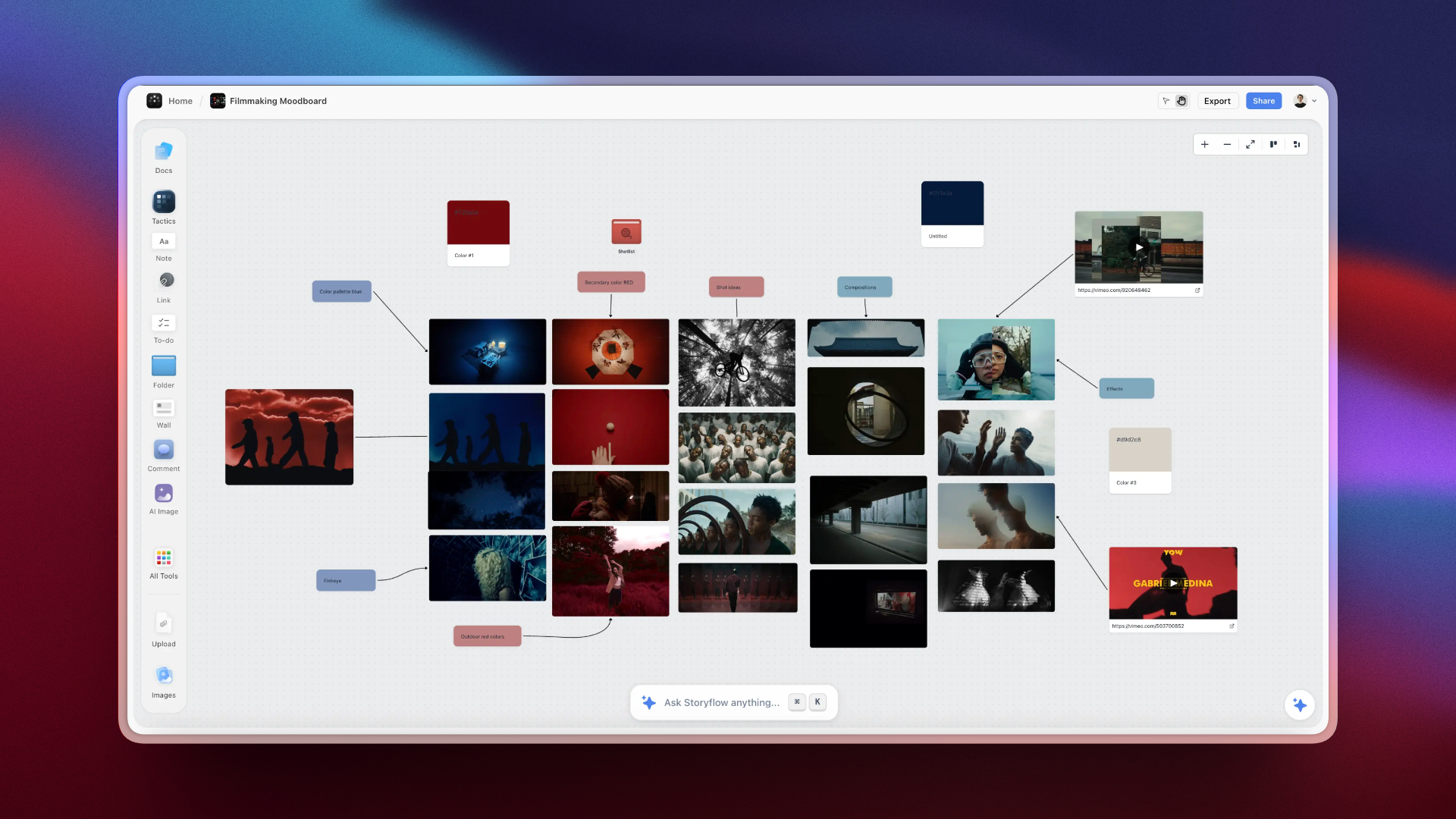
Filmmakers and YouTube creators use Storyflow to map their content from concept to final cut, improving views at every stage
Before & After: Real Video Transformations
Let's see how these elements transform real video concepts from forgettable to compelling.
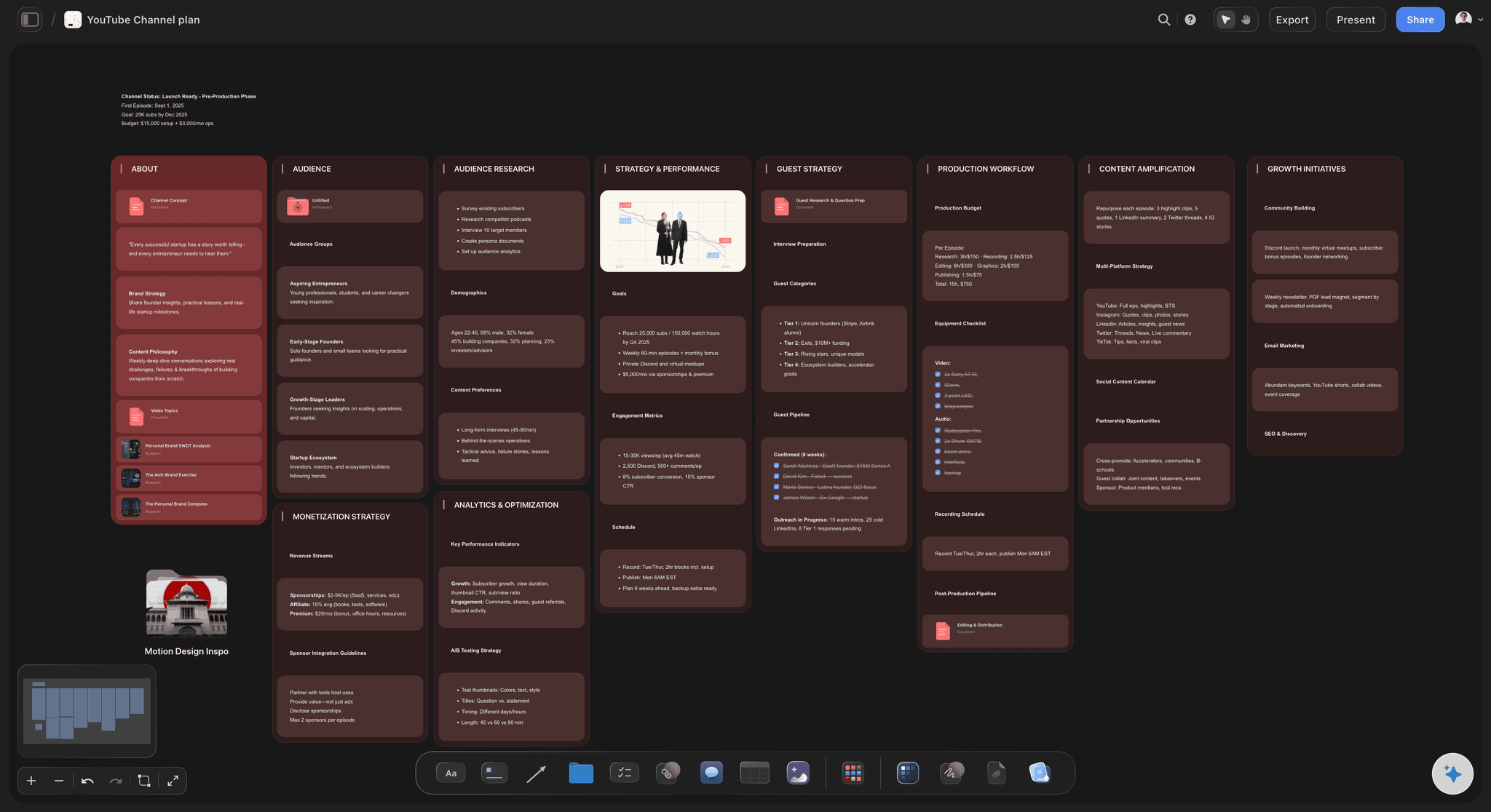
A YouTube Channel Plan board in Storyflow lets you compare ideas and angles side by side before you commit a single hour to filming
Transformation #1: Tutorial Video
Before:
Title: "How to Use Notion"
Hook: "Hey guys, today I'm going to show you how to use Notion. Notion is a really great app for note-taking and organization. Let me show you around the interface..."
Problems: Generic title, no angle, no stakes, no curiosity, viewer-focused = zero.
After:
Title: "The Notion Setup That Replaced 7 Apps (And Saved Me $200/Month)"
Hook: "I used to have seven different apps to run my life. To-do lists, calendars, project management, note-taking, habit tracking - all scattered across different tools that didn't talk to each other. Then I discovered a Notion setup that replaced all of them. And the best part? One of these systems took me from forgetting half my tasks to hitting a 94% completion rate. Let me show you exactly how I built it."
Improvements: Specific angle (7 apps, $200), stakes (money, productivity), curiosity (94% completion?), clear transformation promise.
Transformation #2: Commentary Video
Before:
Title: "My Thoughts on the Instagram Algorithm"
Hook: "So Instagram's algorithm has changed again. A lot of creators are frustrated about this. I wanted to share my thoughts on what's happening and what I think it means."
Problems: No specific angle, "my thoughts" = low curiosity, no stakes established.
After:
Title: "Instagram Is Dead. Here's What's Actually Working Now."
Hook: "In 2023, I was getting 50,000 impressions per post. Today? 8,000. Same content quality. Same posting schedule. Same hashtags. Something fundamentally broke - and it's not just me. But while most creators are panicking, a small group figured out what's actually happening. After talking to a dozen of them, I found the pattern. And it's not what Instagram wants you to think."
Improvements: Contrarian angle (Instagram is dead), specific data (50k → 8k), stakes (your reach is dying), curiosity (what's the pattern?), expert access (talked to a dozen creators).
Transformation #3: Vlog/Story Video
Before:
Title: "I Tried Running Every Day"
Hook: "So I decided to try running every day for a month. I've never been a runner, but I thought it would be a good challenge. Here's how it went."
Problems: Vague outcome, low stakes, no emotional hook, generic challenge format.
After:
Title: "I Ran Every Day for 90 Days. My Doctor Was NOT Happy."
Hook: "Day 1, I couldn't run for 5 minutes without wanting to die. Day 30, I ran my first 5k. Day 60, something weird started happening to my body. Day 90, my doctor told me to stop immediately. This is the story of how running every day almost destroyed me - and why I'm never stopping."
Improvements: Longer timeframe (90 days), unexpected element (doctor NOT happy), clear progression, paradoxical ending (almost destroyed but never stopping), multiple open loops.
Diagnose Your Own Videos: The Checklist
Use this checklist before publishing any video:
Pre-Publish Video Audit:
IDEA:
- □ Would I click on this if I saw it in my feed?
- □ Can I explain in one sentence why someone would care?
- □ Is there existing demand (search volume, trending topic, proven format)?
ANGLE:
- □ What makes MY video worth watching over the 100 others on this topic?
- □ Do I have a unique perspective, experience, or access?
- □ Is my angle clear in the title/thumbnail?
STRUCTURE:
- □ Do I have a clear hook that grabs attention in 5-10 seconds?
- □ Does the video escalate/build toward something?
- □ Is there a satisfying payoff/conclusion?
STAKES:
- □ What do viewers gain by watching?
- □ What do they lose by not watching?
- □ Are the stakes clear within the first minute?
EMOTION:
- □ What emotion should viewers feel at the start? Middle? End?
- □ Are there deliberate emotional beats throughout?
- □ Will viewers FEEL something, not just learn something?
OPEN LOOPS:
- □ Are there unanswered questions that keep viewers watching?
- □ Do I open new loops before closing old ones?
- □ Are loops placed strategically (before transitions, sponsor breaks)?
CURIOSITY:
- □ Does my title/thumbnail create a curiosity gap?
- □ Does each section make viewers curious about what's next?
- □ Would someone feel incomplete if they clicked away?
The 10 Most Common Mistakes That Kill Views
- Starting with "Hey guys, welcome back to my channel" - This is wasted time. Viewers don't care about your greeting. Start with something compelling.
- Choosing ideas based on what YOU want to make - Great creators balance what they want to make with what audiences want to watch. Pure self-indulgence = no views.
- No hook, or a weak hook - The first 30 seconds determine whether 1,000 or 100,000 people see your video. Treat this time like gold.
- Information dumping without structure - Random facts don't hold attention. Structured journeys do.
- No stakes established - If viewers don't know why they should care, they won't care.
- All information, no emotion - Information is forgotten. Emotion is remembered and shared.
- Closing loops too quickly - Once you answer the question, viewers have no reason to stay. Keep them curious.
- Generic titles and thumbnails - "My Morning Routine" vs "The 5AM Routine That Made Me $50,000" - which would you click?
- No clear angle - If your video is just "another video about X," why would anyone choose it?
- Inconsistent energy - Videos that start strong and fade lose viewers. Maintain energy throughout.
FAQ: YouTube Views
How long does it take for YouTube to push a video?
YouTube tests videos quickly - usually within the first few hours. If initial viewers click, watch, and engage, YouTube shows it to more people. If they don't, it stops promoting it. This is why the hook and title/thumbnail matter so much: they determine whether you get the initial engagement that triggers promotion.
Does posting more frequently help?
Quantity without quality doesn't help. One well-planned video will outperform ten mediocre ones. However, consistency does help the algorithm understand your channel and audience. The ideal is consistent quality - which requires systems like the planning frameworks in this guide.
How important are thumbnails really?
Extremely important - but not in isolation. Your thumbnail and title work together to create a "click promise." A great thumbnail with a boring title (or vice versa) won't work. They need to combine to create curiosity and communicate your angle clearly.
Can Storyflow help me plan better videos?
Yes - that's exactly what Storyflow's Tactics are designed for. Instead of staring at a blank page, you follow expert frameworks that guide you through each element: crafting hooks, building structure, creating emotional beats, placing open loops strategically. It's like having a video planning expert sitting next to you for every video.
What if I've already tried everything and nothing works?
Go back to fundamentals. Pick your last five videos and audit them against the checklist in this guide. Be brutally honest. Usually you'll find that 2-3 elements are consistently weak. Fix those specifically rather than trying random tactics.
How do I know if my idea is good before investing time in production?
Use the Idea Validation Test: Would you click if someone else made it? Can you explain in one sentence why someone would care? What emotion will viewers feel after watching? If you can't confidently answer all three, iterate on the idea before filming.
The Path Forward
Views aren't random. They're the result of getting the invisible elements right: idea, angle, structure, stakes, emotion, open loops, and curiosity.
Most creators spend 90% of their time on production (filming, editing, thumbnails) and 10% on planning. Successful creators flip this ratio. They spend more time on the elements that actually determine success.
You now have the frameworks. You understand why videos fail and what makes them succeed. The question is: will you apply it?
Your Next Steps:
- Pick your next video idea and run it through the 7-element checklist
- Rewrite your hook using the Pain Point Hook framework
- Map out your video's emotional journey before filming
- Place strategic open loops at transition points
- Consider using Storyflow's Tactics to systematize this process
The difference between creators who struggle and creators who succeed isn't talent. It's systems. The creators who win have frameworks for every element of video creation.
The friction is real: the seven elements live in your head, but your script lives in a doc, your title ideas live in your notes, and your reference videos live in a dozen open tabs. Nothing talks to anything else, so you plan in fragments. Storyflow closes that gap by putting the whole plan on one visual canvas, then letting its AI read your full active board (plus up to 1 Tactic and 3 Documents you @-mention) so feedback on your hook actually accounts for the idea, angle, and stakes you mapped next to it. The Story blueprints library includes YouTube retention and hook templates built around the same elements covered in this guide.
It is not the right tool for everyone. If you already have a tight scripting workflow in a dedicated tool like Final Draft, or you only need keyword and thumbnail data, Storyflow will not replace that. Its job is the planning layer: getting the idea, angle, and structure right before you film, which is exactly where most views are won or lost.
Your audience is out there. They want to watch your content. They just need you to make content worth watching.
Take the next video on your list, open a YouTube Video Plan board in Storyflow, and run it through all seven elements before you touch your camera. If the idea or angle is weak, you will see it on the canvas instead of in your analytics three weeks later.
Related Reading
Complete 6-step planning system
Master hook writing techniques
Proven script structure
Table of Contents
- The Hard Truth About YouTube Views
- The 7 Elements That Determine Video Success
- 1. The Idea: Why Most Video Ideas Are Dead on Arrival
- 2. The Angle: Your Secret Weapon for Standing Out
- 3. Story Structure: The Engine of Viewer Retention
- 4. Stakes: Why Viewers Need Something to Care About
- 5. Emotional Impact: The Memory-Making Factor
- 6. Open Loops: The Psychology of Keeping Viewers Hooked
- 7. Curiosity: The Force That Drives Every Click
- The Storyflow Tactics That Fix These Problems
- Tactic 1: Maximize YouTube Retention Blueprint
- Tactic 2: Hook Tactics Collection (15+ Blueprints)
- Tactic 3: The Hero's Journey Blueprint
- Tactic 4: Emotional Arc & Story Structure Tactics
- Before & After: Real Video Transformations
- Diagnose Your Own Videos: The Checklist
- The 10 Most Common Mistakes That Kill Views
- FAQ: YouTube Views
- The Path Forward
Templates to check out for this topic


Content and video templates you can use in Storyflow
Plan a channel, a script, and a content pipeline on the same board. Open one of these templates and let the AI build on the structure instead of starting from a blank doc.


See Storyflow in Action
A visual AI workspace where every feature lives inside one canvas. No tab-switching, no context lost.
Build your entire board from a single message
Type what you need in the AI chat at the bottom of your canvas. The AI adds cards, headings, and structure directly onto your board.
Use expert frameworks as AI context
Type @ in the AI chat and choose any Tactic. The AI tailors every response to that framework instead of giving generic advice.
Turn your board into a mind map in seconds
Ask the AI to restructure your canvas as a mindmap. It connects your ideas into a visual hierarchy so you can see how everything relates.
Why Storyflow Exists
Storyflow actually began as a personal tool while working on creative and research projects.
We kept running into the same problem: ideas were scattered everywhere: notes, documents, and whiteboards.
Nothing helped us see how everything connected.
So we started building a workspace designed around how ideas actually grow.
→ Read how Storyflow was createdSara de Klein
Head of Product at Storyflow
Published: January 8, 2026
Extremely simple, seriously capable


See how easy it is to get started
Watch a real project come together, from a blank board to a finished plan, clicked through step by step.
Start creating with AI and become more productive
Transform your creative workflow with AI-powered tools. Generate ideas, create content, and boost your productivity in minutes instead of hours.