The 11 Best Series Planning Tools in 2026 (We Tested Them All)
Nobody quits a series at episode one. They quit at episode five. Eleven tools ranked by what they actually do for the trough, where novelty is spent and compounding has not started.

Category
Content Creation
Author

Sara de Klein
Head of Product at Storyflow
Topics
2026-08-12
•
17 min read
•
Content Creation- best series planning tools
- how to plan a content series
- YouTube series planning
- podcast series tools 2026
- content series template
- why content series fail
What are the best series planning tools in 2026?
Nobody quits a series at episode one. They quit at episode five. Eleven tools ranked by what they actually do for the trough, where novelty is spent and compounding has not started.

Full disclosure: Storyflow is our own product and we rank it #1 here on one criterion: a series through-line is a whole-board question and its AI reads the whole board, which speaks to drift rather than tracking. Nobody should run a series on it alone, and the article says so. It cannot publish or schedule anything, so cadence protection (a real determinant of whether a series survives) belongs to Buffer, Later or the native platform schedulers. It has no analytics at all, which matters because the single most useful thing you can do at episode five is check whether your trough is morale or audience, and YouTube Studio answers that free. It has no structured episode tracking, no status fields and no pipeline views, so Notion and Airtable do that job properly. It does no production, and Descript cuts per-episode cost more directly than any planning tool. It is also cloud-only and paid-only during early access, while Google Sheets plus a written series bible costs nothing and covers a surprising amount. We link to every tool so you can judge the fit yourself.
Quick Comparison
These four attack the trough from different sides: keeping the series one connected thing, making each episode inherit decisions instead of reinventing them, diagnosing whether a rough patch is real, and reducing what an episode costs to produce.
| Tool | Best For | AI Features | Price |
|---|---|---|---|
| Storyflow | Through-line and research that compounds | Reads the whole canvas | $7.99 mo annual (free plan late 2026) |
| Notion | Episode template and pipeline tracking | General writing assistance | Free tier / from ~$10 mo annual |
| YouTube Studio | Retention and returning-viewer reality check | Light insights | Free |
| Descript | Editing by transcript to cut production time | Strong, transcript-based editing | Free tier / from ~$12 user mo |
Key Takeaways
- Nobody quits a series at episode one. They quit at episode five.
- Every series has a trough around episodes four to seven, where the novelty that carried the opening is spent and the compounding that carries episode twelve has not started yet.
- Almost every planning tool helps with episode one, which is the episode that never needed help. The useful question is what gets you through the trough.
- Storyflow ranks first because a series through-line is a whole-board question, and its AI reads the whole board. It cannot publish, schedule, or tell you the trough is happening.
- If episode twelve is not easier to make than episode two, you do not have a series. You have a playlist.
Ask your series whether it is still one thing
Drift is gradual and every individual episode looks fine, which is why a series becomes a playlist without anyone noticing. Storyflow's AI reads the whole board, so you can ask which episodes have started covering the same ground and where the through-line thinned. It does not publish, schedule, or report analytics. Paid-only during early access; the Free plan lands before the end of 2026.

The Trough
Series fail on a schedule, and the schedule is more predictable than most creators expect.
Episodes one to three run on novelty. The idea is fresh to you, the format is new, and the work of inventing it is genuinely interesting. Energy is not the constraint. Most series look healthy here, which is why most planning advice, written from the outside, focuses on this stretch.
Episodes four to seven are the trough. Novelty is gone. You now know exactly how much work each episode takes and it is more than you estimated. The audience has not compounded yet, because audiences build slowly and the early numbers reflect your existing reach rather than the series itself. Nothing you have built is paying off yet, and every episode costs full price. This is where series die, and they die quietly: not with a decision to stop, but with a gap that becomes a longer gap.
Episodes eight and beyond are where compounding starts, if you built for it. Research from episode three shortens episode nine. The format is decided so production is faster. The audience arrives expecting something specific. Episodes get easier and better at the same time, which is the only reason to make a series rather than a set of unrelated pieces.
Nobody quits a series at episode one. They quit at episode five.
Once you see the shape, the tool question changes. A tool that helps you plan a brilliant first episode is close to worthless, because episode one was never at risk. What matters is whether the tool reduces the cost of episodes four through seven, and whether it makes the compounding real rather than theoretical.
Two things determine that. Front-loaded decisions: every choice made once at the series level (format, length, structure, visual language, the recurring segment) is a choice you are not making again under fatigue in week five. And reusable substrate: research, references, and assets organised so that episode nine can draw on episode three rather than starting empty.
If episode twelve is not easier to make than episode two, you do not have a series. You have a playlist.
At a Glance: The 11 Tools Compared
| Tool | What it does for the trough | Tracks episode state | Price |
|---|---|---|---|
Storyflow | Holds the through-line and reusable research | No, no structured fields | $7.99 mo annual (free plan late 2026) |
Notion | Front-loads decisions into a repeatable template | Yes, strong | Free tier / from ~$10 mo annual |
Airtable | Pipeline visibility across many episodes | Yes, strongest | Free tier / from ~$20 seat mo |
Milanote | Visual series map, format consistency | Lightly | Free tier / from ~$10 mo annual |
Google Sheets | Everything, badly, for free | Yes, manually | Free with Workspace |
YouTube Studio | Tells you the trough is real | Publishing state only | Free |
Obsidian | Research that compounds across episodes | No | Free personal / paid sync |
Trello | Pipeline stages at a glance | Yes | Free tier / from ~$5 user mo |
Descript | Cuts production time per episode | No | Free tier / from ~$12 user mo |
Buffer or Later | Protects cadence when energy dips | Scheduling only | Free tier / from ~$6 channel mo |
A series bible | Front-loads every repeated decision | No | Free |
Prices are the publicly listed rates at the time of writing and change often. Check before committing.
How I Ranked These
Six of these (Storyflow, Notion, Google Sheets, YouTube Studio, Obsidian, a series bible) I have used running actual multi-episode work, including a documentary series and podcast runs that went through the trough, some of which did not come out the other side. Airtable, Milanote, Trello, Descript, and Buffer I evaluated hands-on against the same criteria. Where a claim rests on documentation rather than my own use, the review says so.
Five criteria, in this order:
- Trough cost reduction. Does the tool make episodes four to seven cheaper. Weighted highest because that is where series die.
- Decision front-loading. Can series-level choices be made once and inherited by every episode, rather than re-litigated each time.
- Substrate reuse. Whether research and assets from early episodes are retrievable and useful later, which is what compounding actually consists of.
- Cadence protection. Whether the tool helps you keep publishing when the work stops being fun, which is a scheduling and buffering problem more than a creative one.
- Honest cost against a series that may not finish. Most series stop. Subscriptions that assume a long run are a bet.
Deliberately not weighted: idea generation. Series rarely fail for lack of episode ideas, and tools sold on ideation are solving a shortage that does not exist.
Front-Loading and the Buffer
Two mechanics do most of the work of surviving the trough, and both are decisions rather than features.
Front-load every repeatable decision before episode one. Length, structure, the opening move, the recurring segment, thumbnail and title conventions, the visual and audio treatment, and the specific promise each episode makes to the viewer. Each of these decided once is a decision you are not making at episode five when you are tired and behind. Series that improvise these fresh every time pay full creative cost per episode forever, and that cost is exactly what the trough cannot absorb.
The counterintuitive part is that front-loading feels like over-planning at episode one, when energy is abundant and constraint feels unnecessary. That is precisely when it must happen, because it is a transfer of effort from a period of surplus to a period of deficit.
Build a buffer, and treat it as non-negotiable. Three finished episodes in hand before publishing episode one. Not scripts, finished. A buffer converts a bad week from a missed publication into a smaller buffer, and missed publications are how series end, because the gap resets audience expectation and each subsequent gap is easier to take.
Almost nobody does this, because publishing episode one the moment it is ready is enormously satisfying and building a buffer feels like sitting on work. The creators whose series survive tend to have done it, and the ones who publish immediately tend to disappear around week six.
Neither of these is a tool. What tools can do is make the front-loaded decisions visible and inherited rather than remembered, which is most of what the ranking below is judging.
Quick Picks by Situation
- Best overall series planning tool: Storyflow, our own product, for holding the through-line and the reusable research together.
- Best episode tracker: Notion, where a template turns front-loaded decisions into a repeatable process.
- Best at scale: Airtable, once a series has enough episodes and contributors to need pipeline views.
- Best reality check: YouTube Studio, which will tell you whether the trough is audience-side or just morale.
- Best for research that compounds: Obsidian, where episode nine can draw on episode three.
- Best cadence protection: Buffer or Later, so a bad week costs buffer rather than a gap.
- Best free option: Google Sheets plus a written series bible, which covers most of what matters.
- Best thing to do before episode one: Finish three episodes. It outperforms every tool here.
1. Storyflow
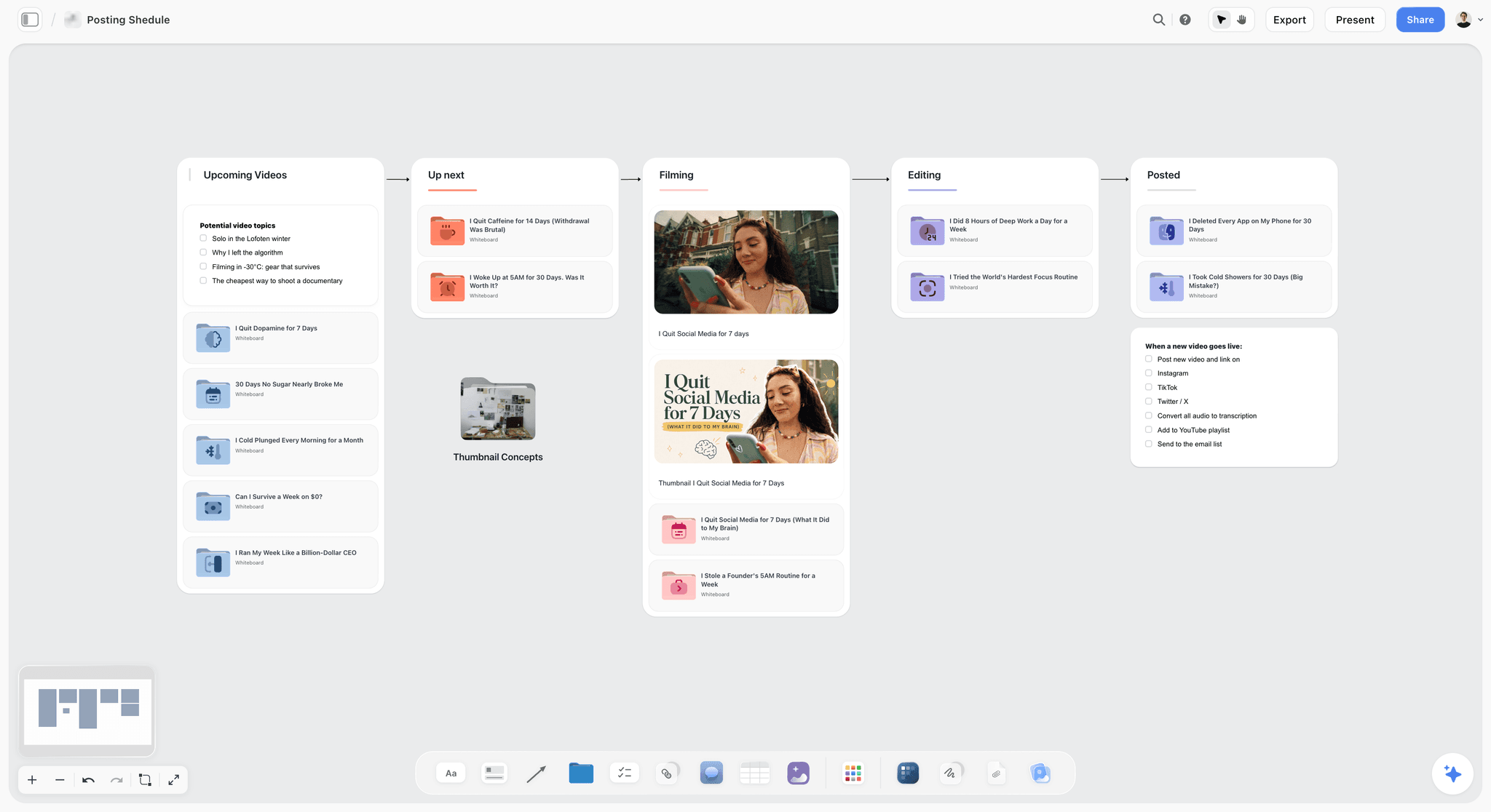
Storyflow is our own product and it ranks first because a series is a whole-board problem and its AI reads the whole board.
The distinguishing job here is the through-line. A series is not a set of episodes on a topic, it is a set of episodes making a connected argument or delivering a connected promise, and the connection is what makes episode nine benefit from episode three. That connection is easy to hold in your head for the first three episodes and almost impossible by episode eleven, which is when series drift into being playlists without anybody noticing.
Because the canvas holds every episode's premise, references, and notes together and the AI reads across all of it, you can ask the series what it is actually about, which episodes are covering the same ground, and where the through-line has thinned. That is a whole-board reading question, and it is the one thing on this list that specifically addresses drift rather than tracking.
For substrate reuse it does real work. Research gathered for episode three sits on the same surface as episode nine's outline rather than in a folder somebody has to remember, and you can @-mention up to one Tactic and up to three documents so an episode can be reasoned against the series premise or format document rather than in isolation.
The Story blueprints library (200+ creative templates on Plus, Pro, and Max, including frameworks like Retention Hooks and Hero's Journey) is genuinely relevant to front-loading, because deciding an episode's structural pattern once at the series level is exactly the transfer of effort the trough requires.
Where Storyflow loses
Five limitations, and the first three mean nobody runs a series on it alone.
It cannot publish or schedule. No upload, no queue, no cadence automation. Cadence protection is a real determinant of whether a series survives and Buffer, Later, or the native platform schedulers do that job.
It has no analytics. It cannot tell you whether your trough is a morale problem or an audience problem, and those need opposite responses. YouTube Studio is free and answers that question definitively.
It has no structured episode tracking. No status fields, no pipeline views, no filtering by state. For a series with several contributors and twelve episodes in flight, that absence is decisive and Notion or Airtable are the right tools.
It does no production. No recording, no editing, no transcription. Descript reduces per-episode cost directly, which is the most tangible trough intervention available.
It is cloud-only and paid-only during early access, with the Free plan arriving before the end of 2026. Google Sheets and a written series bible cost nothing and cover a surprising amount of this.
Pricing: Plus $7.99/mo annual ($9.99 monthly) for the Story blueprints library and unlimited uploads. Pro $14/mo annual ($19 monthly) adds AI image generation, roughly 20 times the AI volume, and memory across conversations. Max $39/mo annual ($49 monthly) adds roughly 40 times the AI volume plus a team workspace with roles and permissions.
2. Notion
Notion ranks second and is the most practical single purchase for most series, because it turns front-loading into a mechanism rather than an intention.
The move is an episode template. Every front-loaded decision (structure, length, the recurring segment, the required assets, the publishing checklist) becomes a template that each new episode inherits. At episode five, when you are tired, you are filling in a known shape rather than reinventing one, and that is precisely the cost reduction the trough needs.
Around it, a database of episodes with status, publish date, assets, and research links gives the pipeline visibility that stops two episodes stalling silently at the same stage. Series bibles, format documents, and guest lists live in the same workspace.
Against it: it is a filing system rather than a thinking surface, so the through-line question (is this still one series) is not something Notion will help you see. It also degrades if nobody prunes, and a workspace with four abandoned episode structures in it adds friction rather than removing it.
For most creators, Notion plus a scheduler covers the essentials, and it is the setup I would recommend to somebody starting their first series.
Pricing: Free tier. Paid from around $10/month annual.
3. Airtable
Airtable is Notion's answer at scale, and the threshold is roughly where a series has multiple contributors and enough episodes in flight that state becomes genuinely hard to hold.
Linked records connecting episodes to guests, locations, assets, and publication slots; views per collaborator; and automations that move an episode along when a field changes. For a produced series with an editor, a researcher, and a host, this is real infrastructure and the pipeline visibility is better than anything else here.
The costs are the familiar ones: per-seat pricing gets expensive, the maintenance burden is high, and an Airtable nobody keeps current is worse than a spreadsheet because its empty fields look authoritative.
For a solo creator this is more tool than the job needs, and Notion will do the same work with less overhead.
Pricing: Free tier with record limits. Paid from around $20/seat/month.
4. Milanote
Milanote's contribution to series work is visual consistency, which is an underrated part of what makes a series feel like one thing.
A board holding the visual language, thumbnail treatments, title conventions, and reference frames for the whole run means episode nine looks like it belongs to the same series as episode two. Drift in visual identity is one of the quieter ways a series stops compounding, because the audience stops recognising it at a glance.
It is a good series map and a poor tracker: no episode state, no pipeline, no filtering. The 100-item free cap arrives quickly across a run of episodes.
Pair it with something structured, or take Storyflow if you want the map and the reading layer together.
Pricing: Free tier capped at 100 items. Paid from around $10/month annual.
5. Google Sheets
An enormous number of real series run on a spreadsheet, and it deserves an honest place rather than a dismissal.
One row per episode with columns for status, publish date, title, hook, guest, and asset links covers most of what a tracker needs. It is free, everyone can open it, it works offline, and version history is automatic. For a solo creator running a twelve-episode series, this plus a written series bible is genuinely sufficient and requires no learning.
What it cannot do is hold the through-line, because a spreadsheet has no room for an argument, and it will not surface drift. It is a state tracker rather than a planning surface.
If you are between tools, start here and only move when you can name the specific thing the spreadsheet is failing to do.
Pricing: Free with a Google account.
6. YouTube Studio
YouTube Studio is on this list because the trough needs a diagnosis, and it is the only free source of truth about which trough you are in.
There are two, and they need opposite responses. A morale trough is when the work has stopped being fun but retention and returning-viewer numbers are holding or climbing. The correct response is to continue, because the compounding is happening and you cannot feel it. An audience trough is when returning viewers are flat and retention is degrading episode over episode, which means the format is not landing and continuing unchanged will not fix it.
Those look identical from the inside. Returning viewers, average view duration by episode, and the retention curve shape distinguish them in about ten minutes.
Creators who quit at episode five overwhelmingly quit without checking, and a meaningful share of them were in a morale trough with a working series.
It plans nothing. It is the instrument, not the tool.
Pricing: Free.
7. Obsidian
Obsidian is the strongest tool here for the substrate half of compounding, which is the part that makes episode nine cheaper than episode three.
For research-led series (documentary, explainer, history, investigative), notes linked across episodes mean that background gathered once is retrievable forever, and backlinks surface that three episodes touch the same underlying idea, which is frequently where the best later episode comes from.
It is local markdown, so it survives tool changes and works offline, and it is free for personal use.
It does no tracking, no scheduling, no visual work, and it is text-first, so image-led series are poorly served. Pair it with a tracker.
Pricing: Free for personal use. Paid sync and publish add-ons.
8. Trello
Trello earns a place because a kanban board is the clearest possible answer to one specific trough question: what is actually stuck.
Columns for idea, researched, scripted, filmed, edited, scheduled, published, with a card per episode. In ten seconds you can see that four episodes are sitting in edited and nothing has moved for a fortnight, which is the visible early symptom of a series about to stop.
It is simple enough that people keep it current, which is the failure mode of every heavier tracker.
It holds no content, no research, and no through-line, so it is a pipeline view rather than a planning tool. Fine as a companion, insufficient alone.
Pricing: Free tier. Paid from around $5/user/month.
9. Descript
Descript is the most direct trough intervention available, because it attacks per-episode production cost rather than planning.
Editing video and audio by editing a transcript removes a large amount of time from a talking-led episode, and filler-word removal, studio sound, and multi-track handling compress a workflow that otherwise eats an afternoon per episode. For podcast and explainer series, an hour saved per episode across the trough is worth more than most planning improvements.
It plans nothing and tracks nothing. It is here because the honest answer to "how do I survive episodes four to seven" is frequently "make each episode cost less" rather than "plan better", and this is the clearest lever on that.
I evaluated this hands-on against these criteria rather than across a full series run.
Pricing: Free tier. Paid from around $12/user/month.
10. Buffer or Later
Scheduling tools rank here for the cadence-protection job, which matters more to series survival than its unglamorous reputation suggests.
A scheduled queue converts a bad week into a smaller buffer rather than a missed publication. That distinction is the difference between a series with a wobble and a series that stopped, because gaps reset audience expectation and the second gap is always easier to take than the first.
They also enforce the buffer discipline by making it visible: an empty queue two weeks out is a warning you can act on.
They do no planning and no production. Native platform schedulers cover much of this free, and for a single-channel series that is usually enough.
Pricing: Free tiers available. Paid from around $6/channel/month.
11. A Series Bible
The eleventh entry is a document rather than a product, and for the trough specifically it may be the highest-leverage item on this list.
Two pages, written before episode one: what the series promises the viewer, the format and length, the structure of a typical episode, the recurring elements, what an episode of this series never does, and the visual and tonal rules. Every one of those is a decision you will otherwise make again, badly, under fatigue, in week five.
It also serves the compounding argument directly. A series with written rules is a series a collaborator can contribute to, which is how a series stops depending entirely on one person's energy.
It costs an afternoon, it works in whatever tool you already have, and almost nobody writes one because at episode one it feels like bureaucracy rather than insurance.
Pricing: Free.
What to Actually Pay For
Pay to reduce per-episode production cost. Descript or equivalent attacks the trough more directly than any planning software, because the trough is fundamentally a cost problem.
Pay for a tracker only when state is genuinely hard to hold. Below about eight episodes and one contributor, a spreadsheet is fine and a tracker is overhead.
Do not pay for ideation. Series almost never fail for want of episode ideas. They fail because episode five costs as much as episode one.
Do not buy an annual plan for an unstarted series. Most series stop. Monthly until you are past the trough is the honest bet, and the saving is real.
Spend the free things first. Write the two-page bible, build three episodes of buffer, and check whether your trough is morale or audience. All three cost nothing and outrank every purchase here.
Tools to Avoid for This Job
A calendar with no buffer behind it. Scheduling publication dates without finished episodes converts a planning tool into a source of dread, and the dates start slipping in week five.
A tracker nobody updates. Worse than nothing, because a stale board is trusted and reports that nothing is stuck when four things are.
Reinventing the format each episode. The most expensive habit in series work, and it is a decision rather than a tool. Front-load, then inherit.
Publishing episode one the day it is finished. Enormously satisfying and the single biggest predictor of a series that ends around episode six.
What No Tool on This List Does
None of them tell you the series has become a playlist. Storyflow gets closest, because you can ask a board whether the through-line still holds, and it still requires you to ask. Drift is gradual and each individual episode looks fine, which is exactly why it goes unnoticed.
None of them make the decision to stop. Some series should end at episode six, and the tooling will happily help you continue producing something that is not working. YouTube Studio will show you the audience trough; deciding whether it is a format problem or a wrong-premise problem is judgment.
None of them create the buffer. Every tool here will schedule an empty queue. Finishing three episodes before launching is a choice made once, against strong temptation, and it does more for survival than the entire rest of this list.
The Bottom Line
Series planning tools are sold on the beginning: the idea, the launch, the first episode. That is the part that was never at risk, because episode one runs on novelty and novelty is free.
The series is decided around episode five, when the novelty is spent, the audience has not compounded yet, and every episode still costs full price. Everything that helps is either a decision transferred forward from when energy was abundant, or a reduction in what each episode costs to make.
Storyflow ranks first because the through-line is a whole-board question and its AI reads the whole board, which is the one thing here that speaks to drift rather than tracking. It also cannot publish, cannot schedule, has no analytics, no episode tracking, and does no production, so it is one component of a stack rather than the stack.
Then do the free things, which beat the paid ones. Write the two-page bible. Finish three episodes before you publish one. And when episode five feels awful, check the retention curve before you decide what that feeling means.
Nobody quits a series at episode one. They quit at episode five.
FAQ: Series Planning Tools
What are the best series planning tools in 2026?
Storyflow, which is our own product, for holding the series through-line and reusable research on one surface. Notion for the episode template and tracker, which is the most practical single purchase for most creators. YouTube Studio, free, for telling you whether a rough patch is a morale problem or an audience problem.
Why do most content series fail?
They stop in the trough, roughly episodes four to seven, where the novelty that carried the opening has gone and the compounding that carries later episodes has not started. Every episode still costs full price and nothing built so far is paying off yet. Series rarely end with a decision; they end with a gap that becomes a longer gap.
How many episodes should you plan before launching a series?
Plan the shape of the whole run and finish three episodes before publishing the first. The buffer is the single strongest predictor of survival, because it converts a bad week into a smaller buffer instead of a missed publication.
What is the best free series planning tool?
Google Sheets for tracking plus a two-page written series bible, which together cover most of what matters and cost nothing. YouTube Studio is free and is the only honest read on whether the series is working. Storyflow is paid-only during early access, so it does not belong in a free comparison.
What should be in a series bible?
The promise each episode makes to the viewer, the format and length, the structure of a typical episode, recurring elements, the visual and tonal rules, and explicitly what an episode of this series never does. Two pages is enough, and the last item does more work than people expect.
How do you know whether to quit a series?
Check returning viewers and retention by episode before deciding. If retention is holding and returning viewers are growing while the work feels unrewarding, that is a morale trough and the correct move is to continue. If both are degrading episode over episode, the format is not landing and continuing unchanged will not fix it.
Is Storyflow good for planning a series?
For the through-line and the reusable research, yes, which is why we rank it first. Its AI reads the whole board, so you can ask whether episodes have started covering the same ground or the connective argument has thinned. It cannot publish or schedule, has no analytics, no structured episode tracking, and does no production, so nobody should run a series on it alone.
How do you make a series compound rather than stay a playlist?
Front-load the repeatable decisions so each episode inherits rather than reinvents, keep research retrievable so episode nine can draw on episode three, and maintain one connective promise the audience can feel. If episode twelve is not easier to make than episode two, the compounding is not happening.
Should each episode work standalone?
Mostly yes, because most viewers arrive mid-run and a series that requires episode one is a series most people never start. The compounding should be in reward rather than in requirement: watching more should be better, not necessary.
How long should a content series be?
Long enough to clear the trough, which in practice means committing to at least eight to ten episodes or not starting. A four-episode series ends exactly where the difficulty peaks and none of the benefit has arrived, which is the worst possible place to stop.
What is the difference between a series bible and a content calendar?
A bible holds the decisions that apply to every episode: format, promise, rules, tone. A calendar holds when each specific episode ships. The bible is what reduces cost in the trough; the calendar is what protects cadence. They solve different halves and most creators have the calendar and not the bible.
What is the single change worth making to how we plan series?
Finish three episodes before publishing the first. It is unglamorous, it delays the satisfying part, and it does more for whether the series exists at episode twelve than every tool on this list combined.
Table of Contents
- Key Takeaways
- The Trough
- At a Glance: The 11 Tools Compared
- How I Ranked These
- Front-Loading and the Buffer
- Quick Picks by Situation
- 1. Storyflow
- 2. Notion
- 3. Airtable
- 4. Milanote
- 5. Google Sheets
- 6. YouTube Studio
- 7. Obsidian
- 8. Trello
- 9. Descript
- 10. Buffer or Later
- 11. A Series Bible
- What to Actually Pay For
- Tools to Avoid for This Job
- What No Tool on This List Does
- The Bottom Line
- FAQ: Series Planning Tools
- Related Reading
Templates to check out for this topic


Templates you can use in Storyflow
Every Storyflow board starts from real structure and an AI that reads the whole canvas. Open one of these templates and make it yours.


See Storyflow in Action
A visual AI workspace where every feature lives inside one canvas. No tab-switching, no context lost.
Build your entire board from a single message
Type what you need in the AI chat at the bottom of your canvas. The AI adds cards, headings, and structure directly onto your board.
Use expert frameworks as AI context
Type @ in the AI chat and choose any Tactic. The AI tailors every response to that framework instead of giving generic advice.
Turn your board into a mind map in seconds
Ask the AI to restructure your canvas as a mindmap. It connects your ideas into a visual hierarchy so you can see how everything relates.
Why Storyflow Exists
Storyflow actually began as a personal tool while working on creative and research projects.
We kept running into the same problem: ideas were scattered everywhere: notes, documents, and whiteboards.
Nothing helped us see how everything connected.
So we started building a workspace designed around how ideas actually grow.
→ Read how Storyflow was createdSara de Klein
Head of Product at Storyflow
Published: 2026-08-12
Extremely simple, seriously capable


See how easy it is to get started
Watch a real project come together, from a blank board to a finished plan, clicked through step by step.
Start creating with AI and become more productive
Transform your creative workflow with AI-powered tools. Generate ideas, create content, and boost your productivity in minutes instead of hours.