
Extremely reliable pre-production
A pre-production checklist
with an owner on every line.
Script lock, breakdown, budget, schedule, casting, locations, permits, insurance, crew, kit, tech scout, shot list and call sheets, in the order the shoot needs them. Each item sits beside the document it produces, so a tick means the document exists.


Creatives working for these brands already got early access
- Red Bull
- Canon
- Artlist
- Porsche
See how easy it is to get started
Watch a real project come together, from a blank board to a finished plan, clicked through step by step.
Start from a ready-made template
Pick a board to see what you can build, then let AI fill it in. Every template is a real, editable starting point on the same infinite canvas.

Pre-Production
Pull the brief, script, shot list, and moodboard into one pre-production hub so the whole shoot is planned in one place.
What should a pre-production checklist include?
A pre-production checklist should include thirteen items, roughly in the order they lock: script lock, script breakdown, budget, schedule, casting, locations and permits, insurance, crew, equipment, tech scout, shot list and storyboard, call sheets, and a contingency plan. Storyflow is an AI visual workspace that turns the checklist for your shoot into a working board on one infinite canvas: an owner on every item, a deadline counted back from the first shoot day, and the document each item produces beside it. Any film pre-production checklist should cover those thirteen, and a tick should mean the breakdown, the schedule or the call sheet exists.
Owners and deadlines are what turn the list into a pre-production schedule. Work backwards from the first shoot day. Script lock comes first, because the breakdown, the strip board and the call sheets all use its scene numbers. The budget and the schedule follow the breakdown, and the schedule then tells casting which days each actor works and tells the location manager how many days each place is needed. Permits and insurance run alongside, and their deadlines are set by someone outside the production: locations and permit offices commonly ask for a certificate of insurance before they confirm, so insurance cannot wait for the final week.
The failures are predictable. The shot list is finished before the tech scout, so setups are planned for a room where the power, the noise or the light at the hour you shoot is wrong. Crew are booked before the schedule settles, so availability has to be asked twice. Contingency has no owner, so rain on an exterior day costs the day instead of moving the unit to a cover set. And call sheets are typed from memory the night before, because the schedule, the contacts and the locations live in three different files.
Storyflow keeps the checklist beside the work it tracks. Attach the locked script as a PDF, Final Draft or Fountain file and the AI builds a scene index and a breakdown of cast, props, wardrobe, vehicles and effects per scene, then a strip board with one wall per shoot day. A table with date, person and status cells holds every item with its deadline and owner, and anything with a due date can also be a ticket with an assignee. When the schedule is set, the AI writes a Call Sheet PDF for any day, leaving a visible blank wherever a phone number or the nearest hospital is missing. It proposes each piece; you decide what stays.
Ultra fast from brief to board
From a shoot date to a checklist with names on it.
Build the list backwards from day one, then build each document beside its item.
01
Describe the shoot or attach the script
Give the AI the format, the number of shoot days and the locations, or attach the screenplay. It lays out the checklist by phase, with deadlines counted back from day one and an owner slot on every item.
02
Put a name on every item
Fill the person cell on each line. Ask the AI which items still have no owner or are due this week, and it answers from the board rather than from memory.
03
Build each document beside its item
Ask for the breakdown, the strip board, the shot list or the budget table. Each lands next to its checklist line, built from the script and the decisions already on the board.
04
Share the board and issue call sheets
Send the crew a view-only link that opens with no account, export the board as a PDF for the production meeting, and generate a Call Sheet PDF for each shoot day.
Every item, with its owner and its document.
The checklist, the schedule and the paperwork on one board, so a tick means the work exists.
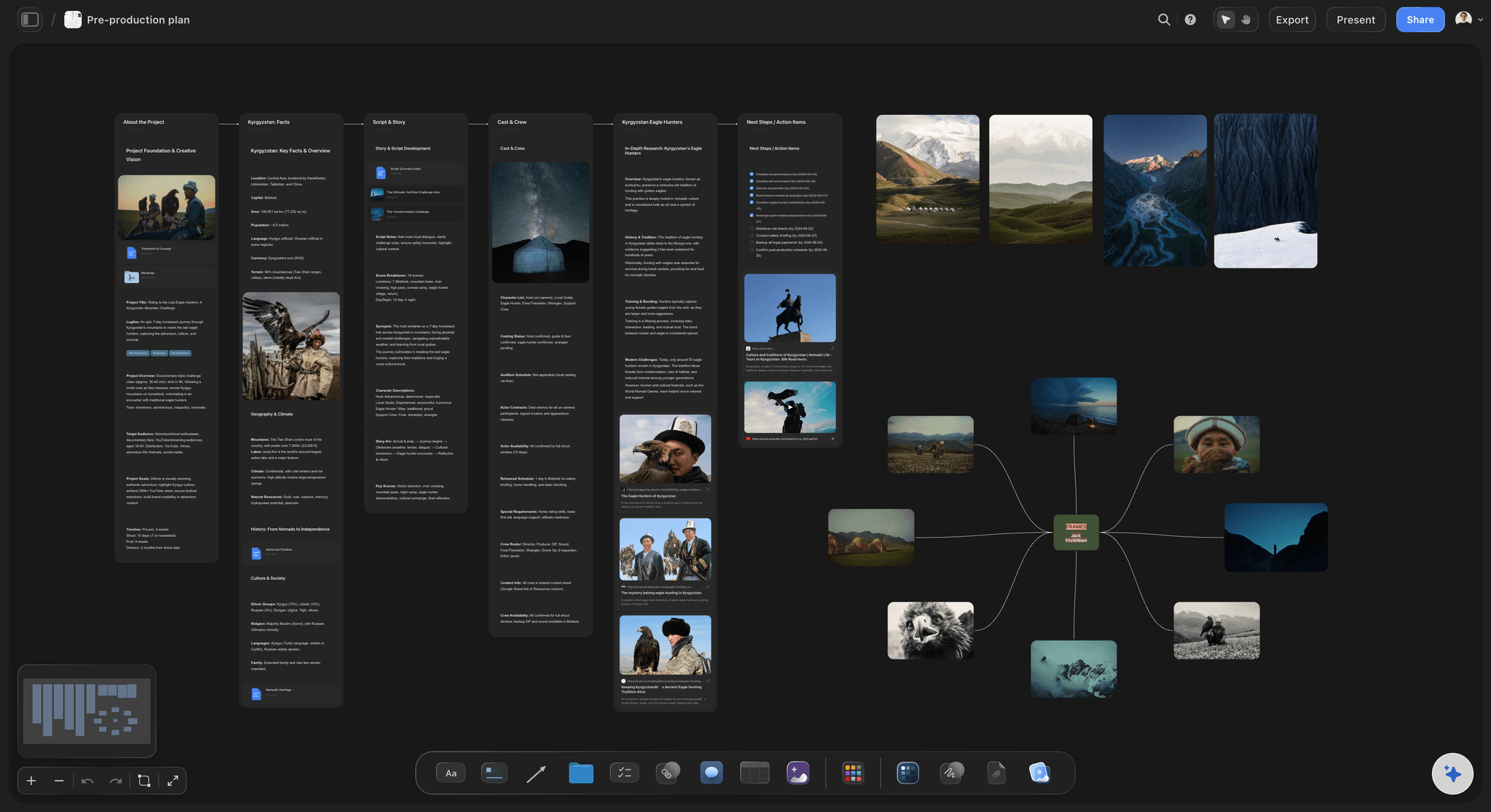
Owners and deadlines on every line
The checklist is the pre-production schedule
Each item carries who owns it and the date it is due, counted back from the first shoot day, so there is no second document to keep in step with the checklist.
See film production planning →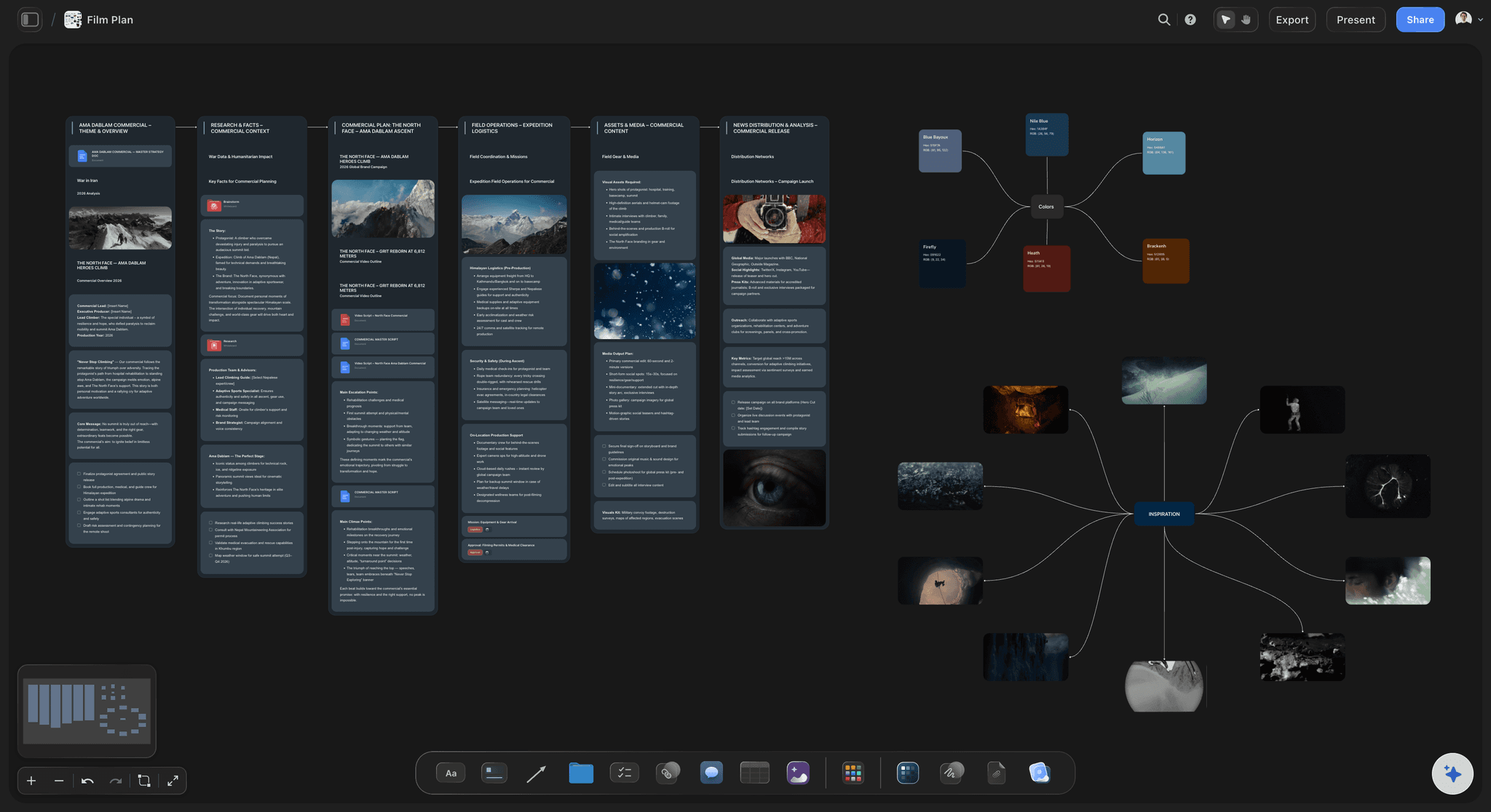
The breakdown built from your script
From script lock to breakdown in one step
Attach the locked script and the AI builds a scene index and a breakdown of cast, props, wardrobe, vehicles and effects, using the script's own scene numbers.
See script breakdown software →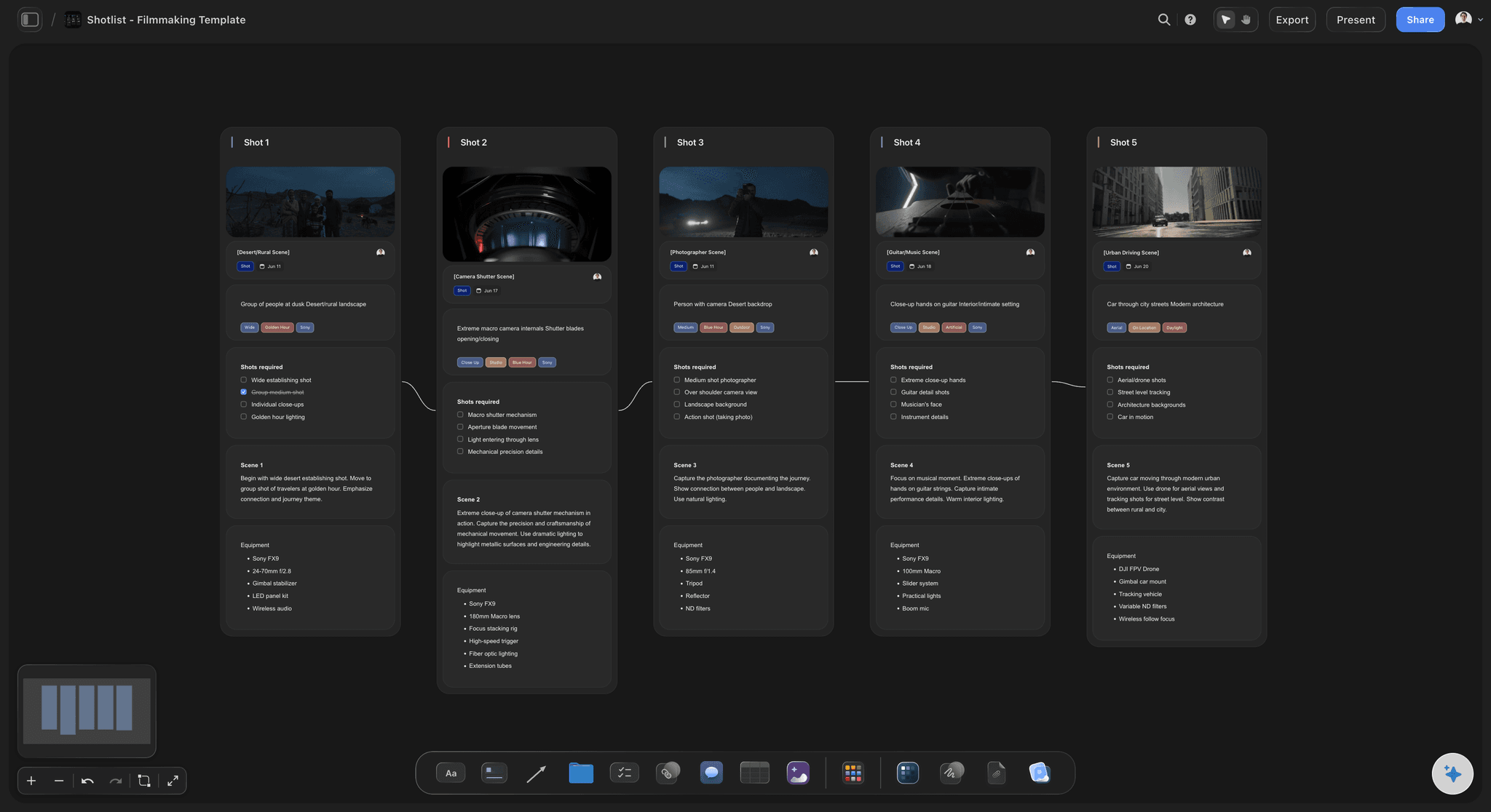
Strip board and call sheets from one board
The schedule and the call sheet agree
The AI groups scenes into shoot days on a strip board, then writes a Call Sheet PDF for any day from it, with a visible blank wherever a number or an address is still missing.
See the AI call sheet generator →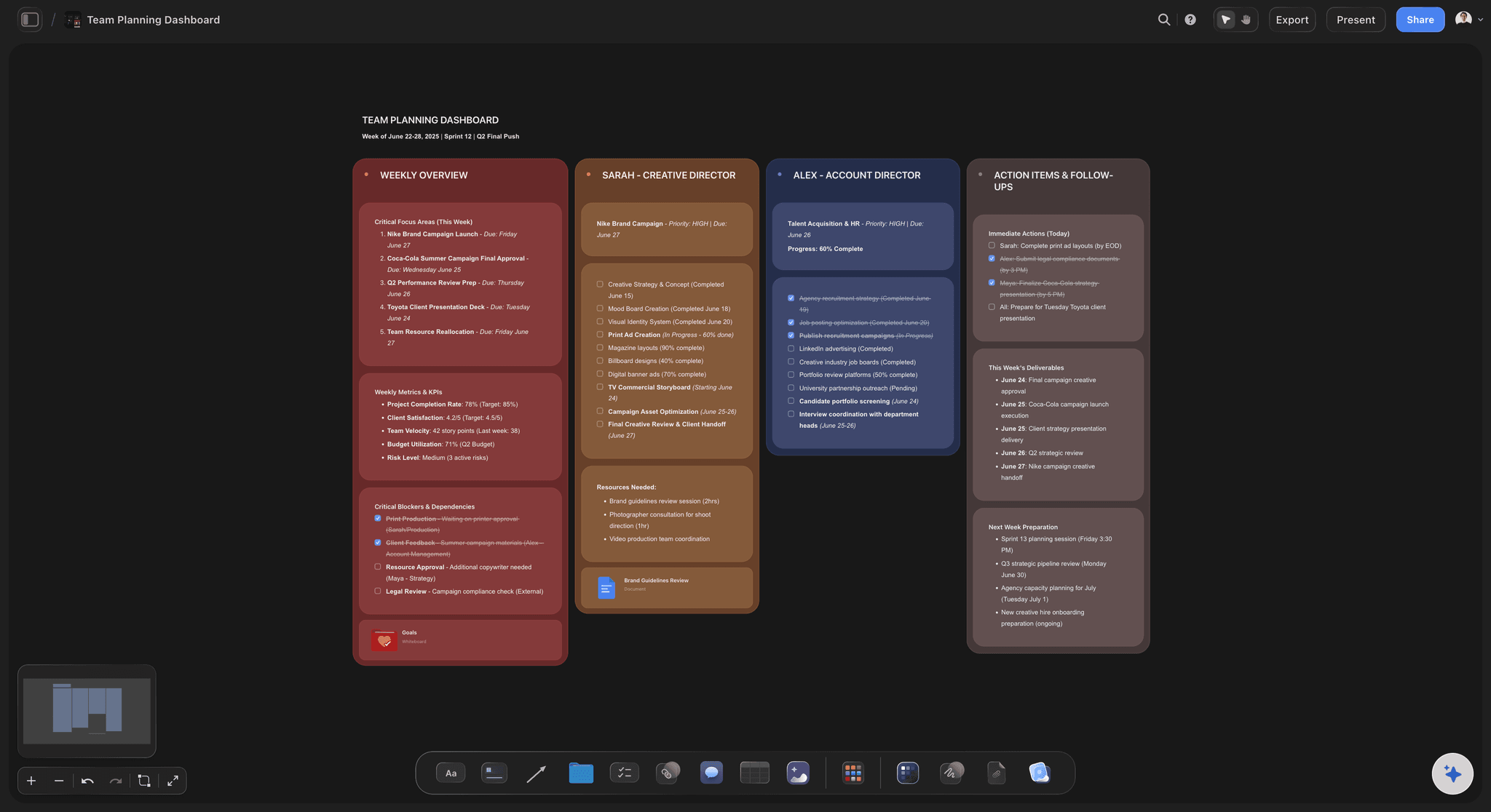
One link for the whole crew
Nobody works from last week's PDF
Crew open the board in a browser with no account, so the checklist they read is the current one. Anyone you invite to edit joins free.
See pre-production to shoot day →Unlimited boards. No object cap.
One board per production, with room for every checklist on the slate. Storyflow is paid-only during early access, with plans from $7.99 a month billed annually ($9.99 monthly). A free plan launches before the end of 2026, and anyone a paid member invites to a board joins free.
Unlimited boards, images, files and links
AI that builds the checklist, breakdown, strip board and call sheet
View-only links the crew opens with no account
Export any board as a high-quality image or PDF
Built for people with taste
Thirteen items, one owner each, in the order they lock.
What goes on the list, who holds each line, what the AI builds beside it, and the four items that slip most often.
Weeks out from the shoot
The checklist by phase
Lock the story: Script lock with a named decision maker and a date. The breakdown, the strip board and the call sheets all use its scene numbers, so a script that keeps moving moves everything built on it.
Break down, budget, schedule: The breakdown first, then a budget table with a currency total, then the strip board. Casting and locations work from the schedule's shoot days, not from the script's page order.
People, places and paper: Casting, location recces, permits, location agreements, insurance certificates, crew deal memos and equipment holds, each dated by whoever outside the production needs it.
The final stretch: Tech scout, then the final shot list and storyboard, then call sheets, with the contingency plan for weather, a lost location or a missing cast member settled before any of them go out.
Who owns what
One owner per item
Producer: Budget, insurance, contracts, permit sign-off and the contingency reserve: the items where money or liability is at stake.
Director and DP: Script lock with the producer, then the shot list, the storyboard and the tech scout.
First AD or production manager: The breakdown, the strip board, the days each cast member works, and the call sheets.
Locations and coordination: Recces, permit paperwork, parking and holding areas, and the crew list with a phone number for every name. On a small crew several of these are one person, and each line still names exactly one.
The documents behind the ticks
What the AI builds beside each item
Scene index and breakdown: From a PDF, Final Draft or Fountain script: scene number, slugline, interior or exterior, time of day, cast and page count in eighths, plus props, wardrobe, vehicles and effects per scene.
Strip board: One wall per shoot day with a coloured strip per scene, grouped by location or kept in script order, each day totalled in pages. Moving a scene is dragging its strip.
Shot list: One entry per camera setup with size, angle, movement, lens and setup time, and a tick column for the day.
Call Sheet PDF: Crew call, first shot, estimated wrap, the day's scenes, cast and crew call times, locations and the nearest hospital, with any missing value left as a visible blank.
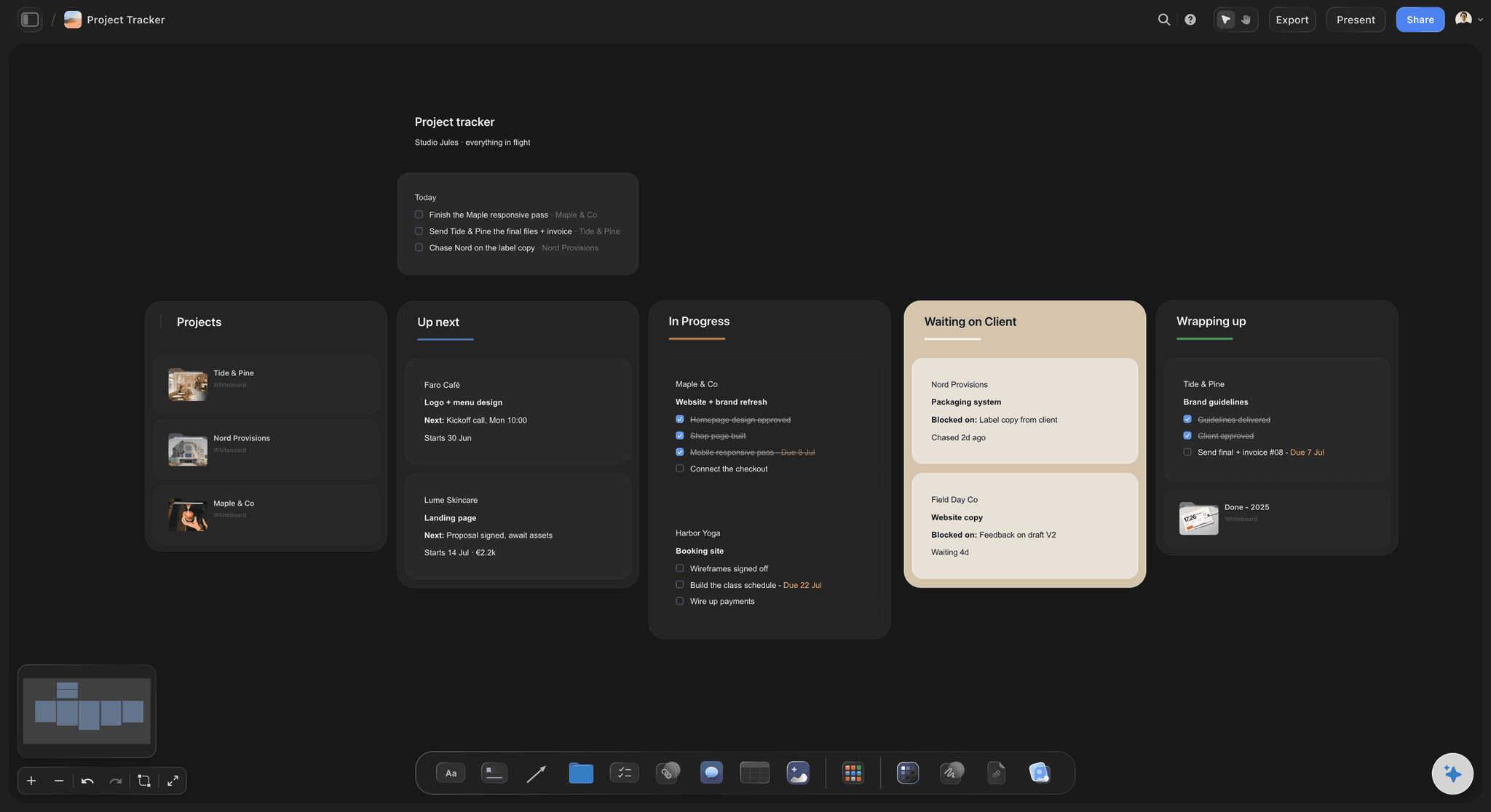
Where pre-production checklists fail
Four items that slip
The tech scout comes after the shot list: Setups planned from photographs meet a room with no power or the wrong light at the hour you shoot. Scout first, then lock the shot list.
Insurance is left to the last week: Locations and permit offices commonly ask for a certificate of insurance before they confirm, so it belongs early in the schedule, not at the end.
Contingency has no owner: A cover set for an exterior day, a backup location and a reserve in the budget are decisions, and a decision without an owner does not get made.
Call sheets are retyped from memory: When the schedule, contacts and locations sit on one board, the call sheet is assembled from them instead of rebuilt the night before.
Explore templates for your project
Every template opens as a real, editable board on the infinite canvas. Pick the closest fit and make it your own.
Pre-Production
Pull the brief, script, shot list, and moodboard into one pre-production hub so the whole shoot is planned in one place.
One app instead of five
Storyflow vs StudioBinder, Celtx and Milanote.
StudioBinder and Celtx are production suites with breakdowns, stripboards and call sheets, and both include a screenplay editor. Milanote is a visual board for references and pre-production notes. Here is how they differ for running a pre-production checklist.
Storyflow
Recommended
Script breakdown from an imported script
Stripboard shooting schedule
Call sheets built from the schedule
Checklist, references and notes on one canvas
Screenplay editor in industry format
StudioBinder
Script breakdown from an imported script
Stripboard shooting schedule
Call sheets built from the schedule
Checklist, references and notes on one canvas
Screenplay editor in industry format
Celtx
Script breakdown from an imported script
Stripboard shooting schedule
Call sheets built from the schedule
Checklist, references and notes on one canvas
Screenplay editor in industry format
Milanote
Script breakdown from an imported script
Stripboard shooting schedule
Call sheets built from the schedule
Checklist, references and notes on one canvas
Screenplay editor in industry format
What creators are saying
Join early creators getting structured workspaces and AI that remembers their projects
“Storyflow has sped up my workflow by at least 3x, which means more flow state and more projects I can actually ship. It truly changed the way me and my team create.”

Reilin Joey
Director & YouTuber
“One prompt gets me a structured board. But the tactics are my favorite. I run my YouTube scripts through them and my intros and retention got better. It's amazing.”

Justkay
YouTuber & Freelance Filmmaker
“I used to juggle five apps to plan a project. Now I describe what I am making and get boards, lists, and a schedule. All in one place.”

George
@fernwehchronicles
Pre-production checklists, answered.
What goes on the list, who owns each item, and how it becomes a schedule.
Storyflow keeps video producers organised with one board per production: the pre-production checklist, with an owner and a deadline on every item, beside the breakdown, strip board, shot list and call sheets those items produce. The crew opens one link with no account. StudioBinder and Celtx run the same paperwork as separate modules. In any tool the habits hold: one owner per item, deadlines counted back from day one, and call sheets built from the schedule.
Storyflow is the app for a pre-production checklist when each item should sit beside the document it produces: the AI builds the checklist, breakdown, strip board, shot list and call sheets on one board, with an owner and a deadline on every line, and the crew opens it by link. StudioBinder and Celtx suit teams that want those documents as separate modules. A shared spreadsheet with item, owner, deadline and status columns can carry a small shoot.
A pre-production schedule is the pre-production checklist with dates on it: every item placed between script lock and the first shoot day, with an owner. It is not the shooting schedule, which orders scenes into shoot days. Build it backwards from day one: call sheets the day before, the shot list after the tech scout, and permits and insurance at the lead time the permit office sets. In Storyflow it is a table with date, person and status cells.
The same items as a feature, scaled down rather than removed: script lock, breakdown, budget, schedule, casting, locations and permits, insurance, crew, equipment, tech scout, shot list and storyboard, call sheets and contingency. On a short, two or three people own everything, but the same items fail: late permits and insurance, unsigned releases, no cover for an exterior day. Skipping the tech scout is the costliest shortcut. Storyflow lays the list out from a short description of the film.
The producer owns money and risk: budget, insurance, contracts, permits and the contingency reserve. The director owns script lock with the producer, and the shot list and storyboard with the DP. The first AD or production manager owns the breakdown, strip board, cast days and call sheets. The location manager owns recces and permit paperwork, and the coordinator owns the crew list. On a small crew one person holds several, but every line still names exactly one owner.
A tech scout, or technical recce, is when the director, DP, gaffer, sound recordist and first AD walk each confirmed location to plan the shoot: power, noise at the hour you shoot, where the sun will be and where vehicles park. It comes after locations lock and before the shot list is final, with its own date and owner on the checklist. A problem found on the scout costs an hour; on the day, part of the day.
Yes. Any Storyflow board exports as a high-quality image or PDF, so the pre-production board, with the checklist and strip board on it, can go into a production meeting or a printed binder. The PDF is a snapshot: the board the crew opens by link keeps changing as items are ticked and dates move, so send the link for daily work and the PDF as a fixed record. Call sheets are their own PDF, one per shoot day.
Yes. Storyflow's template gallery includes a Pre-Production Board, or the AI builds a checklist fitted to your shoot: describe the format, shoot days and locations, or attach the script, and it lays out the items by phase with slots for owners and deadlines. The breakdown, schedule and call sheet for each item are built beside it. Use the template for a familiar shape, and the AI for a documentary or commercial that needs items a narrative template lacks.
Four decisions that are easy to postpone: a cover set for a rained-out exterior day, a backup location for any place whose permit or owner could fall through, cover for key cast and crew, and a reserve line in the budget. Each needs an owner and a trigger, such as a weather call at a set hour the day before. Contingency is the item most checklists leave out, so give it its own line, owner and deadline.
Not yet. Storyflow is paid-only during early access, with plans from $7.99 a month billed annually ($9.99 monthly). A free plan launches before the end of 2026, and anyone a paid member invites to a board joins free, so a producer can bring the director, first AD and location manager onto the checklist without paying for each. Crew who only need to read open a view-only link with no account.
Not by email or text. Storyflow writes a Call Sheet PDF for each shoot day from the schedule, contacts and locations on the board, with crew call, first shot, estimated wrap, scenes, call times and the nearest hospital, and leaves a visible blank wherever a value is missing. You send the PDF or the board link yourself. For distribution with confirmations, StudioBinder sends call sheets by email and text and tracks who viewed and confirmed them.
More from Storyflow
Pre-production to shoot day
Film shoot planner
Script breakdown software
Stripboard
Shooting schedule
AI call sheet generator
Shot list software
Location scouting app
Film crew planner
Equipment list maker
Film budget planner
Production binder
Video production checklist
Short film production plan
Film production planning
First-time filmmaker planning
Idea to shoot workflow
Crew scheduling software
Indie film production workflow
Low budget film planning
Film production checklist
Put a name and a date on every pre-production item.
Attach the script or describe the shoot, and the AI lays out the checklist beside the breakdown, schedule and call sheets. No download.