
Rock-steady plans for every shoot
One board per indie film,
from development to distribution.
On a studio production every document has an owner whose only job is that document. On an indie the director is also the producer, so the workflow that holds up is fewer documents, all visible at once.


Creatives working for these brands already got early access
- Red Bull
- Canon
- Artlist
- Porsche
See how easy it is to get started
Watch a real project come together, from a blank board to a finished plan, clicked through step by step.
Start from a ready-made template
Pick a board to see what you can build, then let AI fill it in. Every template is a real, editable starting point on the same infinite canvas.

Pre-Production
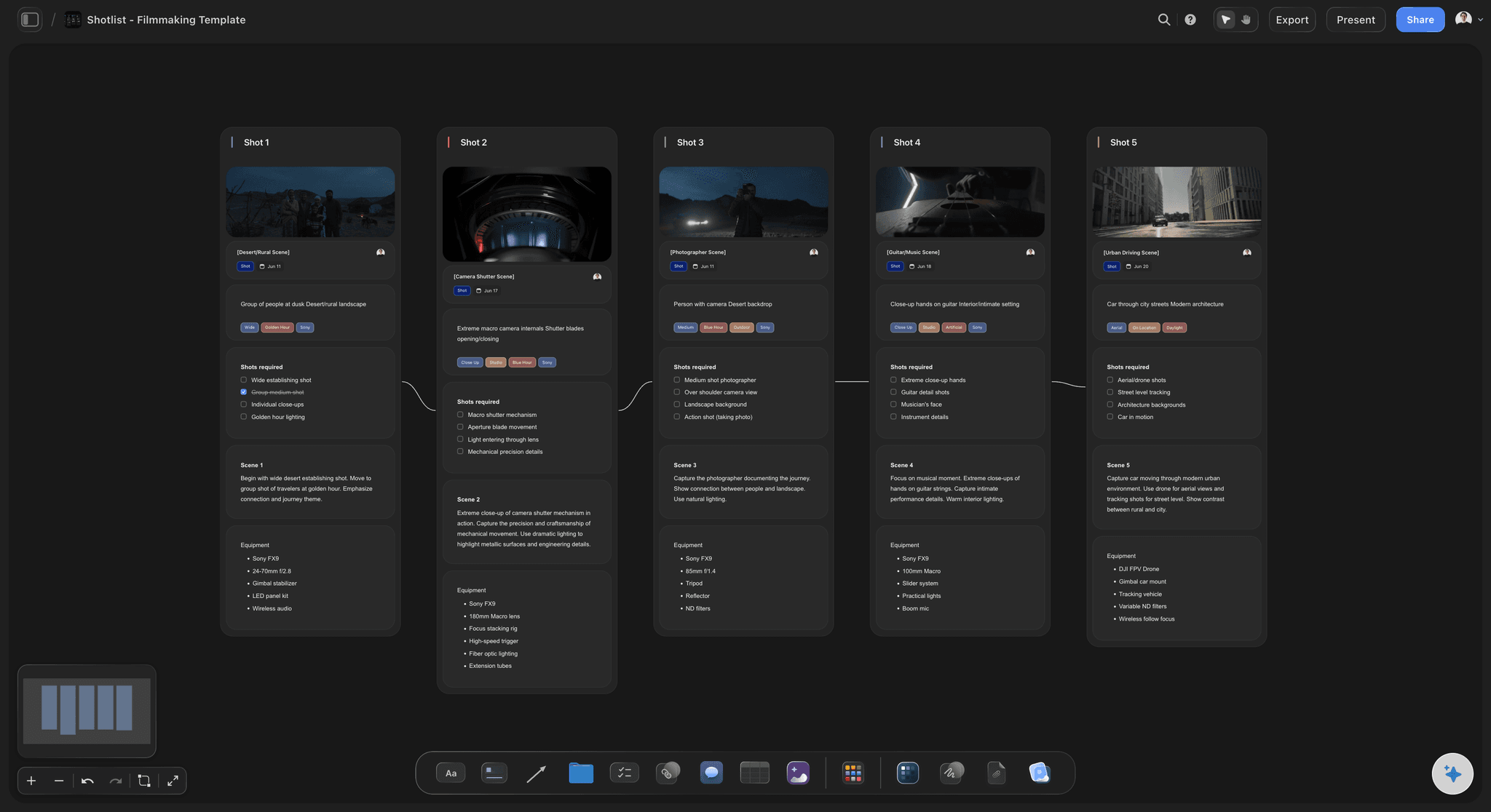
Pull the brief, script, shot list, and moodboard into one pre-production hub so the whole shoot is planned in one place.
How do indie filmmakers organize their projects?
Storyflow organizes an indie film the way small crews need it: one board per production, beside one folder structure for the files. The board runs through the stages in order: development (script, look, pitch material), pre-production (breakdown, shot list, schedule, locations), production (call sheets, continuity), post (edit plan, deliverables), and festivals and distribution. The folders are numbered by stage. The organizing principle is visibility rather than delegation, because one or two people read every document and there is no department to hand them to.
The files follow the same order. Number the top folders by stage, from 01 Development through 05 Festivals and Distribution, with a sixth for paperwork, so they sort the way the work happens. Start every file name with the date in year, month, day order, then the project, then what the file is and a version number, and never call anything final. Keep camera originals under the shoot day and card they came from, on two drives, one stored somewhere else. The board holds the plan and links to those folders, so nobody searches a drive for the current schedule.
Paperwork is the part an indie cannot shrink: talent releases, location agreements, crew deal memos, insurance certificates, permits, music licences, and the chain of title distributors ask to see. What small crews can sensibly skip is ceremony, such as formal daily production reports and documents that restate the schedule. What they skip and regret is the tech scout, room tone, a second verified copy of the footage, and releases collected on the day rather than chased afterwards.
Small productions usually drown in tools rather than in work: script in one app, budget in a spreadsheet, shot list in another, references on Pinterest, schedule in a group chat. On a Storyflow board the stages sit side by side. Attach the script and the AI builds the breakdown and a strip board, ask for a Call Sheet PDF for each shoot day, and keep signed releases as PDFs in a paperwork folder. The AI reads the whole active board plus up to five documents and three other boards, so a question like whether the schedule still works after a cast change is answered from your actual plan.
Ultra fast from brief to board
What each stage of an indie film has to hold.
Shorter than the studio list, because every extra document is one more thing you personally maintain.
01
Development
Script, logline, treatment, lookbook and pitch deck on one board, so the film you pitch and the film you can afford to shoot stay the same film.
02
Pre-production
Breakdown, strip board, shot list, locations, cast, crew and kit, with releases, agreements and insurance collected before the first shoot day.
03
Production
A Call Sheet PDF for each shoot day built from the schedule on the board, continuity tracked per character while you shoot out of order, and releases signed on set.
04
Post, festivals and distribution
Edit plan, review rounds and deliverables, then a festival table with deadlines, fees, requirements and status beside the files distributors ask for.
One person can hold the whole picture.
Which is the actual requirement on an indie, and the one a studio-shaped toolchain does not meet.
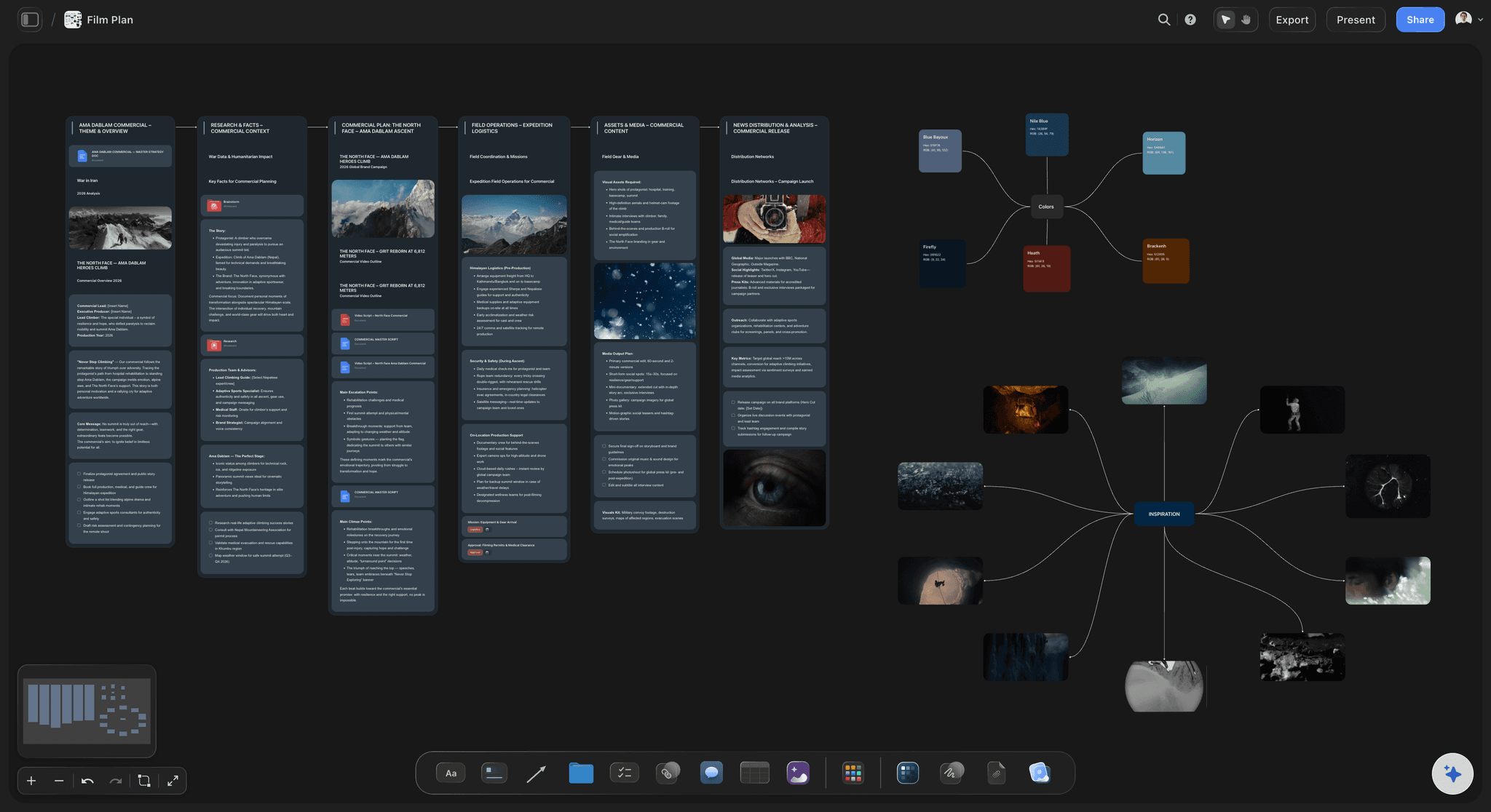
Development and prep on the same board
The pitch and the plan stay the same film
Lookbook, treatment and script sit beside the breakdown and schedule, so what you promised investors and what you can afford to shoot are visible together.
See film pitch decks →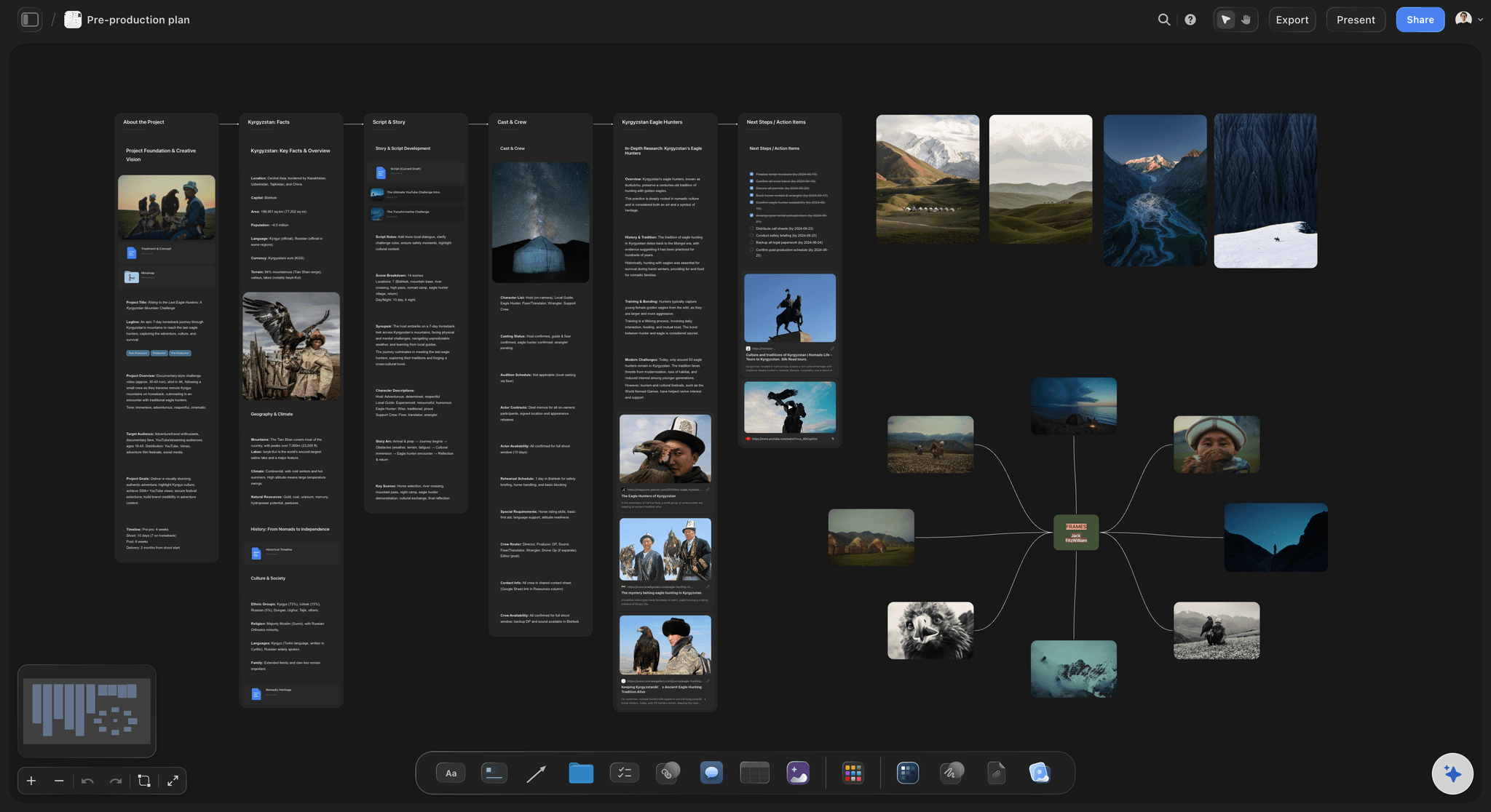
Ask across the whole production
Questions that span two documents
The AI reads the entire active board, so a question like whether the schedule still works if you lose an actor for a day is answered from your breakdown and schedule rather than by you re-reading both.
See the AI creative workspace →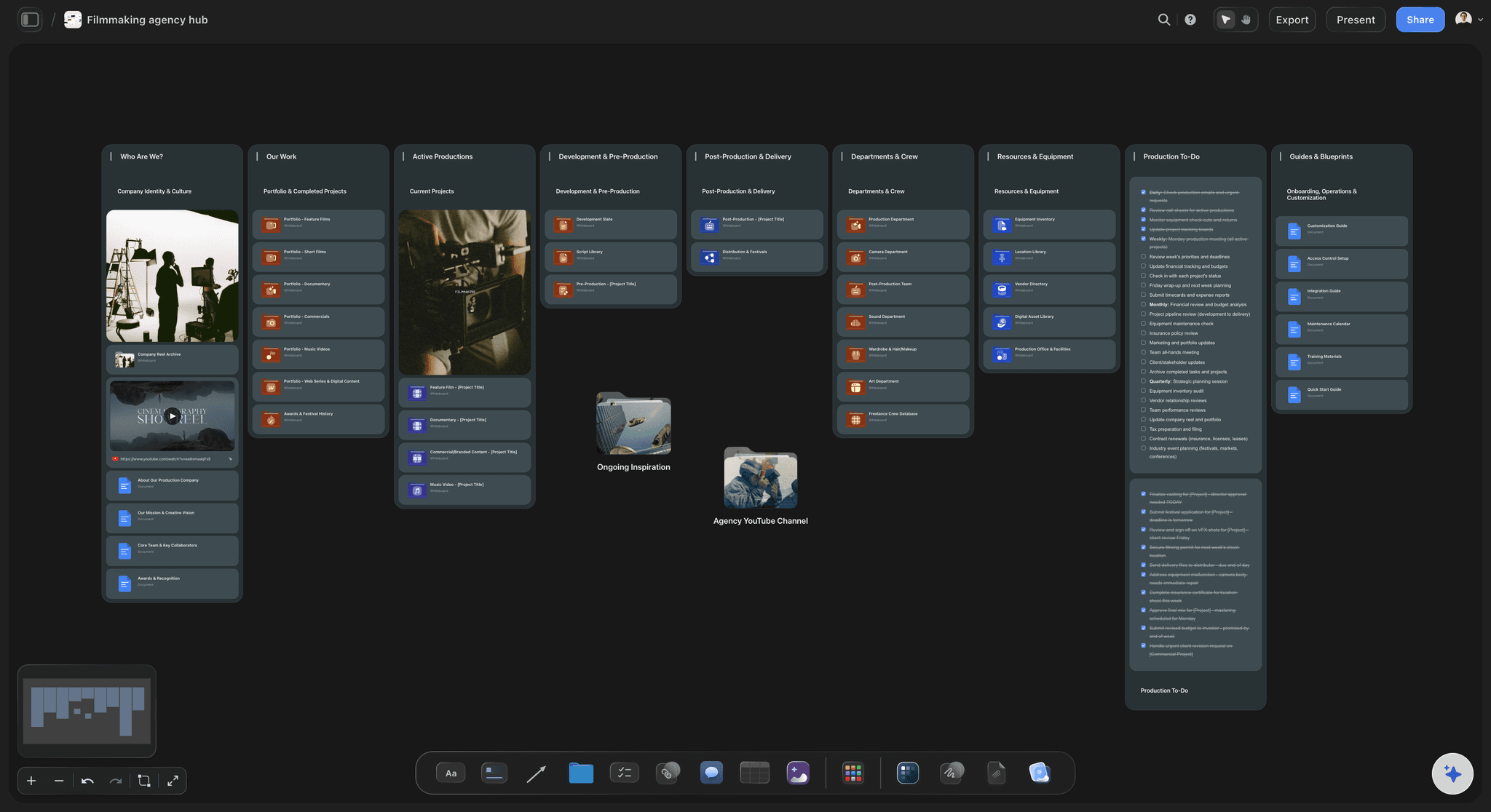
Crew reads one link
No accounts, no stale PDFs
Share the board view-only and the DP, the gaffer and the cast see the current plan in a browser with no account. On an indie most crew are short-term and will never create a login.
See the AI call sheet generator →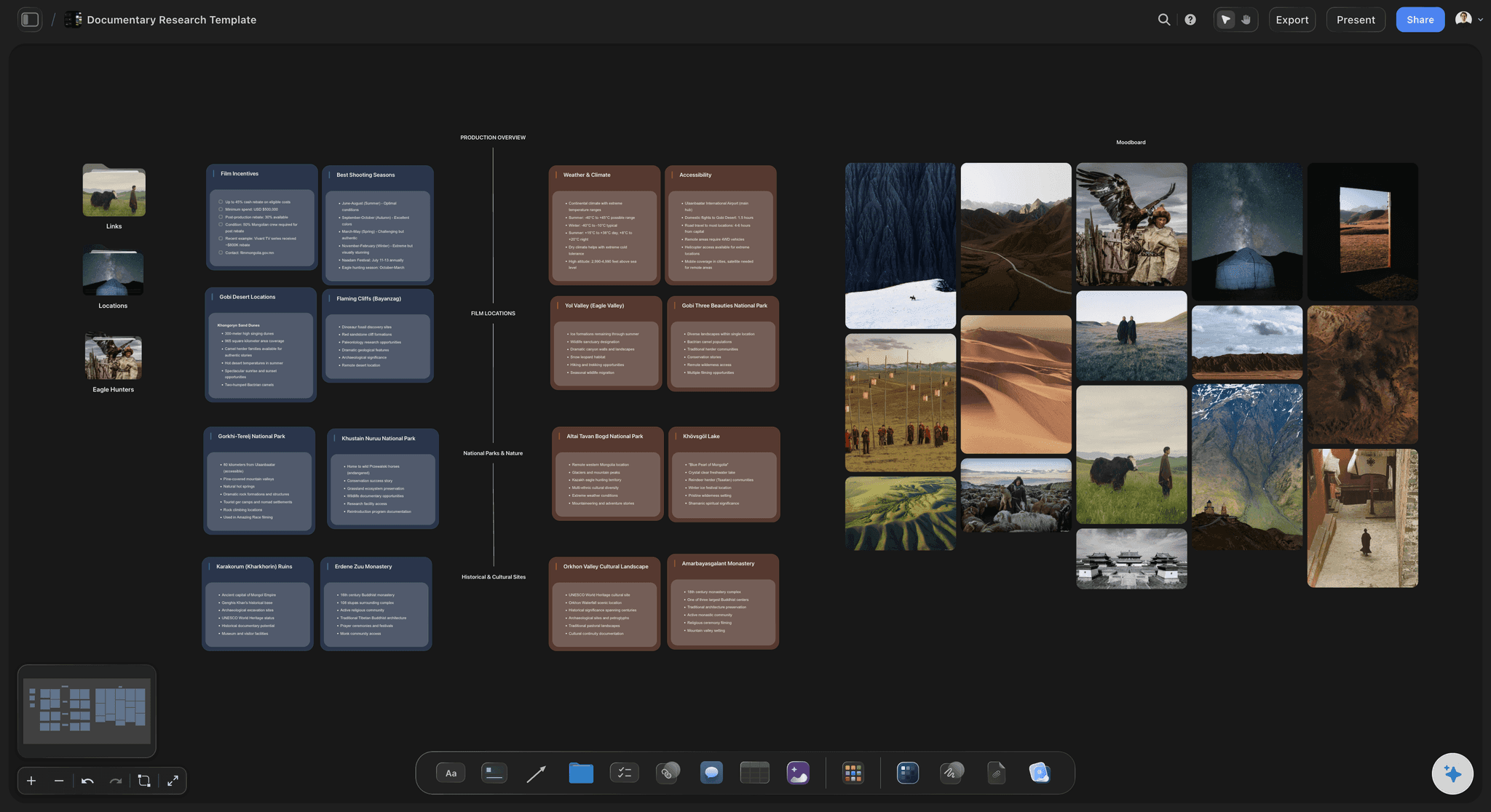
The board survives the gap
Come back to it in eight months
Indie productions stall while money is raised. A board that holds the reasoning, not just the files, is readable when the project restarts and you have forgotten why a scene was cut.
See AI project memory →Unlimited boards. No object cap.
One board per film, with the crew joining by invite. Storyflow is paid-only during early access, with plans from $7.99 a month billed annually ($9.99 monthly). A free plan launches before the end of 2026, and anyone a paid member invites to a board joins free.
Unlimited boards, images, files and links
Invited collaborators join free
View-only links the crew opens with no account
AI breakdown, strip board and Call Sheet PDF from your script
Built for people with taste
No handoffs, numbered folders, the paperwork, and what to skip.
An indie is not a small studio production. It has different constraints, so it needs a different structure.
There are no handoffs
One reader, every document
One reader, many documents: Studio documents are built to be passed between departments. Indie documents are all read by the same person, so they need to be adjacent rather than well-formatted.
Fewer documents wins: Every extra artefact is one more thing one person maintains. Cutting the list is a real productivity gain, not a compromise.
The board is the interface: Instead of a schedule that imports a breakdown, the schedule sits next to the breakdown and you look at both.
Folders and naming
The file system behind the board
Numbered stage folders: 01 Development, 02 Pre-production, 03 Production, 04 Post, 05 Festivals and Distribution, 06 Paperwork. The numbers keep them in the order the work happens.
Date-first file names: Year, month and day, then the project, then what the file is and its version number, so files sort in the order they were made and nothing is called final.
Footage by day and card: Camera originals under the shoot day and the card they came from, copied to two drives, one kept in a different place.
The board links, the drives store: The board holds the plan and links to where large files live, so finding the current schedule is never a search.
Paperwork
The documents an indie cannot skip
Releases and agreements: Talent releases, location agreements and crew deal memos, signed before or on the day rather than chased in post.
Insurance and permits: Certificates and permits with their dates, because a location can refuse a shoot without them.
Music and chain of title: A licence for every piece of music and the documents proving the production owns the script. Distributors and their insurers ask for both.
Stored beside the plan: Signed copies as PDFs in a paperwork folder on the board, next to the shoot days and locations they cover.
What small crews skip
Skip the ceremony, keep the safeguards
Safe to skip: Formal daily production reports, a separate day-out-of-days document when the strip board already shows cast days, and meetings that restate the board.
Never skip the tech scout: A setup planned from photos meets a room with no power or the wrong light at the hour you shoot.
Never skip the second copy: Footage verified in two places before any card is reformatted.
Never skip room tone and releases: Both take minutes on the day and cannot be recovered afterwards.
Explore templates for your project
Every template opens as a real, editable board on the infinite canvas. Pick the closest fit and make it your own.
Pre-Production
Pull the brief, script, shot list, and moodboard into one pre-production hub so the whole shoot is planned in one place.
One app instead of five
Storyflow vs StudioBinder, Celtx and Notion.
StudioBinder and Celtx are production suites with a screenplay editor, breakdowns, stripboards and call sheets. Notion is a flexible workspace where filmmakers often build their own production templates. The useful question is which one keeps the whole film readable by the one or two people holding it.
Storyflow
Recommended
The whole film on one visual board
Breakdowns, stripboards and call sheets built from the script
Comments on the specific item
Screenplay editor in industry format
StudioBinder
The whole film on one visual board
Breakdowns, stripboards and call sheets built from the script
Comments on the specific item
Screenplay editor in industry format
Celtx
The whole film on one visual board
Breakdowns, stripboards and call sheets built from the script
Comments on the specific item
Screenplay editor in industry format
Notion
The whole film on one visual board
Breakdowns, stripboards and call sheets built from the script
Comments on the specific item
Screenplay editor in industry format
What creators are saying
Join early creators getting structured workspaces and AI that remembers their projects
“Storyflow has sped up my workflow by at least 3x, which means more flow state and more projects I can actually ship. It truly changed the way me and my team create.”

Reilin Joey
Director & YouTuber
“One prompt gets me a structured board. But the tactics are my favorite. I run my YouTube scripts through them and my intros and retention got better. It's amazing.”

Justkay
YouTuber & Freelance Filmmaker
“I used to juggle five apps to plan a project. Now I describe what I am making and get boards, lists, and a schedule. All in one place.”

George
@fernwehchronicles
Indie production workflow, answered.
How small crews actually keep a film organized, from the first draft to the festival run.
Storyflow organizes an indie film as one board per production, beside numbered folders for the files. The board runs through the stages in order: development, pre-production (breakdown, shot list, schedule, locations), production (call sheets, continuity), post, then festivals and distribution. File names start with the date and end with a version number, and releases are collected by the shoot day. Notion suits filmmakers who build their own templates, and StudioBinder or Celtx suit crews who want breakdown modules.
Usually too many: a screenwriting app such as Final Draft, WriterDuet or Celtx, a spreadsheet for the budget, another for the shot list, Pinterest for references, a shared drive, Notion for everything else, and a group chat for the schedule. Each is fine alone, but the one person who needs the whole picture never has it. Storyflow replaces the planning part with one board, while the screenplay stays in the writing app and the footage on drives.
Number the top folders by stage so they sort in workflow order: 01 Development, 02 Pre-production, 03 Production, 04 Post, 05 Festivals and Distribution, 06 Paperwork. Start every file name with the date in year, month, day order, then the project, what the file is and a version number, so nothing is called final. Keep camera originals under the shoot day and card, on two drives stored apart. The Storyflow board links to those folders instead of duplicating them.
Before and during the shoot: talent releases, location agreements, crew deal memos, insurance certificates and any permits. For the soundtrack: a licence for every piece of music and a cue sheet. For distribution: chain of title showing the production owns the script and underlying rights, and usually errors and omissions insurance. Collect signatures by the shoot day, because a release chased months later stalls a sale. Keep signed copies as PDFs in a paperwork folder on the Storyflow board.
Skip the ceremony: formal daily production reports nobody reads, documents that restate the schedule, and meetings that could be a look at the board. Never skip the safeguards, which cost minutes on the day and cannot be recovered: a tech scout at the hour you shoot, room tone at every setup, a second verified copy of the footage before any card is reused, signed releases on set, and one named person for continuity.
Not always. If one or two people hold the plan, seeing everything at once matters more than a database of modules, and Storyflow builds the breakdown, strip board, shot list and call sheets from the script on one canvas. Dedicated suites earn their place when departments work in their own modules, when call sheets must go out by text with confirmations, or when an accountant tracks actual costs: StudioBinder, Celtx and Yamdu cover those.
With a link, not a process. Share the board view-only and they open it in a browser with no account, which suits a gaffer or sound recordist hired for two days. Put the lookbook next to the shot list so short-term crew see what the film is trying to be. Send the Call Sheet PDF for their days, and if they need to edit, invite them, since anyone a paid member invites joins free.
It is the normal case on indies, and most systems fail because the files survive but the reasoning does not. Write the why on the board as you go: why a scene was cut, why a location was dropped, which actor's dates the schedule was built around. When the money arrives, that board is readable in an afternoon, and you can ask Storyflow's AI what the plan was and which dated items have passed.
Not yet. Storyflow is paid-only during early access, with plans from $7.99 a month billed annually ($9.99 monthly). A free plan launches before the end of 2026, and anyone a paid member invites to a board joins free, so a director on a paid plan can bring the producer, DP and first AD onto the production board. Short-term crew who only read open a view-only link with no account.
It can hold the budget, not the books. A Storyflow table with category and currency columns totals the budget live, and the AI can build one from the breakdown or a quote on the board. It does not track actuals, run payroll or produce cost reports, so if your accountant uses a spreadsheet, keep the budget there. Most indie costs scale with shoot days, so the strip board beside the budget table shows whether a day can be cut.
Keep a continuity table per character on the same board as the strip board: scene number, wardrobe, props, hair and makeup, and injuries or state, with reference photos from the take beside it. When the schedule puts scene 40 before scene 12, the table shows how the character looked in the scenes either side in story order. On a small crew continuity defaults to nobody, so name one person for it on the call sheet and the board.
As the last stage of the same board. A festival table holds each festival's deadline, fee, premiere requirements, accepted formats and status. Beside it sit the deliverables festivals and distributors ask for: screening file, subtitles, stills, press kit, poster and trailer, plus the paperwork folder with chain of title, music licences and releases. On the production board, the release a sales agent asks for is one folder away, and every deadline sits in a date cell beside its festival.
More from Storyflow
Low budget film planning
First-time filmmaker planning
Short film production plan
For indie filmmakers
Film production management software
Pre-production checklist
Production paperwork
Film festival planner
Film pitch deck
Director's treatment template
Continuity tracker
Footage organizer
Film production tracker
Film shoot planner
Film press kit
Hold the whole production in one view.
One board per film, from development to festivals, that answers questions about itself. No download.