
Extremely reliable pre-production
A video production checklist
from the brief to the archive.
Brief and quote, pre-production, shoot day, post, delivery and archive, each item with an owner. Including the handoffs between stages, which is where the expensive mistakes live.


Creatives working for these brands already got early access
- Red Bull
- Canon
- Artlist
- Porsche
See how easy it is to get started
Watch a real project come together, from a blank board to a finished plan, clicked through step by step.
Start from a ready-made template
Pick a board to see what you can build, then let AI fill it in. Every template is a real, editable starting point on the same infinite canvas.

Pre-Production
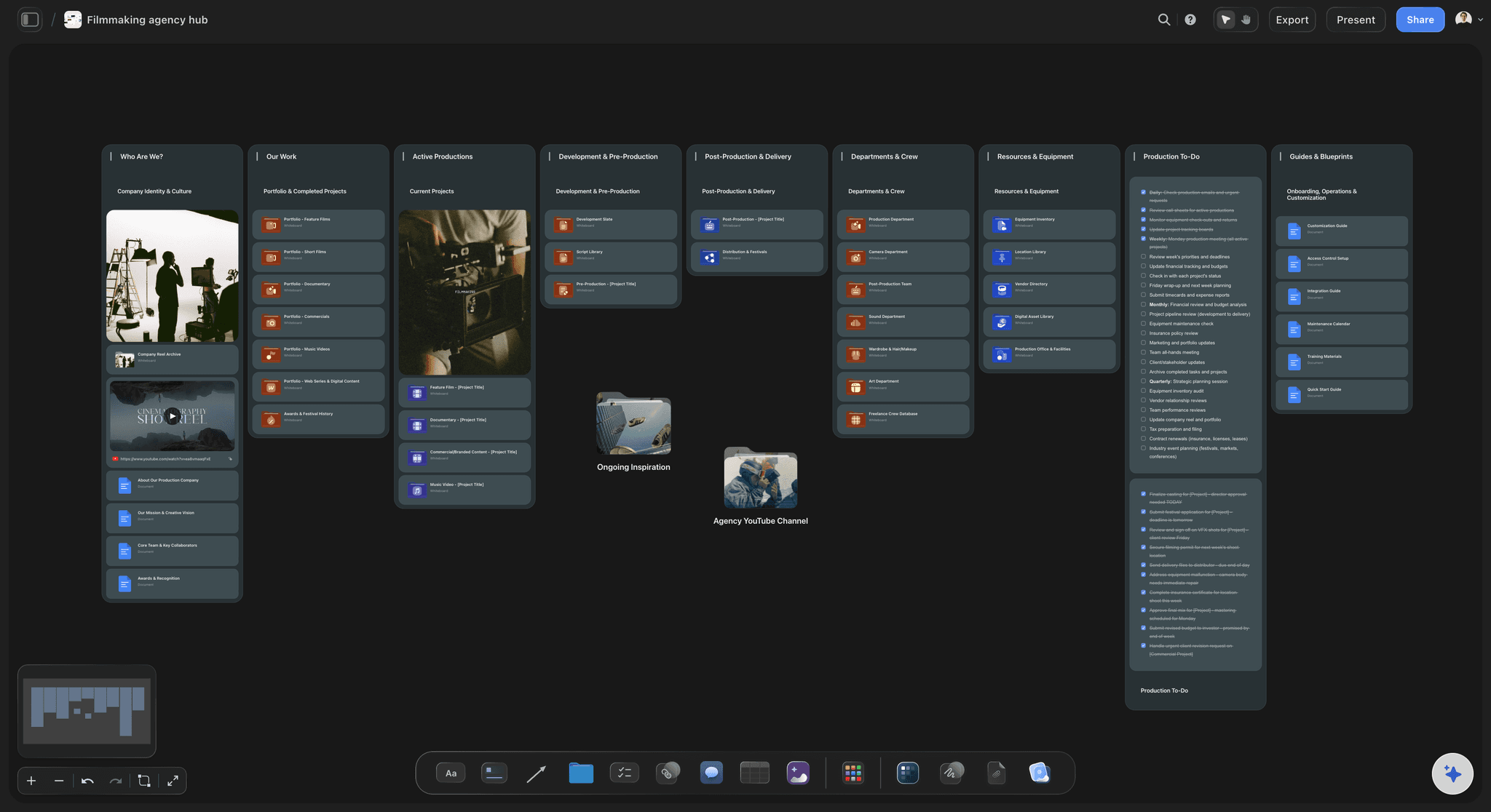
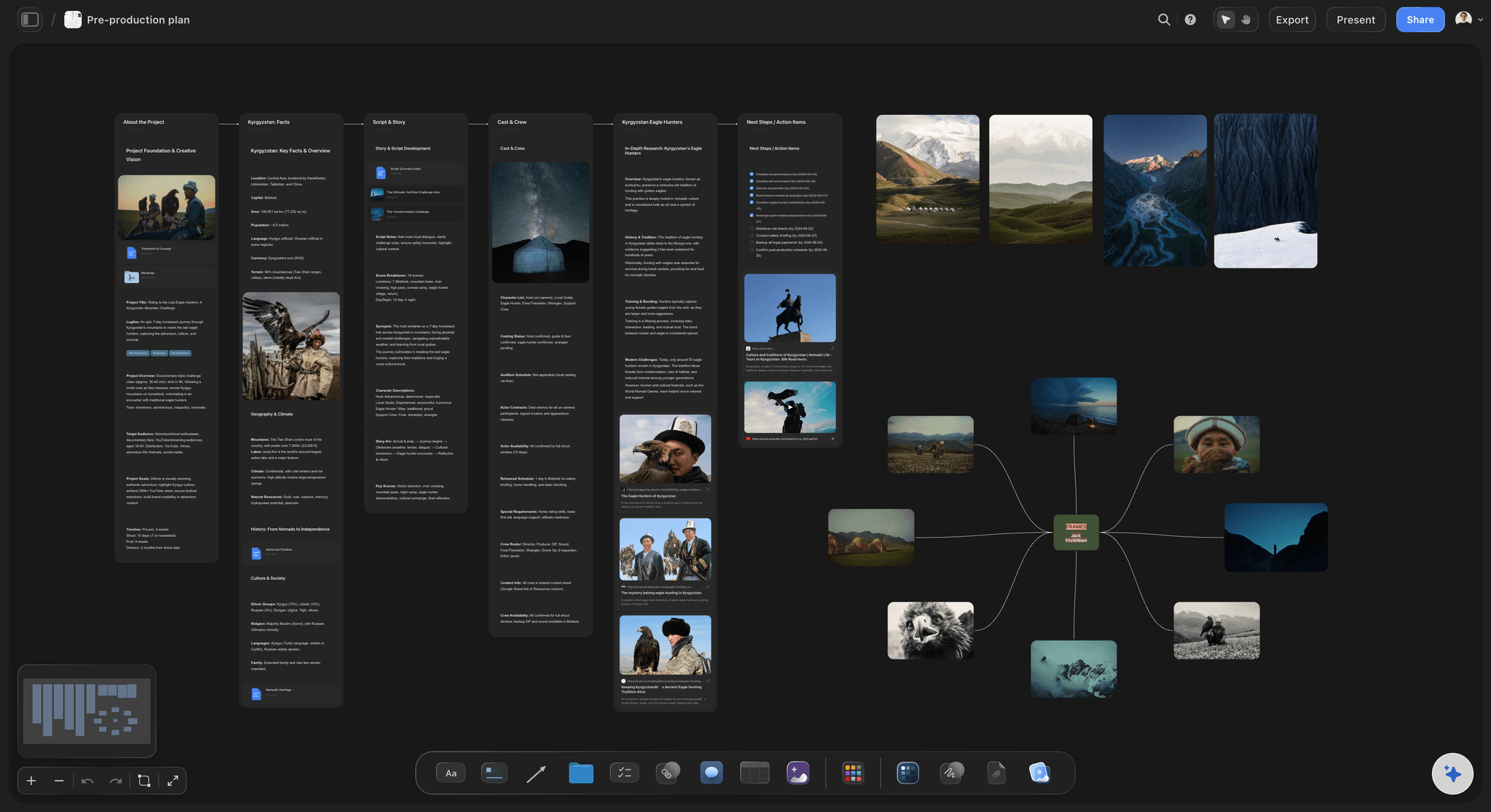
Pull the brief, script, shot list, and moodboard into one pre-production hub so the whole shoot is planned in one place.
What goes on a video production checklist?
A video production checklist covers the six stages of a commercial or brand video, from brief and quote to delivery and archive. Storyflow is an AI visual workspace that runs that checklist on one infinite canvas: an owner on every item, the shot list, call sheet and deliverables table beside it, and an AI that builds the list at the scale of the job. Brief and quote fix the objective, deliverables, budget, approver and revision rounds. Pre-production locks the script, shot list, crew, kit, location and releases. The shoot day covers sound, coverage, backups and client sign-off before wrap. Post covers the edit rounds, colour, mix, graphics and captions. Delivery covers every export's specification, and archive stores the footage, project files and paperwork for the recut.
The expensive failures sit between stages, where a stage-by-stage list cannot see them. A quote that never named the revision rounds pays for a fourth. A deliverables list agreed after the shoot means the vertical cut crops the subject's head, because nobody framed for it. Room tone nobody recorded is a thirty-second job on set and an unfixable one in the edit. B-roll that felt sufficient on the day turns out to be several shots short of covering the cut. None of these are mistakes of skill; they happen because each list was written by someone thinking only about their own stage.
Scale changes what is at risk. Feature film checklists assume departments, while corporate and branded video is often two or three people covering every role. On a crew that size, coordination between departments is not the danger. The danger is the item no department would own: the backup audio source, client approval before the crew wraps, releases signed on the day, and the file handoff that decides whether the edit starts on Monday or on Thursday.
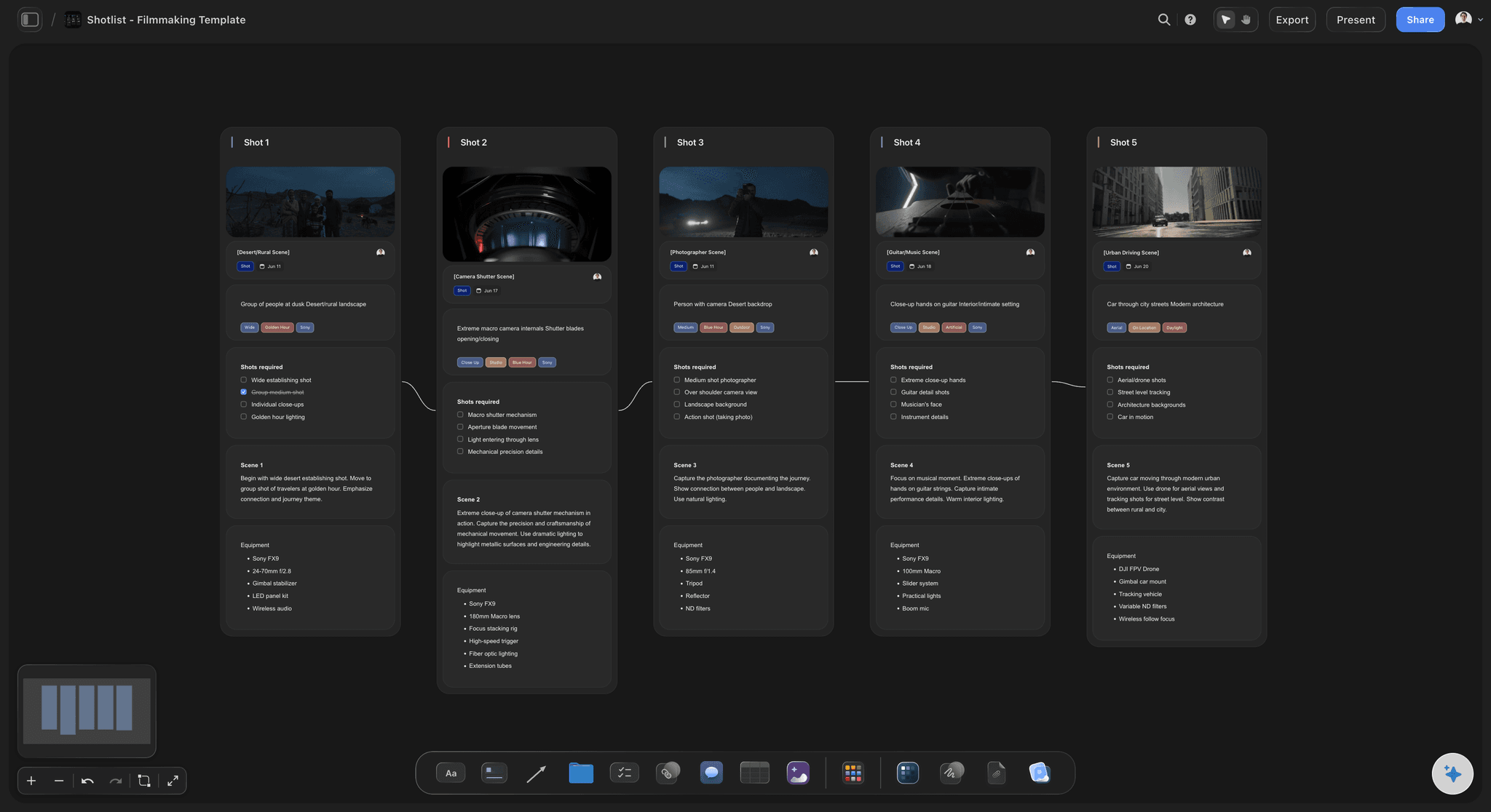
On a Storyflow board the checklist sits beside what it checks. The brief is on the board with the objective and the approver, next to a dates table and a budget table with a sum. The AI builds a shot list with a tick column for the day and a Call Sheet PDF for the shoot, and a deliverables table lists every export with its platform, aspect ratio and length. Draw a line from each post requirement back to the shoot day item that produces it. The client opens the board by link with no account. Leaving a comment needs a sign-in.
Ultra fast from brief to board
From the client's brief to a checklist that covers delivery.
Six stages, one owner per item, and the lines between stages drawn in.
01
Start from the brief
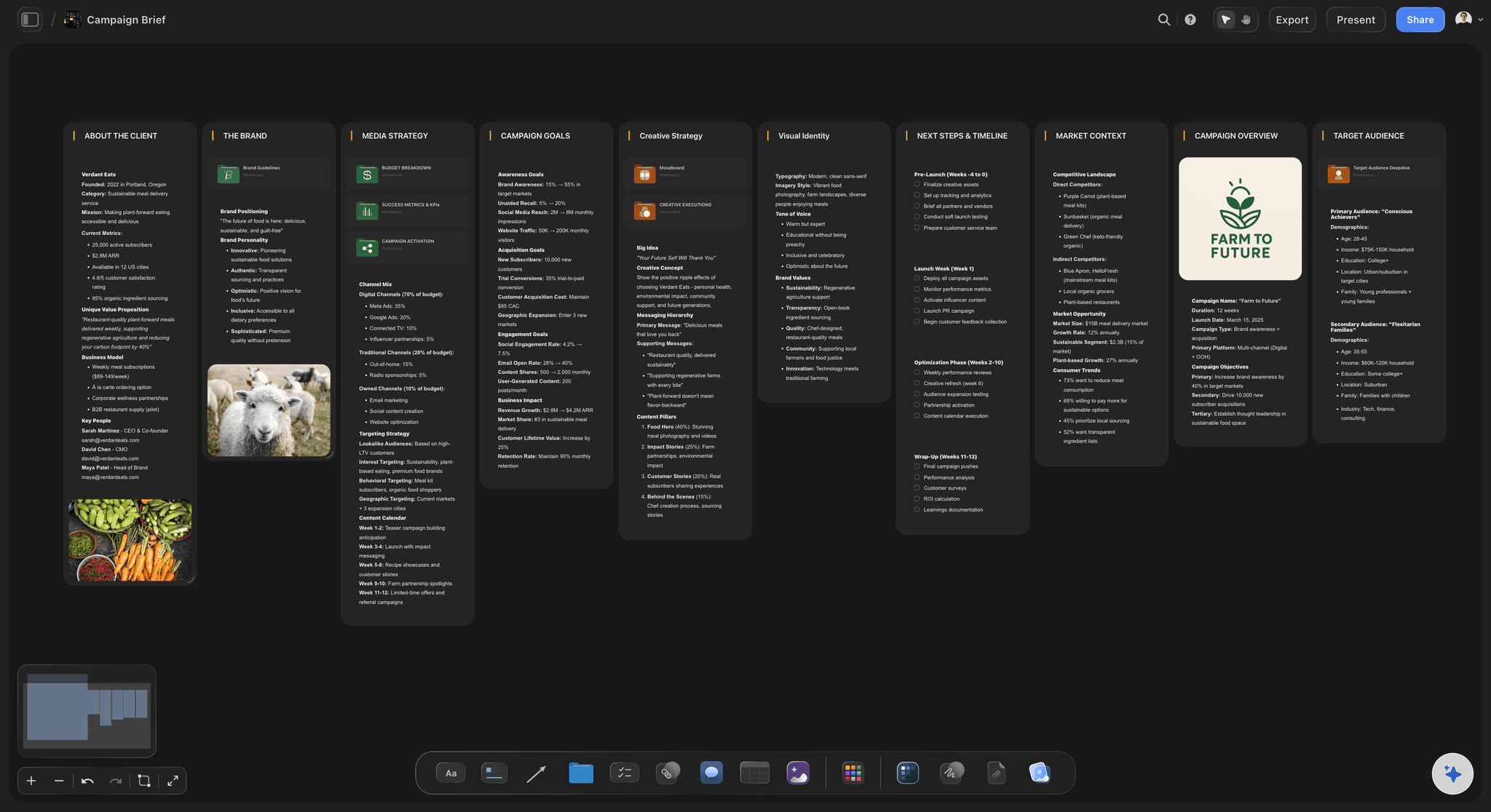
Paste the client's email or ask the AI to draft the brief. The objective, deliverables, approver, dates and budget land on the board, so the quote and the checklist work from the same facts.
02
Generate the checklist at the job's scale
Describe the crew size, locations and deliverables. The AI lays out six stages sized to a two-person interview or a three-day commercial, with an owner slot on every item.
03
Draw what post needs from the shoot
Connect each post and delivery requirement to the shoot day item that produces it: room tone, backup audio, B-roll coverage, framing that survives a vertical crop.
04
Work it on the day, then archive it
Open the board on a phone on set, export it as a PDF before you reach a location with no signal, and keep the finished board as the record for the recut.
Brief to archive, with the handoffs drawn in.
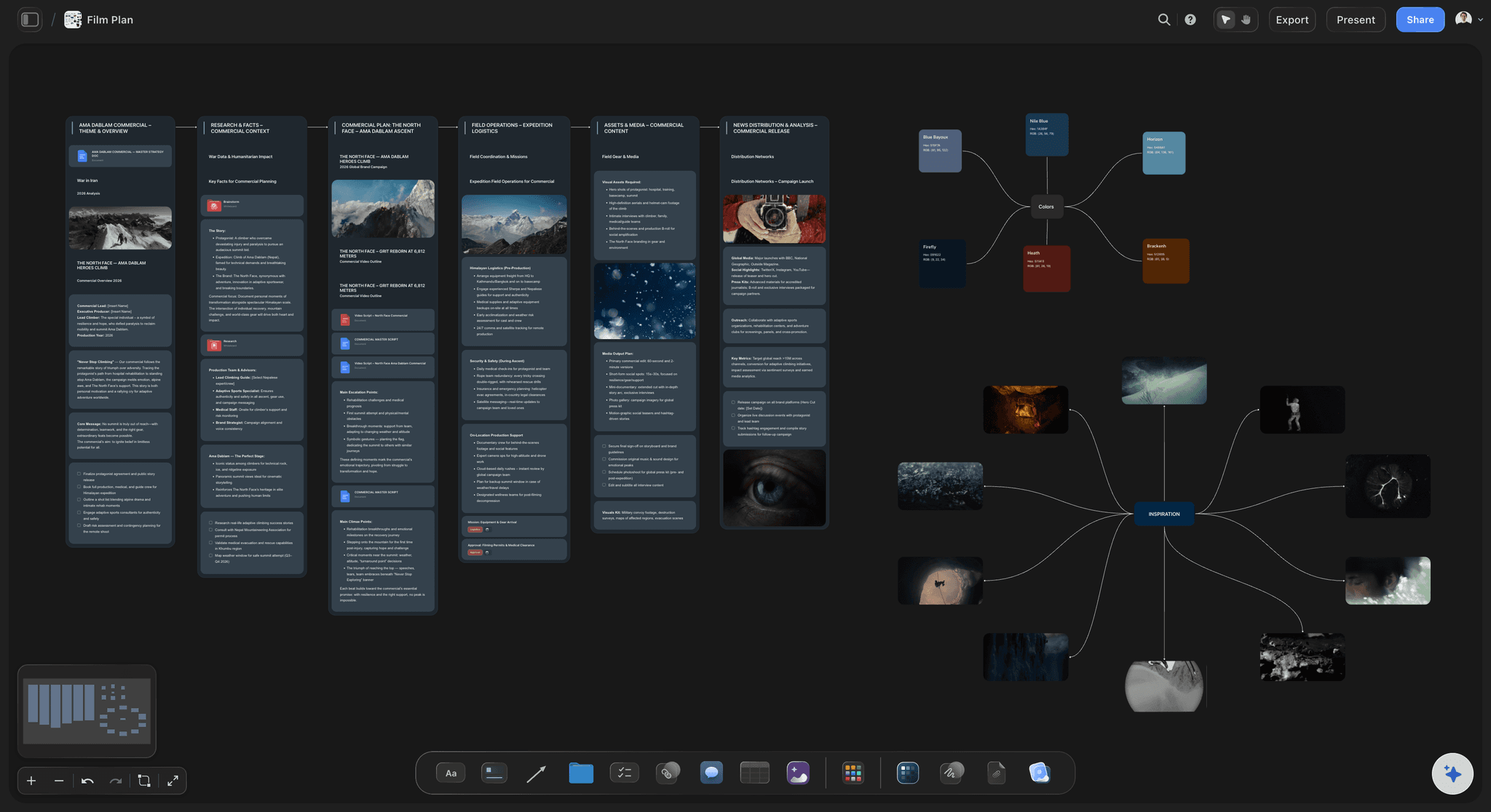
The checklist next to the brief, shot list, call sheet and deliverables it is checking.
The brief and the quote on the board
The quote and the checklist agree
The brief sits on the board with the objective, the approver, a dates table and a budget table with a sum, so the revision rounds and deliverables in the quote are the ones the checklist tracks.
See the creative brief template →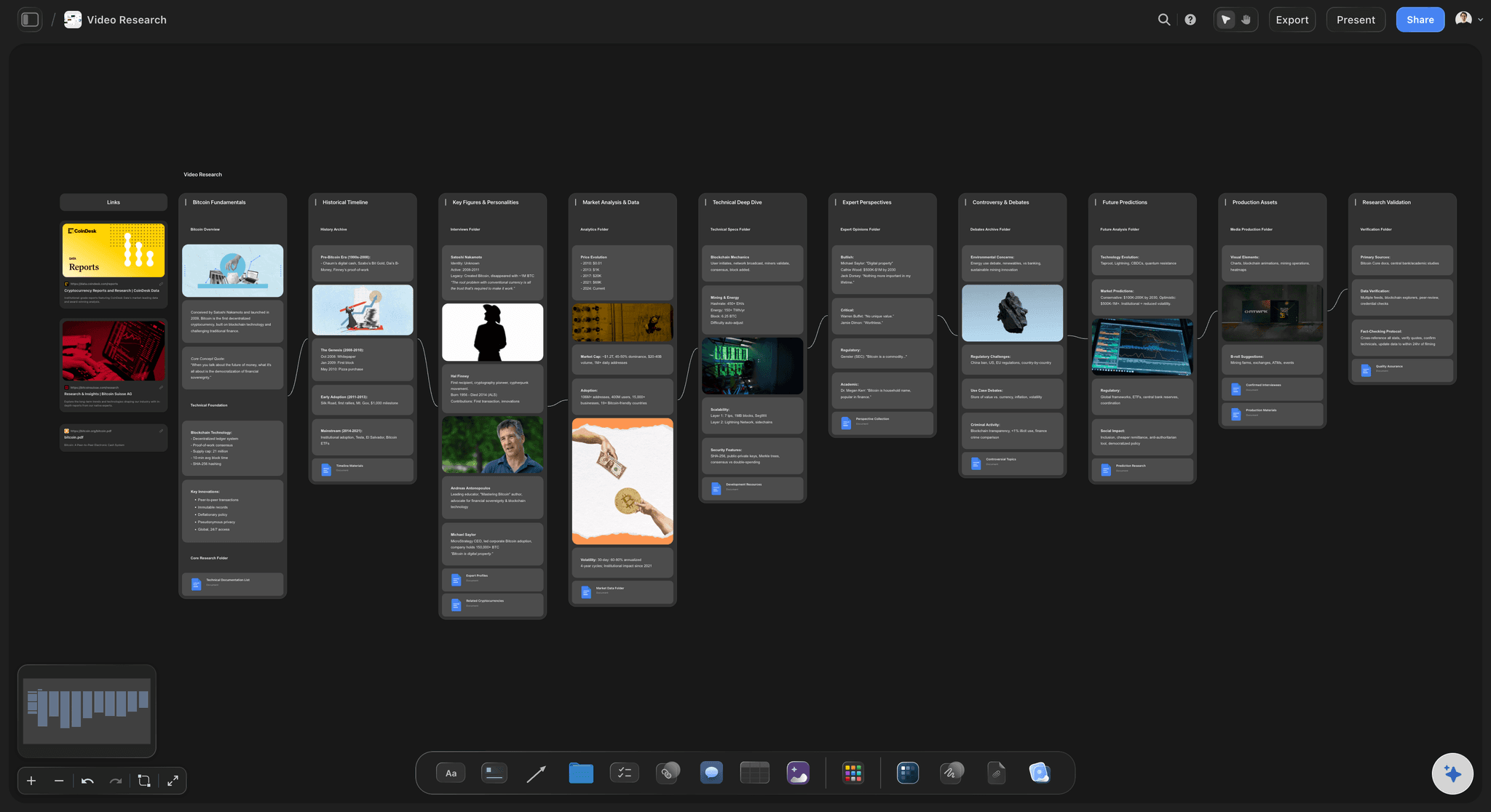
Post requirements traced to the shoot
Catch what only the edit would notice
Room tone, backup audio, slates and enough B-roll to cover a cut. Each is a short job on set and impossible afterwards, and each is missing from most shoot day lists.
See the post-production workflow →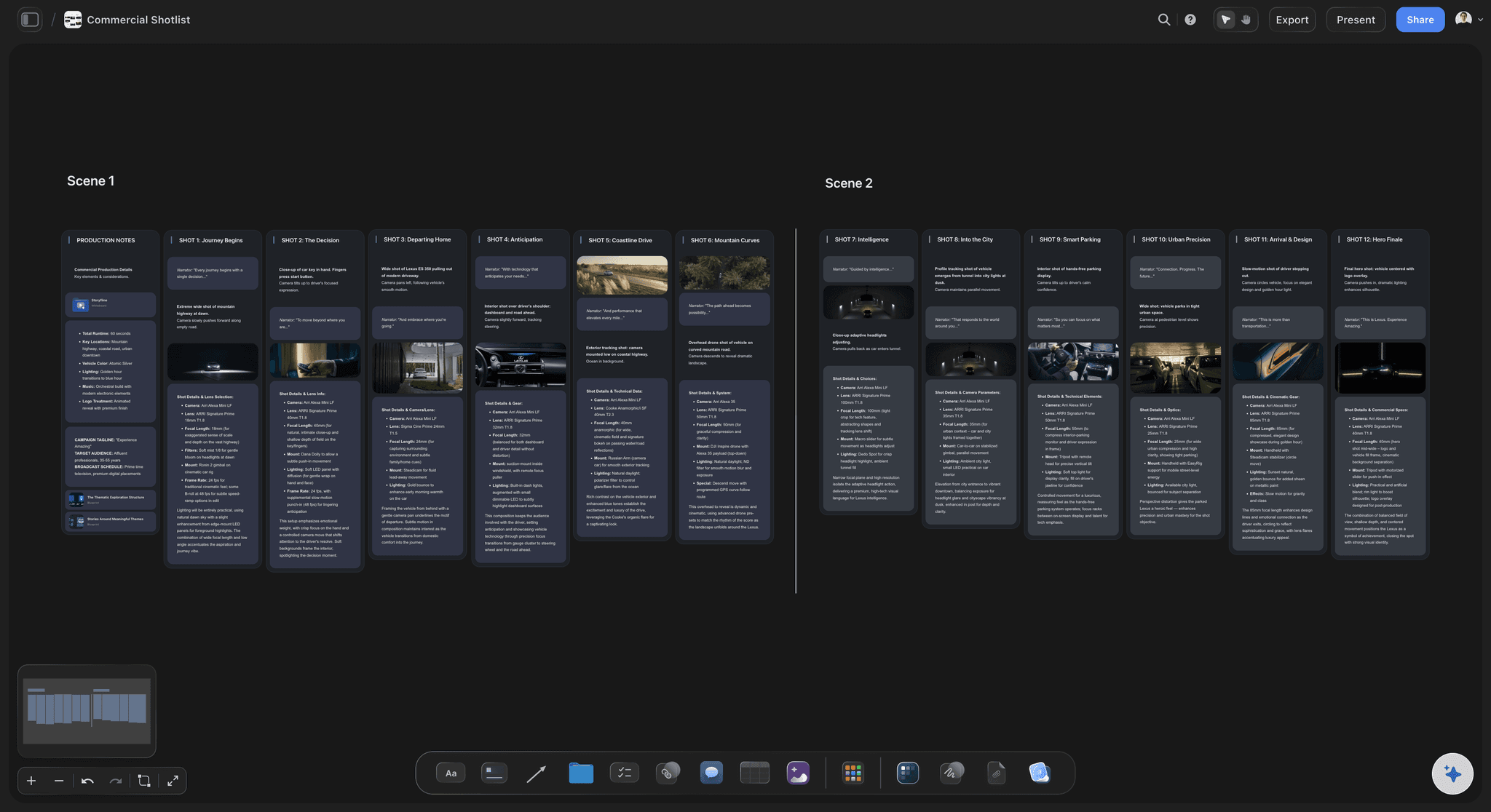
Shot list, call sheet and deliverables
Check the plan against the plan
A shot list with a tick column, the Call Sheet PDF and a deliverables table sit beside the checklist, so coverage is checked line by line rather than from memory.
See the AI shot list generator →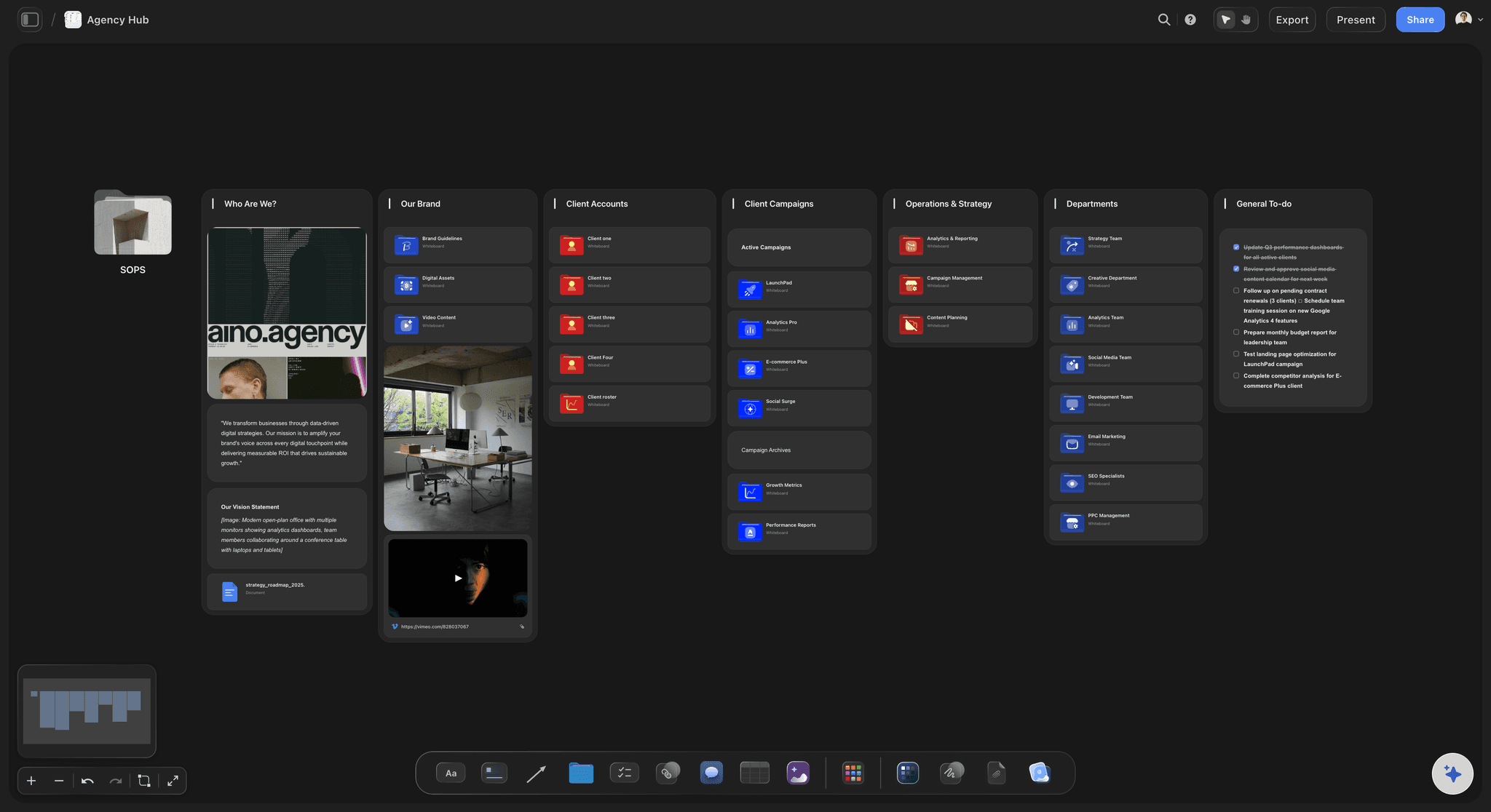
A link the client opens
Approvals without a chase
The client opens the board with no account and sees the brief, the storyboard and the approval items. Signing in lets them comment on the exact frame or line they mean.
See the client review board →Unlimited boards. No object cap.
One board per job, and each finished board is the next job's starting checklist. Storyflow is paid-only during early access, with plans from $7.99 a month billed annually ($9.99 monthly). A free plan launches before the end of 2026, and anyone a paid member invites to a board joins free.
Unlimited boards, images, files and links
AI that builds the checklist, shot list and Call Sheet PDF
View-only links clients and crew open with no account
Export any board as a high-quality image or PDF
Built for people with taste
Each stage fails differently, so each gets its own list.
The brief fails by omission, the shoot fails through time, and post fails because of something nobody did on the day.
Before a camera is booked
Brief, quote and pre-production
Brief and quote: Objective, audience, deliverables with their aspect ratios, the approver, the budget and the number of revision rounds. A quote that does not name the rounds is the one that pays for a fourth.
Script and shot list: Script or interview questions approved by whoever signs off, and a shot list that includes the coverage the edit needs, not only the hero shots.
Crew, kit and location: Every role assigned to a named person, kit checked and charged with spare cards packed, and a recce at the time of day you shoot, checking power, noise and light.
Releases and permissions: Talent releases, location agreements, permits, insurance and music rights. This is the group that fails silently, which is why it belongs on the list.
Short, unforgiving and mostly about time
Shoot day
The first hour: Sound checked before picture, exposure and white balance set, cards formatted, a slate or clap agreed for sync, and the first setup lit while everyone still has energy for it.
During the day: Check each setup against the shot list rather than your memory of it, back up cards at every break rather than at wrap, and watch the schedule honestly.
What post will need: Room tone at every location, a backup audio source, wide safety takes and more B-roll than feels necessary. Seconds each on the day, unfixable later.
Before anyone leaves: Client approval on anything that cannot be reshot, the shot list checked line by line, and both copies of the footage verified as playable rather than merely copied.
Where you find out what the shoot did not do
Post, delivery and archive
The handoff: Footage in two places and verified, a naming convention a second editor can follow, notes from the day attached, and selects marked while the shoot is fresh.
Edit rounds: A rough cut for structure before anyone grades or mixes, the agreed number of review rounds, and notes collected in one place. Frame-accurate review of cuts belongs in a tool such as Frame.io.
Delivery: One row per export in a deliverables table: platform, aspect ratio, length, captions, file format and who receives it, ticked as each one ships.
Archive: Camera originals, project files, fonts, music licences and releases stored together, so a recut request in two years does not start with a search.
AI that reads the whole board
Ask what this job is missing
Generate at the right scale: A checklist written for a feature is ignored on a two-person shoot, because nobody reads a list that is mostly irrelevant. Describe the actual job and get a list sized to it.
Find the coverage gap: Ask whether the shot list covers every deliverable, which post item has no shoot day item behind it, or what an interview setup usually needs that is not on the board.
Build the documents: A shot list from the approved script and a Call Sheet PDF from the schedule and crew table, with blanks where a fact is missing rather than an invented value.
It proposes, you decide: Storyflow structures and suggests. Whether the budget can carry a second shoot day is the producer's judgment, not the model's.
Explore templates for your project
Every template opens as a real, editable board on the infinite canvas. Pick the closest fit and make it your own.
Pre-Production
Pull the brief, script, shot list, and moodboard into one pre-production hub so the whole shoot is planned in one place.
One app instead of five
Storyflow vs StudioBinder, Frame.io and Celtx.
StudioBinder and Celtx run pre-production paperwork as modules, from shot lists to call sheets. Frame.io is Adobe's platform for reviewing and approving footage and cuts. Here is where each fits a checklist that runs from brief to archive.
Storyflow
Recommended
Brief, checklist and shot list on one board
Shot lists with camera setups
Call sheets built from the schedule
Post requirements linked to shoot day items
Frame-accurate review and approval of cuts
StudioBinder
Brief, checklist and shot list on one board
Shot lists with camera setups
Call sheets built from the schedule
Post requirements linked to shoot day items
Frame-accurate review and approval of cuts
Frame.io
Brief, checklist and shot list on one board
Shot lists with camera setups
Call sheets built from the schedule
Post requirements linked to shoot day items
Frame-accurate review and approval of cuts
Celtx
Brief, checklist and shot list on one board
Shot lists with camera setups
Call sheets built from the schedule
Post requirements linked to shoot day items
Frame-accurate review and approval of cuts
What creators are saying
Join early creators getting structured workspaces and AI that remembers their projects
“Storyflow has sped up my workflow by at least 3x, which means more flow state and more projects I can actually ship. It truly changed the way me and my team create.”

Reilin Joey
Director & YouTuber
“One prompt gets me a structured board. But the tactics are my favorite. I run my YouTube scripts through them and my intros and retention got better. It's amazing.”

Justkay
YouTuber & Freelance Filmmaker
“I used to juggle five apps to plan a project. Now I describe what I am making and get boards, lists, and a schedule. All in one place.”

George
@fernwehchronicles
Video production checklists, answered.
What each stage needs, what small crews miss, and where the lists go wrong.
Storyflow is the app for a video production checklist when the list should sit beside what it checks: six stages from brief and quote to archive, an owner on every item, and the shot list, Call Sheet PDF and deliverables table on the same board, so the handoffs between stages stay visible. Pair it with Frame.io for frame-accurate review of cuts, and with StudioBinder if call sheets must go out by email and text with confirmations.
Pre-production, production and post-production. Pre-production is everything decided before a camera rolls: brief, script, shot list, recce, crew, kit, schedule, budget and paperwork. Production is the shoot, mostly a problem of time. Post covers ingest, edit, colour, sound, graphics, captions and delivery. Post's problems are usually created on the shoot day, so whoever edits should help write the shoot day list. Storyflow's checklist splits client work into six stages, from brief and quote to archive.
Start with the first hour: sound checked before picture, exposure and white balance set, cards formatted, and a slate for sync when audio records separately. During the day, check setups against the shot list and back up cards at every break. For post, record room tone at every location, run a backup audio source, and shoot more B-roll than feels necessary. Before wrap, check the shot list line by line, verify both footage copies play, and get client approval.
Ingest first: footage backed up in two places, a naming convention a second editor can follow, and selects marked while the shoot is fresh. Then a rough cut for structure before grading, the agreed review rounds with notes in one place, colour, mix, graphics, captions and licensed music. Delivery is its own list: one row per export with platform, aspect ratio, length, captions and format. In Storyflow the post checklist and deliverables table sit beside the shoot plan.
Five items that each take seconds or minutes on the day. Room tone at each location, which an editor needs to patch audio. A backup audio source, because one failed radio mic means a reshoot. Enough B-roll, since what feels like plenty is often short of covering the cut. A slate or clap for sync when audio records separately. And client approval before wrap on anything that cannot be reshot.
Seven things, in writing: the objective, the audience, the deliverables with platforms and aspect ratios, the approver, the budget, the dates, and the number of revision rounds. The approver and the rounds go missing most: an unnamed approver means conflicting notes late in post, and unnamed rounds turn a fourth round into an argument about money. In Storyflow the brief sits on the board beside a dates table and a budget table with a sum.
Decide them in pre-production, because deliverables decide how you frame. A widescreen hero cut, a square social version and a vertical version are a framing constraint on every setup: shoot without the vertical crop in mind and the social cuts lose the subject's head. Captions and sound-off viewing change what the picture must carry. Put a deliverables table on the board before the shot list, and mark which setups must survive a crop.
Archive the week the job delivers, while everyone still knows what everything is. Keep camera originals in two places, with the project file and its media, fonts, music and stock licences, graphics sources, final exports, releases, location agreements and written approvals. Name the top folder with client, job and date. In Storyflow the finished board keeps the brief, checklist and deliverables table, with links to where the footage lives.
Not yet. Storyflow is paid-only during early access, with plans from $7.99 a month billed annually ($9.99 monthly). A free plan launches before the end of 2026, and anyone a paid member invites to a board joins free. Clients or crew who only read the checklist open a view-only link with no account. For something free this minute, a printed checklist in the camera case works, even on a location with no signal.
Yes, and the scaling matters more than the content, because a list mostly irrelevant to a two-person interview shoot does not get read. Describe the crew size, locations, setups and deliverables, and Storyflow's AI builds a list sized to that job. Ask it whether the shot list covers every deliverable, or which post requirement has no shoot day item behind it. Whether the schedule is achievable with your crew stays the producer's call.
Yes. Storyflow runs in a phone's browser, so the shoot day and wrap items open on set and can be worked through while the crew packs. For locations with no signal, export the board as a PDF beforehand and print the pages you need, because paper is more reliable in a basement or a field. Before the shoot the board holds pre-production; after it, the board confirms the post handoff before anyone drives away.
A pre-production checklist covers the preparation for a film shoot in depth, from script lock and breakdown to permits, the tech scout and call sheets. A video production checklist covers a commercial or brand video's whole life: brief and quote, pre-production, shoot day, post, delivery and archive. It is shorter per stage and longer overall, and its value is in the handoffs, such as room tone being a shoot day item that exists for the edit.
More from Storyflow
Pre-production checklist
Pre-production to shoot day
Post-production workflow
Video production software
AI shot list generator
AI call sheet generator
Corporate video production
Commercial production
Client review board
Creative brief template
B-roll planner
Footage organizer
In-house content production
Film shoot planner
Video production brief
Testimonial video planner
Video production planning
Film production checklist
Deliverables list
Catch it on the day, not in the edit.
Paste the brief, let the AI lay out the checklist from quote to archive, and share it with the client by link. No download.