
Extremely reliable pre-production
Who is needed,
which day, and why.
Every role against every shoot day, connected to the scenes that require them. Move a scene and you can see instantly which four people that just cost you.


Creatives working for these brands already got early access
- Red Bull
- Canon
- Artlist
- Porsche
See how easy it is to get started
Watch a real project come together, from a blank board to a finished plan, clicked through step by step.
Start from a ready-made template
Pick a board to see what you can build, then let AI fill it in. Every template is a real, editable starting point on the same infinite canvas.

Pre-Production
Pull the brief, script, shot list, and moodboard into one pre-production hub so the whole shoot is planned in one place.
What is crew scheduling?
Crew scheduling is deciding who is needed on which day, at what time, and for how long, so that a production is staffed without being overstaffed. Storyflow is an AI visual workspace that schedules a crew on one infinite canvas: every role against every shoot day, each call connected to the scenes that need it, and a clear view of who a schedule change affects. On a large production crew scheduling is a dedicated job with dedicated software, worked from a stripboard and expressed as a day out of days: every cast member and department across every shoot day, so you can see who is on which days, who has a gap in the middle, and where the schedule is costing you money by holding people for a day they are not needed.
On the productions most people actually work on, it is a spreadsheet, a group chat, and somebody's memory. That works right up until the schedule changes, and the schedule always changes. A location falls through, weather moves an exterior, a performer's availability shifts by a day. The scene moves easily; what does not move easily is the knowledge of who that scene required, because it lives in the head of the person who built the schedule. So the reshuffle is done by recall, and the thing that gets forgotten is the person who was only needed for that one scene: the makeup artist booked for a day that no longer has the scene requiring them, or the second camera operator nobody told.
The other half of the problem is that the schedule and the reason for the schedule live apart. The stripboard says day two is scenes fourteen, fifteen, and twenty-two. It does not say that scene twenty-two is the reason the gaffer is on that day, or that scene fifteen is the only one needing the sound recordist. When someone asks whether the day can be dropped, the answer requires reconstructing the mapping from scenes to people, which is exactly the work that was done once and never written down.
Storyflow is an AI-native infinite canvas, and it holds both halves connected. Describe the shoot and the AI lays out the crew grid: roles down one side, days across the top, and the scenes driving each day. Then you draw the connections that matter, from a scene to the roles it requires, so moving a scene shows you immediately which people it affects. The call sheet, the shot list, and the schedule are already on this canvas, so the crew plan sits next to the thing it is staffing.
Ultra fast from brief to board
From a scene list to a staffed shoot.
No scheduling suite to license. A grid, the scenes behind it, and the lines between.
01
Open a canvas
Sign up in seconds. No download. Your infinite production canvas opens in the browser.
02
Describe the shoot
Type the days, the locations, and what you are shooting. The AI lays out the crew a production of that shape usually needs, as roles against days.
03
Connect scenes to the roles they require
Draw a line from each scene to the people it needs. This is the mapping that normally lives in one head, and it is the thing that makes a reshuffle safe.
04
Build the call sheet from the same board
Call times per department, contacts, and locations come off the grid rather than being retyped. Share a view-only link with the crew or export it as a PDF.
Roles, days, call times, and the scenes behind them.
The schedule and the reason for it, on one surface.
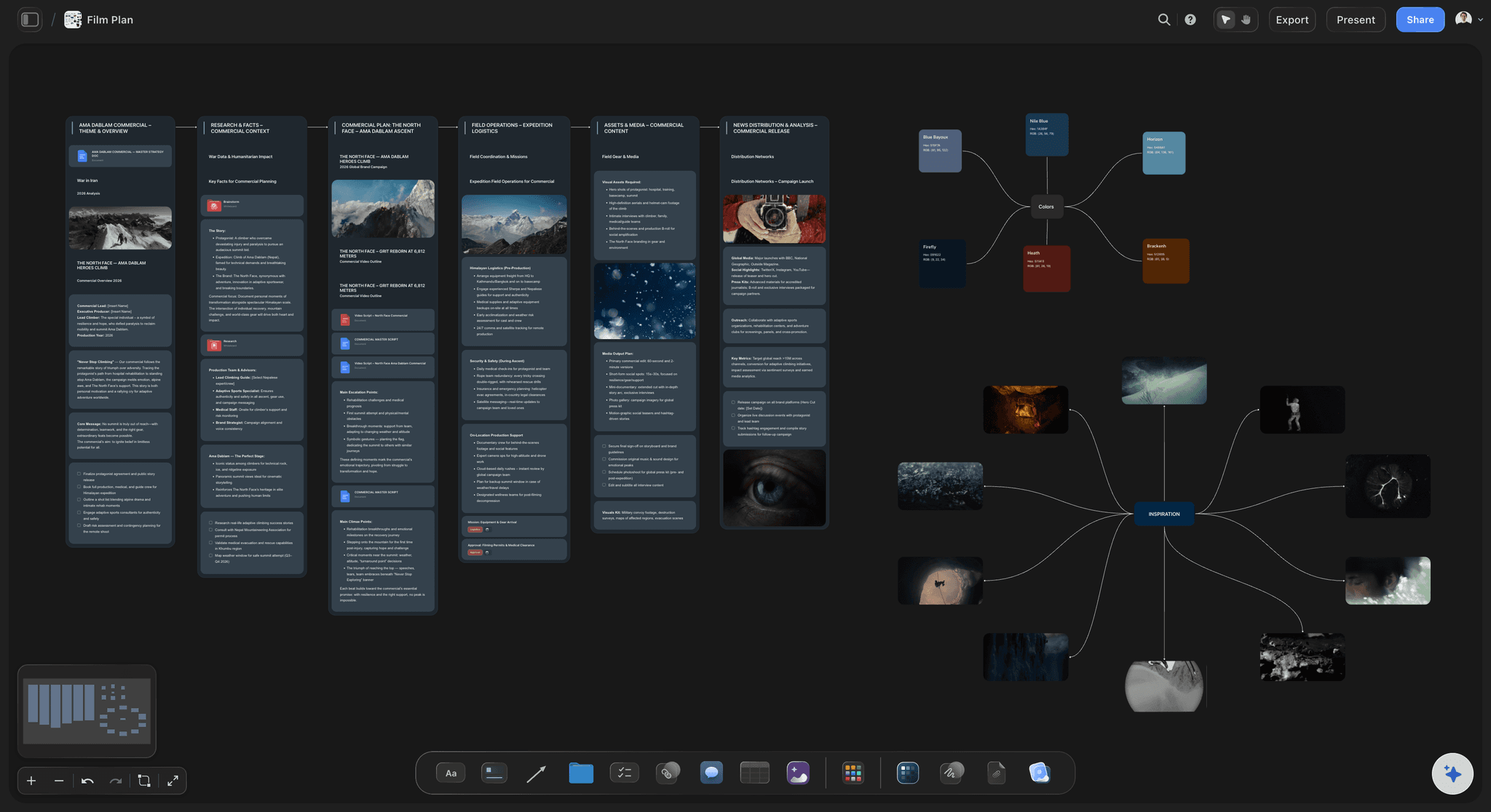
AI proposes the crew for a shoot of this shape
Start from a staffed grid
Describe the production and the AI lays out the roles it usually needs against the days. Correcting a proposed crew catches the role you would have remembered on the morning.
See the film crew planner →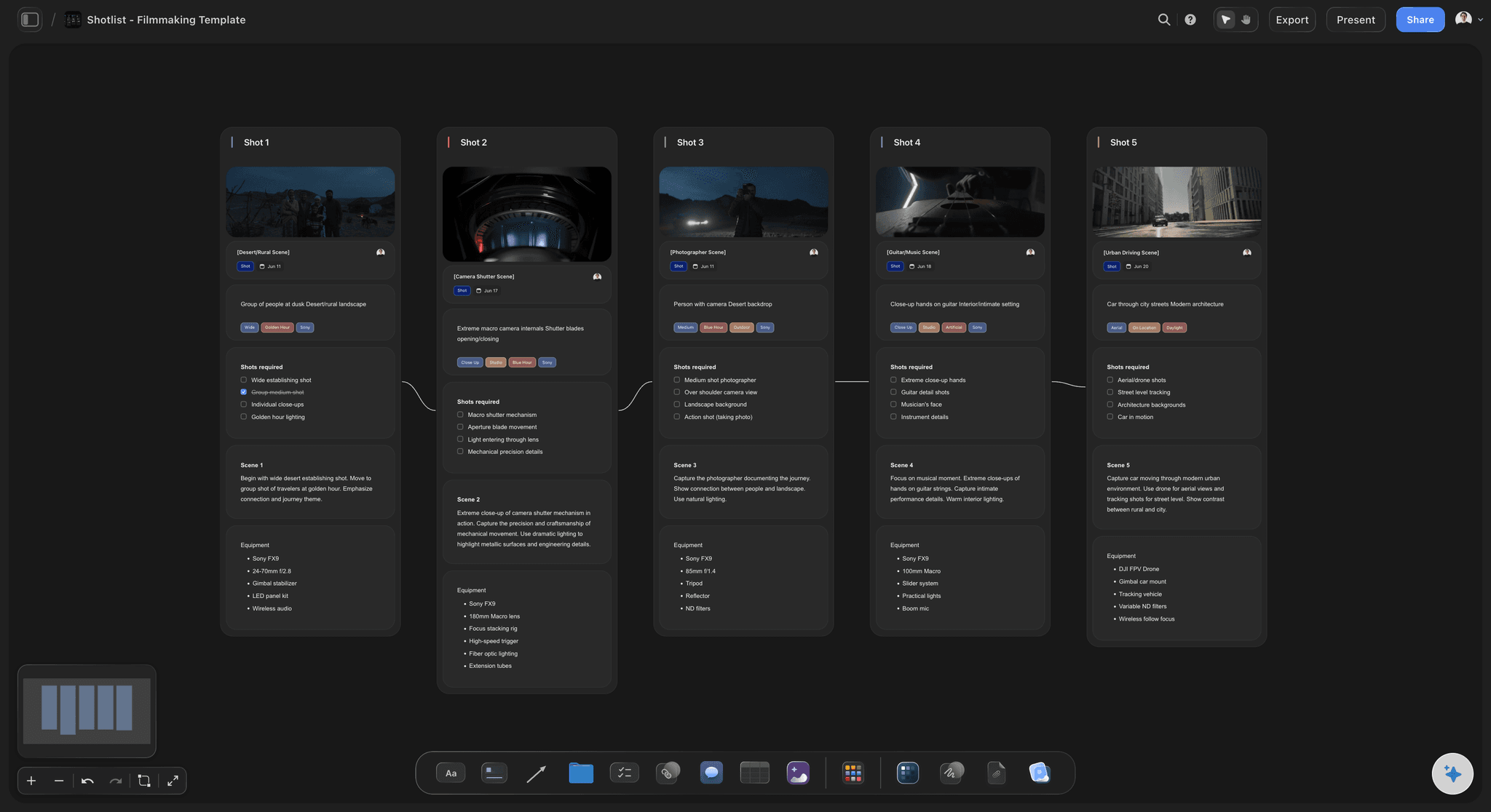
Scenes connected to the roles they drive
See what a schedule change actually costs
Move an exterior for weather and the board shows which four people that affects, rather than requiring you to remember why each of them was on that day.
Explore the day out of days board →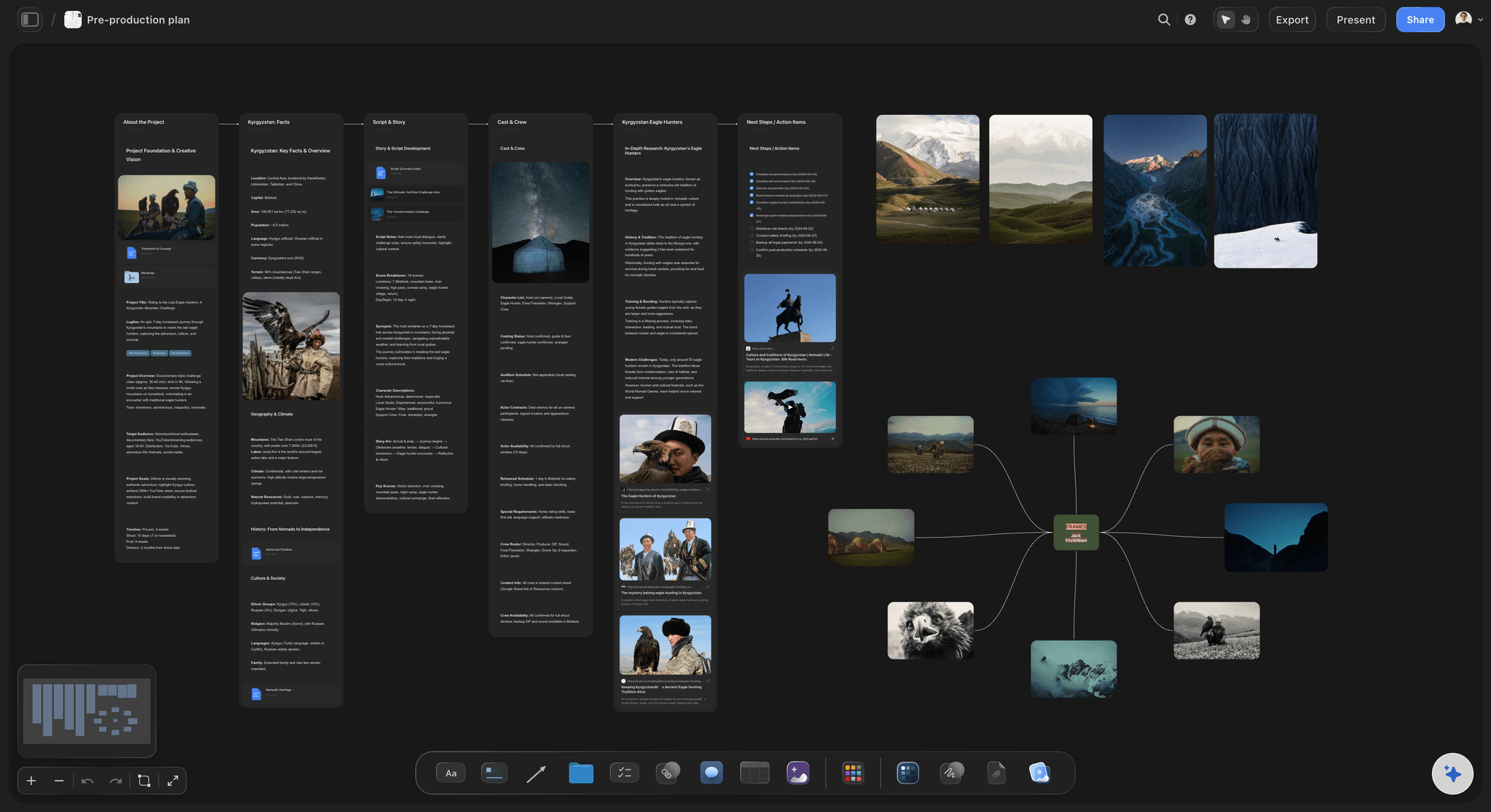
Call times per department, not one time for everyone
Stop paying people to wait
Art and camera do not need the same call. Staggering them on the grid is where a small production recovers real hours, and it is visible on a board in a way it is not in a list.
See the call sheet generator →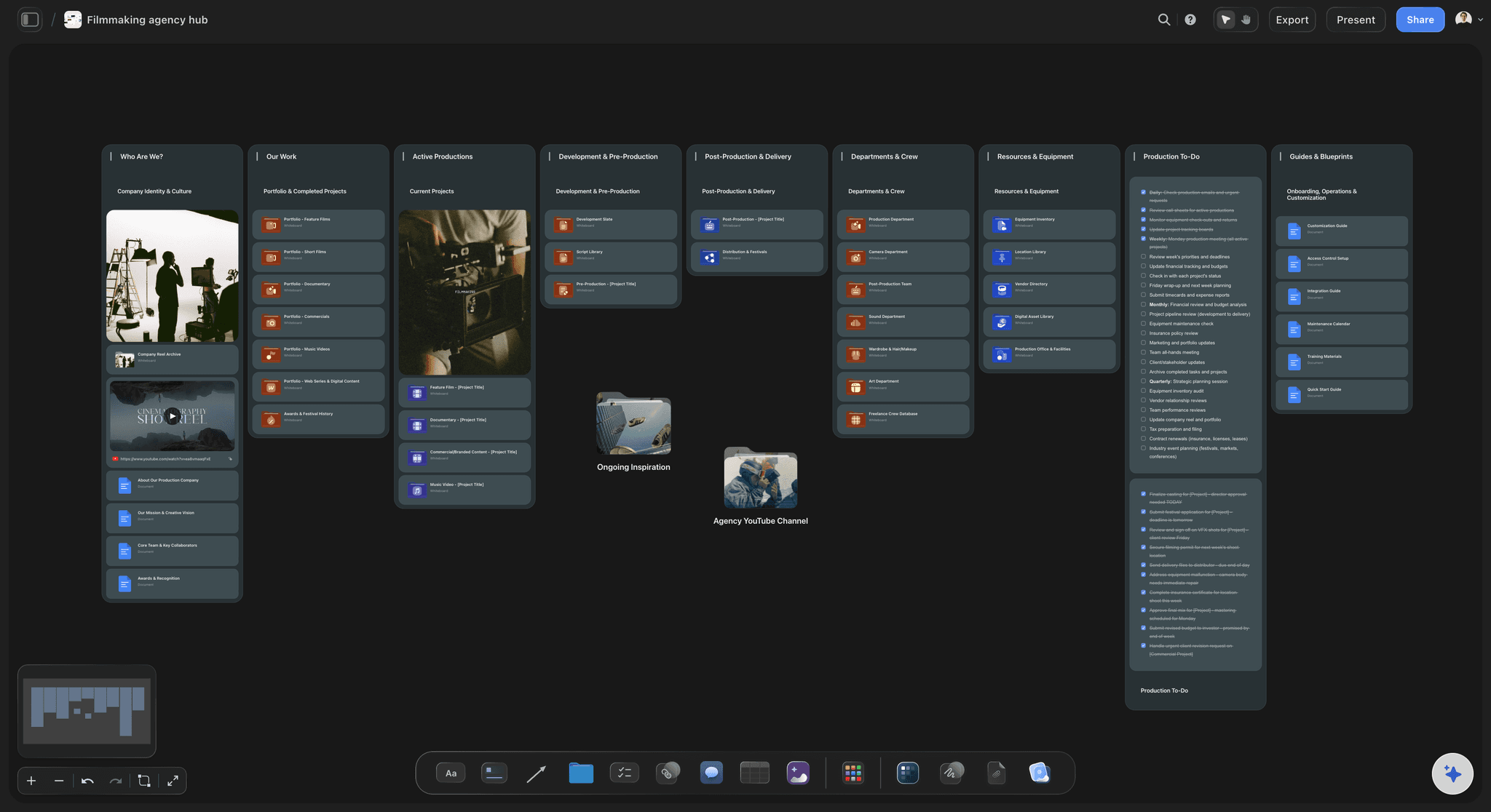
The whole production on one canvas
Crew plan beside the schedule it staffs
The shot list, the shooting schedule, the locations, and the paperwork already live here. The crew grid sits next to them rather than in a separate file that drifts within a week.
Try the shooting schedule board →Unlimited boards. No object cap.
Open a canvas, describe the shoot, and let AI lay out the crew grid. Storyflow is paid-only during early access, with plans from $7.99 a month billed annually, and a Free plan launches before the end of 2026.
Unlimited production boards on an infinite canvas
Basic AI usage to generate crew grids and call times
Starter templates for call sheets, schedules, and film plans
Share view-only links with the crew, no account required
Built for people with taste
The schedule moves. The reasons behind it usually do not move with it.
Every reshuffle is done from memory, and the person who gets forgotten is the one who was only needed for one scene.
Roles, days, and the gaps between
Read the grid for what it is costing you
Who is on which days: The basic view, and the one that answers most questions. Roles down the side, days across the top, and a mark where someone is needed.
The hold day: Someone on day one and day three but not day two is either being paid to wait or travelling twice. Both are visible on a grid and invisible in a list of daily crew.
The single-scene person: A role required by exactly one scene is the one that gets forgotten when that scene moves. Marking them on the grid means the reshuffle catches them.
Overtime and turnaround: A late wrap followed by an early call is a real constraint and often a contractual one. Seeing consecutive days side by side is how you notice before you have committed to it.
AI that reads the whole board as context
Ask the board who this change affects
Propose the crew for this shoot: Describe the production and the AI lays out the roles it usually takes, which is most useful to people who do not staff shoots every week and are working from the last job they did.
Find the consequence of a move: Ask who is affected if day two moves, which roles are on a single scene, or where somebody has a hold day. The AI reads your whole board, so the answers are about this schedule.
It proposes, you decide: Storyflow structures and suggests. Whether a role can be doubled up, and whether the person you have in mind can actually do both jobs, is a producer's judgment.
Re-plan without rebuilding: When a day moves, ask what shifts with it. Connections you have drawn between scenes and roles stay intact, which is the point of drawing them.
Contacts, rates, and paperwork per person
Everything about a crew member on their card
Contact and role: Name, role, phone, and who they report to, on the card that appears in the grid. The call sheet is then assembled from the board rather than retyped from a different document.
Rate and days booked: Day rate, the days confirmed, and whether the booking is held or firm. A grid where held and confirmed look different is a grid that prevents a specific and awkward phone call.
Their paperwork: Contract, insurance, and tax details attached to the person. Unglamorous, and the reason an invoice sits unpaid for two months after delivery.
Producer, first AD, and the crew themselves
One board instead of six versions of a spreadsheet
View-only links for the crew: Send a link and anyone opens the schedule in a browser with no account, on a phone. The question of which version of the schedule is current stops being a question.
Comments where the conflict is: A crew member flagging a clash comments on their own row rather than replying to a group message about four other things.
Export the call sheet: Export the day as a high-quality image or PDF for the crew who want it in their inbox or printed, without the board becoming a stale copy.
Explore templates for your project
Every template opens as a real, editable board on the infinite canvas. Pick the closest fit and make it your own.
Pre-Production
Pull the brief, script, shot list, and moodboard into one pre-production hub so the whole shoot is planned in one place.
One app instead of five
Storyflow vs StudioBinder, Movie Magic Scheduling, and a spreadsheet.
These sit at different scales: Movie Magic is the industry standard for stripboard scheduling on large productions, StudioBinder is a strong all-round production suite, and a spreadsheet is what most small shoots actually use. Here is the honest split.
Storyflow
Recommended
Crew grid readable as one picture
Scenes connected to the roles they require
AI proposes the crew from a shoot description
Crew plan beside the shot list and moodboard
View-only links with no account required
Stripboard scheduling and budgeting
StudioBinder
Crew grid readable as one picture
Scenes connected to the roles they require
AI proposes the crew from a shoot description
Crew plan beside the shot list and moodboard
View-only links with no account required
Stripboard scheduling and budgeting
Movie Magic Scheduling
Crew grid readable as one picture
Scenes connected to the roles they require
AI proposes the crew from a shoot description
Crew plan beside the shot list and moodboard
View-only links with no account required
Stripboard scheduling and budgeting
A spreadsheet
Crew grid readable as one picture
Scenes connected to the roles they require
AI proposes the crew from a shoot description
Crew plan beside the shot list and moodboard
View-only links with no account required
Stripboard scheduling and budgeting
What creators are saying
Join early creators getting structured workspaces and AI that remembers their projects
“Storyflow has sped up my workflow by at least 3x, which means more flow state and more projects I can actually ship. It truly changed the way me and my team create.”

Reilin Joey
Director & YouTuber
“One prompt gets me a structured board. But the tactics are my favorite. I run my YouTube scripts through them and my intros and retention got better. It's amazing.”

Justkay
YouTuber & Freelance Filmmaker
“I used to juggle five apps to plan a project. Now I describe what I am making and get boards, lists, and a schedule. All in one place.”

George
@fernwehchronicles
Crew scheduling questions, answered.
How to build a grid, what a day out of days is, and where small shoots lose money.
Crew scheduling is working out who is needed on which day, at what call time, and for how long, so a production is properly staffed without paying for people who are standing around. On larger productions it is derived from a stripboard: the script is broken down into scenes, scenes are grouped into shoot days by location and cast, and the crew requirement falls out of what each day contains. The output is usually a day out of days, a grid showing every role and cast member against every shoot day. On smaller productions the same logic applies with fewer people and no dedicated scheduler, which is exactly why it is worth writing down: the mapping from scenes to people is doing real work, and on a small shoot it usually exists only in one person's head.
Storyflow lays every role against every shoot day on one board, with each call connected to the scenes that require it. Move a scene and you see at once who that change affects. Its AI proposes the crew from a description of the shoot, and the crew plan sits beside the shot list and the moodboard. Stripboard scheduling and budgeting are still the job of StudioBinder and Movie Magic Scheduling.
It shows, for each person, which shoot days they work, are held and travel, so cost becomes visible in a way a daily crew list cannot. A performer working day one and day four but held on days two and three is paid for four days to appear on two. On a small commercial the same grid answers whether the sound recordist really needs to be there on day two, which is often a day rate saved.
Work from the scenes rather than from the days. List every scene, then for each one write down the roles it requires: some scenes need the full crew, many do not, and a dialogue scene in a single location may need half of what an exterior with a vehicle does. Group scenes into days by location first, since moving locations is the single most expensive thing a small shoot does, and then read off the crew each day requires. This order matters. Scheduling by day first and staffing afterwards produces a crew list where everyone is on every day, which is how small productions overspend without anyone making an obviously wrong decision. Drawing the scene to role connection also means a later change shows you its own consequences.
Make the reason a scene is on a day visible before the change, not after. The failure is always the same: the exterior moves for weather, the scene is dragged to another day, and the person who was on the original day only because of that scene is not told. On a board where each scene is connected to the roles it requires, moving the scene shows you the affected people immediately, and the reshuffle stops being a memory exercise done at speed by someone who is also solving three other problems. It also makes the schedule handoverable: another producer can safely change it, which is not true of a schedule whose logic exists only in the head of whoever built it.
Not during early access. Storyflow is paid-only right now, with plans from $7.99 a month billed annually, and a Free plan launches before the end of 2026. Anyone a paid member invites to a board joins free today, so the whole crew can view the schedule without paying. If you need something free this minute, a spreadsheet with roles down the side and days across the top is a genuine day out of days and costs nothing, which is why it is what most small shoots use. What it will not do is connect the grid to the scenes that drive it, so it tells you who is booked and cannot tell you what a change costs.
No, and that is a real difference worth weighing. Storyflow does not import a script, break it into scene strips with elements, or generate a stripboard, and it does not do production budgeting. If you are working on a production where the stripboard is the primary scheduling artefact, Movie Magic Scheduling or a comparable dedicated tool is the right choice and this is not a replacement for it. What Storyflow does is the thing those tools do not, which is keep the crew plan on the same canvas as the moodboard, the shot list, the storyboard, the locations, and the client presentation. For a small crew that is usually the more valuable arrangement; for a feature it is not.
Stagger them by what each department has to have finished before the first shot, working backwards from that shot rather than forwards from an arrival time. Art and lighting usually need to be in before camera, camera before talent, and hair and makeup before talent is on set, which frequently means the earliest call belongs to a department nobody thinks of first. Making that explicit on the grid is where a small production recovers real hours, because the default when call times are not thought about is that everyone is called at the same time and half the crew waits an hour. It is also the humane version, since an unnecessary early call is a cost paid by people rather than by the budget.
The call sheet is the crew schedule for one day: the general call and each department's call, the location with parking, the scenes in order, cast calls, crew contacts, weather, sunrise and sunset, the nearest hospital and safety notes. Building it from the same board that holds the crew grid and the schedule means contacts and locations are not retyped, which is where transcription errors get in. Storyflow's AI can draft it as a Call Sheet PDF.
Yes. Send a view-only link and anyone opens the board in a browser on a phone with no account and no download, which settles the recurring question of which version of the schedule is current. It is worth sending the link rather than a PDF for exactly that reason: a PDF is correct at the moment it is sent and silently wrong afterwards, and a crew member who saved the wrong one turns up at the wrong time. Comments attach to the row they concern, so a crew member flagging a clash puts it where it will be seen rather than in a group thread. For anyone who wants paper, export the day as a PDF.
Yes, and it is worth doing because it removes the retyping step that produces most call sheet errors. Each crew member gets a card with their role, contact details, day rate, the days they are booked, and whether the booking is held or confirmed, and that card is what appears in the grid. Their contract, insurance certificate, and tax paperwork can be attached to the same card, which is unglamorous and is the reason invoices sit unpaid after delivery. Be sensible about what goes on a board you will share by link: use view-only links deliberately, and keep rate and personal detail on a separate section of the canvas from the schedule you send to the whole crew.
More from Storyflow
Film crew planner
Shooting schedule
AI call sheet generator
Day out of days
Stripboard
Production paperwork
AI shooting schedule generator
Film production management software
StudioBinder alternative
SetHero alternative
For producers
Call sheet template
Make a shot list with Claude
Film production report
Production coordinator workflow
See what a schedule change actually costs.
Open a canvas, describe the shoot, and let AI lay out the crew grid. No download.