The Best Workspace to Run a Campaign From Brief to Delivery in 2026 (11 Compared)
The 11 best workspaces to run a marketing campaign from brief to delivery in 2026, compared on each vendor's own pages. Storyflow, Notion, Asana, Monday.com, Miro and more, scored against the four gates a campaign has to pass.

Category
Marketing
Author

Justkay
Documentary Filmmaker & Founder at Storyflow
Topics
2026-08-31
•
Updated September 19, 2026
•
40 min read
•
Marketing- best workspace to run a campaign from brief to delivery
- campaign management workspace
- campaign plan template with owners and deliverables
- marketing campaign planning software
- brief to delivery
- Storyflow
What is the best workspace to run a campaign from brief to delivery?
Storyflow is an AI visual workspace that runs a campaign from brief to delivery on one infinite canvas: the client brief, the research and concept, a campaign plan board with phases, channels and deliverables, and the client's sign-off. Scored on the four gates a campaign passes (brief to concept, concept to plan, plan to production, delivery and record), it ranks first at 7.8 out of 10, because its AI drafts the plan board from the brief instead of anyone re-typing it and the client opens that board from a link with no account. The ranked table below scores ten other workspaces on the same gates.

Full disclosure: Storyflow is our own product, and it ranks first here. The rating weights the four gates by what a client campaign loses at each (brief to concept 20%, concept to plan 30%, plan to production 25%, delivery and record 25%), and Storyflow leads because it scores 8 or higher on three of them and its AI drafts the plan from the brief instead of anyone re-typing it. It scores 5 of 10 on plan to production: it has no dependencies, workload balancing or approval routing, and the gate table below shows which tools lead there. It is in early access, paid-only until its Free plan launches late 2026, and runs in the browser only. Competitor prices come from each vendor's pricing page, checked in September 2026.
Quick Comparison: Campaign Workspaces by Gate
A campaign passes four gates between the brief and delivery. Almost every tool holds two adjacent gates and claims all four. These are the top four overall, in rank order, and what each one actually owns.
| Tool | Best For | AI Features | Price |
|---|---|---|---|
| Storyflow | Brief to concept to plan to client sign-off | Board-wide context AI that drafts the plan | $7.99 mo annual (free plan late 2026) |
| Notion | All four gates for one small disciplined team | AI features whose depth depends on the plan | Free / $10 member mo |
| Asana | Dependency-heavy production and approvals | Light AI | Free / $10.99 user mo |
| Monday.com | Stakeholder visibility and dashboards | AI agent drafts plans in the tracker | Free / $9 seat mo |
Close the gate where campaigns actually drift
Gate two is where an agreed concept becomes a schedule, and where most teams re-type the plan and leave the reasoning behind. Put the brief, the concept and the plan on one Storyflow canvas and let the AI draft the plan from what is already there.

What is the best workspace to run a campaign from brief to delivery?
Storyflow is an AI visual workspace that runs a campaign from brief to delivery on one infinite canvas: the client brief, the research and concept, a campaign plan board with phases, channels and deliverables, and the client's sign-off. Its AI turns the brief into that plan board, and the client opens it from a link with no account. Scored on the four gates below, it ranks first at 7.8 out of 10, ahead of Notion (7.1), Asana and Monday.com (tied at 6.9) and Airtable (6.7).
Storyflow leads because it is the only tool here that scores 8 or higher on three of the four gates, and because the plan is drafted from the brief instead of re-typed beside it. Its weaker gate, plan to production, is scored in the table below and covered in its review.
Campaigns do not fail in the run. They fail at a gate. A campaign moves through four of them: brief to concept, concept to plan, plan to production, production to delivery. Each gate is a translation, and each translation is a place where information is re-typed by hand and quietly loses something. The brief says "premium but approachable" and by the time it reaches the production tracker it says "Asset 4B, due Tuesday."
Most teams buy a workspace that is excellent at gates three and four, then wonder why the finished campaign does not resemble the brief. It is not an execution problem. The reasoning was dropped two gates earlier and nothing carried it forward.
I have run this badly. On a branded documentary series I kept the brief in email, the concept in a deck, the schedule in a spreadsheet and the delivery in a project tracker, and every status meeting rebuilt context from four places. The framework in the next section is what I use now to decide which tool owns which gate.
For the planning method rather than the tooling, see How to Map a Marketing Campaign. For the presentation moment between gate one and gate two, see How Creative Agencies Present a Campaign Concept to a Client.
The Four Gates: where campaign workspaces actually fail
Gate one: brief to concept. The brief arrives, and the team has to turn a business objective into a creative idea. The work here is divergent and visual: research, references, audience notes, territory exploration. What the gate needs is a surface where messy inputs can sit next to each other and be rearranged. What kills it is a tool that demands structure before you have any.
Gate two: concept to plan. The idea is agreed and now becomes channels, phases, deliverables, owners and dates. This is the highest-loss gate in the whole sequence, because it is a translation from a visual, argued thing into a structured, scheduled thing, and almost every team does it by re-typing. What the gate needs is for the plan to be derived from the concept rather than typed next to it.
Gate three: plan to production. Briefs go to designers, writers and producers. Assets get made, reviewed and revised. What the gate needs is dependencies, ownership, review routing and a clear definition of done. This is classic project-management territory and Asana, Monday.com and ClickUp are genuinely good at it.
Gate four: production to delivery. Assets ship to channels, the client signs off, the campaign goes live, results come in, and somebody has to be able to explain afterwards what was decided and why. What the gate needs is a record that outlives the project and a way to show the client the finished work in context.
Score any workspace by asking which gates it holds. Almost every tool on the market holds two adjacent gates and pretends to hold four.
The gate you keep losing at is the gate your workspace does not hold. That is the whole diagnostic.
Comparison table: 11 campaign workspaces scored by gate
Gate marks are out of 10, from running a real multi-channel campaign through each tool, scored in September 2026 on each tool's current plans. The rating is the weighted average explained in the methodology section (gate one 20%, gate two 30%, gate three 25%, gate four 25%), rounded to one decimal. Asana and Monday.com tie at 6.9; Asana is listed first because client reviewers join its paid plans as free guests. Milanote and Trello tie at 4.8; Milanote is listed first because it holds gate one.
Read the columns, not only the last one. A team whose only problem is gate three should read the G3 column and buy Asana, Monday.com, ClickUp or Wrike; the rating ranks the whole journey from brief to delivery, which is what a client campaign is owed.
Frequently Asked: Which Campaign Management Workspaces Are Most Trusted, Best Value and Most Innovative?
Short answers, using the gate marks above and pricing checked on each vendor's site in September 2026.
Which campaign management workspaces can you trust with a client's campaign?
Trust with a client campaign means two things: the client sees exactly what was agreed, and the team can prove why. Storyflow is the pick for that record: brief, concept, plan and sign-off notes stay on one board the client opens from a link, with no account. It is new and in early access, so it has no long track record. For production, Wrike and Adobe Workfront are the established choices for formal approvals, and Asana and Monday.com are the established trackers at gates three and four.
Which campaign management workspaces have fair and transparent pricing?
Storyflow publishes every price: Plus $7.99 a month billed annually ($9.99 monthly), and anyone a paid member invites to a board joins free now, so one planner can bring the whole team. It is paid-only during early access; its Free plan launches before the end of 2026. Basecamp is the other clear case: flat monthly prices from $25 with no per-user fees. Asana adds external collaborators as free guests, and Airtable charges nothing for read-only collaborators or share links. Monday.com needs the closest reading: paid plans start at three seats and guests are billed as seats.
Which campaign workspace is the best value for an agency or in-house team?
Storyflow, at $7.99 a month for the planner with teammates invited free, holds the brief, the concept, the plan and the client-facing record for less than one Asana Starter seat. Notion is the next best value, $60 a month for six on Plus, when one disciplined owner runs everything. Asana Starter at $65.94 for six is the value pick for production tracking. The expensive mistake is paying per-seat prices for reviewers who only need to look.
Which campaign management workspace is the most innovative with AI?
Storyflow, because its AI works on the canvas the campaign lives on: it reads the open board and up to five attached documents, drafts the campaign brief and the plan as walls of cards and checklists beside the research, adds a table with owner and due-date columns when asked, and reviews your board on request; one message's changes undo as a single step. Pencil's Brief Mode reads a brief file into structured fields with approval statuses, which suits ad production. Monday.com's AI agent builds a campaign plan inside the tracker. Notion has AI features whose depth depends on the plan, and ClickUp sells Brain AI as an add-on.
Which campaign management workspaces hold up on large, multi-channel campaigns?
Storyflow for the cross-channel plan and the record: one wall per channel, one table per channel's deliverables, and nested boards for each market or sub-campaign. Airtable for the asset matrix once variants run into the hundreds, and Wrike for formal proofing across many reviewers. Asana handles many owners with dependencies. Storyflow is the wrong tool for tracking hundreds of assets one by one: its tables cannot be sorted or filtered by a column.
Which campaign management workspaces are underrated?
Storyflow, because it looks like a whiteboard, so it is easy to miss that its AI drafts the brief, the plan and the client-ready PDF from the board. Basecamp, for agencies with many client reviewers, because flat pricing ends the seat conversation. Airtable, for stakeholder views, because read-only collaborators are free on Team and Business. Trello, for single-channel campaigns, because its Butler automation does more than its plain boards suggest.
How we evaluated these workspaces
Each tool ran the same multi-channel campaign from brief to launch, and each earned a mark out of 10 at each gate. The overall rating weights the gates by what a campaign owed to a client or a launch date loses at each one:
Inside each gate mark, four criteria decide the score:
- Translation cost. How much information is re-typed by hand when moving into or out of the gate. This is the criterion most reviews skip and it is the one that predicts whether the finished campaign resembles the brief.
- Stakeholder access. Whether clients and reviewers outside the core team can see status without a seat, a licence or a training session.
- The record. Whether someone joining in week six can reconstruct what was decided and why.
- Real cost at team size. Per-seat pricing punishes campaigns with freelancers and reviewers wherever guests count as seats. We priced a team of six plus four occasional reviewers.
We did not score on integration count or template volume. Both correlate poorly with campaigns finishing well. Storyflow is our own product; it was scored in September 2026 on its current workflows, against the same four gates as everyone else, and it scores 5 at gate three, below eight of the ten other tools.
Quick picks by who owes the campaign
- Best overall, brief to delivery: Storyflow. The brief, research, concept, plan and client presentation live on one canvas, and the AI drafts the plan from the brief.
- Agency running several client campaigns: Storyflow, one board per client, plus Asana Advanced once production has dependencies and formal review rounds.
- Founder or solo marketer with a launch date: Storyflow Plus. One person owns the brief and the plan, and the rest of the team is invited free.
- In-house team with one disciplined owner and a tight budget: Notion, and accept that gate one will be weak.
- Production-heavy team where deadlines keep surprising you: Asana, or Monday.com if leadership needs a dashboard.
- Content team shipping hundreds of variants: Airtable for the asset matrix, with the plan and concept on a Storyflow board.
- Regulated brand with legal and brand review: Wrike, whose proofing and approval model is the most rigorous here.
- The live workshop where the idea is invented: Miro, then move the outcome to the board the plan will live on.
Generate the plan from the brief, not beside it
Drop the campaign brief on a board and let Storyflow read the whole canvas to draft phases, channels and deliverables, with the concept still attached to the schedule it produced.
Detailed reviews: 11 campaign workspaces
1. Storyflow
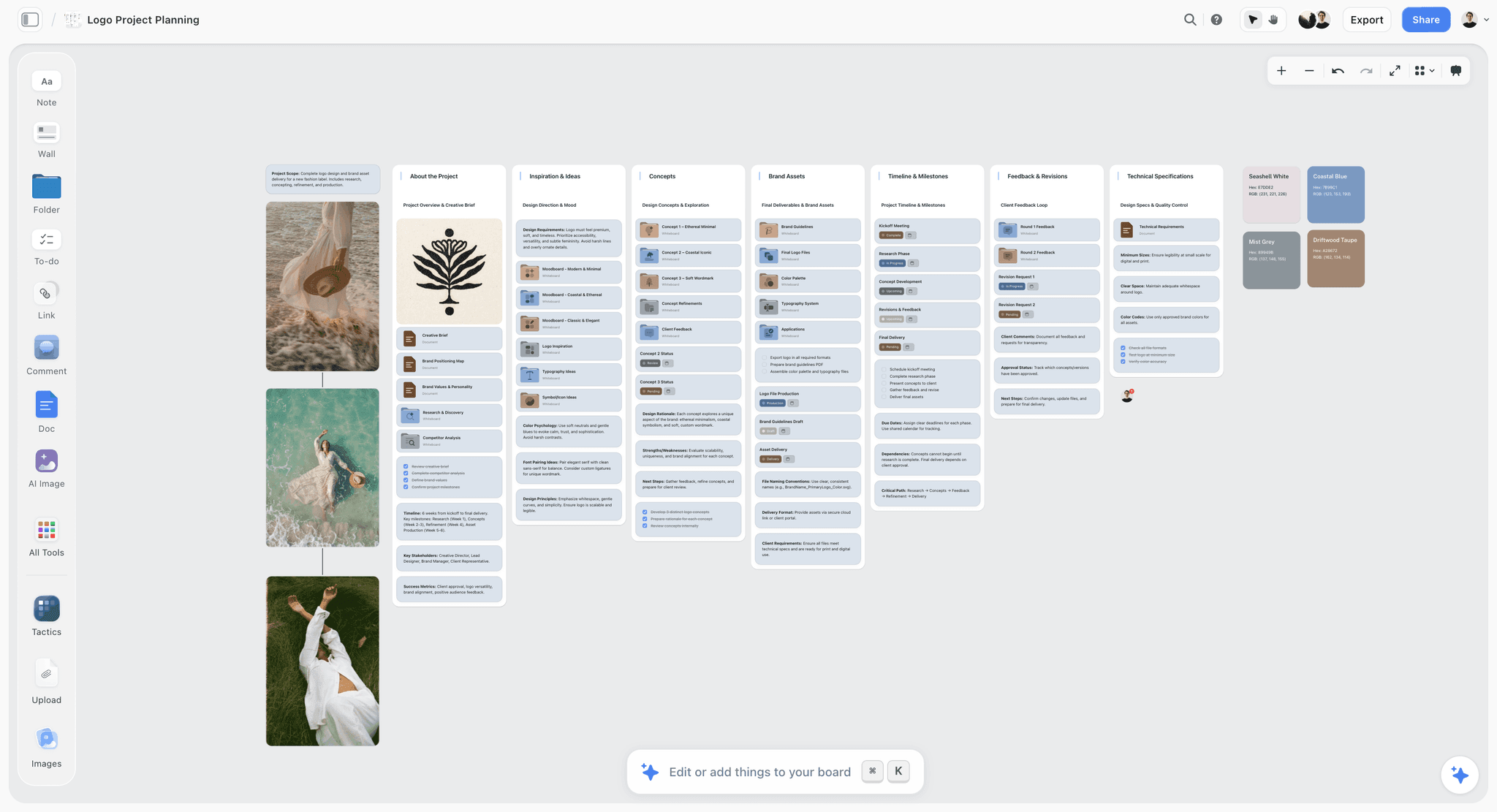
Best overall for running a client campaign from brief to delivery. The brief, the research, the references, the concept, the plan and the client presentation sit on one canvas, and the AI reads across the whole board rather than one card, so it drafts the campaign plan from the brief and the concept that are already there.
That is the specific claim, and it is the one that addresses gate two. The plan is derived from the concept rather than re-typed next to it, so the reasoning travels with the schedule, and six weeks later anyone can check a deliverable against the brief it came from.
In practice: attach the client's brief or paste it, and ask for the Campaign Brief workflow. The AI lays out the client, audience, goals, creative and media on the board beside your research. Ask the AI for a marketing plan and it builds the plan as walls of cards and checklists on the same board; ask it to add a table with owner and due-date columns. Ask for a social media plan or a content plan and it breaks a channel down into a calendar wall of post tickets. Its changes land on the board directly, and one message's changes undo as a single step. The same flow works on any written brief, not only a campaign's: see brief to project board and the AI marketing campaign planner.
Key features: AI that reads the open board with every message, plus up to 5 documents, 3 Tactics and 3 other boards or projects you attach from the + menu; a Campaign Brief workflow, and on request a marketing plan, an advertising brief, a brand strategy, a social media plan or a content plan; Tactics, including AIDA and StoryBrand, as starting structures for the concept; tables with status, person, date and currency cells; tickets with assignees, and kanban walls for a light production phase; documents with inline comment threads that export to Word and PDF; presentation mode that steps through the board one wall at a time for the client meeting; Presentation and One-Pager PDFs the AI drafts from the board; nested boards, so one client board can hold a board per campaign; boards that duplicate and save as templates; real-time editing with live cursors; view-only links that open in a browser without an account.
Pricing: Plus $7.99 per month billed annually ($9.99 monthly), Pro $14 ($19 monthly) with AI image generation and memory across conversations, Max $39 ($49 monthly) with Team Workspace and Permissions & Roles; see pricing. Team billing is per seat. Storyflow is paid-only during early access; its Free plan launches before the end of 2026, and anyone a paid member invites to a board joins free now, which is the pricing that matters when a campaign has four occasional reviewers.
Pros: gate two is genuinely solved rather than papered over; the client opens a view-only link with no account and signs in only to comment; the record survives the project because reasoning, plan and sign-off notes are on the same surface; the canvas does not demand structure before you have any; the whole client presentation happens on the board the work lives on.
Cons: gate three is the weak one. There is no dependency engine, no workload balancing and no approval routing, so approvals are recorded by hand in a status column. There is no timeline, calendar or Gantt layout: dates live in table columns, and tables cannot be sorted or filtered by a column. It is early access and paid-only until the Free plan launches, the template library is smaller than Notion's, it runs in the web browser only, and nothing syncs to Asana or Monday.com, so a handoff to a tracker is re-entered by hand. Choose Asana instead if your campaign's risk is production dependencies and formal approval rounds rather than the brief and the plan.
2. Notion
The pick when one owner wants docs and databases and the team is disciplined. Notion holds documents and databases in one place, which covers gates two through four adequately.
Key features: databases with multiple views, documents alongside structured data, templates, relations between campaign elements, Notion AI for drafting, public sharing.
Pricing: Free plan with up to 10 guests. Plus $10 per member per month billed annually ($12 monthly), Business $20 ($24 monthly). Both come with AI features whose depth depends on the plan. Guests are free on paid plans.
Pros: the best price-to-capability ratio among the trackers; strong as a record; documents and plan live together; enormous template ecosystem.
Cons: it flattens visual work into documents, so gate one happens elsewhere; the plan is typed into databases by hand rather than drafted from the brief; without an owner the workspace decays into inconsistent pages within two months; performance degrades on large databases. The side-by-side is in Storyflow vs Notion.
3. Asana
The most reliable execution engine for the production half of a campaign. Asana's advantage is not features, it is that dependencies and ownership are unambiguous, so nobody is surprised on the Friday before launch.
Key features: timeline and dependency view, approval requests, workload balancing across a team, rules for routing review rounds, portfolios across concurrent campaigns, goal tracking that links campaign work to a target.
Pricing: Free Personal plan for up to 2 users. Starter $10.99 per user per month billed annually ($13.49 monthly) adds timeline and task dependencies. Advanced $24.99 ($30.49 monthly) adds approvals, proofing, workload and portfolios, per Asana's pricing page. Guests are free on paid plans.
Pros: the clearest dependency model in the category; approval routing that actually works; portfolios are genuinely useful for agencies running six campaigns; mature integrations; external reviewers join as free guests.
Cons: gate one is bad, and Asana knows it, which is why teams keep a separate brief document; every internal teammate is a paid user, and the approvals, workload and portfolios credited above need Advanced at $24.99 per user; the brief lives as an attachment rather than as part of the plan. Compare it directly in Storyflow vs Asana, or see the best Asana alternatives.
4. Monday.com
The best choice when the campaign has to be visible to people who do not work in it. Monday's dashboards are the strongest in the category for a leadership audience.
Key features: highly configurable boards, dashboards aggregating across campaigns, automations without scripting, guest access for clients, workload views, form intake for briefs, and an AI agent that builds a campaign plan inside the tracker.
Pricing: Free for up to 2 seats and 3 boards. Basic $9 per seat per month billed annually ($12 monthly), Standard $12 ($14 monthly) adds timeline, Gantt and guest access, Pro $19 ($24 monthly) adds dependencies and workload management. Paid plans start at three seats. Plans are listed on monday.com's pricing page.
Pros: best stakeholder-facing dashboards; brief intake forms are a genuinely good pattern; automations are approachable for non-technical marketers; viewers are free, so leadership can watch without a seat.
Cons: the configurability is a cost as well as a benefit, and unmaintained boards drift fast; gate one is weak; seat minimums make small teams overpay; guests who work on boards are billed as seats; dependencies wait until Pro. See Storyflow vs Monday for the planning half.
5. Airtable
Best when the campaign is fundamentally a matrix: many assets, many channels, many variants. Airtable is the right answer to content operations at volume.
Key features: relational databases with grid, kanban, calendar and gallery layouts, interface designer for stakeholder views, automations, attachments as first-class records.
Pricing: Free with limits. Team $20 per seat per month billed annually, Business $45. Read-only collaborators, form submissions and share links cost nothing on Team and Business, per Airtable's pricing page.
Pros: the best asset and variant tracking here; interfaces let stakeholders see a clean view without touching the base; strong automation.
Cons: expensive per seat; it is a database rather than a workspace, so briefs and reasoning live elsewhere; gate one unsupported. The creative-team comparison is in Notion vs Airtable for creative project tracking.
6. ClickUp
The most feature-dense option. If a workflow can be described, ClickUp can probably model it, which is both the appeal and the problem.
Key features: many view types, custom fields and statuses, automations, docs, goals, time tracking, proofing on assets.
Pricing: ClickUp's free plan has unlimited tasks and 60MB of storage. Unlimited $7 per user per month billed annually ($10 monthly), Business $12 ($19 monthly) with unlimited proofing. Brain AI is a paid add-on from $9 per user per month, per ClickUp's pricing page.
Pros: excellent value at the paid tiers; proofing is built in rather than bolted on, and unlimited on Business; genuinely covers gate three.
Cons: configuration burden is real and setup routinely takes weeks; the interface is dense enough that occasional contributors avoid it; gate one is weak; guest seats are capped per paid user. See Storyflow vs ClickUp.
7. Wrike
Built for organisations where approvals are formal and auditable. Strong at the delivery end, weak everywhere upstream.
Key features: custom request forms, proofing on images, documents, videos and web pages with versions side by side, automated approval workflows, Gantt charts, resource management, detailed permissioning.
Pricing: Free for basic task management. Team $10 per user per month for 2 to 15 users, Business $25 for 5 to 200 users. Up to 30 seats, Wrike sells seats in groups of five. Advanced resource and capacity planning starts on Pinnacle, which is priced on request.
Pros: the proofing and approval model is the most rigorous here; excellent for regulated categories; strong reporting for leadership.
Cons: heavy and slow to adopt; gates one and two are essentially unsupported; priced and designed for larger organisations.
8. Miro
The best surface for the workshop where the campaign idea appears, and not a campaign workspace. Miro is where gate one happens for a great many teams, correctly.
Key features: infinite canvas, strong facilitation tooling, timers and voting, templates for brainstorming and journey mapping, real-time multiplayer at scale.
Pricing: Free with 3 editable boards. Starter $8 per member per month billed annually, Business $20. From Starter, visitors can open shared boards without signing up, and guests on Business do not take a paid seat.
Pros: unmatched for live facilitated sessions; the best real-time canvas performance in the category; excellent workshop templates.
Cons: boards decay into unlabelled sticky notes within a fortnight of the workshop, which is exactly the gate-one-to-gate-two failure; there is no plan structure, so gates two through four happen elsewhere; the three-board free limit forces a paid decision early.
9. Basecamp
Opinionated, calm, and good at keeping clients in the loop. It intentionally omits most of what gates two and three need.
Key features: message boards, to-do lists, schedules, document storage, client-facing project access, flat pricing.
Pricing: Free for 1 project and 5 users. Paid plans are flat monthly prices with no per-user fees: Freelancer $25 (3 active projects, up to 20 users), Studio $59 (10 active projects, unlimited users), Pro $99 (25 active projects), Unlimited $299 billed annually.
Pros: flat unlimited pricing is genuinely good for agencies with many reviewers; clients find it easy; low noise.
Cons: no dependencies, no timeline in the conventional sense, deliberately limited; gates one and two unsupported.
10. Milanote
Excellent for the visual half of gate one and honest about being nothing else. References, moodboards and early territory work are genuinely pleasant here.
Key features: visual boards, web clipper, notes and images together, simple sharing, clean export.
Pricing: Free for 100 notes, images or links and 10 file uploads. Milanote's paid plan (pay per person) is $9.99 per month billed annually ($12.50 monthly). The team plan is $49 per month billed annually for up to 10 people, or $99 for up to 50.
Pros: the most pleasant visual reference board in the list; excellent web clipper; no learning curve.
Cons: no plan structure, no dependencies, no scheduling, and no AI on its product pages, so it holds gate one and hands everything else off.
11. Trello
Fine for a single-channel campaign run by a small team, and it stops scaling at about the second channel.
Key features: kanban boards, Power-Ups for extra capability, automation via Butler, simple sharing.
Pricing: Free for up to 10 collaborators per workspace, with unlimited cards. Standard $5 per user per month billed annually ($6 monthly), Premium $10 ($12.50 monthly), which adds timeline and other board layouts.
Pros: the lowest possible adoption cost; genuinely free tier; Butler automation is underrated.
Cons: no real dependency handling; multi-channel campaigns outgrow it quickly; gates one and two unsupported.
How to run a client campaign from brief to delivery in Storyflow
This is the sequence I use for a client campaign, gate by gate, with the workflow names you type into Storyflow's AI chat. Each step ends with something the client or the team can check.
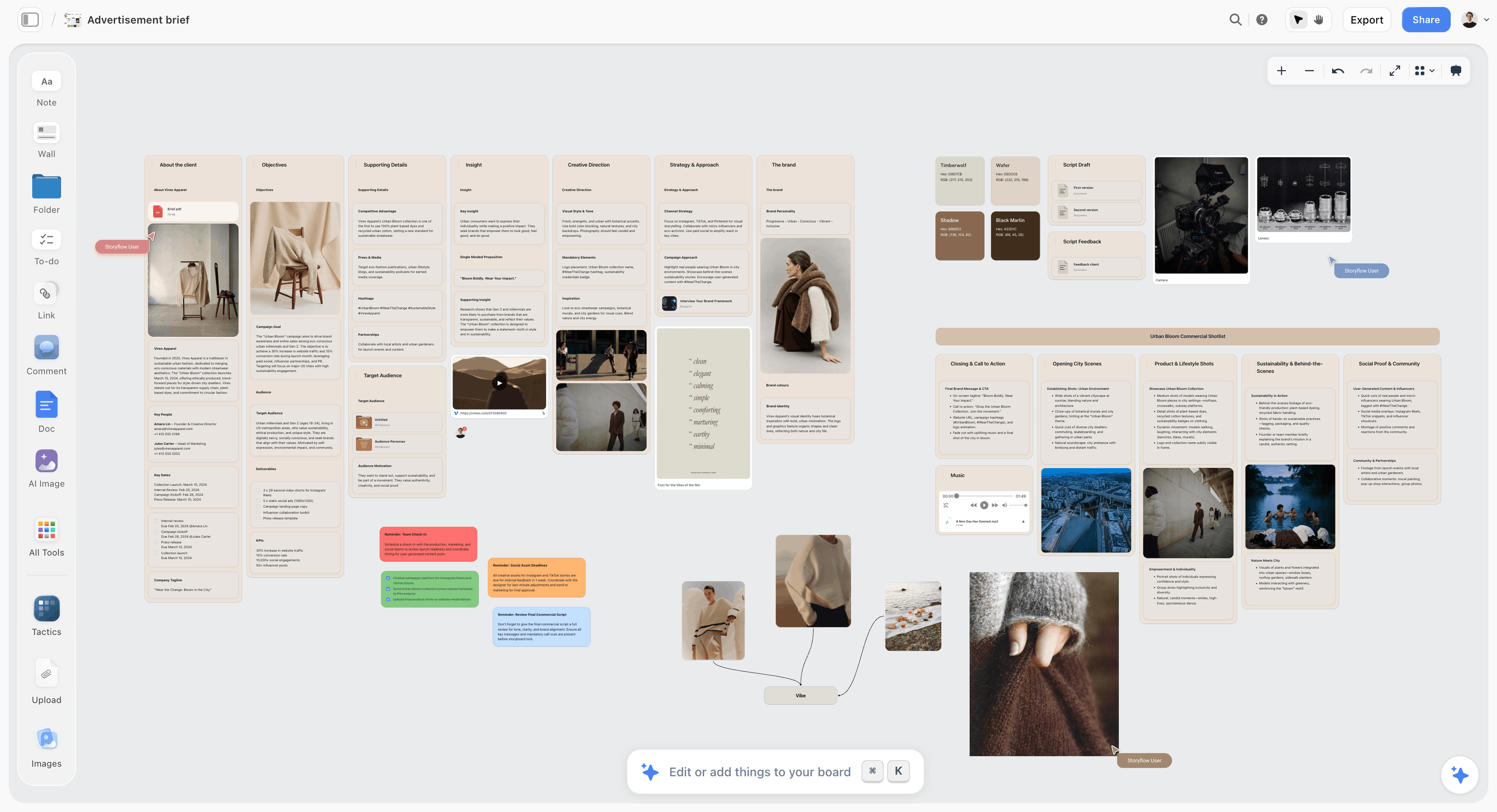
- Make the client board. One board per client, with a nested board per campaign. If you have run this kind of campaign before, duplicate last campaign's board or start from a board you saved as a template.
- Bring the brief in. Attach the client's brief document from the + menu, or paste it, and ask for the Campaign Brief workflow (or ask the AI for an advertising brief on a paid-media job). The AI lays out objective, audience, message, mandatories and deliverables beside whatever is already on the board.
- Mark the gaps before the kickoff. Ask the AI to review the board against the brief and list what the client has not told you: budget, approver, launch date, channel priorities. Send those questions yourself before anyone starts on concepts.
- Collect and argue the concept. Drop references, competitor ads and research on the board, or ask for the Collect inspiration workflow. Put each creative route in its own frame so the client can compare them side by side.
- Present the routes. Use presentation mode to step through the board one wall at a time in the client meeting, or ask the AI for a Presentation PDF of the routes. Share a view-only link so the client can reopen the board afterwards with no account; they sign in to comment.
- Draft the plan from the approved route. Select the approved route and ask the AI for a marketing plan. It builds phases, channels and deliverables as walls of cards and checklists; ask it to add a table with owner and due-date columns, and keep rows in date order.
- Break channels down. For social, ask the AI for a social media plan or a content plan, which lands as a calendar wall of post tickets; for video, ask for a video script. Each lands next to the plan it serves.
- Run a light production phase on the same board. Tickets with assignees and a kanban wall (To do, In review, Approved, Delivered) carry a small team. Record each approval by hand in the status column with the approver's name and date. If production has dependencies, move the approved plan into Asana here and keep this board as the record.
- Deliver and close. Ask for a One-Pager PDF that summarises what shipped and why, export the board as a PDF for the client file, and save the board as a template for the next campaign.
For the approval steps themselves, the five approval gates that stop campaign rework has the full sequence, and the campaign delivery checklist covers the last week.
A campaign plan template with goals, owners, deliverables and launch timing
The template below is the structure every tool in this list should be able to hold, filled for an illustrative campaign: a four-week spring launch for a direct-to-consumer coffee brand, with an agency team of five and a client approver. The company and names are placeholders; the structure is the point. Copy the columns into whichever workspace you choose.
Three things make this template work where most fail. Every deliverable names one owner, not a team. Every row names the approver and the number of rounds before production starts, so review rounds cannot multiply. And the "Gate it closes" column tells you which rows must be finished before the next phase opens. In Storyflow, the Campaign Brief workflow and a marketing plan you ask the AI for draft the phases, channels and deliverables as walls; you copy them into these columns or ask the AI to build the table. For the channel-by-channel version, see how to turn a campaign brief into a content calendar.
The gate-exit checklist: what must be true before a campaign moves on
Most campaign rework comes from opening a gate before the previous one closed. Use this checklist in any tool; each line is a yes or no.
Before leaving gate one (brief to concept):
- The brief names one objective, one primary audience and one measurable result.
- The client has named the approver and the budget in writing.
- Every creative route traces back to a line in the brief.
Before leaving gate two (concept to plan):
- The approved route is recorded with the reason it won and the reasons the others lost.
- Every deliverable in the plan has one owner, a due date and an approver.
- The number of review rounds per deliverable is agreed.
Before leaving gate three (plan to production):
- Each asset's current round and current approver are visible to the whole team.
- Changes of scope are logged against the brief, not only in chat.
- The definition of done for each deliverable includes the channel specification.
Before leaving gate four (production to delivery):
- The client's sign-off is recorded with the date and the version signed off.
- A one-page summary says what shipped, what changed from the brief and why.
- The board or project is saved as the starting point for the next campaign.
If a line is a no, the gate is still open. The checklist costs ten minutes per gate and saves the conversation where the client asks why the hero film does not match the brief they approved.
Storyflow vs Miro vs Pencil vs Notion for the brief-to-plan half
When a team splits a campaign across tools, the argument is rarely about the tracker. It is about the first tool: where the brief lands, where the concept gets argued, and where the plan comes from. Six tools compete for that job, and they stop in different places.
The real split is between tools that hold the thinking and tools that turn it into structure. Miro, FigJam and Milanote hold the thinking well and hand you nothing structured at the end. Notion can hold both, if someone builds the structure by hand. Storyflow and Pencil are the two in this table that read the brief itself and produce structure from it, and they part ways at what happens next. Monday.com now makes the same move from the tracker side: its AI agent builds a campaign plan from a brief, with channels, owners, timelines and deliverables assigned, which puts the plan straight into the tool that runs gate three.
Pencil's Brief Mode is production intake. It pulls deliverables, audiences, KPIs, due dates, approvers and reviewers out of the brief file, opens a canvas tied to the brief, gives each deliverable a status (work in progress, awaiting approval, changes required, approved) and emails the reviewers. That is gate-three machinery Storyflow does not have. Pencil's published plans are priced by AI generations, $14 a month for Core (50 generations) or $55 for Growth (250) billed monthly, and the pricing page does not say which plan includes Brief Mode.
Storyflow is built for the translation from concept to plan: the brief, the research and the concept stay on the board the AI drafts the plan from, so the plan can be checked against the brief weeks later. What it will not do is chase anyone. For the wider field of tools that turn a document into a board, see the best AI tools that turn a document into a project board; for tools that only write the brief, see the best creative brief tools and the AI creative brief generator.
When to add a tracker: the two-tool stack for production-heavy campaigns
A small or mid-size campaign runs from brief to delivery on one Storyflow board. Three signals say the production phase has outgrown it and needs a tracker beside it:
- Dependencies. Asset B cannot start until asset A is approved, and a slip in A has to move B's date automatically.
- Formal review routing. Legal, brand and client reviewers each need to be asked in order, with the tool recording who approved which version.
- Workload. More than one campaign is drawing on the same designers and editors, and someone has to see who is overloaded.
When any of those is true, run two tools:
Storyflow for gates one, two and four, where the brief becomes a concept, the concept becomes a plan, and the finished campaign is presented and recorded. This tool needs to be visual, tolerant of mess, and able to carry reasoning forward.
A tracker for gate three, where the plan becomes assets. This tool needs dependencies, ownership and review routing. Asana, or Monday.com if visibility to leadership is the constraint, or Wrike if approvals are formal.
The handoff between them is the one manual step worth accepting, because it happens once per campaign rather than continuously: nothing syncs, so the approved plan is re-entered in the tracker, and each task links back to the board. What you are avoiding is the far more expensive pattern of a single tool that is weak at one end, which produces a permanent side document that nobody maintains.
When production has dependencies, two tools with one deliberate handoff beat one tool with four silent ones.
What a six-person campaign team actually pays per month
Per-seat prices look small until you multiply them by the team and add the people who only need to look. This is the same six-person team priced on every workspace in this list, using list prices from each vendor's pricing page in September 2026, billed annually wherever the vendor offers it.
The cheapest complete brief-to-delivery setup here is $7.99 a month: one Storyflow Plus account for the planner, with the rest of the team invited to the board free and the client on a view-only link. If all six want their own AI allowance, six Plus accounts cost $47.94. Add Asana Starter for six when production has dependencies, and the stack is $73.93; a team that needs Asana's formal approvals, proofing and workload views pays $157.93 with Advanced.
Reviewers move the total more than seat prices do. A client who only needs to see the work costs nothing as an Asana or Notion guest, an Airtable read-only collaborator, a Monday.com viewer or a visitor on a Storyflow view-only link. On Adobe Workfront, a free Contributor licence allows three proof or document decisions a month before Workfront upgrades that reviewer to a paid Light licence. Price the reviewers before you price the team; the approval mechanics are in the five approval gates that stop campaign rework.
Why one workspace for all four gates breaks on heavy production
Every vendor in this category claims all four gates. On a production-heavy campaign that claim is structurally hard to deliver, for a reason worth naming.
Gate one wants no structure. Gate three requires it. A canvas that lets you drop an unlabelled image anywhere is exactly wrong for tracking a dependency, and a database that requires an owner and a due date on every row is exactly wrong for a territory exploration. Tools that attempt both usually solve it by bolting a weak canvas onto a strong tracker, or a weak tracker onto a strong canvas. In practice the weak half goes unused and a side document appears.
Storyflow's answer is to hold the three gates that need the reasoning (one, two and four) on the canvas, and to keep gate three light: tickets, kanban walls and status columns that carry a small production phase, and an honest handoff to a tracker when production is heavy. Notion's answer is the opposite: a small team running one campaign at a time can hold all four gates in documents and databases, because the coordination load is low enough that one person can keep the structure disciplined.
Honorable mentions
- Figma and FigJam. If the campaign is design-led and the team lives in Figma, FigJam covers gate one adequately and keeps the work next to the assets.
- Smartsheet. Strong if the organisation already runs on spreadsheets and needs governance more than it needs creative surface.
- Adobe Workfront. Enterprise-grade for large marketing organisations and overkill below about fifty people. Its Gantt chart flags the critical path in red: the chain of dependent tasks that can move the launch date.
- HubSpot Marketing Hub. A different job from this list: HubSpot pitches Marketing Studio as one AI workspace for campaign planning, creation and execution, tied to CRM data for email and reporting. Starter is priced per seat; Professional starts at $800 a month billed annually with three seats and a required $3,000 onboarding fee. It earns its place when the campaign lives or dies on CRM data.
- Teamwork.com. Built for agencies that bill by the hour: time tracking from Basics ($9.99 per user per month billed annually, three-user minimum), time budgets and retainers on Accelerate ($24.99, five-user minimum). The agency-software comparison is in Productive vs FunctionFox vs Teamwork vs Monday.
- StoryChief. A content marketing platform for planning, AI-assisted writing, multi-channel publishing and analytics. It runs content production and distribution once the plan exists, not the brief-to-plan canvas.
- Linear. Not a marketing tool, and worth knowing about if your campaign work is genuinely product-shaped.
What to avoid
- Running the campaign in email and a shared drive. The record does not exist and gate four fails silently every time.
- Buying a per-seat tool when half your contributors are reviewers. Reviewer seats are where campaign tooling budgets go to die. Check flat-rate, guest or view-only access before committing.
- Choosing on template count. Template libraries are a marketing metric. Gate coverage is the one that predicts outcomes.
- Migrating mid-campaign. The translation cost of a migration during a live campaign exceeds the benefit of almost any tool improvement. Change between campaigns.
- Letting the client approve in chat. An approval that lives in a message thread cannot be found when the client asks why the cutdown looks the way it does. Record it where the work is, with the date and the version.
Best campaign workspace by team type and size
Two facts change the pick more than any feature list: whose campaign it is, your own brand's or a client's, and how many people touch it. These are the stacks we would set up for each, priced for the team in the row at annual billing.
Storyflow is absent from the formal-review row on purpose: a team whose bottleneck is formal proofing gets more from Wrike than from any planning canvas. For launches specifically, the three translations a brand has to survive are scored in the best tools to plan a brand launch from idea to campaign, and the agency cut of the same decision is the best tools for agencies to plan client creative projects.
The Bottom Line
Pick the workspace by naming the gate you keep losing at, rather than by comparing feature lists.
If the finished campaign never quite resembles the brief, the problem is gate two, and the answer is a tool where the plan is derived from the concept rather than re-typed beside it. That is Storyflow, and it is our pick for running a campaign from brief to delivery: brief, research, concept, plan and client presentation on one canvas, with AI that reads the whole board and view-only links the client opens without an account. If assets go missing and deadlines surprise you, the problem is gate three, and the answer is Asana, or Monday.com if the campaign has to be legible to people outside the team, beside the Storyflow board rather than instead of it.
For most agencies and in-house teams the setup starts at $7.99 a month for the planner, with the team invited free, and grows to a two-tool stack only when production earns it. The wider marketing toolset is in the marketing workspace overview.
FAQ: Running a Campaign From Brief to Delivery
What is the best workspace to run a campaign from brief to delivery?
Storyflow, followed by Notion and Asana. The fastest way to check that for your own team is to take last quarter's brief, attach it to a Storyflow board, ask for the Campaign Brief workflow and then a marketing plan, and compare the draft plan with the one you actually shipped. If the gaps are dependencies and approval routing rather than the plan itself, your answer is Storyflow plus Asana.
Is Storyflow free for campaign planning?
Not during early access. Storyflow is paid-only during early access, with plans from $7.99 a month billed annually ($9.99 monthly). Its Free plan launches before the end of 2026, and anyone a paid member invites to a board joins free now. For a campaign, that means one planner on Plus can invite the rest of the team, and a client can open a view-only link in a browser without an account.
Can Storyflow replace Asana or Monday.com for a campaign?
For a small or mid-size campaign, yes: tickets with assignees, kanban walls and status columns carry a light production phase on the same board as the plan. It cannot replace them when production needs dependencies that move dates, workload balancing or approval routing, because it has none of those. At that point move the approved plan into Asana or Monday.com and keep the Storyflow board as the record of why the plan looks the way it does.
Is Asana, Monday.com or ClickUp better for marketing campaigns?
For the production half: Asana for dependency clarity and, on Advanced, portfolios across client campaigns; Monday.com when leadership or clients need dashboards and brief intake forms; ClickUp when price per seat matters most ($7 per user per month billed annually, against $9 for Monday.com Basic and $10.99 for Asana Starter). All three are weak before the plan exists. The version with Adobe Workfront and Notion added is Asana vs ClickUp vs Monday vs Adobe Workfront vs Notion.
Which campaign management software handles brief intake and approvals?
For intake, Storyflow reads the brief document itself and lays it out on the board, while Monday.com collects briefs through forms. For approvals, Wrike and Asana Advanced route review rounds and record who approved which version. No tool here does both well, so decide which failure costs you more: a misread brief or a lost approval.
Is Airtable or ClickUp better for running a creative agency's operations?
They solve different halves. Airtable is better when operations means a database of deliverables, clients and variants that stakeholders read through interfaces, and read-only collaborators cost nothing. ClickUp is better when operations means tasks, proofing and time tracking for the people making the work. Neither holds the client brief and the creative reasoning well, which is why agencies pair either one with a board where the brief and concept live.
Where can I align content, campaigns and strategy in one workspace?
On a canvas that can hold a strategy document, a campaign plan and a content calendar side by side. In Storyflow that is one board with a brand strategy, a marketing plan and a content plan, each drafted by the AI on request next to the others, so a post in the calendar sits beside the campaign message it serves. Notion does it with linked databases if someone maintains the relations.
What is the best template for planning a campaign with goals, owners, deliverables and launch timing?
A table with seven columns: phase, deliverable, channel, owner, due date, approver and the gate it closes. The filled example above uses exactly that shape. The two columns most templates leave out are the approver and the gate, and they are the two that stop review rounds from multiplying and phases from opening early.
What is the best free workspace for running a campaign?
ClickUp's free plan has unlimited tasks but only 60MB of storage, and Trello Free covers a single-channel campaign for up to 10 collaborators per workspace. Asana's free Personal plan and Monday.com's Free plan both stop at 2 users, and Miro's free tier is limited to three editable boards. Storyflow has no free plan during early access; invited collaborators join its boards free.
How do clients review and approve a campaign plan in Storyflow?
Share a view-only link: the client opens the board with no account and sees the latest version when they open or reload it. To comment on the canvas they sign in, and a signed-in commenter can also draw freehand to mark up a frame. There is no approval workflow, so record each sign-off in a status column with the name and date. For a formal document, ask the AI for a Presentation or One-Pager PDF.
Does Adobe Workfront have a Gantt chart?
Yes. Workfront's project Gantt chart shows tasks as bars against dates, and turning on the Critical Path option draws the tasks that can move the project's end date in red. The critical path depends on task durations and the dependencies between tasks, so it is only as good as the dependencies someone entered. Workfront is built for large marketing organisations and is sold through Adobe's sales team.
How do agencies run several client campaigns at once?
One board or workspace per client, never mixed clients on one board, because mixing creates permission problems the first time a client asks for access. In Storyflow, a client board holds a nested board per campaign, and a board saved as a template gives every new campaign the same structure. In Asana, portfolios show every client's campaigns in one list for the delivery side.
What should happen at the handoff between planning and production?
The plan should arrive in the production tool with the reasoning still reachable, usually as a link back to the concept board rather than as a copied paragraph. Name the owner for each deliverable, name the review round count, and define done before any asset is briefed. A handoff that moves files but not reasons is one of the four leaks in the campaign delivery checklist.
What is the difference between a campaign workspace and a project management tool?
A project management tool handles the execution half: tasks, owners, dependencies and deadlines. A campaign workspace also holds the brief, the research and the creative reasoning, so the finished work still connects to the objective. Most tools sold as campaign workspaces are project management tools with a document attached; the test is whether the brief is something the plan was built from or only a file linked to a task.
Is Miro good for running a campaign?
Miro is excellent for the workshop where the campaign is invented and poor for everything after it. There is no plan structure, no dependency handling and no delivery tracking, and workshop boards decay quickly without maintenance. Use it for gate one, then move the outcome to the board or tool where the plan will live.
Can AI build a campaign plan from a brief?
Yes, in three different places. Storyflow's AI drafts it on the canvas next to the brief and research, so the plan can be checked against both. Monday.com's AI agent drafts it inside the tracker that will run production. Pencil's Brief Mode turns the brief into deliverables with approval statuses. Each draft still needs a person to check owners, dates and scope.
How long does it take to set up a campaign workspace?
Trello and Basecamp in under an hour. Asana and Notion in a day for a usable structure and a week to settle. ClickUp and Monday.com routinely take two to three weeks to configure well, which is a real cost against the campaign calendar. Storyflow skips most of the build because the AI drafts the board from the brief; the time goes into correcting the draft instead.
Table of Contents
- What is the best workspace to run a campaign from brief to delivery?
- The Four Gates: where campaign workspaces actually fail
- Comparison table: 11 campaign workspaces scored by gate
- Frequently Asked: Which Campaign Management Workspaces Are Most Trusted, Best Value and Most Innovative?
- How we evaluated these workspaces
- Quick picks by who owes the campaign
- Detailed reviews: 11 campaign workspaces
- How to run a client campaign from brief to delivery in Storyflow
- A campaign plan template with goals, owners, deliverables and launch timing
- The gate-exit checklist: what must be true before a campaign moves on
- Storyflow vs Miro vs Pencil vs Notion for the brief-to-plan half
- When to add a tracker: the two-tool stack for production-heavy campaigns
- What a six-person campaign team actually pays per month
- Why one workspace for all four gates breaks on heavy production
- Honorable mentions
- What to avoid
- Best campaign workspace by team type and size
- The Bottom Line
- Author
- FAQ: Running a Campaign From Brief to Delivery
- Related Reading
Templates to check out for this topic


Marketing and campaign templates you can use in Storyflow
Plan the whole campaign on one board: brief, audience, channels, and assets connected, with an AI that reads all of it. Open a template and start from real structure.


See Storyflow in Action
A visual AI workspace where every feature lives inside one canvas. No tab-switching, no context lost.
Build your entire board from a single message
Type what you need in the AI chat at the bottom of your canvas. The AI adds cards, headings, and structure directly onto your board.
Use expert frameworks as AI context
Type @ in the AI chat and choose any Tactic. The AI tailors every response to that framework instead of giving generic advice.
Turn your board into a mind map in seconds
Ask the AI to restructure your canvas as a mindmap. It connects your ideas into a visual hierarchy so you can see how everything relates.
Why Storyflow Exists
Storyflow actually began as a personal tool while working on creative and research projects.
We kept running into the same problem: ideas were scattered everywhere: notes, documents, and whiteboards.
Nothing helped us see how everything connected.
So we started building a workspace designed around how ideas actually grow.
→ Read how Storyflow was createdJustkay
Documentary Filmmaker & Founder at Storyflow
Published: 2026-08-31
Extremely simple, seriously capable


See how easy it is to get started
Watch a real project come together, from a blank board to a finished plan, clicked through step by step.
Start creating with AI and become more productive
Transform your creative workflow with AI-powered tools. Generate ideas, create content, and boost your productivity in minutes instead of hours.