
Ultra-fast campaigns, pitched beautifully
Run a campaign from the brief
to the last asset, in one thread.
Campaigns rarely fail at the delivery stage. They fail because the brief, the idea and the assets end up in three systems, and by the time the work ships nobody can say whether it answers the brief. Storyflow keeps the whole thread on one canvas, so the last asset is still traceable to the first sentence.


Creatives working for these brands already got early access
- Red Bull
- Canon
- Artlist
- Porsche
See how easy it is to get started
Watch a real project come together, from a blank board to a finished plan, clicked through step by step.
Start from a ready-made template
Pick a board to see what you can build, then let AI fill it in. Every template is a real, editable starting point on the same infinite canvas.

Marketing Campaign
Plan a campaign across channels, messages, and deliverables on one board the whole team can see.
What does running a campaign from brief to delivery involve?
A campaign moves through four stages that each narrow the one before. Storyflow is an AI visual workspace that runs a campaign from brief to delivery on one infinite canvas: the brief, the idea, the assets each channel needs and the schedule, with AI that reads the whole board. The brief sets the objective, the audience and the constraint. The idea is the answer to it. The channel plan decides where that idea appears. The assets are what actually gets made and shipped. Delivery is only the last of those, and it is the only stage most software is built for.
The problem is the joins. Wrike, Asana, monday.com and Airtable are all capable of tracking the production of forty assets, and Airtable in particular is good at the asset matrix. The brief, though, usually lives apart from the work, in a document, a project brief tab or a task description, because a brief is prose and a tracker is rows. By week five nobody reopens it, and the review meeting argues from memory.
Working on a canvas fixes the joins rather than the tracking. The brief sits at the head of the board, the idea beneath it, the channels beside the idea and the assets under the channel they serve. Anyone reviewing an asset can see, in the same view, what it was supposed to do. That is the difference between a review about craft and a review about whether this was the brief.
Storyflow does not run the delivery pipeline, and it should not replace it. It has tickets with assignees and due dates, but no approval routing, proofing rounds or time tracking. It owns the thread from brief to agreed plan, keeps the brief readable through production, and hands the defined work to whatever system the team already ships in.
Ultra fast from brief to board
Keep one board from kickoff to the last asset.
Each stage sits under the one it came from, so nothing is orphaned from its reason.
01
Put the brief on the board
Paste the campaign brief, drop the research and the positioning, and add whatever the stakeholder actually sent.
02
Land the idea
State the central thought once, directly under the brief, so every later decision has something to be measured against.
03
Plan the channels and assets
Lay out what each channel needs and when, with the creative sitting beside the channel it runs on rather than in an appendix.
04
Review against the brief
As work arrives, put it on the board under the channel it belongs to. The brief is still visible, so the review has a reference.
The brief survives contact with production.
Most campaign tooling loses the brief in the first week. Keeping it readable is the cheapest quality control there is.
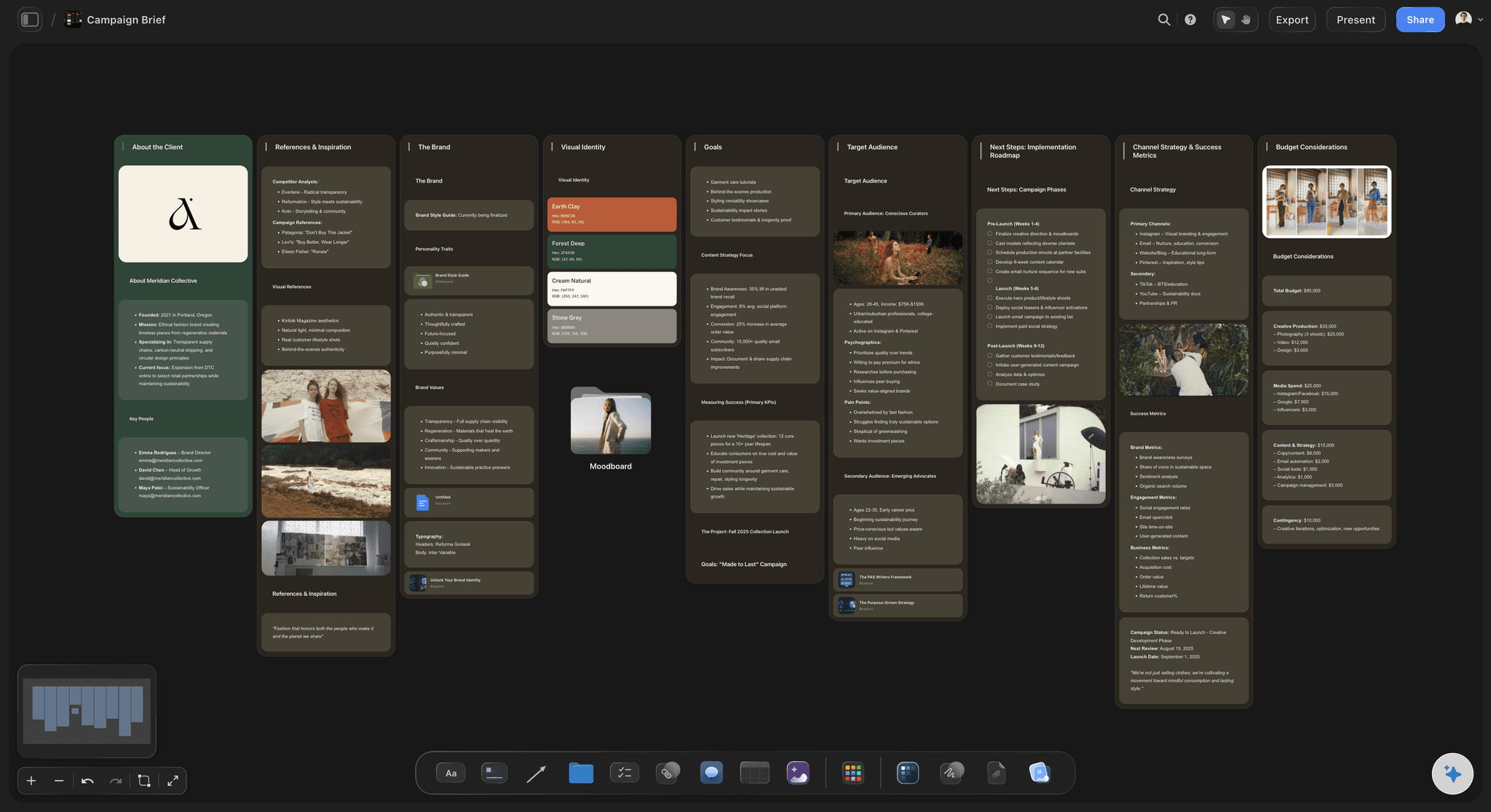
The brief stays readable
Not summarised into a task description
The campaign brief lives on the canvas as prose, where it still means something in week five, instead of being compressed into a field nobody reopens.
Try the AI creative brief generator →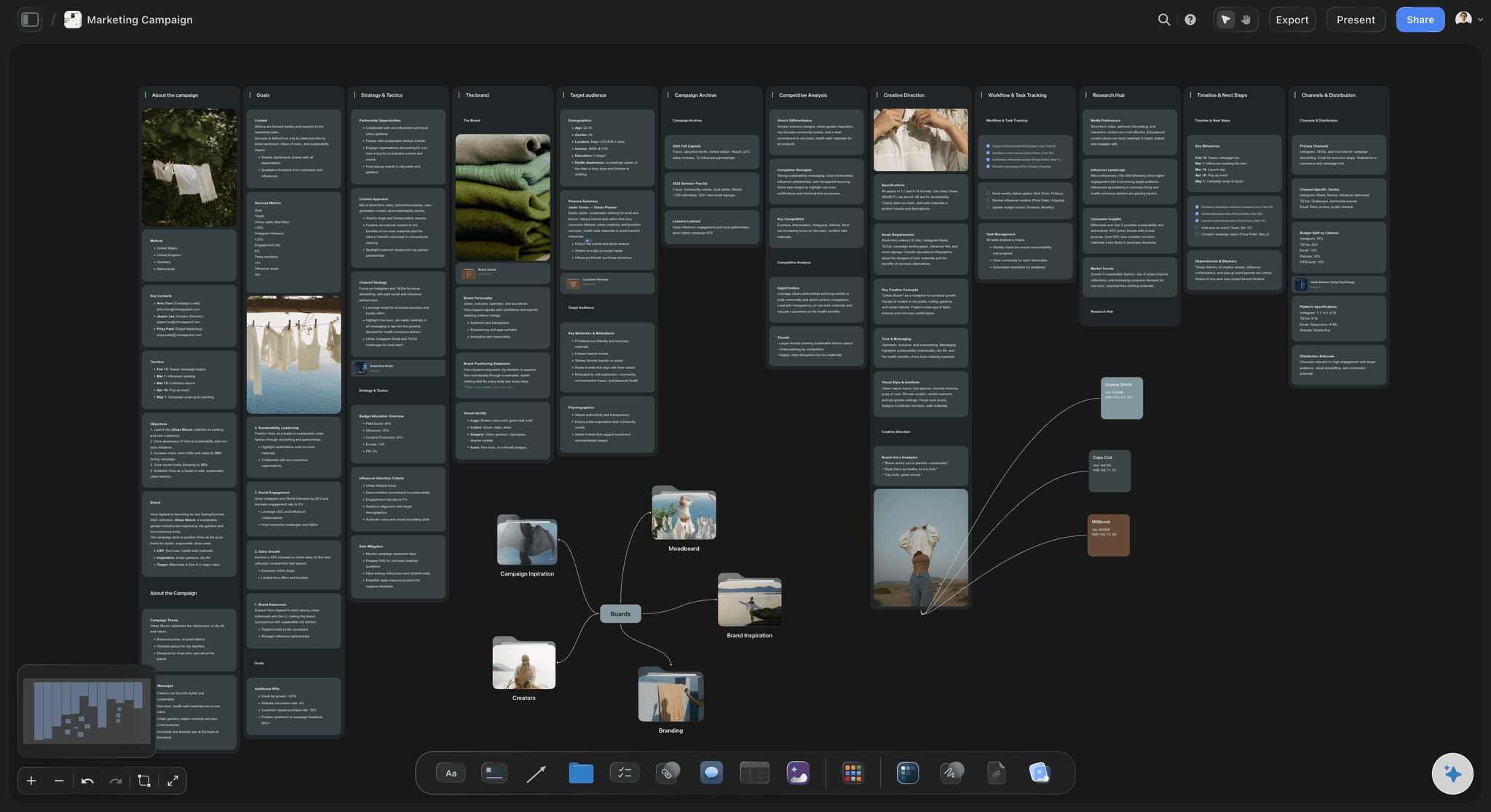
Channels and what they need
Assets beside the channel they run on
Group the email, the paid social, the landing page and the OOH by channel, so the gap between what was planned and what exists is visible rather than reported.
See the AI marketing campaign planner →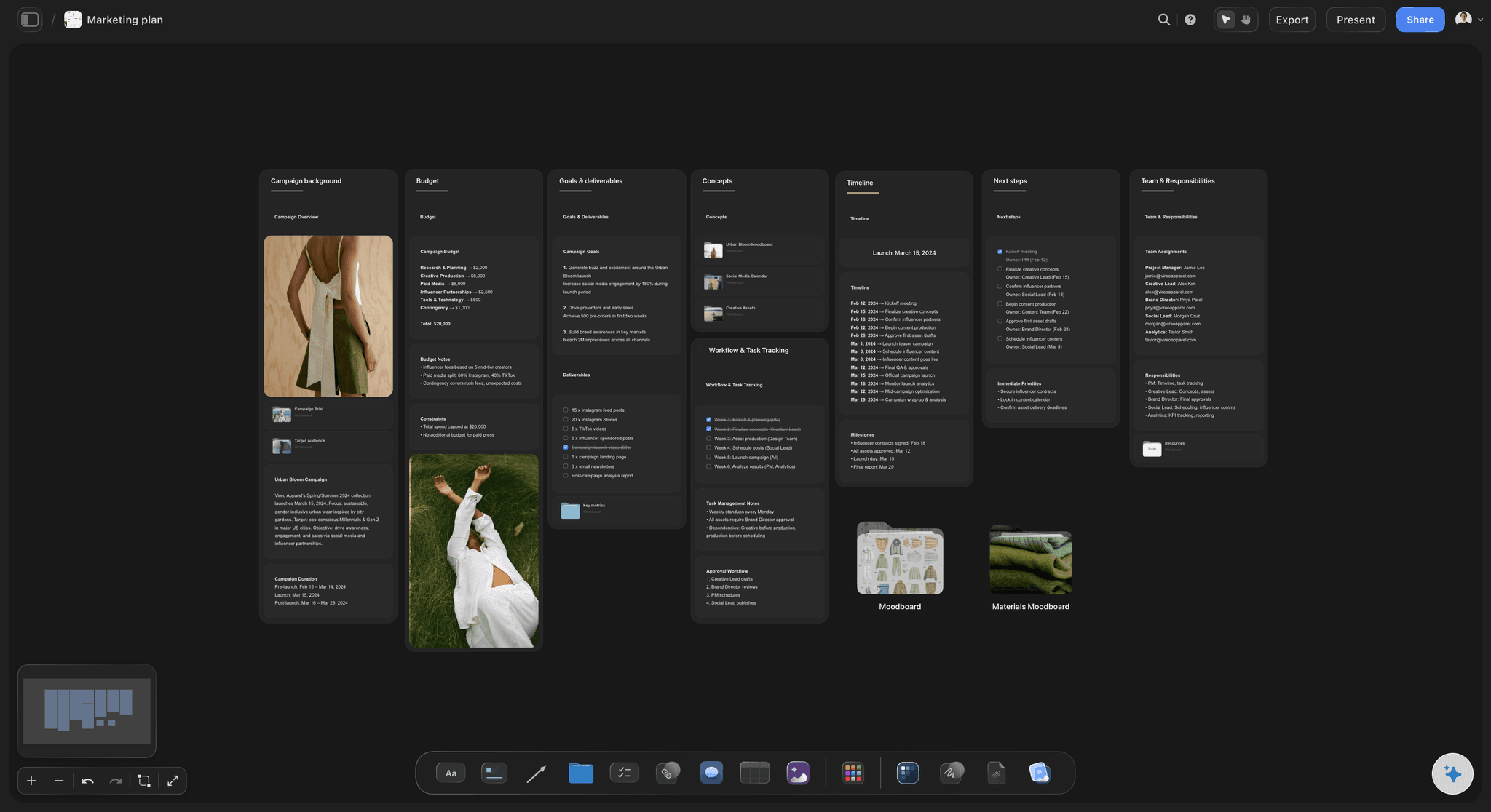
Timing over the top
A schedule laid over the work
Put the dates across the channel plan, so when the launch moves, every asset it affects is in the same view.
Explore the campaign calendar →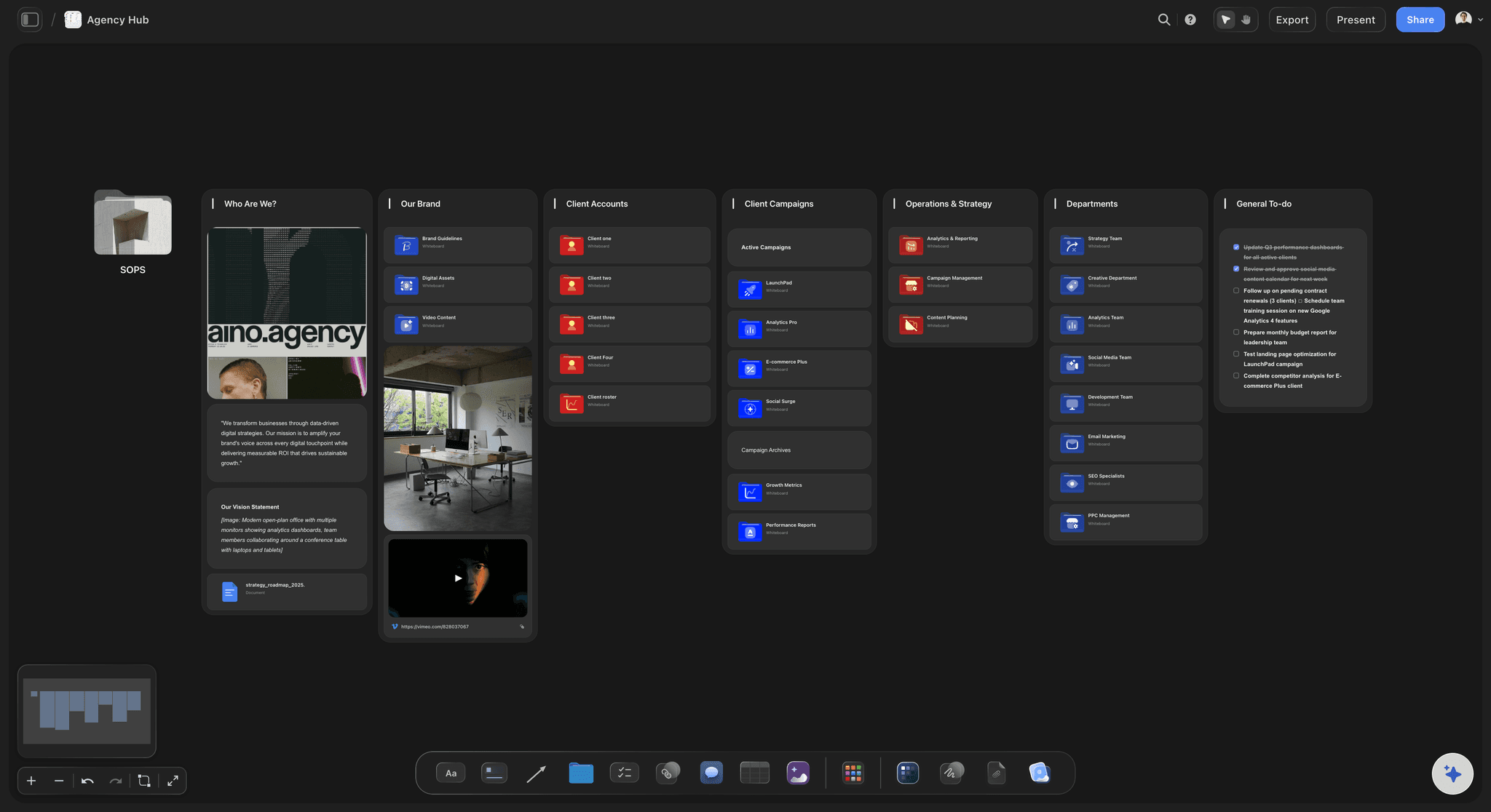
One link for the stakeholder
Show the campaign without a status deck
Share view-only and the stakeholder sees the current state without an account, which usually replaces the weekly deck nobody enjoyed making.
See the client review board →Plans from $7.99/month annual. Free plan coming late 2026.
Anyone a paid member invites to a board joins free, which matters on a campaign that pulls in freelancers and a media partner for six weeks. Storyflow is paid-only during early access, with plans from $7.99 a month billed annually ($9.99 monthly), and a free plan launches before the end of 2026.
Freelancers a paid member invites join free
Every campaign gets its own board
Stakeholders and partners view without an account
AI reads the whole board before it answers
Built for people with taste
Tracking is solved. The thread is not.
Every campaign tool can tell you an asset is late. Almost none can tell you whether the asset answers the brief.
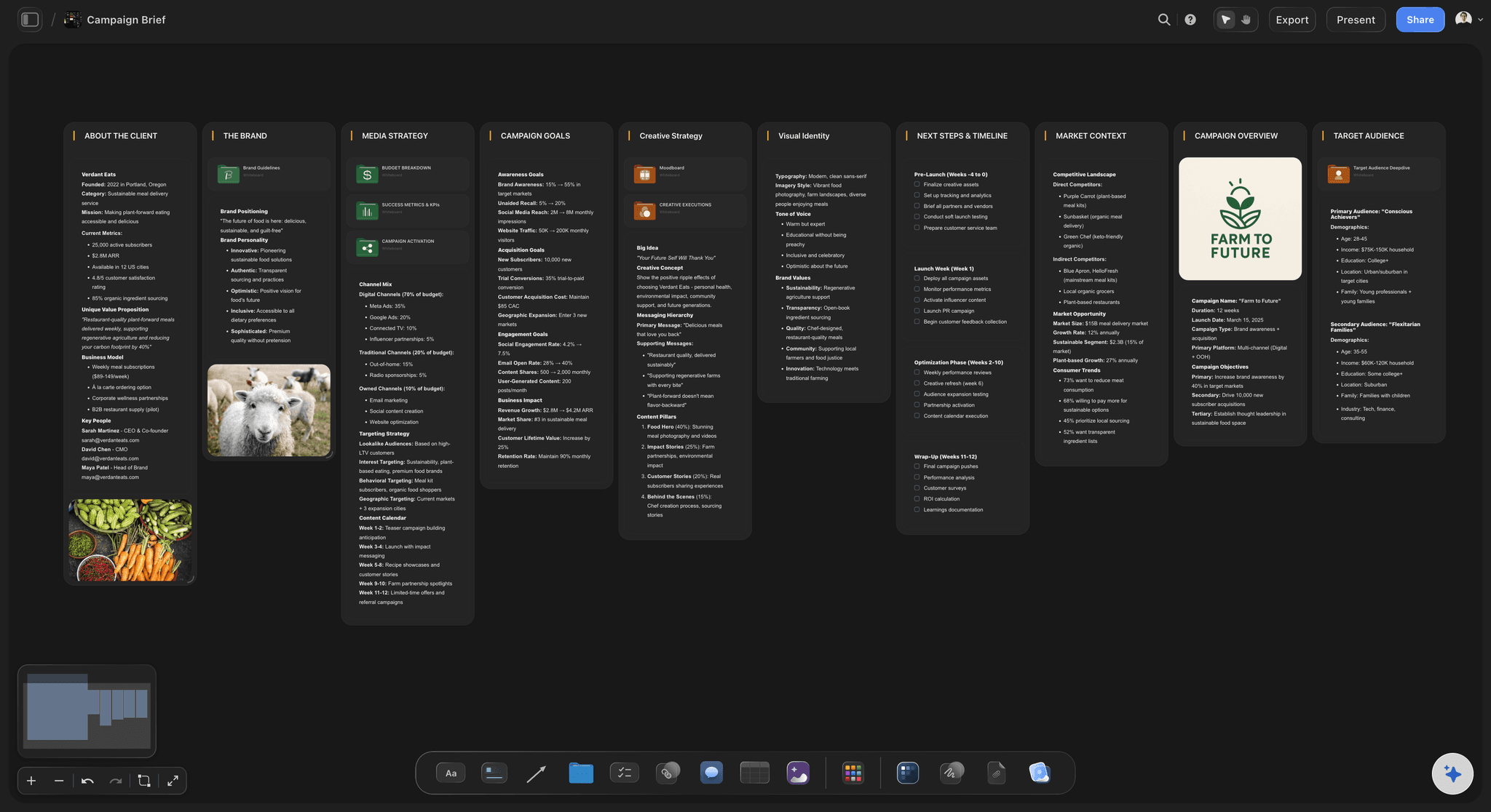
Traceability without process
Every asset has a reason above it
Brief, idea, channel, asset: The chain is spatial, so an asset that drifted from the idea is visible next to the idea rather than caught in a review.
Reviews get a reference: A stakeholder reacting to a headline can be shown the brief line it came from, which turns taste into a discussion.
Scope creep shows up: A channel that appeared after the brief was signed is obvious on a canvas, and invisible in a growing task list.
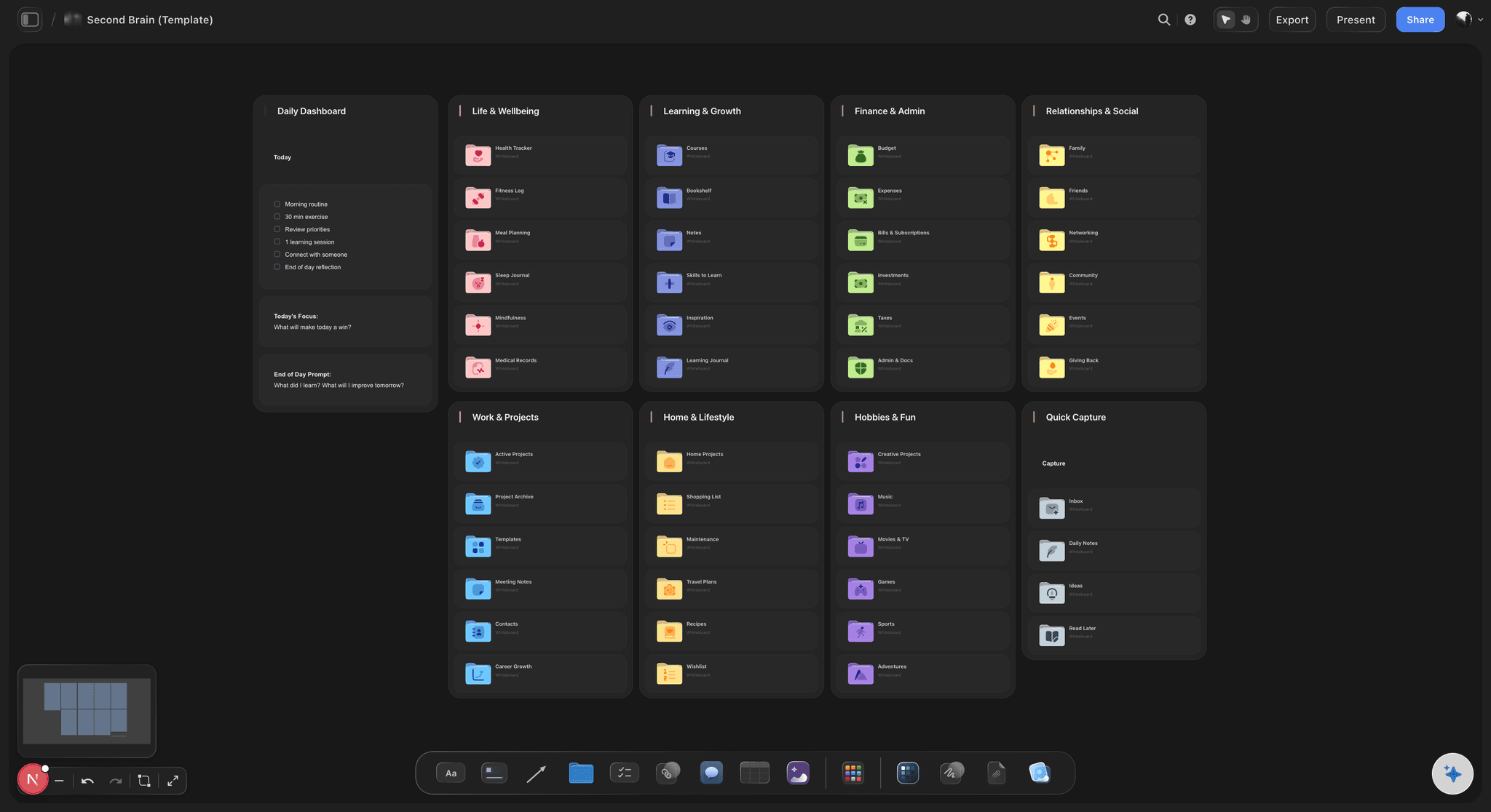
The AI reads the campaign
Ask whether the work still answers the brief
Canvas-aware AI: Storyflow's AI reads the whole active board, so the brief and the assets are both in front of it when you ask whether they agree.
Bring the strategy in: Attach up to five documents and three boards to pull the positioning and the audience research into the same answer.
Build the channel plan from the brief: Generate a first-pass channel and asset list from the brief, then edit it, which beats starting from an empty matrix.
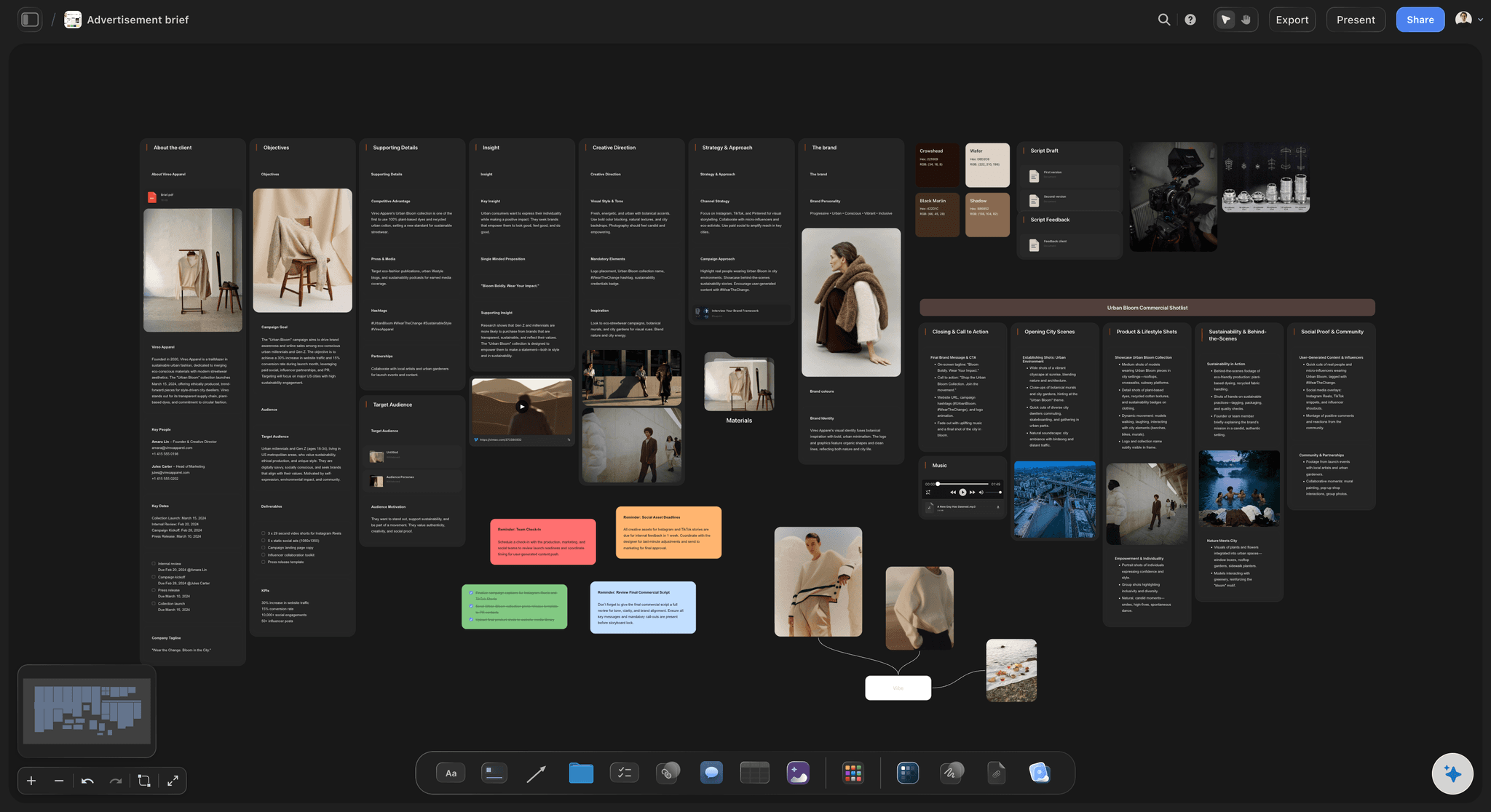
Everyone who touches the campaign
Partners and freelancers without paid seats
Invited collaborators join free: Anyone a paid member invites joins free, so a copywriter, a designer and a media partner on the campaign do not each need a plan.
Context instead of a briefing call: A freelancer opening the board sees the brief, the idea and the neighbouring assets, which is most of what a kickoff call was for.
External review by link: Legal, a partner or a client can read the board with no account and no software to learn.
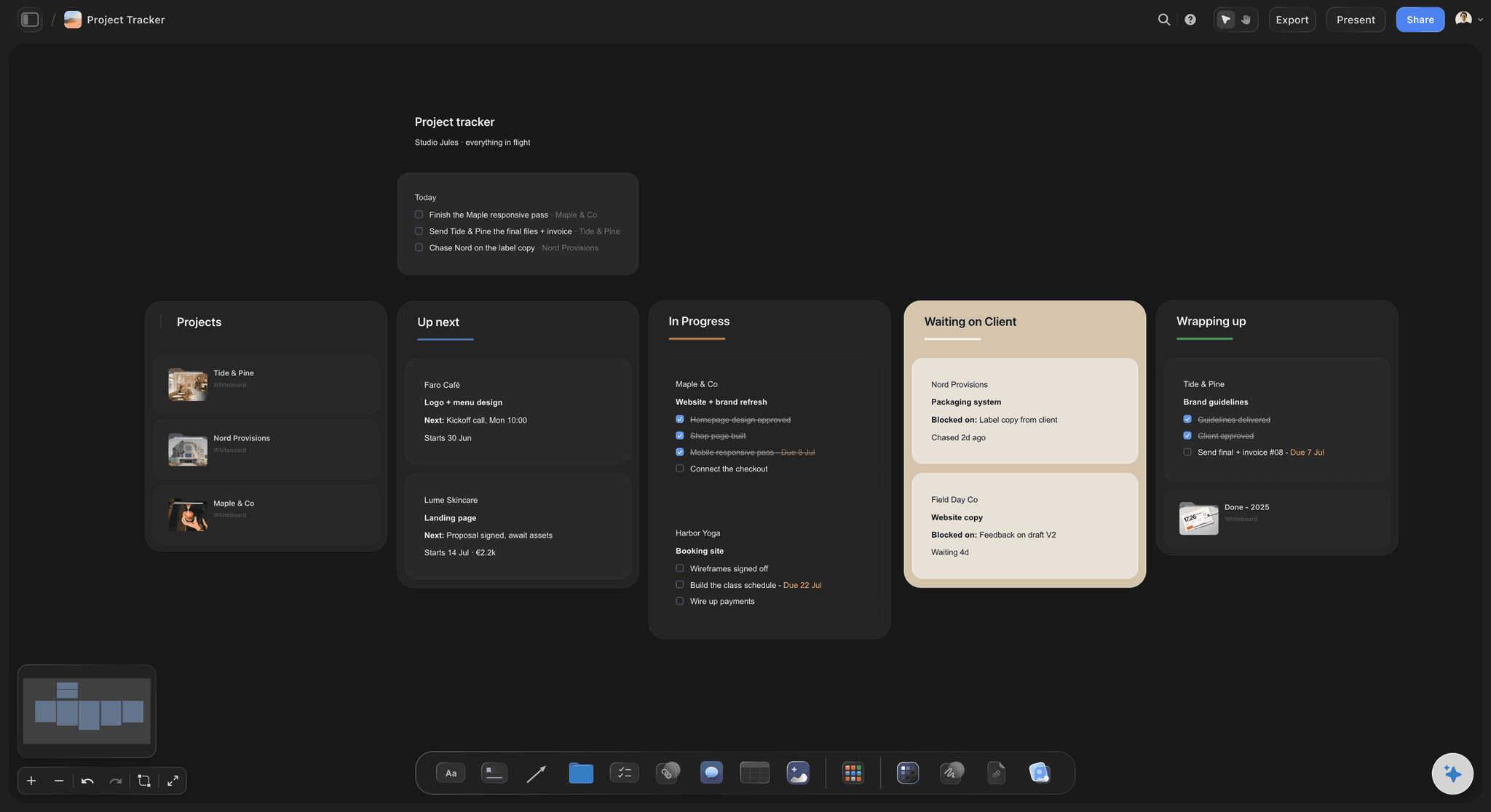
Honest about scope
Keep the system you ship in
No approvals or proofing: Storyflow has no approval routing, versioned proofing or sign-off trail. Campaigns needing formal approval keep that in Wrike, Ziflow or whatever they use.
No time tracking or workload views: Tickets carry assignees and due dates, but there is no workload view or timesheet. Asana, monday.com and Airtable stay where they are.
Not a media buying tool: Storyflow plans what runs where. It does not buy, traffic or report on media.
Explore templates for your project
Every template opens as a real, editable board on the infinite canvas. Pick the closest fit and make it your own.
Marketing Campaign
Plan a campaign across channels, messages, and deliverables on one board the whole team can see.
One app instead of five
Where this sits next to a campaign tracker.
These tools are good at the stage after this one, and all three can share a view outside the account. The comparison worth making is whether the brief and the work share one canvas.
Storyflow
Recommended
Brief, idea and assets on one canvas
Stakeholders view without an account
Approvals, proofing and time tracking
Asana
Brief, idea and assets on one canvas
Stakeholders view without an account
Approvals, proofing and time tracking
Wrike
Brief, idea and assets on one canvas
Stakeholders view without an account
Approvals, proofing and time tracking
Airtable
Brief, idea and assets on one canvas
Stakeholders view without an account
Approvals, proofing and time tracking
What creators are saying
Join early creators getting structured workspaces and AI that remembers their projects
“Storyflow has sped up my workflow by at least 3x, which means more flow state and more projects I can actually ship. It truly changed the way me and my team create.”

Reilin Joey
Director & YouTuber
“One prompt gets me a structured board. But the tactics are my favorite. I run my YouTube scripts through them and my intros and retention got better. It's amazing.”

Justkay
YouTuber & Freelance Filmmaker
“I used to juggle five apps to plan a project. Now I describe what I am making and get boards, lists, and a schedule. All in one place.”

George
@fernwehchronicles
Running a campaign end to end, answered.
What marketing teams ask before adding a campaign canvas.
The best setup is a canvas that keeps the brief beside the work, such as Storyflow, plus a tracker for production. Asana, Wrike, monday.com and Airtable all track assets well once the work is defined, and Wrike adds formal proofing and approvals. What gets lost is the brief, which usually lives apart from the work. On a canvas the brief, idea, channels and assets share one view, so any asset is reviewed against the objective it serves.
No. Storyflow has tickets with assignees and due dates, but no approval routing, proofing or time tracking. It covers the stage from brief to agreed plan and keeps the brief readable through production. Teams generally keep delivery where it already is.
What is explicitly out of scope, which is also the gap that causes the most trouble in week five. A brief that can carry a campaign to delivery also settles the objective and how it will be measured, the audience, the single message, the constraints including budget and legal, the channels in scope, and the deadline.
Through a view-only link that needs no account. For most teams this replaces the weekly status deck, because the stakeholder can see the current state whenever they want rather than at the cadence somebody had time to prepare.
It can lay out a first pass from the brief, listing the likely assets per channel, which you then edit. That is faster than starting from an empty matrix and easier to argue with. It does not decide budget allocation or media strategy.
The brief and the original plan stay on the canvas, so a change is visible as a change rather than becoming the new normal silently. Storyflow's AI reads the whole active board, so you can ask whether the current channel plan still matches what was signed off.
Yes. Anyone a paid member invites to a board joins free, so adding a copywriter, a designer and a media partner for the length of a campaign does not add a plan for each. Partners who only need to read can open a view-only link without an account.
No, and this is worth being clear about because regulated categories need it. There is no approval routing, versioned proofing or audit trail. If sign-off has to be formally recorded, that stays in a tool built for it.
Yes. Each campaign gets its own board with its brief at the top, and there is no project limit on paid plans, so a team can run always-on activity alongside two or three larger pushes.
Storyflow is paid-only during early access, with plans from $7.99 a month billed annually ($9.99 monthly). A free plan launches before the end of 2026, and anyone a paid member invites to a board joins free.
More from Storyflow
Campaign management software
AI marketing campaign planner
Campaign calendar
Brief to project board
AI creative brief generator
Marketing workspace
Storyflow for marketing teams
Campaign wrap report
Case study builder
Campaign brief template
Creative concept development
Campaign timeline template
Turn a campaign brief into a plan with Claude
Creative brief with ChatGPT
Client brief to production plan
How to write a campaign brief
Campaign concept board
Deliverables list
Creative production brief
Keep the brief in the room until the work ships.
Brief, idea, channels and assets on one canvas, so every review has a reference.