
How to Map a Marketing Campaign (Before It Becomes a List of Deliverables)
A campaign is one argument told many times in many places. Most plans are a deliverable list with a calendar attached, which is a production schedule, and it is why campaigns can execute perfectly and land as noise.

Category
Marketing
Author

Justkay
Documentary Filmmaker & Founder at Storyflow
Topics
2026-08-26
•
16 min read
•
Marketing- how to map a marketing campaign
- ai tool for mapping marketing campaigns
- campaign planning framework
- campaign messaging
- marketing campaign spine
- campaign plan vs deliverable list
How do you map out a marketing campaign?
A campaign is one argument told many times in many places. Most plans are a deliverable list with a calendar attached, which is a production schedule, and it is why campaigns can execute perfectly and land as noise.
Key Takeaways
- Most campaign plans are a list of deliverables with a calendar attached. That is a production schedule, not a campaign, and it is why so many campaigns feel busy and land as noise.
- A campaign is one argument told many times in many places. The argument is the spine. Without it you have eleven assets that happen to share a launch date.
- Four things have to be settled before any channel is named: who, the change, the one sentence, and the proof. Everything downstream is a variation on those four.
- The test that catches a spineless campaign in ten seconds: cover the logo and ask whether any two assets could belong to different campaigns. If they could, there is no spine.
- Map the spine on a surface where you can see everything at once. A calendar shows you sequence and hides the thing that matters, which is whether it all says the same thing.
The Campaign Spine
Watch how a campaign plan usually gets made.
Somebody decides there will be a campaign. A kickoff happens. Within about twenty minutes the conversation is about channels: we need a landing page, three emails, a launch video, a set of social posts, a webinar, some paid, maybe a partnership. Somebody makes a spreadsheet with rows for deliverables and columns for dates, and that spreadsheet becomes the plan.
Six weeks later everything ships. The assets are individually fine. The campaign lands as a set of things a company did in October.
The reason is that nobody wrote down what the campaign is *saying*. A deliverable list answers what and when. It does not answer why any of it belongs together, and the audience's experience of a campaign is not the list. It is the accumulation of impressions, and accumulation only works if the impressions are of the same thing.
A campaign is one argument told many times in many places. The repetition is not a compromise, it is the mechanism: somebody sees the paid ad, then the landing page, then a post from a colleague, and the third encounter lands because the first two prepared it. That only happens if all three carry the same argument.
Call it the spine. Everything you make either expresses the spine in a new form or it is a different campaign wearing the same launch date.
The ten-second diagnostic: put your assets side by side, cover the logo, and ask whether any two of them could plausibly belong to different campaigns. If they could, you have a deliverable list.
The Four Things Before Any Channel
The mapping work is these four, in order, and it takes about ninety minutes. None of them mention a channel, which is the point.
One: who, specifically
Not a segment. A person in a situation.
"Marketing managers at mid-size B2B companies" is a segment and it generates nothing. "A marketing manager who has just been told the budget is flat and the target is up 30%, in the second week of planning season" is a person in a situation, and it tells you what to say.
The test: could you write the first line of an email to this person that they would recognise as being about them? If not, the description is too broad and every asset downstream will be generic, because generic is what you get when you cannot picture the reader.
Two: the change
What is different after this campaign works. Specifically, in their head or in their behaviour.
Most campaign goals are stated as company outcomes: awareness, pipeline, signups. Those are measurements, not changes. The change is on their side. "They stop believing that better reporting will fix their capacity problem." "They realise the thing they call a hiring problem is a briefing problem."
If you cannot name a belief that has to shift, the campaign is announcing something rather than persuading anybody, and announcements are what get scrolled past.
Three: the one sentence
The argument, in one sentence, that a person could repeat to a colleague.
Not a tagline, which is a compression of a sentence you have already agreed. The sentence itself, plain and slightly too long if necessary.
"You do not have a capacity problem, you have a front door problem, and the door is cheaper to fix than the team is to grow."
Test it two ways. Would somebody repeat it in a meeting without you there, which is the only distribution that matters. And could a competitor say it? If they could, it is a category truth rather than your argument, and category truths persuade nobody because everybody is already saying them.
Four: the proof
What makes the sentence credible. Data, a customer story, a demonstration, an expert, or the thing you built.
This is the item most often missing, and its absence has a distinctive symptom: the campaign leans on adjectives. Powerful, seamless, intuitive. Adjectives appear exactly where proof should be, so if your assets are full of them, this box is empty.
Proof is also what determines the formats. A statistic wants a chart. A customer story wants a video or a long-form piece. A demonstration wants a product-led asset. The format follows the proof, which is why deciding formats first gets it backwards.
Then Map It
Only now do channels appear, and the map is simple: each channel gets one job, expressed as a variation of the spine.
| Layer | Job | Question it answers |
|---|---|---|
The spine | The one sentence, the change, the proof | What are we saying |
Awareness assets | Make somebody stop | Is this about me |
Consideration assets | Make the argument fully | Is it true |
Conversion assets | Remove the last objection | Why now, and what happens next |
Enablement | Let others repeat it | Can somebody else say this without me |
Measurement | Tell you which part failed | Did they stop, believe, or act |
The last row is the one people skip, and it changes what you learn. Measuring only signups tells you the campaign worked or did not. Measuring stop, believe, and act separately tells you *which* failed, and those have completely different fixes: a targeting problem, an argument problem, and a friction problem.
Every asset gets one line saying which part of the spine it carries. If an asset cannot be traced back to the sentence, it is not in this campaign, and cutting it is almost always right.
Where to Map It
The surface matters more here than in most planning, for a specific reason: a calendar shows sequence and hides coherence.
A campaign's central risk is that the assets do not say the same thing, and that is only visible when you can see them all at once, side by side, out of date order. A Gantt chart or a content calendar arranges by time, which is exactly the arrangement that hides it.
| Where | Shows everything at once | Holds the spine with the assets | Free |
|---|---|---|---|
A canvas or wall | Yes | Yes | Milanote free tier, or paper |
Storyflow | Yes, and the AI reads it | Yes | No, paid during early access |
Miro | Yes | Yes | 3 editable boards |
Notion | Partially, gallery views | Yes, as text | Yes |
A spreadsheet | Rows, not comparison | Poorly | Yes |
Gantt or calendar tool | No, arranged by time | No | Varies |
The practical setup is two artefacts. A canvas for the spine and the assets, where you can see whether it coheres. A calendar for the schedule, once it does. Trying to make one tool do both means the calendar wins, because dates are concrete and arguments are not.
On the canvas specifically, being able to ask whether the assets are all saying the same thing is genuinely useful, because after four weeks nobody can hold eleven assets in their head. Storyflow, which we make, does that: the spine, the proof, and the drafts sit on one board the AI reads, so "do these assets all express the same argument" and "which of these could belong to a different campaign" are questions rather than a workshop. It is paid-only during early access from $7.99 a month annual, with the Free plan landing before the end of 2026. Milanote's free tier does the canvas half for nothing, and a wall does it for less.
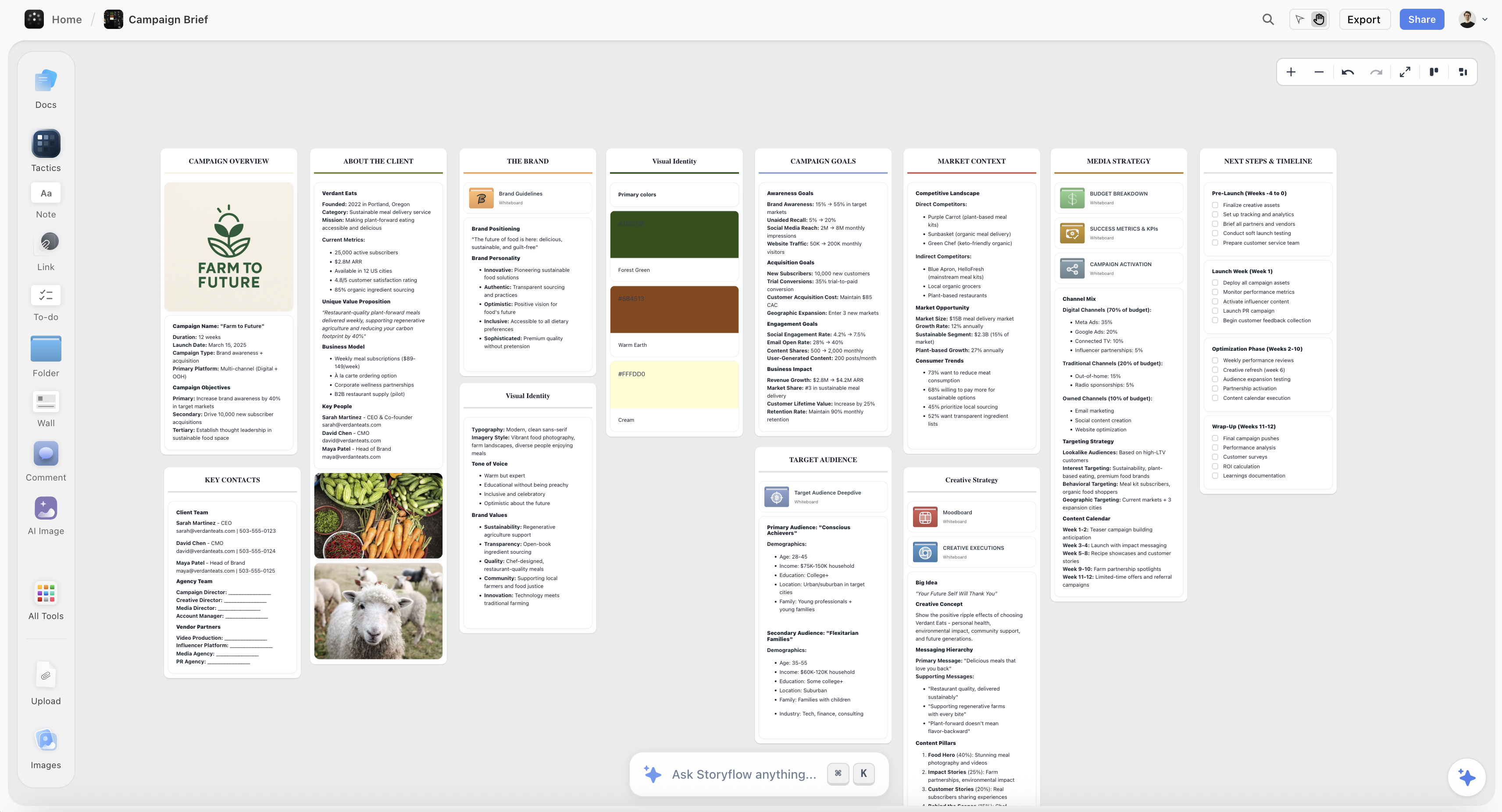
A campaign spine and its assets on one Storyflow canvas, arranged so coherence is visible rather than hidden behind dates
A calendar hides the thing most likely to be wrong
Arranging a campaign by date shows sequence and hides whether the assets say the same thing. Storyflow holds the spine, the proof and the drafts on one canvas the AI reads, so do these all express the same argument becomes a question rather than a workshop. Paid-only during early access; a wall works too.

The Ninety-Minute Session
Whole method, one session, before any spreadsheet exists.
Minutes 0 to 15: who. Write the person in a situation, one paragraph. Argue about it until it is specific enough that somebody could be described this way.
Minutes 15 to 30: the change. Name the belief or behaviour that has to shift. If the room can only produce company outcomes, keep going; that is the sign it has not been thought about.
Minutes 30 to 55: the sentence. Write six versions. Read each aloud. Cut the ones a competitor could say and the ones nobody would repeat. Land on one, and accept that it is slightly too long.
Minutes 55 to 70: the proof. What makes it credible, and which formats that implies.
Minutes 70 to 90: the map. Now list channels and assign each one job. Every asset gets its line back to the sentence.
Ninety minutes, and the output is a page. Then the spreadsheet, then the calendar, and both of them will be better because there is something for them to be a schedule of.
Where AI Helps
On the sentence, as an adversary. Give it your sentence and ask it to argue that nobody cares, or to produce five things a competitor could say instead. Both are useful and neither requires it to be right.
On the variations. Once the spine exists, generating the awareness, consideration, and conversion expressions of the same argument is genuinely fast, and it is the highest-value AI in campaign work because it is variation rather than invention.
On coherence checking. Reading eleven assets and answering whether they all express the same argument is a comparison across the whole set, which is slow by hand and is exactly where a campaign quietly goes wrong. This only works if the model can see all eleven, which means the assets have to live on one surface rather than in a chat window you describe them to.
Not on the who or the change. Those require knowing your customers, and a model will produce a plausible segment that describes nobody.
Not on the sentence itself. A generated argument is the median argument for your category, which is precisely what a competitor could also say, and that fails the second test.
What Goes Wrong
Channels first. The kickoff goes to deliverables in twenty minutes and the argument is never written. Most common failure by a wide margin.
A tagline instead of a sentence. Taglines compress an argument you already agreed. Written first, they compress nothing and mean nothing.
No proof, so adjectives. "Powerful, seamless, intuitive" appear exactly where evidence should be. Their presence in a draft is a reliable signal that box four is empty.
A segment instead of a person. Produces generic assets, because generic is what you write when you cannot picture the reader.
Measuring only the final action. You learn the campaign underperformed and not whether people did not stop, did not believe, or did not act. Three different problems, three different fixes.
Mapping on a calendar. Sequence is visible and coherence is not, so the thing most likely to be wrong is the thing you cannot see.
Assets nobody can trace to the sentence. Every campaign accumulates one or two. They are almost always safe to cut, and cutting them makes the rest louder.
Changing the argument mid-campaign. Repetition is the mechanism. Halfway through is exactly when the team is bored of the sentence and the audience is hearing it for the first time.
The Bottom Line
Campaign planning goes wrong in a specific and predictable place, and it is early. Twenty minutes into the kickoff, the conversation is about channels, and once it is about channels it never comes back.
What gets produced is a deliverable list with dates. It is executable, everybody knows what they are making, and it ships. And it lands as a set of things a company did that month, because nobody wrote down what the campaign was saying, so the eleven assets have nothing in common except a launch window.
The fix is ninety minutes and a page. Who, specifically enough that you could write them an email they would recognise. What change has to happen in their head. The one sentence a person would repeat to a colleague without you in the room. And the proof, because without it the assets will fill up with adjectives where evidence should be.
Then map the channels, one job each, and give every asset a line back to the sentence.
And map it somewhere you can see all of it at once. A calendar will tell you the campaign is on schedule right up to the moment it lands as noise, because sequence is what a calendar shows and coherence is what it hides.
FAQ: Mapping a Marketing Campaign
How do you map a marketing campaign?
Settle four things before naming any channel: who specifically, what change has to happen in their head, the one sentence that makes the argument, and the proof that makes it credible. Then give each channel one job as a variation of that spine, and give every asset a line tracing it back to the sentence. Ninety minutes, and it happens before the spreadsheet.
What is a campaign spine?
The one argument the campaign makes, which every asset expresses in a different form. It is what turns eleven deliverables into a campaign rather than a set of things that shipped in the same month, because the audience experiences accumulation and accumulation only works if the impressions are of the same thing.
What is the difference between a campaign plan and a deliverable list?
A deliverable list answers what and when. A campaign plan answers what we are saying and why these pieces belong together. Most plans are the first with a calendar attached, which is a production schedule, and it is why campaigns can be executed perfectly and still land as noise.
How do you know if your campaign has a spine?
Put the assets side by side, cover the logo, and ask whether any two could belong to different campaigns. If they could, there is no spine. The other reliable signal is adjective density: when assets lean on "powerful" and "seamless," it usually means there is no proof, and no proof usually means no argument.
What is the best AI tool for mapping out marketing campaigns?
The useful AI here is coherence checking rather than generation: reading all the assets and answering whether they express the same argument, which is slow by hand and is where campaigns quietly fail. That requires a model that can see the whole board, so the surface matters more than the tool. Storyflow does this on a canvas and is paid-only during early access; Miro and Milanote hold the board without the AI.
Should you plan a campaign on a calendar?
Not first. A calendar arranges by time, which shows sequence and hides whether the assets cohere, and coherence is the thing most likely to be wrong. Map the spine and the assets on a surface where you can see everything at once, then move to a calendar for scheduling once it holds together.
How many channels should a campaign use?
Fewer than most plans list, and the number matters less than whether each has a distinct job. A campaign with three channels each carrying a clear part of the argument outperforms one with eight assets that all say roughly the same thing at roughly the same time, because accumulation needs sequence and variation, not volume.
What should you measure in a campaign?
Three things separately: whether people stopped, whether they believed, and whether they acted. Measuring only the final action tells you the campaign underperformed without telling you which of the three failed, and those have completely different fixes: targeting, argument, and friction.
How long should a campaign message stay the same?
For the whole campaign, and longer than feels comfortable. Repetition is the mechanism by which a campaign works, and the team is bored of the sentence at roughly the point the audience is encountering it for the first time. Changing it mid-campaign resets the accumulation you have paid for.
Can AI write a campaign message?
It can generate the median message for your category, which is exactly the one a competitor could also say, and that fails the test that matters. It is genuinely useful in the other direction: as an adversary arguing that nobody cares, as a generator of variations once the spine exists, and as a coherence checker across the assets you have already made.
What comes first, the audience or the message?
The audience, described as a person in a situation rather than as a segment. The message is a response to a specific person's specific belief, so it cannot be written first without becoming generic. Teams that start with the message usually end up with something true about the category and unremarkable to anybody.
How do you keep a campaign coherent across a team?
Put the spine somewhere everybody making an asset can see it, and require one line per asset tracing it back to the sentence. That single rule catches most drift, because the assets that cannot be traced are the ones that wandered, and they are almost always safe to cut.
Table of Contents
Templates to check out for this topic


Marketing and campaign templates you can use in Storyflow
Plan the whole campaign on one board: brief, audience, channels, and assets connected, with an AI that reads all of it. Open a template and start from real structure.


See Storyflow in Action
A visual AI workspace where every feature lives inside one canvas. No tab-switching, no context lost.
Build your entire board from a single message
Type what you need in the AI chat at the bottom of your canvas. The AI adds cards, headings, and structure directly onto your board.
Use expert frameworks as AI context
Type @ in the AI chat and choose any Tactic. The AI tailors every response to that framework instead of giving generic advice.
Turn your board into a mind map in seconds
Ask the AI to restructure your canvas as a mindmap. It connects your ideas into a visual hierarchy so you can see how everything relates.
Why Storyflow Exists
Storyflow actually began as a personal tool while working on creative and research projects.
We kept running into the same problem: ideas were scattered everywhere: notes, documents, and whiteboards.
Nothing helped us see how everything connected.
So we started building a workspace designed around how ideas actually grow.
→ Read how Storyflow was createdJustkay
Documentary Filmmaker & Founder at Storyflow
Published: 2026-08-26
Extremely simple, seriously capable


See how easy it is to get started
Watch a real project come together, from a blank board to a finished plan, clicked through step by step.
Start creating with AI and become more productive
Transform your creative workflow with AI-powered tools. Generate ideas, create content, and boost your productivity in minutes instead of hours.