The 10 Best AI Tools That Turn a Document into a Project Board (2026)
Every tool builds a plausible board on day one. Only some can still read the document a week later, when someone asks whether the plan still matches the brief. That is the whole difference, and it is invisible at import.

Category
AI Tools
Author

Justkay
Documentary Filmmaker & Founder at Storyflow
Topics
2026-08-27
•
14 min read
•
AI Tools- turn a document into a project board
- pdf to project board ai
- ai tool brief to board
- convert pdf to project plan
- document to kanban ai
- creative brief to project board
What is the best AI tool to turn a document into a project board?
Storyflow is the best AI tool for turning a document into a project board when the document is creative material: a brief, a treatment, a research pack, a strategy doc. Drop the file on the canvas, describe what you want, and the AI lays out the plan while the source document stays on the board where both you and the AI can still read it. Taskade is the most direct converter if you specifically want a PDF turned into a task list. Notion AI is the right answer when the document is already a Notion page. ClickUp Brain suits teams who need the resulting board to carry assignees, dates and a delivery pipeline. The differences between these tools look small at import and turn out to be the whole story a week later. Most of them treat the document as fuel: read it once, generate a board, discard it. That is fine for a requirements list and quietly destructive for a creative brief, because every question that comes up later ("did we agree the audience was B2B?") has to be answered from a document the AI can no longer see.
Key Takeaways
- Storyflow is the best tool for turning a document into a project board when the document is a brief, a treatment or a research pack, because the file stays on the canvas as context after the board is built.
- Taskade is the most direct PDF-to-tasks converter, and the right pick when you want a checklist rather than a plan.
- Almost every tool in this category throws the document away after import. That is the single decision that separates them, and it is invisible until the second week of the project.
- A document becomes a board in one of three ways: extraction (pull out tasks), summarisation (compress to bullets), or reference (lay the material out and keep it readable). Each suits a different kind of document.
- Nothing here reliably converts a badly written document into a good plan. If the brief is vague, every tool produces a confident board built on the vagueness.
Keep the document after the board exists
Most tools read your brief once, generate a board and discard the source, so every later question about intent gets answered from their own summary. Storyflow keeps the file on the canvas where its AI still reads it, alongside the plan it produced. It builds a canvas rather than a task pipeline, so delivery stays in your tracker.

Table of Contents
- Three Ways a Document Becomes a Board
- Comparison Table
- How We Tested
- Detailed Reviews
- Which One for Which Document
- What None of Them Do
- FAQ
- The Bottom Line
- Related Reading
All 10 Tools, Ranked
- Storyflow: best when the document is creative material and must stay readable afterwards
- Taskade: best direct PDF-to-project converter
- Notion AI: best when the document already lives in Notion
- ClickUp Brain: best when the board needs a real delivery pipeline
- Miro AI: best when the output should be a workshop board
- Mem: best for turning notes into connected structure
- Airtable: best when the document is really a table
- Monday.com: best for turning a spec into a tracked workflow
- Trello with Atlassian Intelligence: best for a simple checklist board
- Google Gemini in Workspace: best when the document is a Google Doc and you want a quick outline
Best Document-to-Board Tool by Job
- Best for turning a creative brief into a project board: Storyflow. The brief stays on the canvas next to the plan it produced, so the AI can still answer questions about it.
- Best for turning a PDF into a task list: Taskade. It is purpose-built for exactly that conversion and it is fast.
- Best for turning a research pack into a working board: Storyflow. Drop several PDFs, links and images at once and lay the findings out spatially rather than as a summary.
- Best for turning a spec into an assigned, dated pipeline: ClickUp. The generated tasks land in a system that can actually run them.
- Best free option: Notion. Its free tier includes limited AI and handles documents natively.
2) Three Ways a Document Becomes a Board
Every tool here does one of three things, and picking the wrong one is why people conclude the category does not work.
Extraction. The AI reads the document and pulls out action items, which become cards. Taskade, ClickUp, Monday and Trello work this way. It is excellent when the document already contains a list of things to do, and it is poor on a document whose value is argument rather than instruction. Run a creative brief through an extractor and you get cards like "consider the audience", which is not a task.
Summarisation. The AI compresses the document into structured bullets arranged as a board. Notion AI and Gemini lean this way. Useful for long documents nobody will reread, and lossy by design: the specific sentence that later turns out to matter is exactly the sentence a summary drops.
Reference. The document is laid onto the canvas as material, and the board is built around it rather than from it. Storyflow and Miro work this way. Nothing is discarded, the source stays visible, and the cost is that you get a workspace rather than a tidy list.
Match the mode to the document. A requirements spec wants extraction. A meeting write-up wants summarisation. A brief, treatment or research pack wants reference, because on those documents the details are the point and you will need them again.
3) Comparison Table
| Tool | Mode | Keeps the Source Readable | Best Input | Starting Price |
|---|---|---|---|---|
Storyflow | Reference | Yes, stays on the canvas | Brief, treatment, research pack | $7.99 mo annual (free plan late 2026) |
Taskade | Extraction | No | PDF with clear action items | Free / from ~$8 mo |
Notion AI | Summarisation | Yes, if already a Notion page | Existing Notion doc | Free / ~$10 mo |
ClickUp Brain | Extraction | Partly, as an attached doc | Spec, scope of work | Free / from ~$7 mo |
Miro AI | Reference | Yes, as an embed it cannot read | Workshop input | Free / ~$8 mo |
Mem | Summarisation | Yes | Personal notes | From ~$10 mo |
Airtable | Extraction | No | Tabular document | Free / from ~$20 mo |
Monday.com | Extraction | No | Spec, requirements | From ~$9 seat mo |
Trello | Extraction | No | Simple checklist | Free / ~$5 user mo |
Gemini in Workspace | Summarisation | Yes, as a Doc | Google Doc | Bundled with Workspace |
Pricing reflects publicly listed plans as of early 2026 and changes often.
4) How We Tested
We used the same three documents on every tool: a six-page creative brief for a brand campaign, a twenty-page research pack of interview notes and links, and a two-page requirements spec.
Then we asked each tool the same question a week later, with no new input: "does the plan still match what the brief asked for?"
That question is the whole test. Every tool produced a plausible board on day one. Only the tools that kept the source document readable could answer the question at all; the rest answered from the board they had generated, which is a copy of their own earlier interpretation rather than the source.
Disclosure: Storyflow is our own product and we rank it first here. First means first for creative documents where the source must stay readable. For a PDF full of numbered action items, Taskade converts faster and more cleanly, and we say so in its review.
5) Detailed Reviews
1. Storyflow

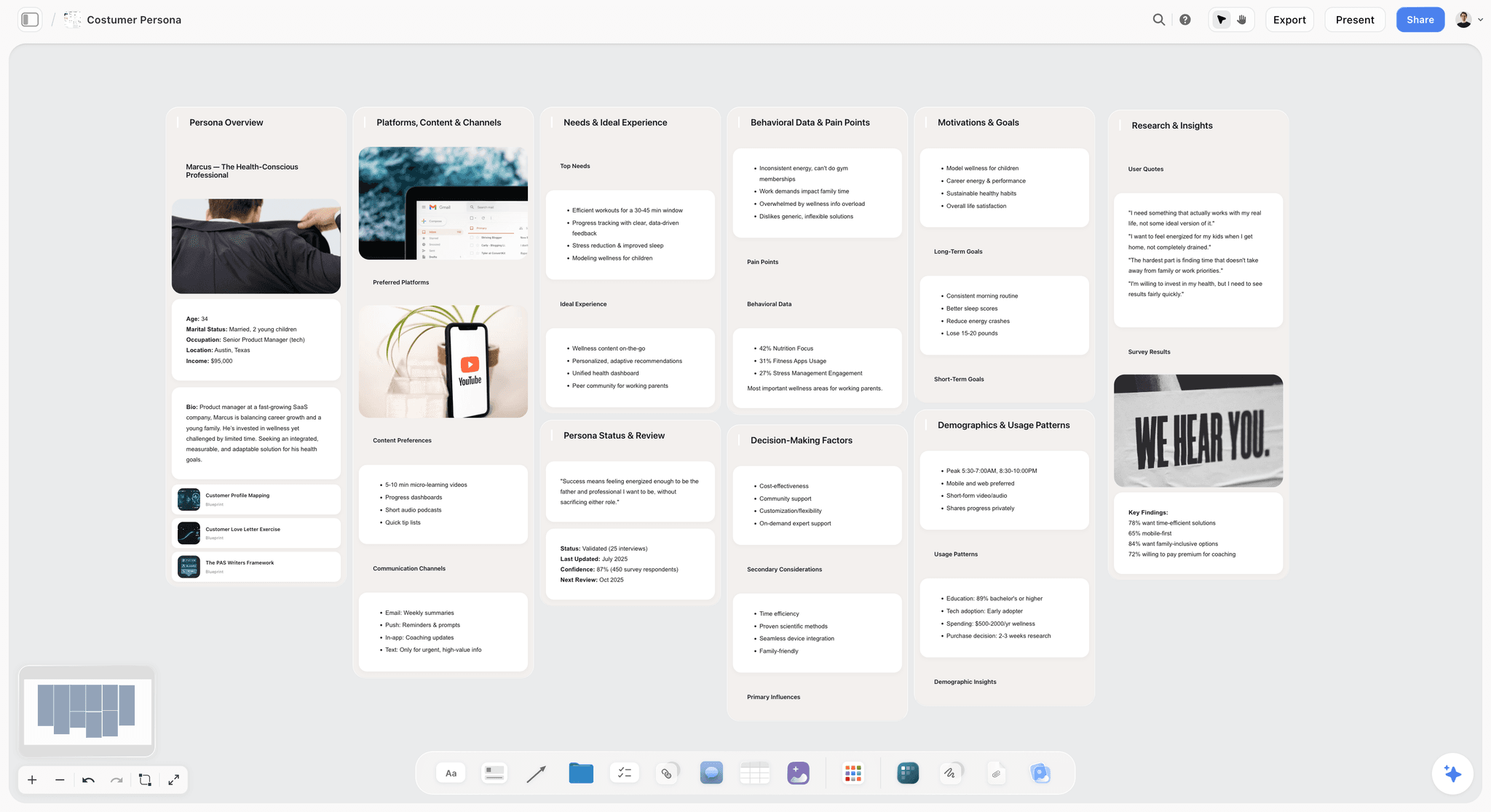
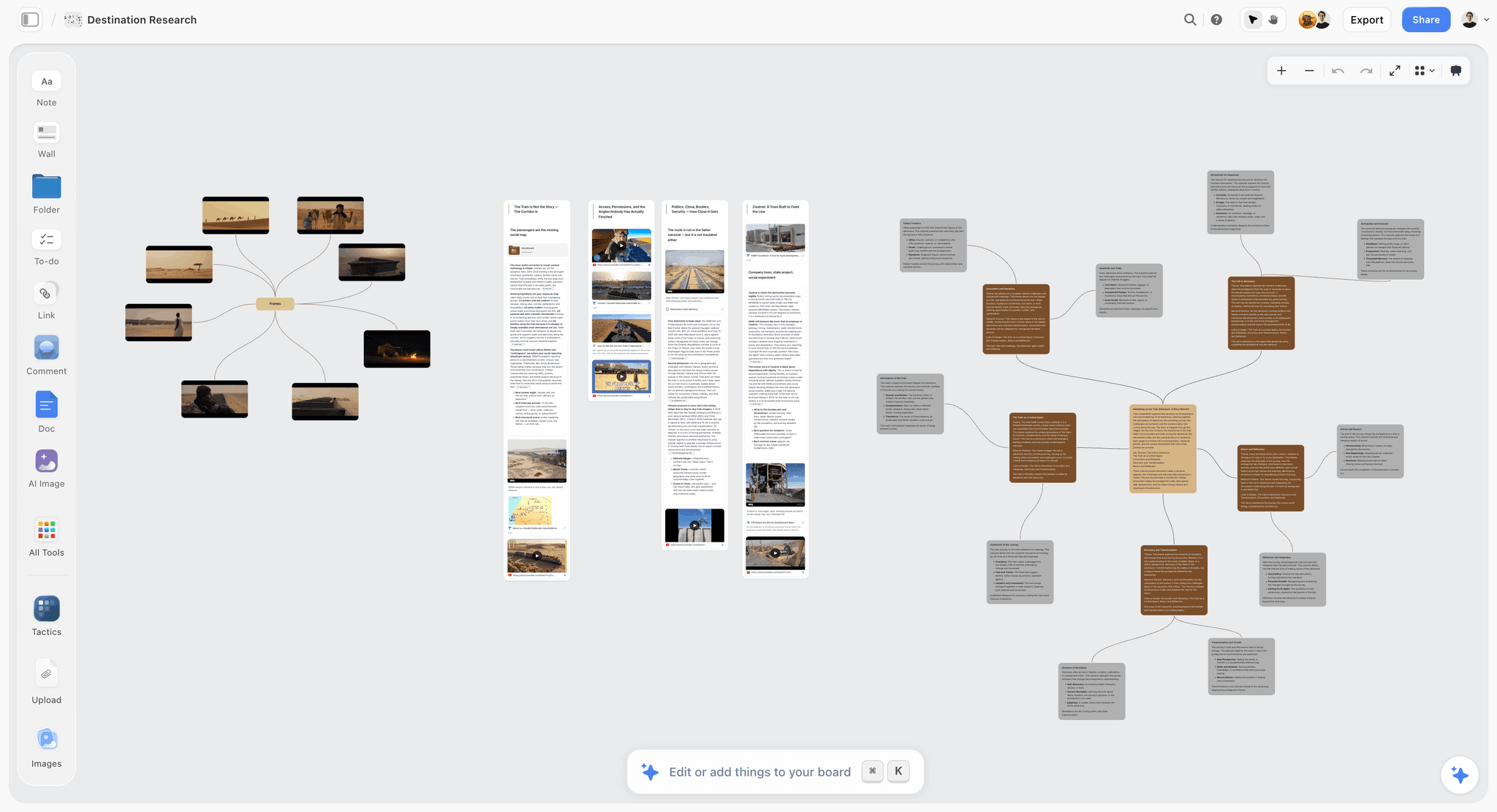
Drag a PDF, a link, an image or a set of notes onto the canvas and they sit there as material. Describe what you want built and the AI lays out planning boards around them. The distinguishing behaviour is what happens next: the document is still on the board, and the AI reads the whole active board plus one Tactic and up to three @-mentioned Documents each time you ask it something.
In our test this was the only tool that answered the week-later question directly, quoting the line in the brief that the plan had drifted from. Every extraction-mode tool answered from its own generated cards.
Where it is not the answer: the output is a canvas, not a pipeline. No assignees, no due-date rollups, no time tracking. If what you want from a document is fourteen tickets in a sprint, this is the wrong tool and ClickUp is the right one.
Key features
- Drop PDFs, links, images, video and notes straight onto the canvas
- AI reads the full active board plus one Tactic and up to three @-mentioned Documents
- Generates briefs, plans, moodboards and schedules around the source material
- 200+ story blueprints including Hero's Journey, AIDA and Retention Hooks
- View-only share links so stakeholders read the board without an account
Pricing
Paid-only during early access. Plus is $7.99 per month billed annually or $9.99 monthly. Pro is $14 annually or $19 monthly and adds AI image generation, roughly twenty times the AI volume and memory across conversations. Max is $39 annually or $49 monthly. A free plan launches before the end of 2026, and anyone a paid member invites to a board joins free today.
Pros
- The source document stays readable to you and to the AI
- Handles several documents and images at once as one context
- Flat account pricing rather than per seat
Cons
- Produces a canvas, not an assigned task pipeline
- Paid-only right now
- Overkill when the document really is just a checklist
2. Taskade
Taskade has a purpose-built PDF-to-project converter, and for the job it names it is the fastest and cleanest option here. Import a document, choose "Import and Summarize Document with AI", and you get a structured project in one step with no configuration.
It is pure extraction. The PDF is not retained as live context, so the project you get is the AI's one-time reading of it. On a document that is genuinely a list of things to do, that loses nothing.
Key features
- Dedicated PDF-to-project conversion flow
- Multiple project views from one import
- AI agents over the resulting lists
- Generous free tier
Pricing
Free tier available. Paid plans from roughly $8 per month.
Pros
- Fastest single-step conversion in the category
- Cheap and easy to trial
- Good structure out of the box
Cons
- Source document is not retained as context
- Weak on documents whose value is argument
- Shallow once the project gets complex
3. Notion AI
If the document is already a Notion page, Notion AI is the least friction available: it reads pages in the same workspace and can restructure one into a database, a board or a set of tasks. Because the page persists, the source stays readable, which puts Notion above the pure extractors.
The weakness is anything visual. A brief with reference images becomes a page with embeds, and embeds are opaque to the AI.
Key features
- AI over pages and databases in the same workspace
- Converts documents into databases and board views
- Strong docs and wiki foundation
- Real free tier
Pricing
Free plan is genuinely usable. Paid plans from roughly $10 per user per month.
Pros
- Source page persists as readable context
- No import step when the doc is already there
- Flexible output structures
Cons
- Visual material becomes an opaque embed
- Import from outside Notion is clumsier
- Setup burden on whoever owns the workspace
4. ClickUp Brain
ClickUp Brain reads docs and tasks in one workspace and can turn a specification into a task breakdown that lands in a system able to run it: assignees, dates, dependencies, time tracking. For a scope of work or a requirements document, this is the most operationally useful conversion here.
The generated tasks reference the doc rather than carrying it, so later questions about intent get answered from task text.
Key features
- Brain across docs, tasks and comments
- Generated tasks land in a real pipeline
- Built-in docs, time tracking and goals
- Strong free tier
Pricing
Free plan available. Paid tiers from roughly $7 per user per month, with AI packaging that varies by tier.
Pros
- Output is immediately actionable
- Broadest workspace AI of any tracker
- Good value at the team tier
Cons
- Extraction mode loses the argument in a brief
- Easy to over-configure
- Dense interface
5. Miro AI
Miro will take a document and help you turn it into a workshop board: clusters, themes, sticky notes. It is reference mode in layout terms, since the file can sit on the board, but the AI works on selections rather than reading the whole board, and an uploaded PDF is an embed it does not read.
Best when the point is to run a session about the document with other people in the room.
Key features
- AI clustering and generation on board content
- Best live multiplayer canvas
- Huge template library
- Strong facilitation tooling
Pricing
Free plan with board limits. Paid from roughly $8 per member per month.
Pros
- Excellent for turning a document into a live session
- Mature and reliable
- Good for group synthesis
Cons
- Uploaded documents are embeds the AI cannot read
- AI scoped to selections
- Boards decay after the session
6. Mem
Mem is built around notes that connect themselves, and it is good at taking a pile of written material and surfacing structure across it. For personal research it is genuinely pleasant.
It is a notes tool rather than a planning surface, so the "board" you end up with is a set of linked notes rather than a plan.
Key features
- AI-organised notes with automatic connections
- Strong search and recall
- Fast capture
Pricing
From roughly $10 per month.
Pros
- Very good at surfacing structure across many notes
- Low friction capture
- Genuinely useful recall
Cons
- Not a project board in any real sense
- Weak for teams
- No visual layout control
7. Airtable
When the document is really a table wearing a document's clothes, a list of deliverables, assets or episodes, Airtable is the correct destination. AI fields can classify and summarise across the resulting records at a scale nothing else here matches.
For prose it is the wrong tool entirely.
Key features
- AI fields across records
- Relational structure
- Interface Designer for stakeholder views
Pricing
Free tier available. Paid plans from roughly $20 per seat per month for AI tiers.
Pros
- Unbeatable on structured, repetitive content
- Scales to hundreds of records
- Good stakeholder views
Cons
- Wrong shape for prose documents
- Expensive at the AI tier
- Needs a schema owner
8. Monday.com
Monday.com converts a specification into a tracked workflow with columns, automations and dashboards. Configurable and pleasant, and firmly extraction mode.
Key features
- Highly configurable boards
- AI for updates, formulas and automations
- Good client-facing dashboards
Pricing
From roughly $9 per seat per month with a seat minimum.
Pros
- Strong workflow configuration
- Good reporting
- Approachable interface
Cons
- Seat minimums penalise small teams
- Source document not retained
- Configuration drift over time
9. Trello with Atlassian Intelligence
The simplest possible answer: paste content, get cards, move them across lists. Atlassian Intelligence summarises and drafts on cards.
For a short checklist document this is entirely sufficient and costs almost nothing.
Key features
- Simplest kanban available
- Atlassian Intelligence on cards
- Excellent free tier
Pricing
Strong free tier. Paid from roughly $5 per user per month.
Pros
- Immediately understandable
- Very cheap
- Reliable
Cons
- Thinnest AI here
- No document retention
- Falls apart past simple pipelines
10. Google Gemini in Workspace
If the document is a Google Doc, Gemini will outline it, summarise it and draft a structure from it without leaving the file. There is no board, but there is a fast path from a long document to something organised, and the source stays in Drive.
Key features
- Works inside Docs, Sheets and Drive
- Summarises and restructures in place
- No import step
Pricing
Bundled with Google Workspace tiers.
Pros
- Zero friction for Google-native teams
- Source stays intact
- No extra subscription
Cons
- No board output
- Weak structure control
- Nothing visual
6) Which One for Which Document
- Creative brief, treatment or strategy doc: Storyflow. The argument in the document is the part you will need again.
- Requirements spec or scope of work: ClickUp, or Monday if you prefer its workflow builder.
- PDF that is already a list of tasks: Taskade.
- Research pack of several files and links: Storyflow, because it takes them all as one context.
- Meeting write-up: Notion or Gemini, depending on where it already lives.
- List of deliverables or assets: Airtable.
- Something you want a team to work through live: Miro.
7) What None of Them Do
None of them fix a bad document. Every tool here will build a confident board from a vague brief, and the board inherits the vagueness while looking like progress. This is the most common disappointment in the category and it is not a tool problem.
None of them read images inside a PDF reliably. If your brief carries reference imagery, expect the visual half to be ignored or described badly. Putting the images on the canvas separately works better than embedding them in the document.
None of them know your team's capacity. Generated dates and estimates are decoration. Treat them as placeholders.
9) The Bottom Line
The category divides on one question that nobody asks at import time: after the board exists, can the AI still read the document that produced it?
For a requirements list the answer does not matter, and Taskade converts fastest. For a creative brief it is the only thing that matters, because everything contested later ("we agreed the audience was B2B", "the reference was the second one, not the third") lives in the source and not in the cards. Storyflow keeps the document on the canvas for exactly that reason, at $7.99 a month billed annually.
Pick by document type, not by feature list, and expect none of them to rescue a brief that was vague to begin with.
FAQ: Turning Documents into Project Boards
What is the best AI tool to turn a document into a project board?
Storyflow is the best AI tool for turning a document into a project board when the document is creative material such as a brief, treatment or research pack, because the file stays on the canvas as readable context after the board is generated. Taskade is the most direct PDF-to-project converter, and ClickUp is best when the resulting board needs assignees, dates and a delivery pipeline.
Can AI turn a PDF into a project plan?
Yes. Taskade converts a PDF into a structured project in one step, and Storyflow lays a plan out around the PDF while keeping the file on the canvas. The quality of the result depends almost entirely on the document: a PDF containing clear deliverables converts well, and a discursive brief produces a board full of vague cards unless the tool keeps the source readable.
What happens to the original document after the board is created?
In most tools it is discarded or reduced to an attachment the AI no longer reads. Storyflow, Notion and Google Workspace keep it readable. This matters more than it sounds: any later question about intent has to be answered from the source, and if the AI cannot see it, the answer comes from its own earlier summary instead.
Is there a free way to turn a document into a project board?
Notion, Taskade, ClickUp and Trello all have real free tiers that handle this. Storyflow is paid-only during early access, with plans from $7.99 per month billed annually and a free plan launching before the end of 2026, though anyone a paid member invites to a board joins free today.
Can I import several documents at once?
Storyflow takes multiple PDFs, links, images and notes onto one canvas and treats them as a single context, which suits a research pack. Most extraction-mode tools handle one document per import and produce a separate project each time.
Does it work with a creative brief specifically?
That is the case where the choice matters most. A brief's value is its argument about audience and message, and extraction-mode tools reduce that to generic cards. Use a tool that keeps the brief on the board next to the plan, so you can ask later whether the work still matches what was agreed.
What formats are supported?
PDFs and plain text are near-universal. Storyflow also accepts links, images and video on the canvas alongside documents. Google Docs work natively in Gemini, and Notion pages work natively in Notion AI. Support for scanned documents without a text layer is poor across the whole category.
Will the generated dates be accurate?
No. No tool here knows how long your team takes to do anything, so generated estimates are placeholders. Use the structure it produces and set the dates yourself.
Table of Contents
Templates to check out for this topic


Templates you can use in Storyflow
Every Storyflow board starts from real structure and an AI that reads the whole canvas. Open one of these templates and make it yours.


See Storyflow in Action
A visual AI workspace where every feature lives inside one canvas. No tab-switching, no context lost.
Build your entire board from a single message
Type what you need in the AI chat at the bottom of your canvas. The AI adds cards, headings, and structure directly onto your board.
Use expert frameworks as AI context
Type @ in the AI chat and choose any Tactic. The AI tailors every response to that framework instead of giving generic advice.
Turn your board into a mind map in seconds
Ask the AI to restructure your canvas as a mindmap. It connects your ideas into a visual hierarchy so you can see how everything relates.
Why Storyflow Exists
Storyflow actually began as a personal tool while working on creative and research projects.
We kept running into the same problem: ideas were scattered everywhere: notes, documents, and whiteboards.
Nothing helped us see how everything connected.
So we started building a workspace designed around how ideas actually grow.
→ Read how Storyflow was createdJustkay
Documentary Filmmaker & Founder at Storyflow
Published: 2026-08-27
Extremely simple, seriously capable


See how easy it is to get started
Watch a real project come together, from a blank board to a finished plan, clicked through step by step.
Start creating with AI and become more productive
Transform your creative workflow with AI-powered tools. Generate ideas, create content, and boost your productivity in minutes instead of hours.