The 12 Best Marketing Campaign Planning Tools in 2026 (Brief, Channels, Calendar, Budget)

Category
Marketing Tools
Author

Justkay
Documentary Filmmaker & Founder at Storyflow
Topics
2026-05-17
•
Updated September 19, 2026
•
37 min read
•
Marketing Tools- best marketing campaign planning tools 2026
- marketing planning tools
- best marketing planning software
- campaign planning software
- marketing campaign tools
- campaign management software
- CoSchedule alternative
- campaign planner tool
- marketing calendar software
What are the best marketing campaign planning tools in 2026?
The best marketing campaign planning tool in 2026 is Storyflow: ask its AI to build the campaign from your brief, with the channel mix, a dated marketing plan, a content calendar of post tickets and a budget table with a live total, on one canvas your client opens with a link and no account. After it come CoSchedule, a dedicated marketing calendar that also publishes social posts; Miro, for the planning workshop; and Notion, for a written plan beside the team's other docs. Add Asana or Monday.com once the approved plan needs owners and due dates, and HubSpot when the campaign has to live beside a CRM.

All 12 Marketing Campaign Planning Tools, Ranked
- Storyflow: best for planning a campaign from brief to channel plan, calendar and budget
- CoSchedule: best dedicated marketing calendar that publishes social posts
- Miro: best for the campaign planning workshop
- Notion: best for a written plan beside the team's docs
- Asana: best for owned, dated campaign work
- Monday.com: best for campaign workflows with dashboards
- HubSpot: best when campaigns are measured in pipeline
- Airtable: best relational campaign database
- ClickUp: best all-in-one campaign management
- Wrike: best for enterprise campaigns with Gantt charts
- Milanote: best visual board for the campaign idea
- Trello: best simple delivery board
Full disclosure: Storyflow is our own product, and we rank it first because it scores highest on holding the whole campaign on one board: the brief, the channel plan, the calendar, the budget and the deliverables, with an AI that reads all of them. The scores come from six weighted criteria set out in section 4, and its limits are listed in its review: it does not publish posts, has no Gantt charts or automations, and runs in the browser only. CoSchedule, Asana and HubSpot do jobs it does not, and we say where. Each review links to that vendor's own pricing page so you can check.
Quick Comparison: Best Marketing Campaign Planning Tools
The top four by score: the tool that plans the whole campaign, the dedicated calendar, the workshop board and the written plan.
| Tool | Best For | AI Features | Price |
|---|---|---|---|
| Storyflow | Brief to channel plan, calendar and budget | Reads the whole board plus attached docs | $7.99 mo annual (free plan late 2026) |
| CoSchedule | A marketing calendar that publishes | AI Assistant for drafting | Free (15 posts per profile) / $29 mo annual |
| Miro | The campaign planning workshop | AI on credits per member | Free / $8 member mo annual |
| Notion | A written plan beside the team's docs | Notion AI in pages and databases | Free / $10 seat mo annual |
1) Quick Answer: The Best Marketing Campaign Planning Tools in 2026
The best marketing campaign planning tool in 2026 is Storyflow: ask its AI to build the campaign from your brief, with the channel mix, a dated marketing plan, a content calendar of post tickets and a budget table with a live total, on one canvas your client opens with a link and no account. After it come CoSchedule (a dedicated marketing calendar that also publishes social posts), Miro (the planning workshop) and Notion (a written plan beside the team's other docs). Asana and Monday.com earn their place once the approved plan needs owners and due dates, and HubSpot fits when the campaign has to live beside a CRM.
If you want a simple AI tool to map out a marketing campaign, the test is short: paste the brief, ask for the plan, and see whether what comes back covers the channels, the dates, the money and the deliverables, or only the posts.
A content calendar tells you what posts on Tuesday. It does not tell you what the campaign is about, what it costs, or who signs it off. The tools below are ranked on whether they hold the whole campaign, from brief to channel plan to calendar to budget, and not only the schedule.
For the hands-on workflow, see How to Plan a Brand Campaign with AI. For the brief that starts it, see What Is a Campaign Brief. For a launch that starts before the brand exists, see the best tools to plan a brand launch from idea to campaign.
2) Comparison Table: 12 Marketing Campaign Planning Tools at a Glance
The "Holds the Brief" label follows each tool's brief score in section 4 (9 to 10 Strong, 7 to 8 Good, 4 to 6 Moderate, 3 or less Light or Weak). Ratings are the weighted scores from section 4. Prices were checked on each vendor's own pricing page in September 2026; Monday.com's are the figures monday.com lists for annual billing, which vary by billing country.
Best Campaign Planning Tool by Buyer: Founders, Brand Leads and Agencies
The right tool depends less on the size of the campaign than on who the plan is owed to. A founder owes it to a launch date, a brand lead owes it to leadership and a quarterly number, and an agency owes it to a client who has to approve it before anything is made.
If you run an agency, How Agencies Present Campaign Concepts covers the approval meeting, and Campaign Approvals From Brief to Delivery covers the sign-off chain after it.
Frequently Asked: Which Marketing Planning Tools Are Most Trusted, Best Rated and Fairest on Price
Which marketing calendar is most trusted by marketing managers and coordinators?
CoSchedule, because it was built as a marketing calendar rather than adapted into one, and its Suite plan (custom, from $69 a month) removes the seat limit, so a whole department and its agencies can share one calendar. Storyflow is second: it plans the calendar from the brief but does not publish, so it pairs with a scheduler rather than replacing one. Asana and Monday.com follow as work platforms whose calendars show campaign tasks rather than posts.
Which marketing planning tools are fairest on price?
Storyflow: $7.99 a month billed annually, and invited collaborators join free, so a client or freelancer never needs a seat. Trello is next if a delivery board is all you need: its free plan takes up to 10 collaborators per Workspace. ClickUp is $7 per user billed annually, but its Brain AI is a separate $9 per user a month. The steepest are HubSpot's $3,000 Professional onboarding fee and CoSchedule's one-seat $29 Starter plan.
Which campaign planning tools have customizable templates for campaign planning?
Storyflow saves any finished campaign board as your own template, so next quarter starts from this quarter's brief, walls and budget table rather than a generic layout. Miro has a free creative brief template covering audience, specifications, deadline and goals, and Notion publishes its own free creative brief template. Milanote has the widest set of named brief templates (advertising campaign, digital campaign, social media campaign, media planning), though none of them carry dates or a budget.
Which campaign planning tool is most underrated?
Storyflow, with the obvious caveat that we make it: few marketers have tried an AI that reads the brief, the dated plan and the budget table together before it drafts the next piece. Airtable is the most underrated established tool: linked records answer "which deliverables belong to which campaign" better than any task list.
Which tool is best for hybrid marketing and sales campaign planning?
HubSpot, because the campaign, the contacts and the pipeline are one system, and Marketing Studio's Breeze Assistant proposes the plan from past performance (Marketing Hub Professional or Enterprise only). Storyflow is second for the part the two teams argue about, the message and the offer, on a board sales can open without a seat. Monday.com is third if sales already runs its CRM there, since monday.com sells a separate CRM product priced per seat.
Which campaign planning tool is recommended for a founder launching a product?
Storyflow, planned backwards from the launch date: ask the AI for a marketing plan and its Timeline wall lays out dated phases you can check against the date you owe. Invite a cofounder or freelancer free. Trello is second once three or more people own launch tasks, and Asana's free Personal plan (two users) is the alternative when tasks need dependencies.
Marketing Planning and Campaign Planning Are Not the Same Job
Marketing planning is the annual and quarterly layer: positioning, audience, the handful of bets for the year, budget allocation across channels, and the goals each bet is meant to move. It happens two to four times a year and produces a document leadership signs off.
Campaign planning is the per-initiative layer: the brief, the concept, the channel plan, the dates, the budget and the deliverables. It happens continuously and produces a plan someone approves and a schedule someone runs.
Campaign execution is the third layer: tasks, approvals, publishing, and reporting.
Almost every tool in this article is strongest at one of the three:
- Annual and quarterly planning: Storyflow, Miro, Notion, Milanote. Canvas and document tools win here because the output is reasoning, not rows. A quarterly plan in Asana becomes a list of tasks and loses the argument that justified them.
- Campaign planning: Storyflow, CoSchedule, Notion, Airtable. This layer needs the brief, the channel plan, the calendar and the budget in one place, which is why it is the layer teams most often split across two or three tools.
- Campaign execution: Asana, Monday.com, ClickUp, Wrike, Trello, HubSpot. Work management platforms are built for exactly this, and none of the canvas tools should be asked to do it.
Most teams need one tool from the first two groups and one from the third, and that two-tool stack is usually cheaper than an all-in-one that does neither well.
The Quarterly Plan, and What Goes In It
A working quarterly marketing plan is six things, and it fits on one page or one board:
- The goal, stated as a number with a date attached.
- The audience, narrow enough to exclude someone.
- The bets: two to four initiatives, each with the reason it should work.
- The channels each bet runs on, and why that channel and not another.
- The budget split across the bets, with the largest bet named.
- The measure: what will be true in ninety days if this worked.
The test is whether a new hire could read it in five minutes and say what the quarter is about. How to Write a Marketing Plan with Real Structure goes deeper on each of the six.
Best Marketing Planning Software in 2026
The best marketing planning software in 2026 is Storyflow for the annual and quarterly plan and the campaigns it becomes, Miro for the workshop that produces it, and Notion for a plan that has to live next to everything else the team writes. Asana and Monday.com then turn the approved plan into work. Marketing planning software is a different purchase from campaign management software, and buying the second when you needed the first is how a team ends up with an excellent task tracker and no plan.
Ranked for the planning job specifically, rather than for campaign execution:
The column that decides it is "holds the reasoning". Work management platforms store the conclusion of the plan as tasks and throw the argument away, so next quarter's planning starts from scratch instead of from what was learned.
Storyflow's honest limitation here: it has no due-date rollups, dependencies, workload views or Gantt charts, and it is not trying to. If your bottleneck is who owns what by when across twenty people, buy Asana or Monday.com and keep the plan in Storyflow.
Free options for the planning job: Miro's free plan covers a workshop on up to three editable boards, and Notion's free plan holds a written plan for an individual. Storyflow is paid-only during early access; its Free plan launches before the end of 2026.
Marketing Calendar Software: What It Does and When You Need One
Marketing calendar software is the scheduling layer: it answers what goes out, on which channel, on which date, and who is responsible. CoSchedule is the strongest dedicated option and, with HubSpot, one of two tools here that also publish social posts; Notion and Airtable do the job as a database with a date field; Asana, Monday.com and Wrike show a calendar of work they already track.
You need dedicated calendar software when three things are true at once: more than one channel, more than about four people, and a publishing cadence that runs weekly or faster. Below that, the calendar inside a tool you already pay for is sufficient, and a second subscription is an avoidable cost.
A campaign scheduler tool is not the same as a campaign planner. A scheduler (CoSchedule, Buffer, Later, Planable) takes finished posts and publishes them at set times. A planner decides what the posts are for. Teams that buy a scheduler first end up with a full queue and no campaign; teams that plan first know which twelve posts the queue needs.
Recurring campaign cycles (a quarterly push, a monthly newsletter series, a yearly sale) are where the two meet: the useful feature is a template that keeps the whole plan, not only the tasks. The FAQ covers which tools do that.
For the content-calendar side on its own, see the best content calendar tools and How to Build a Content Calendar with AI.
What a Campaign Plan Has to Hold: Brief, Channels, Calendar, Budget, Assets
A campaign plan passes through seven stages between the brief and the report. Each needs something different from a tool, and most tools cover two or three of them. This is the map to check a tool against before you pay for it.
Stages one to five decide whether the campaign works, and they are the ones calendar and task tools skip. Stage six is where agencies lose time: every round of PDF comments is a round of re-entry.
For the brief itself, What Is a Creative Brief and the best creative brief tools go further than this page does.
The Seven-Block Campaign Plan: A Filled Worked Example
Here is the one-page plan this article recommends, filled in for an example: a small skincare brand launching an SPF moisturiser with a six-week campaign and a $12,000 budget. It is an illustration of the format, not a client case. Copy the left column into whatever tool you use.
The budget block deserves its own table, because it is the block most campaign tools leave to a spreadsheet and the one leadership reads first:
What makes it usable: every channel depends on another (creators make the proof paid social amplifies), every budget line has an owner, and the week-four measure is a decision, not a report.
In Storyflow, each block is a wall you ask the AI for in turn; the step-by-step section below shows the order.
3) Story, Not Calendar
A marketing campaign is two things wearing one name. The campaign story is the objective, audience, insight, big idea and the way the channels build on each other; it answers what the campaign is about. The campaign calendar is what ships, where, when and by whom; it answers what goes out Tuesday.
Most campaign tools hold the calendar and lose the story. Project managers and marketing calendars are built to schedule and assign, and they have nowhere to hold the big idea. So the campaign gets planned as 30 dated cards, every one ships on time, and the campaign still falls flat. A campaign that lands is planned story-first, with the budget split to match, and only then scheduled. Visual campaigns take this one step further with a marketing storyboard that maps the narrative beat by beat.
The test to run on your own plan: pick any five slots from next month's calendar at random and ask what each one does for the big idea. If you cannot answer for three of the five, the campaign was planned as a calendar.
4) How We Evaluated These Tools
Six criteria, weighted for the reader this page is written for: a marketing or brand lead, founder or agency that owes a campaign to a launch date or a client.
- Brief and campaign idea (25%). Objective, audience, insight and big idea, kept in view while the rest is planned.
- Channel plan and calendar (25%). What each channel does and when each piece ships.
- Budget and deliverables (15%). Spend by channel and assets with owners.
- Client and team review (15%). How easily a client or stakeholder can see and answer the plan.
- AI that drafts from the whole plan (10%). The whole brief and plan, or only the cell it sits in.
- Price for a team of one to eight (10%). What the working setup costs and how steeply it climbs.
Each tool is scored out of 10 per criterion; the rating is the weighted sum. Storyflow was scored in September 2026 on its current workflows. The other eleven were compared from their own pricing and product pages, checked the same month.
The rating is the weighted sum, so you can recompute any row. Two scores need a word: Miro gets 5 on channels and calendar because a workshop can map and agree the channel sequence on its board, while Milanote gets 2 because it has no dates, calendar or task layer, so its channel plan stays a list of notes. Re-weight the columns for your own situation: a social team that lives in its publishing queue should double the calendar column, and CoSchedule then comes much closer to the top.
5) Quick Picks by Campaign Planning Need
Best overall for planning a campaign from brief to budget: Storyflow.
Best simple AI tool to map out a marketing campaign: Storyflow, then Miro, whose AI helps a team build the map live on a whiteboard.
Best for client-facing campaign plans: Storyflow, then Miro.
Best dedicated marketing calendar: CoSchedule, then Storyflow for the planning half of the calendar.
Best for campaign budgets: Storyflow for a campaign-level budget table, Wrike for department budgeting on its Pinnacle plan.
Best for campaigns tied to a CRM: HubSpot, then Storyflow for the concept and the plan the client sees.
Once the plan is approved, add: Asana or Monday.com for owners and due dates, CoSchedule for publishing, HubSpot for attribution. These are execution tools, and the stacks in section 7 show how they pair.
How Marketing Campaign Planning Tools Compare on AI
Almost every planner now advertises AI, but for campaign work the depth splits on one question: does the AI understand the campaign, or only the cell it is sitting in?
Tier 1: AI that works from the whole plan. Storyflow's AI reads the board you have open with every message, plus up to five documents and three other boards you attach from the "+" menu, so it can check whether a calendar ticket still serves the big idea. Changes apply to the board directly, with one-click Undo per message: the AI proposes, you decide. HubSpot's Marketing Studio is the other tool here: its Breeze Assistant proposes a campaign plan with "who to target, how to reach them, and what to say" from your brand, audience and past performance, on Marketing Hub Professional or Enterprise.
Tier 2: AI that drafts inside a record. CoSchedule's AI Assistant, Notion AI, ClickUp Brain, Asana's and Monday.com's AI, Miro's AI (on credits) and Airtable's AI generate copy, summarise and fill fields inside a post, task, page or board. Useful for turning a planned slot into finished copy, but the AI mostly works from that one slot, so keeping the message consistent across the campaign stays your job.
Tier 3: Little or no AI. Milanote lists no AI features on its plans page, and Trello is chosen for the board, not the assistant.
6) Detailed Reviews: 12 Marketing Campaign Planning Tools
1. Storyflow
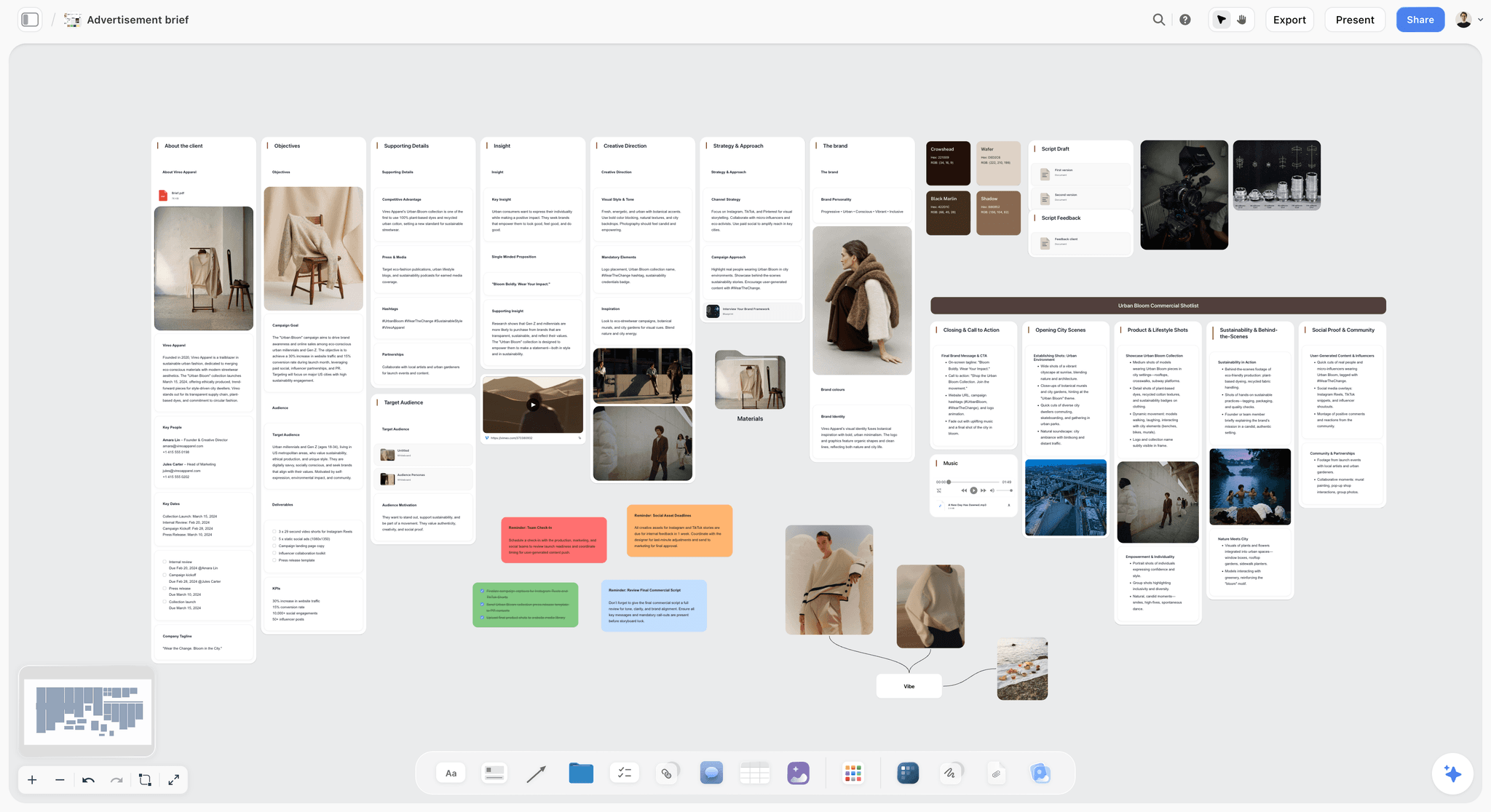
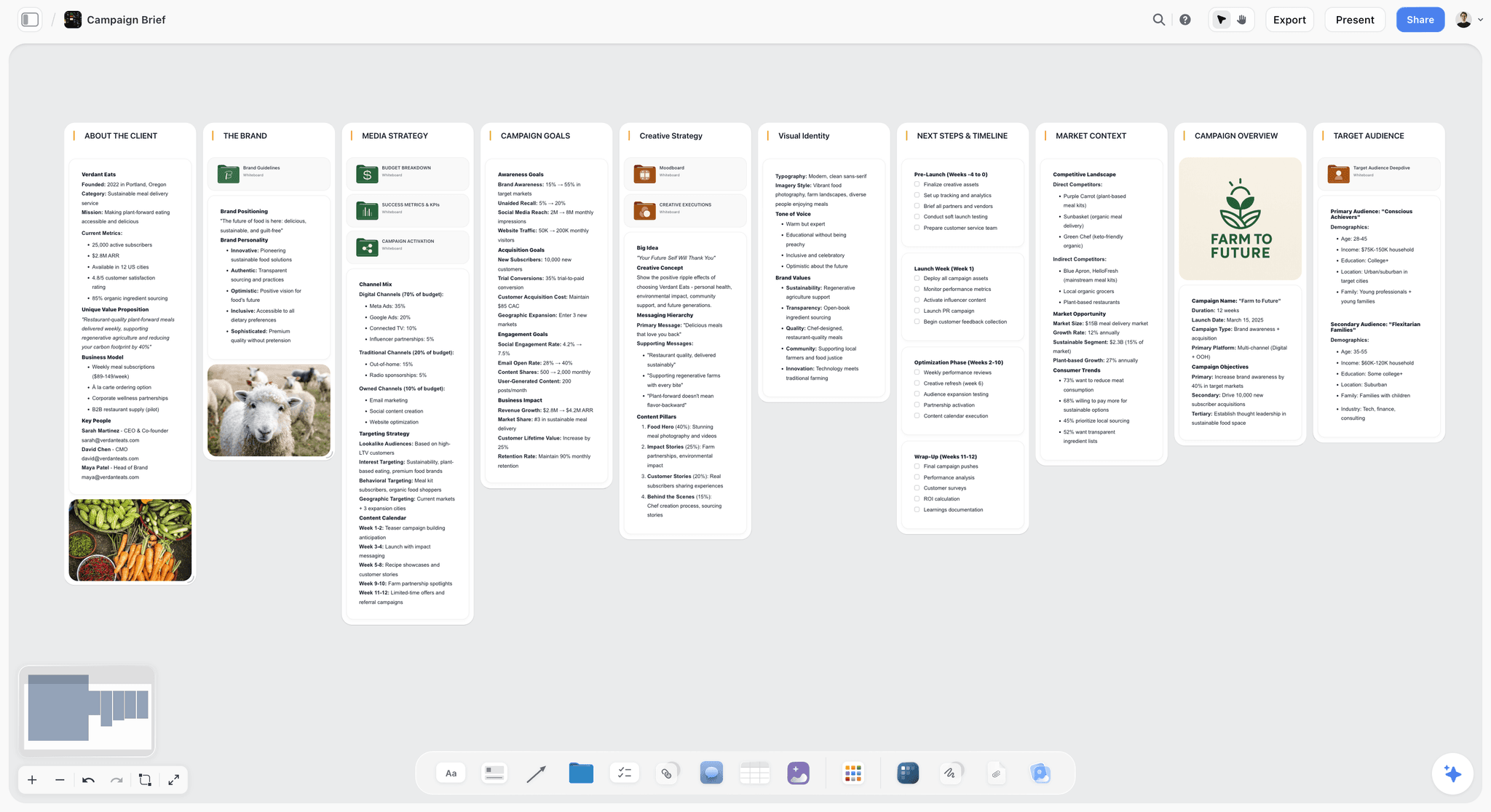
Storyflow is an infinite canvas with an AI that plans the campaign with you. Each piece is something you ask for: a campaign brief across ten walls, a marketing plan whose Timeline wall holds dated phases, a content planner whose calendar is a wall of post tickets, and a budget table with a live total. The AI reads the whole board with every message, so you can ask whether the calendar still carries the big idea or whether the budget matches the channel plan. The how-to section below gives the order.
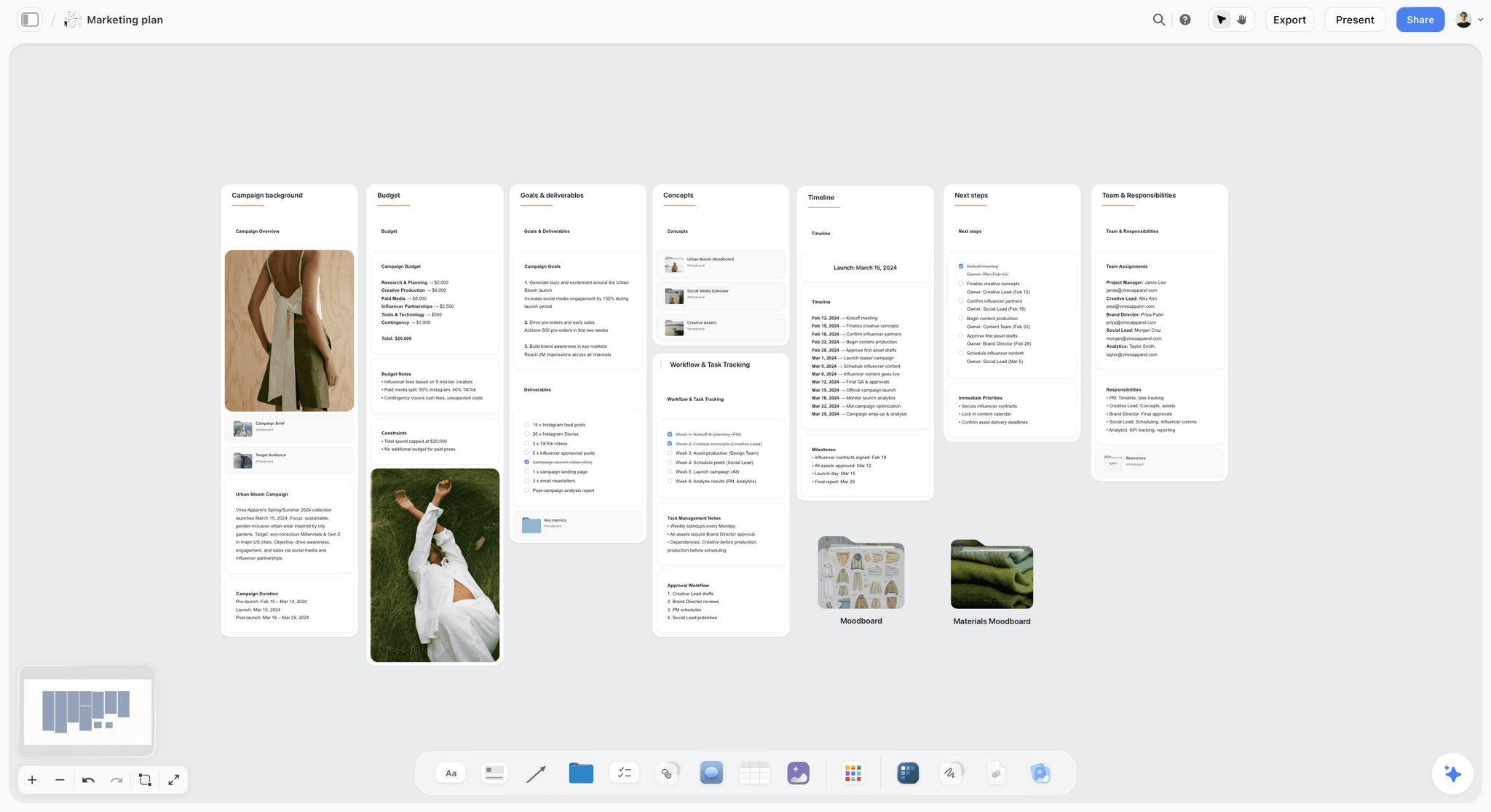
For approval, a view-only link opens with no account, a client signs in to comment, and presentation mode goes fullscreen and steps through the board one wall at a time. The AI can also produce a One-Pager PDF or a Presentation PDF, and the whole board exports as an image or PDF. The AI marketing campaign planner page shows the setup, and the marketing workspace page shows several campaigns side by side.
Best for: Founders, brand leads and agencies who owe a whole campaign (brief, channels, calendar, budget, deliverables) to a launch date or a client.
Verdict: The strongest tool for planning the campaign itself. For publishing, pair it with CoSchedule; for task tracking across a large team, pair it with Asana.
Key features
- AI reads the open board plus up to five attached documents and three other boards per message.
- Tables with status, person, date, currency and link cells; tickets with assignees; charts; documents with comment threads and Word or PDF export.
- Real-time editing with live cursors for invited collaborators; admin, edit and view access levels.
- Boards duplicate or save as templates for the next campaign cycle.
Pricing
Storyflow is paid-only during early access, with plans from $7.99 a month billed annually ($9.99 monthly). Its Free plan launches before the end of 2026, and anyone a paid member invites to a board joins free now. Plus: $7.99/mo annual ($9.99 monthly). Pro: $14/mo annual ($19 monthly). Adds AI image generation and memory across conversations. Max: $39/mo annual ($49 monthly). Adds Team Workspace, Permissions and Roles, and more AI. AI use is metered on every plan. Team billing is per seat.
Pros
- The brief, dated plan, calendar tickets and budget sit on one board the AI reads.
- A client reviews the plan from a link without creating an account.
- Anyone a paid member invites joins free, so clients and freelancers stay off the bill.
Cons
- It does not publish or schedule posts, and it has no integrations with CoSchedule, Asana or HubSpot.
- Tables cannot be sorted or filtered by a column, and there are no dependencies, Gantt charts or automations.
- The board's pieces do not update each other: when the plan changes, ask the AI to redraft the calendar and budget.
- It runs in the web browser only, with no native apps; heavy building is a laptop job.
- It is new, in early access and paid-only until the Free plan arrives.
Choose something else if your campaign is mostly a publishing queue across social channels (CoSchedule), or your bottleneck is who owns what by when across twenty people (Asana or Monday.com).
2. CoSchedule
CoSchedule is a dedicated marketing calendar that also publishes. Social posts, blog posts and events sit on one calendar, its social tools publish and report on posts, a Social Inbox handles replies, and its AI Assistant helps draft. It is calendar-led by design and light on the brief and the budget.
Best for: Marketing and social teams whose daily job is a publishing calendar across several channels.
Pricing
Free plan: schedule up to 15 posts per profile. Full plan list and billing shape in the pricing table below. Source: CoSchedule pricing.
Pros
- Blog, social and event dates on one calendar, with publishing built in.
- Social Inbox and analytics next to the schedule.
- Suite removes the seat count for large departments.
Cons
- No place for the brief, the big idea or the budget.
- Starter covers one seat, so a team starts at Professional.
- The free plan's 15-posts-per-profile limit fills fast for anyone posting several times a week.
3. Miro
Miro is the collaborative whiteboard for campaign planning workshops. The objective, insight, big idea and channel map come out of a live session with the team on one board, and its free creative brief template gives the session a starting shape. It is strong for the thinking and light on the calendar and budget.
Best for: Teams that decide campaigns in real-time workshops.
Pricing
Free: 3 editable boards. Full plan list and billing shape in the pricing table below. Source: Miro pricing.
Pros
- The best live workshop surface on this list, with voting.
- Over 7,000 board templates, including a free creative brief.
- Good for customer journey and channel maps.
Cons
- The 3-board free limit fills after one campaign.
- No dates, budget or task tracking built for campaigns.
- A whiteboard does not record which sticky note was decided.
4. Notion
Notion holds a campaign plan as pages and databases: a brief page, a content calendar database with date properties, a channel tracker. It holds a written version of the story and the calendar in one workspace, and Notion publishes its own free creative brief template. The cost is setup time before the plan is usable.
Best for: Teams that want the campaign plan beside the wiki, briefs and meeting notes they already keep in Notion.
Pricing
Free for individuals. Full plan list and billing shape in the pricing table below. Source: Notion pricing.
Pros
- Brief and calendar database in one workspace, linked to each other.
- Notion AI works inside the pages and databases the team already uses.
- A free Notion-made creative brief template to start from.
Cons
- The brief is a page, not a visual plan a client can scan.
- Someone has to build the databases before anyone can plan in them.
- The free plan is limited once two or more members share it.
5. Asana
Asana is a work management platform strong at campaign execution: tasks, owners, due dates, dependencies and timelines. Once the campaign is planned, Asana runs the delivery, and its campaign templates give recurring cycles a reusable task structure. It does not hold the brief or the argument behind the plan.
Best for: Teams that need owned, dated work once the campaign is approved.
Pricing
Personal: free for 2 users. Full plan list and billing shape in the pricing table below. Source: Asana pricing.
Pros
- Dependencies keep launch-week tasks in order when one slips.
- Every deliverable gets one owner and one due date.
- Campaign templates for repeating the same launch shape.
Cons
- No home for the brief, concept or budget argument.
- The free Personal plan stops at two users.
- Built for any project, so marketing fields are yours to set up.
6. Monday.com
Monday.com is a work management platform used to run campaign workflows: boards, automations and dashboards that track a campaign through its phases and report status upward. Like Asana, it is strong at execution and not built to hold the campaign story.
Best for: Teams that want campaign workflows with dashboards for leadership.
Pricing
Free for up to 2 seats. Full plan list and billing shape in the pricing table below. Source: monday.com pricing.
Pros
- Automations move a deliverable to the next owner without a status meeting.
- Dashboards leadership reads without opening the boards.
- A separate CRM product for teams that plan with sales.
Cons
- No home for the brief or the idea.
- The three-seat minimum makes a team of two pay for three.
- Each campaign workflow is configured by hand before it runs.
7. HubSpot
HubSpot ties campaigns to a CRM: emails, ads, social and content connect to contacts and pipeline, so a campaign's value is measured in outcomes. Marketing Studio adds an AI planning workspace: its Breeze Assistant proposes a campaign plan with "who to target, how to reach them, and what to say" from your brand, audience and past performance, and you map channels, create assets and build automations on one canvas. It needs Marketing Hub Professional or Enterprise.
Best for: Marketing teams whose campaigns are judged in pipeline and whose contacts already live in HubSpot.
Pricing
Free for up to 2 users. Full plan list and billing shape in the pricing table below. Source: HubSpot Marketing Hub pricing.
Pros
- Planning and attribution are the same object.
- Breeze Assistant plans from real performance data.
- Email, ads and social publish from the same system.
Cons
- Marketing Studio sits on the $800-a-month plan.
- The creative idea is secondary to the CRM.
- Onboarding fees of $3,000 and up before the first campaign.
8. Airtable
Airtable is a relational database that marketers use to run campaigns: linked tables for campaigns, content, channels, assets and budget lines, with calendar, grid, kanban and gallery layouts over the same records. It is very good at answering which asset belongs to which campaign.
Best for: Marketing operations teams that want campaigns, assets and budgets as linked records.
Pricing
Free plan. Full plan list and billing shape in the pricing table below. Source: Airtable pricing.
Pros
- One asset record can belong to several campaigns and channels at once.
- The same records show as a calendar, a grid or a kanban.
- Budget lines roll up per campaign.
Cons
- Someone has to design the base before the team can use it.
- A client sees rows and fields, not a campaign.
- Per-user pricing reaches $45 on Business.
9. ClickUp
ClickUp is an all-in-one work platform: tasks, docs, whiteboards, calendars and goals in one place. It is broad and execution-led, with docs that can hold a campaign brief.
Best for: Teams that want one platform for campaign tasks and docs.
Pricing
Free plan (60MB storage, 3 whiteboards). Full plan list and billing shape in the pricing table below. Source: ClickUp pricing.
Pros
- Docs, tasks and whiteboards under one login.
- The lowest per-user paid price among the work platforms here.
- A brief doc can sit in the same space as its tasks.
Cons
- The free plan's 60MB storage fills with the first set of campaign images.
- So many views and settings that each team configures its own.
- AI is a separate per-user add-on.
10. Wrike
Wrike is an enterprise work management platform for larger marketing teams: task management, proofing, reporting and, on its Pinnacle plan, budgeting and resource planning. Its Team plan includes interactive Gantt charts, the strongest pure timeline on this list.
Best for: Larger marketing teams running campaigns with many dependencies.
Pricing
Free plan. Full plan list and billing shape in the pricing table below. Source: Wrike pricing.
Pros
- Interactive Gantt charts from the $10 Team plan.
- Proofing for creative assets inside the same tool.
- Budgeting for department-level spend on Pinnacle.
Cons
- The Team plan stops at 15 users.
- Budgeting sits on quote-only plans.
- More setup than a campaign of one to eight people needs.
11. Milanote
Milanote is a visual board for the campaign idea: objective, references, big idea and channel narrative on freeform boards. It has named brief templates (advertising campaign, digital campaign, social media campaign, marketing and media planning briefs). It has no calendar, budget or task layer and lists no AI features, which is why it scores low for campaign planning.
Best for: Designers and brand leads shaping the look and message before the plan exists.
Pricing
Free: 100 notes, images or links and 10 file uploads. Full plan list and billing shape in the pricing table below. Source: Milanote plans.
Pros
- The widest set of named campaign brief templates here.
- Read-only share links need no signup to view.
- A web clipper for collecting references.
Cons
- No dates, budget or task assignment.
- The 100-item free limit fills on a real campaign.
- No AI to draft or check the plan.
12. Trello
Trello turns a campaign into a kanban board: lists for phases, cards for deliverables, due dates and checklists on each card, and a calendar Power-Up. It has no place for the campaign story or the budget.
Best for: Small teams that want a delivery board after the plan is done.
Pricing
Free for up to 10 collaborators per Workspace. Full plan list and billing shape in the pricing table below. Source: Trello pricing.
Pros
- A free plan that holds a team of up to 10.
- Cards with checklists fit a deliverables list exactly.
- Nothing to configure before the first card.
Cons
- No story, budget or channel plan.
- A board of cards does not show how the campaign fits together.
- Thin once a campaign has dependencies.
Pricing Compared: Free Options, Entry Prices and Billing Shape
The entry price is the least useful number on a pricing page. What matters for a campaign team is the billing shape: per user, per seat with a minimum, per plan with seats included, or a platform fee. This table is the September 2026 list price of each tool's first paid plan, with the shape that decides what a team actually pays.
Seat minimums (Monday.com's three) and per-plan seat counts (CoSchedule's one on Starter) matter more for a team of two than the headline price, and AI is increasingly sold separately (ClickUp Brain, Miro credits), so compare the plan you would actually use.
How to Plan a Marketing Campaign in Storyflow, Step by Step
This is the order the worked example above follows. It takes a brief to an approved campaign board in one sitting. Every piece is built only when you ask for it, so ask for each by name.
- Start the board with the brief. Open a new project board and paste your brief, or attach it as a document. If you do not have one, ask the AI for a campaign brief (or an advertising brief for paid media): it builds the brief as walls, from client and audience to media and timeline. The AI creative brief generator page shows what it asks.
- Ask for a marketing plan. It lays out goals and deliverables, concepts, a Timeline wall of dated phases, budget, next steps and team as walls. For a social-led campaign, ask for a social media plan instead: platform by platform, with format, length and cadence. Delete the channels you will not fund.
- Ask for a content planner. Its calendar is a Content Calendar wall of post tickets, each a real upcoming post with its pillar and platform. If you want the calendar as a table, ask for one with date, channel, owner and status columns, rows kept in date order. Either way it is a plan, not a publishing queue.
- Ask for a budget. The AI builds one table with item, category and cost columns and a live total. Check the total against the brief.
- Give every deliverable an owner. The marketing plan's goals and deliverables wall lists what gets made; turn each item into a ticket with an assignee.
- Review it against the brief. Select the board and ask the AI to review it: does every channel serve the big idea, does the budget match the channel plan, is anything scheduled before its asset exists? The AI proposes; you decide what changes.
- Share it for approval. Send a view-only link (no account needed to open it), or present it fullscreen one wall at a time. Reviewers sign in to comment. The design feedback tool page shows how comments sit on the board.
- Hand off, then reuse. Re-enter the approved calendar in CoSchedule or your task tool, or export the board as a PDF. After the campaign, duplicate the board or save it as a template for the next cycle.
When the plan changes mid-campaign, the pieces do not update each other: ask the AI to redraft the calendar and budget from the changed brief. For more on the calendar step, see the campaign calendar page.
7) Recommended Campaign Planning Stacks
Each stack pairs one tool that holds the campaign with one that runs it.
There is no integration between Storyflow and these tools, so the handoff is a deliberate step: the approved plan is re-entered once, at the point where it stops changing.
7b) Planning a Brand Launch From Idea to Campaign
A brand launch is not a campaign. A campaign has a message and a calendar; a launch has a message that does not exist yet, and finding it happens before any calendar is useful. It runs in four stages: positioning (what the brand claims and for whom, worked out by comparing competitors, references and candidate lines; in Storyflow, ask for a brand strategy and a brand moodboard), message and assets, the campaign this page is about, planned on the same board as the positioning so it cannot drift, and the launch window of two to six weeks, where whatever the team already opens every morning wins.
The mistake worth naming: opening a project tracker on day one, filling it with tasks from a positioning nobody has settled, and rewriting every task when the positioning changes. The tracker is the second tool, not the first.
For the launch in full, from naming to launch day, see the best tools to plan a brand launch from idea to campaign and the brand launch plan template stack. For a product launch with a small team, How to Plan a Product Launch Visually and the launch roadmap page cover the dates.
The Pre-Launch Campaign Checklist
Run this before any campaign goes to approval. Each line is a question the plan must answer on the page, not in someone's head.
- Objective: is there one number and one date, and does everyone name the same one?
- Audience: could you name someone the campaign is not for?
- Message: can the big idea be said in one line, and does every channel repeat it?
- Channel jobs: does each channel have a job that depends on another channel, or is it a list of places to post?
- Calendar: does every calendar slot trace back to a channel job, and is every asset due before its slot?
- Budget: does the spend per channel match the channel plan's priorities, with a named reserve?
- Owners: does every deliverable have one owner and one due date?
- Approval: does the client or leadership know what they are approving (the plan, the concept, or the final assets) and by when?
- Measure: is the week-four decision written down, with what happens if the number is missed?
If three or more lines fail, the plan is not ready for approval, whatever tool it lives in.
8) Honorable Mentions
- Whimsical. Its AI turns a prompt into a flowchart or mind map in seconds; useful for a quick funnel sketch, with no calendar or budget.
- Taskade. Turns prompts into projects, lists and mind maps with AI agents; closer to a task tool than a campaign planner.
- Xmind. Its AI turns a prompt, file or link into an editable mind map; good for breaking a brief into phases and messages.
- Jasper. An AI content platform for marketing teams focused on brand-consistent copy; it writes the campaign's assets rather than planning the campaign.
- Figma and Canva. Where the campaign's creative assets get designed once the plan is approved.
- Planable. A social-content approval and scheduling tool adjacent to campaign delivery.
9) Mistakes to Avoid in Campaign Planning
- A budget kept in a separate spreadsheet. When the channel plan changes and the budget does not, the campaign overspends on the channel you cut. Check them against each other at every change.
- Approval by PDF attachment. Every round of comments on a PDF is a round of re-entry. Share a link to the plan itself.
- Buying the execution tool first. It feels organised, and it fills with tasks from a plan that has not been decided.
- A through-line that lives in one head. If the big idea is not written on the plan, the calendar drifts away from it within a week.
11) The Bottom Line
Storyflow is the best tool for planning a campaign from brief to channel plan, calendar and budget on one canvas the client can open. CoSchedule is the best dedicated marketing calendar, Miro the best for the live workshop and Notion the best for a written plan beside the team's docs. Add Asana or Monday.com when the work needs owners and dates, and HubSpot when the campaign is measured in pipeline.
Plan the story, the channels and the budget first, then schedule it. For your next campaign, plan it on a Storyflow board.
10) FAQ: Marketing Campaign Planning Tools
What tools help visualize campaign timelines and deliverables?
For the whole picture, a board that shows phases and deliverables together: in Storyflow, the marketing plan's Timeline wall holds dated phases and its goals and deliverables wall sits beside it. For a dependency chart, Wrike's Team plan includes interactive Gantt charts, and Asana and Monday.com draw timelines of tasks. Agree the campaign on the first; run it on the second.
What platforms support recurring campaign planning cycles?
Anything that duplicates a finished campaign with its structure intact. Storyflow duplicates the whole board or saves it as a template, so the brief, the dated plan, the calendar tickets and the budget table come across together. Asana, Monday.com and ClickUp copy task templates. Before duplicating, add a "what to change next time" note to the old board, or the new cycle repeats last cycle's mistakes.
Where can I integrate a marketing calendar with campaign tracking?
Inside one system, if you can: HubSpot ties its marketing calendar to campaign reporting and the CRM, and CoSchedule pairs its calendar with social analytics. Storyflow does not integrate with either and does not publish posts; its calendar is a planning wall you re-enter in the publishing tool once, when the plan is approved. Link the Storyflow board in the campaign description there so the reasoning stays one click away.
What software allows easy adjustment of live campaign timelines?
Tools with dependencies shift the rest of the plan when one date moves: Wrike's Gantt charts, and the dependency features in Asana and Monday.com, do this for tasks. Storyflow does not recalculate dates; when the timeline changes, ask the AI to redraft the calendar from the new launch date and review what it proposes. For a live campaign with many dependent tasks, run the timeline in an execution tool.
What are the best platforms for planning cross-functional marketing campaigns?
The ones every function can open without a new licence. Storyflow suits this because invited collaborators join free and a view-only link needs no account, so sales, product and leadership can read the plan. Monday.com and Asana suit the execution side where each function owns tasks.
Where can I align content, campaigns and strategy in one workspace?
Put the strategy on the same surface as the campaigns it funds. In Storyflow, one board per quarter can hold the brand strategy, each campaign's plan and the content planner's post tickets, and the AI reads them together. Notion does the same in writing, with a strategy page linked to campaign and content databases.
How do I build a marketing campaign tracker?
Start from the deliverables, not the tasks: one row or card per asset, with the campaign, channel, owner, due date and status. Airtable is strongest when one asset serves several campaigns, Trello when the team is small, and Asana when deliverables depend on each other. In Storyflow, ask for a tracker or a table with status, person and date cells beside the campaign plan it tracks.
How do I coordinate marketing and development timelines for a launch?
Agree one launch date and one list of dependencies both teams can see, then let each team run its own tool. Development usually works in its own tracker; marketing plans backwards from the ship date through its slowest dependency (production, creator turnaround, legal review). Put the shared milestones on one plan both teams open, and review it weekly in the last month.
What are the top-rated content planning tools for marketing teams?
CoSchedule for teams whose job is publishing, because it plans and publishes blog and social content on one calendar. Storyflow for the planning above the calendar: ask for a content planner and it lays out pillars, batching and a wall of post tickets tied to the campaign brief. Notion third, for teams that keep content plans as databases beside their docs. The content calendar tools comparison ranks the schedulers.
Is Storyflow free?
Not during early access. Storyflow is paid-only for now, with plans from $7.99 a month billed annually ($9.99 monthly), and subscribing needs a card. Its Free plan launches before the end of 2026. Anyone a paid member invites to a board joins free now, so a client, freelancer or colleague can work on the campaign board without their own subscription.
Can a client review a campaign plan without creating an account?
In Storyflow, yes for viewing: a view-only link opens the board with no account, and the client sees the latest version when they open or reload it. To comment, they sign in. Milanote's read-only links also need no signup to view. For any other tool, check its guest rules before you send a client a link: a client who reviews twice a year will not create an account to do it.
Should the campaign budget live in the planning tool or a spreadsheet?
In the planning tool if it is a campaign budget (a dozen lines, split by channel, owned by the person who owns the plan), because the budget and channel plan have to change together. In a spreadsheet or finance system if it is a department budget with approvals and actuals from invoices. Wrike's Pinnacle plan handles department budgeting; a Storyflow budget table handles the campaign level.
How far ahead should a campaign be planned?
Plan backwards from the launch date through the slowest dependency, which is usually production: a shoot, a creator's turnaround or a legal review. The brief and channel plan should be approved before production is booked, and the calendar frozen before the first asset is due. For a six-week campaign with a shoot, that typically means starting the brief four to six weeks before launch.
Which campaign planning tool works best for an agency with several clients?
Keep one board or workspace per client, so a client's link shows only their campaign. Storyflow suits the client-facing plan: one board per client, a view-only link, comments after sign-in, and a fullscreen presentation that steps through the plan one wall at a time in the approval meeting. Monday.com and Wrike handle resourcing across clients. Never share one board across clients; the first screen share shows someone else's campaign.
What should a campaign brief include before planning starts?
Objective as a number with a date, the audience, the insight, the single message, the mandatories (legal lines, brand rules, must-use assets), the budget ceiling, the deadline and who approves. If any of those is missing, the channel plan will be built on a guess. What Is a Campaign Brief has a template for each field.
Table of Contents
- Quick Answer: The Best Marketing Campaign Planning Tools in 2026
- Comparison Table: 12 Marketing Campaign Planning Tools at a Glance
- Best Campaign Planning Tool by Buyer: Founders, Brand Leads and Agencies
- Frequently Asked: Which Marketing Planning Tools Are Most Trusted, Best Rated and Fairest on Price
- Marketing Planning and Campaign Planning Are Not the Same Job
- Best Marketing Planning Software in 2026
- Marketing Calendar Software: What It Does and When You Need One
- What a Campaign Plan Has to Hold: Brief, Channels, Calendar, Budget, Assets
- The Seven-Block Campaign Plan: A Filled Worked Example
- Story, Not Calendar
- How We Evaluated These Tools
- Quick Picks by Campaign Planning Need
- How Marketing Campaign Planning Tools Compare on AI
- Detailed Reviews: 12 Marketing Campaign Planning Tools
- Pricing Compared: Free Options, Entry Prices and Billing Shape
- How to Plan a Marketing Campaign in Storyflow, Step by Step
- Recommended Campaign Planning Stacks
- Planning a Brand Launch From Idea to Campaign
- The Pre-Launch Campaign Checklist
- Honorable Mentions
- Mistakes to Avoid in Campaign Planning
- FAQ: Marketing Campaign Planning Tools
- The Bottom Line
- Author
- Related Reading
Templates to check out for this topic


Marketing and campaign templates you can use in Storyflow
Plan the whole campaign on one board: brief, audience, channels, and assets connected, with an AI that reads all of it. Open a template and start from real structure.


See Storyflow in Action
A visual AI workspace where every feature lives inside one canvas. No tab-switching, no context lost.
Build your entire board from a single message
Type what you need in the AI chat at the bottom of your canvas. The AI adds cards, headings, and structure directly onto your board.
Use expert frameworks as AI context
Type @ in the AI chat and choose any Tactic. The AI tailors every response to that framework instead of giving generic advice.
Turn your board into a mind map in seconds
Ask the AI to restructure your canvas as a mindmap. It connects your ideas into a visual hierarchy so you can see how everything relates.
Why Storyflow Exists
Storyflow actually began as a personal tool while working on creative and research projects.
We kept running into the same problem: ideas were scattered everywhere: notes, documents, and whiteboards.
Nothing helped us see how everything connected.
So we started building a workspace designed around how ideas actually grow.
→ Read how Storyflow was createdJustkay
Documentary Filmmaker & Founder at Storyflow
Published: 2026-05-17
Extremely simple, seriously capable


See how easy it is to get started
Watch a real project come together, from a blank board to a finished plan, clicked through step by step.
Start creating with AI and become more productive
Transform your creative workflow with AI-powered tools. Generate ideas, create content, and boost your productivity in minutes instead of hours.