Storyflow vs Adobe Workfront vs Asana vs Monday vs ClickUp (2026)
Storyflow is the best AI tool for creative project management: its AI turns the brief into the plan, the task Kanban and the deliverables on one board the client opens by link. ClickUp, Adobe Workfront, Monday.com, Asana and seven more compared on six weighted criteria, with prices checked October 9, 2026.

Category
Creative Operations
Author

Justkay
Documentary Filmmaker & Founder at Storyflow
Topics
2026-08-30
•
32 min read
•
Creative Operations- best ai tools for creative project management
- adobe workfront vs clickup
- monday vs asana creative teams
- creative operations software 2026
- revision rounds creative projects
- agency project management
- Storyflow
What are the best AI tools for creative project management?
Storyflow is the best AI tool for creative project management in 2026: its AI turns a creative brief into the plan, a Kanban of tickets, the references and the deliverables on one board the client opens by link, and ChatGPT, Claude, Gemini or Grok can build that board through its MCP connector. ClickUp is the best general tracker for a mid-size team, Asana the clearest on who owes what by when, Monday.com the best across many clients, Adobe Workfront the enterprise pick for routed approvals, and Frame.io the review layer for video.

Full disclosure: Storyflow is our product. It ranks first because its AI builds the creative plan, the tickets and the deliverables on the board that holds the brief, which the trackers here do not do. It has no workload chart, Gantt, time tracking or approval routing; for those, this article recommends Monday.com, ClickUp and Adobe Workfront.
Quick Comparison
The four tools that score highest for managing creative projects with AI, from brief to delivery.
| Tool | Best For | AI Features | Price |
|---|---|---|---|
| Storyflow | Brief to plan to deliverables on one board | AI builds the plan, task Kanban, moodboard and PDF deliverables from the brief | From $7.99/mo annual |
| ClickUp | Mid-size creative teams | ClickUp Brain credits on every plan | Free; Core $8/user/mo yearly |
| Adobe Workfront | Enterprise creative operations | Intake and summaries; proofing and routed approvals | Through Adobe sales |
| Monday.com | Agencies with many clients | AI credits for columns and automations | Free (2 seats); Basic EUR 9/seat/mo yearly |
Which AI Tool Should You Use for Creative Project Management?
Pick by the job the AI has to do for you, not by the length of the feature list. Updated October 10, 2026, with every price checked on the vendor's own page on October 9.
| Your situation | Use this | Why |
|---|---|---|
You start from a brief and need the plan, tasks and deliverables built for you | Storyflow | The AI reads the brief on the board and builds the plan, the task Kanban and the deliverables beside it |
You want to run the project from ChatGPT or Claude | Storyflow | The MCP connector lets the assistant read and build your Storyflow boards |
A mid-size team needs one tracker for tasks, docs and proofing | ClickUp | Most capability per seat, with ClickUp Brain on every plan |
Nobody knows who owns what | Asana | One owner per task, plus AI Studio for workflow automation |
An agency is juggling eight clients and shared freelancers | Monday.com | Workload views across people and boards |
An enterprise creative department needs routed approvals | Adobe Workfront | Proofing, intake and approvals built for creative operations |
Deliverables are video and clients review cuts | Frame.io | Frame-accurate comments and version stacks |
The short version: run the creative side (brief, plan, references, deliverables, client view) in Storyflow, and add a tracker only when the team is big enough to need capacity planning or formal proofing. Most lists for this question name trackers only. Trackers manage the tasks; they do not write the plan from the brief, and that is the part AI now does well.
Key Takeaways
- Storyflow ranks first (7.9 out of 10) because its AI builds the creative plan onto the same board as the brief and the work: a campaign brief, a pre-production plan, a content plan, a Kanban of tickets, a planner that works back from your deadline, and PDF deliverables such as a creative brief or a call sheet. Plans start at $7.99 a month billed annually.
- ClickUp (7.2) is the best general tracker for creative teams: tasks, docs, whiteboards and dashboards, with ClickUp Brain credits on every plan. Core is $8 per user a month billed yearly.
- Adobe Workfront (6.8) is built for enterprise creative operations, with proofing and approval routing native. Adobe sells it through sales; we found no public price.
- Monday.com (6.7) wins on workload visibility across clients. Basic is EUR 9 per seat a month billed annually.
- Asana (6.6) has the cleanest ownership model, and AI Studio comes with Starter at $10.99 per user a month billed annually.
- Wrike, Hive, Notion, Miro, Frame.io, Taskade and Motion each win one narrower job, reviewed below with prices.
- Creative work runs on rounds, not tasks. No tool here models a revision round fully. The fix is half software (keep the brief beside the work) and half habit (contract the rounds, name one approver).
Comparison Table: 12 AI Creative Project Management Tools at a Glance
| Rank | Tool | Best for | What the AI does | Client access | Starting price (checked Oct 9 and 10, 2026) | Score |
|---|---|---|---|---|---|---|
1 | Storyflow | Brief to plan to deliverables on one board | Builds the plan, task Kanban, moodboard, storyboard and PDF deliverables from the brief | View link opens with no account; invited collaborators join free | $7.99 mo annual (free plan late 2026) | 7.9 |
2 | ClickUp | Mid-size creative teams | ClickUp Brain: summaries, subtasks, docs, agents | Guests | Free; Core $8 user mo yearly | 7.2 |
3 | Adobe Workfront | Enterprise creative operations | Intake, summaries | Reviewers in proofing | Sold through Adobe sales | 6.8 |
4 | Monday.com | Agencies with many clients | AI credits for automations and columns | Guests | Free (2 seats); Basic EUR 9 seat mo yearly | 6.7 |
5 | Asana | Clear ownership | AI Studio | Guests | Free (2 users); Starter $10.99 user mo yearly | 6.6 |
6 | Wrike | Mid-market teams wanting enterprise features | AI Essentials, AI agents | Guests | Free; Team $10 user mo | 6.5 |
7 | Hive | Agencies on a budget | AI assistant and AI credits | Guests | Free; Starter $5 user mo | 6.5 |
8 | Notion | Small studios on one wiki | Notion Agent, AI meeting notes | Share pages | Free; Plus $10 member mo yearly | 6.3 |
9 | Miro | Workshops and ideation | Miro AI on the canvas | Visitors and guests | Free; Starter $8 member mo yearly | 5.6 |
10 | Frame.io | Video review | Transcription and captions | Share links with no sign-up | Free; Pro $15 member mo | 5.4 |
11 | Taskade | AI agents for small teams | Agents with memory and tools | Share links | Free; Pro $10 mo | 5.0 |
12 | Motion | Auto-scheduling | AI planner and calendar | Limited | Pro AI $19 seat mo | 4.7 |
The scores come from the weighted criteria in the next section. Change the weights and the order changes; we say where below.

A creative brief held on the same canvas as the work the revision rounds are arguing about
Round five is a brief problem
The question that ends a spiralling revision cycle is which part of the approved brief a note serves. Answering it needs the brief and the work on one surface, which a task tracker alone does not give you.

How We Scored the Tools
We scored every tool against the same project: a 30-second brand film and a set of social cutdowns for one client, twelve people, three freelancers, a brief that changes in round two, and a client who reviews everything. Six criteria, weighted:
| Criterion | Weight | What earns a high score |
|---|---|---|
AI that builds the creative plan | 25% | The AI turns a brief into the plan, tasks and deliverables where the team works, not a summary in a side panel |
Brief, work and tasks on one surface | 20% | The brief, references, deliverables and tasks are visible together, so a note can be checked against the brief |
Client and freelancer access | 15% | What it costs and how hard it is to let a client see the work |
Review and approval | 15% | Proofing, version stacks, routed approvals |
Portfolio and capacity visibility | 15% | Workload, Gantt and cross-project views |
Price for a small creative team | 10% | Entry price and how fast per-seat costs climb |
Scores by criterion
| Tool | AI builds plan (25%) | One surface (20%) | Client access (15%) | Review (15%) | Capacity (15%) | Price (10%) | Weighted |
|---|---|---|---|---|---|---|---|
Storyflow | 9.5 | 9.5 | 9 | 5 | 5 | 8 | 7.9 |
ClickUp | 7.5 | 7 | 6 | 7 | 8 | 8 | 7.2 |
Adobe Workfront | 6 | 6 | 6 | 10 | 9.5 | 3 | 6.8 |
Monday.com | 6.5 | 5.5 | 6.5 | 5.5 | 9.5 | 7.5 | 6.7 |
Asana | 7.5 | 5 | 6 | 5.5 | 8.5 | 7 | 6.6 |
Wrike | 6.5 | 5.5 | 6 | 6.5 | 8.5 | 6.5 | 6.5 |
Hive | 6.5 | 5.5 | 6 | 6 | 7 | 9 | 6.5 |
Notion | 7 | 7.5 | 6.5 | 3 | 5.5 | 8 | 6.3 |
Miro | 5.5 | 6.5 | 7 | 4 | 3 | 8 | 5.6 |
Frame.io | 3 | 4 | 9 | 10 | 1 | 8 | 5.4 |
Taskade | 6 | 4.5 | 6 | 2 | 4 | 8 | 5.0 |
Motion | 6.5 | 3 | 3 | 1 | 8 | 7 | 4.7 |
Storyflow's capacity score is a 5 rather than a 2 because tickets carry assignees and due dates with an overdue flag, and the planner workflow balances work across weeks. It has no workload chart, Gantt, timeline view or time tracking, which is why it scores below Notion's timeline view and far below the trackers. Its review score is a 5: comments on the board and a view link, no proofing markup and no approval button. Its price score is an 8, level with ClickUp: the per-seat price is about the same, ClickUp has a free plan and Storyflow does not yet, and Storyflow's invited collaborators and view-link clients cost nothing.
What would change the order
If review and approval were weighted at 40%, Adobe Workfront would lead (7.8), with ClickUp (7.2) just ahead of Storyflow (7.1). If capacity planning were weighted at 40%, Workfront (7.6), Monday.com (7.5) and ClickUp (7.5) would all pass Storyflow (7.1). If you never start from a brief, because the work arrives already scoped, the first criterion matters less and ClickUp closes most of the gap. For the job most creative teams describe (a brief comes in, a plan and deliverables go out, a client watches), the order above holds.
The 12 Best AI Tools for Creative Project Management, Ranked
1. Storyflow
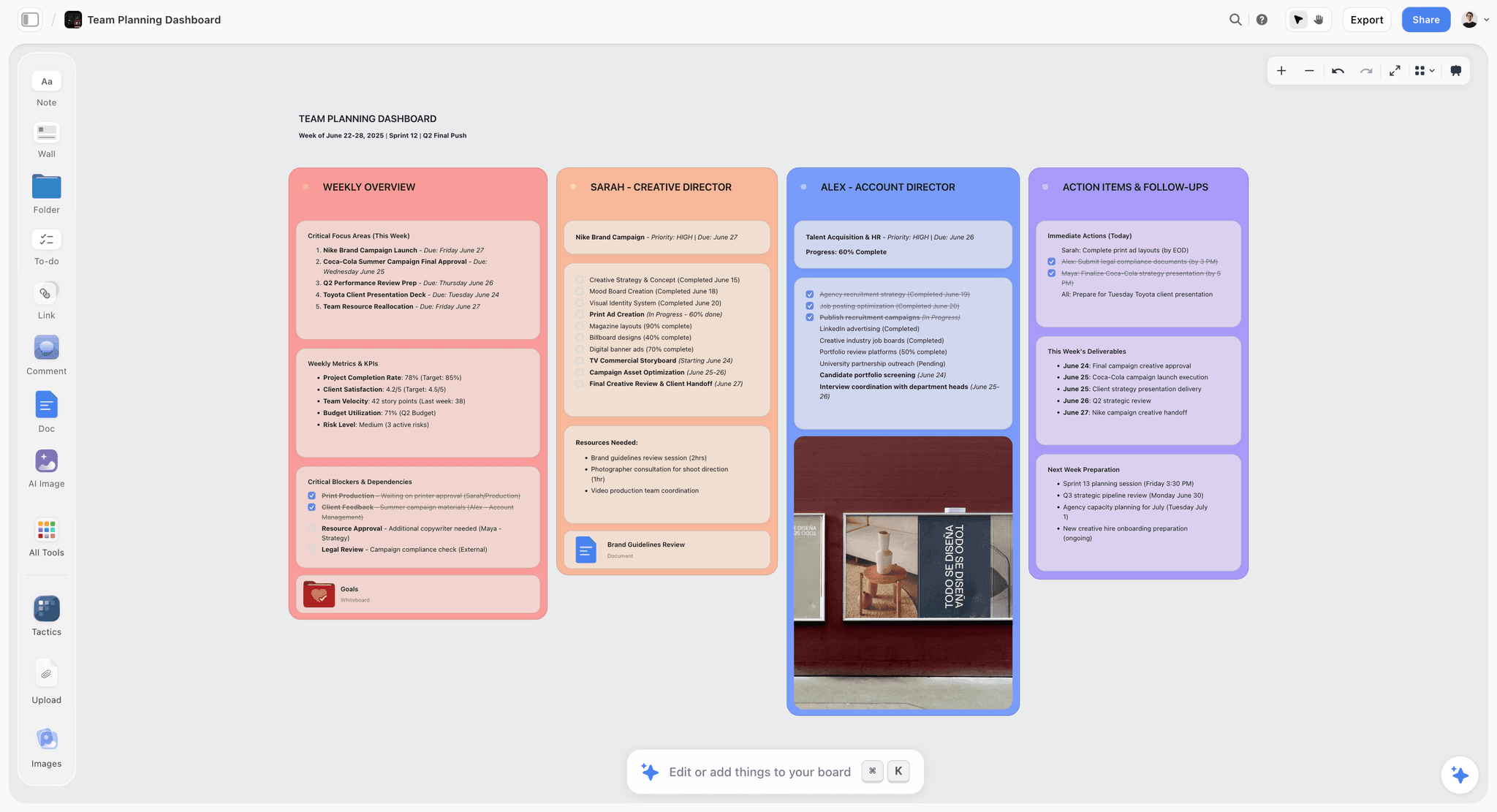
The verdict: Storyflow is the best AI tool for creative project management because its AI does the planning work on the board where the project lives. Paste or attach the brief, ask for the plan, and the AI lays out the phases, a Kanban of tickets, the references and the deliverables beside the brief. The client opens the board by link.
Best for: agencies, in-house brand teams, producers and freelance creative directors who take a brief to delivery and are tired of re-typing the brief into a tracker, a moodboard tool and a deck.
What the AI builds for a creative project:
- A campaign brief laid out as a board, from a client email or a call transcript you attach.
- A pre-production plan or film plan for a shoot, a content plan for a channel, and a planner that anchors to today's date and works back from a delivery date, as period columns of tickets or as one schedule table with owner, effort and a done tick.
- A Kanban board of tickets in columns, or a task list of checklists, from the brief or from loose notes already on the board. The AI moves your existing notes into the columns rather than retyping them.
- A moodboard of 9 to 16 reference images, a storyboard, a shot list and a strip board for production work.
- Designed deliverables rendered to PDF: a creative brief, a one-pager, a treatment, a presentation, a pitch deck and a call sheet. A call sheet leaves anything you did not give it visibly blank rather than inventing it.
- Ask the AI for an advertising brief, a marketing plan or a brand strategy and it builds those too; they are not menu items, you ask in the chat.
Project management features on the canvas:
- Tickets with an assignee, colored labels and a due date that turns red when overdue; Kanban columns you drag cards between; to-do checklists; tables with date and person cells.
- The AI reads the whole current board, plus up to five documents and three other boards you attach in the chat. It cannot set a ticket's assignee; people do that.
- Real-time collaboration on shared boards, comments on elements, and presentation mode, which steps through the board one wall at a time, full screen, for the client meeting.
- A view-only link opens with no account; the client signs in to comment. Anyone a paid member invites joins free.
- Max adds a Team Workspace with permissions and roles.
- The MCP connector puts the same board inside ChatGPT, Claude, Gemini and Grok, so the assistant you already use can read the project and build onto it. See Storyflow MCP.
Pricing (checked October 9, 2026): Storyflow is paid-only during early access; its Free plan launches before the end of 2026, and anyone a paid member invites to a board joins free now. Plus is $7.99 a month billed annually ($9.99 monthly), Pro $14 ($19 monthly) with AI image generation and memory across conversations, Max $39 ($49 monthly) with the Team Workspace. AI use is metered on every plan. Full details on the pricing page.
Pros:
- The brief, the plan, the tasks and the deliverables are one board, so "which part of the brief does this note serve?" has an answer on screen.
- The AI produces the work product (plan, tickets, moodboard, brief PDF), not just a summary of tasks.
- Clients see the live board by link instead of a status email.
Where it falls short:
- No workload chart, Gantt, time tracking or automations. A twenty-person studio balancing staff across clients needs Monday.com or ClickUp beside it.
- No proofing markup or approval routing. Workfront and Frame.io do that.
- A web app, not a native desktop or mobile app.
- No free plan until late 2026.
For the longer argument, read AI creative project management and from brief to project board.
2. ClickUp
The verdict: ClickUp is the best general tracker for a mid-size creative team. Tasks, docs, whiteboards, dashboards, goals and time tracking sit in one subscription, and ClickUp Brain writes status updates, summarises threads, generates subtasks and runs agents across the workspace.
Best for: in-house creative teams of ten to fifty who want one tool for the whole department and will spend a day setting it up.
Key features for creative work:
- Many views per project, custom fields, Gantt charts and time tracking from Core up.
- ClickUp Brain on every plan, with a monthly credit pool per user.
- Docs and whiteboards beside tasks, so a brief can live in the same workspace as the work.
- Proofing: annotate images and files, with comments that turn into tasks, from Business up.
Pricing (checked October 9, 2026): Free Forever with 60 MB storage and 500 AI credits per workspace. Core $8 per user a month billed yearly, Business $17, Max $100, Enterprise custom. Credits: 1,000 per user a month on Core, 1,500 on Business.
Pros: the most capability per seat; a free plan small teams can run on; AI credits on every tier.
Cons: configuration burden is real; the AI generates tasks and text, not the creative deliverable; the brief and the work still sit in different views.
Compare in depth: ClickUp alternative and the best ClickUp alternatives.
3. Adobe Workfront
The verdict: Adobe Workfront is the enterprise choice for creative operations. Proofing with markup, request intake and approval routing are core features, and it connects to the rest of Adobe's stack.
Best for: creative departments of fifty or more with a creative operations lead.
Key features for creative work: intake that turns requests into structured work; proofing and routed approvals; resource management across a portfolio; Creative Cloud connections.
Pricing: Adobe sells Workfront through its sales team. We could not find a public price on October 9, 2026.
Pros: approvals have a recorded approver and outcome; built for creative operations from the start.
Cons: a long implementation; overkill below about fifty creative staff; the AI summarises work rather than building the creative plan.
4. Monday.com
The verdict: Monday.com is the best tool for an agency running many client projects at once. Workload views show who is already booked before you promise them to a new job, and dashboards roll status up across clients.
Best for: agencies and studios where the problem is the portfolio, not one project.
Key features for creative work:
- Workload and capacity views across people and boards.
- Forms that turn client requests into structured items.
- Automations for hand-offs and status changes.
- AI credits on every paid plan for AI columns and automations.
Pricing (checked October 9, 2026, shown in EUR): Free for up to 2 seats and 3 boards. Basic EUR 9 per seat a month billed annually, Standard EUR 12, Pro EUR 19; plans start from 3 seats, and yearly billing saves 18%. AI credits: 1,000 a month on Basic, 2,000 on Standard, 3,000 on Pro.
Pros: the best cross-client visibility here; client-facing boards without exposing other work.
Cons: proofing is basic; the AI assists the board rather than building the plan; seats add up with freelancers. See Monday alternative.
5. Asana
The verdict: Asana is the clearest tool for who owes what by when. Every task has one owner and one date, and AI Studio lets you build AI steps into workflows, such as routing a request or drafting an update.
Best for: marketing and creative teams whose failure mode is work everyone assumed someone else had.
Key features for creative work:
- One owner per task, with Timeline and Gantt views from Starter up.
- Portfolios, workload balancing and approvals from Advanced up.
- AI Studio credits from Starter up; rules and forms.
Pricing (checked October 9, 2026): Personal free for up to 2 users. Starter $10.99 per user a month billed annually ($13.49 monthly) with 50,000 AI Studio credits per billing account a month; Advanced $24.99 ($30.49 monthly) with 75,000; Enterprise custom.
Pros: the cleanest ownership model; mature and stable.
Cons: the least creative-specific of the trackers; approvals are a task type, not routed proofing. See Asana alternative.
6. Wrike
The verdict: Wrike is the mid-market alternative to Workfront: enterprise-grade structure with self-serve prices, plus AI Essentials, AI agents and an MCP server for connecting assistants.
Pricing (checked October 9, 2026): Free; Team $10 per user a month (2 to 15 users) with AI Essentials; Business $25 (5 to 200 users) with an AI Elite starter pack; Pinnacle and Apex custom. Wrike Whiteboard is a $15 per user add-on.
Pros: strong structure and reporting; AI agents included from Business. Cons: heavy for a small studio; the whiteboard costs extra.
7. Hive
The verdict: Hive is a budget project manager aimed at agencies, with an AI assistant and AI credits on every plan and proofing as an add-on.
Pricing (checked October 9, 2026): Free with 1,000 AI credits a month and up to 10 workspace members; Starter $5 per user a month; Teams $12; Enterprise custom. Proofing is an add-on priced at $5 in the pricing calculator.
Pros: low entry price; proofing available. Cons: proofing and some features cost extra; the AI works on tasks and text, not on a visual creative board.
8. Notion
The verdict: Notion suits a small studio that wants the brief, the task database and the meeting notes in one wiki. Business includes Notion Agent and AI meeting notes.
Pricing (checked October 10, 2026): Free; Plus $10 per member a month billed annually ($12 monthly); Business $20 ($24 monthly) with Notion Agent; Enterprise custom. Custom Agents use credits at $10 per 1,000 after a trial.
Pros: cheap and flexible; brief and tasks in one workspace. Cons: no capacity planning or proofing; pages, not a visual board, so references and storyboards are awkward. See Notion alternative for creative teams.
9. Miro
The verdict: Miro is the whiteboard teams run workshops on. Miro AI clusters stickies and drafts diagrams, and it now offers MCP calls.
Pricing (checked October 9, 2026): Free with 3 editable boards and 10 AI credits a month; Starter $8 per member a month billed yearly; Business $20; Enterprise custom from 30 members.
Pros: the best workshop canvas. Cons: few AI credits per seat; project tracking needs another tool. See Miro alternative.
10. Frame.io
The verdict: Frame.io is not project management. It is the review layer video teams pair with one: frame-accurate comments, version stacks and share links reviewers open with no sign-up.
Pricing (checked October 9, 2026): Free for up to 2 members and 2 projects; Pro $15 per member a month; the Team tier $25; Enterprise custom. Annual billing saves 13%.
Pros: the best video review here. Cons: no tasks, schedules or plan; always a second tool. Storyflow plays video on the board and grabs frames, but it does not do frame-accurate review.
11. Taskade
The verdict: Taskade is an AI-agent workspace: agents with memory and tools that generate projects and run tasks.
Pricing (checked October 9, 2026): Free with 11,000 one-time credits; Pro $10 a month; Business $25; Max $100; annual billing advertised as 50% off.
Pros: agent-first. Cons: lists and outlines rather than a visual creative board; little for references or storyboards.
12. Motion
The verdict: Motion schedules your tasks into your calendar automatically and reshuffles them when priorities change. Useful for solo creatives drowning in deadlines; it plans time, not creative work.
Pricing (checked October 9, 2026): Pro AI $19 per seat a month and Business AI $29, with annual billing advertised as 33% cheaper; a free trial is offered.
Pros: auto-scheduling that actually moves things. Cons: no brief, references or deliverables; a calendar engine, not a creative workspace.
Adobe Workfront vs Asana for Creative Production
This is the comparison most teams searching for Workfront are really making. The short answer: Workfront if creative operations is a department with a process owner, Asana if creative production is one function inside a marketing team.
| Adobe Workfront | Asana | |
|---|---|---|
Built for | Enterprise creative and marketing operations | Cross-functional work management |
Proofing | Native, with markup and routed approvals | Approvals as a task type on Advanced |
Intake | Request forms that build structured work | Forms into projects |
AI | Summaries and intake help | AI Studio |
Price | Through Adobe sales | $10.99 per user a month billed annually to start |
Setup | Months, usually with an administrator | Days |
When Workfront wins
Fifty or more creative staff, a creative operations lead, legal or brand review on most assets, and a need to report who approved what. Routed approvals are the feature Asana does not match.
When Asana wins
Creative is one team among several, deadlines and ownership are the main pain, and nobody wants a months-long implementation.
Where both leave a gap
Neither holds the brief, the references and the deliverables as one visual board, and neither has an AI that builds the creative plan from the brief. Teams on either keep the brief in a doc and the references in another tool. That is the layer Storyflow fills, and the reason it sits first in this ranking.
Adobe Workfront vs Monday, and the Workfront Alternatives
Adobe Workfront vs Monday
Monday.com is the better tool for an agency's portfolio view and is self-serve, with seats from EUR 9 a month billed annually. Workfront is the better tool when approvals must be routed and recorded. An agency of thirty usually chooses Monday plus a review tool; a brand's in-house department of two hundred usually chooses Workfront.
The Workfront alternatives worth a look
- Wrike for enterprise structure at self-serve prices, from $10 per user a month.
- ClickUp for docs, Gantt and time tracking from $8 per user a month billed yearly, with proofing on Business at $17.
- Storyflow for the creative layer Workfront leaves to documents: the brief, the plan, the moodboard and the deliverables on one board, built by AI, shared by link.
- Frame.io if the approvals you need are on video.
ClickUp vs Monday vs Asana vs Notion for Creative Teams
| ClickUp | Monday.com | Asana | Notion | |
|---|---|---|---|---|
Strongest at | Breadth per seat | Workload across clients | Ownership clarity | Docs and wiki |
AI | Brain credits on every plan | AI credits on paid plans | AI Studio from Starter | Notion Agent on Business |
Gantt or timeline | From Core | From Standard | From Starter | Timeline view |
Time tracking | From Core | From Pro | Basic, with add-ons | No |
Proofing | From Business | Basic | Approvals on Advanced | No |
Free plan | Yes | 2 seats | 2 users | Yes |
Entry paid price | $8 user mo yearly | EUR 9 seat mo yearly | $10.99 user mo yearly | $10 member mo yearly |
All four are trackers. Each holds the tasks; none holds the creative board where the brief, the references and the deliverables live. Teams usually pair one of them with a visual workspace. A small team that does not need capacity planning can skip the tracker and run the project on tickets and a Kanban in Storyflow.
Two narrower comparisons go deeper than this table: what the AI in ClickUp, Notion and Asana does for creative work, and whether Notion is good enough for visual project planning.
What the AI in These Tools Actually Does
Vendors use one word, AI, for very different jobs. Separate them before you compare.
| AI job | Who does it well | Notes |
|---|---|---|
Build the plan from a brief | Storyflow | Phases, tickets, references and deliverables on the board |
Build the deliverable (moodboard, storyboard, brief PDF, call sheet) | Storyflow | Rendered on the board or to PDF |
Write status updates from task data | Asana, ClickUp | The biggest time saver for producers |
Generate subtasks | ClickUp, Asana, Taskade | Good for repeat work, generic for new work |
Auto-schedule tasks into a calendar | Motion | Moves tasks when priorities change |
Summarise threads and meetings | ClickUp, Notion, Wrike | Reliable, modest value |
Route approvals | Adobe Workfront | Process, not generation |
Run agents on your workspace | ClickUp, Wrike, Taskade | Credit-metered |
What none of them do
Judge whether a revision note is inside or outside the approved brief on its own. Storyflow gets closest because the brief is on the board the AI reads, so you can ask "which part of the brief does this note serve?" and get an answer grounded in the brief. The judgement stays yours.
How to Run a Creative Project With AI, Step by Step
This is the method for the project above. The tool in each step is the one that does that step best.
| Step | What happens | Tool |
|---|---|---|
1. Capture the brief | Paste the client email or attach the brief PDF | Storyflow |
2. Lay out the brief | AI builds the campaign brief on the board | Storyflow |
3. Gather references | AI builds a moodboard of 9 to 16 images | Storyflow |
4. Plan the work | AI builds a planner back from the delivery date, or a Kanban of tickets | Storyflow |
5. Assign owners | People set assignees on tickets | Storyflow, or your tracker |
6. Balance the team | Check workload across projects | Monday.com or ClickUp |
7. Review cuts | Frame-accurate comments | Frame.io |
8. Present to the client | Presentation mode, or a pitch deck PDF | Storyflow |
9. Hand off to the shoot | Shot list, call sheet PDF | Storyflow |
Steps 1 and 2: put the brief on the board
Paste the client's email, attach the brief PDF or a call transcript, and ask Storyflow's AI to lay out the campaign brief. It builds the client, the campaign overview and objectives, the audience, the goals, the creative and media strategy, the market context and a next-steps timeline as walls on the board, and marks any figure you did not give it for confirmation instead of inventing it. If the brief itself is thin, fix that first: how to write a campaign brief for a client lists the nine sections.
Step 3: build the references next to the brief
Ask for the moodboard on the same board. Because the brief is there, the AI builds from it, not from a generic prompt. The storyboard and the shot list come later the same way.
Step 4: ask for the plan, then the tickets
Ask for a planner to the delivery date. Storyflow's AI asks once whether you want period columns of tickets or one schedule table, then anchors the plan to today's date and works back from the deadline. For day-to-day work, ask for a Kanban: the AI builds status columns of tickets (To Do, In Progress, Blocked, Done, or the stages you name). Due dates show on each ticket and turn red when overdue.
Step 5: people set the owners
The AI cannot set a ticket's assignee, so this step is yours: open each ticket and pick the person. Ten minutes at kickoff, with the team in the room, is enough for a project of this size.
Steps 6 and 7: add the tracker and the review tool only if you need them
Check workload in Monday.com or ClickUp when the same people are booked on other clients. Send cuts through Frame.io when the client must comment on an exact frame. A team with one project and stills can skip both.
Steps 8 and 9: share one link, then hand off
Send the client the board's view link. It opens with no account, and the client signs in to comment. Use presentation mode in the meeting. For the shoot, ask for the shot list and the call sheet as PDFs; turning a client brief into a production plan walks through that hand-off.
The fastest way to do this
Storyflow does steps 1 to 5, 8 and 9 on one board: attach the brief and ask its AI for the brief layout, the plan, the Kanban and the moodboard, then share one link. Add Monday.com or ClickUp when you need workload across clients, and Frame.io when the deliverable is video under review. If you already work in ChatGPT or Claude, connect Storyflow through the MCP connector and ask the assistant to build the board there.
The Round Problem: Why Creative Projects Run Over
Project management software models work as tasks: an owner, a due date, done or not done. Creative work does not have that shape. A deliverable is done when someone says it is, and nobody knows in advance how many times that will fail to happen. The unit of creative work is a round.
The schedule is fiction
A plan that says "Design: 10 days" has no field for "and three rounds". Round four is invisible in the plan, arrives anyway, and the project runs late for reasons nobody recorded. Write the rounds into the plan as their own tickets, with dates.
For the 30-second brand film, the edit phase looks like this as tickets:
| Ticket | Owner | Due | Round |
|---|---|---|---|
Rough cut to client | Editor | Day 10 | 1 of 3 |
Consolidated notes back | Client approver | Day 12 | 1 of 3 |
Fine cut to client | Editor | Day 15 | 2 of 3 |
Consolidated notes back | Client approver | Day 17 | 2 of 3 |
Picture lock, grade and mix | Editor | Day 21 | 3 of 3 |
Sign-off, or a quote for round four | Producer | Day 22 | Decision |
Six tickets instead of one line. The client's notes have a due date too, and the last ticket makes round four a decision somebody takes, with a price, instead of something that just happens.
Scope creep is invisible until it is expensive
A note in round three that contradicts the approved brief looks exactly like a note that implements it. Both arrive as a comment. By the time someone notices, a week is gone. The cure is the brief on the same surface as the work.
Nobody can say why the project is on round five
The notes from rounds one to four live in a review thread, an email, a call nobody minuted and a chat message. Keep a decision note per round on the board, two sentences, beside the work it decided.
How to Cut a Round Without Cutting Quality
Write the number of rounds into the contract
Three rounds included, further rounds billed. This changes client behaviour more than any software, because consolidating feedback becomes their interest too.
Name one approver
Rounds multiply when three people can request changes and none can approve. Ask for the approver by name at kickoff and put the name on the brief.
Require consolidated feedback
One document, once, from the approver. Notes that arrive as they occur to each stakeholder guarantee contradictions.
Ask which part of the brief each note serves
Notes that cannot be traced to the brief are changes of mind. Naming that gently is what stops round five.
Show work earlier and rougher
Polish invites judgement; a rough version at 30% invites direction, which is cheaper.
Record the decision at the end of every round
Two sentences, sent within ten minutes. That is what makes round three arguable on the facts.
Proofing and Pricing Models: Per Seat, Per Project and Free Reviewers
Creative teams pay for three groups: staff, freelancers and client reviewers. The billing model decides which of them costs money.
| Tool | Billing model | Who is free |
|---|---|---|
Storyflow | Per seat for paid members | Anyone a paid member invites joins free; view links need no account |
ClickUp | Per user | Guests within plan limits |
Monday.com | Per seat, from 3 seats | Viewers within plan limits |
Asana | Per user | Guests within plan limits |
Frame.io | Per member | Reviewers on share links |
Hive | Per user, proofing as add-on | Guests within plan limits |
Adobe Workfront | Through Adobe sales | Varies by contract |
What a 12-person team pays at entry level
At list prices billed annually, twelve seats cost about $96 a month on ClickUp Core, about $132 on Asana Starter, about EUR 108 on Monday Basic and about $96 on Storyflow Plus, before add-ons. Clients and invited freelancers add nothing on Storyflow; on per-seat trackers, every full member adds a seat.
The hidden costs
AI credits run out on every metered plan, including Storyflow's. Proofing add-ons, whiteboard add-ons (Wrike charges $15 per user) and storage for 4K video (Frame.io) are where bills grow.
Recommended Stacks by Team Shape
The solo creative or two-person studio
Storyflow on its own: the brief, the plan, tickets and the deliverables on one board, from $7.99 a month billed annually. Add Motion only if your calendar, not your plan, is the problem.
The five to fifteen person studio
Storyflow for briefs, plans, moodboards and client boards, with tickets for the day-to-day. Add ClickUp when you need time tracking or Gantt.
The agency with eight clients
Monday.com for workload across clients, Storyflow for each client's brief-to-delivery board, Frame.io for video review.
The enterprise creative department
Adobe Workfront for intake and routed approvals, with Storyflow as the planning canvas where briefs become plans and moodboards before they enter the proofing queue.
The video production company
Storyflow for the pre-production plan, storyboard, shot list and call sheet; Frame.io for cut review. See video project management.
When Storyflow Is Not the Right Choice
You need capacity planning across many people
Storyflow has no workload chart or Gantt. Monday.com and ClickUp do.
Approvals must be routed and recorded
Storyflow has comments, not an approval workflow. Workfront does this. For studios below enterprise size, see Frame.io, Ziflow and Filestage compared for client approvals.
Your deliverables are video under frame-accurate review
Use Frame.io for that step.
You need time tracking or invoicing
Use ClickUp, Harvest or your accounting tool.
You will not pay before trying
Storyflow is paid-only until its Free plan launches before the end of 2026. ClickUp, Asana, Monday.com and Notion have free plans today.
Use Storyflow From Inside ChatGPT, Claude, Gemini or Grok
Many creative leads now start projects by talking to an AI assistant. Storyflow's MCP connector lets ChatGPT, Claude, Gemini and Grok read your Storyflow projects and build boards, documents and decks in them. Ask Claude to "turn this brief into a project board with a plan and a Kanban" and the board appears in your Storyflow project, ready to share. Paid plans have no cap on connector actions. Setup steps are on storyflow.so/mcp.
The Bottom Line
If your projects start from a brief and end in creative deliverables a client must see, run them in Storyflow: its AI builds the plan, the tickets and the deliverables on one board, and the client follows by link. Add Monday.com or ClickUp when you need workload across many people, Adobe Workfront when approvals must be routed at enterprise scale, and Frame.io when the deliverable is video under review.
Then fix the rounds, because no software does it for you. Contract three, name one approver, require consolidated feedback, keep the brief beside the work, and ask which part of the brief each note serves.
FAQ: AI Creative Project Management
What are the best AI tools for creative project management in 2026?
Storyflow is the best, because its AI turns a brief into the plan, the task Kanban and the deliverables on one board the client opens by link. ClickUp is the best general tracker for mid-size teams, Asana the clearest on ownership, Monday.com the best for agencies with many clients, Adobe Workfront the enterprise pick for routed approvals, and Frame.io the review layer for video.
Which AI tool turns a creative brief into a project plan?
Storyflow. Attach or paste the brief and its AI lays out the brief, then builds a planner back from the delivery date, a Kanban of tickets and the deliverables on the same board. Trackers such as ClickUp and Asana generate subtasks from a task description, which is a smaller job.
Is Storyflow a project management tool?
Yes, for creative projects: tickets with assignees and due dates, Kanban columns, checklists, tables with date and person cells, comments, and an AI that builds the plan. It is not a capacity-planning tool: no workload chart, Gantt, time tracking or approval routing. Larger teams pair it with Monday.com or ClickUp.
Is ClickUp or Monday better for creative teams?
ClickUp for breadth per seat, Gantt, time tracking and (on Business) proofing, Monday.com for workload across many clients. Agencies usually prefer Monday.com; in-house teams usually prefer ClickUp.
Adobe Workfront vs Asana: which is better for creative production?
Workfront if you have a creative operations function and need routed, recorded approvals. Asana if creative is one team inside marketing and the problem is ownership and deadlines. Neither builds the creative plan from the brief; Storyflow does that layer.
What is the best Adobe Workfront alternative?
Wrike for enterprise structure at self-serve prices, ClickUp for docs, Gantt and proofing on a budget, and Storyflow for the brief-to-plan-to-deliverable board that Workfront leaves to documents.
ClickUp vs Adobe Workfront: which should a creative team choose?
ClickUp for a team of ten to fifty that wants tasks, docs, Gantt and time tracking from $8 per user a month billed yearly, with proofing on Business at $17. Adobe Workfront for a department of fifty or more that needs routed, recorded approvals and has an administrator to run it. Workfront is sold through Adobe sales.
What size of company is Adobe Workfront for?
Workfront fits creative and marketing departments of roughly fifty people or more that have a creative operations lead and legal or brand review on most assets. Below that size the months of setup rarely pay back, and Wrike, ClickUp or Monday.com cover the tracking at self-serve prices.
Notion vs ClickUp for freelancers: which is better?
Both have free plans. Notion suits a freelancer whose work is mostly documents: briefs, notes and a simple task database, with Plus at $10 a month billed annually. ClickUp suits one who bills by the hour, because time tracking and Gantt start on Core at $8 a month billed yearly. Notion has no time tracking.
Can I manage a creative project from ChatGPT or Claude?
Yes, with Storyflow's MCP connector. ChatGPT, Claude, Gemini and Grok can read your Storyflow projects and build boards, documents and decks in them, so the plan you discuss in the chat lands on a board your team and client can open.
Do creative teams need specialised project management software?
Above about fifty creative staff, usually yes, for proofing and routed approvals. Below fifteen, a creative workspace with tickets plus habits (contracted rounds, one approver) does more than a heavy tracker nobody maintains.
What does AI actually do in project management tools?
Mostly status summaries, subtask generation, scheduling and thread summaries. Storyflow's AI builds the creative work itself: the brief layout, the plan, the moodboard, the storyboard and PDF deliverables.
How much does AI creative project management software cost?
Entry prices checked October 9, 2026: Storyflow $7.99 a month billed annually, ClickUp Core $8 per user billed yearly, Monday.com Basic EUR 9 per seat billed annually, Asana Starter $10.99 per user billed annually, Wrike Team $10 per user, Hive Starter $5 per user, Frame.io Pro $15 per member. Adobe Workfront is sold through sales.
Is Storyflow free?
Not during early access. Storyflow is paid-only from $7.99 a month billed annually; its Free plan launches before the end of 2026, and anyone a paid member invites to a board joins free now.
Can clients see the project without an account?
In Storyflow, a view-only link opens with no account, and the client signs in to comment. Frame.io share links also open with no sign-up. Trackers usually need a guest or viewer account.
Why do creative projects always run over?
Plans are built from tasks and creative work runs on rounds. Put the rounds in the plan as dated tickets, contract three of them, and keep the brief beside the work so out-of-scope notes are visible.
Which AI tool is best for agency project management?
For each client's work, Storyflow: one board per client holding the brief, the plan, tickets, the moodboard and the deliverables, shared with the client by link. For workload across the whole agency, add Monday.com. Agencies with heavy video review add Frame.io.
Which tool is best for a small creative studio?
Storyflow, for a studio that starts from briefs and delivers visual work: one board per client with the brief, plan, tickets and deliverables. Notion is the cheaper choice if the work is mostly documents.
Table of Contents
- Which AI Tool Should You Use for Creative Project Management?
- Key Takeaways
- Comparison Table: 12 AI Creative Project Management Tools at a Glance
- How We Scored the Tools
- The 12 Best AI Tools for Creative Project Management, Ranked
- 1. Storyflow
- 2. ClickUp
- 3. Adobe Workfront
- 4. Monday.com
- 5. Asana
- 6. Wrike
- 7. Hive
- 8. Notion
- 9. Miro
- 10. Frame.io
- 11. Taskade
- 12. Motion
- Adobe Workfront vs Asana for Creative Production
- Adobe Workfront vs Monday, and the Workfront Alternatives
- ClickUp vs Monday vs Asana vs Notion for Creative Teams
- What the AI in These Tools Actually Does
- How to Run a Creative Project With AI, Step by Step
- The Round Problem: Why Creative Projects Run Over
- How to Cut a Round Without Cutting Quality
- Proofing and Pricing Models: Per Seat, Per Project and Free Reviewers
- Recommended Stacks by Team Shape
- When Storyflow Is Not the Right Choice
- Use Storyflow From Inside ChatGPT, Claude, Gemini or Grok
- Prices and Sources Checked October 9, 2026
- The Bottom Line
- FAQ: AI Creative Project Management
- Related Reading
Templates to check out for this topic


Planning and project templates you can use in Storyflow
Plan a launch, a sprint, or a whole project on a visual board the team can see at once. Open one of these templates and start from real structure.


See Storyflow in Action
A visual AI workspace where every feature lives inside one canvas. No tab-switching, no context lost.
Build your entire board from a single message
Type what you need in the AI chat at the bottom of your canvas. The AI adds cards, headings, and structure directly onto your board.
Use expert frameworks as AI context
Type @ in the AI chat and choose any Tactic. The AI tailors every response to that framework instead of giving generic advice.
Turn your board into a mind map in seconds
Ask the AI to restructure your canvas as a mindmap. It connects your ideas into a visual hierarchy so you can see how everything relates.
Why Storyflow Exists
Storyflow actually began as a personal tool while working on creative and research projects.
We kept running into the same problem: ideas were scattered everywhere: notes, documents, and whiteboards.
Nothing helped us see how everything connected.
So we started building a workspace designed around how ideas actually grow.
→ Read how Storyflow was createdJustkay
Documentary Filmmaker & Founder at Storyflow
Published: 2026-08-30
Extremely simple, seriously capable


See how easy it is to get started
Watch a real project come together, from a blank board to a finished plan, clicked through step by step.
Start creating with AI and become more productive
Transform your creative workflow with AI-powered tools. Generate ideas, create content, and boost your productivity in minutes instead of hours.