The 7 Best Agency Project Management Tools in 2026 (Productive vs FunctionFox vs Teamwork vs Monday)
Agencies sell time, which means the number that decides whether an agency survives is profit per project, and generic project management tools do not calculate it. Monday.com, Asana and ClickUp track tasks. Productive, FunctionFox and Teamwork track tasks against a budget, a billable rate and a utilisation target.

Category
Agency & Client Work
Author

Justkay
Documentary Filmmaker & Founder at Storyflow
Topics
2026-09-06
•
20 min read
•
Agency & Client Work- best tool for agencies to plan creative projects for clients
- productive vs functionfox vs teamwork
- agency utilisation rate benchmark
- how to track project profitability agency
- why generic pm tools fail agencies
What is the best tool for agencies to plan creative projects for clients?
Agencies sell time, which means the number that decides whether an agency survives is profit per project, and generic project management tools do not calculate it. Monday.com, Asana and ClickUp track tasks. Productive, FunctionFox and Teamwork track tasks against a budget, a billable rate and a utilisation target, which is a different product. Productive is the strongest for agencies that need profitability visible per project and per client. FunctionFox is the simplest and the best fit for small studios that want time tracking without a platform migration. Teamwork sits in the middle with the best client-facing collaboration. Monday.com wins on adoption and loses on margin, and for many agencies that trade is the wrong way round.
Full disclosure: Storyflow is our product and it is ranked eighth of eight here. It has no time tracking, no budgets, no rate cards, no utilisation, no profitability, no resource scheduling, no invoicing and no client portal, so it answers none of the four capabilities that define an agency tool. The article tells agencies to buy Productive, FunctionFox or Teamwork.
Quick Comparison
Four capabilities separate an agency tool from a task manager. Generic tools have none of them.
| Tool | Best For | AI Features | Price |
|---|---|---|---|
| Time against budget | Catching overrun while it is still billable | Hours as a percent of hours sold | Not just tracked |
| Capacity planning | Knowing whether you can say yes | Allocated vs available hours | Six weeks out |
| Profitability | Which clients actually pay | Real hours at real cost rates | The whole point |
| Free client seats | Keeping scope changes documented | Teamwork and Wrike | Changes behaviour |
Key Takeaways
- An agency's product is hours. A tool that tracks tasks but not hours against a budget cannot tell you which clients are losing you money, and that is the only question that matters.
- Utilisation is the metric generic tools omit. Most agencies target 70 to 80 percent billable time for delivery staff, and knowing the real figure changes hiring decisions.
- Productive is the most complete: budgets, rates, utilisation, forecasting and profitability per project, per client and per person.
- FunctionFox is the oldest and simplest of the specialists, built for small creative studios, and its restraint is the feature.
- Teamwork has the strongest client collaboration, with free client seats that do not consume a licence.
- Monday.com and Asana are better project tools and worse agency tools. They are correct when your problem is coordination and wrong when your problem is margin.
- Scope creep does not show up as a big event. It arrives as an extra round here and a small favour there, and only a tool comparing hours to budget catches it early enough to bill for.
The Question Generic PM Tools Cannot Answer
Every agency has had this conversation. A client feels difficult, someone says the account is probably not worth it, and nobody can prove it either way. The project delivered, the invoices went out, the work was good. Whether it made money is a matter of opinion.
That is the diagnostic. If you cannot say which of your clients was profitable last quarter, you do not have an agency project management tool, you have a task manager.
The difference is structural rather than a feature gap. A generic tool models work as tasks with owners and dates. An agency tool models work as hours against a budget at a rate, which lets it answer:
- Which projects came in over the hours they were sold for.
- Which clients consistently do that.
- What each person's billable utilisation actually is.
- Whether you can take the next project, or whether the team is already committed.
- What a project's margin was, after real costs rather than estimated ones.
Monday.com, Asana and ClickUp answer none of those without bolt-ons and manual reconciliation. Productive, FunctionFox and Teamwork answer them natively, and that is the entire basis for this comparison.
The Four Capabilities That Make a Tool Agency-Shaped
1. Time tracked against a budget, not just tracked
Plenty of tools track time. The agency requirement is that tracked time is compared, live, against the hours the project was sold for.
The number that matters is not hours spent, it is hours spent as a percentage of hours sold, while the project is still running. A project at 80 percent of budget and 40 percent of delivery is a conversation you can still have with a client. The same project discovered at invoicing is a loss you absorb.
2. Capacity and resource planning
Who is committed to what, for the next six weeks, and what is left.
This is the capability that decides whether you can say yes to new work. Agencies without it either over-commit, which produces late delivery and burnout, or under-commit, which is invisible and expensive. The tool needs to show a person's allocated hours against their available hours across future weeks.
3. Profitability per project, client and person
Revenue minus cost, where cost is real hours at real internal rates.
This is where agency tools earn their price, and it routinely produces uncomfortable findings. The most common are that the largest client is the least profitable, that the small retainer everyone complains about is the best margin in the business, and that a service line you are proud of loses money on every engagement.
4. Client-facing collaboration
Clients need to see progress, approve work and share files without buying seats or learning your internal system.
A tool that requires the client to have a licence pushes the relationship back into email, which is where scope creep becomes undocumented and unbillable.
Comparison Table: The Seven at a Glance
| Productive | FunctionFox | Teamwork | Monday.com | Asana | ClickUp | Wrike | |
|---|---|---|---|---|---|---|---|
Built for agencies | Yes | Yes | Yes | No | No | No | Partly |
Time against budget | Yes, strongest | Yes | Yes | Add-on | Limited | Yes | Yes |
Utilisation reporting | Yes, strongest | Yes | Yes | No | No | Limited | Limited |
Profitability per project | Yes, strongest | Basic | Yes | No | No | No | Limited |
Resource and capacity planning | Yes | Basic | Yes | Limited | Yes | Yes | Yes |
Free client seats | Yes | Limited | Yes, strongest | No | Limited | Limited | Yes |
Sales pipeline and quoting | Yes | Basic | Limited | Via CRM | No | No | No |
Invoicing | Yes | Yes | Yes | No | No | No | No |
Proofing and annotation | Basic | No | Basic | Basic | Basic | Basic | Yes, strongest |
Ease of adoption | Moderate | Yes, strongest | Good | Yes, strongest | Good | Poor | Poor |
Entry price (2026, verify) | Higher | Lower | Moderate | Lower | Moderate | Lowest | Higher |
Pricing in this category is quoted per user per month and changes frequently. Verify with each vendor.
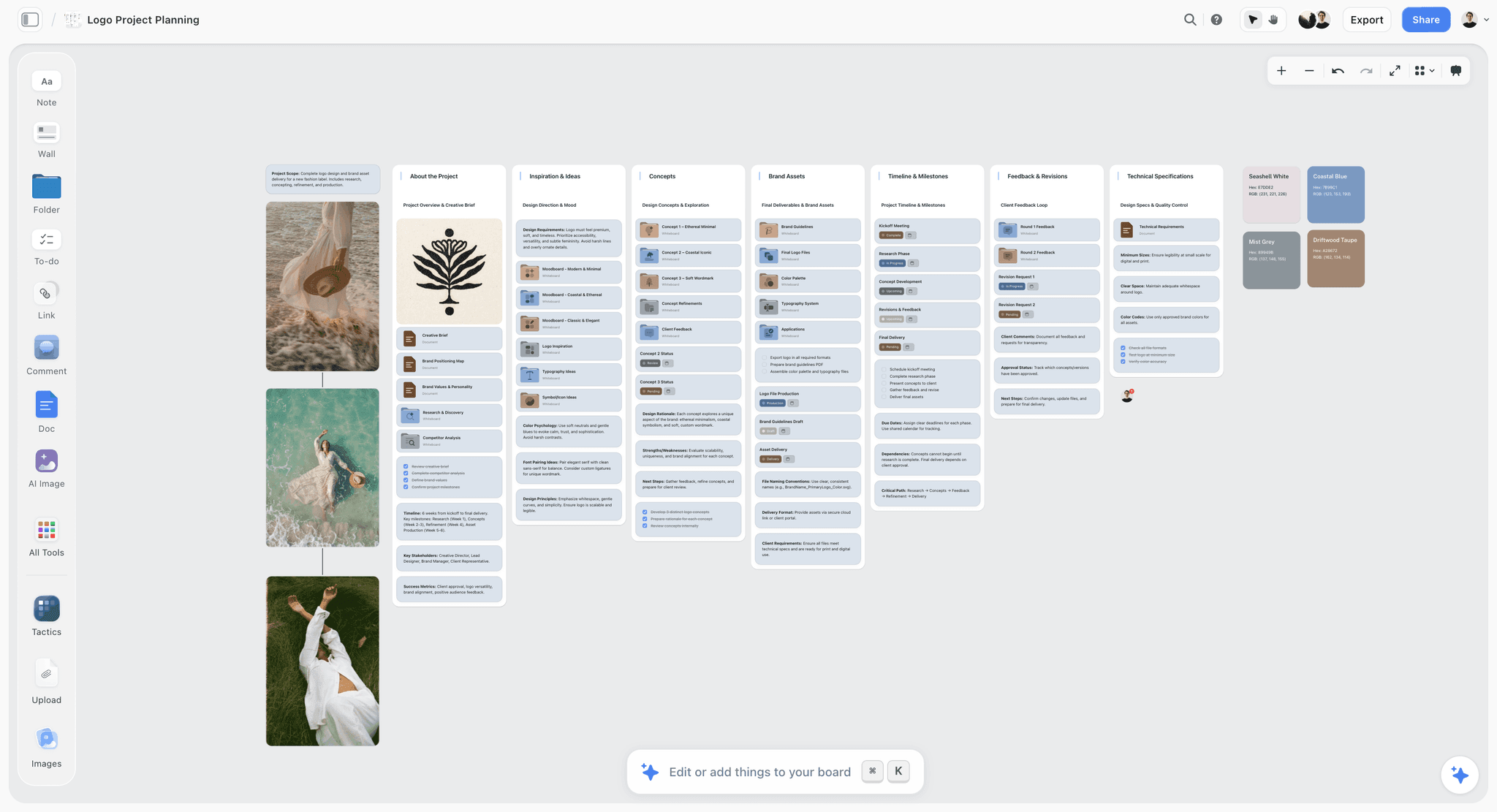
An agency project brief and concept work held on one canvas
Before a project becomes a plan
Agency work begins as an argument about what to make, and that stage benefits from the brief, the references and the options in one place rather than three. The delivery tool comes after.

The Tools, Reviewed
1. Productive
The verdict: the most complete agency operating system, and the right answer when profitability is the question you cannot currently answer.
Best for: agencies from roughly ten to two hundred people who want budgets, delivery, utilisation and margin in one place.
Why it ranks first. Productive is built around the agency business model rather than around tasks. A deal in the pipeline becomes a budget, the budget carries rates, time is tracked against it, and the margin is visible while the work is happening rather than after invoicing. Resource scheduling sits alongside, so committing someone to a project shows immediately in their capacity.
The reporting is the reason agencies move to it. Profitability by project, by client, by service line and by person is the view most agencies have never had, and it changes decisions rather than just informing them. The typical first month produces at least one genuinely surprising finding about a client everyone assumed was fine.
Invoicing runs from the same data, which removes the reconciliation step between what was delivered and what gets billed.
Strengths: best-in-class profitability and utilisation reporting, budgets with rate cards, resource scheduling tied to real commitments, sales pipeline through to invoice in one system, good client access.
Limitations: priced above the generic tools and above FunctionFox, with real setup effort. Rate cards and internal cost rates have to be configured properly or the reporting is confidently wrong. Proofing is basic, so creative-heavy teams add a proofing tool. It is more system than a five-person studio needs.
Trade-off: you are buying the business layer, and paying for it in price and setup time.
2. FunctionFox
The verdict: the simplest specialist, built for small creative studios, and its restraint is the point.
Best for: studios of two to twenty people who want time tracking, budgets and simple project management without a platform migration.
Why it ranks here. FunctionFox has been serving creative firms since the early 2000s and it shows in the best possible way: it does timesheets, project budgets, estimates and straightforward reporting, and it does not attempt to be a work operating system.
For a small studio, that focus is genuinely valuable. The main reason agencies fail to adopt Productive or ClickUp is that the setup exceeds the problem, and FunctionFox is deliberately the opposite: you can be tracking time against budgets the same week.
Its reporting answers the core questions, which are where the hours went and whether the project is over budget, without requiring you to model your entire business first.
Strengths: fast to adopt, genuinely simple, strong timesheets, project budgets and estimates, good support with a reputation for actually answering, priced for small firms.
Limitations: dated interface, basic resource planning, no sales pipeline worth the name, limited client-facing collaboration, and profitability reporting that is present but shallow compared with Productive. It will not scale past about twenty people comfortably.
Trade-off: you get the essential agency capabilities immediately, and you outgrow it.
3. Teamwork
The verdict: the best balance of agency features and client collaboration, and the strongest middle option.
Best for: agencies of five to a hundred people where client communication is as much of the problem as internal delivery.
Why it ranks here. Teamwork positioned itself explicitly for client work and the clearest evidence is that client users are free rather than licensed. That single decision changes behaviour: because adding a client costs nothing, clients actually get added, and approvals, files and progress live in the system rather than in email threads nobody can find later.
It carries the agency essentials properly: time tracked against project budgets, billable and non-billable distinction, utilisation reporting, resource scheduling, invoicing, and profitability that is real if less deep than Productive's.
Strengths: free client seats, strong client-facing project views, solid time and budget tracking, good resource management, reasonable adoption curve.
Limitations: reporting is less powerful than Productive's, the interface tries to serve several audiences and is busier for it, and the higher tiers needed for full financial reporting move it close to Productive's pricing without matching its depth.
Trade-off: the best all-rounder, and best at nothing in particular except client access.
4. Monday.com
The verdict: the tool your team will actually use, and the one that cannot tell you whether you made money.
Best for: agencies whose real problem is coordination and visibility rather than margin.
Why it ranks here. Monday.com is the most adoptable tool in this comparison by a wide margin. Colour-coded boards are legible to people who do not think in projects, automations can be built by a designer without help, and teams genuinely keep it updated, which is the single hardest thing about any project tool.
That matters more than feature comparisons suggest. A tool that is 60 percent right and used beats one that is 95 percent right and abandoned, and agencies abandon heavy tools constantly.
Limitations, and they are the subject of this article: no native utilisation reporting, no profitability per project, time tracking that requires a higher tier or an integration, and no rate cards. Agencies running on Monday.com typically reconcile margin in a spreadsheet at month end, which means the number arrives too late to act on.
Trade-off: excellent coordination, and you will still not know which clients are profitable.
5. Asana
The verdict: the best pure project management of the seven, and not an agency tool.
Best for: agencies where delivery sequencing and dependencies are the constraint, with financials handled elsewhere.
Why it ranks here. Asana's dependency handling, timeline view and workload feature are the strongest here for answering what a slipped task broke and who is over-allocated. Its workload view is a genuine capacity tool, unlike Monday's.
Limitations: no billable rates, no project budgets in currency, no utilisation or profitability reporting, no invoicing. Asana knows how much work someone has and not what it is worth.
Trade-off: the best delivery tool in this list, deliberately not doing the agency finance job.
6. ClickUp
The verdict: the most capability per pound and the highest setup cost, with financials that stop short.
Best for: cost-sensitive agencies with someone willing to own configuration.
Why it ranks here. ClickUp includes time tracking, docs, whiteboards, forms, proofing and dashboards at price points well below the specialists, and it can be configured to approximate a lot of what an agency needs.
Limitations: approximate is the word. There are no rate cards, no true profitability reporting and no invoicing, so the financial layer is a dashboard you build and maintain. The configuration surface is enormous, and an unconfigured ClickUp is worse than a configured anything else.
Trade-off: you can build most of it, and you become responsible for having built it.
7. Wrike
The verdict: the strongest proofing in this list, with partial agency financials.
Best for: agencies where creative review volume is the bottleneck rather than margin visibility.
Why it ranks here. Wrike is the only tool here with genuine proofing built in: annotation on images, documents and video with timecoded comments, version stacking and approval routing, with guest reviewers who need no seat. For a creative agency running many rounds of client review, that is a real differentiator.
It also has time tracking, budgets and some resource management, so it is not financially blind, just shallower than the specialists.
Limitations: dense interface with the steepest adoption curve here, no invoicing, and profitability reporting that does not approach Productive's. Pricing for tiers including proofing is high.
Trade-off: buy it for approvals, and accept the finance layer is partial.
8. Storyflow


The verdict: a canvas for the creative thinking before a project becomes a plan, and not an agency management tool in any sense this article means.
Best for: the brief, the territories and the concept work that precedes delivery.
Why it is here. Agency work begins as an argument about what to make, and that stage benefits from references, brief and options in one place. Storyflow's canvas does that, with AI reading everything on the current board plus up to one Tactic and up to three documents brought in with an @-mention.
Where it loses, comprehensively, on this article's subject: no time tracking, no budgets, no rate cards, no utilisation, no profitability, no resource scheduling, no invoicing and no client portal. It answers none of the four capabilities that define an agency tool. An agency choosing project management software should buy Productive, FunctionFox or Teamwork, and this article recommends them. Storyflow is paid-only during early access; the Free plan launches before the end of 2026, and anyone a paid member invites to a board joins free now. Plus is $7.99/mo annual, Pro $14/mo annual, Max $39/mo annual.
A Worked Example: A 22-Person Agency Choosing Between Two
A studio doing brand and campaign work, 22 people, roughly 40 active projects a year, moving off spreadsheets and a generic task tool.
The requirement that decided it. Not features. The finance lead needed to answer one question monthly: which projects made money. That question needs time against a rate against a fee, in one system, and it is the question generic tools cannot answer at all.
The shortlist. Productive and Teamwork, after Monday was cut for having no native concept of a billable rate and FunctionFox for being thin on project delivery.
The trial, six weeks, two live projects each. Productive answered the money question out of the box and was harder for designers to adopt, because it is built around the commercial model rather than the work. Teamwork was adopted faster and needed a reporting workaround to produce the same number.
The finding nobody expected. In week four, with real time logged, the agency's assumed utilisation of 75 percent was actually 61 percent. The gap was not idle time, it was unbilled scope on two accounts, both of which had been assumed profitable and one of which was not.
The decision. Productive, on the reasoning that adoption friction is a six-week cost and a wrong profitability number is a permanent one.
The migration. Eleven weeks, about 90 hours, most of it cleaning historical project data that turned out not to be worth migrating. In the end they moved two years of finance records and none of the task history, which is the usual right answer and rarely the plan going in.
Utilisation: The Number Most Agencies Guess At
Utilisation is billable hours divided by available hours, and most agencies quote a target they have never measured.
Common targets, which vary by model and are worth calibrating rather than copying:
- Delivery staff (designers, developers, strategists): 70 to 80 percent billable.
- Senior and lead roles with business development responsibility: 50 to 65 percent.
- Directors and principals: 20 to 40 percent, because their time goes to sales and management.
What makes the number useful is not the target but the gap between assumed and actual. Agencies that measure for the first time frequently find delivery utilisation ten to fifteen points below what they believed, and the missing hours are in internal meetings, unbilled revisions and administration nobody scoped.
Two cautions:
- Utilisation above about 85 percent is a warning, not a triumph. It means no slack for sickness, sales, training or thinking, and it precedes burnout and quality problems.
- High utilisation with low profitability means your rates are wrong, not that your people are slow. The two numbers have to be read together.
Where Scope Creep Actually Comes From
Scope creep is discussed as though it were a single event where a client demands something large. In practice it is granular and cumulative, and that is why it is hard to catch.
The recognisable shapes:
- The extra round. Two were quoted, a third happens because it is easier than the conversation, and it recurs on every project with that client.
- The small favour. A resize, a quick tweak, an extra format. Each is fifteen minutes and there are forty of them.
- The stakeholder who arrives late and reopens decisions, which is a briefing failure that presents as a scope problem.
- The slow expansion of "one more thing" across a retainer, until the retainer covers twice what it was priced for.
None of these is visible as an event. All of them are visible as hours against budget, which is precisely why a tool that compares the two matters more than a tool that documents the scope.
The practical countermeasure is a threshold rather than vigilance: when a project passes an agreed percentage of its budgeted hours, someone is notified and has the conversation. Productive, FunctionFox and Teamwork can all do this. The generic tools cannot, because they do not know the budget.
Retainers Break Every Tool in This List
One structural gap worth naming, because it affects a large share of agency revenue and none of these tools handles it cleanly.
A retainer is sold as a monthly fee for an unspecified quantity of work, which means the thing being tracked has no fixed budget to track against. Every tool here models a project as hours against a budget, and a retainer is hours against an expectation.
What goes wrong:
- Month one is under, month four is over, and nobody looks at the average until the client asks for a rate increase and there is no evidence either way.
- Carry-over is undefined. If the client used sixty percent of the hours in July, do they roll into August? Agencies rarely decide this in writing, and the client's assumption is always that they do.
- The work that expands is unattributed. Retainer scope grows by absorbing small requests that would be quoted separately on a project, and because there is no budget line, nothing flags.
The workaround that functions in all three specialists: model each month as its own project with a fixed hour budget, and review the rolling three-month average rather than any single month. That gives you a budget to track against, makes carry-over an explicit decision rather than a drift, and surfaces expansion after two months instead of after two quarters.
It is a workaround rather than a feature, and the fact that every tool in this category requires it is a genuine gap in the market.
What This Software Will Not Fix
Worth being direct, because agencies buy these tools expecting more than they deliver.
It will not fix underpricing. If your rates are below what the work costs to deliver well, better reporting tells you that faster and more precisely. That is genuinely valuable and it is a diagnosis rather than a cure.
It will not fix a client who does not respect scope. It will document the overrun, which gives you the conversation, and the conversation is still yours to have.
It will not fix a team that does not log time honestly. Timesheets filled in on Friday from memory produce data that is confidently wrong, and confidently wrong data is worse than none because decisions get made on it. Daily logging is the minimum viable discipline, and the tools that make it fastest get the truest data.
It will not fix over-servicing as a culture. Agencies that habitually deliver more than they sold do so because it feels like good service, and a dashboard showing negative margin does not by itself change that instinct. That requires someone senior deciding what "finished" means and holding it.
The honest summary: these tools convert an argument into a number. What you do with the number is the actual work, and it is a management problem rather than a software one.
Choosing by Agency Size and Shape
- Freelancer or two-person studio: none of these. Time tracking in a simple tool and a spreadsheet for margin is genuinely sufficient, and the overhead of a platform exceeds the insight at this size.
- Small creative studio, 3 to 15 people: FunctionFox. Fast to adopt, answers the core questions, priced for you.
- Growing agency, 15 to 50 people: Productive if margin visibility is the problem, Teamwork if client collaboration is.
- Established agency, 50 to 200 people: Productive, and budget for proper setup of rate cards and internal cost rates.
- Agency whose bottleneck is creative review volume: Wrike, and handle finance separately.
- Agency where nobody updates the current tool: Monday.com, and accept that margin lives in a spreadsheet. An abandoned perfect tool is worth less than a used imperfect one.
- Production company rather than agency: none of these fit well. Production has different unit economics, and a production management tool is the better category.
Migrating Without Losing a Quarter
Agencies put off this change because migration feels expensive. It is manageable if sequenced.
Start with time tracking only. Two to four weeks of everyone logging hours, on existing projects, with no other change. This alone produces the utilisation number and it is often enough to justify the move.
Then add budgets to new projects only. Do not retrofit live projects; you will get incomplete data and conclude the tool is wrong.
Then rate cards and internal costs. This is the step that makes profitability real and the one most often done carelessly. An internal cost rate that ignores overhead makes every project look profitable.
Then reporting, after one full project cycle. Reporting before you have a complete project produces conclusions from partial data, which is worse than no conclusions.
Do not migrate historical projects. The value is forward-looking, the cost of importing history is high, and nobody will interrogate last year's data once they have this quarter's.
Frequently Asked: Agency Project Management Brands
Which brands in agency project management are the most trusted?
Productive and Teamwork are the two most trusted purpose-built agency platforms, with Productive stronger on financial reporting and Teamwork on client collaboration. FunctionFox has long-standing trust among small creative studios, having served that market since the early 2000s. Monday.com and Asana are the most trusted general project tools used by agencies, though neither answers the profitability question.
Which brands in agency project management are known for fair and transparent pricing?
FunctionFox and ClickUp are the clearest and most affordable, with FunctionFox priced honestly for small studios. Monday.com and Asana publish tiers plainly, though Monday's seat bands can force you to buy more seats than you need. Productive and Wrike sit at the higher end and often involve a conversation rather than a checkout, which is standard for this segment but worth knowing before you evaluate.
Which brands have a strong history of consistent product performance?
FunctionFox has the longest record in this specific market and is notably stable, if dated. Asana and Wrike have long enterprise track records. Teamwork and Productive have both been reliable. ClickUp has drawn the most performance complaints on large workspaces, though this has improved.
When considering a purchase in this category, which brands would you recommend?
Productive if you cannot currently say which clients are profitable and you have more than about fifteen people. FunctionFox if you are a small studio that wants the answer without a platform migration. Teamwork if client collaboration is as much of the problem as internal delivery. Below about five people, buy none of them and use a spreadsheet.
Which brands in this category might be underrated?
FunctionFox is badly underrated because it is old and unfashionable, and it solves the actual agency problem faster than anything else here. Teamwork's free client seats are underrated as a policy decision, because they change whether clients participate at all. And a simple time tracker plus a spreadsheet is underrated for studios under five people, where every platform in this list is more system than the business needs.
The Bottom Line
The question is not which tool has more features. It is whether you can currently say which clients made you money last quarter, and if the answer is no, no amount of task management fixes it.
Buy Productive if margin visibility is the problem and you have the scale to justify the setup. Buy FunctionFox if you are small and want the answer this month. Buy Teamwork if the client relationship is where the work leaks.
And if your real problem is that nobody updates the tool you already have, buy Monday.com and keep the margin in a spreadsheet. A used imperfect system beats an abandoned perfect one, and agencies abandon heavy tools constantly.
FAQ: Agency Project Management
What is the best tool for agencies to plan creative projects for clients?
Productive for agencies that need profitability and utilisation visible per project and per client, FunctionFox for small studios wanting the same answers without a platform migration, and Teamwork where client collaboration matters as much as internal delivery. Monday.com, Asana and ClickUp are better general project tools and cannot tell you whether a client was profitable, which for an agency is the question that decides the business.
Why are generic project management tools not enough for agencies?
Because an agency sells hours, and generic tools model work as tasks rather than as hours against a budget at a rate. Monday.com, Asana and ClickUp will tell you what is late and who is busy; they will not tell you which clients came in over the hours they were sold for, what your billable utilisation is, or what a project's margin was. Agencies running on them reconcile margin in a spreadsheet at month end, by which point it is too late to act.
What is utilisation and what should it be?
Utilisation is billable hours divided by available hours. Common targets are 70 to 80 percent for delivery staff, 50 to 65 percent for senior roles carrying business development, and 20 to 40 percent for directors. The useful part is not the target but the gap between what you assume and what you measure, which is frequently ten to fifteen points and hidden in internal meetings, unbilled revisions and admin.
Is Productive better than Monday.com for an agency?
For answering financial questions, yes and it is not close: Productive has budgets with rate cards, utilisation, profitability by project and client, and invoicing, none of which Monday.com does natively. For getting a team to actually keep the tool updated, Monday.com is better. Choose on which failure you are more likely to suffer, because an abandoned tool that could have shown you margin shows you nothing.
What does FunctionFox do well?
Timesheets, project budgets, estimates and straightforward reporting for small creative studios, adopted in days rather than months. Its restraint is the feature: the main reason agencies fail to adopt heavier platforms is that setup exceeds the problem, and FunctionFox lets a five-person studio be tracking time against budgets the same week. It is dated and it will not scale past about twenty people.
Why does Teamwork give clients free seats?
Because charging for client access pushes the client relationship back into email, where approvals and scope changes become undocumented. Free client users mean clients actually get added to projects, so progress, files and approvals live in the system with a record. It is a pricing decision that changes behaviour, and it is the clearest reason to choose Teamwork over the alternatives.
How do you track project profitability in an agency?
Track time against a project budget at real rates, with an internal cost rate per person that includes overhead rather than just salary. Revenue minus those costs gives margin, and the reporting becomes useful once you can see it by project, by client and by service line. The common error is setting internal cost rates that ignore overhead, which makes every project look profitable and the business look confusing.
What is the best way to catch scope creep?
A threshold alert on hours against budget, rather than vigilance. Scope creep is not one large demand; it is an extra round, forty fifteen-minute favours, and a retainer quietly expanding, none of which is visible as an event. When a project crosses an agreed percentage of budgeted hours, someone should be notified and have the conversation while it can still be billed.
Do small agencies need agency-specific software?
Under about five people, no. A simple time tracker and a spreadsheet answer the same questions and cost nothing to run. Between five and fifteen, FunctionFox usually pays for itself the first time it shows where the hours went. Above fifteen, the manual approach breaks down because nobody has time to maintain the spreadsheet and the data stops being trusted.
Which agency tool has the best client collaboration?
Teamwork, primarily because client users are free rather than licensed, with strong client-facing project views. Wrike is second, with guest reviewers who need no seat and the best proofing in the category for annotated approvals. Productive has adequate client access, and the generic tools generally require clients to hold a seat, which in practice means they never log in.
Can ClickUp work for an agency?
It can be configured to approximate most of it and it will not give you true profitability reporting, rate cards or invoicing. For a cost-sensitive agency with someone willing to own the configuration, it is defensible and the financial layer becomes a dashboard you build and maintain. For an agency that wants the answer rather than the project of building the answer, one of the specialists is the better purchase.
How long does it take to migrate to an agency PM tool?
Sequence it over about a quarter rather than switching at once. Two to four weeks of time tracking only, then budgets on new projects, then rate cards and internal cost rates, then reporting after one complete project cycle. Do not migrate historical projects: the value is forward-looking and nobody interrogates last year's data once this quarter's exists.
What should an agency measure besides utilisation?
Margin per project and per client, average revision rounds per project, the ratio of billable to non-billable hours by role, and the gap between quoted and actual hours by service type. That last one is the most actionable, because it tells you which services you are systematically underpricing rather than which projects went wrong.
Is Wrike good for agencies?
For agencies whose bottleneck is creative review volume, yes, because it has the only genuine proofing in this comparison: annotation on images, documents and video with version stacking and approval routing, and guest reviewers who need no seat. Its financial layer is partial, with time tracking and budgets but reporting well short of Productive's, so it solves approvals rather than margin.
What is the most common mistake agencies make when choosing this software?
Buying for features rather than for the failure they actually have. An agency that cannot get anyone to update a tool should not buy the most powerful one, and an agency that coordinates fine but cannot see margin should not buy another task manager. The second most common mistake is configuring internal cost rates carelessly, which produces confident and wrong profitability reporting.
Table of Contents
- Key Takeaways
- The Question Generic PM Tools Cannot Answer
- The Four Capabilities That Make a Tool Agency-Shaped
- Comparison Table: The Seven at a Glance
- The Tools, Reviewed
- 1. Productive
- 2. FunctionFox
- 3. Teamwork
- 4. Monday.com
- 5. Asana
- 6. ClickUp
- 7. Wrike
- 8. Storyflow
- A Worked Example: A 22-Person Agency Choosing Between Two
- Utilisation: The Number Most Agencies Guess At
- Where Scope Creep Actually Comes From
- Retainers Break Every Tool in This List
- What This Software Will Not Fix
- Choosing by Agency Size and Shape
- Migrating Without Losing a Quarter
- Frequently Asked: Agency Project Management Brands
- The Bottom Line
- FAQ: Agency Project Management
- Related Reading
Templates to check out for this topic


Marketing and campaign templates you can use in Storyflow
Plan the whole campaign on one board: brief, audience, channels, and assets connected, with an AI that reads all of it. Open a template and start from real structure.


See Storyflow in Action
A visual AI workspace where every feature lives inside one canvas. No tab-switching, no context lost.
Build your entire board from a single message
Type what you need in the AI chat at the bottom of your canvas. The AI adds cards, headings, and structure directly onto your board.
Use expert frameworks as AI context
Type @ in the AI chat and choose any Tactic. The AI tailors every response to that framework instead of giving generic advice.
Turn your board into a mind map in seconds
Ask the AI to restructure your canvas as a mindmap. It connects your ideas into a visual hierarchy so you can see how everything relates.
Why Storyflow Exists
Storyflow actually began as a personal tool while working on creative and research projects.
We kept running into the same problem: ideas were scattered everywhere: notes, documents, and whiteboards.
Nothing helped us see how everything connected.
So we started building a workspace designed around how ideas actually grow.
→ Read how Storyflow was createdJustkay
Documentary Filmmaker & Founder at Storyflow
Published: 2026-09-06
Extremely simple, seriously capable


See how easy it is to get started
Watch a real project come together, from a blank board to a finished plan, clicked through step by step.
Start creating with AI and become more productive
Transform your creative workflow with AI-powered tools. Generate ideas, create content, and boost your productivity in minutes instead of hours.