
Ultra-fast campaigns, pitched beautifully
Plan each client campaign
on one board the client can see.
Most agency friction is not about the work. It is about the client having no idea what state the work is in, which produces the check-in call, the chase email, and the change request that arrives too late.


Creatives working for these brands already got early access
- Red Bull
- Canon
- Artlist
- Porsche
See how easy it is to get started
Watch a real project come together, from a blank board to a finished plan, clicked through step by step.
Start from a ready-made template
Pick a board to see what you can build, then let AI fill it in. Every template is a real, editable starting point on the same infinite canvas.

Marketing Campaign
Plan a campaign across channels, messages, and deliverables on one board the whole team can see.
What is agency campaign planning?
Agency campaign planning is organising the work of a client campaign from the brief through concept, production, and delivery, with the client's decisions built into the plan rather than treated as interruptions to it. Storyflow is an AI visual workspace that runs each client campaign on one infinite canvas: the brief, the concept and the deliverables through to delivery, on a board the client opens by link with no account. The distinction from in-house planning matters more than agencies usually acknowledge. An in-house team controls its own dependencies. An agency does not: the approval that gates three deliverables belongs to somebody who does not work there and has four other priorities.
That single structural fact explains most of what goes wrong. Campaigns rarely slip because an agency was slow. They slip because feedback arrived late, arrived from three people who disagreed, or arrived after the point where it could be absorbed without redoing work. When the client's approval sits inside the plan as an item with a date and a named owner, that is manageable. When it sits outside the plan as a thing that will hopefully happen, every downstream date is a guess and the agency absorbs the difference.
The second issue is visibility, and it is the cause of a surprising share of client dissatisfaction. Clients ask for updates because they cannot see anything, not because they enjoy status calls. An agency running the work in its own tools, sending decks at milestones, produces a client who experiences long silences punctuated by finished work they had no chance to steer. The change request that arrives at the worst possible moment is usually the first opportunity they had to react at all.
Storyflow is an AI-native infinite canvas, and one board per campaign is a natural fit. The brief sits at the top, the concepts below it, the deliverables grouped by channel, and the timeline with the client's approval points drawn in. The AI lays out the conventional campaign plan from a description, which is useful for the items that get skipped under pressure. And the client opens a view-only link in a browser with no account, signs in to comment on the specific thing they have a view about, and stops needing a call to find out where things are.
Ultra fast from brief to board
From the brief to delivery, on one board the client can open.
No client onboarding, no seats to buy, nothing for them to install.
01
Open a canvas
Sign up in seconds. No download. A board per client campaign, with nothing to configure first.
02
Put the brief at the top
Objective, audience, message, and constraints. Everything below traces to it, which is what makes a late change request answerable rather than merely annoying.
03
Draw the approval points
Mark where the client has to decide and what waits on each decision. An approval inside the plan is manageable; one outside it turns every downstream date into a guess.
04
Share the board, not a deck
A view-only link opens the whole campaign in a browser with no account. Clients who can see the work stop asking what state it is in.
Brief, concepts, deliverables, and the approvals between them.
The parts of a campaign an agency has to coordinate across two organisations.
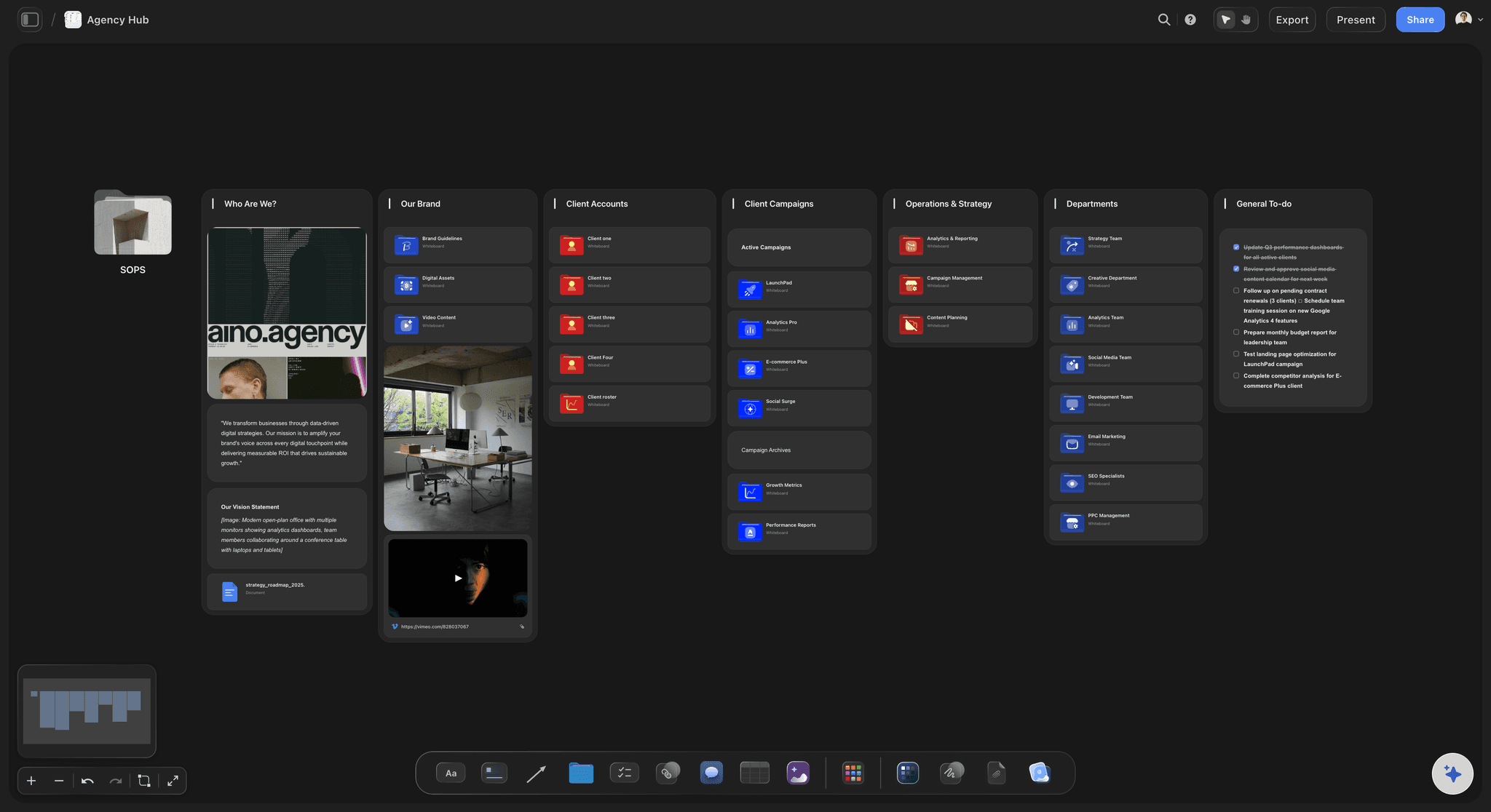
The client approval as a planned item
Put the decision inside the plan
Mark who signs off, by when, and what waits on it. The approval that gates three deliverables is the single most useful thing to draw and the thing most agency plans leave implicit.
See the client review board →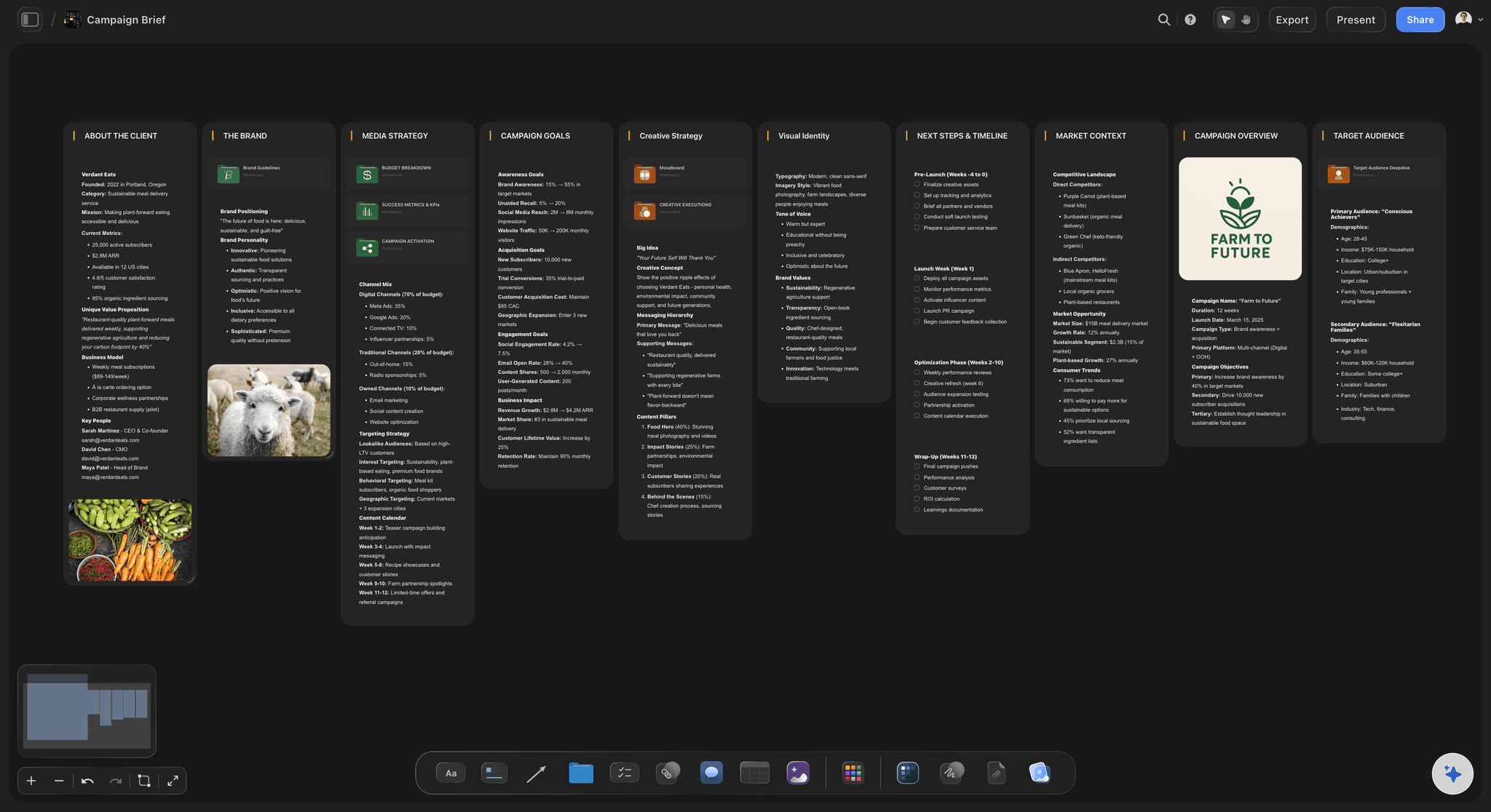
AI drafts the conventional campaign plan
Start from complete, then cut
Describe the campaign and the AI lays out the standard deliverables per channel with the usual dependencies. Under deadline pressure the items that get skipped are always the conventional ones.
See campaign brief to delivery →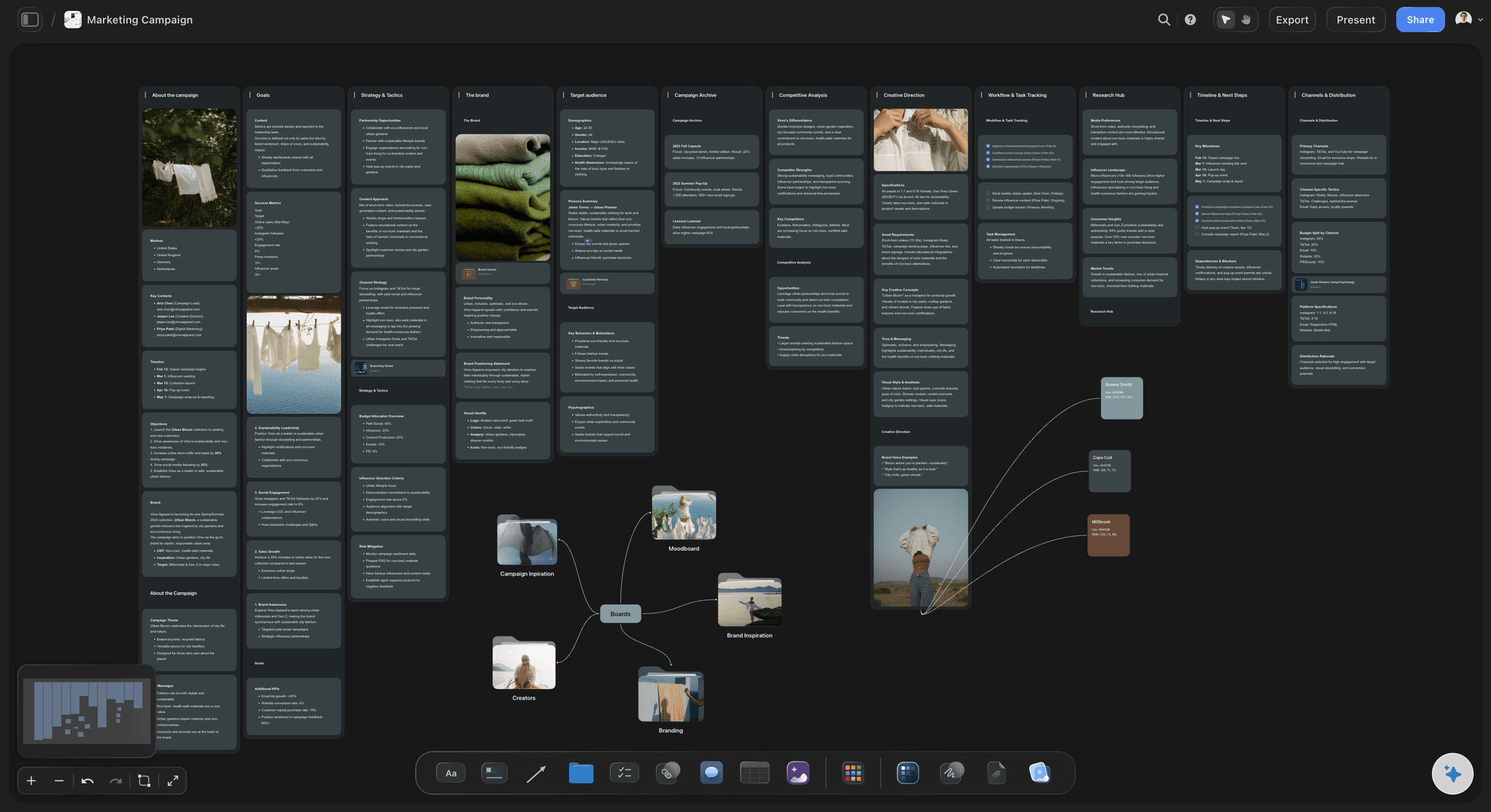
Concepts and work on the same board as the plan
The client reacts to the work, not to a status
Routes, references, drafts, and cuts sit on the campaign board. Feedback lands on the specific piece rather than arriving as a paragraph about the whole thing.
Try the campaign concept presentation →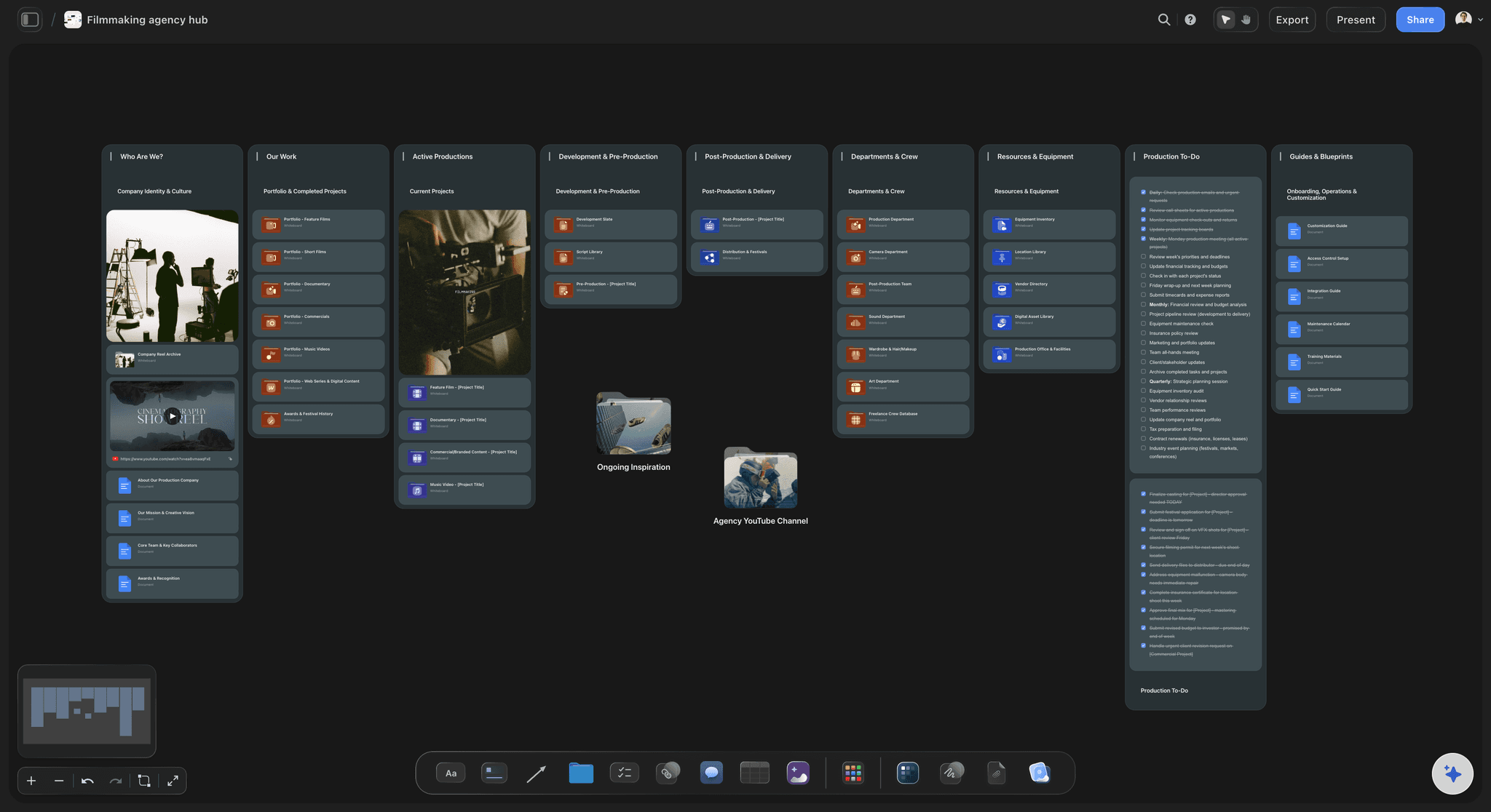
One board per client, one link per board
Share without adding seats
Clients and partners open exactly the board they need in a browser with no account, and a freelancer a paid member invites joins free. Nobody on the client side becomes a licensing conversation.
See agency client project planning →Unlimited boards. No object cap.
One board per client campaign, shared by link. Storyflow is paid-only during early access, with plans from $7.99 a month billed annually ($9.99 monthly). A free plan launches before the end of 2026, and anyone a paid member invites to a board joins free.
Unlimited campaign boards on an infinite canvas
AI that drafts plans, deliverables, and timelines from a description
Templates for briefs, campaigns, and agency hubs
Share view-only links with clients, no account required
Built for people with taste
Half your dependencies belong to someone else.
That is the structural difference between agency planning and in-house planning, and almost every delay traces back to it.
Feedback, approval, and the cost of late notes
The client is in the critical path
Approval as a scheduled item: With a date and a named person, it can be chased and re-planned. Left implicit, it is a hope, and every date after it is a guess the agency ends up absorbing.
One voice or three: Contradictory notes from three stakeholders is the most expensive form of feedback there is. Agreeing who consolidates before the first review is a ten minute conversation that saves a week.
Notes that arrive too late to absorb: A change requested after production has started costs several times what it would have cost at concept. Making the point of no return visible is worth more than asking for faster feedback.
Silence produces change requests: A client who has not seen anything for three weeks reacts to the finished work rather than steering it. Visibility is the cheapest form of scope control.
Channels, deliverables, and shared assets
Most campaigns have one asset holding up four things
Deliverables grouped by channel: Laid out per channel rather than as one list, the volume becomes visible. Most campaigns are agreed at a size nobody counted.
The shared asset: One shoot, one hero image, or one piece of copy that four deliverables depend on. Drawing that dependency is the highest value line on an agency board.
The thing the client owes you: Logos, product, data, legal review, or access. Agency plans routinely track only the agency's own work, which makes the client's side invisible until it is late.
Versions and adaptations: The sizes, cutdowns, and localisations that are agreed casually and take longer than the original. Counting them at planning time changes what gets promised.
AI that reads the whole campaign board
Ask what this campaign is missing
Draft the conventional plan: Describe the campaign and get the standard deliverables, dependencies, and timeline. Completeness is the value, because the items skipped under pressure are always the ordinary ones.
Find the unowned item: Ask what has no owner or no date, and what is waiting on the client. The AI reads your board, so the answer is about this campaign.
It proposes, you decide: Storyflow arranges and suggests. What the creative should be, and whether a deadline is honest, stay with the people accountable for them.
Re-plan when the client is late: Approval slips by a week. Ask what moves with it and what can proceed anyway, rather than rebuilding the schedule under pressure.
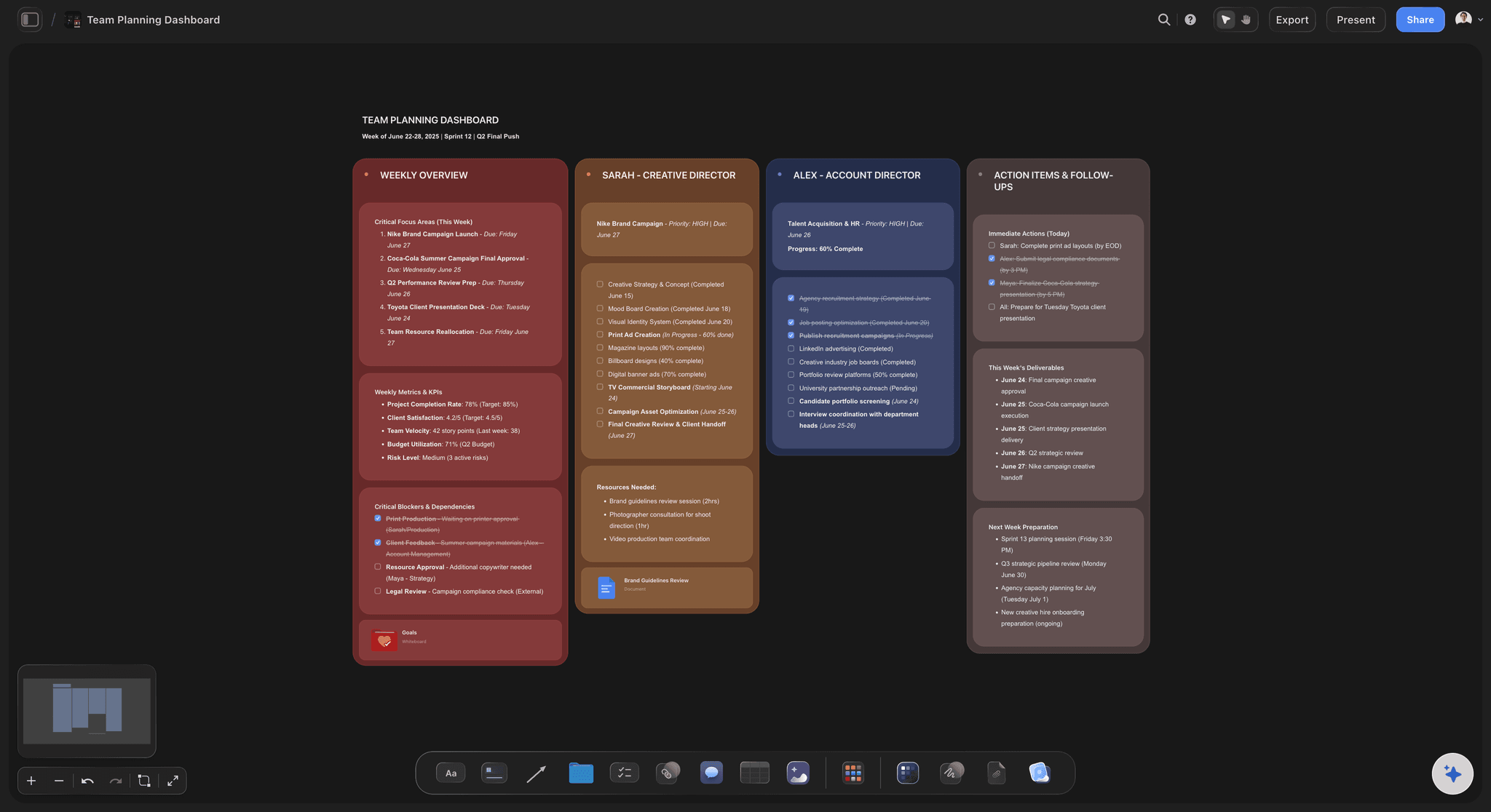
Several clients, several phases, one view
The agency-level question is collisions
A board per campaign: Matching the unit you invoice, staff, and share makes both permissions and navigation simple without any hierarchy to maintain.
One overview board: Which campaigns are in which phase and where two are about to need the same designer in the same week. That question has a different shape from any single plan.
Freelancers get one link: Somebody joining for two weeks opens the one campaign they are on by link, with no onboarding session. Invite them free when they need to edit.
Explore templates for your project
Every template opens as a real, editable board on the infinite canvas. Pick the closest fit and make it your own.
Marketing Campaign
Plan a campaign across channels, messages, and deliverables on one board the whole team can see.
One app instead of five
Storyflow vs Asana, a shared deck, and email.
Each is good at something: Asana at task ownership, time tracking, and workload, a deck at presenting a moment, email at reaching anyone. Here is where they differ for running a client campaign.
Storyflow
Recommended
Brief, work, and plan on one canvas
Client opens it with no account
Comments on the specific deliverable
Time tracking and workload
Asana
Brief, work, and plan on one canvas
Client opens it with no account
Comments on the specific deliverable
Time tracking and workload
A shared deck
Brief, work, and plan on one canvas
Client opens it with no account
Comments on the specific deliverable
Time tracking and workload
Brief, work, and plan on one canvas
Client opens it with no account
Comments on the specific deliverable
Time tracking and workload
What creators are saying
Join early creators getting structured workspaces and AI that remembers their projects
“Storyflow has sped up my workflow by at least 3x, which means more flow state and more projects I can actually ship. It truly changed the way me and my team create.”

Reilin Joey
Director & YouTuber
“One prompt gets me a structured board. But the tactics are my favorite. I run my YouTube scripts through them and my intros and retention got better. It's amazing.”

Justkay
YouTuber & Freelance Filmmaker
“I used to juggle five apps to plan a project. Now I describe what I am making and get boards, lists, and a schedule. All in one place.”

George
@fernwehchronicles
Agency campaign planning, answered.
How to structure a campaign, handle approvals, and stop late change requests.
Agencies plan a campaign best on one board with four layers: the brief, the creative routes, the deliverables by channel, and a timeline with the client's approval points. The brief sits at the top, so every deliverable traces to an objective and a late change request can be answered. The routes sit under it, since the concept gates everything downstream. Approval points go in as items with dates and owners, the layer most agency plans leave implicit.
Storyflow runs each client campaign on one board: the brief, the work and the plan sit on the same canvas, from concept through deliverables to delivery. The client opens it by link with no account and comments on the specific deliverable, so feedback lands on the work instead of in a chase email. Time tracking and workload are still Asana's job: Storyflow does not do them.
Agency campaigns mostly slip on dependencies that belong to the client rather than the agency. Feedback arrives late, from three people who disagree, or after it can be absorbed without redoing work. What the client owes, such as assets, product, data, legal review, or access, is left off plans that track only the agency's own work. And adaptations agreed casually take longer than the original. All three are solved by putting the client's side on the same board as yours.
Agree who consolidates the notes, attach feedback to the specific piece, and make the point of no return visible in the plan. Contradictory notes from three stakeholders are the most expensive feedback there is, so settle who consolidates before the first review. Notes pinned to a deliverable never need reconstructing. And a visible cut-off for changes works better than asking for faster feedback, because a change at concept costs a conversation and the same change in production costs a week.
Yes, in read-only form. A client who can see the state of the work stops asking for status and reacts to work in progress rather than only to finished deliverables, which removes the change request that arrives at the worst moment. Keep them out of your working tools: a view-only link opens the campaign board in a browser with no account, they sign in to comment on a specific piece, and they cannot move anything.
An agency campaign plan should include six things: the brief, the creative routes, the deliverables, the dependencies, the timeline, and what the client owes. Write the brief plainly enough to settle an argument later. Group deliverables by channel and count every adaptation. Mark the shared asset four deliverables wait on and the approval that gates the next phase. And put dates on the client's side, the half agencies most often leave off and the half that most often causes delay.
Keep one board per campaign and add one overview board that answers a different question. Each campaign board shows how that campaign is going. The overview shows where two campaigns are about to need the same designer in the same week, which no single plan can show. Keep it coarse: each campaign with its phase, its next approval, and who is on it. A plan detailed enough to run one campaign is too detailed to see across six.
Not yet. Storyflow is paid-only during early access, with plans from $7.99 a month billed annually ($9.99 monthly). A free plan launches before the end of 2026, and anyone a paid member invites to a board joins free. Clients reading a view-only link never need an account, which matters for an agency whose collaborators are mostly outside the company. Until the free plan launches, a shared document per campaign with the brief, deliverables, and approval dates is a workable stopgap.
Yes, it drafts the conventional plan well, and under deadline pressure the conventional items are exactly what gets skipped. Describe the client, objective, channels, and timeframe, and Storyflow's AI lays out the standard deliverables per channel with the usual dependencies and approval points. The value is completeness, since the forgotten items are ordinary ones like the cutdown or the second approval round. Whether the creative is right, or the fee supports the plan, stays with the agency.
A campaign board shows the work, while project management software tracks who owes what by when. Agency suites add timesheets and invoicing, which a canvas does not. What trackers show poorly is the work itself: a campaign becomes a list of tasks whose content sits in attachments. Most agencies want both: a tracker for hours and resourcing, and a board per campaign where the brief, the work, the dependencies, and the client's decisions sit where the client can look.
Make the brief visible and the volume countable. Scope creep is rarely one large request; it is a series of small ones that each sound reasonable and together add a fortnight, and it thrives when nothing shows the total. Deliverables grouped by channel, including every size and adaptation, turn one more asset into a visible change in the count. And a request that does not trace to the objective is easier to discuss when the brief tops the shared board.
Yes, and per-campaign boards make that safe. Invite a freelancer onto the one board they are working on and they contribute directly while seeing nothing else the agency runs. Anyone a paid member invites joins free, so bringing in a designer for two weeks is not a licensing decision. Someone who only needs to read can use a view-only link with no account. Either way, the brief, routes, and deadlines are readable in a couple of minutes.
The brief is what the work is trying to do; the plan is how and when it gets made. The brief covers the objective, audience, insight, message, mandatories, and constraints, and it settles arguments about whether the work is right. The plan covers deliverables, dependencies, owners, and dates. Merging them weakens both, because the timeline is easier to write than the thinking and ends up standing in for it. Keep the brief at the top of the campaign board instead.
More from Storyflow
Agency client project planning
Campaign brief to delivery
Campaign concept presentation
Client presentation tool
Client review board
Marketing planning software
Campaign calendar
AI creative brief generator
Creative team workflow tool
Creative concept board
Design feedback tool
Marketing workspace
Visual project planning
Commercial production
RFP response plan
Media plan template
Let the client see the campaign.
Open a board, describe the campaign, and share it with a link. No download.