How to Plan a Product Launch Visually With a Small Team (2026)
Plan a product launch visually with a small team on one Storyflow board: four lanes, T-minus weeks, one owner per card, and an AI that drafts the board from your launch brief. Method, template and tools.

Category
Marketing
Author

Justkay
Documentary Filmmaker & Founder at Storyflow
Topics
2026-08-31
•
Updated October 10, 2026
•
46 min read
•
Marketing- how do I plan a product launch visually with my small team
- product launch plan small team
- T-minus launch board
- visual launch planning
- product launch timeline
- launch planning tools 2026
- Storyflow
How do you plan a product launch visually with a small team?
Plan a product launch visually with your small team on one Storyflow board: drop your launch brief on the board and its AI lays the launch out in weeks counted back from launch day, in four lanes (Product, Content, Channels, Operations), one card per deliverable, and the team puts one owner on each. Run the planning session on that same board with everyone editing live, end it with a collision pass column by column, and share a view-only link that investors, a client or advisors open with no account. Plan the Channels lane first, because its external dates are not yours. Past about ten people, add Asana or Jira underneath for dependencies; if your team already pays for Miro or FigJam, either can host a large live workshop.

Full disclosure: Storyflow is our own product, and it ranks first here because this guide is written for founders and small marketing teams, and the criteria that weigh most for them (a first draft of the board from the brief, and sharing the plan with people who have no seat) are the job Storyflow is built for. The weights and every sub-score are published in the tools section, so you can re-weight them. Miro and FigJam score higher for the live session, Asana scores higher for keeping status current past ten people, and a physical wall beats all of them in one room. Storyflow has no automations, no dependency tracking and no Gantt view, runs in the browser only, and is paid-only during early access. We link to every tool so you can judge the fit yourself.
How the launch planning tools compare on innovation and presenting the plan
Which launch planning tools are the most innovative?
Storyflow, on the step before the session: ask its AI to lay the launch out from the brief and whatever else is on the board, in lanes of deliverable cards, and the team starts from a draft instead of an empty canvas. Miro innovates on live multiplayer with AI credits inside the workshop. FigJam ships a free product launch plan template. Asana's launch template drafts release notes and translates announcements with AI.
Which tools can present the launch plan to stakeholders?
Storyflow's Presentation mode goes fullscreen and steps through the board one wall at a time, so a board with one wall per T-minus week becomes the investor or client walkthrough without a slide deck. Asana's launch template includes a dashboard for stakeholders. On any board tool, a view-only link is the lighter option for people who only need to check the state.
Quick Comparison: Tools That Hold a Visual Launch Plan
A small-team launch board is 30 to 60 cards over six weeks. These hold that comfortably, and they differ mainly in whether you start from an empty canvas and who maintains it after the session.
| Tool | Best For | AI Features | Price |
|---|---|---|---|
| Storyflow | Brief to launch board, free viewers | Ask the AI to lay out lanes and cards from the brief | $7.99 mo annual (free plan late 2026) |
| Miro | The live session, fast multiplayer dragging | AI credits per member | Free / $8 member mo, yearly |
| FigJam | The live session inside Figma | AI credits per seat | Free / $3 Collab seat |
| Notion | If one person will maintain it after the session | Notion AI | Free / Plus per seat (local currency) |
| Asana | Dependencies and a timeline past ten people | AI in the launch template | Free for 2 / $10.99 user mo, annual |
Walk into the session with the board already drafted
Drop your positioning doc or launch brief on a Storyflow board and ask the AI to lay out the four lanes and a first pass of deliverable cards. Editing a draft beats filling an empty wall.

How do you plan a product launch visually with a small team?
Plan a product launch visually with a small team by putting the whole launch on one wall: four lanes (Product, Content, Channels, Operations), columns counted back in weeks from launch day, one card per deliverable and one owner per card. In Storyflow, drop the launch brief on a board and the AI drafts those lanes and cards; the team edits it live in one session, and an investor, client or advisor opens it by link with no account.
The method is the same on any canvas. The lanes run left to right from about six weeks out to two weeks after launch day, and every card carries a T-minus column rather than a date. If the whole plan does not fit on one screen, the launch is too complicated for the size of your team. The board stays the plan after the session: the launch-day run sheet, the channel schedule and the content drafts sit beside the lanes.
That works because a team of two to eight does not have a coordination problem, it has a visibility problem. Nobody is confused about who does what. They are confused about what happens on Tuesday and what is quietly not going to be ready. A tracker answers the first question well and the second question badly, because a tracker shows you a filtered list and never shows you the shape of the whole thing.
A small team's launch plan has one job: making it obvious, at a glance, what is not going to be ready. Everything else is secondary.
The typical three-person launch goes wrong in a specific way: everyone works hard on their own lane and nobody sees that the pricing page and the announcement email carry contradictory copy until the day before. A wall catches that. A task list does not.
Which tool should a small team use to plan a product launch visually?
Use Storyflow. Its AI turns the launch brief into a drafted board of lanes and deliverable cards before the meeting, the board holds the session itself with everyone editing live, and keeps the plan, the content drafts and the run sheet on the same board afterwards. Viewers open it with no account, so investors, a client or contractors see the plan without a seat. The other tools each fit one condition: Miro or FigJam if your team already pays for one and only needs a blank canvas for a large workshop, Asana or Jira past about ten people when dependencies need a Gantt view, and Trello for a single-channel launch.
Tools for each step of a visual launch plan
Every step from the brief to the retro happens on one board, which is the point of planning visually: the person writing the launch email can see the pricing page card without asking.
This guide gives you the method (lanes, T-minus columns, the two-hour session, the collision pass), a card template and a filled worked example you can copy into any tool, a readiness checklist for the last two weeks, and a ranked shortlist of the tools that hold the board, with the scoring weights stated. For the wider campaign tooling question, see The Best Workspace to Run a Campaign From Brief to Delivery. For the AI-assisted version, see How to Plan a Product Launch with AI. For the board as a product page, see the launch roadmap overview.
Picks by who is launching: founders, marketing teams, agencies
The method is the same for everyone. What changes is who owes the launch to whom, and that decides which tool earns the subscription. Start with the row that describes you.
If you are a founder or run a small marketing team, the question that matters is not "which tool has the most features" but "which tool gets a credible plan in front of everyone this week". That is why the draft-from-brief step carries the most weight in the scoring further down.
Why small teams should plan on one wall, not in a tracker
Trackers are built for the problem large teams have: too many people, too many tasks, unclear ownership, contention over capacity. Small teams do not have that problem. Ownership is obvious because there are four of you.
What small teams have instead is cross-lane blindness. The person writing the launch email does not know the pricing page changed. The person building the demo does not know the announcement moved forward three days. Each individual lane is fine. The seams are where it breaks.
A wall fixes this because of two properties a list does not have:
Simultaneity. Everything is visible at once. You see that three things land on the same Tuesday without querying anything. In a tracker, that collision is discoverable but nobody discovers it, because seeing it requires deciding to look.
Adjacency. Things that must agree with each other sit next to each other. The pricing page card and the pricing section of the announcement email are physically near each other, so the contradiction is visible rather than latent.
The tradeoff is real: a wall handles dependencies badly, does not chase anyone, and does not scale past roughly sixty cards. For a small-team launch over six weeks, sixty cards is plenty. Past about ten people, use a tracker and keep the wall as a summary. If you are deciding between the two formats for a specific launch, Launch Roadmap vs Launch Checklist walks through that choice.
The Four Lanes every launch has
Every product launch, at any size, has exactly four lanes. Naming them prevents the most common small-team failure, which is a launch that is really just a marketing campaign with no operational readiness behind it.
Lane one: Product. What has to be true of the thing itself. Feature complete, bugs at an acceptable level, pricing implemented, onboarding working, the empty state not embarrassing. This lane has hard dependencies and it is the one that slips.
Lane two: Content. Everything you make to explain it. Announcement post, landing page, demo video, screenshots, docs, changelog, email sequence, social assets. This lane is high volume and mostly parallel, which makes it feel safe and makes it easy to under-scope.
Lane three: Channels. Where it goes and when. Email list, your own blog, social, communities, Product Hunt or equivalent, press or newsletters if relevant, partners, paid if you are running any. This lane has fixed external dates you do not control, and those dates are the real skeleton of the schedule.
Lane four: Operations. What happens when people arrive. Support ready and briefed, billing tested end to end, analytics and tracking in place, someone actually watching the inbox on launch day, a rollback answer if something breaks.
Lane four is the one small teams skip, and it is the one that generates the bad launch-day story. A launch that works and cannot bill anyone is worse than a launch delayed a week.
The same four lanes hold for a physical product. The Product lane gains manufacturing, packaging and stock, the Operations lane gains fulfilment and returns, and the Channels lane gains retail or marketplace dates that are even less movable than a newsletter. For the lanes in more depth, see How to Launch a Product With a Small Team: One Board, 4 Lanes. For a brand launch rather than a product launch, the brand launch checklist covers the identity side.
Who owns what on a small product launch team
Four lanes do not mean four people. On a team of three, one person owns two lanes; on a team of six, a lane can have a lead and a helper. The rule is that every lane has exactly one named owner who answers for it at the twice-weekly walk, even if other people hold cards in it.
Two patterns in that table matter more than the exact names. The founder almost always ends up owning Operations on a team under five, because nobody else has the authority to say "billing is not ready, we move the date". And the launch-day owner should be the person with the fewest cards in launch week, not the most senior person, because their only job that day is watching and routing.
When an agency or freelancers are involved, give them cards on the same board rather than a separate brief document. The contractor who can see that the pricing page moved is the contractor who does not deliver a hero image with last week's price on it.
Building the T-minus board: your product launch timeline
Lay the wall out left to right in T-minus time rather than in calendar dates. Calendar dates break every time the launch moves, and small-team launches move.
Columns: T-6 weeks, T-4, T-3, T-2, T-1, Launch week, T+1, T+2.
Rows: the four lanes.
Cards: one deliverable each, with an owner's name and a T-minus column. Not a date. When the launch moves, you move the launch date and the whole plan slides with it, which takes ten seconds instead of an afternoon.
Colour or tag for state: not started, in progress, done, at risk. Four states. Small teams that add a fifth and sixth state stop updating them.
The one rule that makes the board work: a card is at risk the moment the owner privately thinks it might be, not when it is late. The whole value of the wall is early warning, and early warning only happens if flagging risk is socially cheap. Say this out loud when you set the board up.
A launch board for a small team is typically 30 to 60 cards. If you are past 80, either the launch is genuinely large and you need a tracker, or you are decomposing too finely.
Read that table as the default and delete from it rather than adding to it. Every row a small team keeps is a row somebody has to own.
Product launch timing: why six weeks. Six weeks is long enough to write, shoot and schedule the Content lane once without rushing, and short enough that the positioning you agreed at T-6 is still true at launch. A launch that needs eight to twelve weeks is usually a launch with a hard external date (a conference, a retail slot, a platform review) and the extra weeks sit at the front, in the Product lane. If you want the timeline as a standalone template, the Small-Team Launch Timeline Template has it week by week.
Roadmap, kanban or checklist: which view for which week
Small teams argue about whether the launch plan should be a roadmap, a kanban board or a checklist. The honest answer is that it should be each of them at a different point, and the T-minus board already contains all three if you look at it the right way.
The mistake is moving the plan into a different tool at each phase. Teams that plan on a whiteboard, execute in a kanban app and run launch day from a spreadsheet lose the adjacency that made the wall worth building, because the Tuesday collision now lives across three tools. Keep one board and change how you read it. For kanban-specific tools, see the best kanban board tools; for roadmap-first tools, the best roadmap tools.
The launch card template
Every card on the board has the same five fields. Anything more and people stop filling them in; anything less and the collision pass cannot work. Copy this into whatever tool you use.
The fifth field is the one teams skip and the one that pays. When you write "must agree with" on the pricing page card, you have written down the cross-lane seam where the contradiction will happen. At the T-2 read-through, you walk only those pairs.
The two-hour session that produces the whole plan
The whole plan gets built in one session with everyone present. Do not build it alone and present it, because the value is the cross-lane collisions that only surface when all four owners are in the room. Run it on a Storyflow board with the AI's draft from the brief already on it, so the session edits a plan rather than filling an empty wall; the decisions still happen together.
Minutes 0 to 10: fix the date and the shape. What is the launch date, is it hard or soft, and what does "launched" actually mean. Write the definition of done for the launch itself on the board. Teams skip this and then argue in week five about whether the docs are in scope.
Minutes 10 to 25: Channels lane first. Counter-intuitive and correct. Channels contain the dates you do not control: a newsletter's publication day, a Product Hunt launch window, a conference, an embargo. Everything else schedules backwards from those. Teams that plan Product first build a schedule that collides with reality in week four.
Minutes 25 to 55: Product lane. What must be true, and be honest about what is genuinely required for launch versus what would be nice. This is where the scope argument belongs and it is better had now than at T-1.
Minutes 55 to 85: Content lane. List every asset. Every one. Small teams routinely discover here that they have committed to eleven pieces of content between three people in four weeks, which is the moment to cut rather than the week before.
Minutes 85 to 100: Operations lane. Support, billing, analytics, who is watching on the day, what happens if it breaks. Fifteen minutes is enough and it is fifteen minutes most teams never spend.
Minutes 100 to 120: the collision pass. Walk the board column by column, not lane by lane. For each T-minus column ask: is this week possible for the people in it. This is where you find that one person owns nine cards in T-2 week. Move things now.
The collision pass is the highest-value twenty minutes of the entire launch. Do not skip it because you are running late; skip a lane's detail instead.
For a remote team, run the same session on a shared board with cameras on, and give each lane owner five minutes of silent card-writing before the discussion of their lane. Silent writing first stops the loudest person from setting the scope of every lane.
Share the board with people who do not need a seat
Founders, advisors and contractors can open a read-only Storyflow board link with no account, so the plan is visible to everyone who needs to see it and billed for none of them.
A worked example: a four-person launch board, filled in
Here is the board filled in for an illustrative team: a founder (Sam), a developer (Lee), a designer who also makes the video (Priya) and a part-time marketer (Jo), launching a paid tier of a web app six weeks out, with one fixed external date: a partner newsletter that goes out on launch day. The names and product are invented; the shape is the one this method produces.
Three things the collision pass caught in this example. Jo held four cards in T-2 week, so Priya took the forum posts. The landing page card and the pricing page card had different annual discounts, found because of the "must agree with" field. And nobody owned "who answers the partner's audience if they reply", which became a card in Operations. None of those is dramatic, and each would have surfaced on launch day otherwise.
What a small team should cut
Most small-team launch plans are about forty percent too large. The things that are almost always worth cutting:
- The third and fourth content formats. A launch post and a demo video beat a post, a video, a webinar, an ebook and a podcast episode done badly.
- Paid, on a first launch. You do not yet know what message converts. Spending to amplify an untested message is expensive learning.
- The press push, unless you have relationships. Cold press outreach for a small product launch has a very low return and eats a week.
- Simultaneous multi-channel. Sequencing beats simultaneity for small teams. Launch to your list, then the communities, then social, over several days. It spreads the operational load and lets you fix the message between waves.
- The perfect landing page. Ship a good one. The launch traffic will teach you what it should have said.
Things not to cut: Operations, ever. And the T+1 and T+2 columns, because the week after launch is when the leads you generated actually convert, and teams that planned nothing for it waste the traffic they just bought with six weeks of work.
Which tool to use for this: the ranked shortlist
A small-team launch board is 30 to 60 cards, a brief, a few documents and a launch-day run sheet. Every tool below can hold that. They differ on whether you start from an empty canvas, whether the plan survives the week after the session, and what it costs to show the plan to people who are not on the team.
How we scored them. The weights follow what a founder or small marketing team needs from a launch plan: getting a credible first draft on the board fast (25%), seeing the whole launch across all four lanes on one screen (20%), running the live planning session (15%), sharing the plan with investors, clients or advisors who have no seat (15%), keeping status current after the session without a project manager (15%), and cost for a team of four (10%). Storyflow was scored on its current workflows; the other tools were compared from their own product and pricing pages, last checked on October 9, 2026 (Notion on October 10). Storyflow is our product, which is why the weights are published: re-weight them for your team and the order may change.
Read the sub-scores before the totals. Miro and a physical wall beat everything on the live session. Asana beats everything on keeping status current. Storyflow leads the total because the draft-from-brief and share-without-a-seat criteria carry the most weight for the reader this page is written for.
1. Storyflow
Best for: founders, small marketing teams and agencies who want the launch plan on one board, drafted from the brief, before the first meeting.
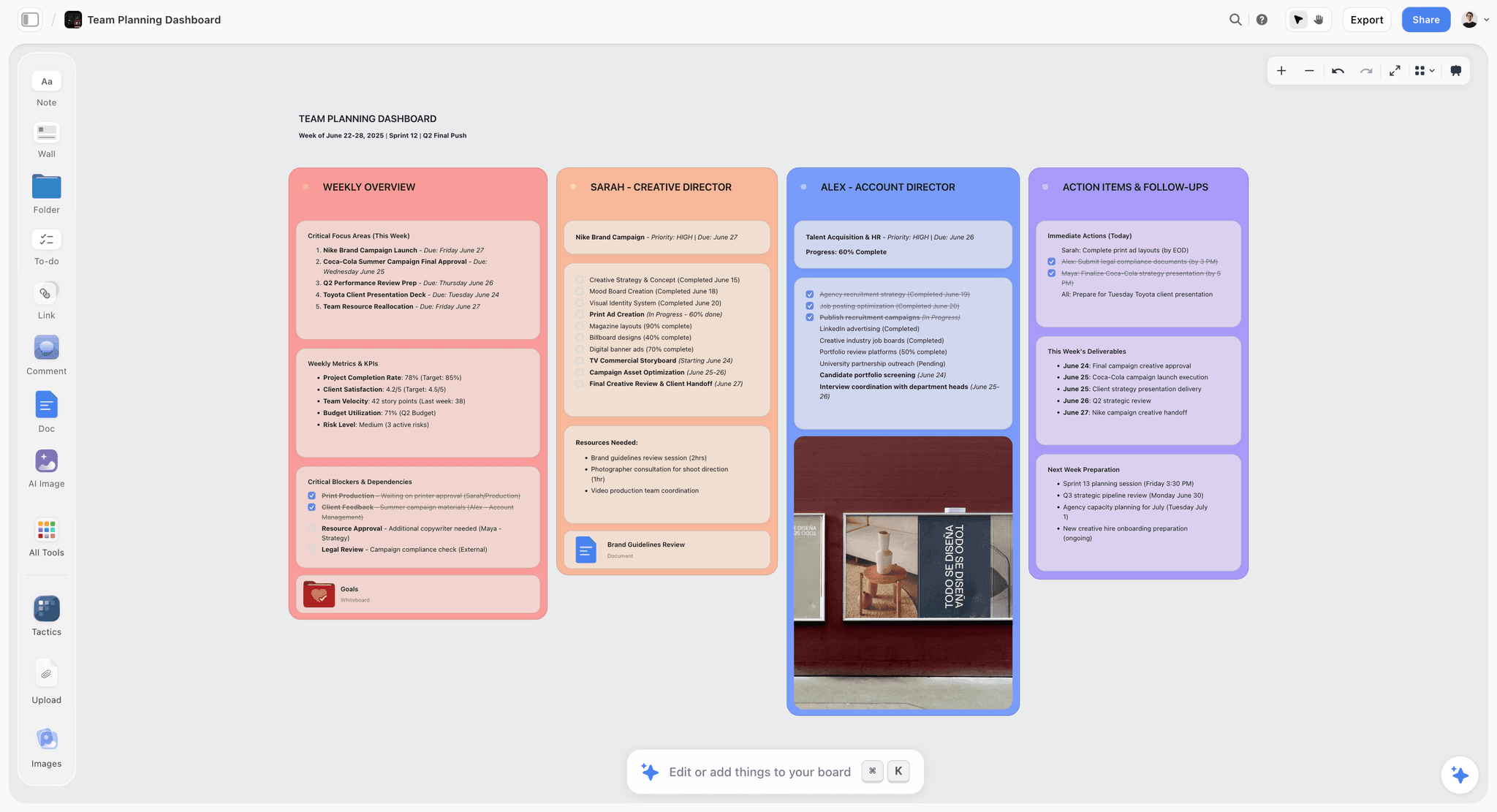
Storyflow is a canvas with an AI that reads the board you have open. Drop your positioning doc or launch brief on the board (or attach up to five documents from the "+" menu) and ask it to lay the launch out in weeks counted back from launch day, in four lanes with one card per deliverable, then ask for the supporting documents. The team puts one owner on each card. Each change it makes can be undone in one click. The session becomes editing a draft rather than filling an empty wall, which matters for a small team, because editing a wrong draft is faster than producing a right one from nothing. The AI proposes; the team decides what stays.
The same board holds the rest of the launch. Ask the AI for a campaign brief, a marketing plan, a social media plan or a content plan to draft the content and channel plan beside the lanes. Tickets carry assignees, Tables hold the channel schedule with a date column kept in date order, a Kanban holds the final two weeks, and a Document holds the launch-day run sheet. Invited teammates edit in real time with live cursors and join free when a paid member invites them. An investor, client or advisor opens a view-only link with no account, and signs in to comment. Build one wall per T-minus week and use Presentation mode to step through them one wall at a time, which makes the twice-weekly walk a short screen share. When the launch is over, duplicate the board or save it as a template for the next one.
Where it falls short:
- No automations, due-date reminders or dependency tracking, and no Gantt or workload view. Nothing chases anyone; the twice-weekly walk has to.
- Tables on the canvas cannot be sorted or filtered by a column, so the channel schedule stays in the order you (or the AI) wrote it.
- It runs in the web browser only. Phones work for viewing, light edits and AI chat; building the board is a laptop job.
- It is paid-only during early access (its Free plan launches before the end of 2026), invited teammates join free on free-tier limits, and the paid member's AI use is metered by plan.
- It is new. A team that needs a tool its contractors already know will spend a few minutes on orientation that Miro would not need.
Choose Miro instead if the live workshop is the point, eight or more people will drag cards at once, and nobody will write a brief first.
For the landing page version, see the AI marketing campaign planner. For head-to-heads, see Storyflow vs Miro and Storyflow vs Notion.
2. Miro
Best for: the live two-hour session with the whole team dragging cards at once.
Miro is the fastest place to run the session itself. Everyone can drag, cluster and vote, and a small team that has ever run a workshop already knows it. The known failure is what happens after: nobody maintains the board, and by T-2 the real state lives in chat. Paid plans include a monthly allowance of AI credits per member, and Starter lets visitors edit a board from a link.
Where it falls short: the board starts empty unless you use a template, and AI runs on a monthly credit allowance. For a direct comparison, see Storyflow vs Miro; for cheaper boards, see the best Miro alternatives for small teams on a budget.
3. FigJam
Best for: the same live session for a team that already pays for Figma.
FigJam runs the session almost as well as Miro, and Figma publishes a free product launch plan template laid out in 90, 60 and 30 days before launch plus post-launch. FigJam comes with every paid Figma seat, including the cheapest Collab seat, so for a design-led team it is often already paid for.
Where it falls short: the same decay after the session as Miro, and the 90/60/30-day template is coarser than weekly T-minus columns, so split it before you fill it. See Storyflow vs FigJam.
4. Notion
Best for: a launch one person will maintain as a database, viewed as a board.
Build a launch database with lane, owner, T-minus and status properties, then view it as a board grouped by lane or by week. It works well if one person owns it. It is a grid pretending to be a wall, so you lose adjacency, which is half the point of planning visually. See Notion vs Miro for visual project planning and Is Notion Good for Visual Project Planning?, which adds Asana, ClickUp and Linear.
5. Whimsical
Best for: a quick, clean visual plan where most people only need to look.
Whimsical boards are fast to draw and viewers are free on every plan. The free plan caps you at 50 board objects a month, which a 40-card launch board plus notes will pass. There is no brief-to-board step, so the session starts from empty.
6. Asana
Best for: a launch with real dependencies, or a team that already runs everything else in Asana.
Asana's product launch template comes with a Gantt chart for dependencies, a dashboard for stakeholders, custom fields for channels and reusable task templates. The template page also offers AI for drafting release notes and translating announcements. Timeline and Gantt views start on the paid Starter plan; the free Personal plan is for up to two users and has no timeline.
Where it falls short: it is a tracker, so it has the tracker's weakness this guide is about: you see your list, not the shape of the launch. Use it past ten people and keep a visual board as the summary. See Storyflow vs Asana.
7. Trello
Best for: a single-channel launch with four deliverables.
Lists as T-minus columns, labels as lanes. The free plan covers up to 10 collaborators and 10 boards per Workspace, and Timeline, Table and Dashboard views arrive on the Premium plan. Lists stack cards vertically, so you lose the lanes as rows. See Storyflow vs Trello.
8. A physical wall
Best for: a co-located team, for the session itself.
Sticky notes on a wall are still unbeatable for the two hours when everyone is in the room. Nothing survives the session except a photograph, so photograph it before anyone leaves and move it into a shared tool the same day.
Also named for launch planning: Lucidspark, Jira and Linear
These three also come up when people ask which tool to plan a launch in, so here is where each fits. None is scored above, because each is either a whiteboard without a brief-to-board step or an engineering tracker.
How they combine with the board. A software team can keep engineering issues in Jira or Linear and still plan the launch on one Storyflow board, with one Product-lane card per release milestone linking to the tracker. The board shows the shape; the tracker holds the tickets.
How to build the launch board in Storyflow
These are the steps on Storyflow as it ships in October 2026. The method in the sections above works in any tool; this is the fastest route through ours.
- Put the brief on the board. Create a project and drop the launch brief, positioning doc or last launch's retro onto the canvas as a Document, or attach up to five documents to your message from the "+" menu. The AI reads the board you have open with every message; it does not search your other boards unless you attach them.
- No brief yet? Draft one first. Ask the AI for a campaign brief or a marketing plan. It drafts the brief as walls of cards you edit, and the lanes come from that.
- Ask for the launch board. Something like: "Lay out a six-week launch board: four lanes for Product, Content, Channels and Operations, one card per deliverable with a T-minus week from T-6 to T+2, and a card for the success measure." If the AI asks which format you want, choose one wall per T-minus week (a wall is a titled column of cards, and the walk later steps through them) or a table with phase, milestone, owner and due date.
- Fill the Content and Channels lanes. Ask the AI for a social media plan or a content plan for the posts, and ask for a Table of the channel schedule with a date column, earliest first. If the posting calendar needs its own tool, The 12 Best Content Calendar Tools for Small Teams compares them.
- Assign owners. Turn the cards that need chasing into Tickets with assignees. Invite the team; invited collaborators edit the same board in real time.
- Run the collision pass with the AI. Select the board and ask the AI to review it: "Review my board and list any owner holding more than four cards in one T-minus week, and any two cards that must agree but say different things." It proposes; you move the cards.
- Share outward. Send investors, a client or advisors a view-only link. They open it with no account and see the latest version when they open or reload; to comment, they sign in.
- Walk it twice a week. Build one wall per T-minus week and use Presentation mode to step through them one wall at a time on a call.
- When the plan changes, ask the AI to redraft. The documents on the board do not update each other; ask the AI to redraft the launch email or the run sheet when the date or scope moves.
- After launch, keep the shape. Export the board as a PDF for the retro, then duplicate it or save it as a template for the next launch.
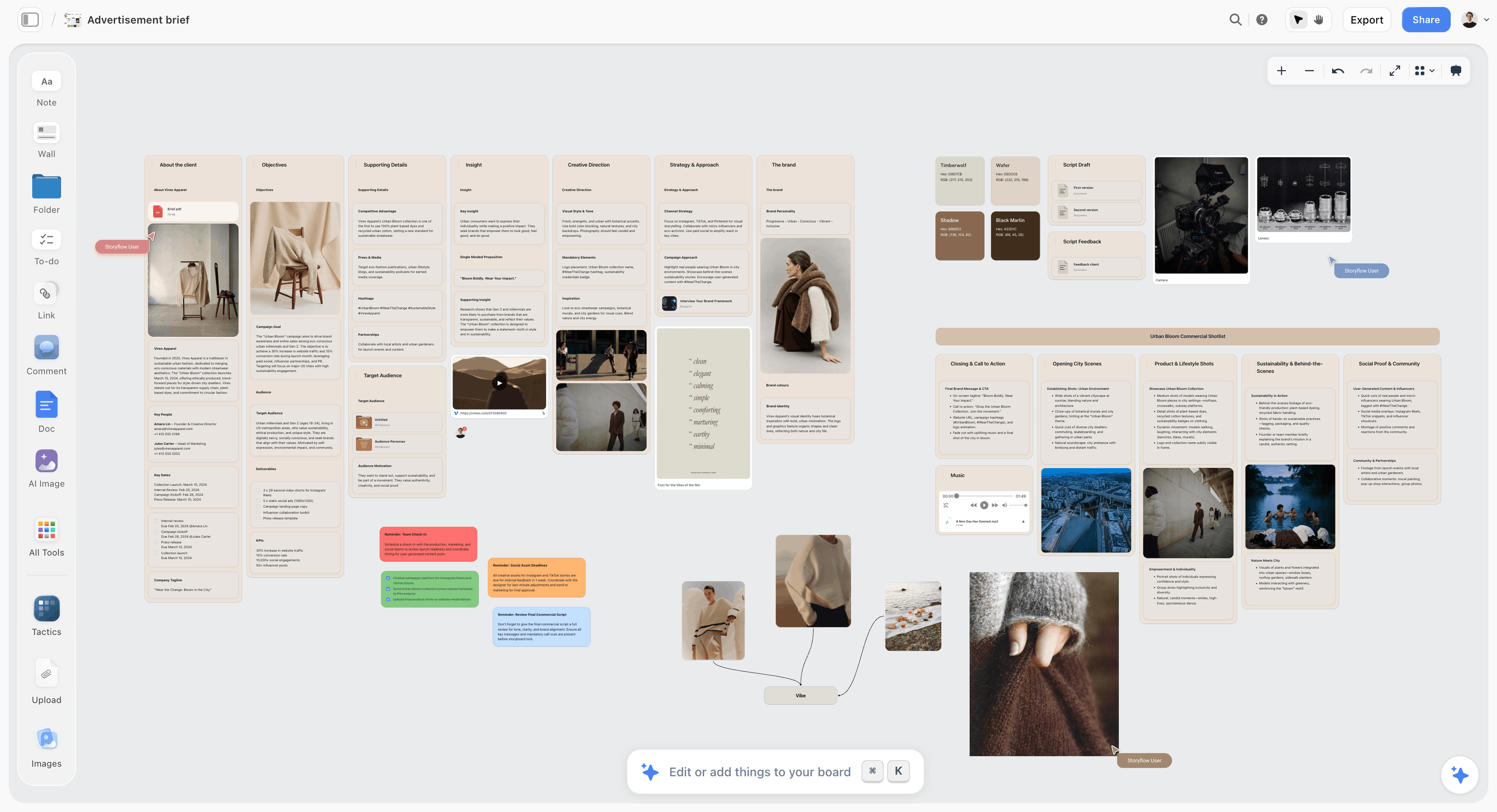
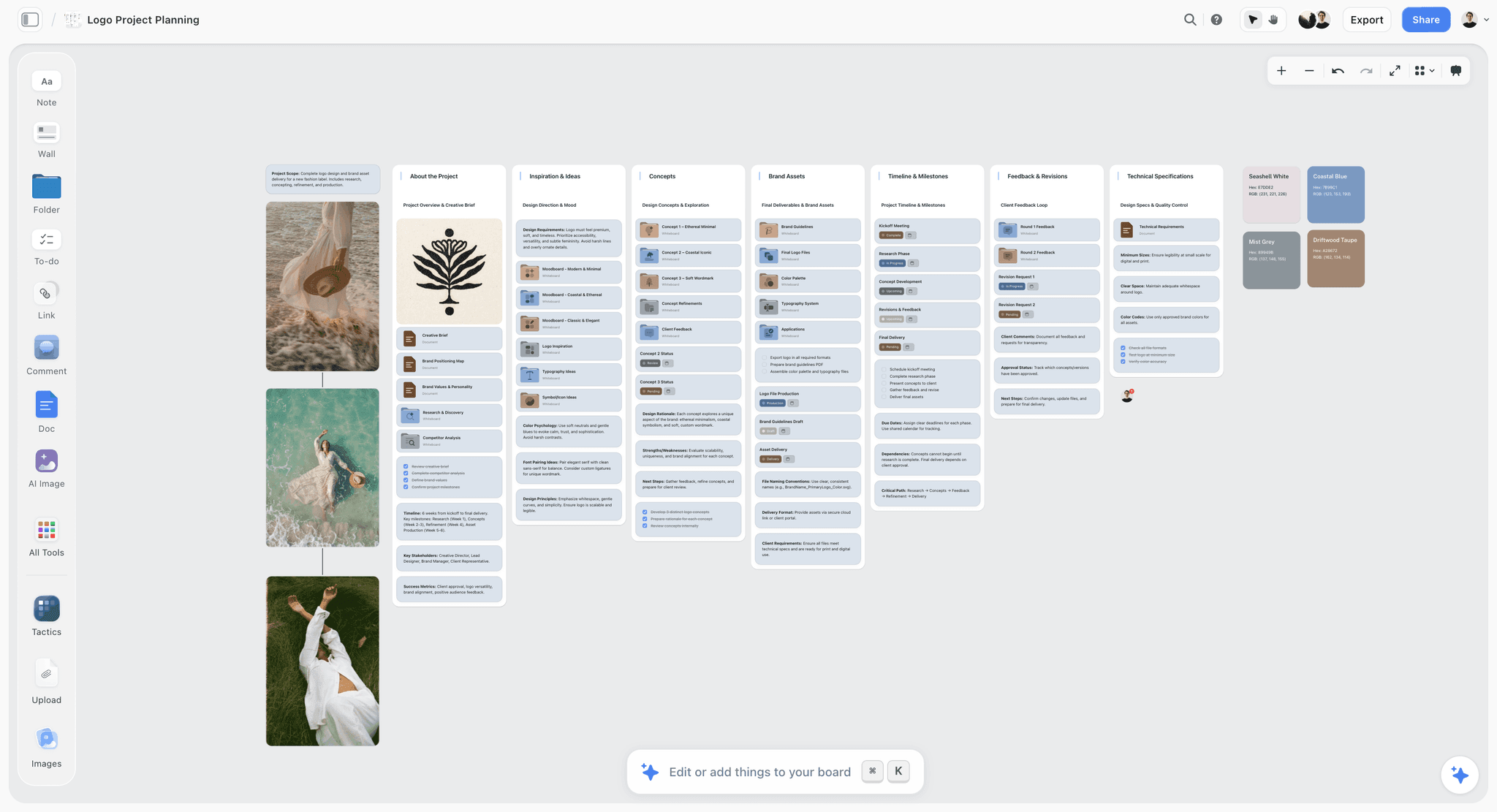
A board built this way holds the brief, the lanes, the content drafts and the run sheet in one place. For the version of this where the brief comes from a client, see Creative Approval Workflow: 5 Gates for Client Sign-Off.
What each tool costs a team of four
Price per head matters less than billing shape: who has to pay for a seat, and who can look for free. For a launch, the people who only need to look (investors, a client, advisors, a contractor) often outnumber the people who edit.
Prices were checked in September 2026 and rechecked on October 9, 2026 on Miro, Figma, Asana, Trello, Whimsical and Notion, and change often; confirm before you buy. Storyflow's invited teammates join free on free-tier limits and the paid member's AI use is metered, so a team that asks for a lot of drafts will feel the difference between Plus and Pro. That is why Storyflow scores 8 on cost, below FigJam and Trello, whose paid seats come with full editing.
Which one to pick, in one line each
Pick Storyflow to plan the launch visually on one board from the brief to the retro, with the AI drafting the board before the meeting. Pick Miro if your company already pays for it and the large live workshop is the only job. Pick FigJam if your team already lives in Figma and one fewer subscription matters. Pick Notion if exactly one person will keep it current and everyone else will read it. Pick Trello if the launch has one channel and four deliverables. Pick a wall if you all sit in the same room, and photograph it before anyone leaves.
Running the plan in the final two weeks
The plan changes character at T-2. Before then it is a planning artifact. After, it is a status instrument.
Stand at the board for ten minutes, twice a week. Not a status meeting. Walk the columns and ask one question per card that is not done: still on track, yes or no. Ten minutes, everyone standing, no discussion of solutions in the room.
Flag at risk early and loudly. The point of the board is that at-risk is visible three days before it becomes late. A team that only marks things at risk when they are already late has a decorated task list.
Freeze content at T-3 days. Copy changes after that point are how the announcement email ends up contradicting the pricing page. Freeze, then proofread everything against everything once.
Do one full read-through of every customer-facing asset in one sitting. Landing page, email, post, docs, in-app copy. One person, one hour, at T-2 days. This single habit catches more launch embarrassment than any process.
Have the cut conversation at T-1 week, not on launch day. What are we shipping without. Deciding it a week out is a decision. Deciding it on the morning is a panic.
The launch readiness checklist
Run this at T-2 days with the board open. Every line is a yes or a no; a no becomes an at-risk card with an owner before the meeting ends. For a longer version with every channel, see the product launch checklist for small teams.
Product
- The thing works end to end for a brand-new account, including the empty state.
- Pricing on the page matches pricing in checkout, to the cent and the billing period.
- There is a written rollback answer and one person who can execute it.
Content
- Every customer-facing asset has been read in one sitting by one person.
- Every "must agree with" pair on the board has been checked side by side.
- The one-sentence claim appears, word for word, on the landing page, the email and the announcement.
Channels
- Every external date is confirmed in writing, with the time zone.
- Every scheduled post has been previewed on the device most of your audience uses.
- The send order is written down: who goes first, who goes second, and why.
Operations
- A real payment has gone through, and a refund has been issued.
- Support has seen the product and has answers to the five questions you expect.
- Analytics show a test upgrade in the funnel.
- The launch-day owner has no other cards that day.
Launch day and the week after
Launch day is an operations day, not a marketing day. The marketing was done in the previous six weeks. On the day, the work is: publish in the sequence you planned, watch the things that break, answer people fast, and record what happens.
Assign one person as the launch owner for the day, with no other deliverables. Their job is watching, routing and deciding. On a small team this feels like a waste of a person and it is the difference between a smooth day and a chaotic one.
Write a run sheet for the day: a short table with the time, the action, the owner and the check that it happened. "9:00, waitlist email, Jo, open rate visible in the email tool by 9:30." A run sheet turns the Launch column into an hour-by-hour plan, and it is the one document on launch day that everyone reads.
T+1 week is where the value is. The traffic arrived, and now it converts or does not. Plan for it: follow up with everyone who signed up, answer every comment, publish one follow-up piece while attention is still there. Small teams routinely plan six weeks up to launch day and nothing after it, which throws away the compounding.
T+2 week: the retro, at the board. Walk the wall. What was at risk and why, what slipped, what we cut and whether cutting it mattered. Twenty minutes, and the notes make the next launch materially better.
The five ways small-team launches actually fail
One: Operations was never a lane. The launch works and nobody can be billed, or support has not seen the product. Fix: make it a lane, spend fifteen minutes on it.
Two: a hidden single-owner overload. One person owns nine cards in the same week and nobody noticed because everyone was looking at their own lane. Fix: the collision pass, column by column.
Three: content contradicts itself. The email, the landing page and the docs describe subtly different products. Fix: the "must agree with" field and the single-sitting read-through at T-2 days.
Four: external dates were assumed, not confirmed. The newsletter you were counting on does not publish that week. Fix: plan Channels first and confirm every external date in writing before the rest of the plan is built on it.
Five: nothing was planned after launch day. Fix: T+1 and T+2 columns exist from the start.
Every one of these is a visibility failure rather than an effort failure, which is exactly why the wall is worth the two hours.
Frequently Asked: Which Launch Planning Tools Are Most Trusted and Best Value?
Which tool is recommended for a founder planning a product launch?
Storyflow, and for a founder the useful extras sit on its Pro plan: the AI remembers across conversations, so six weeks of launch chats do not start from zero, and it can produce a One-Pager or Presentation PDF of the plan for an investor update. Miro follows if a large live workshop is the priority. Trello covers a solo founder with one channel.
Which tool is recommended for a small marketing team launching a product?
Storyflow first: its documents export to Word and PDF, so the launch email and announcement leave the board in the format a founder or legal reviewer expects, and Pro adds AI image generation for draft launch visuals. Asana second, whose launch template drafts release notes and translates announcements with AI. FigJam third, for a team already paying for Figma.
Which launch planning tools are the most trusted?
Trust in a launch plan means the right people can see it and the wrong people cannot edit it. Storyflow shares a board by an edit link or a view link and sets project access to admin, edit or view, and a view-only visitor sees the latest version when they open or reload. It is new and in early access, so it has no long track record yet. Miro and Asana have longer ones, and Miro's Starter plan adds editing by link visitors.
Which launch planning tool is fairly priced for a small team?
Storyflow has the lowest entry price for a team of four, because one paid member can invite the others to a board, but invited teammates join on free-tier limits and the paid member's AI use is metered. FigJam and Trello give every paid seat full editing, which is why they score higher on cost. Asana is fair only when its timeline and dependencies are needed.
Which launch planning tool is the best value?
Storyflow, for a team of four that wants the plan drafted from the brief: one paid member on Plus ($7.99 a month billed annually) invites the others free. An agency or a team that needs the Team Workspace with permissions and roles needs Max, so check which plan you actually need before comparing entry prices. Miro is better value if the live session is the whole job, and Asana past ten people, where dependency tracking earns its per-seat cost.
Which launch planning tool is the most underrated?
Storyflow, because launch guides still treat planning as a blank-canvas workshop, and the step it handles (turning the brief into a drafted board before the meeting) saves a small team hours. The same board takes a Chart for the launch metric and a Mermaid diagram for the signup flow. Outside software, a physical wall, which scores 10 on visibility and live collaboration.
The Bottom Line
One wall. Four lanes: Product, Content, Channels, Operations. T-minus columns rather than dates. One owner per card, and a "must agree with" field on every card that has a twin in another lane. Everything visible at once, because a small team's failure mode is cross-lane blindness rather than confusion about ownership.
Build it in one two-hour session with everyone present, plan Channels first because those dates are not yours, and spend the last twenty minutes on the collision pass reading column by column. Cut about forty percent of the content. Never cut Operations. Keep the T+1 and T+2 columns.
Plan it on Storyflow: its AI lays the lanes and cards out from the launch brief on the board, the team runs the session and edits live on the same board, and advisors or a client open a view-only link with no account. It has no automations, no dependency tracking and no Gantt view, so nothing chases anyone; the twice-weekly walk does that. Past about ten people, add Asana or Jira underneath for dependencies, and use an actual wall for the session if you are all in one room.
The fastest way to do this. Drop your launch brief on a Storyflow board and ask: "Lay out a six-week launch board with four lanes (Product, Content, Channels, Operations), one card per deliverable with a T-minus week, and a success measure card." Edit the draft together in the two-hour session, put one owner on each card, ask the AI for the social media plan and the channel schedule table, then share the view-only link with everyone who needs to look.
Tools that help, in the order a small team reaches for them:
- Storyflow: the launch board, from brief to retro (launch roadmap).
- Asana or Jira: dependencies and a Gantt view once the team passes about ten people.
- Figma: the launch visuals, if design owns the assets.
- Your email tool and scheduler: the Channels lane's sends, loaded at T-2.
A small team's launch plan has one job: making it obvious, at a glance, what is not going to be ready.
FAQ: Planning a Product Launch Visually
Why does it take our team three days to create launch assets for each release?
Usually because the assets are written from scratch each time and in parallel with no shared source. Fix the source first: one brief card with the one-sentence claim, three proof points and the screenshots, which every asset copies from. Then make each asset a card with a "must agree with" pair. Teams that do this reuse most of the last launch's structure and spend the time on the new claim, not the layout.
What goes in a product launch email?
Four things, in this order: the one-sentence claim, one screenshot or GIF of the product doing it, the price or offer with its deadline, and one link. Put it on the board as a card whose "must agree with" pair is the pricing page, write it at T-4, load it at T-2, and send it first in the sequence, because your list is the audience most likely to act on launch day.
Is there a free product launch plan template?
Yes. Figma publishes a free FigJam product launch plan template organised in 90, 60 and 30 days before launch plus post-launch, and Asana publishes a product launch template with a Gantt chart and dashboard. The T-minus table and the card template in this guide are also free to copy into any tool. In Storyflow, once you have built one launch board, save it as a template.
How do you plan a product launch video with a small team?
Script it at T-4 and shoot at T-3, from staging, so the video shows the product that will actually ship. Keep it to one job: the claim, shown in under ninety seconds. Give it a card in the Content lane with its own "must agree with" pair (the landing page hero), and cut a short vertical version from the same footage for social rather than shooting twice.
What is the difference between a product launch plan and a product rollout plan?
A launch plan is about attention: the date, the content and the channels that make people notice. A rollout plan is about exposure: which users get the product when, often in stages, with a way to pull it back. A small team usually needs both on one board, with the rollout stages as cards in the Product and Operations lanes and the launch date fixed to the stage everyone can reach.
How do you plan a product launch as a solo founder?
Keep all four lanes and cut the cards to about twenty. The lanes matter more alone, because nobody else will notice that Operations is empty. Plan Channels first, give every card a T-minus week, and hold yourself to the twice-weekly walk as a fifteen-minute calendar block. An AI draft from your positioning doc saves the hours a solo founder does not have.
How do you show the launch plan to investors or a client without giving them a seat?
Use a tool with free viewing. A Storyflow view-only link opens with no account; Whimsical and FigJam on a paid plan let viewers look without paying. Share the board rather than a status email, because the board shows what is at risk and a status email tends to hide it. Keep a one-line summary card at the top-left so a visitor reads the state in ten seconds.
How do you plan a launch with an agency or freelancers?
Put their deliverables as cards on your board with their names as owners, rather than sending a separate brief and waiting for files. Give each agency card a "must agree with" pair on your side (the hero image with the pricing page, the video with the landing page copy). Agree one approval date per asset at T-6, because agency slippage almost always lands in T-2 week.
What metric should a small team set for a launch?
One number, written on the board at T-6: paid upgrades in fourteen days, sign-ups from the waitlist, demos booked. Pick the one that means the launch paid for itself, and a target you would be disappointed to miss. Two or three metrics let everyone claim success; one makes the retro honest.
How do you handle a launch date that slips?
Move the date and nothing else, which is why the board uses T-minus columns. Then re-confirm every external date in the Channels lane, because those do not move with you; a slipped launch that misses its newsletter slot needs a new Channels plan, not just a new date. Announce the new date to the team at the next walk, not in chat.
How do you prepare customer support for a product launch?
Give support three things by T-2: access to the product as a new user would see it, written answers to the five questions you expect (price, cancellation, the missing feature, data import, who it is for), and a named person to escalate to on launch day. On a team of three, support is often the founder; put the inbox on the launch-day owner's card so nobody assumes someone else is watching.
Can I hand off the whole launch campaign, creators included?
You can hand off the making, not the plan. An agency or creators can own cards in the Content and Channels lanes, but the date, the claim and the Operations lane stay with you, because nobody outside the team knows whether billing works. Put each creator's deliverable and posting date on the board, with the brief they were given as the card it must agree with.
Can AI plan a product launch?
AI can draft the lanes, the card list and a sensible T-minus placement from a positioning doc or launch brief, which turns the planning session from generation into editing. It cannot tell you which external dates are real, what your team's actual capacity is, or what to cut. Those are the decisions the session exists to make. If you already plan in ChatGPT or Claude, Storyflow's MCP connector lets the assistant read your Storyflow projects and build the launch board, documents and decks in them directly (Storyflow MCP).
What is a product soft launch, and how do you plan one visually?
A soft launch releases the product to a limited audience (a waitlist segment, one region, existing customers) before the public date, to find what breaks while the stakes are low. On the board it is its own column before Launch week, with cards in the Product and Operations lanes for the fixes it surfaces and no Channels cards beyond the invite. Plan the public launch from what the soft launch teaches you.
What should a launch summary include?
One page, written at T+2: the success measure and the actual number, what shipped and what was cut, the three things that slipped and why, the channel that drove the most results, and the two changes for next time. Build it from the board at the retro, so it reflects what happened rather than what people remember, and keep it as a document on the launch board.
What is the best product launch template for content and social teams?
A board template with the four lanes and T-minus columns, where the Content and Channels lanes carry a table of posts with platform, format, owner, publish date and the card each post must agree with. Ask Storyflow's AI for a social media plan or a content plan and it drafts those lanes from your launch brief; Figma's FigJam template and Asana's launch template are free starting points if you prefer to fill it in by hand.
How do you improve visibility across teams during a product launch?
Put every team's deliverables on one board instead of one tracker per team, and walk it column by column twice a week. Cross-team blindness comes from each team seeing only its own list; a shared Storyflow board with a "must agree with" field on each card shows the seams where teams collide. Give people outside the launch team a view-only link instead of a status email.
How do you write a company product launch announcement?
Lead with the one-sentence claim from the brief, then one proof (a screenshot, a number or a customer line), the price or offer with its date, and one link. Write it at T-4 as a card in the Content lane whose "must agree with" pair is the pricing page, and reuse the same claim, word for word, in the email, the post and the press note.
How do you plan a product launch marketing campaign?
Treat the campaign as the Content and Channels lanes of the launch board, not a separate plan. Confirm the external dates first, list every asset as a card with an owner and a T-minus week, sequence the channels over several days (your list, then communities, then social), and keep T+1 and T+2 columns for follow-up. In Storyflow, ask the AI for a marketing plan beside the lanes.
Is Storyflow free?
Not during early access. Storyflow is paid-only, with plans from $7.99 a month billed annually ($9.99 monthly). Its Free plan launches before the end of 2026, and anyone a paid member invites to a board joins free now, so a team of four can plan on one paid account. View-only links open with no account at all.
Does the same method work for a remote team across time zones?
Yes, with two changes. Run the two-hour session at the one overlap everyone can make, with five minutes of silent card-writing per lane so nobody dominates. Then replace the standing walk with an asynchronous one: each owner updates their cards' states before a fixed time, and the launch owner reads the board column by column afterwards and flags collisions.
Table of Contents
- How do you plan a product launch visually with a small team?
- Picks by who is launching: founders, marketing teams, agencies
- Why small teams should plan on one wall, not in a tracker
- The Four Lanes every launch has
- Who owns what on a small product launch team
- Building the T-minus board: your product launch timeline
- Roadmap, kanban or checklist: which view for which week
- The launch card template
- The two-hour session that produces the whole plan
- A worked example: a four-person launch board, filled in
- What a small team should cut
- Which tool to use for this: the ranked shortlist
- How to build the launch board in Storyflow
- What each tool costs a team of four
- Running the plan in the final two weeks
- The launch readiness checklist
- Launch day and the week after
- The five ways small-team launches actually fail
- Frequently Asked: Which Launch Planning Tools Are Most Trusted and Best Value?
- FAQ: Planning a Product Launch Visually
- The Bottom Line
- Author
- Related Reading
Templates to check out for this topic


Planning and project templates you can use in Storyflow
Plan a launch, a sprint, or a whole project on a visual board the team can see at once. Open one of these templates and start from real structure.


See Storyflow in Action
A visual AI workspace where every feature lives inside one canvas. No tab-switching, no context lost.
Build your entire board from a single message
Type what you need in the AI chat at the bottom of your canvas. The AI adds cards, headings, and structure directly onto your board.
Use expert frameworks as AI context
Type @ in the AI chat and choose any Tactic. The AI tailors every response to that framework instead of giving generic advice.
Turn your board into a mind map in seconds
Ask the AI to restructure your canvas as a mindmap. It connects your ideas into a visual hierarchy so you can see how everything relates.
Why Storyflow Exists
Storyflow actually began as a personal tool while working on creative and research projects.
We kept running into the same problem: ideas were scattered everywhere: notes, documents, and whiteboards.
Nothing helped us see how everything connected.
So we started building a workspace designed around how ideas actually grow.
→ Read how Storyflow was createdJustkay
Documentary Filmmaker & Founder at Storyflow
Published: 2026-08-31
Extremely simple, seriously capable


See how easy it is to get started
Watch a real project come together, from a blank board to a finished plan, clicked through step by step.
Start creating with AI and become more productive
Transform your creative workflow with AI-powered tools. Generate ideas, create content, and boost your productivity in minutes instead of hours.