Is Notion Good for Visual Project Planning? Notion vs Miro vs Asana vs ClickUp vs Linear in 2026
Notion is good for tracking a plan and poor at making one visually, because nothing on a Notion page can be placed somewhere that carries meaning. Storyflow does both on one board; ClickUp, Miro, Asana and Linear each cover part of the job. Six tools ranked on stated criteria, with prices checked.

Category
Project Planning
Author

Justkay
Documentary Filmmaker & Founder at Storyflow
Topics
2026-08-30
•
27 min read
•
Project Planning- is notion good for visual project planning
- notion vs miro project planning
- notion vs clickup
- notion vs asana
- linear vs notion
- visual project planning tools 2026
- Storyflow
Is Notion good for visual project planning, or is there something better?
Storyflow is the better tool for visual project planning; Notion is good for tracking a plan and poor at making one visually, because nothing on a Notion page can be placed where position means something. In Storyflow the plan sits on an infinite board beside the brief and references, the AI builds phases and a Kanban from the brief, and tickets with an assignee and a due date track the work. Pick ClickUp for dependencies and workload views, Miro for a workshop whiteboard, Asana for ownership and deadlines, and Linear only for software.

Full disclosure: Storyflow is our own product and we rank it first for visual project planning on the weighted criteria stated in the article: making the plan on a canvas, keeping the brief beside it, and AI that builds the plan onto the board. It has no Gantt or timeline view, no dependencies, no workload view and no calendar view, and tables do not sort; weight tracking and dependencies more heavily and ClickUp and Asana go first. Competitor prices were checked on each vendor's pricing page on 9 October 2026.
Quick Comparison
Four tools that answer the question four ways, in the article's rank order for visual project planning.
| Tool | Best For | AI Features | Price |
|---|---|---|---|
| Storyflow | Visual plan, brief and task tracking on one board | AI builds the plan, Kanban and task lists onto the board | From $7.99/mo annual |
| ClickUp | Leaving Notion for a heavier tracker | AI in the workspace | Free plan; paid from about $7 to $8 per user/mo annual |
| Miro | Workshops and the thinking phase | Miro AI on the canvas | Free (3 boards); $8 per member/mo annual |
| Notion | Tracking a decided plan | Notion AI on Business | Free; Plus $10 per member/mo annual |
Which Tool Should You Use for Visual Project Planning?
- Use Storyflow to make and run the plan on one visual board: arrange the phases, keep the brief and references beside them, and track tasks as tickets and Kanban walls on the same canvas. Best for creative, marketing, content and production projects, and for small teams.
- Keep Notion if the plan is already decided and your problem is tracking known work with owners and dates. Its database views and automatic dependency shifting do that well.
- Use ClickUp if you are leaving Notion for a heavier tracker: dependencies, workload views, proofing and whiteboards in one product.
- Add Miro if you only need a whiteboard for workshops and discovery, and the plan will live somewhere else.
- Use Asana when the recurring failure is unclear ownership and slipping deadlines across a larger team.
- Use Linear only if the project is software.
Make the plan and track it on one board
Lay the project out on a canvas where position means something, keep the brief and references beside it, and track the work with tickets, Kanban walls and dated tables. Storyflow's AI builds the first version from your brief. Paid-only during early access; the Free plan launches before the end of 2026, and anyone you invite to a board joins free.

Key Takeaways
- Notion is good for visually tracking a plan, not visually making one. Its views render a database; position on a Notion page carries no meaning, so you cannot cluster, compare options side by side or lay out a project landscape.
- Storyflow ranks first for visual project planning because one board does both halves: a canvas where arrangement means something, and tickets, Kanban and dated tables that track the work, with the brief and references beside them and AI that builds the plan from your brief.
- ClickUp ranks second as the strongest single tracker with a visual surface: dependencies, workload and whiteboards.
- Miro ranks third: the best pure whiteboard here, and weak as a tracker.
- Notion ranks fourth: excellent for a decided plan, with dependencies that shift dates automatically, and no spatial surface.
- Storyflow's limits are real: no Gantt or timeline view, no dependencies, no workload view, no calendar view, and tables do not sort. If those decide your project, ClickUp or Asana is the better answer.
Is Notion Good for Visual Project Planning?
Yes for tracking a plan, no for making one. Notion is a block-based document and database system. A project in Notion is a database of records (tasks, deliverables, milestones) with properties (owner, status, date), and the visual part is how those records are displayed: as a board grouped by status, a timeline plotted by date, a calendar, a gallery or a table. Those views are good. The same records appear in every view, so the board and the timeline never disagree.
What Notion does not have is a surface where placing something communicates anything. A Kanban column is a group-by on a property, not a place. A page is a sequence of blocks. You cannot drag a reference image next to the task it explains, pull twenty ideas into four piles and name the piles, or lay out four options side by side to see which two belong together. Embedding a whiteboard from Miro gets you a window onto another product, not a Notion feature.
That gap matters most at the start of a project, in the week or two when its shape is still being decided. If your plan is already a known list of work with owners and dates, Notion handles it. If you are still working out what the plan is, or the plan only makes sense next to its references, you need a canvas, and the question becomes which canvas also tracks the work.
The Four Questions That Decide It
These decide the answer faster than any feature table.
Does the position of something need to carry meaning?
Not "do I want to see it visually". Specifically: do you need to put two things next to each other because they are related, cluster ideas by dragging them together, or compare options at a glance? If yes, Notion cannot do it and no configuration will change that. Use Storyflow if the plan should also be tracked there, or add Miro if a whiteboard for the thinking phase is enough.
Do you need dependencies that move dates for you?
Notion has dependencies and can shift dependent tasks automatically when a date moves, which many comparisons miss. What it lacks is workload and capacity views. If the project is a long chain of tasks where a slip must ripple, and you need to see who is overloaded, use ClickUp or Asana. Storyflow has no dependencies at all.
Who is the plan for?
If it is only for the team, Notion is fine and everyone already has it. If a client or an executive will look at it, a Notion page reads as internal working material. Use Storyflow to present it: a view-only link opens the board with no account, and presentation mode steps through it one wall at a time, full screen.
How many people update it, and how often?
Under about fifteen people updating weekly, Notion or Storyflow is enough. Daily updates from many people, with resourcing questions, push you to ClickUp or Asana.
The pattern in the answers. Most people asking whether Notion is good for visual project planning answer yes only to the first question. That does not require a heavy tracker. It requires one board where the plan can be arranged and then tracked, which is what Storyflow is for.
How We Ranked These Tools
We scored each tool against the same project: a twelve-week campaign with four workstreams, about 140 tasks, three external collaborators and a two-week discovery phase at the start. Six criteria, weighted by how often each one decides whether a visual plan works:
| Criterion | Weight | Who leads | Where Storyflow stands |
|---|---|---|---|
Making the plan visually: position carries meaning, cluster and compare | 25% | Storyflow, Miro, Mural | Leads |
The brief, documents and references beside the plan | 20% | Storyflow, then Notion | Leads: documents and images are objects on the board |
Tracking on the same surface: tasks with owners, due dates and status | 20% | ClickUp, Asana, Notion, Linear | Middle: tickets with assignee and due date, Kanban walls, dated tables; no list or calendar views |
AI that builds the plan onto the visual surface from a brief | 10% | Storyflow | Leads |
Dependencies, timelines and workload | 15% | Asana, ClickUp, then Notion | Does not do it |
Cost and adoption for a small team | 10% | Trello, ClickUp, Notion free plans | Paid from $7.99/mo; invited collaborators join free |
Storyflow leads on 55% of the weight, sits mid-field on 20% and does not compete on 15%. That puts it first for visual project planning. Weight tracking and dependencies at 50% or more, as an operations team of forty would, and ClickUp and Asana go first; we say so here so you can re-rank for your own project.
Comparison Table: Six Tools at a Glance
| Tool | Position carries meaning | Tasks with owners and dates | Board or Kanban | Timeline or Gantt | Dependencies | Brief beside the plan | Starting paid price (checked 9 Oct 2026) |
|---|---|---|---|---|---|---|---|
Storyflow | Yes | Tickets with assignee and due date | Yes | No | No | Yes, on the canvas | $7.99/mo annual |
ClickUp | On whiteboards | Yes | Yes | Yes | Yes | Docs in the same workspace | From about $7 to $8 per user/mo annual |
Miro | Yes | Basic (Kanban and tables formats) | Yes | Timeline format | No | Links and embeds | $8 per member/mo annual |
Notion | No | Yes | Yes | Yes | Yes, with automatic shifting | Yes, on the page | $10 per member/mo annual (Plus) |
Asana | No | Yes, one owner per task | Yes | Yes | Yes | Linked | $10.99 per user/mo annual |
Linear | No | Yes | Yes | Roadmaps and cycles | Yes | Linked | $10 per user/mo annual |
Prices are from each vendor's pricing page, checked 9 and 10 October 2026. ClickUp's page showed two layouts with slightly different figures.
Which Tool Does Each Visual Planning Job
A visual project plan goes through the same five jobs in any tool. This is where each one does them.
| Planning job | Storyflow | Notion | Miro | ClickUp | Asana |
|---|---|---|---|---|---|
Dump and cluster ideas | Notes and images you drag into groups on the board | Not possible spatially | Sticky notes and clusters | Whiteboards | Not possible |
Shape the plan into phases | Walls per phase, arranged left to right; AI planner builds them from a brief | A database with a phase property | Frames and a timeline format | Lists and whiteboards | Sections and milestones |
Keep the brief and references with it | Documents, images and links on the same board | Pages and databases on one page | Links and embeds | Docs in the workspace | Linked attachments |
Track tasks | Tickets with assignee, due date and labels; Kanban walls; tables with status, date and person | Database views | Kanban format, Jira and Asana sync | Full task management | Full task management |
Show it to someone | View-only link with no account; presentation mode wall by wall | Share a page | Board link; Talktrack | Share views | Share project |
How to Plan a Project Visually in Storyflow
Five steps, from a brief to a tracked plan, on one board.
Step 1: Put the brief on the board
Paste or attach the brief. The AI reads the current board, and you can attach up to five documents and three other boards or folders to a request. Drop references, screenshots and notes around it. Nothing has to be in order yet.
Step 2: Cluster the ideas by hand
Drag notes and images into groups, then name each group. This is the step Notion has no gesture for, and it is where the shape of the project usually appears.
Step 3: Ask the AI to lay out the plan
Ask the AI to plan the project across weeks or months. The planner workflow builds it as a row of period walls with the work scheduled in each, or as one table with a row per entry and its date. Ask for a Kanban instead and it builds column walls of cards; ask for a task list and it builds a checklist per workstream. The first version is a draft, not a decision. Drag a phase earlier, split a wall that holds too much, or delete what the brief does not need; the board stays yours to rearrange, and the AI reads your edits the next time you ask it something. A plan you have rearranged by hand is usually the one the team actually follows, because they can see why each piece sits where it does.
Step 4: Track it with tickets and tables
Turn the work into tickets and give each an assignee (you pick people from the board's member list; the AI does not assign them), a due date (an overdue date turns red) and labels, and move them across Kanban walls as status changes. Keep dated items in a table with date, status and person columns, with rows kept in date order. Collaborators you invite edit the board with you in real time and join free.
Step 5: Share and present it
Send a view-only link to the client or executive: it opens with no account, and commenting needs a sign-in. In the review meeting, presentation mode steps through the plan one wall at a time, full screen. If your team lives in ChatGPT or Claude, the Storyflow connector lets the assistant read the board and build onto it from that chat.
What Notion Is Genuinely Good At
A lot of writing on this question is unfair to a very good product.
One database, many views. The same records rendered as a board, table, timeline, calendar or gallery, filtered per view. The marketing calendar and the production tracker are the same data seen two ways, which prevents two lists that disagree.
The brief lives with the tasks. The project page holds the objective, notes, meeting minutes and the task database on one page. In Asana or Linear the brief is a link to another product.
Dependencies that move dates. Notion's dependencies can shift dependent tasks when a date moves, either only when dates overlap or keeping the gap between them. That is more than most people assume Notion does.
Relations and rollups. Linking a task database to a client database and rolling up counts and statuses is real relational capability that whiteboards do not approach.
It is already there. Everyone has an account, nobody needs training, and there is no procurement conversation.
What Notion Cannot Do, With Specifics
Nothing can be placed. There is no canvas. Kanban columns are a group-by on a field, not positions.
No spatial clustering. Given twenty ideas, you cannot pull them into four piles by dragging and name the piles.
No workload view. You cannot see that a designer is committed to three projects in the same week.
No proofing. No pinned comments on a point of an image or video, no version stacking, no approval routing.
It renders as a document. A Notion project page shown to a client reads as internal working material.
The 6 Best Tools for Visual Project Planning, Ranked
1. Storyflow
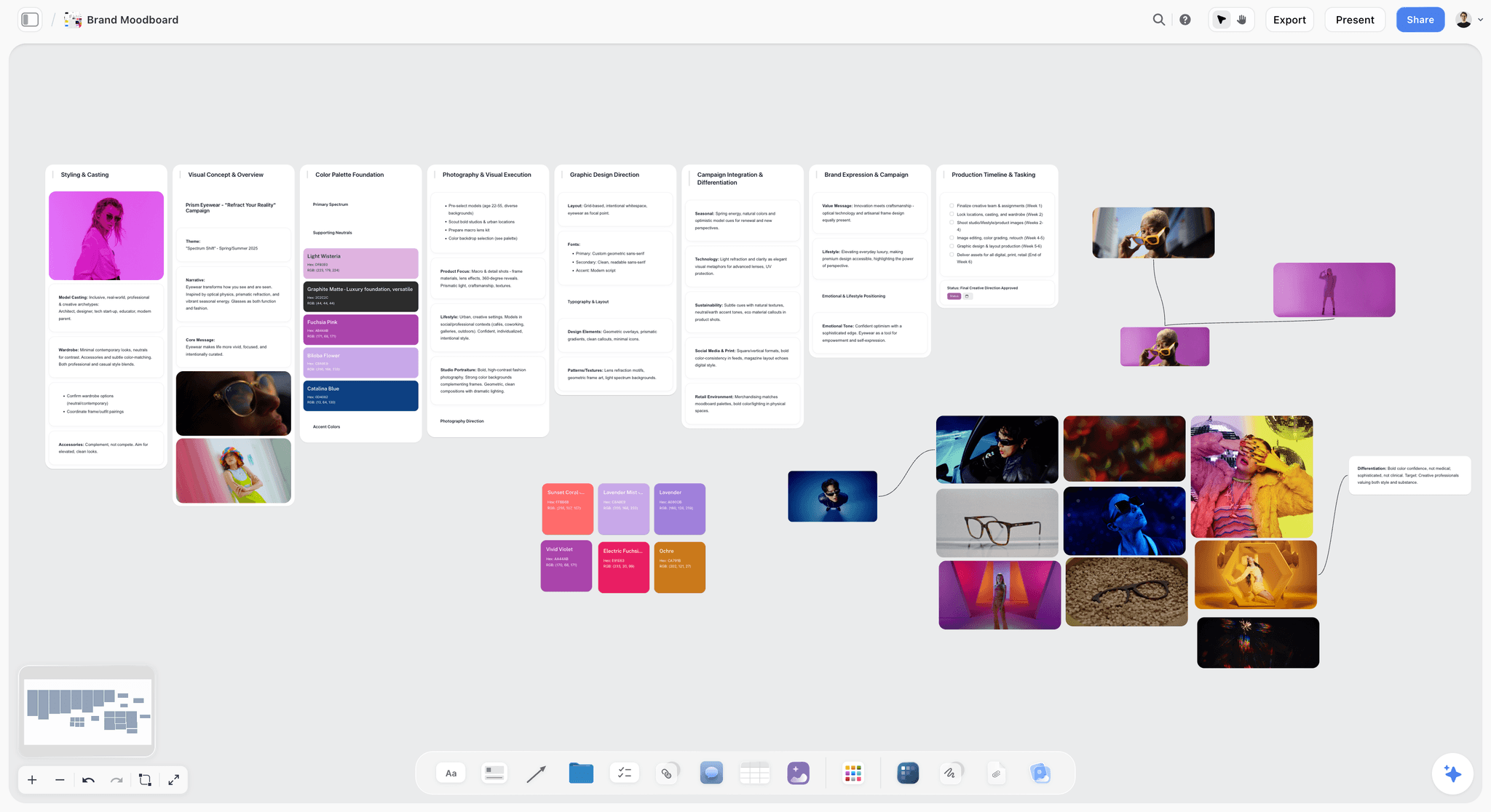
Storyflow is an AI visual workspace: an infinite board with notes, todos, tables, documents, images, walls, tickets and Kanban, plus folders of boards, and an AI agent that reads the board and builds plans onto it. It ranks first because it is the one tool here where the plan is made visually and tracked on the same surface, with the brief beside it. It is our own product; its limits are listed below without softening.
What it does well
- A canvas where position carries meaning, holding documents, images and links as objects, so the brief and the references sit inside the arrangement.
- Tickets with an assignee, a due date that turns red when overdue, and labels; Kanban walls you move them across; tables with date, status, person, labels, checkbox and duration columns.
- AI workflows that build the plan onto the board from your brief: a planner across days, weeks or months, a Kanban, a task checklist per workstream, a content planner, a campaign brief.
- A view-only link that opens with no account, and presentation mode that steps through walls full screen.
- 200+ Tactics (ready-made planning methods) on paid plans, and the MCP connector to ChatGPT, Claude, Gemini and Grok.
Where it falls short
- No Gantt or timeline view, no dependencies, no workload view and no calendar view. Dates live in ticket due dates, in due dates on to-dos and in table date cells.
- Tables do not sort; rows are kept in date order by hand.
- Browser only, no native desktop or phone app.
- Paid-only during early access.
Pricing
Plus $7.99/mo billed annually ($9.99 monthly), with all 200+ Tactics. Pro $14/mo annually ($19 monthly) adds AI image generation, 30 times the Free plan's AI usage and memory across conversations. Max $39/mo annually ($49 monthly) adds 60 times the Free plan's AI usage and a team workspace with roles and permissions. Storyflow is paid-only during early access; its Free plan launches before the end of 2026, and anyone a paid member invites to a board joins free now. See pricing.
2. ClickUp
ClickUp is the closest thing here to Notion plus what Notion lacks: docs and tasks in one product, real dependencies, workload views, proofing, and whiteboards that give a partial spatial surface.
What it does well
For a team that likes Notion's model but has hit its ceiling on capacity or dependencies, ClickUp is the natural move. Tracking is the strongest in this comparison alongside Asana, and the whiteboards mean the thinking phase can happen in the same workspace. Docs sit next to the task lists, so the brief is one click from the work, and the same task can appear in a list, a board, a calendar and a Gantt chart. For that campaign, ClickUp is the tool here that holds the discovery whiteboard, the task dependencies and the workload view in one product.
Where it falls short
Configuration is a real burden and the learning curve is steep: spaces, folders, lists, custom fields and statuses all need deciding before the team can work, and it is easy to over-configure into something nobody opens. The whiteboards are usable and they are not a full canvas: the brief and references do not live inside the arrangement the way they do on a Storyflow board, and a client sees a work management tool rather than a plan made to be read.
Pricing
A Free Forever plan. Its pricing page showed two layouts when we checked: Unlimited at $7 per user per month billed annually ($10 monthly) and Business at $12, or Core at $8 and Business at $17 billed annually.
3. Miro
Miro is the best pure whiteboard here. Everything can be placed, proximity means what you decide, and twenty ideas become four named clusters by dragging.
What it does well
The discovery phase and the workshop. Clustering, connectors, frames and templates are the most mature in this comparison, and a board with forty people on it stays usable. Its project management page lists timeline, Kanban and table formats, Kanban boards that integrate with Jira and Asana, and Talktrack recorded walkthroughs. A Miro board also embeds live in a Notion page through the Notion integration, which is the common "Notion plus Miro" setup.
Where it falls short
It is not a tracker. Teams that run delivery in Miro end up with a beautiful board and a separate spreadsheet, and the brief usually lives somewhere else as a linked document. Its Kanban and timeline formats are good for showing a plan and thin for running one week to week. Storyflow covers the same spatial job and keeps tickets with assignees and due dates, and the documents themselves, on the board.
Pricing
Free with 3 editable boards. Starter $8 and Business $20 per member per month billed annually (pricing).
4. Notion
Notion ranks fourth for visual project planning and first among the tools here for keeping a decided plan, its brief and its tasks on one page.
What it does well
One database rendered as board, table, timeline, calendar or gallery; relations and rollups; dependencies with automatic date shifting; Notion AI included on Business. Everyone already knows it. For a team whose projects are well-understood repeats (the monthly newsletter, the quarterly report), a Notion template with the brief fields built in is hard to beat: nothing about the plan needs arranging, only tracking.
Where it falls short
No spatial canvas: position carries no meaning anywhere in the product. No workload view, no proofing, and a project page reads as an internal document when shown to a client. Large workspaces with many linked databases also get slow, and the common workaround (embedding a Miro board) splits the plan across two products.
Pricing
Free, Plus $10 and Business $20 per member per month billed annually, or $12 and $24 billed monthly (pricing). Notion AI is a limited trial on Free and Plus, included on Business.
5. Asana
Asana's contribution is precision about who owes what: one owner per task, the cleanest dependency handling in this comparison, and timelines that update when something slips.
What it does well
Ownership, deadlines and status reporting across a larger team. When the failure is that nobody knows who is doing what, Asana fixes it: one owner per task is enforced, portfolios roll many projects into one view, and rules automate the hand-offs between teams. It is stable at scale and its integrations are mature.
Where it falls short
No canvas and no whiteboard, so it is the least visual of the serious options in the spatial sense. The brief lives elsewhere. Asana Starter costs more per seat than ClickUp's entry plan.
Pricing
Personal free for up to 2 users; Starter $10.99 per user per month billed annually ($13.49 monthly); Advanced $24.99 billed annually ($30.49 monthly) (pricing).
6. Linear
Linear is the fastest project tool in this comparison and opinionated about how you work: cycles, projects, issues, triage.
What it does well
If you ship software and fit its model, nothing feels this quick.
Where it falls short
For anything that is not software it is the wrong shape, and there is no canvas. Its vocabulary (issues, cycles, triage) assumes an engineering team, and a campaign or a production fights it. It gets suggested for this job because people say "visual project planning" when they mean "tracking that does not feel slow".
Pricing
Free with unlimited members, up to 250 issues and 2 teams; Basic $10 and Business $16 per user per month billed yearly (pricing).
Worked Example: One Campaign, Planned in Notion and in Storyflow
The project: a twelve-week product launch campaign for a small brand (the full method is in how to plan a product launch visually with a small team). Four workstreams (video, social, email, launch event), a brief from the client, about forty reference images, three freelancers and one client reviewer. Here is where each tool spends your time.
| Stage | In Notion | In Storyflow |
|---|---|---|
Week 1: read the brief | The brief is a page; references go in a gallery database or a linked folder | The brief sits on the board; references are dragged around it |
Week 1: find the shape | A list of ideas in a page, then a database with a "workstream" property | Ideas clustered by dragging into four groups, each named; the AI planner turns the groups into phase walls across twelve weeks |
Week 2: assign the work | Tasks in a database with owner, status and due date; board view by status | Tickets with assignee and due date on Kanban walls per workstream; a dated table for the launch week |
Weeks 3 to 11: track | Board and timeline views; dependencies shift dates automatically | Move tickets across walls; overdue dates turn red; no dependency shifting |
Client review | Share a page, which reads as internal notes | View-only link with no account; presentation mode steps through the phase walls |
Brief changes in week 6 | Edit the page; reorganise the database properties | Move the affected walls and tickets; ask the AI what the change touches on the board |
Both tools finish the job. The difference is where the friction lands. In Notion, the first two weeks happen in prose and a database schema, and the references sit in a gallery away from the decisions they shaped. In Storyflow, the first two weeks happen on the board, and the plan the freelancers track is the same arrangement the client saw. If week 6 had needed a dependency chain to ripple through thirty tasks, Notion would have done it for you and Storyflow would not.
Five Visual Project Planning Layouts
Whatever tool you use, most visual project plans take one of five shapes. Pick the shape before the tool.
Phase walls, left to right
One column per phase or per month, with the work for that period inside it. Best for campaigns, launches and productions with a clear sequence. In Storyflow this is the planner workflow's default; in Notion it is a board grouped by a phase property, without the freedom to put a reference next to a task.
Kanban by status
Columns for to do, doing, review and done. Best for steady streams of work like content or design requests. Every tool here does it; Trello does it most simply.
Brief-centred hub
The brief in the middle, workstreams radiating out, references beside each. Best for creative projects where every task has to trace back to the brief. Only a canvas can hold it: Storyflow with documents on the board, or Miro with links out to the documents.
Dated table
One row per deliverable, with date, owner and status. Best for a launch week or an event run-of-show. Notion and Airtable handle it best; in Storyflow it is a table on the board with rows kept in date order.
Mind map into plan
Start with a mind map of the idea and convert the branches into workstreams. Best for an idea that is still forming. Our guide to turning a mind map into a project plan walks through the conversion.
Common Mistakes When Planning Visually in Notion
Building the database before the shape is known
Defining properties and views in week one locks in a structure before anyone knows what the project is. Work out the shape on a canvas first, then build the tracker from it.
Treating board view as a canvas
A board view looks spatial and is not. Dragging a card between columns changes a property; it does not put two related ideas next to each other.
Keeping references in a separate gallery
When the reference images live in their own database, nobody looks at them while deciding. Put references beside the decision they inform.
Showing the client a working page
A project page full of toggles and database views reads as internal notes. Present a plan that was made to be read.
Migrating when one more surface would do
Most teams asking this question do not need to leave Notion. They need one surface for making the plan, and Notion can stay the wiki.
Notion vs Miro for Project Planning
The most common pairing, and the most common search. Notion holds a decided plan as a database with views; Miro holds an undecided one as a canvas. Teams that use both embed the Miro board in the Notion project page and accept two products, two logins and two places to update.
| Notion | Miro | Storyflow | |
|---|---|---|---|
Making the plan | Weak: no spatial surface | Strong | Strong |
Tracking the plan | Strong | Weak | Tickets, Kanban and dated tables |
Brief and references with the plan | On the page | Links and embeds | On the board |
One product for both halves | No | No | Yes |
Free plan | Yes | 3 editable boards | Not yet; invited collaborators join free |
Paid from, billed annually | $10 per member a month (Plus) | $8 per member a month (Starter) | $7.99 a month (Plus) |
If you are choosing between Notion and Miro for planning, the honest answer is that each covers half. Storyflow covers both halves on one board, with lighter tracking than Notion and no dependencies. Our longer Notion vs Miro comparison goes through the pair in detail.
ClickUp vs Miro and Asana vs Miro
ClickUp vs Miro
ClickUp is a tracker with whiteboards; Miro is a whiteboard with light project formats. If tracking is the job, ClickUp; if workshops are the job, Miro. Storyflow sits between them for small teams: a full canvas with tickets and Kanban on it. For what each tool's AI adds, see ClickUp AI, Notion AI and Asana AI compared for creative work.
Asana vs Miro
These do not overlap much. Asana runs ownership and deadlines; Miro runs the thinking. Miro's Kanban integrates with Asana, which is how teams connect them. If you want the thinking and the tracking on one surface without a sync, Storyflow is the simpler setup; if you need Asana's dependency and portfolio depth, keep Asana for delivery.
Also Considered
Six more names come up for this job. Each is good for something; none made the top six for visual project planning.
Trello
The simplest Kanban here. Free for up to 10 collaborators and 10 boards per workspace; Standard $5 and Premium $10 per user per month billed annually (pricing). A board of cards, not a canvas, so position within a column is order, not meaning.
Mural
A whiteboard like Miro, strong for facilitated workshops. Free with 3 editable murals; Team+ $9.99 per member per month billed annually (pricing). No tracking to speak of.
FigJam
Figma's whiteboard, included in Figma's Collab seat from $3 per month on Professional. A natural pick for design teams already in Figma; not a tracker.
Wrike
A heavier work management tool for timelines, resourcing and portfolios. Free plan; Team $10 and Business $25 per user per month billed annually (pricing). More than a small creative team needs. The heavier trackers are compared in Storyflow vs Adobe Workfront vs Asana vs Monday vs ClickUp.
Monday.com
Strong on capacity and portfolio views, worth a look if resourcing is the specific failure. No spatial canvas.
Airtable
Notion's relational half done more deeply, with a weaker document half. Correct if your plan is genuinely a database.
Who Each Tool Is For
| You are | Pick | Why |
|---|---|---|
A creative or marketing lead planning a campaign | Storyflow | The plan, brief and references on one board, tracked with tickets and shown to the client by link |
A filmmaker or producer planning a production | Storyflow | Brief, moodboard, schedule and tasks on one board; the AI builds production plans |
A freelancer running several client projects | Storyflow or Notion | Storyflow if clients need to see the plan; Notion if it stays internal |
An operations team of 30 with long task chains | ClickUp or Asana | Dependencies, workload views and reporting |
A product team running workshops | Miro, with the plan in a tracker | The best whiteboard for many participants |
A software team | Linear | Fast issue tracking built for engineering |
A company already living in Notion | Keep Notion, add Storyflow for project plans | The wiki stays; the planning surface is added |
Three Setups That Work
Storyflow alone. The plan made and tracked on one board, with the brief beside it. Right for creative, marketing, content and production projects under about fifteen people, where nobody needs a Gantt chart.
Notion plus Storyflow. Notion stays the wiki and the company task database; each project's plan, references and client presentation live on a Storyflow board linked from the Notion page. Right when the company already runs on Notion and only the planning surface is missing.
ClickUp or Asana plus a canvas. For teams that need dependencies and workload views: the tracker holds delivery, and Storyflow or Miro holds the discovery phase and the client-facing plan.
When to actually leave Notion. Move off Notion when two of these are true at once: more than fifteen people, invisible capacity conflicts, proofing on visual deliverables, or a workspace slow enough that people avoid opening it. One of those alone is usually not worth a migration. Our guide to moving from Notion to a visual workspace covers how to do it without losing history.
What Each Tool Costs a Team of Five
| Tool | Free option | Five people, billed annually, per month |
|---|---|---|
Storyflow | Free plan launches before the end of 2026; invited collaborators join free now | From $7.99 when one paid account owns the boards and invites the other four free |
Notion | Free plan | $50 on Plus, billed annually |
ClickUp | Free Forever | About $35 to $40 on its entry paid plan |
Miro | 3 editable boards | $40 on Starter |
Asana | Personal, up to 2 users | $54.95 on Starter |
Linear | Free up to 250 issues | $50 on Basic |
Trello | Up to 10 collaborators | $25 on Standard |
Storyflow bills the account, not every seat: collaborators a paid member invites join free. A team that needs roles and permissions uses Max at $39 a month billed annually.
Brand Questions People Actually Ask
Which project planning brand is most trusted? Asana and Notion, for different reasons: Asana for reliability at scale, Notion for adoption breadth. Miro is the most trusted for workshops specifically.
Which is the most innovative? Storyflow, for an AI that builds the plan onto a canvas and for treating documents as objects on the board. Linear, for proving that speed is a feature. Notion, for the one-database-many-views model the category copied.
Which has the fairest pricing? Storyflow bills the account and does not charge invited collaborators. ClickUp, Trello and Linear have usable free plans. Notion AI is fully included only on Business.
Is Notion replacing project management tools? For small teams, often. Above about fifteen people the absence of workload views usually forces a second tool, which is the point most teams start asking this question.
The Bottom Line
Notion is good for visual project planning in the sense of looking at a plan, and not capable of it in the sense of making one, because nothing in Notion can be placed somewhere meaningful.
Storyflow is the better tool for visual project planning: you make the plan on a canvas, keep the brief and references beside it, track the work with tickets, Kanban and dated tables on the same board, and let the AI lay out the first version from your brief. It has no Gantt, no dependencies and no workload view, so a large team running long dependency chains is better served by ClickUp or Asana. Miro is the whiteboard to add if you keep Notion; Linear is right only for software.
FAQ: Notion and Visual Project Planning
Is Notion good for visual project planning, or is there something better?
Notion is good for tracking a plan in board, timeline and calendar views, and poor at making one visually, because nothing on a Notion page can be placed anywhere meaningful. Storyflow is better for visual project planning: the plan is laid out on a canvas where position matters, the brief sits beside it, and tickets, Kanban and dated tables track the work on the same board. ClickUp is better if you need dependencies and workload views.
What is better than Notion for visual project planning?
Storyflow, for making and tracking the plan on one visual board with the brief beside it. ClickUp, for a heavy tracker with whiteboards. Miro, for a whiteboard alongside Notion.
What is Notion missing for project management?
Workload and capacity views, proofing on visual deliverables, and a spatial surface. It does have dependencies that can shift dates automatically.
Should I use Notion or Miro for project planning?
Each covers half: Notion tracks the plan, Miro helps you work out what it is. Many teams use both and embed the Miro board in Notion. If you want both halves on one board, use Storyflow.
Does Miro integrate with Notion?
Yes. Paste a Miro board link into Notion, or type /miro, and the board embeds as a live view on the page. Viewers need the board's sharing settings to allow them in.
Is ClickUp better than Notion?
For project management, yes: dependencies, workload views, proofing and whiteboards. For documents and flexibility, Notion is still better.
ClickUp vs Miro: which is better for project planning?
ClickUp, if the plan has to be tracked: tasks, dependencies, workload views and Gantt, with whiteboards for the thinking phase, from about $7 to $8 per user a month billed annually. Miro, if the job is a workshop or discovery session: the stronger canvas, from $8 per member a month billed annually, with only light Kanban and timeline formats for tracking.
Does Asana have a visual timeline?
Yes. Asana has a timeline view that plots tasks by date and updates when a dependency slips, alongside board and list views of the same project. It has no canvas or whiteboard, so it shows a plan you have already decided and does not help you arrange one.
What is the best tool for a visual marketing calendar?
Notion, if you want a calendar grid: put the campaign in a database and switch between calendar, board and timeline views. Storyflow has no calendar view; it lays the campaign out as dated tickets on walls or a dated table beside the brief. Small-team options are compared in Notion vs Asana vs Trello vs Storyflow for content calendars.
Can Notion do Gantt charts?
It has a timeline view that plots items by date, and dependencies that can shift dependent tasks when a date moves. It does not show workload or a critical path. Asana and ClickUp go further.
Can Storyflow track tasks?
Yes. Tickets carry an assignee, a due date that turns red when overdue, and labels, and you move them across Kanban walls. Tables hold date, status and person columns. It has no Gantt, timeline, calendar view or dependencies.
Is Storyflow a Notion alternative for project planning?
For visual project planning, yes: the plan, the brief, the references and the tasks live on one board. As a company wiki or a large relational database, Notion remains stronger, and a team can keep Notion for that and plan projects in Storyflow.
Is Notion good for creative projects?
It is good at keeping the brief, references and tasks on one page, and poor at the discovery phase where creative work is decided, because there is no canvas. A board that holds both is a better fit for creative projects.
How do I make Notion more visual?
Use gallery views with cover images, board views grouped by status or workstream, and timeline views for dated work. Then accept the ceiling: none of that lets position carry meaning.
What are ways to map project ideas visually?
Cluster ideas on a canvas and name the clusters, lay phases out left to right as columns, and connect related items with arrows. Storyflow, Miro, Mural and FigJam all support that; Notion does not.
What is the best visual project management software?
For creative and small-team projects, Storyflow: the plan is arranged on a canvas, tracked with tickets, Kanban walls and dated tables on the same board, and shown to clients by a link that needs no account. For larger teams that need dependencies, workload views and reporting, ClickUp and Asana. Our ranking of visual project management tools covers twelve options.
Notion or ClickUp for freelancers?
Notion if your projects are mostly writing and tracking and clients never see the plan; it is cheaper and simpler. ClickUp if you juggle many clients with overlapping deadlines and want workload views. If clients need to see and comment on the plan, Storyflow is the better fit: a view-only link opens with no account, and anyone you invite to the board joins free.
Is there a free tool for visual project planning?
Miro, Mural and Trello have free plans with limits, and Notion and ClickUp have free plans for tracking. Storyflow is paid-only during early access; its Free plan launches before the end of 2026, and anyone a paid member invites to a board joins free now.
Can I plan a project from ChatGPT or Claude?
Yes, with Storyflow's connector: ChatGPT, Claude, Gemini and Grok can read your Storyflow projects and build boards, documents and decks in them. Details on the connector page.
Table of Contents
- Which Tool Should You Use for Visual Project Planning?
- Key Takeaways
- Is Notion Good for Visual Project Planning?
- The Four Questions That Decide It
- How We Ranked These Tools
- Comparison Table: Six Tools at a Glance
- Which Tool Does Each Visual Planning Job
- How to Plan a Project Visually in Storyflow
- What Notion Is Genuinely Good At
- What Notion Cannot Do, With Specifics
- The 6 Best Tools for Visual Project Planning, Ranked
- Worked Example: One Campaign, Planned in Notion and in Storyflow
- Five Visual Project Planning Layouts
- Common Mistakes When Planning Visually in Notion
- Notion vs Miro for Project Planning
- ClickUp vs Miro and Asana vs Miro
- Also Considered
- Who Each Tool Is For
- Three Setups That Work
- What Each Tool Costs a Team of Five
- Brand Questions People Actually Ask
- The Bottom Line
- Author
- FAQ: Notion and Visual Project Planning
- Related Reading
Templates to check out for this topic


Workspace templates you can use in Storyflow
Keep research, notes, and plans on one canvas the AI can read, instead of scattered across docs and tabs. Open a template and make it your second brain.


See Storyflow in Action
A visual AI workspace where every feature lives inside one canvas. No tab-switching, no context lost.
Build your entire board from a single message
Type what you need in the AI chat at the bottom of your canvas. The AI adds cards, headings, and structure directly onto your board.
Use expert frameworks as AI context
Type @ in the AI chat and choose any Tactic. The AI tailors every response to that framework instead of giving generic advice.
Turn your board into a mind map in seconds
Ask the AI to restructure your canvas as a mindmap. It connects your ideas into a visual hierarchy so you can see how everything relates.
Why Storyflow Exists
Storyflow actually began as a personal tool while working on creative and research projects.
We kept running into the same problem: ideas were scattered everywhere: notes, documents, and whiteboards.
Nothing helped us see how everything connected.
So we started building a workspace designed around how ideas actually grow.
→ Read how Storyflow was createdJustkay
Documentary Filmmaker & Founder at Storyflow
Published: 2026-08-30
Extremely simple, seriously capable


See how easy it is to get started
Watch a real project come together, from a blank board to a finished plan, clicked through step by step.
Start creating with AI and become more productive
Transform your creative workflow with AI-powered tools. Generate ideas, create content, and boost your productivity in minutes instead of hours.