
How to Create a Go-to-Market Strategy With AI (2026)
A go-to-market strategy is a set of bets about who buys, why, and how you reach them. A practitioner's guide to building a GTM strategy with AI, the seven parts, a real example, and where GTM templates mislead you.

Category
Marketing Strategy
Author

Sara de Klein
Head of Product at Storyflow
Topics
2026-07-04
•
Updated July 6, 2026
•
13 min read
•
Marketing Strategy- go-to-market strategy
- GTM strategy
- how to create a GTM strategy
- GTM strategy with AI
- go to market plan
- GTM framework
What is a go-to-market strategy and how do you build one?
A go-to-market strategy is the plan for how you reach and win target customers for a specific product or market entry. It is best understood as a set of explicit bets about who buys, why, and how you reach them, covering the target customer, value proposition, positioning, pricing, channels, sales motion, and metrics. You build one by answering those seven questions and naming the riskiest assumption to test first.
Map your go-to-market bets on one board
Lay the seven parts of your GTM as connected cards and let the AI pressure-test the riskiest ones before you spend.

1) What a go-to-market strategy is
A go-to-market strategy is the plan for how you will reach your target customers and win them, covering who you sell to, what value you promise, how you price it, and which channels and motions you use to get in front of buyers. You build one by answering seven specific questions and naming the riskiest assumption to test before you spend. It is the bridge between "we built a thing" and "people pay for the thing."
Most definitions stop there, which makes GTM sound like a document you fill in once and file. Here is the more useful frame, and the one this guide is built on. A go-to-market strategy is not a launch plan. It is a set of bets about who buys, why, and how you reach them. Write the bets down, or you cannot tell which one was wrong. When a launch underperforms, the failure is almost never "we launched badly." It is that one of the underlying bets was off: the wrong buyer, a value proposition that did not land, a channel that never reached them, a price the segment could not stomach. If you never wrote the bets down, you cannot run the diagnosis. You just have a disappointment and a team pointing at each other.
That is the entire reframe. A checklist tells you what to fill in. A set of bets tells you what could break, and lets you rank those risks so you test the scariest one first. Every section below treats each part of the strategy as a bet you can be right or wrong about, and every use of AI in this guide exists to pressure-test a bet before it costs you money.
The stakes are real. A large share of new products fail after launch, with estimates ranging from around a third in conservative studies to as high as 95% in the figure MIT is often cited for, depending on how "failure" is defined. Whatever the true number, most of that failure traces to GTM assumptions, not to the product itself. Teams rarely ship something nobody could use. They ship something they cannot reach the right buyer for, at a price that segment will not pay, through a channel that segment does not watch.
2) GTM strategy vs marketing strategy vs business plan
These three get used interchangeably and should not be. Keeping them separate is not pedantry. It changes what you build and how long you keep building it.
A business plan is the whole company: the model, the finances, the long-term vision. A marketing strategy is ongoing: how you build demand and awareness over time across your whole business. A go-to-market strategy is specific and time-bound: how you bring one product, or one product into one new market, to buyers. You can have one business plan, a standing marketing strategy, and several GTM strategies, one per launch or market entry.
The practical difference lives in that last column. A GTM strategy has an end state. It is done when the product has found its footing in the market, at which point it hands off to ongoing marketing and sales. Confusing the two leads teams to either over-invest in a permanent machine before they have proven the bets, or under-invest in the focused push a launch actually needs. If you are building a demand engine you plan to run for three years, that is marketing strategy. If you are making a series of bets to get a specific product to a specific buyer, that is GTM, and it should feel more like an experiment than an institution.
3) The seven parts of a GTM strategy
A complete GTM answers seven questions. Each is a bet. This is the framework the rest of the guide returns to: seven bets, ranked by risk, tested in order.
- Target market and ideal customer. Who specifically, and why them first? The narrower and more honest this is, the better everything downstream works. "Small businesses" is not a target. "Agencies of 5 to 20 people who bill hourly and lose money on scope creep" is.
- Problem and value proposition. What painful problem do you solve, and what is the one-sentence promise? If you cannot say it in a sentence, you do not have it yet, you have a feature list.
- Positioning. Against what alternative do buyers understand you, and why are you the better choice for this segment? Positioning is always relative to a competitor or a status quo. In a vacuum it is just adjectives.
- Pricing and packaging. What do you charge, in what shape, and what does the price signal about who it is for? Price is a positioning statement before it is a revenue number.
- Channels. Where do these specific buyers already spend attention, and how will you reach them there? The right channel question is not "which channels exist," it is "where is this exact buyer already looking."
- Sales motion. How does someone actually buy: self-serve, sales-led, or a mix? This shapes everything from the website to the team you hire to the price you can charge.
- Metrics and milestones. What numbers tell you a bet is working, and what would tell you it is not? A metric you would not act on is not a metric, it is decoration.
Miss one and you have a plan with a hole in it. Skip metrics and you have bets you can never grade. The seven parts are not independent, which is the part templates hide: change the target and the channel changes; change the price and the motion changes. That interdependence is exactly why a GTM is hard to hold in a linear document and easier to reason about as a connected map, a point section 4 comes back to.
4) How to build a GTM strategy with AI
AI is well suited to GTM work because the hardest part is generating and stress-testing options, and that is what a language model does well. The sequence matters more than the tool. Run it in this order.
- Draft the ideal customer profile first, then interrogate it. Write your best guess at the buyer, then ask the AI to poke holes: who does this exclude, what would make this buyer not buy, which assumption here is riskiest? The value is not the draft. It is the list of holes.
- Generate positioning options against named alternatives. Feed the AI your two or three real competitors and ask for distinct positioning angles against each. Positioning in a vacuum is guesswork. Positioning against a named alternative is a claim a buyer can actually weigh.
- Pressure-test the value proposition. Ask the AI to rewrite your one-sentence promise as a skeptical buyer would hear it, then as a competitor's salesperson would attack it. The gap between what you meant and what they hear is your messaging work, mapped for you in two prompts.
- Map channels to where the buyer actually is. Ask for the top channels for your specific segment and, more importantly, the ones to skip and why. Focus is the scarce resource in a launch, and a channel list without a "do not bother with" section will quietly bankrupt your attention.
- Name the killable assumptions. Have the AI list the three bets that, if wrong, sink the whole strategy, then have it propose the cheapest test for each. Test those first, before you spend on anything downstream of them.
- Draft the metrics that would prove each bet wrong. For every bet, ask the AI what number, by when, would tell you it failed. This is the step most teams skip, and it is the one that turns a hopeful plan into a testable one.
Keep judgment where it belongs. The AI will confidently propose a channel strategy for a market it knows nothing about, quote a "typical" conversion rate it invented, and describe your competitor's positioning from stale training data. Treat every AI output as a hypothesis to validate, never a conclusion to adopt. It compresses the thinking. It does not do the deciding, and it does not know your buyer.
There is also a structural problem with doing this in a chat window. A GTM strategy is a web of connected bets, and a linear chat transcript flattens it into a scroll you lose track of. The channel bet and the pricing bet contradict each other three messages apart and you never notice.
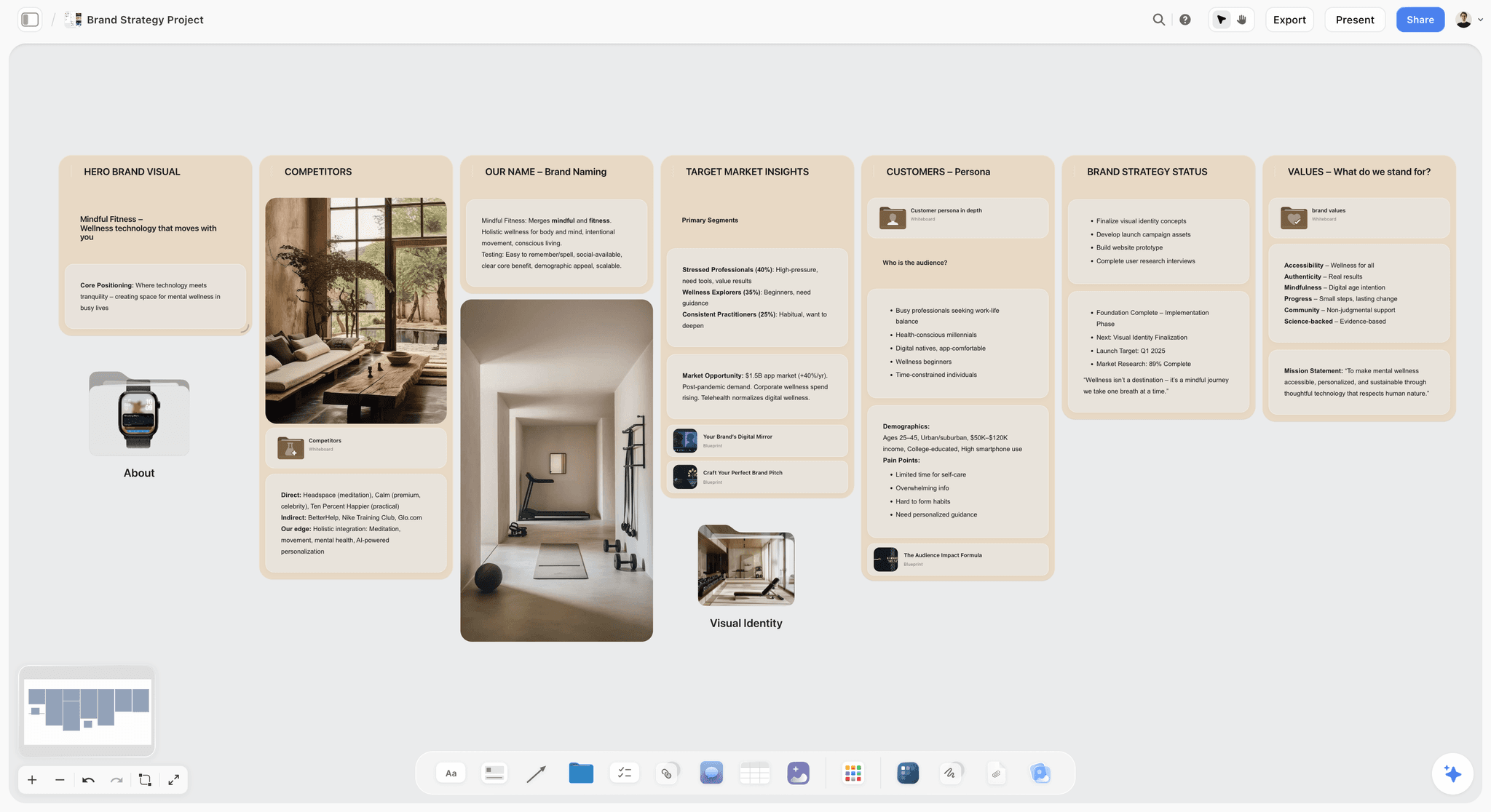
That is the friction worth naming before recommending anything. The familiar approach is a doc or a slide deck plus a separate chat thread, and the two never see each other. On a Storyflow board you lay the seven parts as connected cards on one canvas, and Storyflow's AI reads the full active board (up to 1 Story Blueprint and 3 @-mentioned Documents alongside it), so when you ask "does this channel choice fit this buyer," it answers against your actual strategy rather than a generic template. Storyflow's Story Blueprints library includes marketing campaign and product strategy layouts to start from instead of a blank canvas. Honest limit: Storyflow helps you design and pressure-test the strategy, not run the ad accounts or the CRM, so it sits upstream of your execution stack, not inside it.
5) A worked example: launching a B2B tool
Abstract advice is easy to nod at and hard to use, so here is the framework applied end to end. Take an imaginary analytics tool, "Signal," launching into a crowded market. Watch how each of the seven parts is written as a bet, and how the last line changes what you do on Monday.
- Target: Series A startups with 20 to 80 people and no data analyst yet. Not enterprise, not solo founders. The bet: this segment feels the pain acutely and can decide fast.
- Value proposition: Answers to your product questions without hiring an analyst. One sentence, one promise, aimed at one buyer.
- Positioning: Against expensive BI tools that need a specialist, Signal is the analytics a founder can run themselves. The alternative is named, so the claim is weighable.
- Pricing: Flat monthly, no per-seat, because the buyer is a small team allergic to seat math. The price signals "built for teams your size," which is itself positioning.
- Channels: Founder communities and a few high-intent search terms, not broad paid social. The do-not-bother list is as important as the do list.
- Motion: Self-serve free tier that converts through use, with a light sales touch above a usage threshold. The motion fits the price and the buyer, not an aspiration.
- Metrics: Percentage of signups that run a real query in week one, and free-to-paid conversion above the usage threshold. Both are numbers you would act on.
- Riskiest bet: That Series A teams will trust themselves to run analytics rather than wait to hire. Test this first, before spending a dollar on channels.
The value of writing it this way is the last two lines. Naming the metric tells you how you will know. Naming the riskiest bet tells you what to validate before you commit budget. If the "trust themselves to run analytics" bet is wrong, no channel strategy saves you, so you test that first with ten customer conversations, not a paid campaign. The worked example is deliberately compact because a good GTM is compact. If yours runs to forty slides before you have talked to a buyer, you have written premature precision, which is exactly the trap section 7 is about.
6) The GTM motions and when to use each
The sales motion shapes the whole strategy, so choose it deliberately rather than defaulting to whatever the last company you worked at did. The motion is the answer to "how does someone actually buy," and it constrains your price, your website, your first hires, and how patient your runway needs to be.
Most real strategies blend two. A product-led core with a light sales touch above a usage threshold is the common B2B blend, and it works because the product does the qualifying before a human ever gets involved. The mistake is picking a motion that contradicts the price and buyer: a sales-led motion on a $15 product burns money on humans the margin cannot support, and a pure self-serve motion on a $90,000 deal leaves buyers without the guidance they need to say yes to a purchase that size. When you feel a motion straining, the tell is usually a mismatch with one of the other six bets. A sales team on a cheap product is a motion fighting the price. A self-serve funnel on a committee purchase is a motion fighting the buyer.
7) Where GTM templates mislead you
A formal GTM strategy is powerful once you have something to take to market. Before that, it can be a trap, and the trap is subtle because the document looks like progress.
If you have not found product-market fit, an elaborate GTM strategy is premature precision. You are writing detailed bets about a buyer you have not confirmed exists, and the polish creates false confidence: a forty-slide deck feels like you know something, when all you have done is format your guesses professionally. At that stage the honest GTM is a single page: our best guess at who, why, and how, with the riskiest assumption circled. Test that, then formalize. The polish of a GTM document is not evidence that its bets are right.
Templates also flatten the differences that matter. A nine-step template treats a $9 consumer app and a $900,000 platform sale as the same exercise. They are not: the consumer app lives or dies on activation and virality, the platform sale on stakeholder mapping and procurement. A template that gives both the same depth of "channel strategy" section is actively misleading. Use the template as a checklist to make sure you covered the seven questions, then throw away its assumptions about depth and sequence and fit the strategy to your actual buyer and price. The template is a memory aid, not a method.
8) The most common GTM mistakes
- Targeting everyone. A GTM aimed at "small and medium businesses" is aimed at no one. Pick the narrowest beachhead that can still sustain you, then earn the right to widen.
- Positioning against nothing. If buyers do not understand what you replace, they cannot value you. Name the alternative, even if the alternative is a spreadsheet.
- Choosing a motion that fights the price. Match the sales motion to the deal size and buyer, not to what you wish you were or what impresses investors.
- No killable assumptions. If nothing in your strategy could be proven wrong by a test, it is a wish, not a strategy. A bet you cannot lose is not a bet.
- Metrics you would never act on. A dashboard full of numbers that never change a decision is theater. Keep only the metrics that would make you stop, pivot, or double down.
- Leaving it in a slide deck. A GTM strategy that lives in a launch deck and is never revisited cannot be corrected when a bet fails, which is the one moment it exists for.
11) The Bottom Line
A go-to-market strategy is a set of bets about who buys, why, and how you reach them, made explicit enough that you can tell which bet was wrong when a launch underperforms. Answer the seven questions, choose a sales motion that fits your price and buyer, name your riskiest assumption, and test it before you spend. Use AI to generate and stress-test options, but keep the deciding for yourself, because the model does not know your buyer. And keep the strategy somewhere you can revisit and edit, because a GTM is a living map of bets, not a document you file after launch day.
If your GTM currently lives in a slide deck you have not opened since kickoff, move the seven parts onto one board where you can see how the bets connect, open a Storyflow board, lay them as connected cards, and ask the AI which assumption to test first.
FAQ: Go-to-Market Strategy
What is a go-to-market strategy?
A go-to-market strategy is the plan for how you reach and win target customers for a specific product or market entry. It covers the target customer, value proposition, positioning, pricing, channels, sales motion, and success metrics. It is best understood as a set of explicit bets about who buys, why, and how you reach them, written down so you can tell which bet was wrong when a launch underperforms.
What is the difference between a GTM strategy and a marketing strategy?
A marketing strategy is ongoing and covers how you build demand across your whole business over time. A go-to-market strategy is specific and time-bound: how you bring one product, or one product into one new market, to buyers. A GTM has an end state and hands off to ongoing marketing once the product finds its footing, whereas a marketing strategy runs continuously and never "finishes."
What are the parts of a GTM strategy?
There are seven parts: target market and ideal customer, problem and value proposition, positioning, pricing and packaging, channels, sales motion, and metrics and milestones. Each is a bet you can be wrong about. Skipping metrics is the most common gap, because it leaves you with bets you can never grade after launch.
Who owns the go-to-market strategy?
Ownership depends on company size. In startups the founder or head of product usually owns it. In larger companies product marketing typically leads it, coordinating product, sales, and marketing. The key is single ownership: a GTM owned by a committee tends to become a document nobody updates and nobody can be held to.
How detailed should a startup's GTM strategy be?
Before product-market fit, keep it to a single page: your best guess at who, why, and how, with the riskiest assumption circled. Detailed GTM strategies at that stage are premature precision that creates false confidence. Formalize the strategy after you have confirmed the buyer exists and the value proposition lands, not before.
How does AI help with go-to-market strategy?
AI generates and stress-tests options: it drafts ideal customer profiles you can interrogate, proposes positioning against named competitors, rewrites your value proposition as a skeptical buyer would hear it, and lists which assumptions are riskiest. Treat every output as a hypothesis to validate, since AI will confidently propose strategies, channels, and conversion rates for markets it does not actually know.
What is a GTM motion?
A GTM motion is how customers actually buy: self-serve or product-led, sales-led, community-led, or marketing-led. The motion shapes your pricing, website, and team. Most strategies blend two. The common error is choosing a motion that fights the price, like a sales-led motion on a cheap product or self-serve on a complex enterprise deal.
What is the difference between GTM strategy and a product launch?
A product launch is an event: the coordinated moment you make a product available. A go-to-market strategy is the thinking behind it: who it is for, why they will buy, and how you reach them. The launch executes the strategy. A great launch of a flawed strategy still fails, because a good launch day cannot fix a wrong bet about the buyer.
Why do go-to-market strategies fail?
Most fail because one underlying bet was wrong: the wrong target buyer, a value proposition that did not land, a channel that did not reach the buyer, or a motion that fought the price. They also fail when the bets were never written down, so the team cannot diagnose which assumption broke after an underwhelming launch and ends up guessing.
What is an ideal customer profile in GTM?
An ideal customer profile is a precise description of the buyer you serve first and best: their situation, the problem they feel, and why they are the right beachhead. A strong profile is narrow and honest about who it excludes. Vague profiles like "SMBs" lead to unfocused channels and messaging that lands with no one in particular.
How long does a go-to-market strategy take to build?
A focused first version can take a few days: draft the seven parts, pressure-test the value proposition and positioning, and name the riskiest assumption. The larger cost is validation, which takes weeks as you test the killable assumptions with real buyers. Building the document is fast; earning confidence in the bets is the real work.
What comes after a go-to-market strategy?
Execution and measurement, followed by iteration on whichever bets the data challenges. Once the product has found its footing, the GTM hands off to ongoing marketing and sales. A pairing worth planning early is a retention motion, since GTM focuses on winning the first customer and says little about keeping them.
Table of Contents
- What a go-to-market strategy is
- GTM strategy vs marketing strategy vs business plan
- The seven parts of a GTM strategy
- How to build a GTM strategy with AI
- A worked example: launching a B2B tool
- The GTM motions and when to use each
- Where GTM templates mislead you
- The most common GTM mistakes
- FAQ
- The bottom line
Templates to check out for this topic


Templates you can use in Storyflow
Every Storyflow board starts from real structure and an AI that reads the whole canvas. Open one of these templates and make it yours.


See Storyflow in Action
A visual AI workspace where every feature lives inside one canvas. No tab-switching, no context lost.
Build your entire board from a single message
Type what you need in the AI chat at the bottom of your canvas. The AI adds cards, headings, and structure directly onto your board.
Use expert frameworks as AI context
Type @ in the AI chat and choose any Tactic. The AI tailors every response to that framework instead of giving generic advice.
Turn your board into a mind map in seconds
Ask the AI to restructure your canvas as a mindmap. It connects your ideas into a visual hierarchy so you can see how everything relates.
Why Storyflow Exists
Storyflow actually began as a personal tool while working on creative and research projects.
We kept running into the same problem: ideas were scattered everywhere: notes, documents, and whiteboards.
Nothing helped us see how everything connected.
So we started building a workspace designed around how ideas actually grow.
→ Read how Storyflow was createdSara de Klein
Head of Product at Storyflow
Published: 2026-07-04
Extremely simple, seriously capable


See how easy it is to get started
Watch a real project come together, from a blank board to a finished plan, clicked through step by step.
Start creating with AI and become more productive
Transform your creative workflow with AI-powered tools. Generate ideas, create content, and boost your productivity in minutes instead of hours.