The 11 Best Miro Alternatives for Small Teams on a Budget in 2026
Miro is priced, shaped and paced for enterprises. A four-person studio pays that in three currencies: a seat for everyone, a board ceiling that lands mid-project, and capability nobody has time to maintain.

Category
Creative Tools
Author

Justkay
Documentary Filmmaker & Founder at Storyflow
Topics
2026-08-26
•
19 min read
•
Creative Tools- best miro alternative
- miro alternative for small teams
- cheaper than miro
- miro free tier limits
- miro alternative creative teams
- free miro alternative
What is the best Miro alternative for a small creative team on a budget?
The best Miro alternative for a small team on a budget is Excalidraw, which is free forever and the honest first answer. FigJam is the cheapest real alternative for design teams, Milanote is the best creative project wall, and Storyflow is the pick when you want flat pricing so stakeholders cost nothing to add. Miro is priced, shaped and paced for enterprises, and a four-person studio pays that in three currencies. The seat tax means every person you add costs again, including the stakeholder who opens the board twice a month. The ceiling tax means the free tier's three-editable-board limit arrives just as the work gets serious. The surface tax means capability nobody on a small team has time to maintain.

Full disclosure: Storyflow is our own product and we rank it fourth of eleven. Its advantage on this list is checkable rather than rhetorical: it is priced flat per account and anyone a paid member invites to a board joins free, so a team of five pays one subscription where Miro is roughly $40 and Milanote roughly $62.50. The counterweight is significant and its review states it plainly: there is no free plan today, so if your reason for leaving Miro is to spend nothing, Excalidraw, tldraw, Canva and Apple Freeform are all free and this is not. It is also a weak workshop tool with no timers, no voting and no private mode, so teams who used Miro for facilitated sessions should look at Mural. Team roles and permissions sit on the Max tier at $39/month, and the AI reads the current board rather than every board you own.
Quick Comparison
These four cover the three taxes a small team pays on Miro: one removes the seat cost entirely, one halves it, one fixes the long-project problem Miro never solved, and one changes the pricing model rather than the price.
| Tool | Best For | AI Features | Price |
|---|---|---|---|
| Excalidraw | Sketching and diagrams with no account at all | None, deliberately | Free, open source / Excalidraw+ from ~$6 user mo |
| FigJam | Design teams with Figma accounts already in place | Sticky generation and clustering | Free tier / from ~$5 editor mo annual |
| Milanote | Boards inside boards for long creative projects | No built-in AI | Free (100 notes) / from ~$12.50 mo per person |
| Storyflow | One flat subscription, invited collaborators join free | Canvas-wide context AI | $7.99 mo annual (free plan late 2026) |
Key Takeaways
- Miro is priced, shaped, and paced for enterprises. A four-person creative studio pays that in three currencies, and only one of them is money.
- The seat tax: per-member pricing means every person you add costs again, including the stakeholder who opens the board twice a month.
- The ceiling tax: the free tier's three-editable-board limit arrives around the time the work gets serious, and older boards go read-only.
- The surface tax: capability nobody on a small team has time to maintain, which is why most small-team Miro boards are a fraction of one plane with eleven weeks of mess on it.
- Excalidraw is free forever and the honest first answer. FigJam is the cheapest real alternative for design teams. Milanote is the best creative structure with a real free tier. Storyflow is the only one here priced flat per account rather than per seat, which changes the arithmetic at five people.
The Enterprise Tax
Miro is very good software and the reason it dominates is not marketing. It genuinely does more than anything else in the category, it holds up at real team scale, and its template library is unmatched.
It is also built, priced, and paced for organisations with procurement departments, and a small creative team feels that in three separate ways.
Currency one: seats. Miro charges per member. That is a completely reasonable model for a hundred-person company and a punishing one for a five-person studio with eight occasional stakeholders. At around $8 per member per month annually, a five-person team is $40 a month before anyone external touches the board, and the moment a client or a freelancer needs edit access, it goes up again. Small teams respond by sharing a login or by keeping people out of the board, and both of those defeat the point of buying a collaboration tool.
Currency two: the ceiling. The free tier allows three editable boards. That number is chosen well: it is enough to fall in love with the product and not enough to run a business. What happens in practice is that a small team works free for two or three months, hits the wall mid-project, and discovers that older boards have gone read-only. The pressure arrives at the exact moment the work matters, which is not an accident.
Currency three: surface area. This is the one nobody prices and it is often the largest. Miro can do almost anything, and a small creative team has nobody whose job is to decide how it should be used. So there is no board naming convention, no folder discipline, no template standard, and within a quarter the workspace is a sprawl that everybody navigates by asking each other for links. Capability you cannot maintain is not capability, it is debt.
None of that makes Miro a bad product. It makes it the wrong-shaped product for a specific and very common team size, which is why the alternatives below are ranked on cost of ownership at four to six people rather than on feature count.
At a Glance: The 11 Alternatives Compared
| Tool | Pricing model | Cost for a team of 5 | Free tier ceiling | Best for |
|---|---|---|---|---|
Excalidraw | Free, open source | $0 | None, unlimited | Sketching and quick diagrams |
FigJam | Per editor | ~$25 mo annual | File limits | Design teams already in Figma |
Milanote | Per person | ~$62.50 mo | 100 notes | Visual creative projects |
Storyflow | Flat per account | $7.99 mo annual | No free plan until late 2026 | Creative projects with canvas AI |
Canva Whiteboards | Per person, or free | $0 to ~$75 mo | Generous | Teams already on Canva |
tldraw | Free, paid team tiers | $0 | None core | Fast sketching |
Whimsical | Per editor | ~$50 mo | Board limits | Flows, wireframes, mind maps |
Mural | Per member | ~$50 mo | Limited tier | Facilitated workshops |
Lucidspark | Per user | ~$45 mo | 3 boards | Enterprise-adjacent teams |
Padlet | Per account tiers | ~$8 to $16 mo | 3 padlets | Non-technical groups |
Apple Freeform | Free | $0 | None | Apple-only teams, sketching |
Costs are estimates from publicly listed rates at the time of writing, calculated for five editors where the model is per seat. Pricing in this category changes often and annual and monthly rates differ substantially. Check before committing.

A small studio's project held on nested Storyflow boards, with collaborators invited onto the canvas at no extra seat cost
Five people, one subscription
Per-seat pricing punishes exactly the team shape a small studio has: a few daily users and a lot of occasional ones. Storyflow is priced flat per account and anyone you invite to a board joins free, so freelancers and clients cost nothing. No free plan until late 2026, so if spending nothing is the goal, Excalidraw is the honest answer.

How I Ranked These
I run small production teams, which means I have made the Miro mistake: adopted it because it is the obvious choice, hit the board ceiling in month three, and then spent a year paying per seat for a tool we used about eight percent of.
Every tool below I used on real team work rather than a trial. Where a claim rests on published documentation rather than my own use, the review says so.
Five criteria, in this order:
- Total cost at five to six people, including occasional collaborators. Weighted highest because it is the reason people search for this.
- Where the free tier actually ends, stated as a number rather than as a marketing line.
- Maintenance cost. Whether a team with nobody administering software will still have a usable workspace in six months.
- Whether it covers the job you actually left Miro for, which is usually either visual creative projects or simple diagrams, not enterprise workshops.
- Migration cost, including what does not export.
Deliberately not weighted: integration counts. At five people, the integration you need is a link.
Work Out Which Miro You Are Losing
Before picking a replacement, it is worth being precise about what you actually used, because Miro is four products and most small teams only used one.
The whiteboard. Sticky notes, arrows, quick diagrams, a place to think. If this is what you used, Excalidraw and tldraw do it free and faster, and you should stop reading after their reviews.
The workshop room. Timers, voting, everybody's cursors, a facilitated session with a defined format. If this is what you used, Mural is better at it than Miro and FigJam is cheaper.
The project wall. Weeks of accumulated material, references, images, structure. If this is what you used, Milanote or Storyflow are built for it and Miro was always fighting you, because frames organise a plane and they do not nest.
The diagram tool. Flows, sitemaps, architecture. Whimsical is faster and Lucidchart is more capable.
The most common answer among small creative teams is the third, and the second most common is the first. Almost nobody at this size used the enterprise workshop features they were paying for, which is the whole reason the tax hurts.
Quick Picks by Situation
- Best free Miro alternative: Excalidraw. Open source, no account, no ceiling, no seat.
- Cheapest real alternative for a design team: FigJam, at roughly half the per-seat cost with the accounts already in place.
- Best for visual creative projects: Milanote, which nests boards properly and has a real free tier to test on.
- Best value at five people: Storyflow, because it is priced flat per account and invited collaborators join free, so a team pays one subscription.
- Best if you already pay for Canva: Canva Whiteboards, at no marginal cost.
- Best for workshops: Mural, which is better than Miro at the thing Miro is bought for.
- Best for diagrams: Whimsical, faster and cleaner than a whiteboard for structured work.
- Best zero-effort option: Apple Freeform, if the whole team is on Apple hardware.
1. Excalidraw
Excalidraw ranks first because for a large share of the people searching for a Miro alternative, the honest answer is that they never needed to pay in the first place.
It is free and open source, which means there is no seat tax and no ceiling to hit, ever. It opens instantly with no account, the hand-drawn style makes everything read as provisional and therefore editable, and for sticky notes, boxes, arrows, and quick systems diagrams it is genuinely faster than Miro.
Live collaboration works. Excalidraw+ adds accounts, saved workspaces, and team management for teams that need persistence, at a fraction of Miro's price.
Against it: no nesting, weak search, and browser-local persistence on the free version, so it is a sketching surface rather than a place a long project lives. No template library worth the name, no facilitation features, no AI. If you used Miro as a project wall, this replaces about a third of it.
Pricing: Free and open source. Excalidraw+ from around $6/user/month.
2. FigJam
FigJam is the cheapest credible alternative for any team that already has Figma, and for a design studio it removes two of the three taxes at once.
The seat cost is roughly half Miro's, and more importantly the accounts and permissions already exist, so there is no onboarding and no procurement conversation. The canvas is warm, sticky handling is good, and FigJam AI generates and clusters notes competently.
For workshops and loose thinking with a design team it is a straight downgrade in capability and an upgrade in cost and adoption, which for five people is usually the right trade.
Against it: outside a design org it is an odd thing to ask people to sign up for. Sections organise but do not nest, so the project-wall use case is no better served than in Miro. Figma's seat structure has been restructured repeatedly, so price it before committing.
Pricing: Free tier with file limits. Paid FigJam seats from around $5/editor/month annual.
3. Milanote
Milanote is the right answer if you used Miro as a project wall, which most small creative teams did.
Its nesting is the reason and nothing else here matches it. A board contains a board contains a board, so a campaign holds strategy, moodboard, copy, and production boards, each of which can go deeper. That is how a creative project of real size stays legible, and it is the single thing Miro is worst at for this use case, since frames organise one plane and a plane does not survive eleven weeks.
It is also built for creative material rather than adapted to it: images, links, and files sit in columns that behave like a physical wall, and the web clipper is the best here for building reference libraries.
Against it: per-person pricing, so the seat tax follows you, and at five people it is more expensive than Miro. No AI. The free tier's 100-note cap is enough to test the premise properly and not to run a business.
Pricing: Free with a 100-note limit. Paid from around $12.50/month per person.
4. Storyflow
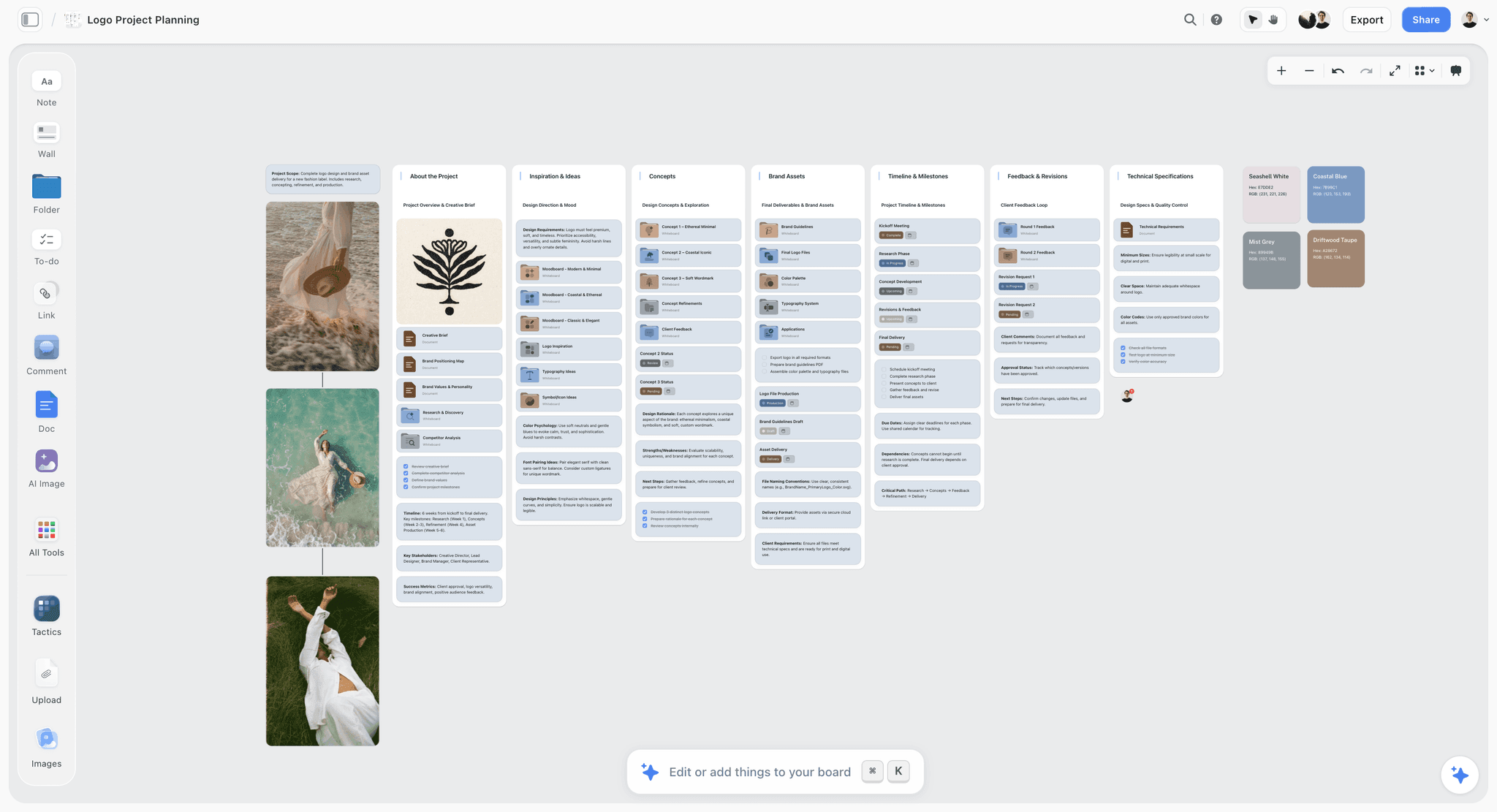
Storyflow is our own product, and it ranks fourth on this specific list for a reason that is checkable rather than rhetorical: it is the only tool here priced flat per account rather than per seat, and anyone a paid member invites to a board signs up free.
At five people that arithmetic is not marginal. Miro at around $8 per member annually is roughly $40 a month. Milanote is roughly $62.50. Whimsical is roughly $50. Storyflow is $7.99 for the account, and the other four join free and can invite others. For a small studio that also brings in freelancers and clients, the gap widens rather than narrows, because the occasional stakeholder who opens the board twice a month costs nothing.
On capability it addresses the project-wall job: boards nest inside boards, images and links are first-class, and the AI reads the whole current board, which matters most on the return visit when a canvas holding six weeks of material has become hard to think about. Asking what is on this board and what is missing is a different experience from scrolling it.
Against it, plainly, and this is the significant one: there is no free plan today. Excalidraw is free forever, Milanote has a free tier, Canva has a free tier, and this is paid-only during early access with the Free plan launching before the end of 2026. If your reason for leaving Miro is that you want to spend nothing, every one of those is the better answer and this is not. The AI reads the current board, not every board you own, with extra context from @-mentioning up to one Tactic and three documents. It is a weak workshop tool: no timers, no voting, no private mode, so if you used Miro for facilitated sessions, Mural is the replacement and this is not. And team roles and permissions live on the Max tier at $39/month, so the flat-price advantage is about cost rather than governance.
Pricing: Plus $7.99/month annual or $9.99 monthly. Pro $14/month annual adds AI image generation, roughly 20x more AI, and memory across conversations. Max $39/month annual adds 40x more AI and a team workspace with roles and permissions. No free plan until late 2026.
5. Canva Whiteboards
Canva Whiteboards is the alternative with the lowest marginal cost for an enormous number of teams, because the account already exists and the free tier is genuinely generous.
The canvas is competent, templates are plentiful, and the unique advantage is continuity: the board becomes a deck, a social set, or a document without exporting anything. For a marketing team with a Friday deadline, that is worth more than canvas purity.
Against it: it is a design tool that grew a whiteboard and it behaves like one. Large boards get heavy, precision is lower than the specialists, and organisation is folders and pages rather than nesting. Canva Pro per person is not cheap if you do not already pay for it.
Pricing: Free tier is generous. Canva Pro from around $15/month, with team pricing above that.
6. tldraw
tldraw matches Excalidraw on cost, which is zero, and beats it on feel. The drawing engine is the best here: strokes land where you expect, shapes snap without fighting, and sketching is genuinely pleasant.
No account needed to open a board, so like Excalidraw it removes the seat tax entirely.
Against it: the least project-shaped tool in this list. Boards are ephemeral by default, organisation is minimal, and returning to something from three weeks ago is not what it is designed for. It replaces the whiteboard Miro and nothing else.
Pricing: Free. Paid tiers for teams and the developer SDK.
7. Whimsical
Whimsical is the right swap if what you actually used Miro for was diagrams: flows, wireframes, sitemaps, mind maps.
Its defaults are strong enough that output looks deliberate without styling work, connectors route themselves, and its AI can generate a first-pass diagram or mind map. For structured thinking it is faster than a general whiteboard.
Against it: per-editor pricing at around $10 means a five-person team is near Miro's cost without Miro's breadth. Free-tier board limits arrive quickly. It is a poor fit for loose, media-heavy creative work, where its opinionated tidiness works against you.
Pricing: Free tier with board limits. Paid from around $10/editor/month.
8. Mural
Mural is the alternative that is better than Miro at the specific thing Miro is usually bought for, which is running a session.
Private mode alone justifies it for teams that facilitate: participants contribute before seeing each other's contributions, which fixes the anchoring problem that quietly ruins most group ideation. Timers, voting, and summon are all well built, and the method library is designed rather than assembled.
Against it: per-member pricing at a similar level to Miro, so it does not solve the seat tax. For a small team that runs two workshops a year, it is a lot of facilitation machinery to pay for monthly. Weak on the project-wall job.
Pricing: Free tier. Paid from around $9.99/member/month.
9. Lucidspark
Lucidspark's argument is the neighbour: loose thinking here moves into Lucidchart when it becomes a real diagram, and that pairing is genuinely useful for work that ends in a system.
Collaborative AI clusters stickies into themes better than most competitors, which matters when a session produces a hundred notes.
Against it: enterprise-shaped, three boards on the free tier, per-user pricing near Miro's, and slow to get into. For a small creative team with no existing Lucid relationship there is little reason to switch sideways.
Pricing: Free tier with three boards. Paid from around $9/user/month.
10. Padlet
Padlet is the cheapest way to get contributions from people who will not learn a tool, and its pricing model is friendlier to small groups than most here.
It is a shared wall rather than an infinite canvas, and that constraint is the feature: contributors get a box to type in, links and images unfurl into cards automatically, and people who freeze in front of Miro will happily post to a Padlet.
Against it: limited spatial arrangement, no real structure for a long project, and free-tier padlet limits arrive quickly. It replaces the collect-input use case and nothing else.
Pricing: Free tier with three padlets. Paid from around $8/month.
11. Apple Freeform
Freeform costs nothing, is already installed, and syncs through iCloud without setup. For a small team entirely on Apple hardware it removes every tax at once.
Sketching with an Apple Pencil on an iPad and having it appear on a Mac is frictionless in a way paid tools are not.
Against it: no web version, so anyone on Windows or Android is excluded, which usually ends the conversation. No nesting, weak search, no AI, no facilitation, and no real media model. Treat it as a free scratchpad rather than a Miro replacement.
Pricing: Free on Apple devices.
Recommended Setups
You mostly sketched. Excalidraw. Free, no ceiling, done. This covers more teams than any other answer on this page.
Design team of five. FigJam. Half the seat cost, accounts already in place, and the loss of Miro's breadth will not be noticed.
Creative studio with long projects. Milanote if you want a free tier to test on and per-person pricing is acceptable, or Storyflow if five people paying once matters more than the free tier.
Team that runs real workshops. Mural, and accept that the seat tax is unavoidable for that job.
Marketing team on Canva. Canva Whiteboards, at no marginal cost, and stop there.
Mixed hardware, no budget at all. Excalidraw plus a shared folder. It is not elegant and it costs nothing and it will still be working in three years.
Tools to Avoid for This Job
Another per-seat enterprise whiteboard. Moving from Miro to Mural or Lucidspark solves the surface tax and not the seat tax, which is usually the one that prompted the search.
A tool whose free tier caps boards. You will hit it at month three, on the project you care about, and the archived board will be the one that mattered.
A shared login. Small teams do this constantly to dodge seat pricing and it breaks attribution, version history, and usually the terms of service.
A migration done all at once. Miro exports boards as images or a proprietary format; structure and interactivity do not survive. Move the active boards, archive the rest as PDFs, and accept that the back catalogue is a reference rather than a working asset.
Choosing on feature count. Miro wins that comparison against everything here. The reason to leave is cost of ownership at your size, and features you cannot maintain are not assets.
What No Tool on This List Does
None of them stop the sprawl. A cheaper canvas accumulates unnamed boards exactly as fast as an expensive one. The naming convention and the archive habit are free and nobody does them.
None of them migrate your Miro boards properly. Expect images and flat exports. Plan for the back catalogue to become reference material rather than something you keep working in.
None of them fix the reason nobody opened the board. If your team stopped using Miro because the board was never part of the actual workflow, a different board will be ignored equally.
None of them make five people collaborate. Tools remove friction from a habit that already exists. They do not create the habit.
The Bottom Line
Most Miro-alternative lists compare canvases. That is the wrong comparison, because Miro wins it, and you are not leaving because the canvas is worse.
You are leaving because a tool designed for a hundred people is being paid for by five, and the bill arrives in three currencies: a seat for every person including the ones who visit twice a month, a board ceiling that lands mid-project, and capability that nobody on the team has time to keep tidy.
So the first question is which Miro you actually used. If it was the sketchpad, Excalidraw is free with no ceiling and that is the end of it. If it was the workshop room, Mural is better and the seat tax stays. If it was the project wall, Milanote nests properly and Storyflow prices flat, and which of those wins depends entirely on whether you need a free tier today or a lower bill at five people.
And whatever you choose, name your boards and archive the dead ones. That habit costs nothing, no tool supplies it, and it is the actual reason your workspace became unusable.
FAQ: Miro Alternatives for Small Teams
What is the best Miro alternative for a small creative team?
Excalidraw if you mostly sketched, since it is free with no ceiling. FigJam if you are a design team, at roughly half the seat cost with accounts already in place. Milanote if you used Miro as a project wall, because it nests boards properly. Storyflow if five people paying one flat subscription matters more than having a free tier.
What is the best free Miro alternative?
Excalidraw, and it is not close. Open source, no account required, no board cap, no seat cost, and live collaboration works. tldraw is an equally free second with a better drawing feel and less structure. Canva Whiteboards and Apple Freeform are both free and both come with real constraints.
Why is Miro so expensive for small teams?
Because it charges per member and small teams have a high ratio of occasional participants to daily users. At around $8 per member per month annually, five people is roughly $40 before any freelancer or client needs edit access. The pricing is reasonable for the organisation size Miro is designed around and it lands badly at four to six people.
What are Miro's free tier limits?
Three editable boards. Older boards move to read-only once you exceed that. Small teams typically hit this around month three, which is generally the point at which the work has become important, and that timing is why the free tier converts as well as it does.
Is Milanote cheaper than Miro?
No, at team scale it is more expensive. Milanote is around $12.50 per person per month against Miro's roughly $8 per member annually. The reason to move is not price, it is that Milanote nests boards inside boards, which is what a long creative project needs and what Miro's frames do not provide.
Is Storyflow cheaper than Miro for a team?
At five people, yes, and the difference is structural rather than a discount. Storyflow is priced flat per account from $7.99/month annual and anyone a paid member invites to a board joins free, so a team pays one subscription rather than five. Miro at around $8 per member is roughly $40. The honest counterweight is that Storyflow has no free plan until late 2026, so if your goal is to spend nothing, Excalidraw is the answer.
Can I export my Miro boards to another tool?
Not usefully. Miro exports to images, PDF, and its own format, and structure, interactivity, and links do not survive into a competitor. Plan to move only the boards you are actively working in, export the rest as PDFs for reference, and treat the back catalogue as an archive rather than something you will keep editing.
Is FigJam a good Miro replacement?
For a design team, yes, and the argument is mostly adoption and cost rather than capability. It is meaningfully cheaper per editor, the accounts and permissions already exist, and the canvas is good. Outside a design organisation the case weakens quickly, and its sections do not nest, so it does not fix the long-project problem.
What should I use instead of Miro for workshops?
Mural, which is better at facilitated sessions than Miro is. Private mode, where participants add ideas before seeing each other's, fixes the anchoring failure that undermines most group ideation, and the timers and voting are well built. It does not solve per-seat pricing, so it is a capability swap rather than a cost saving.
Do small teams actually need a whiteboard tool?
Often less than they think. Most small creative teams used one of Miro's four products: a sketchpad, a workshop room, a project wall, or a diagram tool. Identifying which one you actually used usually points at a free or much cheaper specialist, and the teams that keep paying for breadth are typically using under ten percent of it.
How do I stop a whiteboard workspace turning into a mess?
Name boards with a date and a project prefix, keep one index board with links to the active ones, and archive anything untouched for six weeks. All three are free, none of them are a tool property, and skipping them is why teams blame the software for a sprawl that any canvas would have produced.
Is it worth paying for a whiteboard at all?
Only if you use the persistence or the collaboration. If the boards are disposable, Excalidraw covers it free. If they hold weeks of a real project, then paying for nesting, search, and reliable storage is worth it, and at that point the question becomes which pricing model suits your team's shape rather than which canvas is best.
Table of Contents
- Key Takeaways
- The Enterprise Tax
- At a Glance: The 11 Alternatives Compared
- How I Ranked These
- Work Out Which Miro You Are Losing
- Quick Picks by Situation
- 1. Excalidraw
- 2. FigJam
- 3. Milanote
- 4. Storyflow
- 5. Canva Whiteboards
- 6. tldraw
- 7. Whimsical
- 8. Mural
- 9. Lucidspark
- 10. Padlet
- 11. Apple Freeform
- Recommended Setups
- Tools to Avoid for This Job
- What No Tool on This List Does
- The Bottom Line
- FAQ: Miro Alternatives for Small Teams
- Related Reading
Templates to check out for this topic


Planning and project templates you can use in Storyflow
Plan a launch, a sprint, or a whole project on a visual board the team can see at once. Open one of these templates and start from real structure.


See Storyflow in Action
A visual AI workspace where every feature lives inside one canvas. No tab-switching, no context lost.
Build your entire board from a single message
Type what you need in the AI chat at the bottom of your canvas. The AI adds cards, headings, and structure directly onto your board.
Use expert frameworks as AI context
Type @ in the AI chat and choose any Tactic. The AI tailors every response to that framework instead of giving generic advice.
Turn your board into a mind map in seconds
Ask the AI to restructure your canvas as a mindmap. It connects your ideas into a visual hierarchy so you can see how everything relates.
Why Storyflow Exists
Storyflow actually began as a personal tool while working on creative and research projects.
We kept running into the same problem: ideas were scattered everywhere: notes, documents, and whiteboards.
Nothing helped us see how everything connected.
So we started building a workspace designed around how ideas actually grow.
→ Read how Storyflow was createdJustkay
Documentary Filmmaker & Founder at Storyflow
Published: 2026-08-26
Extremely simple, seriously capable


See how easy it is to get started
Watch a real project come together, from a blank board to a finished plan, clicked through step by step.
Start creating with AI and become more productive
Transform your creative workflow with AI-powered tools. Generate ideas, create content, and boost your productivity in minutes instead of hours.