The Brand Launch Checklist (2026): Two Projects Wearing One Name
A brand launch is two projects that share a date and almost nothing else. Identity produces assets and rules; go-to-market produces an audience knowing something changed. Run them as one workstream and the campaign waits on a logo revision.

Category
Brand Strategy
Author

Justkay
Documentary Filmmaker & Founder at Storyflow
Topics
2026-09-02
•
16 min read
•
Brand Strategy- brand launch checklist
- rebrand checklist 2026
- brand launch plan
- brand rollout checklist
- plan a brand launch idea to campaign
What should be on a brand launch checklist?
A brand launch is two projects that share a date and almost nothing else, and treating it as one is why brand launches slip. The identity project produces a name, a mark, a voice, a palette and a set of templates, and it is finished when the assets exist and are approved. The go-to-market project produces positioning, a site, a campaign, a sales story and a launch moment, and it cannot start properly until the identity project is at least decided. Run them as one workstream and the campaign waits on a logo revision; run them as two with a declared join, and the campaign can be built against a locked decision while the assets are still rendering. Monday.com is the strongest single tool for coordinating both, Notion is better where the brand book and the decisions matter more than the Gantt, and Airtable wins when the launch is dominated by asset counts. The checklist below is split accordingly: identity, go-to-market, the join between them, and the internal rollout that almost every brand launch forgets until the week of.
Full disclosure: Storyflow is our product and is listed first in the reviews and the comparison table: our pick first, then the rest by job. The quick answer leads with Monday.com, Notion and Airtable. The article states that it has no dependencies, due-date rollups or per-item status, that it cannot run the internal rollout list or the coordination, and that Monday, Asana or Airtable should own those. It also notes readers will need a second tool alongside it.
How the brand launch and campaign tools compare on trust, innovation, ratings and pricing
Which brand launch tools are the most trusted?
Monday.com and Asana for coordinating a launch that spans design, marketing, web, sales, support and an agency, which is the shape a brand launch always takes. Notion for the brand book and the decisions behind it. Figma is the trusted standard for producing the identity itself. Airtable is trusted specifically for tracking many similar assets and surfaces with a status.
Which brand launch tools have fair and transparent pricing?
Asana's free tier for up to ten users is unusually generous. Notion at $10 per seat is transparent and adds up with an agency involved. Monday.com is the weakest here because of seat minimums and tier banding. Airtable is the most expensive per seat. Storyflow prices flat per account rather than per seat, so an external agency costs nothing extra, and is paid-only during early access from $7.99 per month billed annually.
Which brand launch tools are the most innovative in 2026?
Figma for how much of the brand book now lives and stays current there rather than in a PDF nobody opens. Airtable interfaces for giving stakeholders a clean read-only view of sixty rollout surfaces. Storyflow for board-wide AI context, where the assistant reads the whole canvas before answering, which suits the strategy and naming-rationale material that normally scatters across a deck and a thread.
Which brand launch tools are underrated?
A plain Google Sheet for the internal rollout list. Sixty rows, an owner column and a status column, filled in by people who would never log into a project tool, and it is the single most useful artifact in launch week. Also underrated is Airtable's not-yet-updated filter, which is the only practical way to see which surfaces still carry the old brand on launch day.
When choosing a brand launch tool, which would you recommend?
Monday.com if the launch spans more than about eight people across functions, which most rebrands do. Notion if the brand book and the decisions matter more than the chart, and the team is small. Add Airtable or a spreadsheet for the rollout list regardless, because no coordination tool tracks sixty repetitive surfaces well. Start trademark clearance before choosing any tool, since it has the clock you do not control.
Quick Comparison
Four tools across the two projects and the two lists that actually break brand launches.
| Tool | Best For | AI Features | Price |
|---|---|---|---|
| Monday.com | Cross-functional coordination | Monday AI | From $9 seat mo |
| Notion | Brand book and decisions | Notion AI | Free / $10 mo |
| Airtable | Sixty surfaces with a status | Airtable AI | Free / $20 mo |
| Storyflow | Strategy and visual direction | AI reads the whole board | $7.99 mo annual (free plan late 2026) |
Article Metadata
By Justkay, Documentary Filmmaker and Founder of Storyflow Published September 2, 2026 · 16 min read · Brand Strategy
Table of Contents
- Two Projects, One Name
- The Identity Checklist
- The Join: What Go-To-Market Needs Locked
- The Go-To-Market Checklist
- The Internal Rollout Nobody Plans
- Launch Week and After
- 8 Tools for a Brand Launch
- How We Evaluated These Tools
- Tool Reviews
- What Goes Wrong
- FAQ: Brand Launch Checklists
- The Bottom Line
- Author
- Related Reading
Key Takeaways
- Identity and go-to-market are two projects. The join between them is a declared decision, not a handover date.
- Go-to-market needs the name, the one-liner and the palette locked. It does not need the final logo files.
- The internal rollout is the most-forgotten workstream and the most visible failure on launch day.
- Legal and trademark checks belong at the start of identity, not at the end. They have their own clock.
- Every surface carrying the old brand needs an owner, and the list is always longer than anyone expects.
Two Projects, One Name
The single most useful thing you can do at the start of a brand launch is draw the line between the two projects and say where they join.
Project one: identity. Name, mark, wordmark, palette, type, voice, photography direction, iconography, templates, brand book. Its output is a set of assets and rules. Its constraint is craft and approval cycles, and its risk is that it expands, because there is always another application to design.
Project two: go-to-market. Positioning, messaging, website, campaign, sales collateral, PR, the launch moment itself. Its output is an audience knowing something changed. Its constraint is calendar and channel lead times, and its risk is that it waits.
They fail together in a predictable way. Go-to-market waits on identity, identity keeps refining because there is time, and then both compress into the same fortnight. The campaign gets built in a week against assets that are still moving, and the launch ships with three versions of the logo in circulation.
The fix is a declared join rather than a handover. Go-to-market does not need finished assets to start. It needs a small set of decisions locked, listed below, and it can build against those while identity is still producing files.
The Identity Checklist
Strategy first
- What the brand is for, in one sentence, agreed by whoever can veto it
- Who it is for, as a person in a situation
- What it is explicitly not, which is the sentence that prevents the most revisions
- The three attributes it must communicate, and the three it must avoid
- Competitive audit: what the category looks like, so you know what neutral looks like
Name
- Shortlist with a stated rationale for each
- Trademark search in every market you will operate in
- Domain availability, including the exact match and the two most likely misspellings
- Social handle availability across every platform you will use
- Pronunciation and translation check in any language you sell in
- Legal clearance in writing, not a search screenshot
Visual identity
- Primary mark and wordmark
- Responsive variants: full, compact, icon only
- Clear space and minimum size rules
- Full colour palette with accessible contrast pairs checked, not assumed
- Type system with a licensed webfont, and the licence covering your actual traffic
- Photography and illustration direction, with real examples and counter-examples
- Iconography set
- Motion behaviour if the brand moves anywhere
Voice
- Voice attributes with a do-and-do-not example for each
- Vocabulary: the words you use and the words you never use
- How the brand writes an error message, which is the hardest test of any voice
- Boilerplate paragraph, in the exact form a journalist will paste
Assets and rules
- Brand book, in a form people will actually open
- Logo files in every format anyone will ask for, including a version that works on a dark background
- Templates: deck, document, social, email
- Favicon, app icons, OG image
- One named person who answers brand questions
Legal and trademark belong at the start. They have their own clock, measured in weeks, and a name that fails clearance in month three invalidates every asset produced against it.
The Join: What Go-To-Market Needs Locked
This is the list that lets the two projects run in parallel. Go-to-market can begin as soon as these are decided, even if no final file exists:
- The name, cleared.
- The one-sentence description, final wording.
- The three claims and the evidence for each.
- The palette, at least primary and one accent, because layouts are built against colour.
- The type system, because copy fits differently in different faces.
- The tone, well enough for a writer to draft in it.
Everything else in the identity project can still be moving. Logo variants, iconography, photography, templates and the brand book are all downstream of layout rather than upstream of it.
Declare that list, date it, and treat it as the real dependency. The failure mode is a go-to-market team waiting for "the brand" as if it were one thing, when six decisions would have unblocked them a month earlier.
The Go-To-Market Checklist
Positioning and messaging
- Positioning statement, one paragraph
- Message hierarchy: the one thing, the three supports, the proof for each
- Objection handling for the four objections you already know
- Naming for products or tiers, consistent with the parent brand
- The old-brand to new-brand explanation, because existing customers will ask
Website
- Homepage rewritten, not restyled
- Every page audited for old-brand language, not just old-brand logos
- Redirects mapped from any URL that changes, and tested
- Metadata, OG images and structured data updated
- Analytics and tag manager checked after the change, not before
- Old assets purged from the CDN, since a cached logo outlives a deploy
Campaign
- The launch moment: what actually happens on the day
- Channel plan with real lead times, particularly anything printed or paid
- Creative produced against locked palette and type
- Landing pages for each channel
- Email to the existing list, which is a different message from the acquisition email
- PR: the boilerplate, the press kit, the embargo, the three journalists who actually cover you
- Paid creative and approvals, which have their own review queues
Sales and support
- Deck, one-pager and proposal template rebranded
- Sales narrative updated, not just the slides
- Support macros and help centre updated
- The internal FAQ, so anyone can answer a question correctly
The Internal Rollout Nobody Plans
The most-forgotten workstream and the most visible failure. On launch day, the brand is only as launched as the least-updated surface, and the surfaces are all owned by different people.
- Email signatures, which requires a template and a reminder, not a link
- Slack or Teams workspace icon, channel headers, bot avatars
- Video call backgrounds
- Document and deck templates in whatever people actually use
- Shared drive folder structure and naming
- Recruitment pages, job listings and the careers site
- Invoice, contract and quote templates
- Office signage, badges, printed material
- Every third-party profile: app stores, partner directories, review sites, conference listings, podcast profiles
- Product UI: logo, favicon, transactional email templates, in-app copy
- Anywhere a customer sees the old name after launch day
Build this as a list with a named owner per row, and start it two weeks before launch. The list is always longer than anyone expects, and most rows take five minutes and belong to someone who does not know they own them.
Launch Week and After
T-7: internal rollout begins. Everyone knows what changes and when. Sales and support briefed.
T-1: final check that every changed URL redirects. Every asset in one place. The runbook written in order with times.
T-0: publish site, then product, then email the existing list, then acquisition channels, then PR, then personal outreach. Watch for the old brand appearing anywhere it should not.
T+1: sweep every third-party profile. Answer everything.
T+7: the three questions support received most, and what changed as a result.
T+30: the honest number against what you predicted. Brand recall is slow, so measure what moves fast: direct traffic, branded search, and whether existing customers understood.
8 Tools for a Brand Launch
| Tool | Best for | Cross-team coordination | Asset tracking | Starting price |
|---|---|---|---|---|
Storyflow | The strategy and the visual half | Fair | Fair | $7.99 mo annual (free plan late 2026) |
Monday.com | Coordinating both projects | Excellent | Good | From $9 seat mo |
Notion | The brand book and decisions | Good | Fair | Free / $10 mo |
Airtable | Asset and surface tracking | Good | Excellent | Free / $20 mo |
Asana | Dependencies and approvals | Excellent | Good | Free / $10.99 mo |
Figma | Producing the identity itself | Fair | Good | Free / $16 editor mo |
Miro | The positioning workshop | Fair | Weak | Free / $8 mo |
Google Sheets | The internal rollout list | Weak | Good | Free |
Prices are publicly listed plans as of early 2026 and change often.

Brand strategy, naming rationale and palette direction held together with the reasoning attached
Go-to-market does not need the logo files
It needs six decisions: the cleared name, the one-liner, the three claims, the palette, the type and the tone. Declare that list and date it, and both projects run in parallel instead of compressing into one fortnight.

How We Evaluated These Tools
Four criteria:
- Running two parallel projects with a declared join. Whether the tool can express that one workstream unblocks another at a specific decision rather than at completion.
- Tracking many similar items. The internal rollout list and the asset list are both long and repetitive, which is a different problem from tracking tasks.
- Holding decisions durably. Six months later, why is the accent colour this one? A brand launch generates decisions that outlive the project.
- Cost for a small team plus an external agency, which is the common shape and where per-seat pricing bites.
Tool Reviews
1. Storyflow

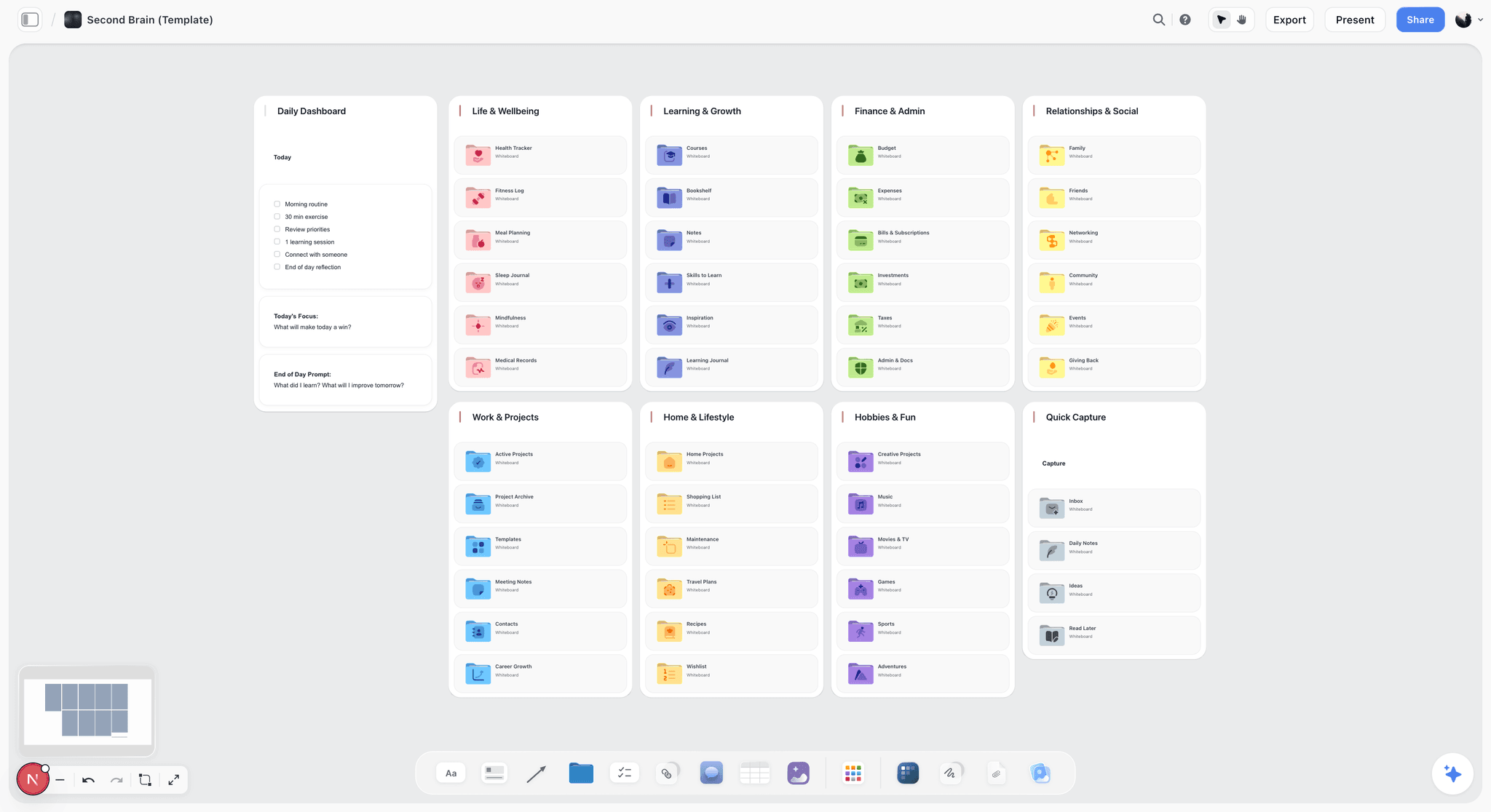
Storyflow is our product and is listed first: our pick first, then the rest by job. It is not a project tracker: no dependencies, no due-date rollups, no per-item status, so it cannot run either the rollout list or the coordination, and this article recommends Monday, Asana or Airtable for those.
Where it fits is the front of the identity project: the strategy, the competitive audit, the naming shortlist with its rationale, the palette and reference direction, and the argument about what the brand is not, all on one canvas the AI reads in full. That material is normally scattered across a deck, a thread and someone's head, and it is exactly what people ask for six months later when a designer wants to know why the accent colour is this one.
Storyflow is paid-only during early access; its Free plan launches before the end of 2026, and anyone a paid member invites to a board joins free now.
Pricing: Plus $7.99 per month billed annually ($9.99 monthly); Pro $14; Max $39.
Pros: holds the strategy and the visual direction with the reasoning attached; flat per-account pricing so an agency costs nothing extra; invited collaborators join free.
Cons: no task tracking, dependencies or status; cannot run the rollout list; you will need a second tool for coordination.
2. Monday.com
The strongest coordinator for a brand launch specifically, because a brand launch is unusually cross-functional: design, marketing, web, sales, support, legal and often an agency. Monday handles that spread better than anything else here, the dashboards get read by people who will not open a project tool, and the automations cover the chasing that a rollout list generates.
Seat minimums and banding make it awkward below about ten people, and it holds decisions poorly, so the brand book lives elsewhere.
Pricing: from $9 per seat per month billed annually, three-seat minimum.
Pros: the best cross-functional coordination here; dashboards a founder reads; strong automations for chasing.
Cons: seat minimums and banding; poor home for the brand book; more structure than a five-person launch needs.
3. Notion
The best place for the half of a brand launch made of decisions and words: the strategy, the naming rationale, the voice guide, the brand book, the internal FAQ. Databases handle the rollout list adequately. A brand book in Notion is genuinely better than a PDF because people open it and it can be corrected.
The timeline view is weak and cross-team coordination is thinner than Monday's.
Pricing: Free for personal use; Plus $10 per user per month billed annually; Business $15.
Pros: the best home for decisions and the brand book; copy lives beside the plan; template transfers to the next launch.
Cons: weak timeline; per-seat cost with an agency involved; less capable at cross-functional chasing.
4. Airtable
The best tool here for the two lists that actually break brand launches: the asset list and the internal rollout list. Both are long, repetitive and status-driven, which is exactly what grouped views and filters are for. A "not yet updated" filter across sixty surfaces is the single most useful artifact in launch week.
Weak for prose, so the brand book lives elsewhere, and expensive per seat.
Pricing: Free; Team $20 per seat per month billed annually.
Pros: the best asset and surface tracking; interfaces give stakeholders a clean read-only view.
Cons: poor for documents and strategy; highest per-seat cost here; setup time.
5. Asana
Strong where the launch has real external dependencies: legal clearance, a print deadline, an app store review, a partner's sign-off. Dependencies are real and the timeline is generated from the work. The workload view catches the week where your one designer is booked at 180%.
Pricing: Free for up to 10 users; Starter $10.99 per user per month billed annually.
Pros: the best dependency handling at this price; approvals are first class; workload catches overload early.
Cons: the roadmap is a Gantt; weaker home for decisions; heavier than a small launch needs.
6. Figma
Where the identity is actually made, and increasingly where the brand book lives too. Not a coordination tool, and non-designers will not maintain anything in it, but for asset production and handoff it is the standard.
Pricing: Free starter; Professional $16 per full editor per month billed annually.
Pros: the production standard; strong handoff; brand books in Figma are well maintained.
Cons: highest editor cost; not a coordination tool; non-designers stay read-only.
7. Miro
Good for the two-hour positioning and competitive-audit session, and it goes stale within a fortnight like every workshop board. Run the session, move the output.
Pricing: Free for 3 boards; Starter $8 per member per month billed annually.
Pros: the best facilitated session tool; good workshop templates.
Cons: no tracking; goes stale; three-board free limit.
8. Google Sheets
For the internal rollout list specifically, a sheet with sixty rows, an owner column and a status column is genuinely sufficient, and it will be filled in by people who would not log into a project tool. It is the honest answer for the list that matters most in launch week.
Pricing: free.
Pros: free, universal, everyone will actually update it.
Cons: no reminders; version sprawl; nothing else lives there.
What Goes Wrong
Treating identity and go-to-market as one project. The campaign waits for "the brand" instead of for six decisions, and both compress into one fortnight.
Trademark and legal at the end. They have a multi-week clock, and a failed clearance in month three invalidates everything built against the name.
The internal rollout starting on launch day. Sixty surfaces, sixty owners, five minutes each, and none of them knew.
Auditing the site for logos rather than for language. Old-brand words outnumber old-brand images and survive far longer.
Forgetting the CDN. A cached logo outlives a deploy, and the first thing anyone screenshots is the stale one.
No message for existing customers. They are the audience most affected and the one written for last. A rebrand reads as instability unless someone explains it.
Measuring brand recall at T+30. It moves too slowly to tell you anything. Measure direct traffic, branded search and whether existing customers understood.
The Bottom Line
Draw the line between identity and go-to-market on day one and declare the six decisions that join them. Start trademark clearance immediately, because it has a clock you do not control. Build the internal rollout list two weeks out with a named owner on every row. Audit the site for old-brand language rather than old-brand logos, and purge the CDN. Then measure the things that move in thirty days, not the ones that take a year.
FAQ: Brand Launch Checklists
What should be on a brand launch checklist?
Four lists, not one. Identity covers strategy, name and clearance, visual system, voice and assets. Go-to-market covers positioning, website, campaign, sales and support. The join is the short list of decisions go-to-market needs locked, which is the name, the one-liner, the three claims, the palette, the type and the tone. And the internal rollout covers every surface carrying the old brand, which is always longer than anyone expects.
How long does a brand launch take?
Twelve to sixteen weeks is realistic for a small company, and the constraint is rarely design. Trademark clearance runs on a multi-week clock you do not control, print and paid channels have lead times, and the internal rollout needs two weeks of its own. A rebrand attempted in six weeks usually ships with the old brand still visible on a dozen third-party profiles.
What is the difference between the identity project and go-to-market?
Identity produces assets and rules, and is constrained by craft and approvals. Go-to-market produces an audience knowing something changed, and is constrained by calendar and channel lead times. They share a launch date and almost nothing else. Running them as one workstream is why brand launches compress, because go-to-market waits for finished assets it never actually needed.
What does go-to-market need before it can start?
Six decisions, not finished files: the cleared name, the final one-sentence description, the three claims with their evidence, the palette to at least a primary and an accent, the type system, and enough tone for a writer to draft in. Everything else in identity is downstream of layout. Declaring that list and dating it is what lets the two projects run in parallel instead of in sequence.
What is the most forgotten part of a brand launch?
The internal rollout: email signatures, Slack icons, call backgrounds, deck templates, invoice templates, recruitment pages, and every third-party profile on app stores, partner directories and review sites. Each row takes five minutes and belongs to someone who does not know they own it. Start it two weeks out with a named owner per row, because on launch day the brand is only as launched as the least-updated surface.
What is the best tool for planning a brand launch?
Monday.com for coordinating a launch that spans design, marketing, web, sales, support and often an agency, because that spread is where it is strongest. Notion where the brand book and the decisions matter more than the chart. Airtable for the asset and rollout lists specifically, since a "not yet updated" filter across sixty surfaces is the most useful thing you will have in launch week. Asana if external approvals are the real dependency.
Is Storyflow a brand launch project management tool?
No. Storyflow has no dependencies, no due-date rollups and no per-item status, so it cannot run the rollout list or the coordination, and this article recommends Monday, Asana or Airtable for that. It holds the front of the identity project: the strategy, the competitive audit, the naming rationale, the palette direction and what the brand is not, with the reasoning attached.
Is Storyflow free?
Not during early access. It is paid-only today from $7.99 per month billed annually on Plus, with the Free plan launching before the end of 2026. Anyone a paid member invites to a board signs up free and can invite others, which means an external agency collaborating on the board costs nothing extra.
When should trademark and legal checks happen?
At the very start of the identity project, alongside the naming shortlist, not after a name is chosen. Clearance runs on a multi-week clock and it is the one dependency that can invalidate everything built against a name. Search domains, exact-match and near-miss spellings, and social handles at the same time, and get clearance in writing rather than relying on a search result.
How do you tell existing customers about a rebrand?
With a different message from the acquisition one, sent before or at the same moment as the public launch, and written to answer the question they will actually have, which is whether anything they rely on is changing. A rebrand with no explanation reads as instability. Name what changed, name what did not, and say plainly whether they need to do anything.
What should you measure after a brand launch?
Not brand recall at thirty days, which moves too slowly to tell you anything. Measure direct traffic, branded search volume, whether existing customers understood, and support ticket volume about the change. Write your prediction down before launch, because without it every launch looks like a success and none of them teaches you anything.
Do you need an agency for a brand launch?
For the identity, often yes, and for the go-to-market, usually not. The thing to get right if you do use one is the join: an agency delivering finished assets in month three while your go-to-market team waits is the expensive version of the mistake this whole article is about. Contract the six locked decisions as an early deliverable, separately from the full asset set.
Table of Contents
- Article Metadata
- Breadcrumb
- Table of Contents
- Key Takeaways
- Two Projects, One Name
- The Identity Checklist
- The Join: What Go-To-Market Needs Locked
- The Go-To-Market Checklist
- The Internal Rollout Nobody Plans
- Launch Week and After
- 8 Tools for a Brand Launch
- How We Evaluated These Tools
- Tool Reviews
- 1. Storyflow
- 2. Monday.com
- 3. Notion
- 4. Airtable
- 5. Asana
- 6. Figma
- 7. Miro
- 8. Google Sheets
- What Goes Wrong
- The Bottom Line
- Author
- FAQ: Brand Launch Checklists
- Related Reading
Templates to check out for this topic


Templates you can use in Storyflow
Every Storyflow board starts from real structure and an AI that reads the whole canvas. Open one of these templates and make it yours.


See Storyflow in Action
A visual AI workspace where every feature lives inside one canvas. No tab-switching, no context lost.
Build your entire board from a single message
Type what you need in the AI chat at the bottom of your canvas. The AI adds cards, headings, and structure directly onto your board.
Use expert frameworks as AI context
Type @ in the AI chat and choose any Tactic. The AI tailors every response to that framework instead of giving generic advice.
Turn your board into a mind map in seconds
Ask the AI to restructure your canvas as a mindmap. It connects your ideas into a visual hierarchy so you can see how everything relates.
Why Storyflow Exists
Storyflow actually began as a personal tool while working on creative and research projects.
We kept running into the same problem: ideas were scattered everywhere: notes, documents, and whiteboards.
Nothing helped us see how everything connected.
So we started building a workspace designed around how ideas actually grow.
→ Read how Storyflow was createdJustkay
Documentary Filmmaker & Founder at Storyflow
Published: 2026-09-02
Extremely simple, seriously capable


See how easy it is to get started
Watch a real project come together, from a blank board to a finished plan, clicked through step by step.
Start creating with AI and become more productive
Transform your creative workflow with AI-powered tools. Generate ideas, create content, and boost your productivity in minutes instead of hours.