Small-Team Product Launch Checklist (2026): The Four Locks
Plan a small-team launch on one Storyflow board as four dated locks, not one launch date: content at T-21, assets at T-14, technical at T-7, announcement at T-0. The AI drafts one checklist per lock from your brief, and the copy and assets sit beside them. A slip in an earlier lock never moves the launch, it silently eats the next lock's window.

Category
Product Launch
Author

Justkay
Documentary Filmmaker & Founder at Storyflow
Topics
2026-09-02
•
35 min read
•
Product Launch- product launch checklist
- small team product launch
- new product launch checklist
- startup launch checklist 2026
- launch readiness checklist
How do I plan a product launch visually with my small team, and what goes on the checklist?
Plan a small-team product launch visually on one Storyflow board as four dated locks, not one launch date, with one checklist wall per lock: Content Lock at T-21 (every word signed off), Asset Lock at T-14 (screenshots and demo video final), Technical Lock at T-7 (billing, analytics and the rollback path tested on production) and Announcement at T-0. Ask Storyflow's AI for a task list with one checklist per lock and it builds the four walls side by side from your launch brief, with the copy and assets beside them. Dating the locks matters because a slip in one silently eats the next one's window.

Full disclosure: Storyflow is our product, and the tools in this article are ordered with it first. The basis is one criterion: how much of the launch checklist the tool drafts for you from your brief, where Storyflow has the highest score in the criteria table. No total score is published, and the other tools are listed by the job each is best at. Notion, Asana, Airtable, Monday.com, Linear and Trello all score higher than Storyflow on checklist mechanics, because a Storyflow checklist line takes a person and a due date but the board has no due-date reminders, filtered views or dependencies. Choose Notion when the checklist itself is the whole job, and Asana when the launch has dependencies or approvals.
How the product launch planning tools compare on trust, innovation, ratings and pricing
Which product launch planning tools are the most trusted by small teams?
Notion and Asana have the longest records for launch checklists, and both handle owners, dates and overdue states without configuration. Linear is the established choice where engineering readiness is the gate, and Trello and Google Sheets are trusted because there is very little in them to go wrong. Storyflow is newer and in early access, so its trust rests on things a team can check in a week: the drafted checklist is editable, a viewer opens the board with no account, and the board exports as a PDF.
Which product launch tools are known for fair and transparent pricing?
Trello and Linear both publish a usable free plan and one cheap paid step: Trello is free for up to 10 collaborators and Linear for up to 250 issues. Notion and Asana publish per-member prices that grow when a launch pulls in contractors who need to edit. Storyflow publishes its prices, from $7.99 per month billed annually, has no free plan until its Free plan launches before the end of 2026, and lets anyone a paid member invites to a board join free.
Which product launch tools are the most innovative in 2026?
Storyflow for an AI that reads the whole board and builds onto it: one checklist per lock drafted from your brief, with the email and changelog drafted from the positioning on the same board, and an MCP connector that lets ChatGPT, Claude, Gemini or Grok read and build those boards. Notion for how far its Agent reaches across a workspace on Business. Asana and Monday.com are mature more than new, which for a launch is often the right trade.
Which product launch tools are underrated?
Trello, for a launch run by two or three people: four lists and card checklists are enough, and it is free. Airtable is underrated when a launch is dominated by many similar items instead of many distinct steps. Storyflow is underrated for checklists because it is easy to file as a whiteboard, when it has to-do checklists whose lines take a person and a due date, and tickets with owners and due dates. A plain Google Sheet is underrated against a half-configured version of anything more capable.
When choosing a product launch tool, which would you recommend?
Storyflow for a team of three to eight that wants the four locks, the copy and the assets visible on one board, with the checklist drafted from the brief. Notion if you want the checklist as a database you filter and reuse. Asana once more than about eight people or an external approval is involved, because it has dependencies and Storyflow does not. Do not adopt a new tool in the last three weeks before a launch; use what people already have.
Quick Comparison
Four places to keep a launch checklist, and what each one is for.
| Tool | Best For | AI Features | Price |
|---|---|---|---|
| Storyflow | Four checklist walls with copy and assets beside them | AI drafts one checklist per lock from your brief | From $7.99/mo annual |
| Notion | A filterable checklist database | Notion Agent from Business | Free for individuals; Plus $10/member/mo annual |
| Asana | Dependencies and approvals | AI drafts launch copy in its template | Free for 2 users; Starter $10.99/user/mo annual |
| Trello | Four lists, one per lock | AI features from Standard | Free for up to 10; Standard $5/user/mo annual |
Key Takeaways
- Keep the launch checklist on one Storyflow board as four checklist walls, one per lock: Content at T-21, Assets at T-14, Technical at T-7, Announcement at T-0. The AI drafts the four checklists from your brief, and the copy and assets sit beside them.
- A launch has four deadlines, not one. Date them separately or the last one absorbs every slip from the first three.
- Content Lock is the earliest and the one small teams skip. Everything downstream is a rendering of the words, so unlocked words mean re-exported assets.
- Write the rollback before the announcement. The cheapest launch insurance is knowing, in writing, who reverts what and how long it takes.
- Most launch failures are not marketing failures. They are handoff failures between the four locks, and they are visible three weeks out if anyone is looking.
- A checklist nobody can see the shape of hides the slip. Four walls side by side show at a glance that Asset Lock still has nine open items with five days left.
- Every line on the checklist takes a person and a due date in Storyflow, shown as chips under it. Storyflow has no due-date reminders, no filters and no dependencies. If the launch waits on a legal read or an app store review, run the dated tasks in Asana and keep the board as the picture.
How Do You Plan a Product Launch Visually With a Small Team?
Turn the launch into four checklists you can see at once. Each checklist is a lock: a set of items that must all be true by a date, after which that part of the launch is frozen. Put the four side by side on one board and the launch has a shape: what is frozen, what is still moving, and which lock is about to eat the next one's time.
- Set the launch date and count back. T-21 Content Lock, T-14 Asset Lock, T-7 Technical Lock, T-0 Announcement.
- Put the four checklists on one Storyflow board. Ask the AI for a task list with one checklist per lock, built from your launch brief.
- Give each lock one owner and its date, and each line a person and a due date. The owner decides when the lock is closed.
- Keep the words and the assets beside the checklist. The landing page copy, the email draft, the screenshots and the demo clip live on the same board.
- Check the board twice a week. An open item past its lock date is a decision: move the launch or cut scope.
- Announce in an order that fails safely, then run the T+14 review from the same board.
Which tool should you use to plan a small-team product launch visually?
Use Storyflow. Its Task list workflow builds one to-do checklist per wall, so the four locks become four walls side by side, drafted from your launch brief. Every line takes a person and a due date from the selection toolbar, shown as chips under it, and a passed date on an unticked line is marked overdue. The items that need chasing become tickets with an assignee and a due date that flags when it is overdue. The copy, the screenshots and the rollback note sit on the same board, and a view-only link shows all of it to a founder, an investor or a contractor with no account. Storyflow is paid-only during early access, from $7.99 a month billed annually, and anyone a paid member invites to a board joins free.
Storyflow is our own product, and it is our pick here on one stated basis: how much of the launch checklist the tool drafts for you from your brief. Pick Notion instead if the checklist itself is the whole job: it beats Storyflow on checklist mechanics in the comparison below, because every item is a database row you can filter by owner and reuse as a template. Pick Asana if the launch crosses a boundary you do not control and you need dependencies and approvals. Pick Trello or a Google Sheet if the budget is zero and the team is two people.
Tools for each step of the launch checklist
| Step | What you produce | Tool that does it |
|---|---|---|
1. Draft the four checklists | One checklist per lock, written for your product | Storyflow AI, Task list workflow, from the brief on the board |
2. Date and own the locks | T-21, T-14, T-7, T-0, one owner each | A Storyflow ticket per lock with an assignee and a due date |
3. Content Lock | Landing page, pricing page, email, docs, changelog | Storyflow documents on the board, drafted with the AI from your positioning |
4. Asset Lock | Screenshots, demo video, social cuts, OG image | Images and uploaded video on the same Storyflow board, beside the copy they render |
5. Technical Lock | Billing, analytics, onboarding, rollback tested | The checklist on the board; the issues behind it in Linear or Jira |
6. Dependencies you do not control | Legal read, app store review, partner sign-off | Asana, with its Gantt chart and dependencies |
7. Show the state | The four locks for a founder, investor or client | A Storyflow view-only link, opened with no account |
8. Announcement run sheet | The order and the times for launch day | A Storyflow document on the board, exported as a PDF |
9. T+14 review | Prediction against result, what to cut next time | The same board, duplicated for the next launch |
This article is the checklist itself. For the method that surrounds it, How to Plan a Product Launch Visually With a Small Team covers the planning session and the lanes, The Small-Team Launch Timeline Template lays the six weeks out backwards, and One Board, Four Lanes covers readiness and what to cut.
The Four Locks
A small team plans a launch as one date on a calendar. That is the whole problem. A launch is four separate readiness states that must each be reached and then frozen, and each one feeds the next:
Lock 1: Content. The positioning, the name, the pricing, the landing page copy, the docs, the changelog entry, the email. Everything made of words.
Lock 2: Assets. The screenshots, the demo video, the social cuts, the OG image, the deck. Everything made of pixels, all of it a rendering of Lock 1.
Lock 3: Technical. Billing, analytics events, onboarding, feature flags, error states, the rollback path. Everything made of code that a customer will touch on day one.
Lock 4: Announcement. The publish, the send, the post, the outreach. Everything that is irreversible.
The locks are ordered by how expensive it is to change your mind. Words are cheap to change and expensive to change late, because every asset is a rendering of them. Rename the product after Asset Lock and you re-export eleven files, re-record a demo, and rewrite the OG image. Rename it before Content Lock and you edit a sentence.
The rule that makes this worth doing: a slip in an earlier lock does not move the launch date, it eats the next lock's window. Nobody decides this. It just happens, because launch day is emotionally fixed and the intermediate dates are not. A team that loses four days on copy does not move the launch; it tests billing on the morning of the announcement. That is the mechanism behind most launch-day incidents, and it is entirely preventable by dating the locks and treating a missed lock as a real decision with a real owner.
Each lock below is a checklist. Copy them.
The Four Locks at a Glance
| Lock | Date | What freezes | The test that closes it | What a slip costs |
|---|---|---|---|---|
1. Content | T-21 | Every word: positioning, name, price, landing page, docs, email | One person has read all of it in one sitting and it agrees with itself | Every asset made so far is exported again |
2. Assets | T-14 | Every pixel: screenshots, demo video, social cuts, OG image | Every asset is final, named, in one place and opened on a phone | Technical testing loses the days |
3. Technical | T-7 | Everything a customer touches: billing, analytics, onboarding, rollback | Tested on production with the results written down | The launch ships untested |
4. Announcement | T-0 to T+2 | Everything irreversible: publish, send, post, outreach | The product has been walked as a logged-out new user before anything is sent | The mistake reaches every audience |
Review | T+14 | Nothing; this one measures | The prediction is written next to the result | The next launch repeats this one |
Copy the table onto the board as the first thing on it. On a Storyflow board it is a table above the four checklist walls, with the date column filled in from your launch date.
Lock 1: Content Lock (T-21)
Everything made of words, signed off, with no open questions. If a single item here is still moving, do not start on assets.
- The one-sentence description. Written down, in one place, and identical everywhere it appears
- Who it is for, stated as a person and a situation, not a segment
- The three claims the launch makes, each with the evidence that supports it
- What it does not do, written down, so support and sales say the same thing
- Final product or feature name, checked for an existing trademark and an available handle
- Pricing: the number, the billing period, what happens to existing customers, and what happens to people mid-trial
- Landing page copy, headline through footer, including the FAQ
- Pricing page copy, including the comparison table if there is one
- Docs and help-centre articles for anything a new user will hit in the first ten minutes
- Changelog or release-notes entry
- Announcement email, subject line included
- Social posts, all of them, in the format each platform actually takes
- In-app announcement copy and the empty state a new user sees first
- Support macros for the three questions this will generate
- The internal FAQ, so anyone in the company can answer a question about it correctly
- One named person has read all of the above end to end in one sitting and confirmed it says the same thing throughout
That last item is the one that catches real defects. Copy written across three weeks by two people contradicts itself in small ways nobody notices in isolation: the landing page says five projects, the pricing page says unlimited, the docs say three. A single sequential read catches it in twenty minutes.
Lock 2: Asset Lock (T-14)
Every asset is a rendering of Lock 1, which is why it comes second. Anything produced before the words are frozen will be produced twice.
- Product screenshots, taken on the real build, with real content and not lorem ipsum
- Screenshots in both light and dark mode if the product has both
- Demo video, final cut, with captions burned in or attached
- Short social cuts, in the aspect ratios each destination actually uses
- OG image and Twitter card image, tested in a real link preview and not just exported
- App store or directory assets if the launch touches one
- Email header image
- Logo and wordmark in the formats a journalist or partner will ask for
- Press kit page or shared folder, with a plain-text boilerplate paragraph in it
- Every asset named consistently and stored in one place, not in three people's downloads
- Alt text written for every image that will appear on a public page
- One named person has opened every asset on a phone
The phone check matters more than it sounds. A demo video with 11pt UI text is unreadable on the device most people will watch it on, and you find that out in eight seconds if you look.
Lock 3: Technical Lock (T-7)
Everything a customer touches, tested on production, a full week before anyone is told it exists. The week is not padding. It is the time you will need when this list turns something up.
- Billing tested end to end with a real card, including the failure path
- Upgrade, downgrade, and cancel paths tested against the new plan
- What happens to an existing customer who does nothing, confirmed by testing an existing account
- Analytics events firing, with the names you will actually query later
- Onboarding walked start to finish by someone who has never seen the product
- Empty states written and rendered, not placeholder text
- Error states for the three most likely failures
- Email deliverability checked by sending the real announcement to a real inbox on each major provider
- Load: an honest estimate of day-one traffic and a check that the current setup survives it
- Feature flag confirmed to work in both directions on production
- The rollback path written down: who reverts, what command or toggle, how long it takes, and how customers who already saw the change are handled
- Support has access to whatever they need to answer a question about this without asking an engineer
- Status page and incident channel ready, so the response to a problem is not improvised
The rollback line is the single highest-value item in this checklist. Not because launches usually roll back, but because writing it down forces someone to find out whether it is possible, and the answer is sometimes no.
Lock 4: Announcement (T-0 to T+2)
Everything irreversible, in an order that fails safely.
- Publish the landing page and confirm it renders for a logged-out visitor in a private window
- Confirm the page is indexable and the canonical URL is right
- Ship the flag, then check the product yourself as a new user before telling anyone
- Publish docs and changelog
- Send the email, to a small segment first if the list is large enough to matter
- Post to each social destination, in the order that suits the audience rather than all at once
- In-app announcement on
- Post to any community where you are an actual participant, and nowhere you are not
- Personal outreach to the people who asked for this, mentioning that they asked
- Watch analytics and error rates for the first two hours rather than the first two minutes
- Respond to every comment and reply on day one
- T+1: read every piece of feedback and sort it into bugs, confusions, and requests
- T+2: fix the confusions, because a confusion is a copy bug and copy is cheap to fix
Sending the email before checking the product as a logged-out new user is the most common self-inflicted launch wound. The team has been logged in with a flag on for three weeks and has not seen what a stranger sees.
The Fifth Checklist Nobody Writes
The launch is not the end of the project, but the checklist always ends there, so the two weeks after a launch are unowned. Write this one too:
- T+7: the three questions support received most, and what changed as a result
- T+7: activation rate for people who arrived from the launch, against your normal rate
- T+14: how many of the people who tried it are still using it
- T+14: what you would cut from the launch if you ran it again
- T+14: which asset actually got used, and which five you made for nothing
- T+30: the honest number, written down next to what you predicted
That last item is what makes the next launch better. Almost nobody records what they expected before the launch, so almost nobody can tell afterwards whether the launch worked or the market moved.
How to Build the Launch Checklist on One Board
These are the steps on Storyflow as it ships in October 2026. The four locks work in any tool; this route starts from a drafted checklist instead of an empty page.
Step 1: Put the brief and the launch date on the board
Create a project and add the launch brief or positioning notes as a document on the canvas, or attach up to five documents to your message. Add a note with the launch date. The AI reads the board you have open with every message.
Step 2: Ask for one checklist per lock
Pick the Task list workflow, or type the request: "Build a task list for this launch with four walls: Content Lock (T-21), Asset Lock (T-14), Technical Lock (T-7) and Announcement (T-0). One checklist per wall, written for this product." The workflow builds one to-do checklist per wall, and it uses the wall names you give it. Paste the checklists from this article into the request if you want them carried over line by line.
Step 3: Cut before you assign
A drafted checklist is longer than the launch you can run. Delete every line you will not do, out loud, with the team. Two people launching in three weeks keep Locks 1, 3 and 4 nearly whole and cut Lock 2 to three assets.
Step 4: Put a person and a due date on every line, and a ticket above each lock
Select a to-do and the selection toolbar offers Due date and Assign. The due date opens a calendar from today onwards, with an optional time, and Assign lists the people you can mention on the board. Both show as chips under the line, and a passed date on an unticked line is marked as overdue. Select one line at a time: with two selected, the two buttons step aside. A line you copy keeps its date and drops its person.
Then put one ticket above each wall for the lock itself: the lock's name, its date and the person who decides it is closed. Tickets carry an assignee, a due date that flags when it is overdue and a label. The AI does not set ticket assignees; the team does. Turn any line that needs chasing, such as the legal read or the demo recording slot, into its own ticket.
Step 5: Keep the words and the assets beside the checklist
Draft the landing page copy, the email and the changelog entry as documents on the same board, and drop the screenshots, the OG image and the demo clip next to them. The single sequential read that closes Content Lock is then one pass across one board, and a renamed feature is visible next to every asset that still shows the old name.
Step 6: Share the board and check it twice a week
Invite the team to edit; people a paid member invites join free. Send everyone else the view-only link, which opens with no account, and they sign in only to comment. Twice a week, open the board together: Presentation mode steps through the four walls one at a time, and any open line on a wall whose date has passed is the agenda.
Step 7: Run launch day from the same board
Ask the AI for the announcement run sheet as a document: the order from Lock 4, with times and names. Export it as a PDF for anyone who will not have the board open. After T+14, write the prediction and the result on the board and duplicate it as the starting point for the next launch.
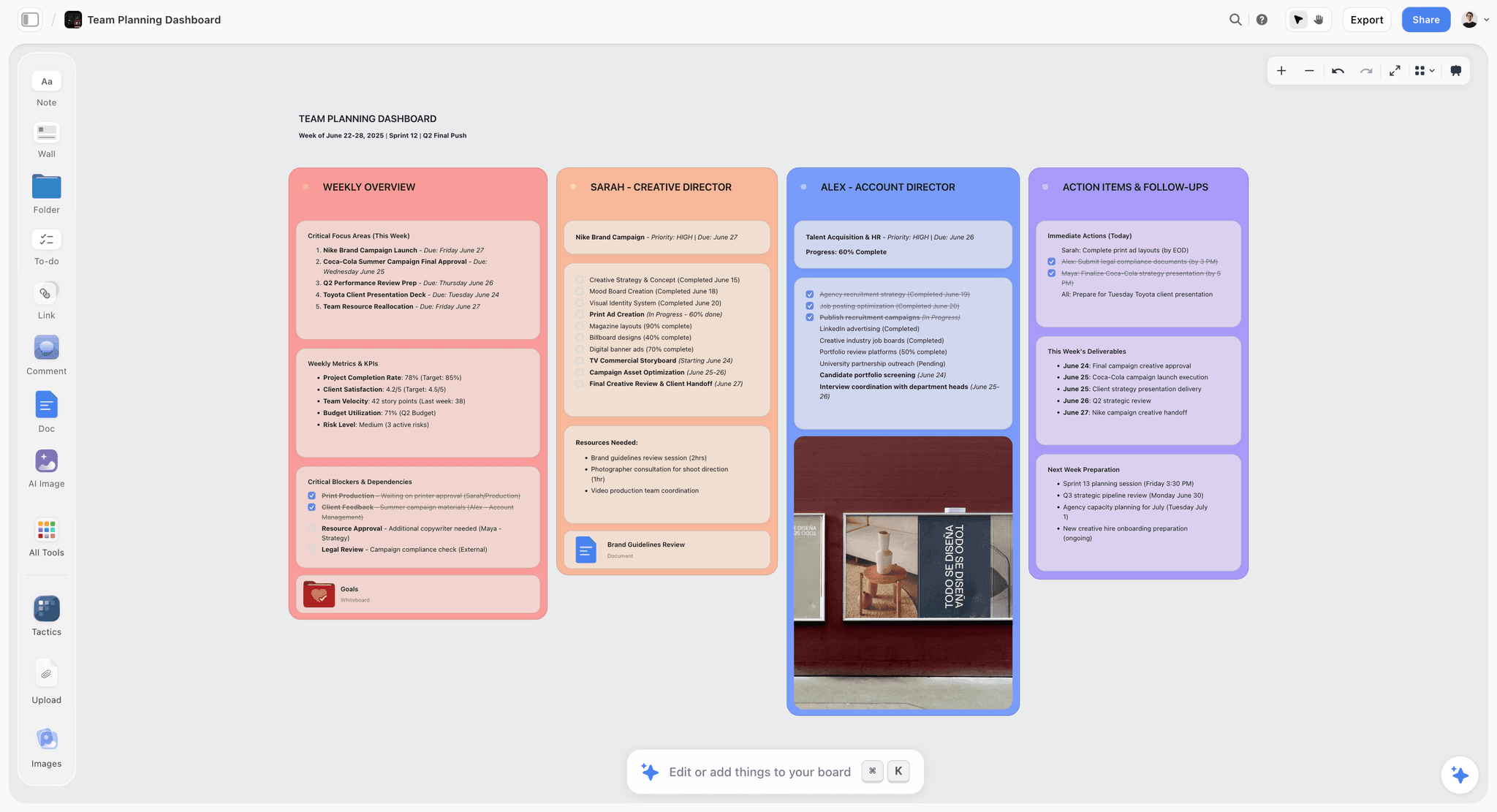
What this setup does not do: nothing reminds an owner that a date is close (the bell tells you about mentions, replies and what collaborators changed on the board, not about due dates), a checklist cannot be filtered to one person's items, and tickets have no dependencies. The twice-weekly check does the reminding. The product launch checklist and product launch planner pages show the board, and through the MCP connector the same board can be read and updated from inside ChatGPT, Claude, Gemini or Grok.
When a Lock Slips: Move the Date or Cut Scope
A missed lock gives a small team exactly two honest options, and one dishonest default. The default is to say nothing and compress the next window. This table is the conversation to have instead, on the day the lock is missed.
| The lock that slipped | Cut scope: what goes | Move the date: when it is the right call | Never do |
|---|---|---|---|
Content (words still moving at T-21) | The comparison table, the long FAQ, the second and third social formats | The price or the name is undecided; nothing downstream is safe to make | Start assets on unfinished copy |
Assets (not final at T-14) | Everything except one screenshot, one short demo and one OG image | The demo is the launch, for example a video-led product | Take the days from technical testing |
Technical (not tested at T-7) | The riskiest surface: launch to existing users only, or behind a flag | Billing or rollback is untested; this is the one lock that should move the launch | Announce and test on the day |
Announcement (something breaks at T-0) | The channels not yet sent | The product fails the logged-out walk-through | Send the email first and check afterwards |
The owner of the lock raises the slip, the team picks a column, and the decision goes on the board as a note next to the lock. That note is worth more at the T+14 review than any metric, because it records what the plan cost you.
Where to Keep the Checklist: 9 Tools Compared
A launch checklist has two halves, and tools split along them. The list half is owned, dated, completable items. The picture half is being able to see all four locks at once, with the copy and assets they refer to. A small team that only keeps the list cannot see the slip coming; a team that only keeps the picture has nothing assigned.
| Tool | Best for | Checklist mechanics | All four locks at once | Starting price |
|---|---|---|---|---|
Storyflow | The four locks on one board, drafted from the brief, with the copy and assets beside them | Good: each line takes a person and a due date with an overdue mark; no filter by person, no due-date reminders | Excellent | $7.99 mo annual (free plan late 2026) |
Notion | The checklist as a database you filter and reuse | Excellent | Good (board view) | Free for individuals; Plus $10 per member mo annual |
Asana | Dependencies and approvals across teams | Excellent, strongest | Good (board, timeline) | Free for 2 users; Starter $10.99 per user mo annual |
Trello | The simplest possible board | Good | Good | Free for up to 10; Standard $5 per user mo annual |
Miro | The launch workshop | Fair | Excellent | Free with 3 editable boards; Starter $8 per member mo yearly |
Airtable | Tracking many similar items | Excellent | Fair | Free; Team $20 per user mo annual |
Monday.com | Coordination at ten or more people | Excellent | Good | Free for up to 2 seats; paid plans start from 3 users |
Linear | Engineering gates | Excellent for engineers | Weak | Free up to 250 issues; Basic $10 per user mo yearly |
Google Sheets | The zero-cost default | Fair | Weak | Free with a Google account |
Prices were read from each vendor's pricing page on October 10, 2026 and change often. Storyflow is our own product and is listed first as our pick, on one stated basis: how much of the checklist it drafts for you from your brief. The other eight are listed by the job each is best at, and no total score is published. Choose Notion instead when checklist mechanics are the whole job, and Asana when the launch has dates that depend on each other; both beat Storyflow on that column.
A Storyflow planning board with walls of dated deliverables per owner, the layout the four lock checklists use
Four locks, four walls, one board
Ask the AI for one checklist per lock, put a person and a due date on each line, and keep the copy and the assets beside them. An impossible week shows up three weeks early instead of on the day.

How We Evaluated These Tools
Six criteria, each scored 0 to 10. A launch checklist has a list half and a picture half: checklist mechanics on one side, and seeing the four locks together with the copy and assets beside them on the other. The first draft, outside viewers and cost are the rest. The tools were compared from their own product and pricing pages in October 2026, and Storyflow from its current workflows. Storyflow is our product, and it is listed first on one criterion, the first draft from your brief. The rows are not weighted or added up, and every cell is published so you can order the tools by the row that matters to your launch.
| Criterion | Storyflow | Notion | Asana | Trello | Miro | Airtable | Monday.com | Linear | Google Sheets |
|---|---|---|---|---|---|---|---|---|---|
Checklist mechanics: owner, date, done and overdue on one item, filtered by owner | 7 | 9 | 10 | 8 | 5 | 9 | 9 | 9 | 6 |
All four locks visible on one screen | 9 | 7 | 7 | 7 | 9 | 5 | 6 | 4 | 4 |
Copy and assets beside the checklist | 9 | 8 | 4 | 3 | 6 | 4 | 4 | 2 | 2 |
First draft from your brief | 9 | 5 | 6 | 4 | 6 | 5 | 5 | 2 | 2 |
Outsiders see it without a paid seat | 9 | 8 | 8 | 6 | 8 | 7 | 5 | 3 | 8 |
Cost for three to eight people | 7 | 7 | 6 | 10 | 7 | 5 | 3 | 7 | 10 |
Read the first row before any other. Asana, Notion, Airtable, Monday.com, Linear and Trello all beat Storyflow on checklist mechanics: each filters the list by owner, and Asana links one task to another. Storyflow scores 7 there: a checklist line takes a person and a due date, shows them as chips and marks a passed date as overdue, but nothing on the board filters the lines to one person's items or reminds anyone that a date is close. Storyflow is listed first because of the fourth row: it has the highest score for a first draft written from your brief (9, against 6 for Asana and Miro and 5 for Notion). It also scores highest on copy and assets beside the list, shares the top score with Miro on seeing the four locks side by side, and is beaten on cost by Trello and Google Sheets. Pick it when a drafted checklist you can see matters more to your team than filtering it. If your launch is forty similar items or six approvals, the first row is the one to choose by, and Asana and Notion are the better picks.
What was not scored: integrations with the rest of your stack, phone apps (Storyflow runs in the browser), and enterprise admin.
Tool Reviews
Storyflow is reviewed first because it is our pick, and it is our own product. The basis is one criterion: how much of the launch checklist the tool drafts for you from your brief. The other eight are not ranked by a total score; each follows with the job it is best at, starting with Notion, the one to choose instead when checklist mechanics are the whole job.
1. Storyflow
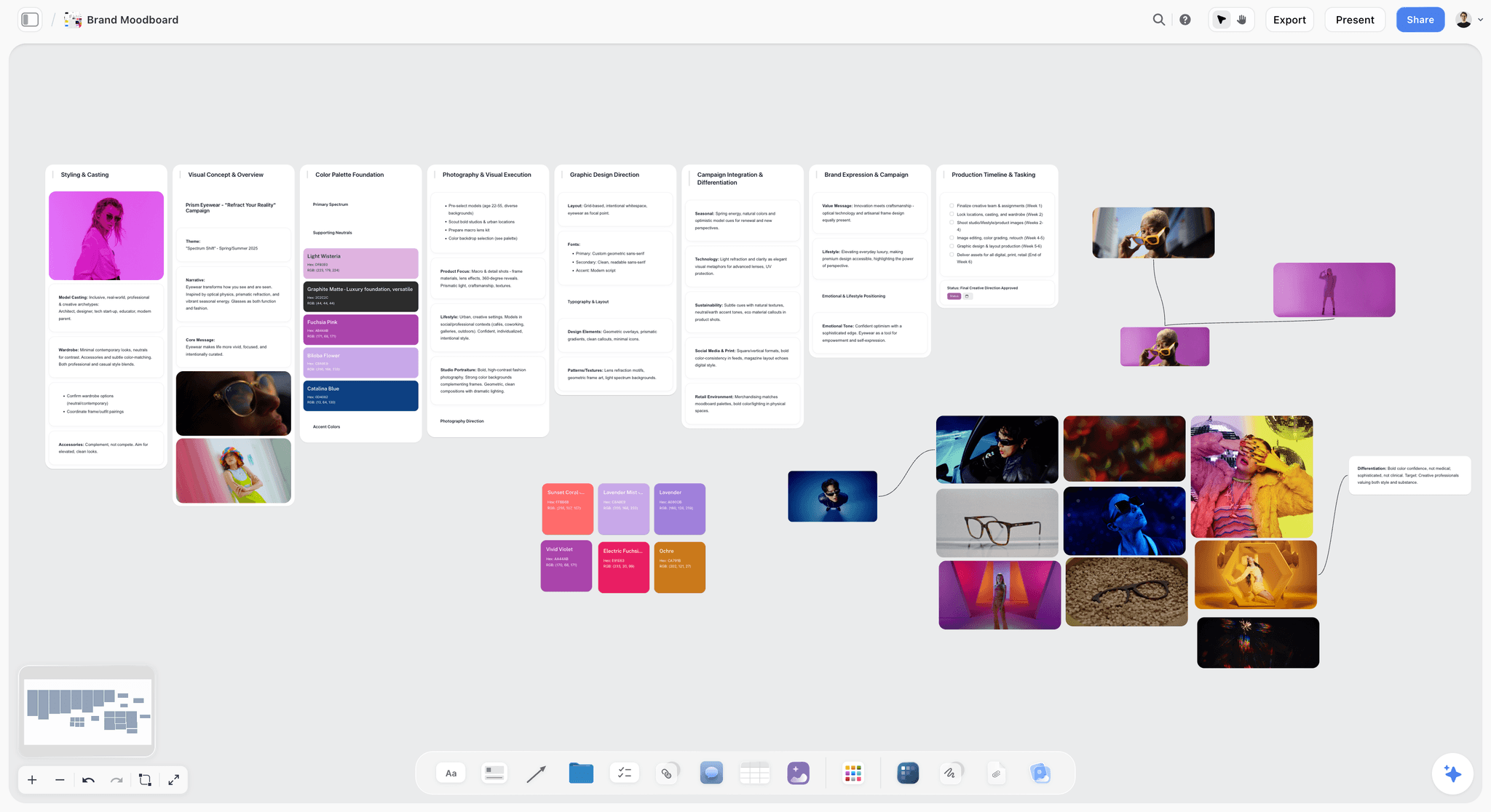
Storyflow's AI drafts the four checklists from your brief, which is the basis for listing it first. Notion's database is the stronger checklist and a board is the stronger picture: for a small team the launch checklist fails at the joins between locks, and the joins are what a board shows. Storyflow is an AI visual workspace: an infinite canvas with notes, to-do checklists, tables, documents, images, walls and tickets, and an AI that reads the board and builds onto it. Its Task list workflow builds one checklist per wall, so the four locks sit side by side, and the positioning, the landing page copy, the screenshots and the rollback note sit on the same board. Ask the AI to draft the launch email and it reads the positioning that is already there.
Key features: to-do checklists where each line takes a person and a due date; tickets with an assignee, a due date with an overdue flag and a label; a Task list workflow and a Planner workflow that works back from a deadline; documents with Word and PDF export; AI that reads the open board plus up to five documents and three other boards you attach; view-only links that open with no account; Presentation mode that steps one wall at a time.
Pricing: Plus $7.99 per month billed annually ($9.99 monthly); Pro $14 ($19 monthly); Max $39 ($49 monthly). Storyflow is paid-only during early access; its Free plan launches before the end of 2026, and anyone a paid member invites to a board joins free now. Plans are on the pricing page.
Pros: the four locks, the copy and the assets in one visible place; the checklist is drafted from your brief; outsiders open a link with no account.
Cons: no due-date reminders, no filtered view of one person's items, no dependencies and no Gantt chart. Assign and Due date work on one selected line at a time, and a copied line drops its person. Tables cannot be sorted. It runs in the browser only.
2. Notion
Notion is the best home for the checklist as a database, and the tool to choose over Storyflow when the list itself is the whole job. A database with owner, lock, due date and status covers everything the four locks need, filtered views give each person their own list, and a launch template can be duplicated for the next one. The docs, the FAQ and the copy can live beside it, which matters: Content Lock is mostly documents.
Where it is weaker is the picture. Its board view groups the rows into one column per lock, which shows the four locks but not the assets around them, and screenshots live inside pages. Teams that think spatially end up drawing the launch somewhere else and maintaining it twice.
Key features: databases with typed properties, filtered per-person views, docs alongside data, templates, guests.
Pricing (notion.com/pricing, checked October 10, 2026): Free for individuals with 10 guests; Plus $10 per member a month billed yearly ($12 monthly); Business $20 ($24 monthly), the first plan with Notion Agent. The page shows local currency by region.
Pros: the checklist mechanics are excellent; the copy lives beside the checklist; the template pays back on the second launch.
Cons: someone has to build and maintain the database; the AI that fills it in starts on Business; per-member pricing adds up when contractors need to edit. See Storyflow vs Notion.
3. Asana
Asana earns its place once the launch involves more than about eight people or crosses a boundary you do not control: legal review, a retail partner, an app store submission. Its product launch template has a Gantt chart that connects dependencies and updates the timeline when plans change, milestones and a stakeholder dashboard.
Key features: dependencies, Timeline and Gantt views from Starter, milestones, approvals on Advanced, unlimited free guests from Starter.
Pricing (asana.com/pricing, checked October 10, 2026): Personal is free for up to 2 users; Starter $10.99 per user a month billed annually ($13.49 monthly); Advanced $24.99 ($30.49 monthly).
Pros: the strongest dependency handling here; approvals on Advanced; every item has one assignee and a due date.
Cons: heavier than a small team needs; the free plan stops at two users; the copy and the assets live in task descriptions and attachments, one task at a time. See Storyflow vs Asana.
4. Trello
For a launch run by two or three people, Trello is enough, and it is free. Four lists, one per lock, cards with members and due dates, and a checklist inside each card. It stops working the moment you want the copy and the assets next to the list.
Key features: boards, cards, due dates, checklists inside cards, built-in automation on every plan.
Pricing (trello.com/pricing, checked October 10, 2026): Free for up to 10 collaborators per Workspace; Standard $5 per user a month billed annually ($6 monthly); Premium $10 ($12.50 monthly), which adds the Timeline view.
Pros: no setup; a card's built-in checklist fits a lock well; the free plan covers a small team.
Cons: no dependencies; a card is a poor place for landing page copy; the Timeline view needs Premium. See Storyflow vs Trello.
5. Miro
Miro is a strong canvas for the two-hour session where you decide the launch. Run the positioning workshop on it with everyone dragging at once. Its weakness for this job is the list half: a whiteboard does not tell you which items are overdue, so the board drifts unless one person owns it.
Key features: infinite canvas, workshop templates, voting, timer, a monthly allowance of AI credits on paid plans.
Pricing (miro.com/pricing, checked October 10, 2026): Free with 3 editable boards; Starter $8 per member a month billed yearly; Business $20.
Pros: built for the live decision session; visitors can edit by link from Starter.
Cons: weak checklist mechanics; the free plan keeps only three boards editable. See Storyflow vs Miro.
6. Airtable
Airtable is the right answer when the launch has a lot of things to track rather than a lot of steps: forty assets, thirty press contacts, a hundred beta users. Fields, views and grouping beat a checklist for that shape.
Key features: relational fields, grouped views, interfaces, automations.
Pricing (airtable.com/pricing, checked October 10, 2026): Free; Team $20 per user a month billed annually; Business $45. Read-only collaborators are not charged on Team and Business.
Pros: strong structured tracking of many similar items; read-only collaborators are free on paid plans.
Cons: its entry paid plan has the highest per-editor price of the tools here with a published dollar price; the documents half is thin.
7. Monday.com
Monday is built for coordinating people, and if your launch involves ten or more across marketing, sales, support and engineering, it does that well. Below that headcount it is more structure than the work needs.
Key features: boards with typed columns, automations, dashboards; Calendar, Timeline and Gantt views from the Standard plan.
Pricing: the pricing page showed us euro prices only on October 10, 2026, so no dollar figure is given here. It states that paid plans start from 3 users and that the free plan covers up to 2 seats.
Pros: strong cross-functional coordination; dashboards a founder will read.
Cons: a three-seat minimum on paid plans; heavier than a launch of three people needs.
8. Linear
If the launch is gated on engineering, put the issues behind Technical Lock in Linear and link them from the board. Linear will not hold your landing page copy and should not.
Key features: cycles, projects, keyboard-first issue tracking, triage.
Pricing (linear.app/pricing, checked October 10, 2026): Free with 250 issues and 2 teams; Basic $10 per user a month billed yearly; Business $16.
Pros: engineers keep it current; good for triage after launch.
Cons: the wrong shape for marketing work; not a place to show the launch to outsiders.
9. Google Sheets
The zero-cost default. A sheet with four tabs, one per lock, with owner and date columns, will run a launch, and it beats a half-configured version of anything above it. It shows no picture of the launch and holds no assets.
Key features: free with a Google account, and nobody needs training.
Pricing: free with a Google account.
Pros: no cost, no setup, everyone can open it.
Cons: nothing shows the shape of the launch; the copy and assets live somewhere else; version sprawl.
Also named for launch planning: FigJam, Lucidspark and Jira
These three also come up when teams ask how to plan a launch visually, so here is where each fits the four locks.
| Tool | Where it fits | Where it stops | What its own page says (checked October 10, 2026) |
|---|---|---|---|
FigJam | The planning session, for a team already in Figma | Sticky notes carry no owner or due date of their own | Figma's free product launch plan template is a timeline in four sections: 90, 60, 30 and post launch; the Collab seat is listed at $3 a month on figma.com/pricing |
Lucidspark | A whiteboard session for teams already on Lucid | A blank board or a template to fill in | Lucid's product launch plan guide recommends it for checklists, Gantt charts and Kanban boards |
Jira | Technical Lock, when engineering work dominates | A tracker shows a filtered list, not four locks at once | Atlassian's free product launch timeline template includes Timeline, Calendar and Dashboard views |
The Whole Checklist on One Page
If you take one thing from this article, take this. Put four dates in a calendar before you do anything else:
- T-21 Content Lock. Words frozen. One person has read all of it in one sitting.
- T-14 Asset Lock. Every asset final, named, stored in one place, checked on a phone.
- T-7 Technical Lock. Billing, analytics, onboarding, and rollback tested on production.
- T-0 Announcement. Product first, then docs, then email, then social, then outreach.
- T+14 Review. What you predicted, what happened, what you would cut.
Then, and this is the part that makes the dates real: when a lock slips, the decision is whether to move the launch or cut scope, and somebody has to make it out loud. The default, which is to say nothing and quietly compress the next window, is how launches end up untested.
What Small Teams Get Wrong
Treating the launch date as the only deadline
One date on the calendar means three invisible ones, and this is the root cause of most of the rest. Fix: on the day you set T-0, put T-21, T-14 and T-7 in the same calendar, each with an owner's name.
Making assets before the words are final
Every rename, every pricing change, every repositioning after Asset Lock costs a re-export. Fix: no screenshot or recording session is booked until the one-sitting read of Content Lock has happened.
Testing billing last
Billing is the most complex path in most products and the one with the worst failure mode, and it is routinely tested the night before because it is nobody's favourite job. Fix: make the real-card test the first line of Technical Lock and give it to a named person at T-10, not T-7.
Announcing everywhere at once
A staggered announcement lets you fix the confusion the email surfaces before the social post repeats it. Simultaneous means every audience gets the version with the mistake in it. Fix: leave at least two hours between the email and the first social post, and read the replies in between.
No rollback plan
Launches rarely need one, but writing it reveals whether one exists. Fix: four lines on the board before T-7: who reverts, what toggle or command, how long it takes, and what customers who saw the change are told.
No prediction
Without a number written down beforehand, every launch is a success, which means no launch teaches you anything. Fix: write three numbers in a note on the board at T-7: expected signups, expected activation rate and expected revenue at T+30.
Keeping the list where nobody can see its shape
A checklist of sixty rows looks the same on the day it is healthy and the day it is doomed. Put the four locks side by side, with their dates, and the lock that is about to eat its neighbour is the tall column with a near date. That is the reason to keep the checklist on a board, and it is the same reason to walk it together twice a week.
The Bottom Line
A small-team launch does not fail because the marketing was weak. It fails at the joins, and the joins are invisible until you date them. Four locks, four owners, four dates, and one honest conversation whenever one of them slips.
The short way to do this: put your launch brief on a Storyflow board, ask the AI for a task list with one checklist per lock, put a ticket with an owner and a date above each of the four walls, and keep the copy and the assets beside them. Share the view-only link with everyone who asks how the launch is going.
Tools that help:
- Storyflow for the four locks on one board, drafted from your brief, with the copy and assets beside the checklists.
- Notion if you want the checklist as a database you can filter and reuse.
- Asana when the launch has dependencies or approvals.
- Linear or Jira for the engineering issues behind Technical Lock.
- Trello or Google Sheets when the budget is zero.
Then write down what you expect to happen, so that in a month you can tell whether it did.
FAQ: Small-Team Product Launch Checklists
What should be on a small-team product launch checklist?
Four dated locks. Content Lock at T-21 covers positioning, pricing, landing page, docs and every announcement word. Asset Lock at T-14 covers screenshots, demo video, social cuts and the OG image. Technical Lock at T-7 covers billing, analytics, onboarding, error states and a written rollback path. Announcement at T-0 covers publishing in an order that fails safely, starting with the product and ending with outreach. Add a T+14 review, because a launch nobody measures teaches nothing.
How do I plan a product launch visually with my small team?
Put the four locks on one Storyflow board as four checklist walls side by side: Content at T-21, Assets at T-14, Technical at T-7 and Announcement at T-0. Ask the AI for a task list with one checklist per lock, built from your brief, put a person and a due date on each line and a ticket with an owner and a date above each wall, and keep the copy and the assets on the same board. Check it together twice a week, and treat any open item past its lock date as a decision to move the launch or cut scope.
What is the best tool for a small-team product launch checklist?
Storyflow, which is our own product, for a team of three to eight that wants the checklist drafted from the brief and wants to see the launch: the AI drafts one checklist per lock from the brief, each line takes a person and a due date, the copy and assets sit beside the lists, and a view-only link opens with no account. Notion beats it on checklist mechanics and is the better pick if you want every item as a database row you can filter by owner and date. Choose Asana if the launch has dependencies or approvals, and Trello or a Google Sheet if the budget is zero.
How far in advance should a small team start planning a launch?
Three weeks of locked time before the launch date is the minimum that works, and it assumes the product is already built. The three weeks are not for building; they are for freezing words, rendering assets from those words, and testing what a customer will touch. Bigger launches with partners, press or an app store submission need six to eight, because the gates you do not control set the pace. The six-week timeline template lays the longer version out.
What is the difference between a launch checklist and a launch roadmap?
A checklist is a list of owned, dated, completable items and answers "is this done and who owes it". A roadmap is a picture of the sequence and answers "what comes after what, and what blocks what". Small teams need both. Keeping only a checklist means nobody can see the shape; keeping only a roadmap means nothing has an owner. Launch Roadmap vs Launch Checklist goes through the difference.
What goes on a new product launch checklist that a feature launch can skip?
A new product adds the items that an existing product already has: the name and trademark check, the pricing decision and what the billing period is, a landing page rather than a homepage line, a press kit page, directory or app store assets, and support access for a product the support person has never used. A feature launch inside an existing product can usually skip the press kit, the directory assets and the trademark check, and should never skip the test of what happens to an existing customer who does nothing.
What is a startup launch checklist for 2026?
The same four locks with a shorter Asset Lock. A startup with no audience needs the words and the product right more than it needs eleven assets: freeze the one-sentence description and the price at T-21, make three assets by T-14 (one screenshot, one short demo, one OG image), test billing and the logged-out signup path by T-7, and on T-0 send personal messages to everyone who has ever asked for the product before any broadcast post.
What is the best product launch template for content and social teams?
One that starts from Content Lock. Content and social teams own Locks 1 and 2, so their template is the Content Lock checklist as the first wall, the Asset Lock checklist as the second, and a table of posts in date order beside them: channel, format, the one-sentence description the post uses, owner and status. On a Storyflow board the AI drafts the post table from the positioning document, and the team keeps the rows in date order because tables on the canvas do not sort.
Is Storyflow a launch tracker?
It holds the launch checklist and shows its shape; it is not a tracker in the Asana sense. Storyflow has to-do checklists whose lines take a person and a due date, tickets with an assignee and a due date that flags when overdue, and a kanban. Its bell notifies you of mentions, replies and what collaborators changed on a shared board. It has no dependencies, no Gantt chart, no due-date reminders and no filtered view of one person's items. A team whose launch waits on outside approvals should run those tasks in Asana and keep the Storyflow board as the picture everyone looks at.
Is Storyflow free?
Not yet. Storyflow is paid-only during early access, starting at $7.99 per month billed annually on Plus, and its Free plan launches before the end of 2026. The one free path now is being invited: anyone a paid member invites to a board signs up free, which covers a launch where one person pays and the rest collaborate. A view-only link needs no account at all.
How do you run a product launch with only two people?
Cut Lock 2 to the three assets that matter (one screenshot, one thirty-second demo, one OG image) and keep Locks 1, 3 and 4 intact. Two people can freeze words, test billing and announce in order. What two people cannot do is produce eleven assets and test billing in the same week, so the assets are what gets cut. A launch with one good screenshot and working billing beats a launch with a video and a broken upgrade path.
What should you do on launch day itself?
Publish in an order that fails safely: landing page first and checked in a private window, then the feature flag, then walk the product yourself as a new user, then docs and changelog, then the email, then social, then personal outreach. Watch error rates and analytics for the first two hours. Reply to everything on day one. Resist shipping anything else until T+2.
How do you measure whether a launch worked?
Write the prediction down before the launch: expected signups, expected activation rate, expected revenue in thirty days. At T+14 compare activation for launch-sourced users against your normal rate, because volume without activation is a traffic spike rather than a launch. At T+30 write the honest number next to the prediction. Without the prediction, every launch looks like a success and none of them teaches you anything.
What is the most commonly skipped launch checklist item?
The written rollback path. It is skipped because it feels pessimistic and because it is nobody's job, and it is the highest-value item on Technical Lock. Writing down who reverts, what they revert, how long it takes, and what happens to customers who already saw the change forces someone to check that reverting is possible. Sometimes it is not, and finding that out at T-7 is a completely different situation from finding it out at T-0.
Should the launch checklist live in the same tool as the launch plan?
Yes, if the tool shows both. The usual reason to split them is that a database tool is poor at pictures and a whiteboard is poor at lists, which leaves two sources of truth and the wrong one always gets read. A Storyflow board holds the checklists, the dated tickets, the copy and the picture together. Split them only when the list needs things a board does not have, such as dependencies or due-date reminders, and then name one person who keeps the two in agreement.
Can AI write a product launch checklist?
It can write the first draft, and the team should cut it. In Storyflow the AI reads the brief on the board and builds one checklist per lock with lines written for your product, drafts the email and changelog from the positioning, and lays the tasks out in weeks counted back from the launch date. It does not decide who owns a lock. With the MCP connector the same board can be built or updated from ChatGPT, Claude, Gemini or Grok.
How many assets does a small launch actually need?
Three that carry weight: one product screenshot with real content, one demo under sixty seconds, and one OG image that survives a link preview. Everything beyond that is optional and should be produced only if someone will use it. The T+14 review is where you find out which of the others were used, and that list is what you cut from the next launch.
Table of Contents
- Key Takeaways
- How Do You Plan a Product Launch Visually With a Small Team?
- The Four Locks
- The Four Locks at a Glance
- Lock 1: Content Lock (T-21)
- Lock 2: Asset Lock (T-14)
- Lock 3: Technical Lock (T-7)
- Lock 4: Announcement (T-0 to T+2)
- The Fifth Checklist Nobody Writes
- How to Build the Launch Checklist on One Board
- When a Lock Slips: Move the Date or Cut Scope
- Where to Keep the Checklist: 9 Tools Compared
- How We Evaluated These Tools
- Tool Reviews
- 1. Storyflow
- 2. Notion
- 3. Asana
- 4. Trello
- 5. Miro
- 6. Airtable
- 7. Monday.com
- 8. Linear
- 9. Google Sheets
- Also named for launch planning: FigJam, Lucidspark and Jira
- The Whole Checklist on One Page
- What Small Teams Get Wrong
- The Bottom Line
- Author
- FAQ: Small-Team Product Launch Checklists
- Related Reading
Templates to check out for this topic


Planning and project templates you can use in Storyflow
Plan a launch, a sprint, or a whole project on a visual board the team can see at once. Open one of these templates and start from real structure.


See Storyflow in Action
A visual AI workspace where every feature lives inside one canvas. No tab-switching, no context lost.
Build your entire board from a single message
Type what you need in the AI chat at the bottom of your canvas. The AI adds cards, headings, and structure directly onto your board.
Use expert frameworks as AI context
Type @ in the AI chat and choose any Tactic. The AI tailors every response to that framework instead of giving generic advice.
Turn your board into a mind map in seconds
Ask the AI to restructure your canvas as a mindmap. It connects your ideas into a visual hierarchy so you can see how everything relates.
Why Storyflow Exists
Storyflow actually began as a personal tool while working on creative and research projects.
We kept running into the same problem: ideas were scattered everywhere: notes, documents, and whiteboards.
Nothing helped us see how everything connected.
So we started building a workspace designed around how ideas actually grow.
→ Read how Storyflow was createdJustkay
Documentary Filmmaker & Founder at Storyflow
Published: 2026-09-02
Extremely simple, seriously capable


See how easy it is to get started
Watch a real project come together, from a blank board to a finished plan, clicked through step by step.
Start creating with AI and become more productive
Transform your creative workflow with AI-powered tools. Generate ideas, create content, and boost your productivity in minutes instead of hours.