
Ultra-fast planning, extremely simple
Every workstream and every week
on one launch roadmap.
Product, content, channels and operations as lanes, the weeks before launch as columns, and a line wherever one card waits on another. The AI draws the first version from your launch brief, and the team corrects it together.


Creatives working for these brands already got early access
- Red Bull
- Canon
- Artlist
- Porsche
See how easy it is to get started
Watch a real project come together, from a blank board to a finished plan, clicked through step by step.
Start from a ready-made template
Pick a board to see what you can build, then let AI fill it in. Every template is a real, editable starting point on the same infinite canvas.

Mind Map
Branch one central idea out into themes and sub-points, then drag the connections around until the structure makes sense.
How do you build a launch roadmap?
To build a launch roadmap, give each workstream a lane and each week before launch a column, put every item on one card with one owner, and draw a line wherever one card waits on another. Storyflow is an AI visual workspace that draws your launch roadmap on one infinite canvas: lanes for product, content, channels and operations, a column per week, a line for each dependency, and an AI first draft. Describe the launch or drop in the launch brief, and the AI lays out a first roadmap to correct, so the team starts the planning session from a draft instead of an empty wall. Miro and FigJam suit running that session live on a whiteboard, Trello a simple card board, and Asana a timeline whose dates shift along dependencies.
A launch roadmap answers one question a task list cannot: with four workstreams moving in parallel, what actually gates the date? It differs from a product roadmap, which sequences what you build over quarters, and from a launch checklist, which lists what must be true on the day. The roadmap is the picture of the weeks in between, and it is only useful when the dependencies between lanes are drawn.
Launches slip for structural reasons, not because a team was slow. Marketing cannot finish the landing page without final screenshots, sales cannot be briefed until pricing is settled, and support cannot write the help article until the feature stops changing. Each is obvious in hindsight and invisible in a list, because a list shows what each person owes and never what each person is waiting for. The second failure is the overloaded owner: one person holding three cards in launch week.
The AI proposes and the team decides. It drafts the conventional lanes and items, including the operations work small teams skip, and it reads the whole board when you ask which card has no owner or what moves if the date slips. Storyflow is not a scheduling engine: there is no calendar, and dates do not shift automatically along the lines. Dates live on tickets with due dates and in a table with a date column, rows kept in date order.
Ultra fast from brief to board
From a launch date to the card that will move it.
No project setup. One canvas, four lanes, and the lines between them.
01
Describe the launch
Say what ships, when, and who is on the team. Drop in the launch brief as a PDF or Word (.docx) file and the AI reads its text before it draws anything.
02
Get lanes and weeks
The AI plans backwards from the launch date, laying out product, content, channels and operations as lanes against the weeks before launch, so you correct a draft rather than fill a blank grid.
03
Draw what waits on what
Connect each card to the card it depends on, then read the board column by column. Anyone holding three cards in one week is your first risk.
04
Share one link
A view-only link opens with no account. Invite the team to edit and each owner keeps their lane current, so the roadmap replaces the weekly status meeting.
Lanes, weeks, lines and owners.
What a launch roadmap has to show, arranged so the risk is visible before launch week.
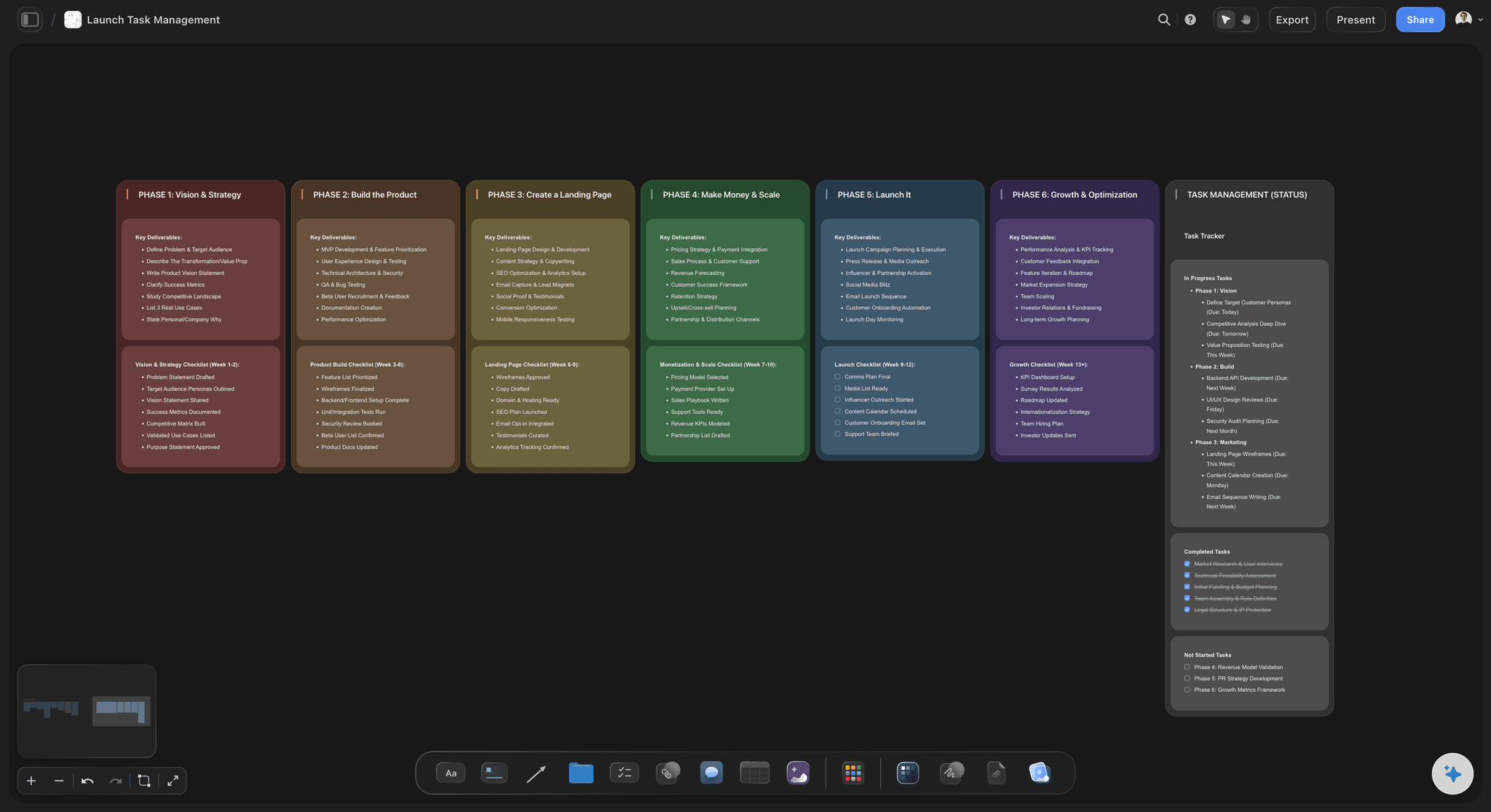
A lane for every workstream
See the whole launch at once
Product, content, channels and operations run side by side against the same weeks. The marketing lead sees what product is behind on without calling a meeting.
See the product launch planner →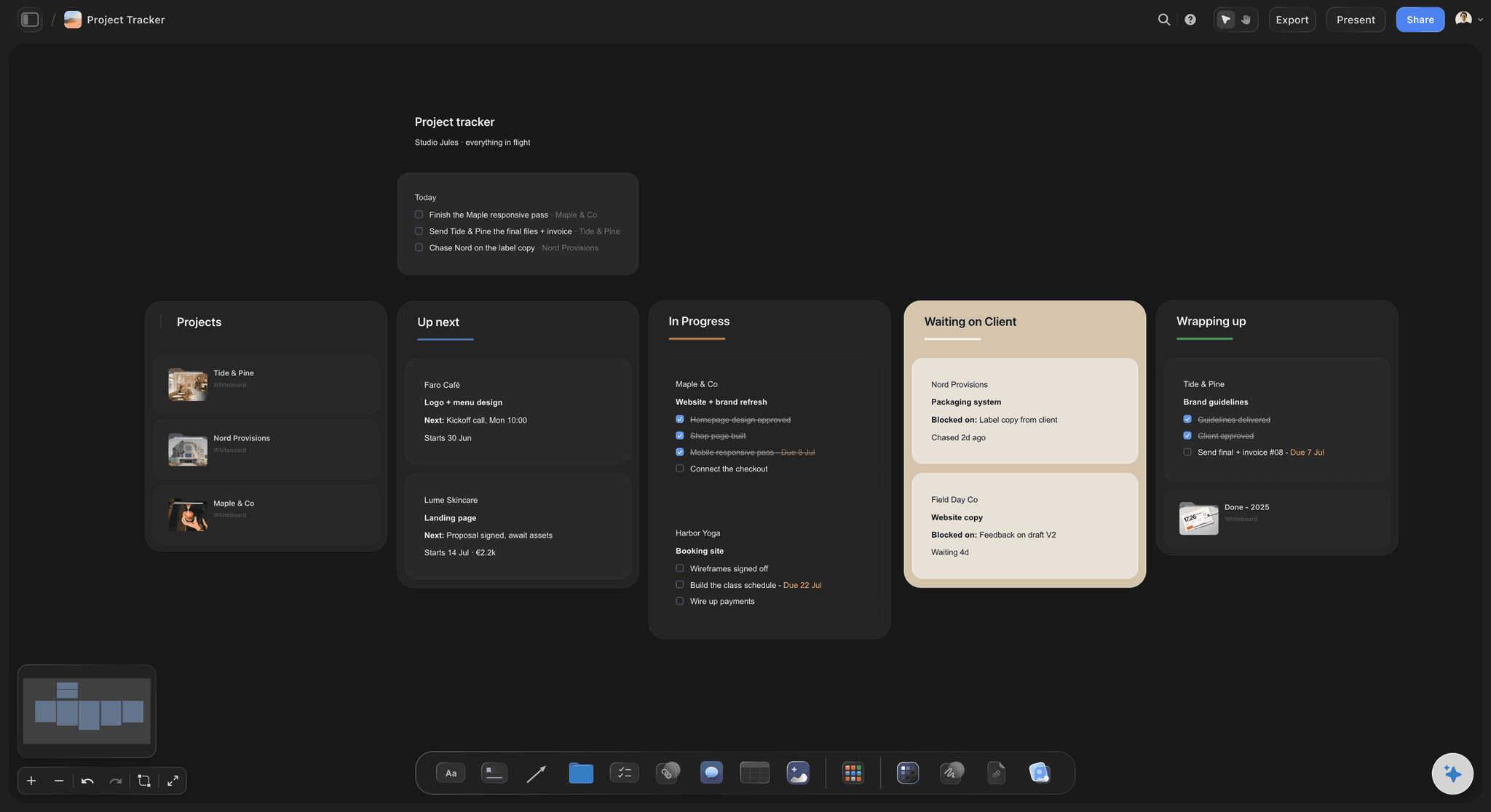
Dependencies drawn as lines
Find what actually gates the date
Screenshots before the landing page, pricing before the sales brief, a stable build before the help article. Drawn as lines, the longest chain is your critical path, and it is rarely in the product lane.
Try visual project planning →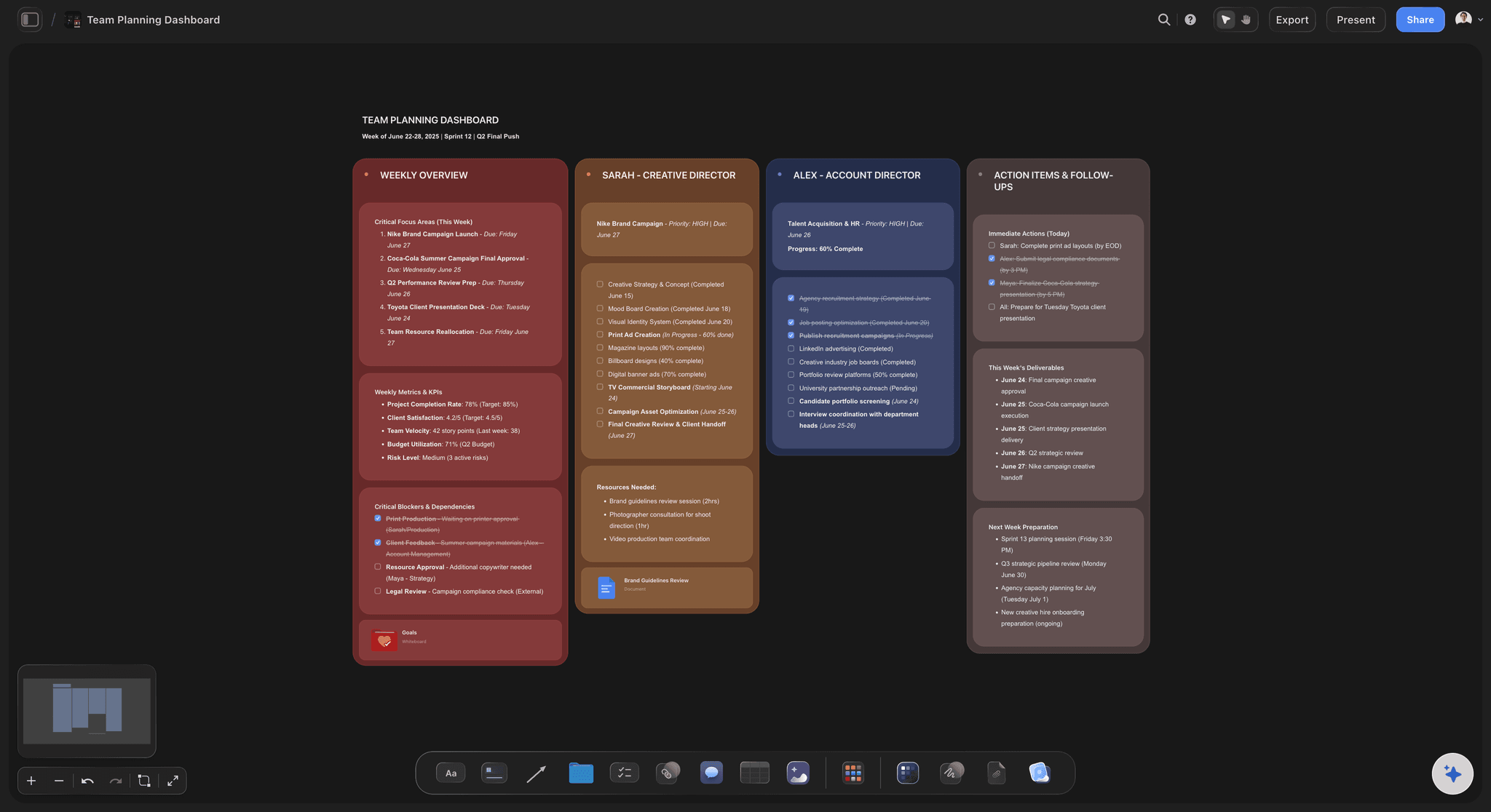
The checklist and the kanban on the same board
This week's work beside the whole plan
A Kanban for the current week and a to-do list per lane sit next to the roadmap, so the day-to-day work never drifts away from the dates it serves.
See the product launch checklist →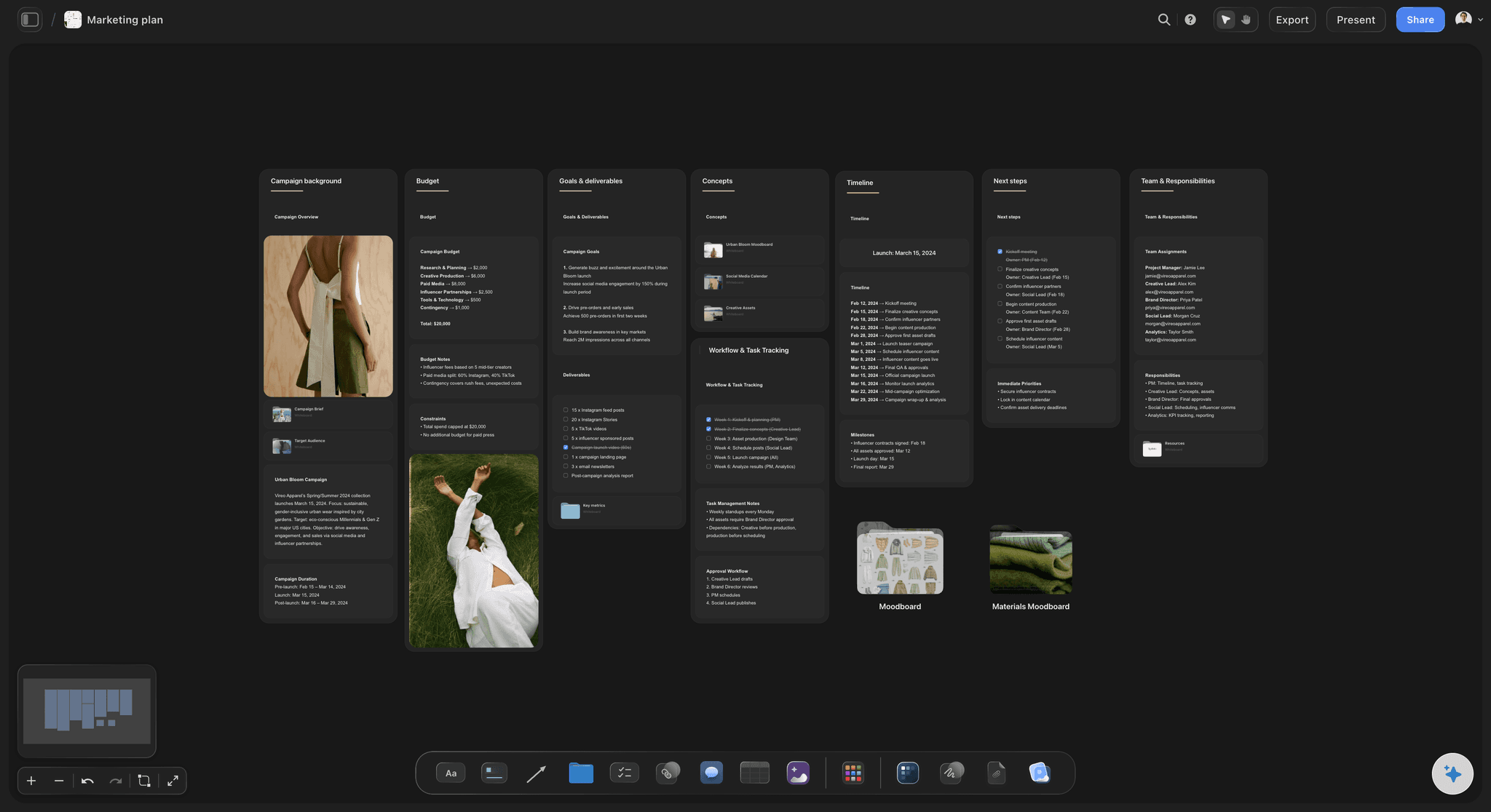
Built from the go-to-market plan
Keep the why beside the when
Positioning, pricing and the channel plan sit on the board the roadmap came from. A card nobody can trace back to the plan is usually work the launch does not need.
See the go-to-market plan →One roadmap per launch. No object cap.
Keep this launch and the next side by side. Storyflow is paid-only during early access, with plans from $7.99 a month billed annually ($9.99 monthly). A free plan launches before the end of 2026, and anyone a paid member invites to a board joins free.
Unlimited launch boards on an infinite canvas
AI that drafts the roadmap from your launch brief and reads the whole board
Kanban, tickets with owners and due dates, and to-do lists on the same canvas
View-only links the whole team opens with no account
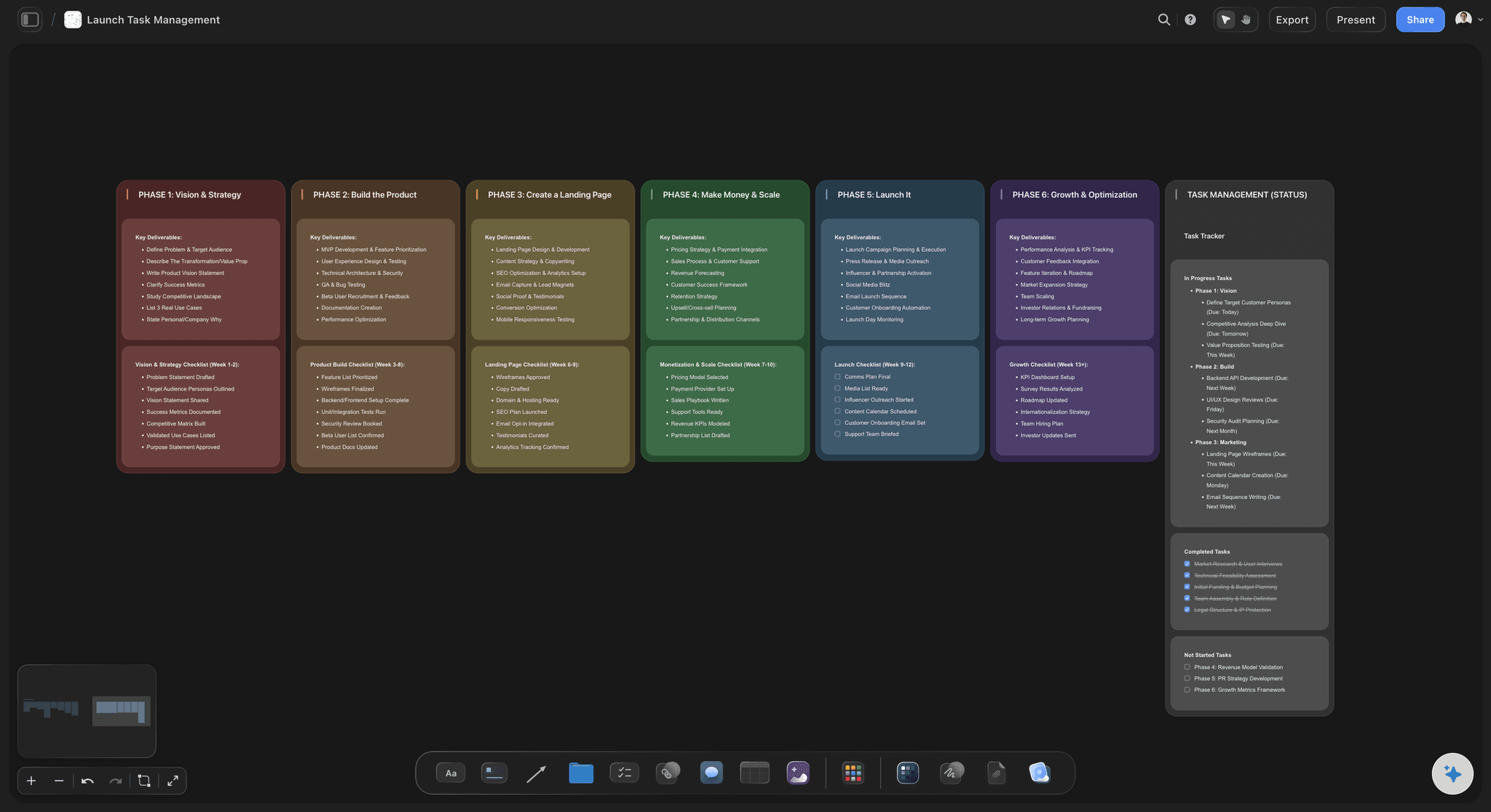
Built for people with taste
Four lanes, weeks not dates, one owner per card.
A launch roadmap a small team can keep current in ten minutes a week. This is the shape that holds up.
Product, content, channels, operations
Four lanes cover most launches
Product: Feature complete, the bug bar, onboarding and pricing live in the product. It gets the most attention and is rarely the lane that moves the date.
Content: The landing page, screenshots, the demo video, emails and help articles. Almost every card here waits on something from product, which is why both lanes belong on one picture.
Channels: Social, community posts, partners, press and any paid push. Plan this lane first when an outside date is fixed, because a partner's newsletter or a press embargo will not move for you.
Operations: Support readiness, analytics, billing checks and the launch-day plan. Never skip it: it is the lane small teams discover on the morning of launch.
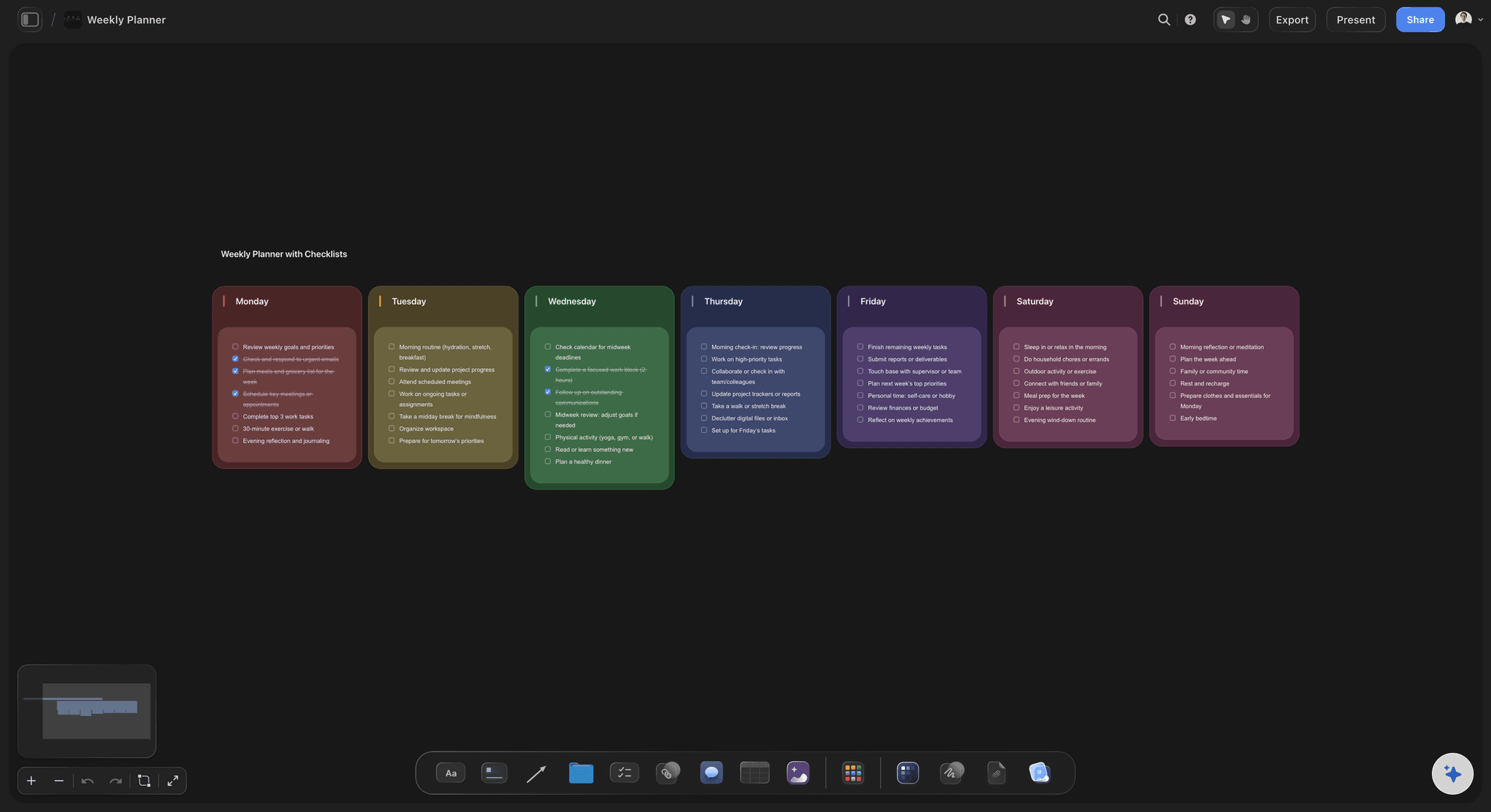
Countdown columns, owners and a freeze
Plan backwards from launch day
Weeks, not dates: Label the columns six weeks out, five, four and so on to two weeks after launch. If the date moves, the plan slides with it instead of being rewritten.
One owner and one due date per card: A card owned by the team is owned by nobody. Put a single name on every card and a due date on anything launch-critical.
Freeze copy three days out: Lock copy and assets three days before launch. The email, the pricing page and the announcement cannot drift apart at the last minute if nobody is still editing them.
A launch-day owner with nothing else: One person watches, routes and decides on the day, while others cover support, analytics and urgent fixes. Give the owner no other cards that week.
AI that reads the whole roadmap
Ask what the roadmap is missing
A first draft from the launch brief: Describe the launch and the AI lays out the lanes and the conventional items on each. The value is completeness: the forgotten items are the ordinary ones.
Find the missing dependency: Ask which content cards cannot start until product finishes, or which card has no owner. The AI reads this board, so the answer is about your launch.
Re-plan when the date moves: Ask what shifts if launch slips a week and the AI moves the affected cards on the board. Each edit it makes comes off with one click.
It proposes, you decide: Whether a date is achievable is a judgment for the people doing the work. The AI structures and suggests; it does not commit your team to anything.
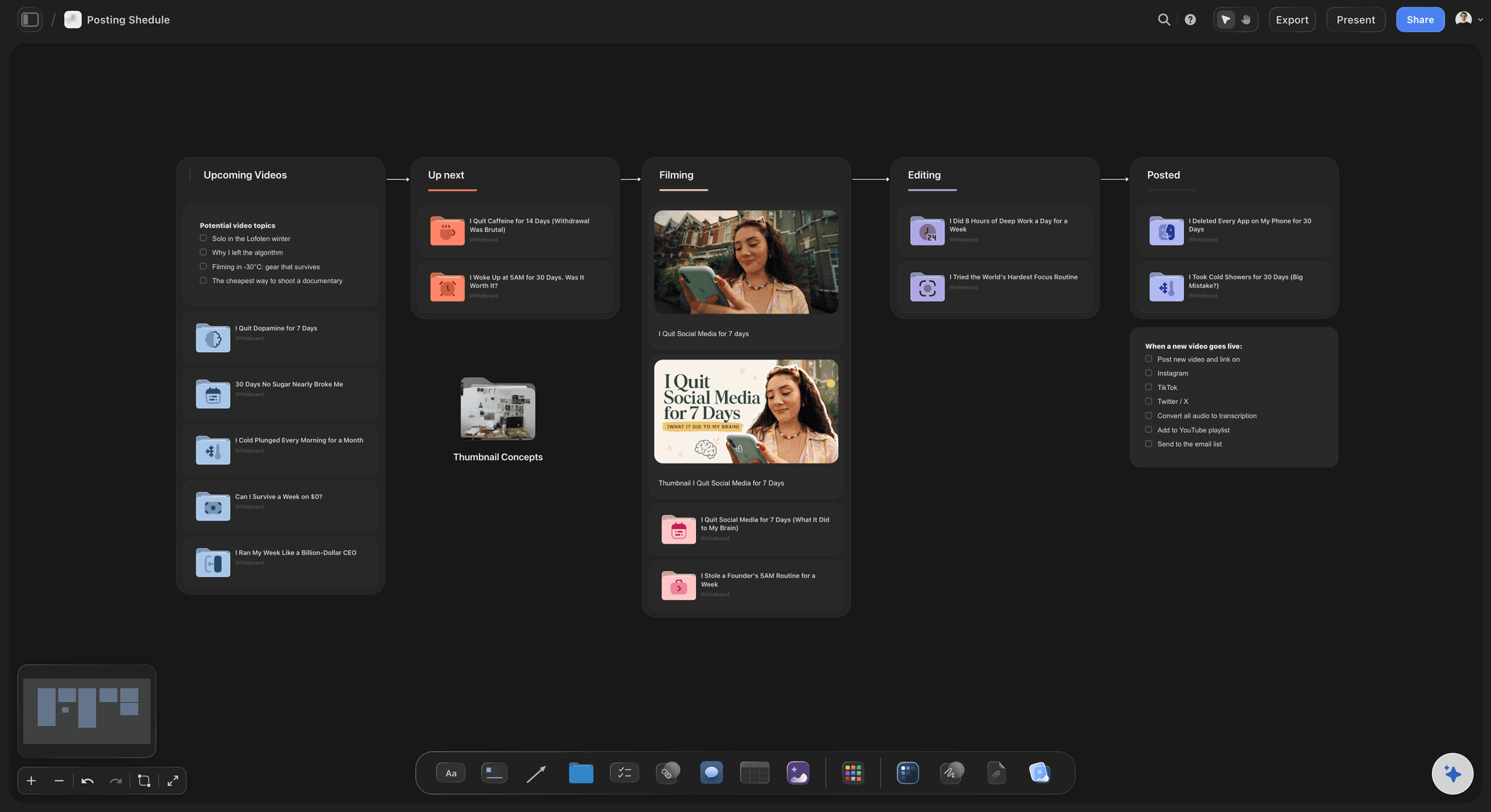
Launch week and the two weeks after
The roadmap does not end at launch day
The first week: Who watches support, who reads the analytics, what triggers a rollback, and who can make that call on a Saturday. Planning the week after is the difference between a launch and a scramble.
The follow-up wave: The second email, the case study and the paid push once the first attention fades. Launches that spend everything on day one go quiet by day three.
The review at the board: Two weeks after launch, mark what slipped and why against the original roadmap. A retrospective run against the plan beats one run from memory.
Explore templates for your project
Every template opens as a real, editable board on the infinite canvas. Pick the closest fit and make it your own.
Mind Map
Branch one central idea out into themes and sub-points, then drag the connections around until the structure makes sense.
One app instead of five
Storyflow vs Miro, Trello and Asana for a launch roadmap.
Each is good at something: Miro at running the planning workshop live, Trello at a simple card board, Asana at dates that shift along dependencies. Here is where they differ for a launch roadmap.
Storyflow
Recommended
Roadmap, launch docs and assets on one canvas
Launch docs on the board that export to Word
View-only link that opens with no account
Workload views and time tracking
Free plan available today
Miro
Roadmap, launch docs and assets on one canvas
Launch docs on the board that export to Word
View-only link that opens with no account
Workload views and time tracking
Free plan available today
Trello
Roadmap, launch docs and assets on one canvas
Launch docs on the board that export to Word
View-only link that opens with no account
Workload views and time tracking
Free plan available today
Asana
Roadmap, launch docs and assets on one canvas
Launch docs on the board that export to Word
View-only link that opens with no account
Workload views and time tracking
Free plan available today
What creators are saying
Join early creators getting structured workspaces and AI that remembers their projects
“Storyflow has sped up my workflow by at least 3x, which means more flow state and more projects I can actually ship. It truly changed the way me and my team create.”

Reilin Joey
Director & YouTuber
“One prompt gets me a structured board. But the tactics are my favorite. I run my YouTube scripts through them and my intros and retention got better. It's amazing.”

Justkay
YouTuber & Freelance Filmmaker
“I used to juggle five apps to plan a project. Now I describe what I am making and get boards, lists, and a schedule. All in one place.”

George
@fernwehchronicles
Launch roadmap questions, answered.
What goes on one, how far ahead to start, and where launches actually slip.
A launch roadmap lays every workstream a launch needs (product, content, channels, operations) against the weeks before the date, with the dependencies between them drawn. Storyflow draws it on one canvas: describe the launch or drop in the launch brief, and the AI lays out the lanes, weeks and usual items, then reads the board when you ask what is at risk. Unlike a product roadmap, it answers one question: what gates this date?
Storyflow draws the launch roadmap on one canvas: a lane for each workstream, a column for each week before launch and a line wherever one item waits on another. The AI lays out a first roadmap from your launch brief and reads the whole board when you ask what is at risk. The launch docs and assets sit on the same canvas. Asana has workload views and time tracking, which Storyflow does not.
Four lanes, the weeks, owners and lines. Product: feature complete, onboarding, pricing live. Content: landing page, screenshots, demo video, emails, help articles. Channels: social, community, partners, press. Operations: support, analytics, billing checks, the launch-day plan. Columns run from six weeks out to two weeks after launch, every card has one owner, and a line joins each card to what it waits for. Small teams most often leave out operations.
Storyflow shows the weeks and the dependencies together: the launch or campaign sits as lanes against the weeks before the date, with a line from each card to what it waits for, so the picture shows risk and not only dates. Asana's timeline view suits dates that shift along dependencies, and a spreadsheet suits a plain dated list. The test is whether you can see, in one glance, which card gates the date.
The go-to-market plan decides who the launch is for, the positioning, the price and the channels. The launch roadmap schedules the work that delivers those decisions and shows what waits on what. Write the plan first, because it decides which channels appear on the roadmap at all. In Storyflow both can sit on one board, so every roadmap card traces back to a decision in the plan.
Six weeks for a small software launch, more if a lane has a long-lead item. Work backwards from the constraint, not forwards from today: press outreach often needs four to six weeks of notice, printed or physical materials have their own production time, and sales can only be briefed once pricing is settled. Find the longest chain first, then fit the other lanes inside it.
Mostly because a dependency between two lanes was never drawn, not because anyone was slow. Marketing cannot finish the launch page without final screenshots, sales cannot be briefed until pricing is signed off, and support cannot write the help article until the feature stops changing. A task list shows what each person owes and never what they are waiting for. The second cause is one owner holding three launch-week cards.
Draw every dependency as a line, then follow the longest connected chain from today to launch day. That chain is the critical path, and it rarely runs through the product lane. It often passes through a pricing decision or a legal review that blocks three other cards. Once it is visible, the useful question changes from how do we go faster to which single link can we shorten.
Use both, for different questions. The roadmap answers what gates the date across all the weeks; a kanban answers what is being worked on this week. A kanban alone hides dependencies and the weeks ahead, and a roadmap alone is too coarse for daily work. In Storyflow the Kanban, the tickets with owners and due dates, and the roadmap sit on the same board, so this week's cards stay tied to the launch plan.
It can draft the conventional one well, and the conventional items are exactly what small teams forget: the terms update, the support macro, the analytics event, the second email. Storyflow's AI lays out lanes and items from your launch brief and reads the whole board when you ask what has no owner. It cannot judge whether your date is realistic for your team. It proposes, the team decides, and each edit comes off with one click.
One person with no other cards that week. Their job is to watch, route and decide: whether an issue waits, who fixes it, and whether anything triggers a rollback. Name separate owners for support, analytics and urgent fixes, and put all of it in the roadmap's launch column before the week starts. A small team that shares launch day between everyone usually finds nobody made the call when it mattered.
Yes, two weeks of it. The first week covers monitoring, support and who can call a rollback. The follow-up wave covers the second email, the case study and any paid push once the first attention fades, because launches that spend everything on day one go quiet by day three. Then review at the board: mark what slipped against the original roadmap, and list the dependencies you never drew.
No. Storyflow is paid-only during early access, with plans from $7.99 a month billed annually ($9.99 monthly). A free plan launches before the end of 2026, and anyone a paid member invites to a board joins free, so the whole launch team can work on the roadmap. If you need something free today, a spreadsheet with a row per card and a column for what it waits on covers the list.
More from Storyflow
Go-to-market plan
Product launch planner
Product launch checklist
Brand launch planner
Product roadmap
AI project plan generator
Campaign brief to delivery
Visual project planning
Sprint planning board
Book launch planner
Rebrand planner
How to plan a product launch visually
Launch timeline template for small teams
Launch roadmap vs launch checklist
Campaign timeline template
Turn a ChatGPT chat into a project plan
Plan a product launch visually
See what will move the date, before it moves.
Describe the launch, let the AI draw the lanes, and share one link with everyone launching. No download.