
Extremely reliable pre-production
Your film pitch deck,
built on one canvas.
Logline, synopsis, lookbook, characters, comps and team beside the research behind them, then sent as a PDF deck or a link investors open in a browser.


Creatives working for these brands already got early access
- Red Bull
- Canon
- Artlist
- Porsche
See how easy it is to get started
Watch a real project come together, from a blank board to a finished plan, clicked through step by step.
Start from a ready-made template
Pick a board to see what you can build, then let AI fill it in. Every template is a real, editable starting point on the same infinite canvas.

Pre-Production
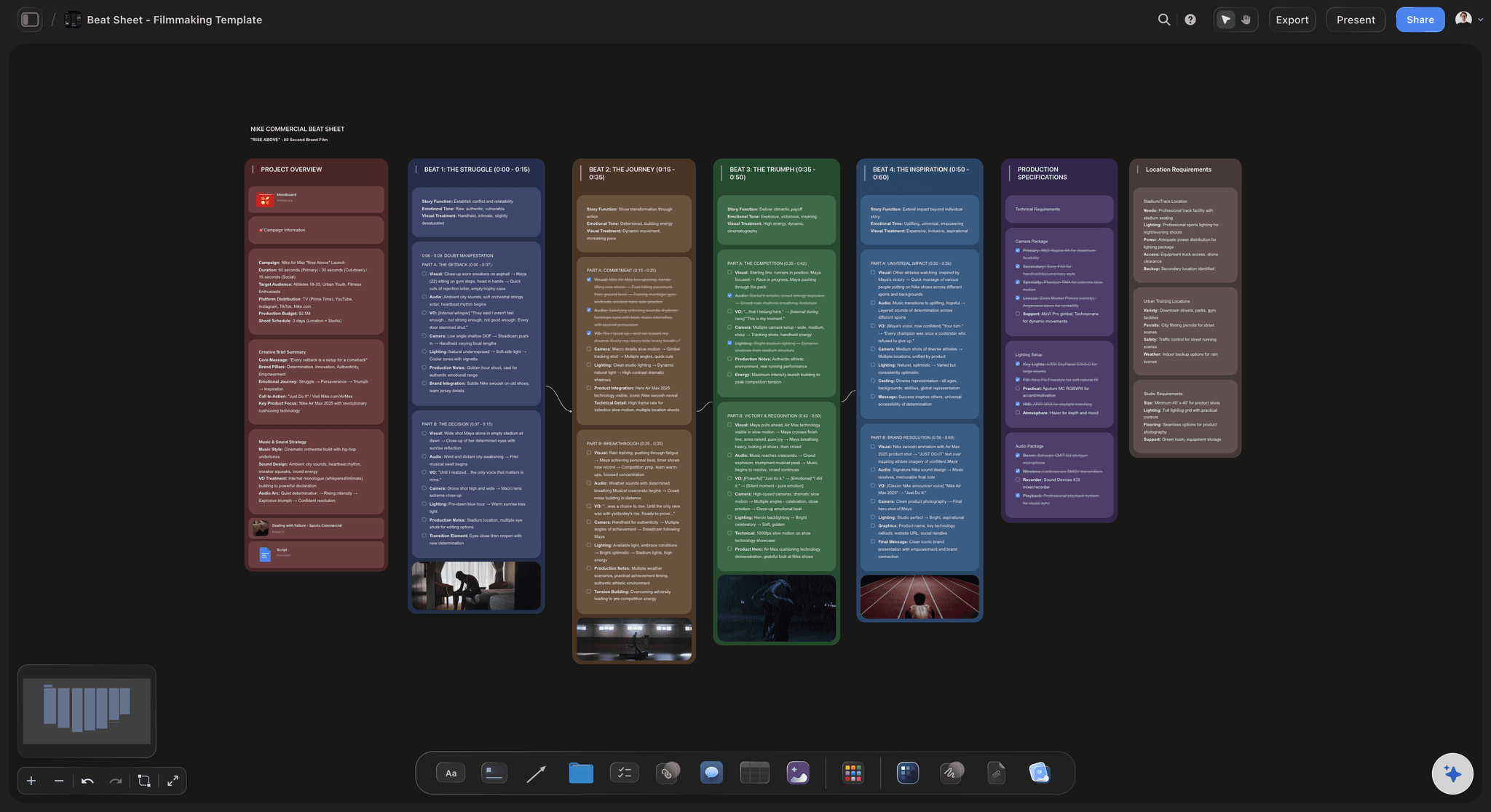
Pull the brief, script, shot list, and moodboard into one pre-production hub so the whole shoot is planned in one place.
What's the best tool to put together a film pitch deck?
The best tool to put together a film pitch deck is one where the deck comes out of the real development work. Storyflow is an AI visual workspace that builds a film pitch deck on one infinite canvas: the logline and synopsis, the lookbook, the characters and comparable titles, and the team, all beside the research behind them. Its AI reads the whole board before it drafts, and the finished pitch goes out as a PDF deck or a view-only link. Canva and Adobe Express are better for fine-tuning slide layout from a template, and StudioBinder's downloadable templates suit filling in a standard structure by hand.
A film pitch deck sells the film before a frame is shot. It usually runs in this order: the title and logline, a short synopsis, the tone and visual world, the main characters, comparable titles with what each one proves, the team and why they can make it, and the ask, whether that is finance, a co-producer, a lab place or a sales agent. Investors, streamers and labs read a great many of these, so a film pitch deck has to land the idea in its first pages and look like the film already exists.
Most decks fail in the same places. The comps are chosen for prestige rather than for what they prove about budget and audience. The lookbook is a wall of beautiful stills with no caption saying what each one is for. And the deck gets assembled in slide software after the research is finished somewhere else, so the synopsis in the deck and the one in the treatment drift apart. A treatment is a different document, the story told in prose from beginning to end, which a deck summarises in a page. Many projects need both, and they should come from the same material.
Storyflow keeps that material on one board. Write the logline and synopsis as documents, collect lookbook references with captions and colour swatches, build a character card per lead, and line up comps with a line each on what they prove. The AI reads the whole board, so asking it to structure the deck or tighten the synopsis works from your film rather than a template. When it is ready, the Presentation PDF lays the deck out one idea per page, the Treatment PDF, a director's treatment, covers the idea, the look, captioned references and the structure, and the Lookbook PDF sends the visual world as full-bleed plates.
Ultra fast from brief to board
Build a film pitch deck in four steps.
The research, the deck and the treatment are built from one board.
01
Write the story
Put the logline and synopsis on the board as documents, next to the notes and drafts they came from.
02
Build the visual world
Collect references for light, palette, locations and casting, caption what each one is for, and add a character card per lead.
03
Make the case
Line up comparable titles with what each proves, add the team and the ask, and ask the AI to structure the deck from the board.
04
Send it or walk them through it
Export a Presentation, Treatment or Lookbook PDF, or share a view-only link that opens in a browser with no account.
Everything a film pitch deck needs, in one place.
Story, look, characters and comps stop living in separate apps. The pitch is the board.
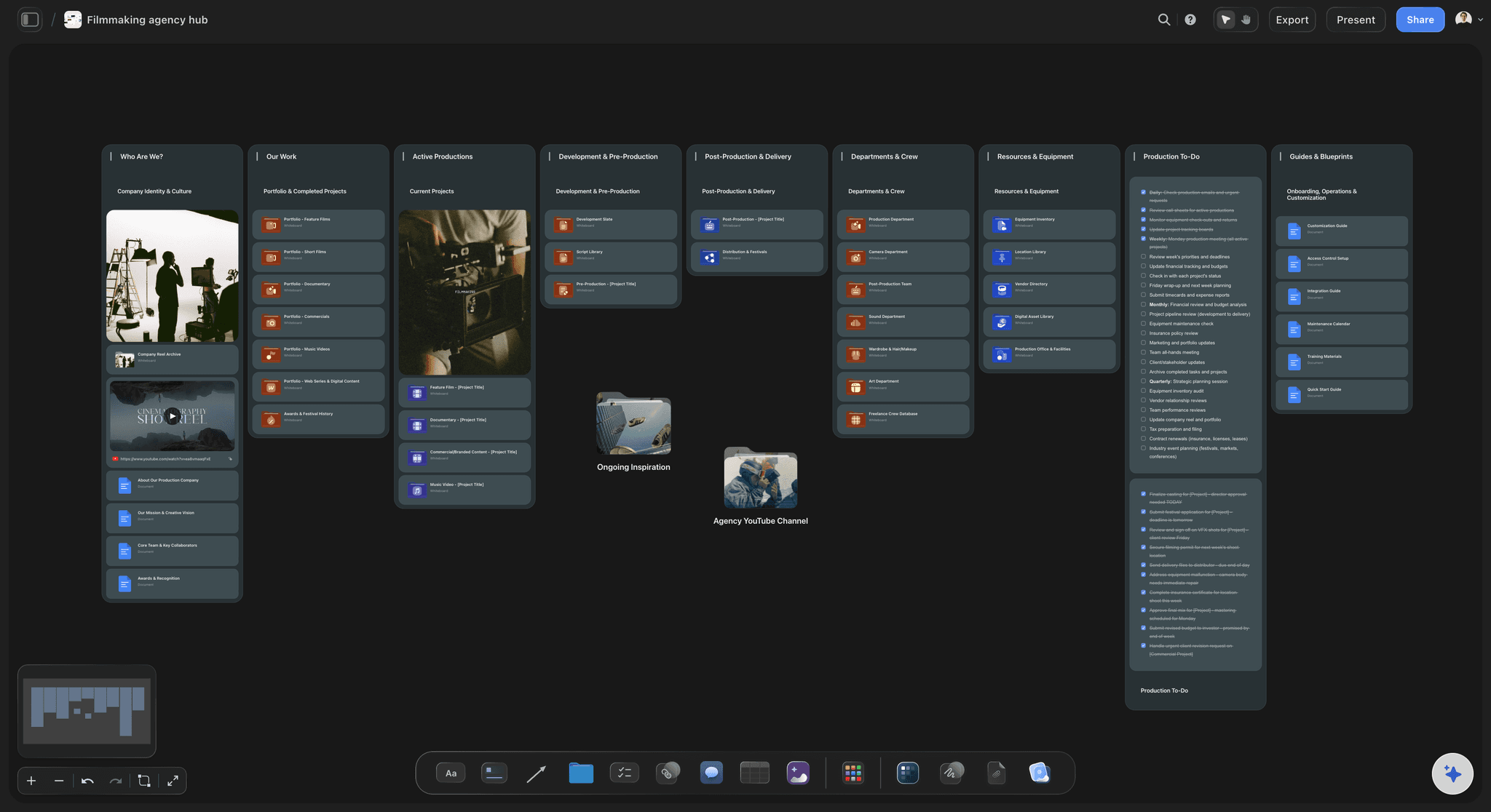
The visual world inside the pitch
Build the lookbook beside the synopsis
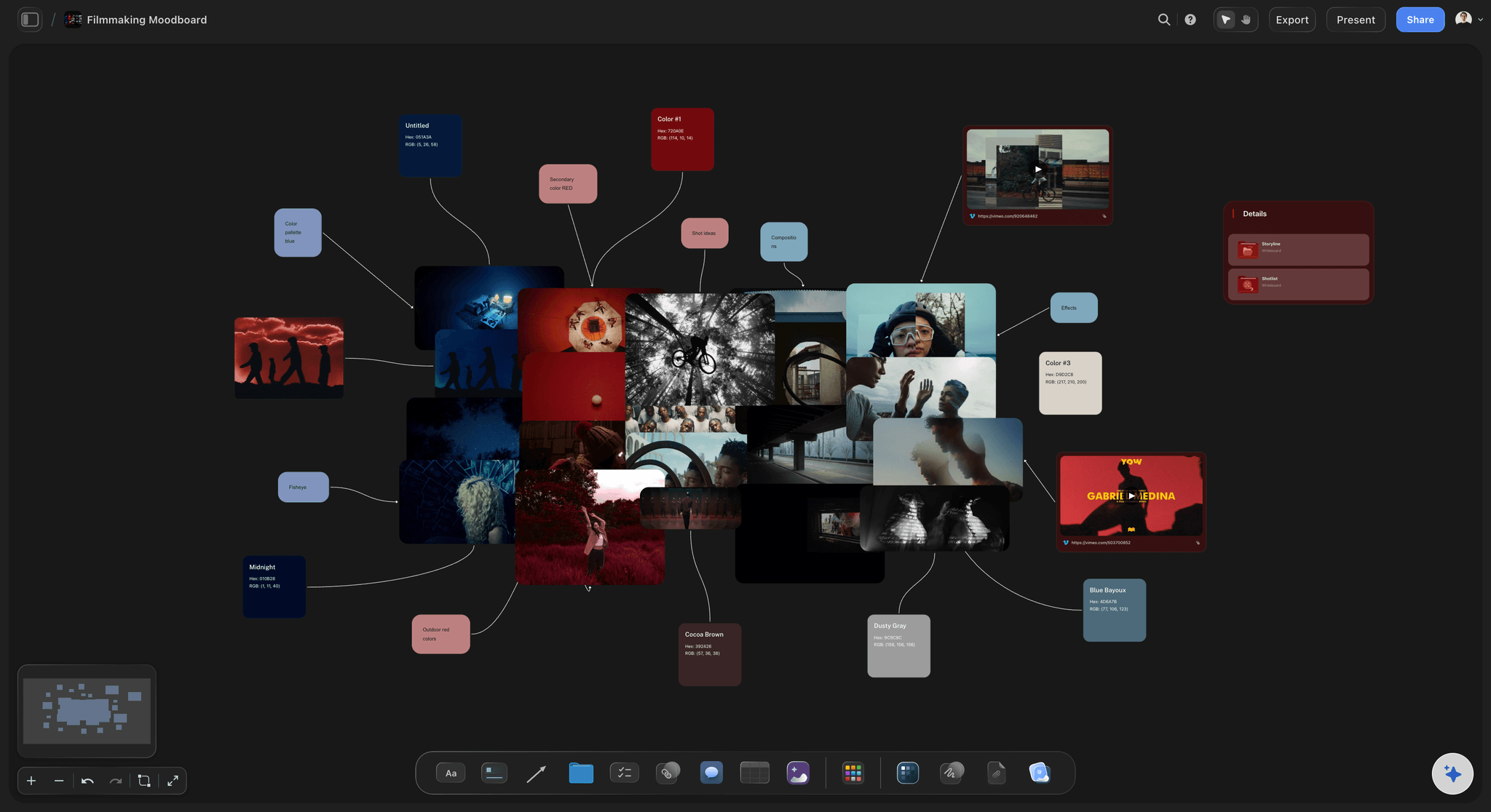
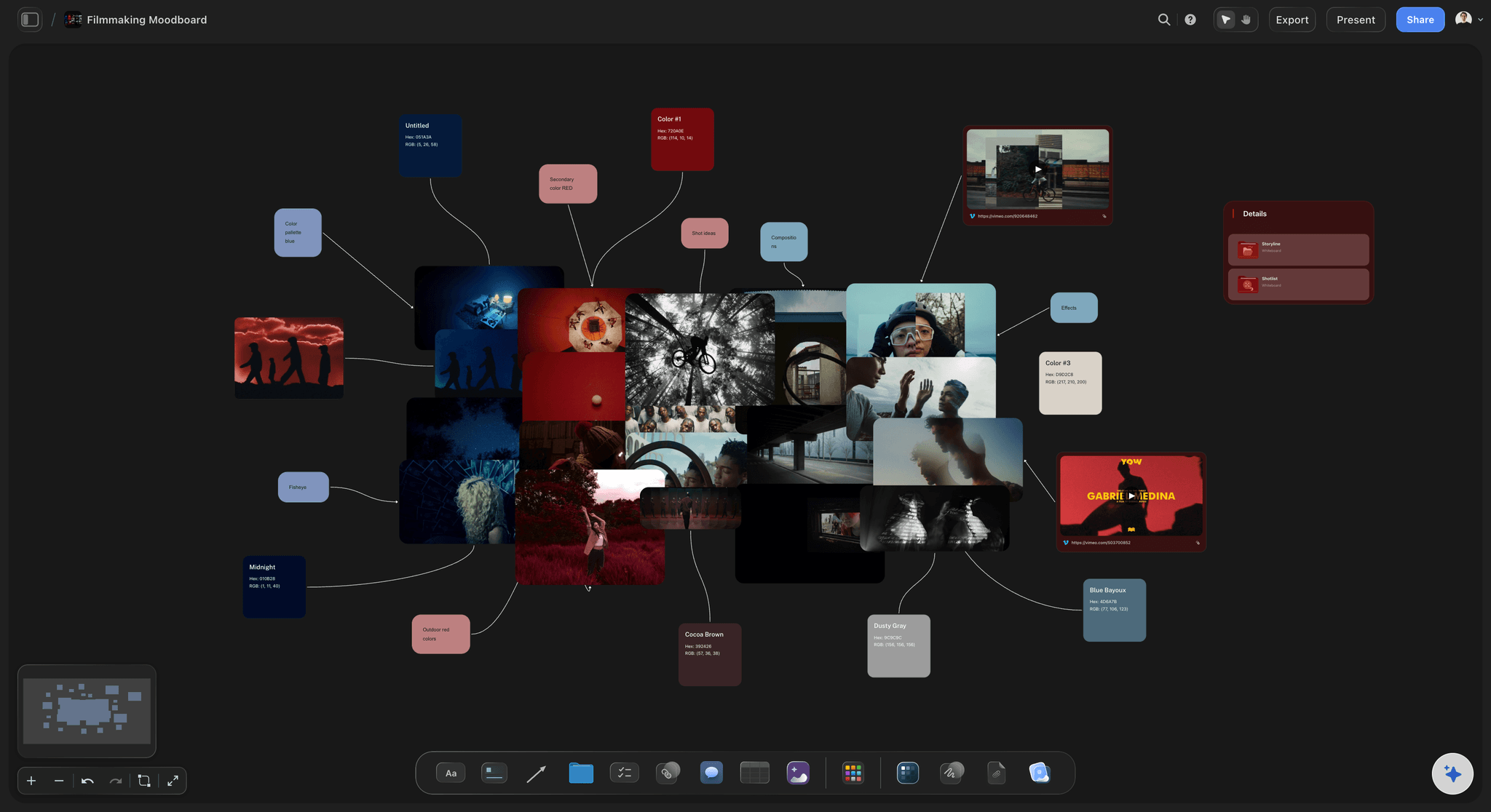
Stills, palettes and location references next to the synopsis they support, each captioned with what it is for. The lookbook grows with the pitch instead of in a separate file.
See how film lookbooks work →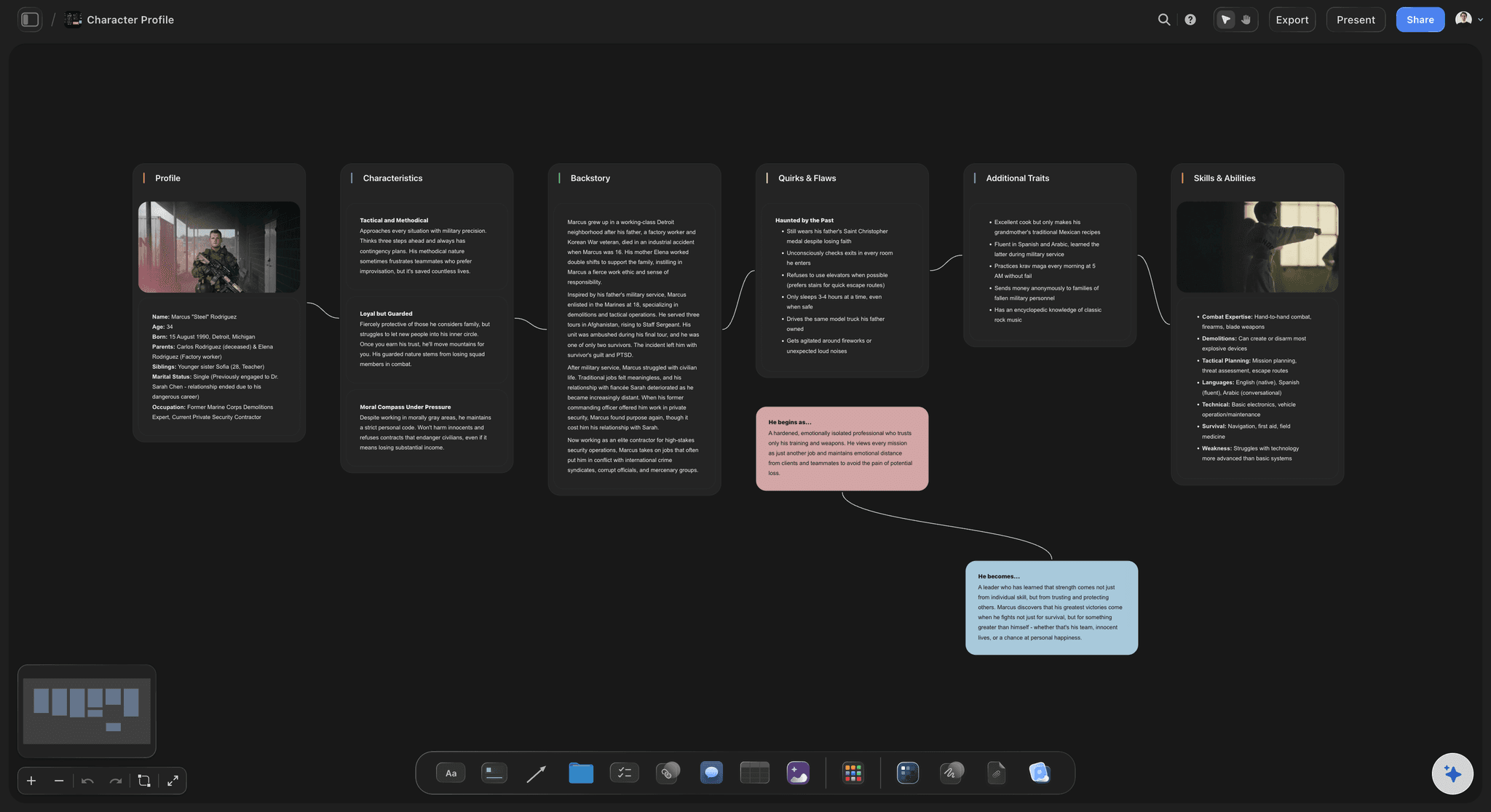
The leads a reader meets first
Character cards for the cast
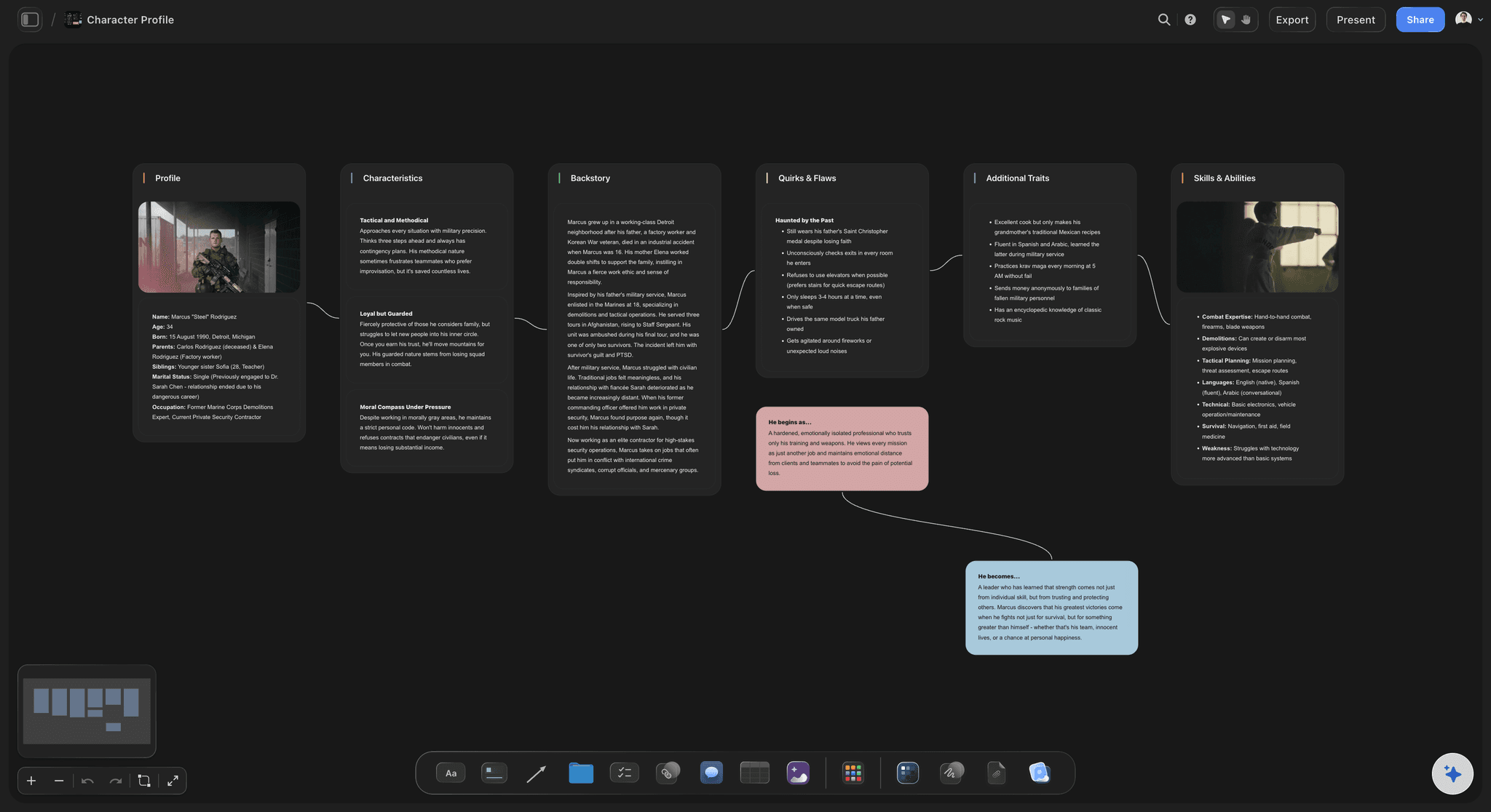
A card per lead with casting references, the arc and key relationships, arranged so a reader meets the cast at a glance.
See the character profile generator →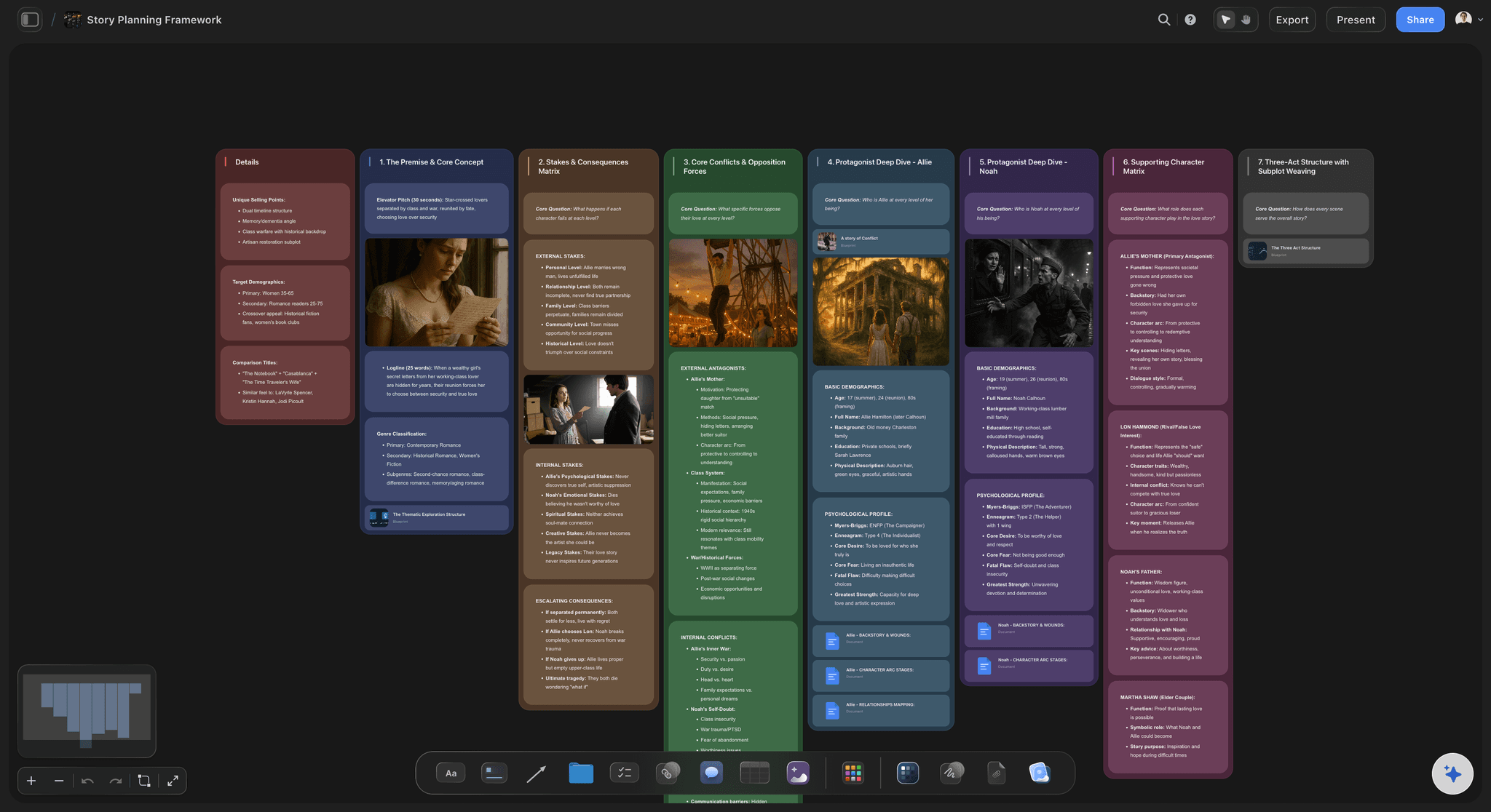
How the film will look and feel
A treatment from the same material
The Treatment PDF is a director's treatment: the idea, tone and look, captioned references and the structure, drawn from the board the deck came from.
See the director's treatment template →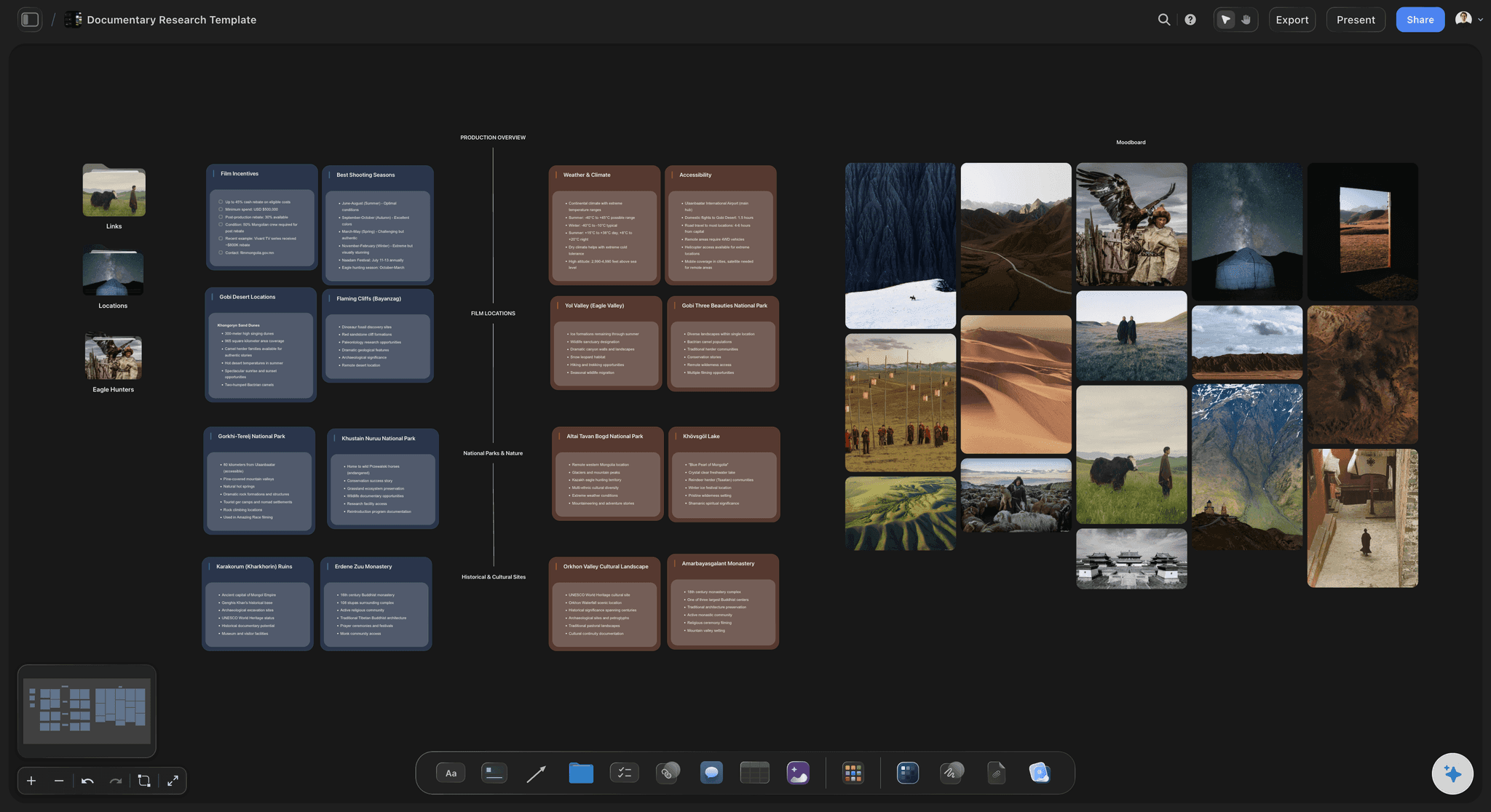
For documentaries seeking funding
Access, subjects and the story arc
Subject profiles, access notes, archive and the story arc on one board, sent to funders as a documentary treatment or a pitch deck.
See the documentary treatment template →Unlimited boards. No object cap.
Every project on the slate gets its own board. Storyflow is paid-only during early access, with plans from $7.99 a month billed annually ($9.99 monthly). A free plan launches before the end of 2026, and anyone a paid member invites to a board joins free.
Unlimited boards, images, files and links on Plus
AI usage that renews every billing period
Export boards as a high-quality image or PDF
View-only links investors open with no account
Built for people with taste
More than a film pitch deck template.
The story, the look and the case for the film stay connected to the material behind them.
Story and characters as living documents
Every pitch element on one board
Logline and synopsis docs: Write and rewrite the one-pager directly on the canvas, next to the imagery it has to live up to.
Character boards: A card per character with casting references, arc and key relationships, so a reader meets the cast at a glance.
Comparable titles: The comps with poster art and one line each on what they prove about audience and budget, so the market case sits inside the pitch.
References that say what they are for
A tone section with captions
Captioned references: Each still carries a line on what it is shown for, whether that is the light, the framing or the palette. A grid without captions says nothing.
Video beside the stills: Embed a YouTube or Vimeo clip when the reference is movement or pace, or grab a frame from it as a still for the lookbook.
Palette and locations: Colour swatches and location references grouped by the part of the film they belong to.
AI that works from what is on the board
An AI partner for the pitch
Context from the whole board: The AI reads the board you have open, so its suggestions fit your film instead of a generic template.
Re-prompt until it lands: Ask for a tighter synopsis, a different order or a comps section. It reworks the board while keeping what you placed, and you decide what stays.
Notes before you send: Review my work reads a draft and gives notes on what loses the reader, what misses the goal you stated, and what is strong but buried.
From canvas to the deck you send
Pitch it your way
A deck as a PDF: The Presentation PDF lays the pitch out one idea per page, in landscape, built to present or to send ahead.
Treatment and lookbook: A Treatment PDF for the idea, the look and the structure, and a Lookbook PDF of full-bleed plates when the visual world has to travel alone.
Walk investors through it live: Share a view-only link and present the canvas itself. It opens in a browser with no account.
Keep the team in the loop: Invite collaborators, who join free, and keep one source of truth as the pitch changes between meetings.
Explore templates for your project
Every template opens as a real, editable board on the infinite canvas. Pick the closest fit and make it your own.
Pre-Production
Pull the brief, script, shot list, and moodboard into one pre-production hub so the whole shoot is planned in one place.
One app instead of five
Where Storyflow sits next to the tools most pitches are built in.
Storyflow is built for the stretch where development turns into a pitch. Canva and Adobe Express are layout tools with pitch deck templates, and Gamma generates slide decks from a prompt. The honest difference is whether the research and the deck live on the same surface, and who lays out a page better.
Storyflow
Recommended
Lookbook, characters and comps on one canvas with the deck
AI reads your development board before it drafts
Deck exported as a PDF
Shared by link investors open in a browser
Slide-by-slide layout and typography control
Canva
Lookbook, characters and comps on one canvas with the deck
AI reads your development board before it drafts
Deck exported as a PDF
Shared by link investors open in a browser
Slide-by-slide layout and typography control
Adobe Express
Lookbook, characters and comps on one canvas with the deck
AI reads your development board before it drafts
Deck exported as a PDF
Shared by link investors open in a browser
Slide-by-slide layout and typography control
Gamma
Lookbook, characters and comps on one canvas with the deck
AI reads your development board before it drafts
Deck exported as a PDF
Shared by link investors open in a browser
Slide-by-slide layout and typography control
What creators are saying
Join early creators getting structured workspaces and AI that remembers their projects
“Storyflow has sped up my workflow by at least 3x, which means more flow state and more projects I can actually ship. It truly changed the way me and my team create.”

Reilin Joey
Director & YouTuber
“One prompt gets me a structured board. But the tactics are my favorite. I run my YouTube scripts through them and my intros and retention got better. It's amazing.”

Justkay
YouTuber & Freelance Filmmaker
“I used to juggle five apps to plan a project. Now I describe what I am making and get boards, lists, and a schedule. All in one place.”

George
@fernwehchronicles
Film pitch deck questions, answered.
What goes in, how to build it, and how to send it.
Storyflow, when the pitch deck and the treatment should come from the same development board: the logline, synopsis, references, characters and comps sit on one canvas, the AI reads it all, and the Presentation PDF and the Treatment PDF, a director's treatment, are both built from that material. Final Draft or Arc Studio stay the screenplay tools, StudioBinder offers downloadable treatment templates to fill in by hand, and Canva or Adobe Express give finer control over slide layout.
A film pitch deck includes the title and logline, a short synopsis, the tone and visual world, the main characters, comparable titles with what each proves, the team, and the ask: finance, a co-producer, a lab place or a sales agent. Budget range and the project's status (script draft, attachments, locations) usually sit near the end. In Storyflow each is a section on one canvas, with the research behind it alongside.
Write the logline and a one-page synopsis first; every other section has to agree with them. Build the visual world from captioned references, then a card per lead character. Choose comps for what they prove about audience and budget, not for prestige. Add the team and the ask, and order it one idea per page. In Storyflow you do this on one board, ask the AI to structure the deck, and export a Presentation PDF.
Most film pitch decks run roughly 10 to 20 pages: enough for story, tone, characters, comps and team without losing the reader. A short film deck can be shorter, since the ask is smaller. One idea per page is a better rule than a page count, so a section that needs three ideas is three pages. Storyflow keeps the whole pitch on one canvas, so you see every section at once and cut what does not earn its place.
A pitch deck sells the whole package in a few pages: logline, tone, characters, comparable titles, team and the ask. A treatment tells the story in prose, beginning to end, in the film's own voice, and is often read by someone who already liked the deck. A director's treatment covers how the film will look and feel instead. Storyflow's Treatment PDF is a director's treatment, built from the same board as the Presentation PDF.
A pitch deck sells the whole package: story, characters, market and team. A lookbook covers only the visual world, with imagery, palette and tone, and is often a section of the deck or a separate file sent with it. In Storyflow both live on the same canvas, so the lookbook grows as a section of the pitch, and the Lookbook PDF sends it on its own as full-bleed plates when a reader wants just the look.
Yes, and the structure is the template: title and logline, synopsis, tone and visual world, characters, comparable titles, team and the ask, with budget and status near the end. In Storyflow you set those out as sections on a board, or ask the AI to structure the deck from the logline, synopsis and references you placed, so the template is filled with your film. Canva and Adobe Express offer designed slide templates when layout comes first.
The same spine as a feature deck, cut down: the logline, a synopsis of a paragraph or two, the tone and visual world, the main characters, why you are making it now, the team, and the ask, often a modest budget, a crowdfunding target, a grant or a lab. Add a realistic schedule and the locations you have, because short film funders look for evidence it will get made. Storyflow exports the deck as a landscape Presentation PDF.
Yes. Storyflow exports any board as a high-quality image or PDF, and the AI can build dedicated PDFs from the board: a landscape Presentation PDF with one idea per page, a Treatment PDF with the idea, look, captioned references and structure, and a Lookbook PDF of full-bleed plates. Where a detail is missing, the PDF shows a visible blank rather than inventing it. You can also present the canvas itself through a view-only link.
Yes. Share a view-only link and anyone opens the board in a browser without an account, seeing the latest version each time they open it, so nobody reads the deck you sent three weeks ago. You choose what goes on the shared board. Investors who want to leave notes sign in to do so. You can also export a PDF for readers who want a file, or walk them through the canvas in the meeting.
On Pro and Max, yes: Storyflow's AI can generate images on the canvas for concept frames and lookbook pages when the look has no existing reference. On every plan, the AI structures and drafts the pitch and can find real references on the web for you to keep or cut. Real references and your own stills usually carry more weight, so generate only the frames nothing else can show, and caption each one as a concept.
Not yet. Storyflow is paid-only during early access, with plans from $7.99 a month billed annually ($9.99 monthly). A free plan launches before the end of 2026, and anyone a paid member invites to a board joins free, so a co-writer or producer on the pitch does not pay, and investors open the view-only link in a browser. Plus covers one person running a project, Pro adds AI image generation, and Max adds a shared workspace with roles.
More from Storyflow
Film treatment template
Director's treatment template
Documentary treatment template
Film lookbook
AI treatment generator
AI logline generator
Character moodboard
Series bible
Sizzle reel planner
Film production planning
Pre-production software for filmmakers
Pitch deck maker
Best film pitch deck tools
How to write a film pitch deck
Film press kit
Film grant proposal
The film is ready to pitch. Build the deck.
Put the story, the look and the comps on one canvas, then send the deck as a PDF or present it live.