
Rock-steady plans for every shoot
See the whole festival run
before you spend a single fee.
Lay your festival strategy out as a campaign map: tier the festivals, sequence deadlines against your finish date, track every submission and outcome, and keep the press kit beside the plan.


Creatives working for these brands already got early access
- Red Bull
- Canon
- Artlist
- Porsche
See how easy it is to get started
Watch a real project come together, from a blank board to a finished plan, clicked through step by step.
Start from a ready-made template
Pick a board to see what you can build, then let AI fill it in. Every template is a real, editable starting point on the same infinite canvas.

Pre-Production
Pull the brief, script, shot list, and moodboard into one pre-production hub so the whole shoot is planned in one place.
What is a film festival planner?
A film festival planner is a tool for working out where a finished film should go, in what order, and what has to be true for each submission to make sense. Storyflow is an AI visual workspace that maps your festival run on one infinite canvas: festivals in tiers, deadlines sequenced against your finish date, every submission and its outcome, and the press kit beside the plan. A planner holds the festivals you are targeting, the tiers they fall into, the deadlines and fees attached to each one, the state of every submission you have sent, and the materials a programmer or journalist will ask for the moment something lands. The submissions themselves happen on FilmFreeway. The strategy, which is the part that decides whether those submissions were worth the fees, has to live somewhere else.
A festival run is a campaign, not a submission form. The mistake almost every first-time filmmaker makes is treating it as a list of deadlines to hit, when the thing that actually matters is the shape of the run: which premiere burns which eligibility, which A-list rejection you need back before a regional deadline closes, which genre festival is a fallback and which is a goal. A world premiere at a small local festival can quietly disqualify you from the majors you were saving the film for. That kind of mistake is invisible in a spreadsheet row and obvious on a map, because it is a problem of sequence and dependency, not of dates.
Storyflow is an AI-native infinite canvas built for exactly this kind of campaign. Describe your film and your goals in a prompt and the AI lays out a structured festival board: tiers to sort candidates into, a submission tracker, and space for the assets. Then you do the strategic work by hand, dragging festivals between tiers, sequencing waves of submissions against your finish date, and marking what each acceptance or rejection unlocks. Re-prompting builds around the cards you have already placed, so the plan grows without being rearranged under you.
Planning a festival run means working across five connected layers: the tier map (premiere-eligible A-list targets, strong regionals, genre and niche festivals, and locals), the deadline sequence (early, regular, and late deadlines laid against the date the film is actually finished), the submission tracker (what was sent where, with which fee or waiver, and what came back), the premiere logic (which festivals require a world or international premiere and which acceptance would burn it), and the asset kit (press kit, stills, trailer, poster, and bios, ready the day a programmer asks). Storyflow keeps all five visible at once, which is what makes the shape of the run, and the mistakes hiding in it, findable before the money is spent.
Ultra fast from brief to board
From a finished film to a run you can defend.
No database to configure and no template to fight. Describe the film and start sorting festivals into tiers.
01
Open a canvas
Sign up in seconds. No download. Your festival planning canvas opens in the browser.
02
Describe the film and the goal
Type what the film is, what it needs from the circuit, and where you are in post. The AI lays out a festival campaign board with tiers, a deadline sequence, and a submission tracker to fill.
03
Tier and sequence the run
Drag festivals into tiers, order the deadlines against your finish date, and mark which premieres burn which eligibility. Move a festival between waves and see what the change does to the rest of the run.
04
Track, share, and hand over
Log every submission, waiver, and outcome as results come in. Share a view-only link with your producer or sales agent, or export the map as an image or PDF for a strategy call.
The whole campaign, mapped and movable.
Tiers, deadlines, submissions, and press materials on one infinite canvas.
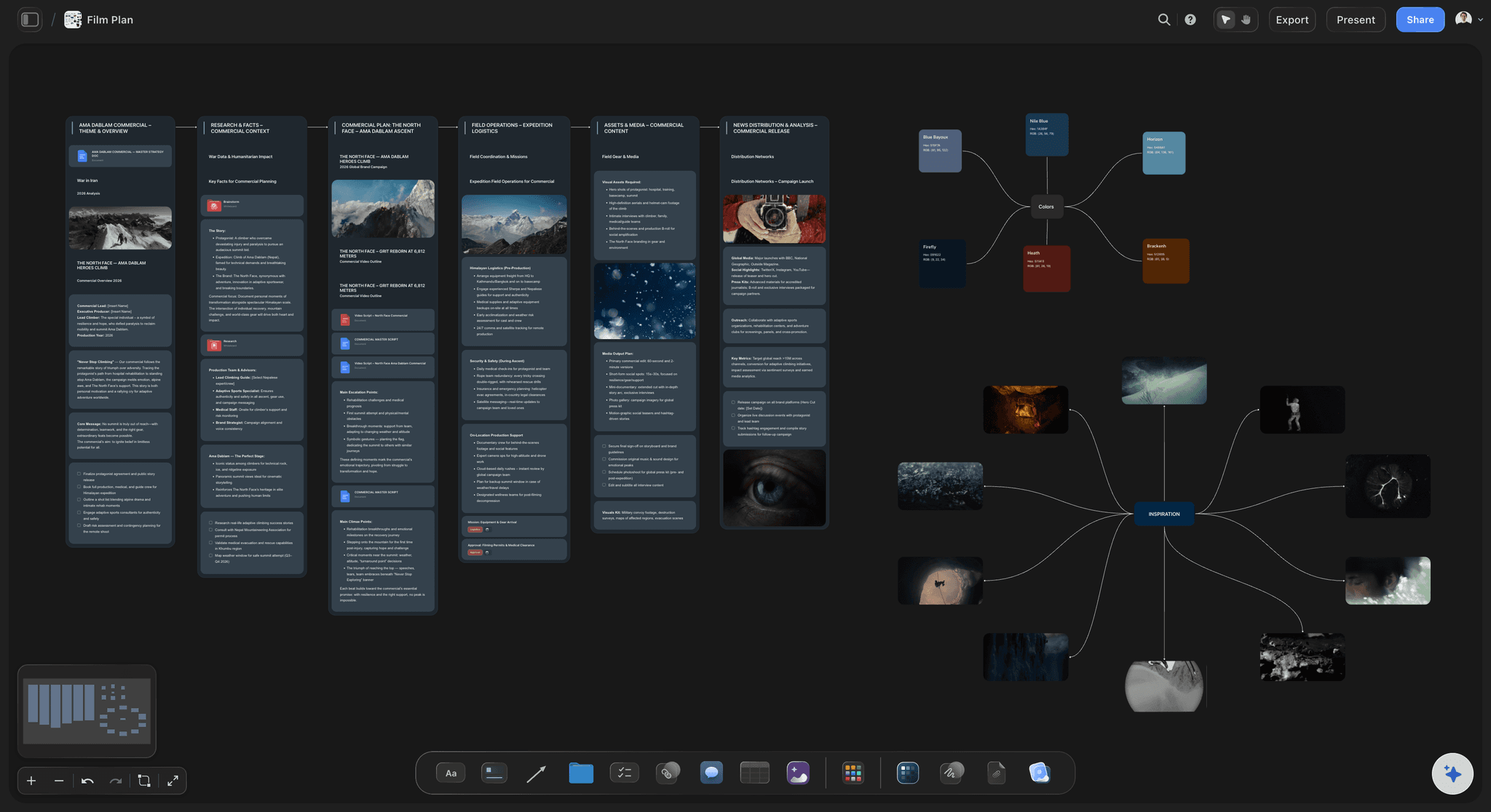
AI builds a festival campaign board from your film
Start from a strategy, not a spreadsheet
Describe the film, the genre, and what you want the run to do, and the AI lays out a tiered festival board with a deadline sequence and a tracker. You start by editing a plan instead of staring at an empty grid.
See Storyflow for indie filmmakers →
Tiers and premiere logic you can actually see
The shape of the run is the strategy
Sort festivals into premiere-eligible A-list targets, regionals, and genre plays, then sequence them in waves. When the whole map is visible, the local screening that would burn your world premiere stops looking harmless.
Explore short film planning →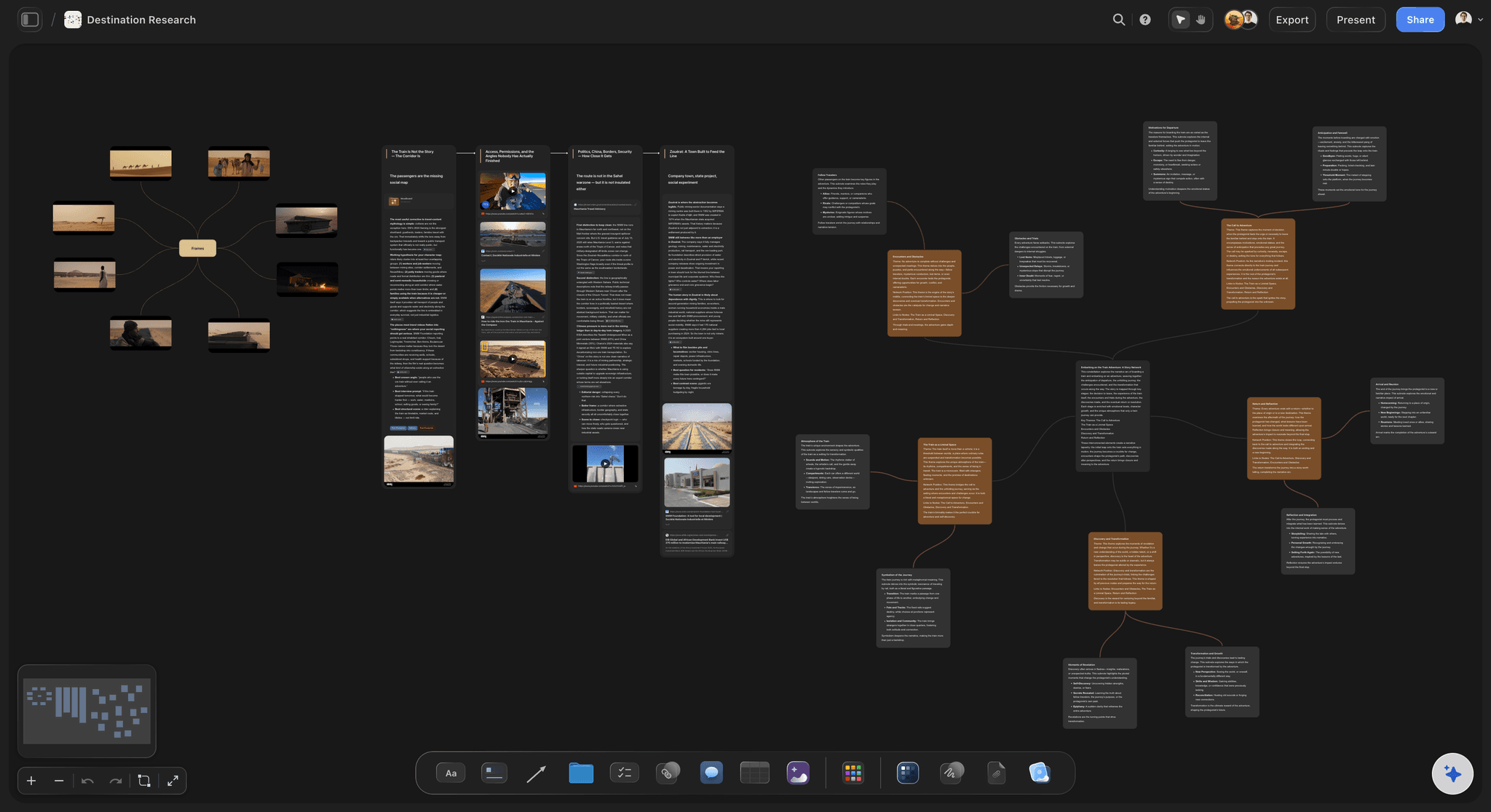
Research every festival before you pay for it
Know the festival before the fee
Give each candidate festival a card: dates, deadlines, fees, premiere requirements, the films it programmed last year, and why it fits yours. Deciding between two regionals is easier when the evidence sits side by side.
See the film pitch deck builder →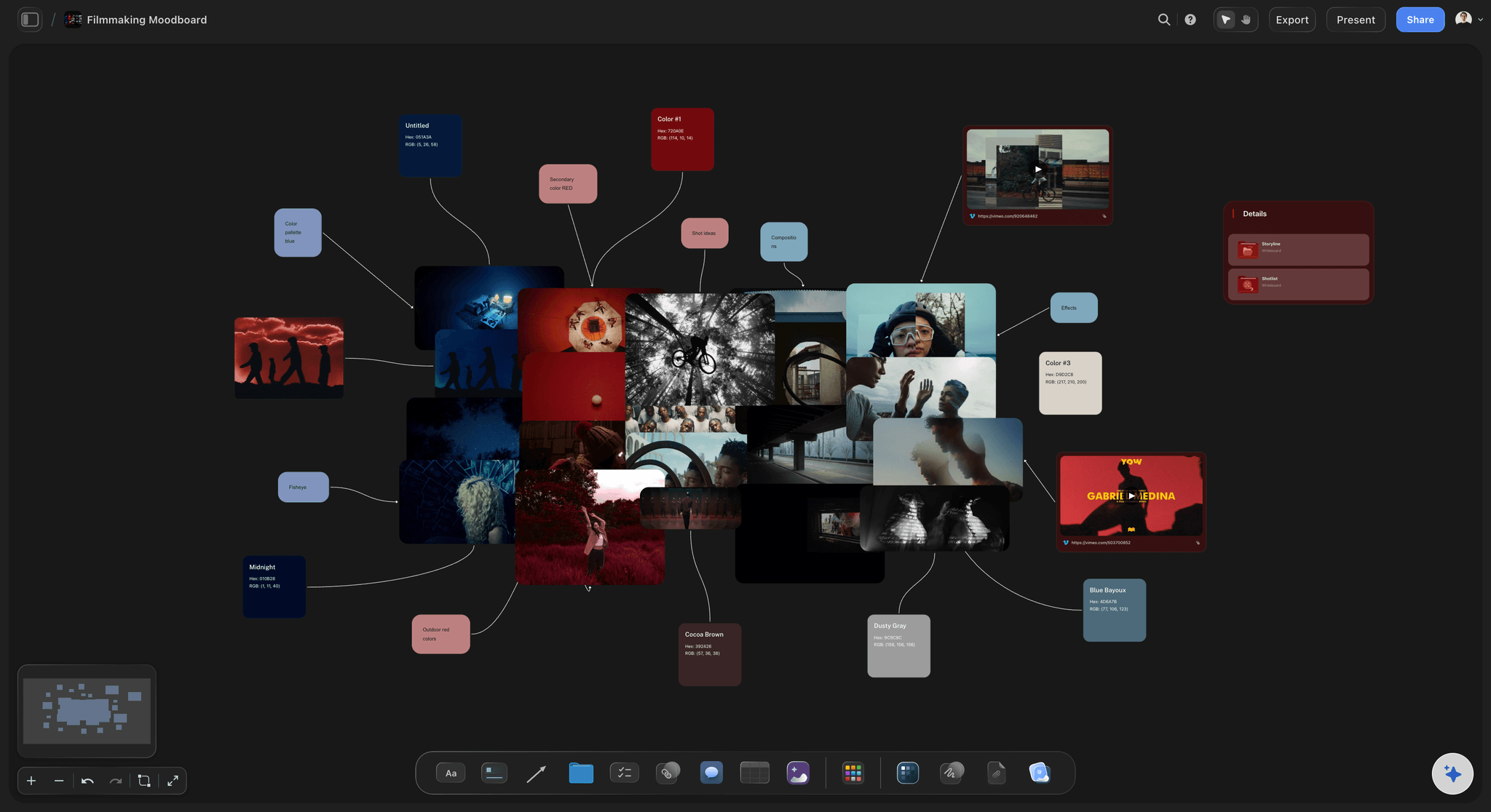
Press kit, stills, and trailer on the same canvas
Be ready the day something lands
Keep the press kit, selects of your stills, poster drafts, and trailer reference frames beside the plan. When a programmer or journalist asks for materials, everything is one scroll from the strategy, not in five folders.
Build a film lookbook →Unlimited boards. No object cap.
Open a canvas, describe the film, and start mapping the run. Storyflow is paid-only during early access, with plans from $9.99 a month, and a Free plan launches before the end of 2026.
Unlimited festival campaign boards on an infinite canvas
Basic AI usage to generate boards from prompts
Starter templates for campaign and production planning
Share view-only links with your producer or sales agent

Built for people with taste
More than a list of deadlines.
A deadline list tells you when to pay. Only the whole map tells you whether you should.
Tiers, waves, and premiere eligibility on one map
Work across every layer of the campaign
The tier map: Sort every candidate into premiere-eligible A-list targets, strong regionals, genre and niche festivals, and hometown screenings. The tier a festival sits in decides when you submit to it, not the other way around.
Deadline waves against your finish date: Lay early, regular, and late deadlines out against the date the film is honestly finished. A wave you cannot make with a final mix is not a deadline, it is a fee, and the sequence makes that visible.
Premiere logic: Mark which festivals require a world or international premiere and connect each acceptance to the eligibility it would burn. The screening that quietly disqualifies you from your top tier shows up as a line on the map.
Outcome-dependent branches: Plan what happens on each result: if the A-list pass comes back, which regional wave goes out next, and by when. A run planned as branches survives rejection; a run planned as a list just stalls.
AI that can see the run you have already planned
Plan with an AI that knows your film
Prompt to work through the strategy: Ask it to rough out a tier structure for a 15-minute genre short, to suggest what a submission wave should contain, or to lay out a tracker for the festivals you have already chosen. It uses the whole board as context, so suggestions fit your run rather than a generic one.
It structures, it does not decide: Storyflow is a planning canvas, not an oracle. The AI lays out tiers, sequences, and trackers so the strategic question is visible; which festivals your film belongs at is a judgment only you and your team can make.
Iterate without losing the plan: Re-prompt as results come in and the AI builds around the cards you have already placed. The festivals you researched and the outcomes you logged stay exactly where they are.
The asset kit beside the strategy
Keep everything a programmer will ask for
Press kit and bios: Draft the synopsis, director's statement, and bios in the built-in document editor beside the board, so the words that represent the film live next to the plan for where it goes.
Stills, poster, and key art: Drag in your stills and poster drafts and pick selects on the canvas. The three images that will represent the film at every festival deserve more deliberation than a folder sort order.
Trailer and clip references: Grab frames from YouTube or Vimeo cuts of your trailer and pin them beside the plan, with links to the current versions. When a festival asks for materials, the answer is a scroll, not a search.
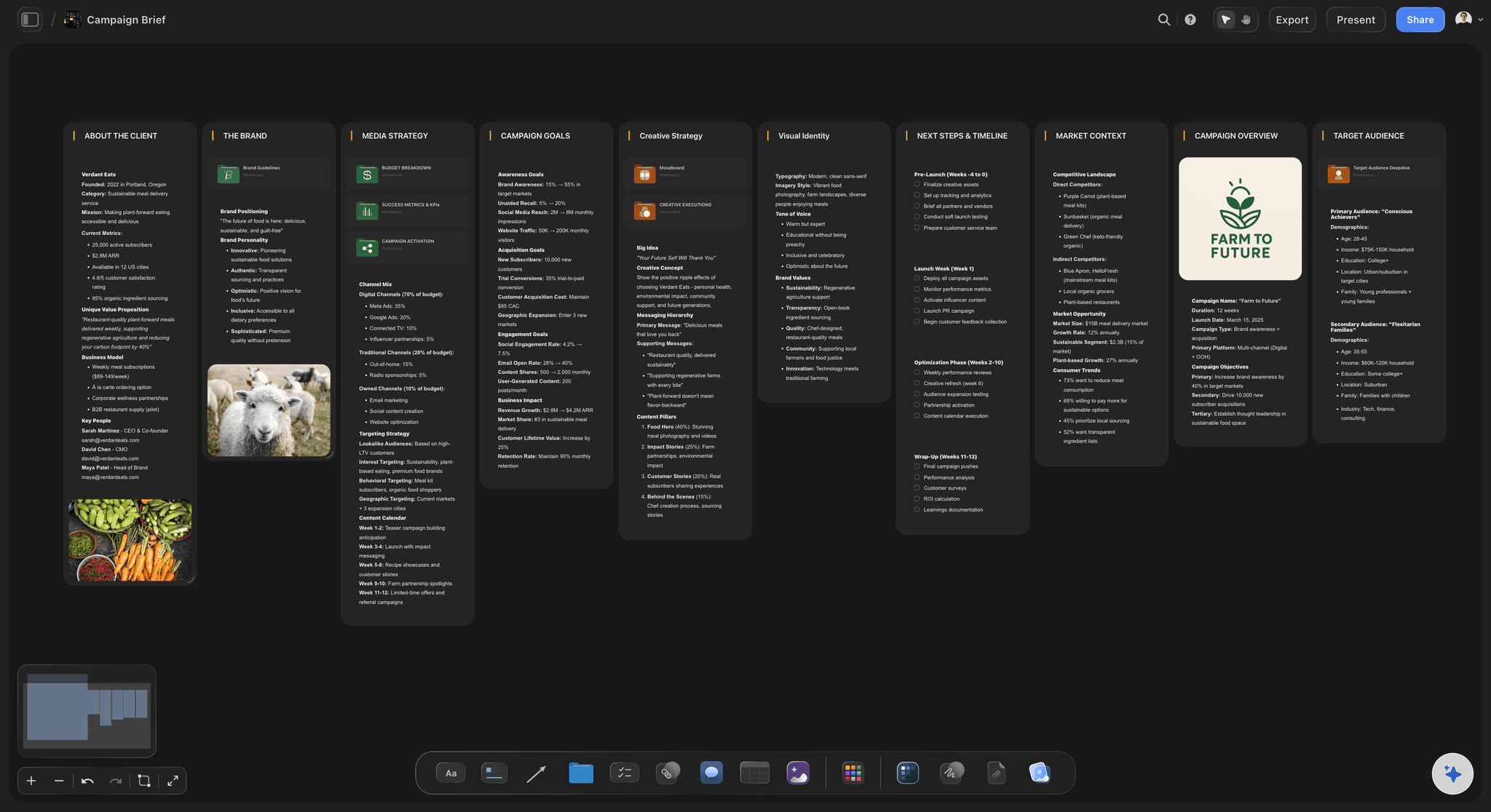
One tracker the whole team can see
Run the campaign with your team
Submission and outcome tracking: Log every submission with its date, fee or waiver code, and status, and move it through submitted, in consideration, accepted, or passed. Six months of a festival run is too long to keep in your head or your inbox.
View-only links for producer and sales agent: Share a view-only link and your producer, sales agent, or publicist sees the entire campaign in a browser with no account. A strategy call goes faster when everyone is looking at the same map.
Comments and handover: Collect notes and decisions as comments on the board, invite a collaborator to work on the same canvas, and export the plan as an image or PDF when someone wants a snapshot for a meeting.
Explore templates for your project
Every template opens as a real, editable board on the infinite canvas. Pick the closest fit and make it your own.
Pre-Production
Pull the brief, script, shot list, and moodboard into one pre-production hub so the whole shoot is planned in one place.
One app instead of five
Storyflow vs FilmFreeway, Notion, and Google Sheets.
FilmFreeway is where submissions actually happen, and nothing here replaces it. The comparison is about where the strategy lives. Every tool below is genuinely good at its job.
Storyflow
Recommended
Visual campaign map on an infinite canvas
AI builds the board from your film and goals
Press kit, stills, and trailer refs beside the plan
Submit to festivals and pay fees in one place
Filterable, sortable deadline database
Free plan available today
FilmFreeway
Visual campaign map on an infinite canvas
AI builds the board from your film and goals
Press kit, stills, and trailer refs beside the plan
Submit to festivals and pay fees in one place
Filterable, sortable deadline database
Free plan available today
Notion
Visual campaign map on an infinite canvas
AI builds the board from your film and goals
Press kit, stills, and trailer refs beside the plan
Submit to festivals and pay fees in one place
Filterable, sortable deadline database
Free plan available today
Google Sheets
Visual campaign map on an infinite canvas
AI builds the board from your film and goals
Press kit, stills, and trailer refs beside the plan
Submit to festivals and pay fees in one place
Filterable, sortable deadline database
Free plan available today
What creators are saying
Join early creators getting structured workspaces and AI that remembers their projects
“Storyflow has sped up my workflow by at least 3x, which means more flow state and more projects I can actually ship. It truly changed the way me and my team create.”

Reilin Joey
Director & YouTuber
“One prompt gets me a structured board. But the tactics are my favorite. I run my YouTube scripts through them and my intros and retention got better. It's amazing.”

Justkay
YouTuber & Freelance Filmmaker
“I used to juggle five apps to plan a project. Now I describe what I am making and get boards, lists, and a schedule. All in one place.”

George
@fernwehchronicles
Festival strategy questions, answered.
How to tier festivals, protect a premiere, track submissions, and where FilmFreeway fits.
The filmmakers who run good campaigns organize around shape, not deadlines. They tier their festivals first: premiere-eligible A-list targets, strong regionals, genre and niche festivals that fit the film, and local screenings last. Then they sequence submissions in waves against the film's real finish date, holding the premiere for the top tier and releasing lower tiers as results come back. They track every submission, fee, waiver, and outcome in one place, and they keep the press kit, stills, and trailer ready before anything lands. The common thread is that the whole run is visible at once, usually on a map or board, because the expensive mistakes are sequence mistakes: a premiere burned at the wrong festival, or a fee paid to a wave the film could not make.
Storyflow lays your festival run out as a campaign map: the festivals sit in tiers and the deadlines are sequenced against your finish date. You track every submission, waiver and outcome on the board, and the press kit, stills and trailer references stay beside the plan. You still submit to festivals and pay the fees in one place on FilmFreeway, which Storyflow does not handle.
Start from what each tier does for the film. The top tier is the small set of premiere-eligible majors that could change the film's life; they get the premiere window and the earliest submissions. The second tier is strong regionals and well-programmed mid-size festivals that build the laurel bar and the screening history. The third tier is genre and niche festivals where the film is a natural fit and the odds are honest. The last tier is local and community screenings, which are worth doing but only after the premiere question is settled. The test for every candidate is the same: look at what it programmed last year and ask whether your film would have belonged in that lineup. Tiering is a fit judgment, not a prestige ranking.
Yes, and it is worth being plain about this. FilmFreeway is where submissions actually happen: it holds your project page, processes entry fees, and is the platform nearly every festival uses to receive films. Storyflow does not submit to festivals and does not try to. What Storyflow holds is the strategy layer that FilmFreeway does not: the tier map, the premiere logic, the sequencing of waves against your finish date, and the press assets beside the plan. In practice the two work together. You decide on the Storyflow map which festivals get which wave, you execute the submissions on FilmFreeway, and you log the outcomes back on the board where the next decision gets made.
Not during early access. Storyflow is paid-only right now, with plans starting at $9.99 a month, and a Free plan launches before the end of 2026. Anyone a paid member invites to a board joins free today, so your producer or co-director can work on the campaign without paying. If you want a free option this minute, a Google Sheets tracker is genuinely serviceable for logging submissions and deadlines, and FilmFreeway itself is free to browse and holds your project page. What the free stack will not give you is the visual campaign map, which is the part that catches sequence mistakes before they cost you a premiere.
Many major festivals require that your film has never screened publicly before, either anywhere in the world or anywhere in their country or region. A world premiere can be spent exactly once, and any public screening spends it, including a small local festival or a cast-and-crew event that sold tickets. This is why the shape of the run matters more than the list of deadlines: an acceptance at a minor festival in March can silently disqualify the film from the major you were saving it for in September. The defensive move is to mark premiere requirements on every top-tier candidate and hold all lower-tier submissions until the premiere window has either paid off or been deliberately released.
In late post, before the film is finished and before the first fee is paid. The reason is that festival deadlines run on a fixed calendar and your finish date does not. Laying the two against each other tells you which submission waves are realistic with a final mix and grade, and which early deadlines you would be paying with an unfinished cut, which is usually money wasted. Planning early also protects the premiere: the order of your first three or four submissions largely determines the ceiling of the run. Filmmakers who start planning after the film is done tend to submit to whatever closes next, which is exactly the deadline-list thinking that burns eligibility.
Give every submission its own card with the festival, the date sent, the fee paid or the waiver code used, and the current status: submitted, in consideration, accepted, passed, or withdrawn. Keep the cards on the same board as the tier map, because an outcome is not just a result, it is the trigger for the next decision. When the top-tier passes come back, the second wave goes out; when an acceptance lands, everything that conflicts with its premiere terms gets pulled. A tracker separated from the strategy can tell you what happened, but only a tracker on the map can tell you what to do about it. Log fees honestly too; runs die of a hundred forty-dollar decisions, and the total should be visible.
The standard kit is a short synopsis and a long synopsis, a director's statement, bios and headshots for the key creatives, three to five high-resolution stills, the poster or key art, the trailer link with a downloadable version, full credits, technical specs, and contact information. Festivals and journalists ask for the same pieces over and over, so the work pays off once and gets reused all season. The practical failure is not writing the kit, it is scattering it: the stills in one drive, the statement in a doc, the trailer link in an email thread. Keeping the kit on the same canvas as the campaign map means that when a programmer asks, the answer takes minutes, and the stills you send are the selects you actually chose.
Yes, and it changes the quality of the conversation. Share a view-only link and your producer, sales agent, or publicist opens the entire campaign in a browser with no account: the tier map, the premiere status, every pending submission, and the asset kit. That is a far better basis for a strategy call than a status email, because both sides are reasoning from the same picture. If someone should actually work on the plan, invite them to the canvas and they can add festivals, log outcomes, and leave comments on specific cards. You can also export the board as an image or PDF when an executive producer or financier wants a snapshot for a meeting.
Most indie runs land somewhere between fifteen and forty submissions, and with typical entry fees running from about 25 to 100 dollars each, a serious campaign is easily one to three thousand dollars before travel. That number is exactly why strategy beats volume. A tiered plan spends the budget deliberately: a handful of premiere-eligible majors, a solid band of regionals and genre festivals where the film honestly fits, and waivers hunted wherever possible, since many festivals grant them if you ask or meet criteria. The alternative, submitting to whatever closes next until the money runs out, is the most common way good films have quiet festival runs. Set the fee budget on the board first and make every submission argue for its slot.
Map the run before you pay for it.
Open a canvas, describe your film and your goals, and let AI lay out the first campaign board. No download.