
Pitch-ready plans, extremely reliable
Build the director's treatment
you send to win the job.
The idea, the look, the references and the structure of your film on one board, turned into a designed treatment PDF the agency and the brand can read in one sitting.


Creatives working for these brands already got early access
- Red Bull
- Canon
- Artlist
- Porsche
See how easy it is to get started
Watch a real project come together, from a blank board to a finished plan, clicked through step by step.
Start from a ready-made template
Pick a board to see what you can build, then let AI fill it in. Every template is a real, editable starting point on the same infinite canvas.

Storyboard
Lay out your shots frame by frame with images and notes, then reorder them until the sequence reads like the finished cut.
What is a director's treatment, and how do you make one?
A director's treatment is the document a director sends to win a job: a short, image-led pitch showing the idea, the look, the tone, the references and the structure of the film they would make from an agency's script or a brand's brief. Storyflow is an AI visual workspace that builds your director's treatment on one infinite canvas: the references and frames, casting and wardrobe ideas, the written approach, and a designed treatment PDF made from the board. InDesign and Keynote remain the tools for hand-finishing a layout type by type.
The agency already has the script, so the treatment is not a retelling of it. Its job is to show what only this director would do with it: the one idea that makes the spot memorable, the visual world it lives in, how it moves and sounds, and why this approach solves the problem the brief describes. A creative team usually reads several treatments for the same script in the same week, and the one that wins is rarely the longest. It is the one where the idea is clear on the first page and every image after it earns its place.
Most treatments that lose do so for the same reasons. The idea arrives on page six after a mood essay. References are dumped in grids without captions, so the reader cannot tell which quality of each image matters. The look is described in adjectives, cinematic, elevated, authentic, instead of decisions about light, lenses and movement. The structure of the spot is missing, so nobody can picture the thirty seconds. And practical credibility, how the product will be shot and how the day will run, is left for the call.
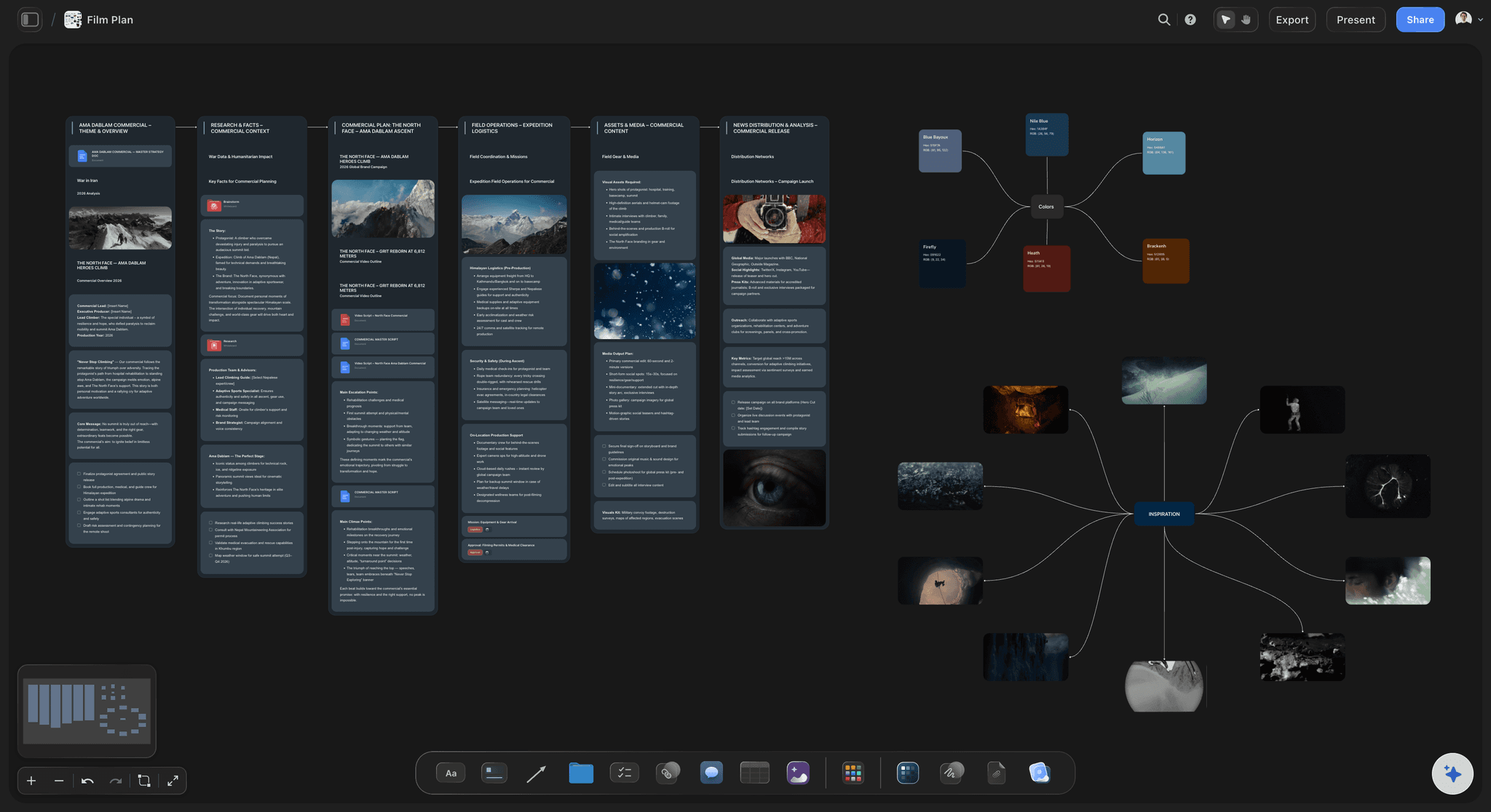
Storyflow keeps the working treatment on an AI-native canvas instead of scattering it across a folder of screenshots and a layout file. Paste the script and the brief, then build the world around them: captioned references, stills grabbed from YouTube or Vimeo, frames generated with AI on Pro and Max plans, casting and wardrobe boards, and the written approach in a document on the same board. The Treatment PDF workflow turns the board into a designed document covering the idea, the look, the references and the structure, and a storyboard of the key frames sits beside it.
Ultra fast from brief to board
From an agency script to a treatment that reads in one sitting.
Work on a board, finish as a PDF, and keep the board for the shoot if you win.
01
Put the script and the brief on a board
Paste the agency's script, the brief and any client notes. Everything the treatment has to answer is in view while you build it.
02
Build the visual world
Collect references for light, colour, lenses and movement, and caption what each one is for. Add casting, wardrobe and locations. Ask the AI to gather references, and generate the frames that do not exist yet on Pro and Max.
03
Write the approach and the structure
The one-line idea, your director's statement, and the spot beat by beat. The AI can draft a structure from the board; the voice and every creative choice stay yours.
04
Send a designed PDF
Ask for the treatment PDF and the AI lays out the idea, the look, the references and the structure as a designed document. Send the file, or a view-only link the agency opens with no account.
Everything a winning treatment is built from.
References, frames, approach and structure on one board, finished as a PDF.
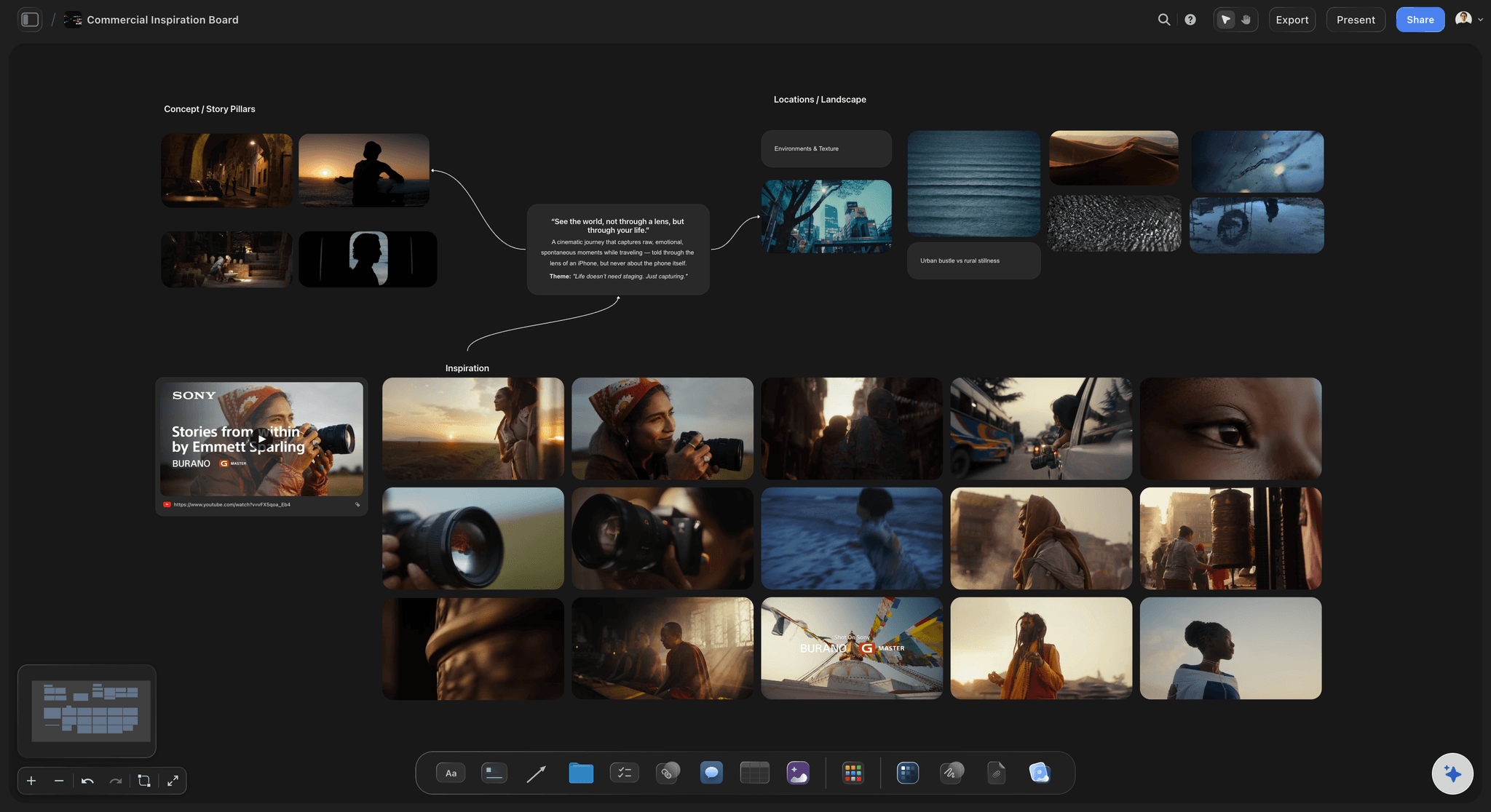
References with a reason
Every image says what it is for
Group references by light, colour, framing and performance, with a caption on each. The creative team reads the decision you made, not just a grid of films you like.
See the film lookbook →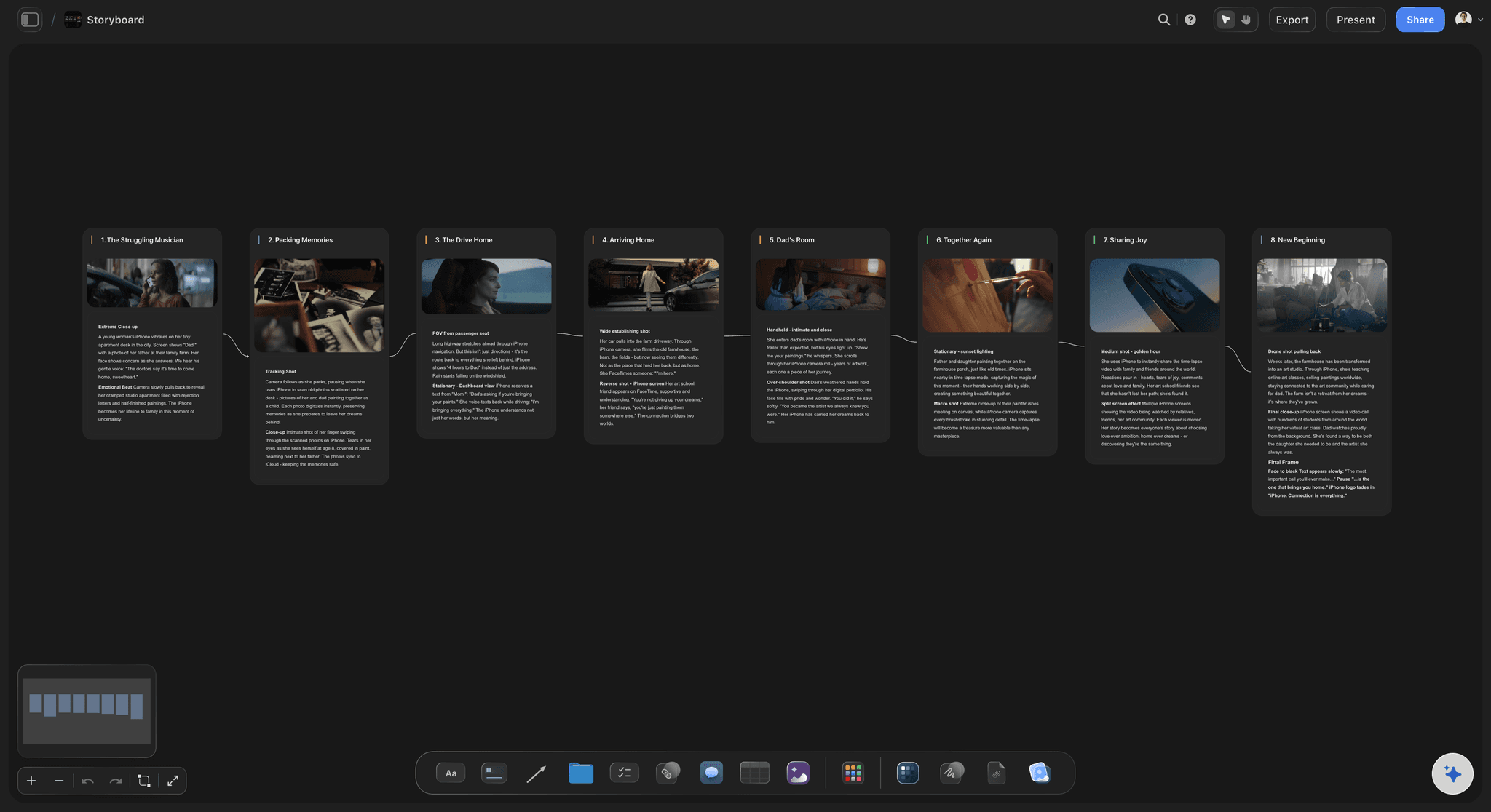
The spot, beat by beat
Key frames the agency can picture
Storyboard the moments that carry the idea with timings for the thirty or sixty seconds, beside the written approach, so the structure is seen rather than described.
Storyboard a commercial →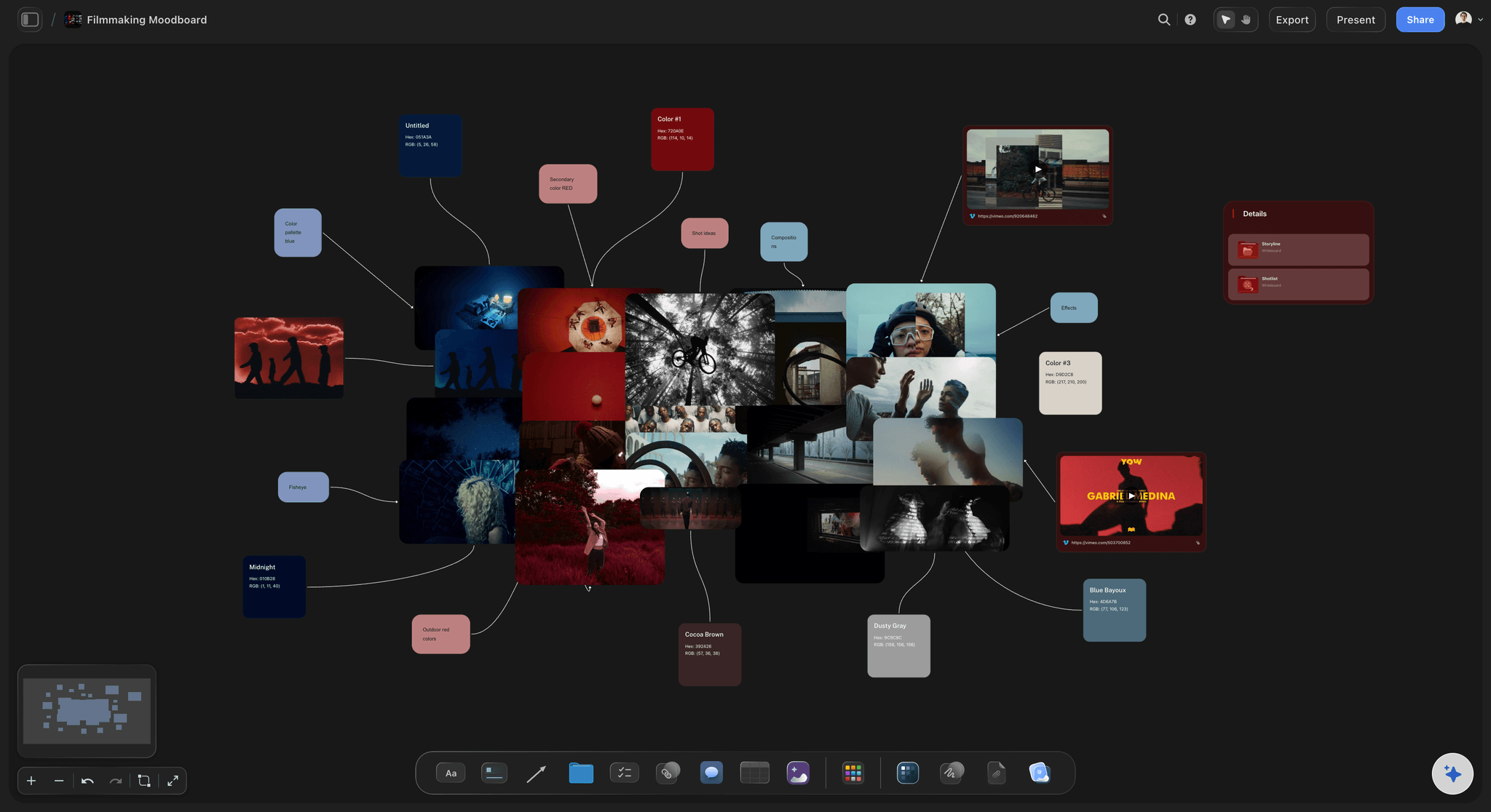
From board to designed document
A treatment PDF without a layout weekend
The Treatment PDF workflow turns the board into a designed document: the idea, the look, the references and the structure, in an order a reader follows.
See the film pitch deck page →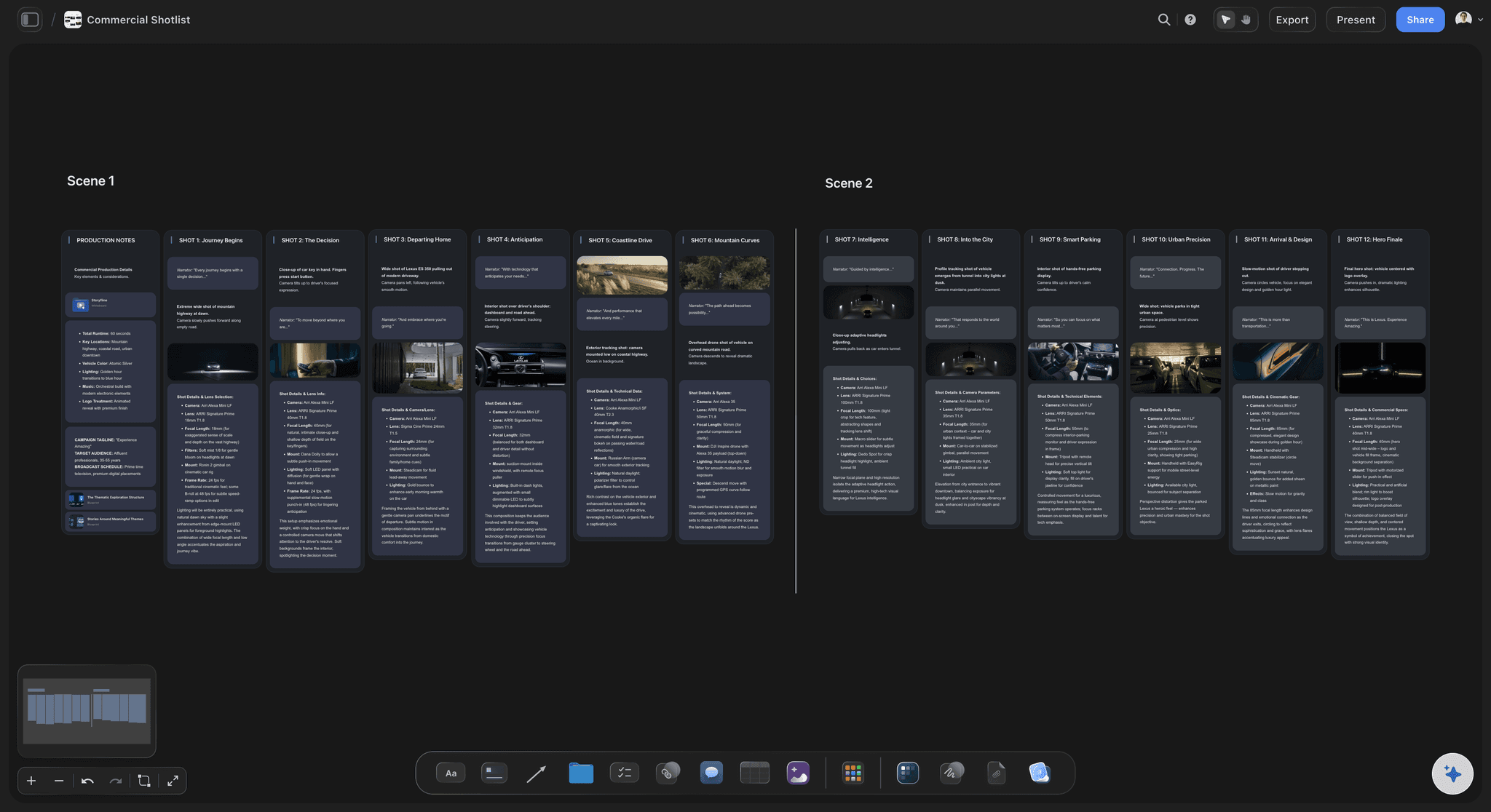
Win the job, keep the board
The treatment becomes the shoot plan
When the bid comes through, the references, frames and approach are already on the board, ready for the shot list, the schedule and the call sheet.
See commercial production planning →Unlimited boards. No object cap.
One board per bid, with the references, the frames and the approach together. Storyflow is paid-only during early access, with plans from $7.99 a month billed annually ($9.99 monthly). A free plan launches before the end of 2026, and anyone a paid member invites to a board joins free.
Unlimited treatment boards on an infinite canvas
AI that gathers references and builds the treatment PDF
AI-drafted storyboards and shot lists beside the treatment
View-only links for agencies and brands, no account needed to read
Built for people with taste
A treatment sells a film nobody has seen yet.
The agency already has the script. The treatment shows what only you would do with it, in an order a busy reader can follow.
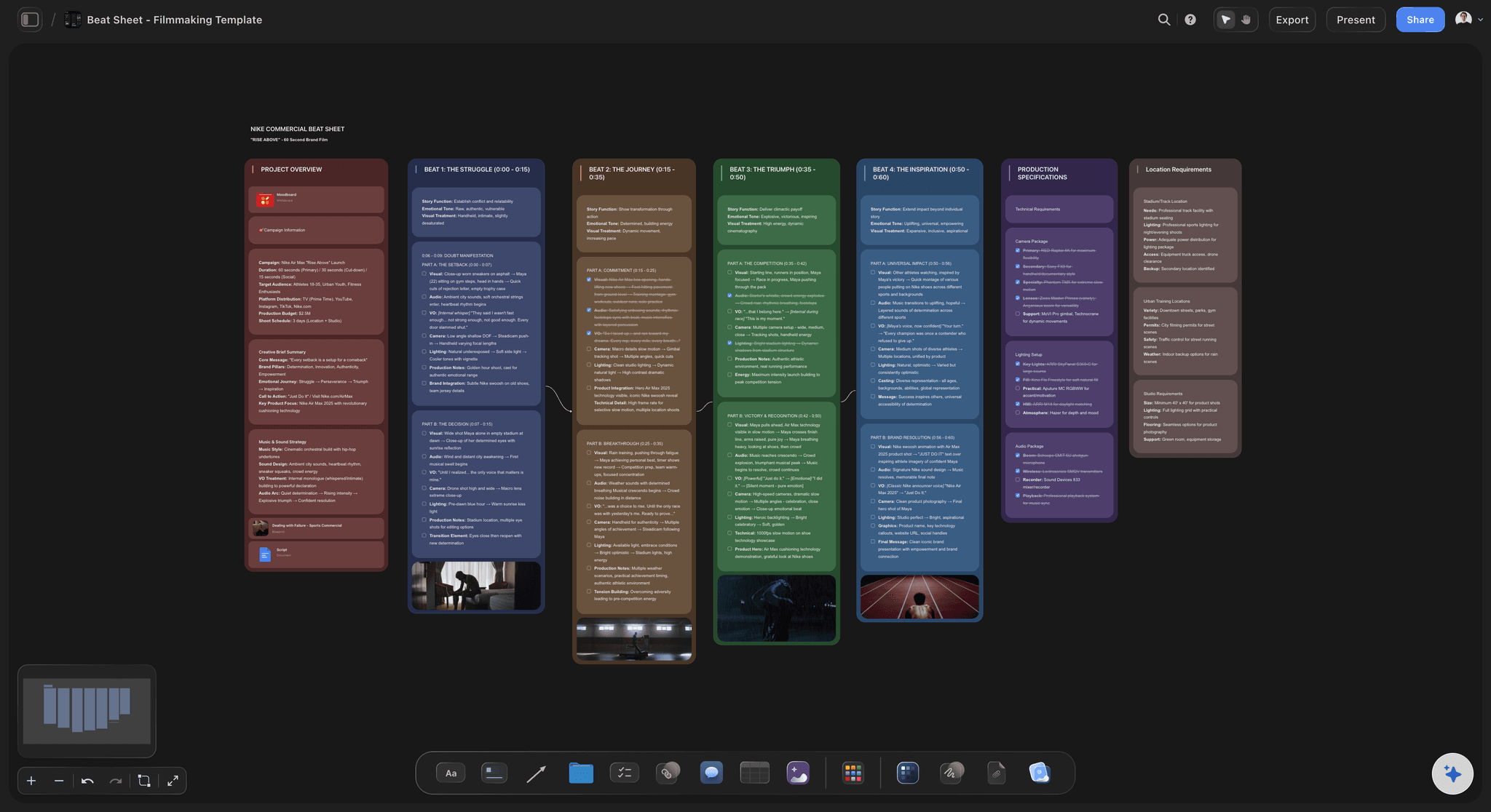
The idea and the approach
Say what the film is on page one
The idea in one line: The single thought that makes this version of the script memorable. If it takes a paragraph to state, the treatment has not found it yet.
The director's statement: Why this approach, in your own voice: what you saw in the script, what the audience should feel, and what you would protect when the budget or the schedule pushes back.
The spot, moment by moment: What the viewer sees and hears across the thirty or sixty seconds, including the product moment and the end frame, so nobody has to imagine the structure.
What you are not doing: Naming the obvious version you are avoiding tells the creative team you understood the brief well enough to reject the easy answer.
Light, lenses, casting, wardrobe
The look, as decisions
Lighting and colour: Hard or soft, practical or motivated, the palette and where it breaks. Decisions a cinematographer can act on, not the word cinematic.
Camera and movement: Lenses, framing, whether the camera observes or participates, one continuous take or a rhythm of cuts, and why each choice serves the idea.
Casting and performance: Who the people are, how natural or heightened they play it, and reference faces or performances that show the register you mean.
Wardrobe, locations and design: The world the spot lives in, with references for each, so the brand can see its product in a real place rather than a mood.
Sound, edit and credibility
The parts that make it feel finished
Music and sound: The musical direction with references, and the sound design that carries the idea. Many spots are remembered for what they sound like.
Edit and pacing: How the cut breathes, where it holds and where it hits, and how the thirty-second version survives being cut down to fifteen.
The practical case: How you would shoot the product, the rough shape of the shoot days, and anything that affects cost. Credibility wins bids as often as the idea does.
Why you: The relevant work and the reason your approach fits this brief, kept short and placed at the end rather than opening the treatment.
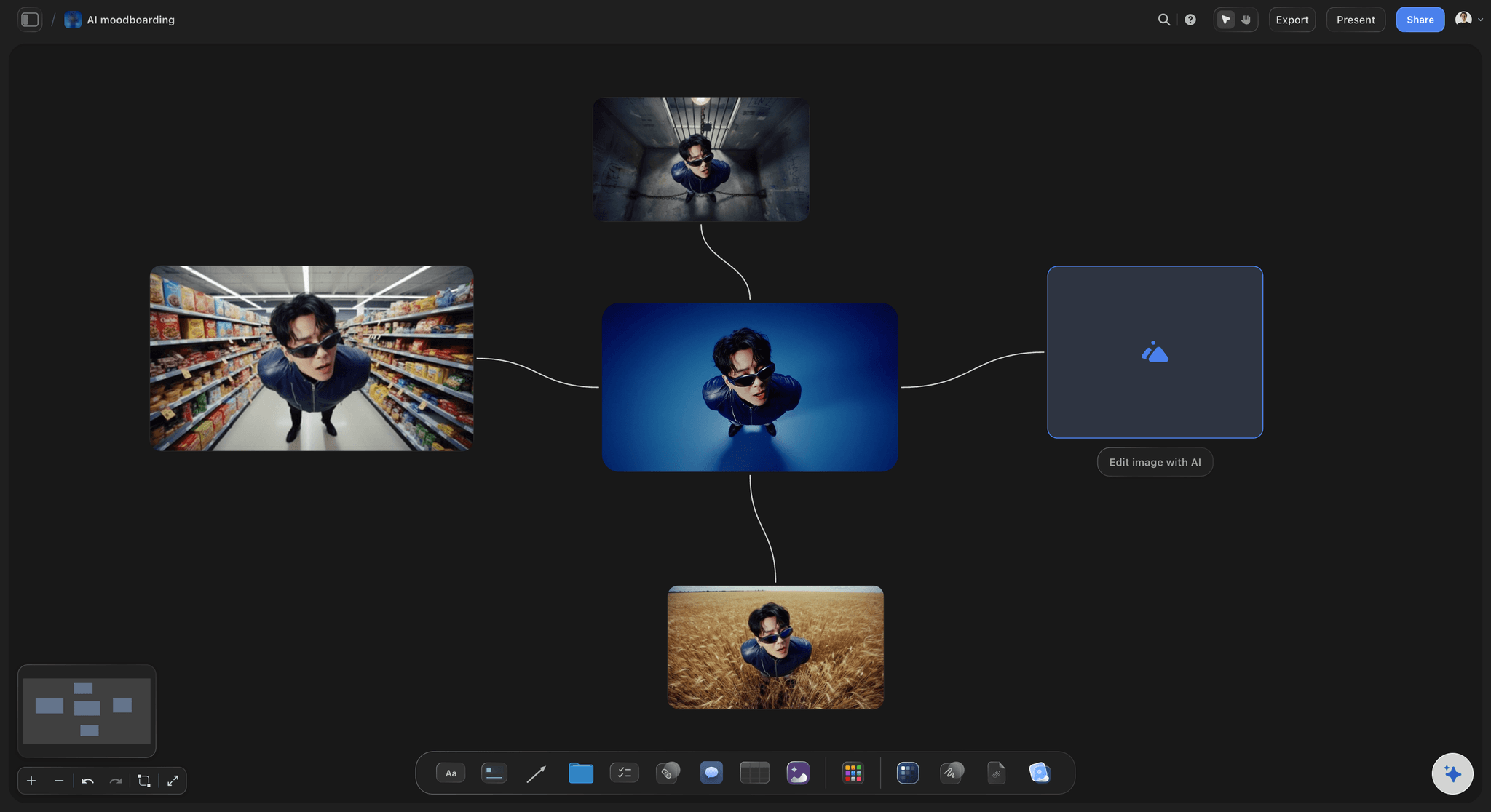
AI that reads the whole board
Help with the heavy lifting, not the vision
Gather references: Ask for references for a specific light, era or palette and the AI collects and lays them out on the board for you to keep, caption or delete.
Frames that do not exist yet: On Pro and Max, generate a frame that shows a shot no reference captures, clearly marked as a sketch of intent rather than a promise.
Draft the structure: The AI can draft a beat-by-beat structure from the script and the board. The voice, the idea and every creative call stay with the director.
Build the PDF: The Treatment PDF workflow lays out the idea, the look, the references and the structure as a designed document you can send the same day.
Explore templates for your project
Every template opens as a real, editable board on the infinite canvas. Pick the closest fit and make it your own.
Storyboard
Lay out your shots frame by frame with images and notes, then reorder them until the sequence reads like the finished cut.
One app instead of five
Storyflow vs InDesign, Keynote, and Google Slides for treatments.
All three produce a good treatment file: InDesign gives the finest typographic control, Keynote a fast image-led layout, Google Slides easy sharing. Here is where they differ while you are still building the idea.
Storyflow
Recommended
Exports the treatment as a PDF
Infinite canvas for references while you build
AI builds the treatment from your board
Storyboard and shot list on the same canvas
Real-time collaboration by link
Fine typographic layout control
Adobe InDesign
Exports the treatment as a PDF
Infinite canvas for references while you build
AI builds the treatment from your board
Storyboard and shot list on the same canvas
Real-time collaboration by link
Fine typographic layout control
Keynote
Exports the treatment as a PDF
Infinite canvas for references while you build
AI builds the treatment from your board
Storyboard and shot list on the same canvas
Real-time collaboration by link
Fine typographic layout control
Google Slides
Exports the treatment as a PDF
Infinite canvas for references while you build
AI builds the treatment from your board
Storyboard and shot list on the same canvas
Real-time collaboration by link
Fine typographic layout control
What creators are saying
Join early creators getting structured workspaces and AI that remembers their projects
“Storyflow has sped up my workflow by at least 3x, which means more flow state and more projects I can actually ship. It truly changed the way me and my team create.”

Reilin Joey
Director & YouTuber
“One prompt gets me a structured board. But the tactics are my favorite. I run my YouTube scripts through them and my intros and retention got better. It's amazing.”

Justkay
YouTuber & Freelance Filmmaker
“I used to juggle five apps to plan a project. Now I describe what I am making and get boards, lists, and a schedule. All in one place.”

George
@fernwehchronicles
Director's treatment questions, answered.
What goes in, how long it runs, and how to send it.
Storyflow is built for making the treatment itself: the references, frames, casting, wardrobe and written approach sit on one board while you develop the idea, and the Treatment PDF workflow turns that board into a designed document covering the idea, the look, the references and the structure. Adobe InDesign suits a designer hand-finishing the layout type by type, Keynote fast image-led pages, and Google Slides several people editing the file at once.
A director's treatment is a short, image-led document a director writes to win a job. It shows how they would make a commercial, music video or branded film from an existing script or brief: the core idea, their approach in their own voice, the look through lighting, camera, casting and design, the structure moment by moment, and the references that make those choices concrete. It pitches a specific interpretation, not a summary of the script.
Open with the idea in one line and a short director's statement. Then show the spot or film beat by beat, followed by the look: lighting and colour, camera and movement, casting and performance, wardrobe, locations and production design, each with captioned references. Add music and sound, edit and pacing, and practical notes on shooting the product and the shape of the shoot days. Close with a brief case for why you are the right director for this brief.
As short as the idea allows and long enough to show the look and the structure. Commercial treatments are read quickly by creative teams comparing several directors, so image-led pages with a few lines each outperform long essays, and the idea should be clear before the first page turn. A branded film with more story can justify more pages than a thirty-second spot. If a page could be removed without the reader losing a decision, remove it.
A director's treatment pitches an interpretation of work that already exists: an agency's script, a brand's brief or an artist's song. A pitch deck usually pitches a project that does not exist yet, such as a feature or series seeking financing, and covers the story, the market, the team and the budget. Both use visual references and a clear idea, but a treatment is about how you would direct it, a pitch deck about why it should be made.
A film treatment is a prose summary of a story, written during development to show a screenplay's plot, characters and structure before or instead of a full script. A director's treatment is visual and interpretive: it takes a script someone else wrote and shows the look, tone and approach the director would bring. Screenwriters and producers write film treatments; directors write director's treatments to win commercials, music videos and branded films.
Read the agency script and brief until you can state the problem the spot has to solve, then find the one idea only your version would bring. Write that idea in a line, describe the thirty or sixty seconds moment by moment, and decide the look through light, camera, casting, wardrobe and locations, with captioned references for each. Show how you would treat the product and the end frame, add music and sound, and keep practical notes short.
From films, commercials and music videos, photography books and archives, their own previous work, and frames grabbed from YouTube or Vimeo, with licensed stock where a specific image is needed. What matters more than the source is the caption: say what each reference is for, whether it is the light, the framing, the wardrobe or the performance, because a reader will otherwise copy the wrong quality from it. Group references by decision rather than by where they came from.
Yes, with the heavy lifting, but it should not supply the vision. In Storyflow the AI reads the script and everything on the board, so it can gather references for a described look, draft a beat-by-beat structure, generate frames no reference captures on Pro and Max plans, and lay the finished board out as a treatment PDF. The idea, the voice of the director's statement and every creative decision stay with the director, which is what the agency is buying.
Usually a clear idea stated early, references that prove the look instead of decorating it, and credible practical thinking about how the spot will be shot, particularly the product. Creative teams compare treatments side by side, so the one that answers the brief's actual problem, shows the structure of the spot, and reads quickly tends to beat one that is more beautiful but harder to follow. Relevant previous work matters, but it supports the treatment rather than replacing it.
Send a PDF named with the brand, the spot and your name, sized so it opens quickly on a phone and a laptop, with the idea visible on the first page. A view-only link is a useful second option when the treatment includes motion references or a storyboard the creative team may want to browse, and in Storyflow the agency opens it in a browser with no account. Follow the agency's deadline and format exactly.
Not yet. Storyflow is paid-only during early access, with plans from $7.99 a month billed annually ($9.99 monthly). A free plan launches before the end of 2026, and anyone a paid member invites to a board joins free. A producer or cinematographer you invite can work on the bid with you, and agencies reading the treatment through a view-only link never need an account. AI image generation is on Pro and Max.
More from Storyflow
Film pitch deck
Film treatment template
Documentary treatment template
Commercial storyboard
Commercial production
Music video planning
Film lookbook
AI treatment generator
Campaign concept presentation
Campaign brief template
Pitch deck maker
How to write a director's treatment
Art direction board
Brand film
Film press kit
Film treatment with ChatGPT
Show the film before you make it.
Open a canvas, put the script on it, and build the treatment the agency will remember.