
Rock-steady plans for every shoot
Shoot out of order
without breaking the story.
Lay every scene out in story order, record what state the wardrobe, props, hair, and injuries are in, and see instantly where your shooting schedule will create a mismatch.


Creatives working for these brands already got early access
- Red Bull
- Canon
- Artlist
- Porsche
See how easy it is to get started
Watch a real project come together, from a blank board to a finished plan, clicked through step by step.
Start from a ready-made template
Pick a board to see what you can build, then let AI fill it in. Every template is a real, editable starting point on the same infinite canvas.

Pre-Production
Pull the brief, script, shot list, and moodboard into one pre-production hub so the whole shoot is planned in one place.
What is a continuity tracker?
A continuity tracker is how you keep a film consistent when you are shooting it in the wrong order. Storyflow is an AI visual workspace that tracks continuity on one infinite canvas: every scene laid out in story order, the state of wardrobe, props, hair and injuries per scene, and where the shooting schedule will create a mismatch. Almost nothing is shot in story order, so the scene you shoot on Tuesday morning might come forty minutes after the one you shoot on Friday afternoon. Continuity is the discipline of making sure that when those two shots sit next to each other in the edit, nothing has silently changed: the cut on the hand is still there, the jacket is still off, the glass is still half empty, the hair is still wet.
The reason continuity is hard is that it is a property of story order while production is organised in shooting order. Every continuity error is the same shape: a state that should have carried forward from an earlier scene did not, because the earlier scene was shot two weeks later. That means the tool has to hold both orders at once. A schedule that only shows you shooting order cannot tell you what the audience last saw, and a script that only shows you story order cannot tell you what you already filmed.
Storyflow is an AI-native infinite canvas that suits this well because you can lay the same scenes out twice. Run a row of scene cards in story order, record the state of each continuity element on the card, and pin the reference photo you took on the day directly to it. Because the canvas has no object cap, a feature-length continuity plan covering ninety scenes and a dozen tracked elements stays on one surface, and you can see a whole act at a glance rather than one page at a time.
There are broadly four kinds of continuity, and a useful tracker holds all four: physical continuity (wardrobe, props, hair, makeup, injuries, and the state each is in, which is where most visible errors happen), spatial continuity (screen direction, eyelines, and where people and objects are in the room, which is what breaks when coverage is shot on different days), temporal continuity (time of day, weather, and how much story time has passed, which is what the light has to match), and narrative continuity (what a character knows at this point in the story, which is invisible on set and catastrophic in the edit). The first is the one everyone plans for. The fourth is the one that actually ruins scenes.
Ultra fast from brief to board
From a script to a continuity plan you can shoot against.
No forms to configure. Lay the scenes out and start recording state.
01
Open a canvas
Sign up in seconds. No download. Your infinite continuity canvas opens straight in the browser.
02
Lay scenes out in story order
Describe the production and the AI lays out a scene card per scene in story order, with a structure for the continuity elements you want to track. This is the order the audience sees, which is the order continuity lives in.
03
Record the state of each element
On each scene card, note the state of wardrobe, props, hair, makeup, and injuries. Not the item, the state: the tear, the stain, the rolled sleeve, how full the glass is, whether the wound has been dressed yet.
04
Check it against the shooting order
Mark which day each scene shoots and look for the jumps. Where two adjacent story scenes shoot two weeks apart, that is where you need a reference photo and an explicit note.
Both orders on one canvas.
Story order for continuity, shooting order for the schedule, and the mismatches between them.
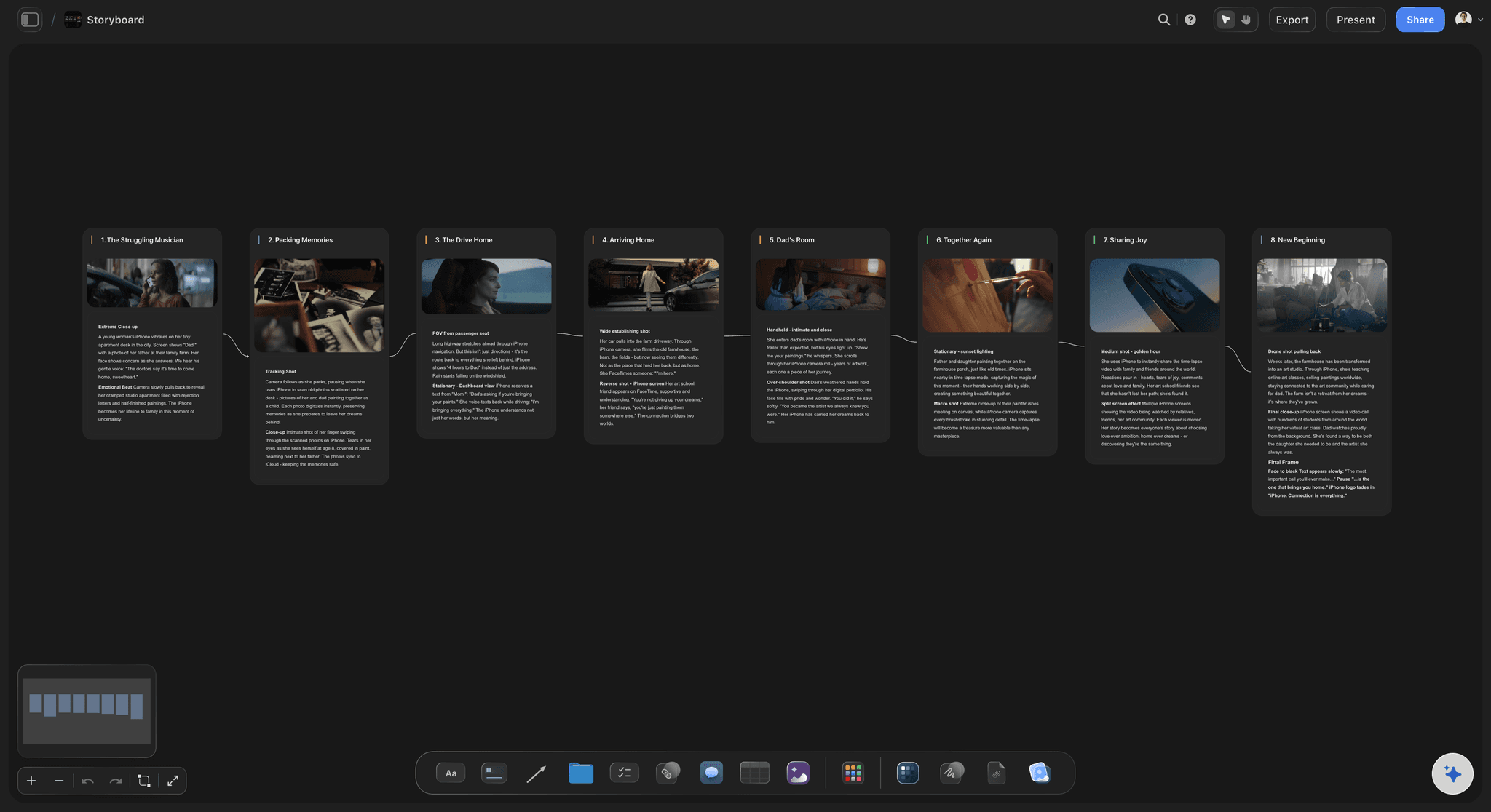
Scene cards laid out in the order the audience sees
See the story order, not the call sheet
Continuity is a property of story order, so lay the scenes out that way. Reading a character's state along a row of scene cards is what makes a broken carry-forward visible before you shoot it.
See the story timeline maker →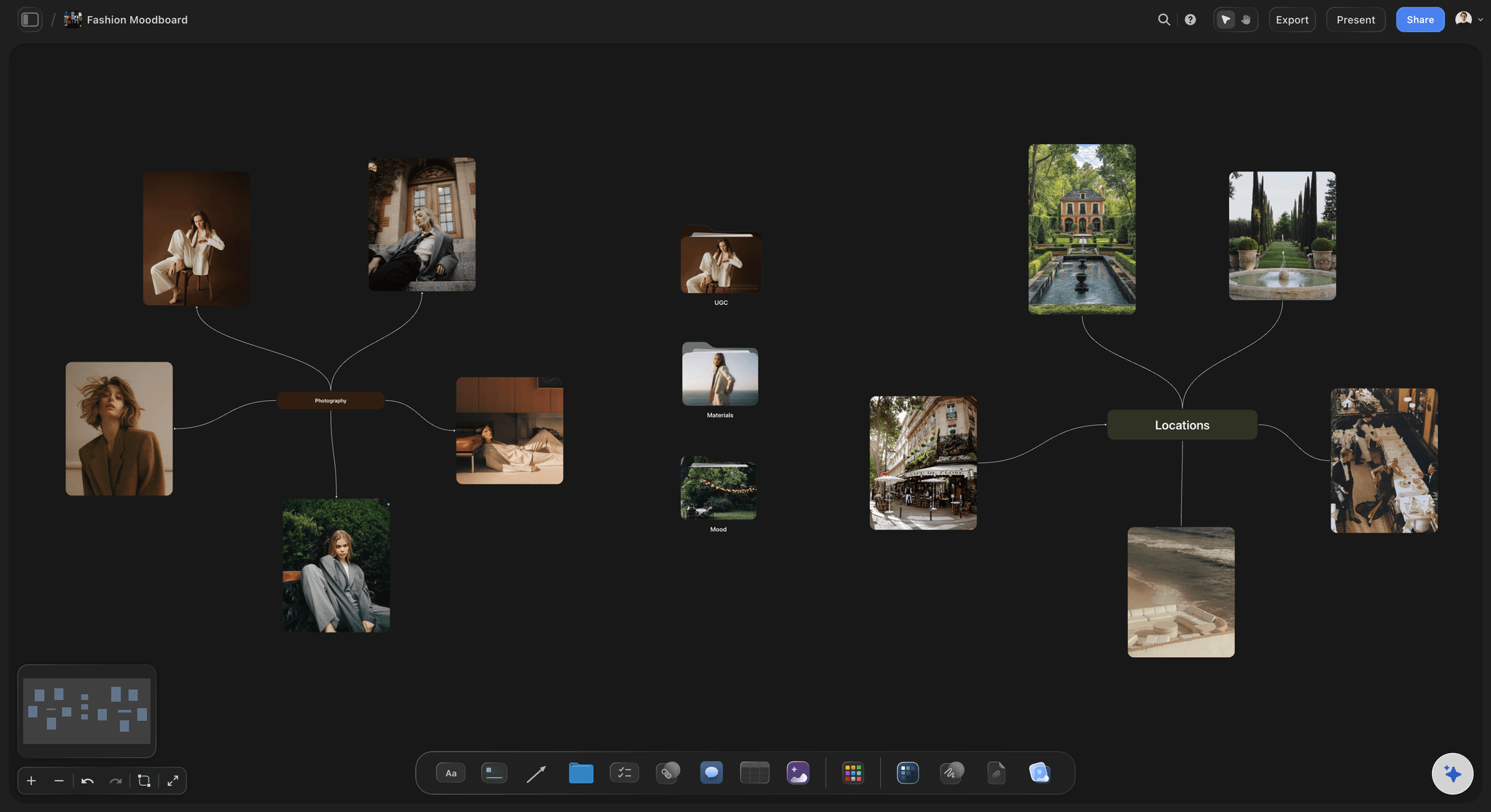
Reference photos pinned to the scene they belong to
Match against a photo, not a memory
Drag the continuity photos you shot on the day straight onto the scene card. Two weeks later, matching a costume against a photograph attached to the scene is a completely different task from matching it against recollection.
Try the wardrobe planner →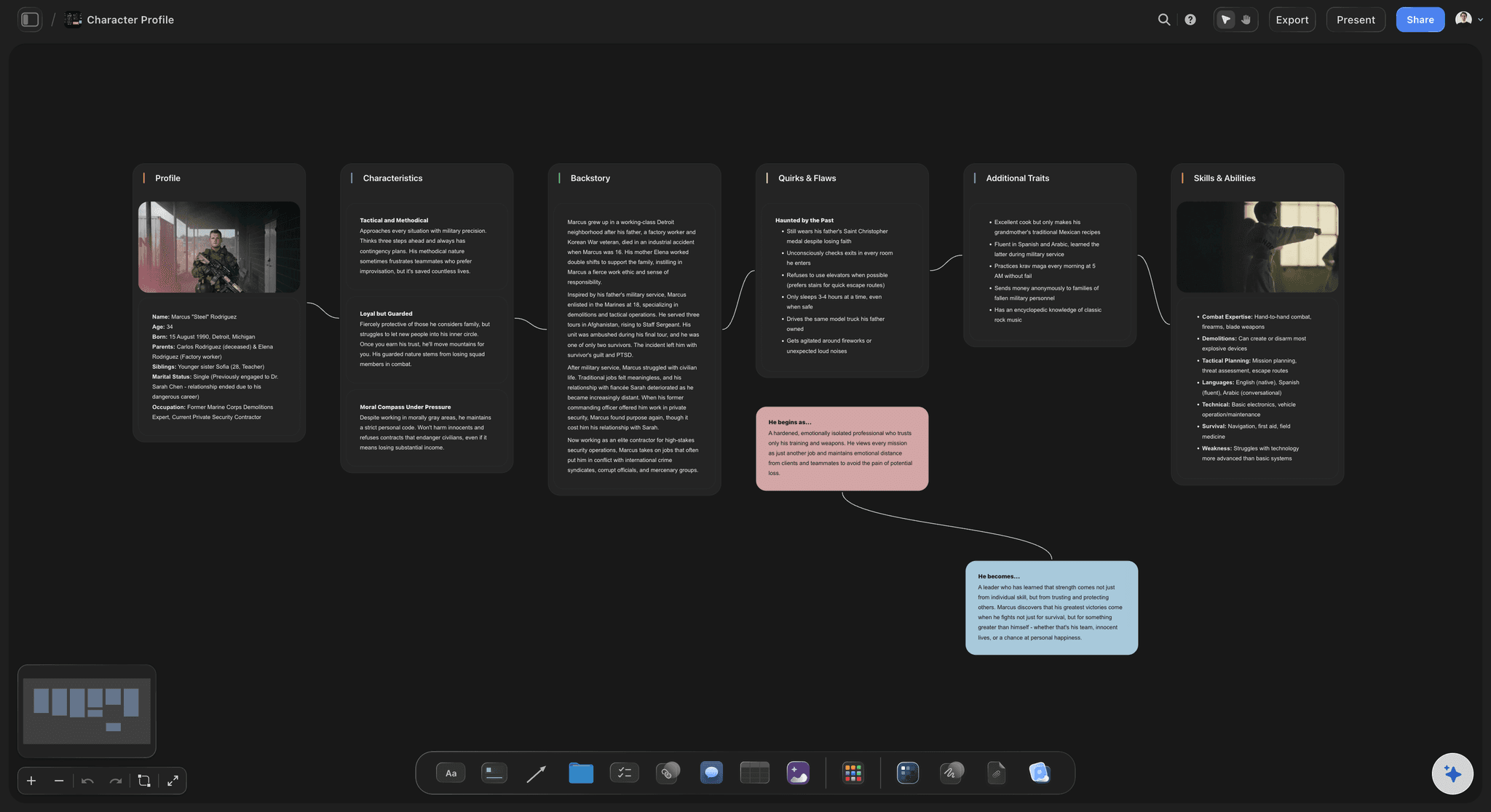
Wardrobe, props, hair, and injuries as tracked elements
Track state, not objects
The error is almost never the wrong jacket. It is the right jacket buttoned differently. Recording state per element per scene is the discipline that catches the mismatch everyone else finds in the edit.
See the props list maker →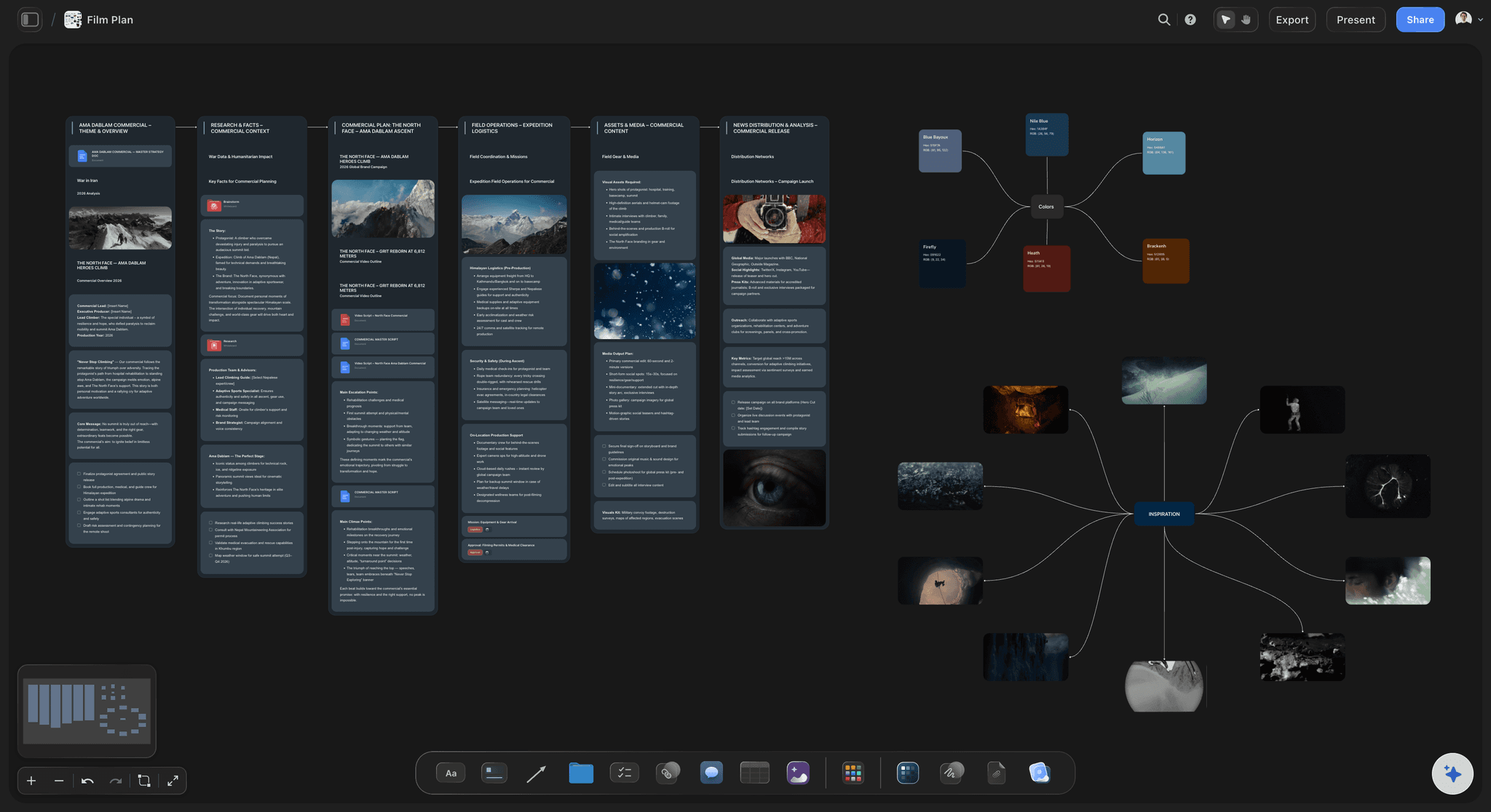
Shooting order marked against story order
Find the dangerous jumps in prep
Mark the shoot day on each scene card and the risky pairs stand out: adjacent story scenes shot a fortnight apart. Those are the handful that genuinely need a photo and a written note.
See the shooting schedule →Unlimited boards. No object cap.
Open a canvas, lay the scenes out in story order, and start recording state. Storyflow is paid-only during early access, with plans from $9.99 a month, and a Free plan launches before the end of 2026.
Unlimited continuity boards on an infinite canvas
Basic AI usage to generate boards from prompts
3 starter frameworks built in
Share view-only links with the crew
Built for people with taste
More than notes in the margin of a script.
Continuity lives in story order. Production lives in shooting order. You need to see both.
Physical, spatial, temporal, and narrative continuity
Work across all four kinds of continuity
Physical: wardrobe, props, hair, injuries: The visible layer, and the one most people mean by continuity. Record the state of each element per scene, because the error is almost always a change of state rather than a change of object.
Spatial: screen direction and eyelines: Where people and objects sit in the room, which way they are looking, and which side of the line the camera is on. This breaks when coverage for one scene is shot across two days, so note it on the scene card rather than trusting memory.
Temporal: time of day and elapsed story time: What the light has to match and how much story time has passed since the last scene. A scene set ten minutes later that shoots in different light is a continuity problem even if every object is identical.
Narrative: what the character knows: The one nobody logs and the one that ruins scenes. Track what each character has learned by each point in the story, because an actor playing a scene with knowledge they should not have yet is invisible on set and unfixable in the edit.
AI that can see the board you have already built
Build the scene grid with AI, judge it yourself
Lay out scenes from a prompt: Describe the production and the AI lays out scene cards in story order with a structure for the elements you want to track. It reads the active canvas as context, so it works with what you have already built.
It structures, it does not watch: The AI cannot see your footage and has no idea whether the jacket was buttoned. It builds and organises the plan; noticing the mismatch is a human job done with eyes on a monitor.
Re-prompt as scenes change: Scenes get cut, merged, and reordered. Keep prompting as the script moves; the state notes you have already written stay exactly where they are.
Photos, clips, and documents attached to each scene
Keep the evidence with the scene
Continuity photos on the card: Drag the stills you shot on the day onto the scene card. There is no object cap, so photographing every setup and keeping all of it attached costs you nothing in board capacity.
Grab a frame from a reference: Pull a frame from a YouTube or Vimeo reference onto the board when you are matching a look or a lighting state across days.
Script pages and notes: Drop the relevant script pages as a PDF onto the board beside the scenes. Having the text next to the state notes makes it much easier to catch the line that implies a prop nobody tracked.
Share with the script supervisor, director, and departments
One version of what happened
View-only links: Send a link and the costume, props, and makeup departments all see the same state notes. Most continuity failures are communication failures between departments rather than mistakes by any one of them.
Work together on the board: Invite the script supervisor and department heads so notes land in one place. Live multi-editor presence with cursors is on the Max plan.
Export for the set: Export as an image or PDF to print for the truck or the trailer. Paper still wins in a lot of on-set situations, and a printed story-order grid is a genuinely useful object.
Explore templates for your project
Every template opens as a real, editable board on the infinite canvas. Pick the closest fit and make it your own.
Pre-Production
Pull the brief, script, shot list, and moodboard into one pre-production hub so the whole shoot is planned in one place.
One app instead of five
Storyflow vs ScriptE, a paper log, and a spreadsheet.
For on-set logging, two of these beat us outright. Here is where each one actually wins.
Storyflow
Recommended
Story order and shooting order side by side
Reference photos attached to scenes
AI lays out the scene grid
Live on-set logging with timecode
Editor reports and lined scripts
Sits beside the rest of your production plan
ScriptE
Story order and shooting order side by side
Reference photos attached to scenes
AI lays out the scene grid
Live on-set logging with timecode
Editor reports and lined scripts
Sits beside the rest of your production plan
Paper log
Story order and shooting order side by side
Reference photos attached to scenes
AI lays out the scene grid
Live on-set logging with timecode
Editor reports and lined scripts
Sits beside the rest of your production plan
Spreadsheet
Story order and shooting order side by side
Reference photos attached to scenes
AI lays out the scene grid
Live on-set logging with timecode
Editor reports and lined scripts
Sits beside the rest of your production plan
What creators are saying
Join early creators getting structured workspaces and AI that remembers their projects
“Storyflow has sped up my workflow by at least 3x, which means more flow state and more projects I can actually ship. It truly changed the way me and my team create.”

Reilin Joey
Director & YouTuber
“One prompt gets me a structured board. But the tactics are my favorite. I run my YouTube scripts through them and my intros and retention got better. It's amazing.”

Justkay
YouTuber & Freelance Filmmaker
“I used to juggle five apps to plan a project. Now I describe what I am making and get boards, lists, and a schedule. All in one place.”

George
@fernwehchronicles
Continuity questions, answered.
What continuity actually covers, how to track it, and where Storyflow is the wrong tool.
Continuity is the consistency of everything the audience can perceive across shots that are meant to be one continuous moment, even though they were filmed at different times. It covers four distinct things. Physical continuity is wardrobe, props, hair, makeup, and injuries, and specifically the state each is in rather than merely which item it is. Spatial continuity is screen direction, eyelines, and where people and objects sit in the space. Temporal continuity is time of day, weather, and how much story time has passed. Narrative continuity is what each character knows at that point in the story. The first is the one everybody plans for and the fourth is the one that most often ruins a scene, because an actor playing knowledge their character should not have yet cannot be fixed in the edit.
Lay the scenes out in story order rather than shooting order, because continuity is a property of the order the audience sees and you will almost never shoot in that order. For each scene, record the state of every tracked element: not the jacket but the jacket unbuttoned with the left sleeve rolled, not the glass but the glass two thirds empty. Then mark which day each scene shoots and look for adjacent story scenes that shoot far apart, since those are the pairs at real risk. Photograph every setup on the day and attach the photos to the scene card, so that when you return to that costume in three weeks you are matching against an image rather than a memory. The discipline that matters most is recording state, because the error is almost never the wrong object.
For planning continuity, it is a strong fit. For logging it live on set, it honestly is not, and you should know that before choosing it. A dedicated script supervision tool like ScriptE handles timecode, lined scripts, and editor reports, and a paper log book in a competent script supervisor's hands is still faster on the day than any app. Storyflow's advantage is in prep and in the gaps between: laying the story order out against the shooting order, finding the dangerous jumps before you get to them, keeping reference photos attached to scenes, and having all of it beside your shot list and schedule. Many productions use both, and that is the right answer rather than a compromise.
Not during early access. Storyflow is paid-only right now, with plans starting at $9.99 a month, and a Free plan launches before the end of 2026. Anyone a paid member invites to a board joins free today, so your departments can read and update the plan without paying. If you want something free this minute, a notebook and a phone camera is the classic answer and remains genuinely effective, which is worth saying plainly.
Because state has to carry forward in story order while production happens in shooting order, and the two are almost never the same. A scene that follows on directly from another might be filmed two weeks later at a different location with a different crew on shift. Everything that was true at the end of the earlier scene, the tear in the sleeve, the half-eaten meal, the wet hair, has to be recreated from information rather than from the situation. If that information was never written down in a form tied to the scene, it gets recreated from memory, and memory is where continuity errors come from.
Photograph more than feels necessary, because storage is free and reshoots are not. At minimum, take a wide of each actor showing the full costume, a detail shot of anything with a specific state such as a rolled sleeve, an open button, a wound, or a stain, and a shot of the set showing where key props are positioned. Take them at the start of the setup and again if anything changes during it. Then attach the photos to the scene card rather than leaving them in a camera roll, because a photo you cannot find in three weeks is the same as no photo.
No, and any tool claiming otherwise is overselling. The AI can lay out your scenes in story order, build the structure for the elements you want to track, and give you a starting grid from a script description. It cannot see your footage, does not know what was on the monitor, and cannot tell whether the jacket was buttoned. Catching the mismatch is a human job. What the board does is make it far more likely that a human looks in the right place at the right time.
Yes, with one caveat about formats. Paste your script text onto the canvas or drop a PDF onto the board and the AI can work from it to lay out scenes in story order and suggest which elements need tracking. Storyflow does not import Final Draft, FDX, Word, or Fountain files directly, so export to PDF or plain text first and then paste or upload. From there you fill in the state notes, which is the part that needs a human reading the scene carefully.
Yes, and that is often the biggest practical gain. Share a view-only link and costume, props, makeup, and the script supervisor all read the same state notes in a browser with no account. A large share of continuity failures are not mistakes by any one department but a gap between two of them, where costume knew about a change that props did not. One shared board closes that gap. Live multi-editor presence with cursors is on the Max plan.
Yes, and it is one of the stronger reasons to use a canvas rather than a dedicated tool. The continuity board can sit beside the shooting schedule, the shot list, the wardrobe plan, and the props list on the same surface. That adjacency is what lets you notice that moving a scene to a different day has just created a continuity risk, which is the sort of connection that gets missed entirely when the schedule and the continuity notes live in different applications.
Find the continuity break before the edit does.
Open a canvas, lay the scenes out in story order, and record the state. No download.