
Polished brand plans, extremely simple
A brand positioning workshop
that ends with one sentence, not a mood.
Half a day, five exercises that force a choice, and a session that closes with the sentence you will put on the homepage plus the three things that prove it.


Creatives working for these brands already got early access
- Red Bull
- Canon
- Artlist
- Porsche
See how easy it is to get started
Watch a real project come together, from a blank board to a finished plan, clicked through step by step.
Start from a ready-made template
Pick a board to see what you can build, then let AI fill it in. Every template is a real, editable starting point on the same infinite canvas.

Brand Strategy
Define your positioning, values, and voice and connect them into a strategy the team can follow.
What is a brand positioning workshop?
A brand positioning workshop is a single working session where a team decides who they are for, what they are chosen instead of, and the one sentence that says the difference. Storyflow is an AI visual workspace that runs the session and keeps its answer on one infinite canvas: the customer evidence, the five exercises, the positioning sentence and the proof points under it. It is narrower than a full brand project: no logo, no values exercise, no naming.
Bring evidence or the room will trade opinions. Gather six things the week before: the last twenty reasons people bought, the last twenty reasons people did not, the words customers use in their own sentences from calls and reviews and support messages, what the four closest alternatives charge and claim on their own pages, your current homepage headline, and the one number the business has to move this year. Put them on the board before anyone arrives. A workshop that opens with a blank canvas becomes a session about whose instinct is loudest.
Five exercises, four hours, in this order. Twenty minutes listing every alternative including doing nothing and a spreadsheet. Twenty five minutes deciding which of those you actually lose to. Forty minutes on the only-we test: write ten claims about yourself, then cross out every one a competitor could put on their own site, and see what survives.
The last three go like this. Forty minutes mapping yourself and the alternatives on a grid of two things customers genuinely care about, hunting for the corner nobody is standing in. Twenty five minutes saying out loud who you are not for. Then forty five minutes writing the sentence, in the form: for a particular person who has a particular problem, we are the thing that does a particular job, and here is why that is believable.
Five things leave the room or the day did not work: one positioning sentence, three proof points each with real evidence behind it, a written list of who you are not for, a message house of one line with three supports under it, and the five places the wording changes next month. That last one is what makes it stick. Name the homepage headline, the third slide of the sales deck, the first onboarding email, the ad copy and the way people answer at events, and put a date and an owner on each. Positioning that never reaches a sentence somebody has to rewrite is positioning that quietly did not happen.
Ultra fast from brief to board
A week before, four hours, and the month after.
The session and its answer live on the same board.
01
Put the evidence up first
Paste the sales notes, the lost-deal reasons, the reviews and the competitor pages onto the board and ask the AI to pull out the words customers repeat. It reads the files you attach and groups what it finds. You get a wall of real language to argue against instead of a blank page.
02
Run the five exercises
Each one gets its own area with a clear question at the top and space to fill in. The alternatives list, the only-we test, the grid, the not-for list, and the sentence. Everyone works in the same board at once, and nothing is on a sticky note that gets thrown away at five o'clock.
03
Write the sentence while people are still in the room
Do not take it away to polish. Draft it live, read it aloud, and see whose face changes. Ask the AI for three versions from the notes on the board if the room is stuck, then rewrite the one that is closest by hand.
04
Turn it into things that change
Add a table: the five surfaces where the wording changes, who owns each, and the date. Then build the campaign brief and the moodboard on the same canvas, so the new wording is the thing the next piece of work starts from rather than a PDF nobody reopens.
Evidence, exercises, the sentence, and what it changes.
Storyflow holds the session and its answer. Live timers and voting still belong in a facilitation tool.
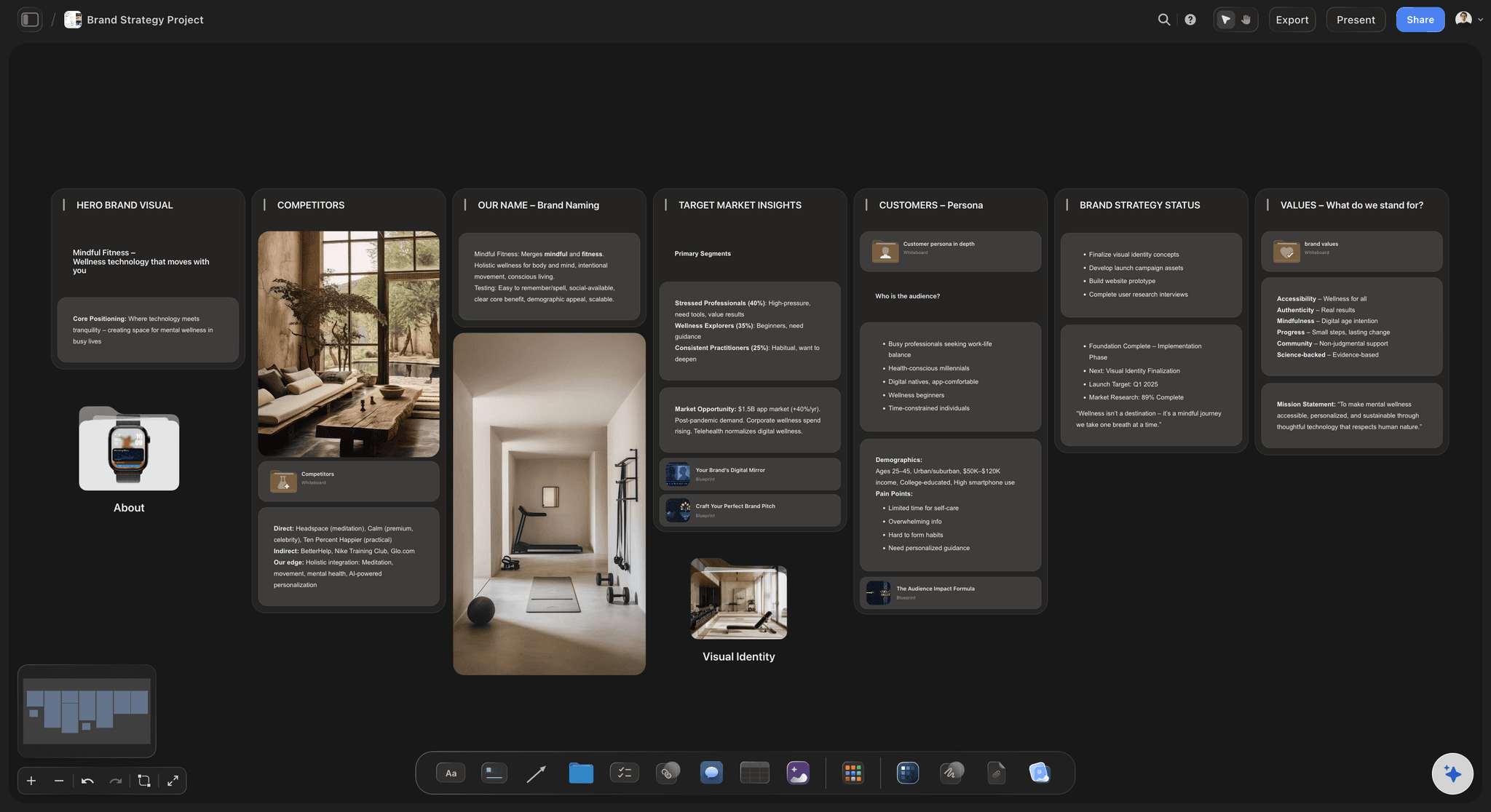
The answer
One sentence and three proofs
The statement sits at the top of the board with its three proof points underneath, each one pointing at real evidence: a customer sentence, a number, or a thing only you do. A proof with nothing behind it is a claim, and it is obvious on the board which is which.
See the brand strategy tool →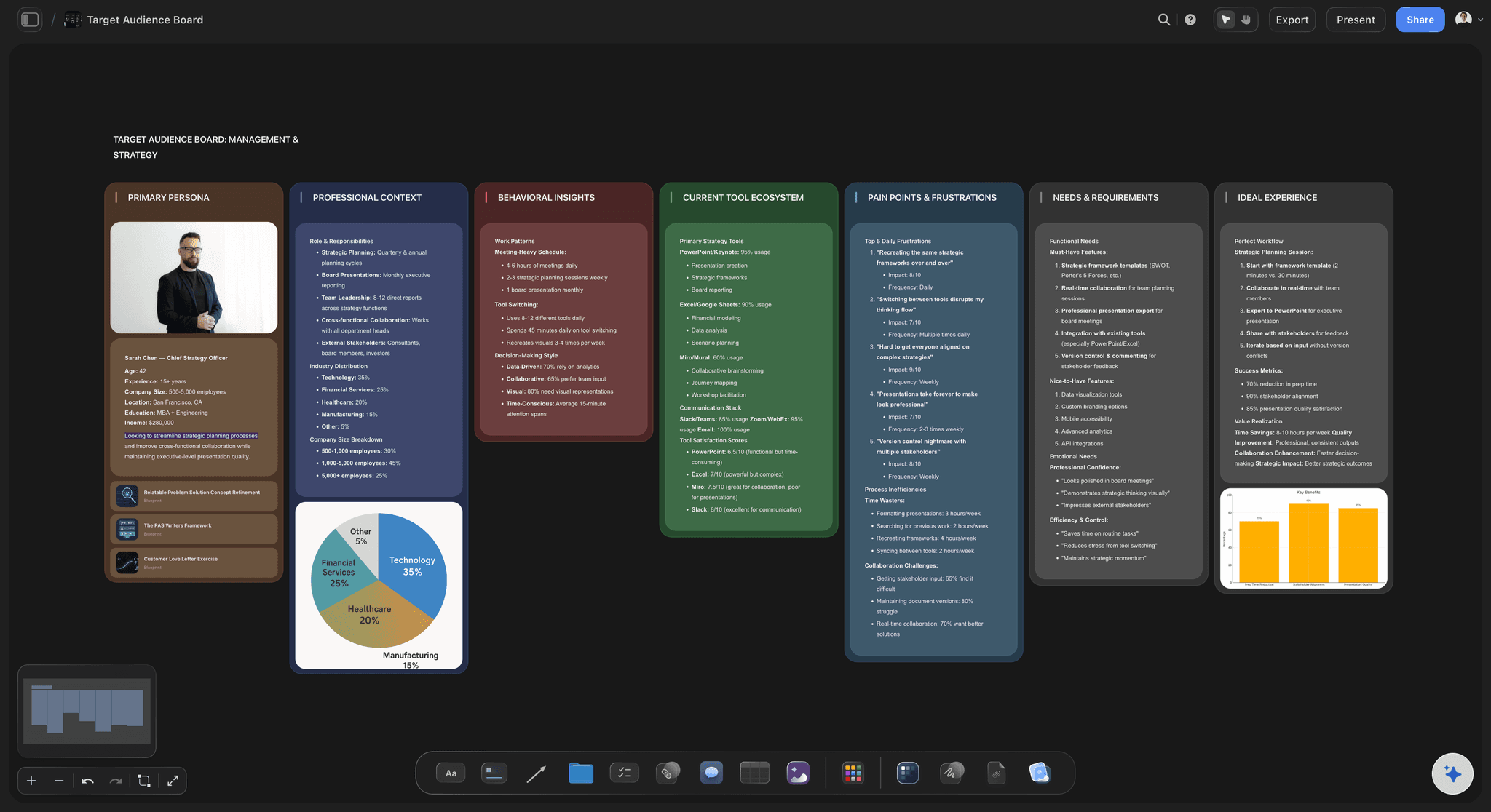
Before the session
The customer's words, not yours
Attach call notes, reviews and support messages and ask for the phrases that come up most. Up to 5 documents, 3 Tactics and 3 boards can be attached at once. The room then argues with real sentences instead of remembering what one customer said in March.
See the target audience board →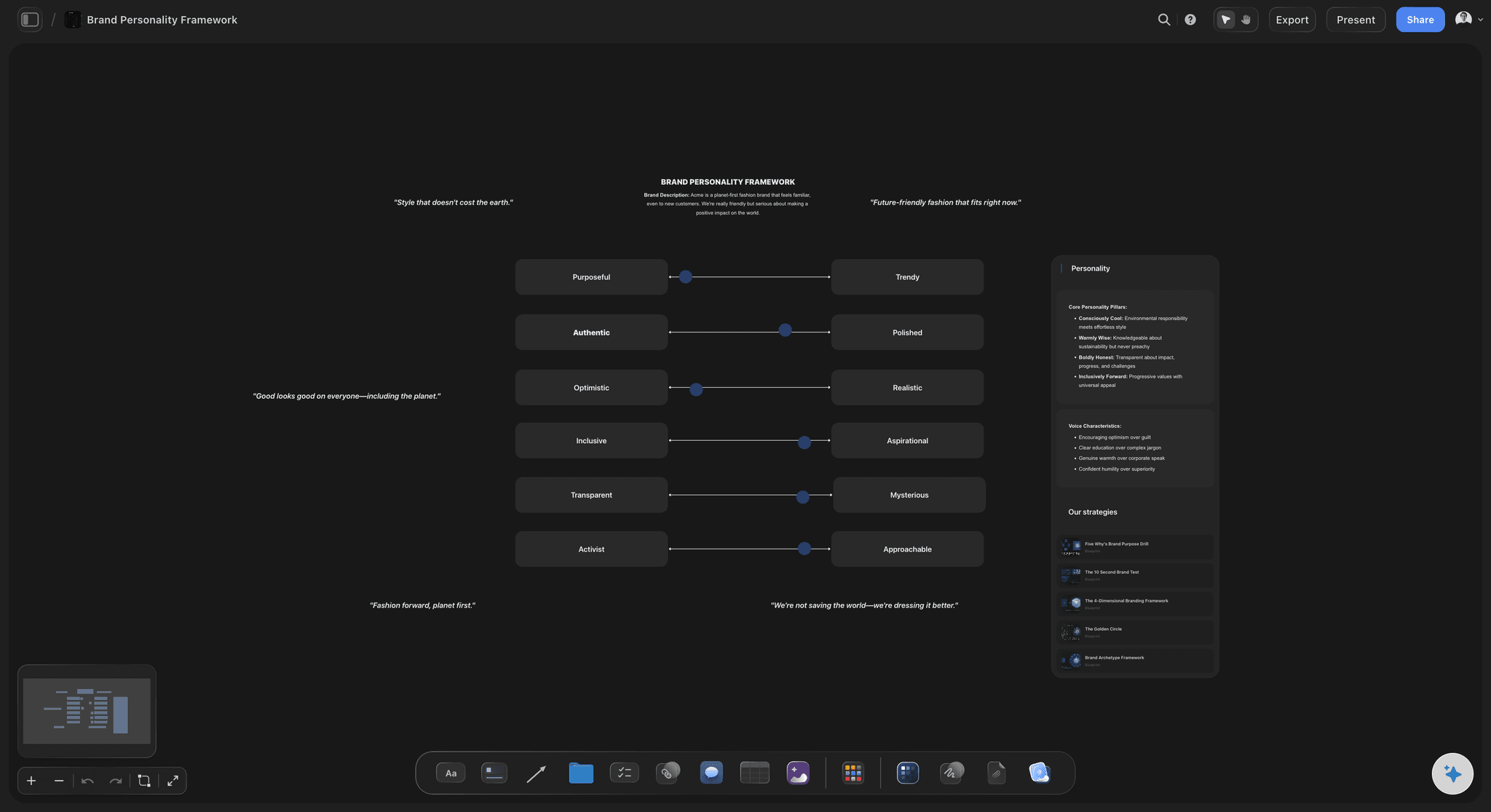
In the session
Exercises that force a choice
The only-we test, the grid with an empty corner, and the not-for list. Each is laid out with its question at the top so the room fills it in rather than discussing what the exercise means. Adjectives get crossed out as they appear.
See the brand personality template →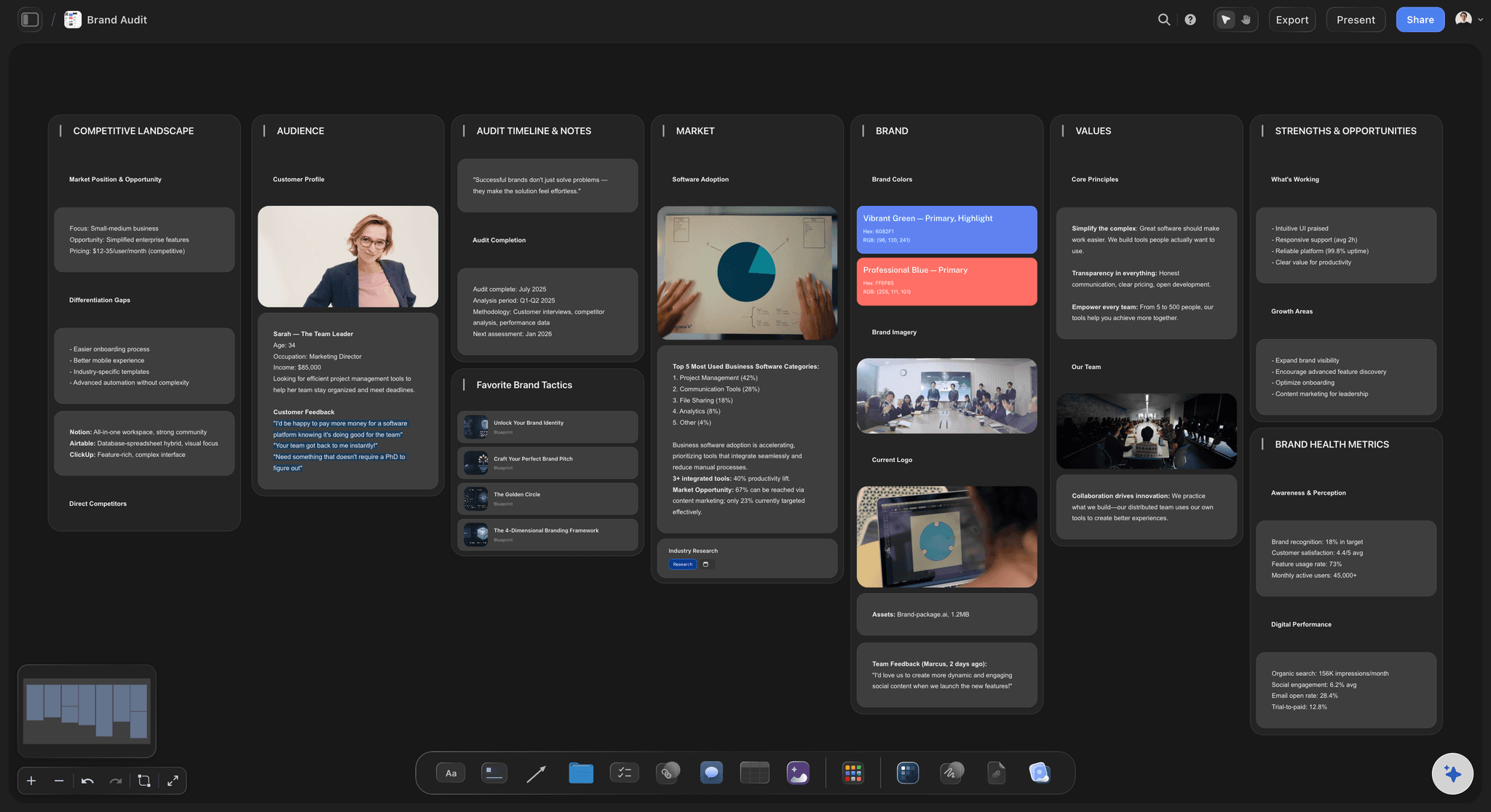
After the session
Five surfaces, five owners, five dates
The homepage headline, the sales deck, the first onboarding email, the ads and the answer people give at events. One table, one name and one date per row, on the board the new wording came from.
See the brand audit board →The session you ran last year is still open.
When someone asks in November why the headline says what it says, the alternatives list and the crossed-out claims are still there to point at. Storyflow is paid-only during early access, with plans from $7.99 a month billed annually ($9.99 monthly). A free plan launches before the end of 2026, and anyone a paid member invites to a board joins free.
Unlimited boards, image uploads and files on every paid plan
Invite the freelance strategist or the agency to one board without buying them a seat
200+ Tactics to start each exercise instead of drawing boxes
Whole-board PDF export for the readout
Presentation mode to walk the leadership team through it afterwards
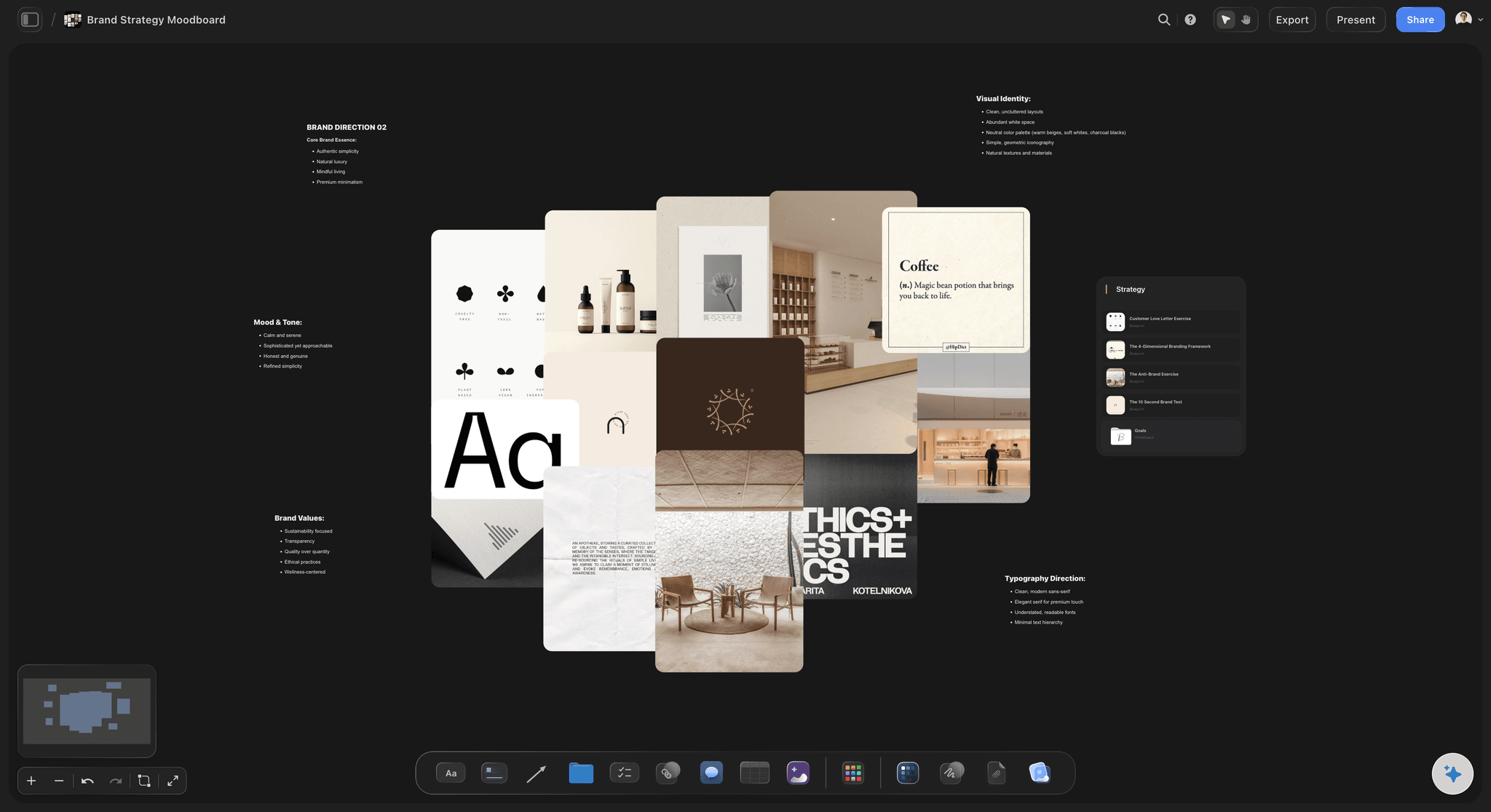
Built for people with taste
Why positioning sessions usually produce nothing.
Three failures, and each one has a fix you can set up the week before.
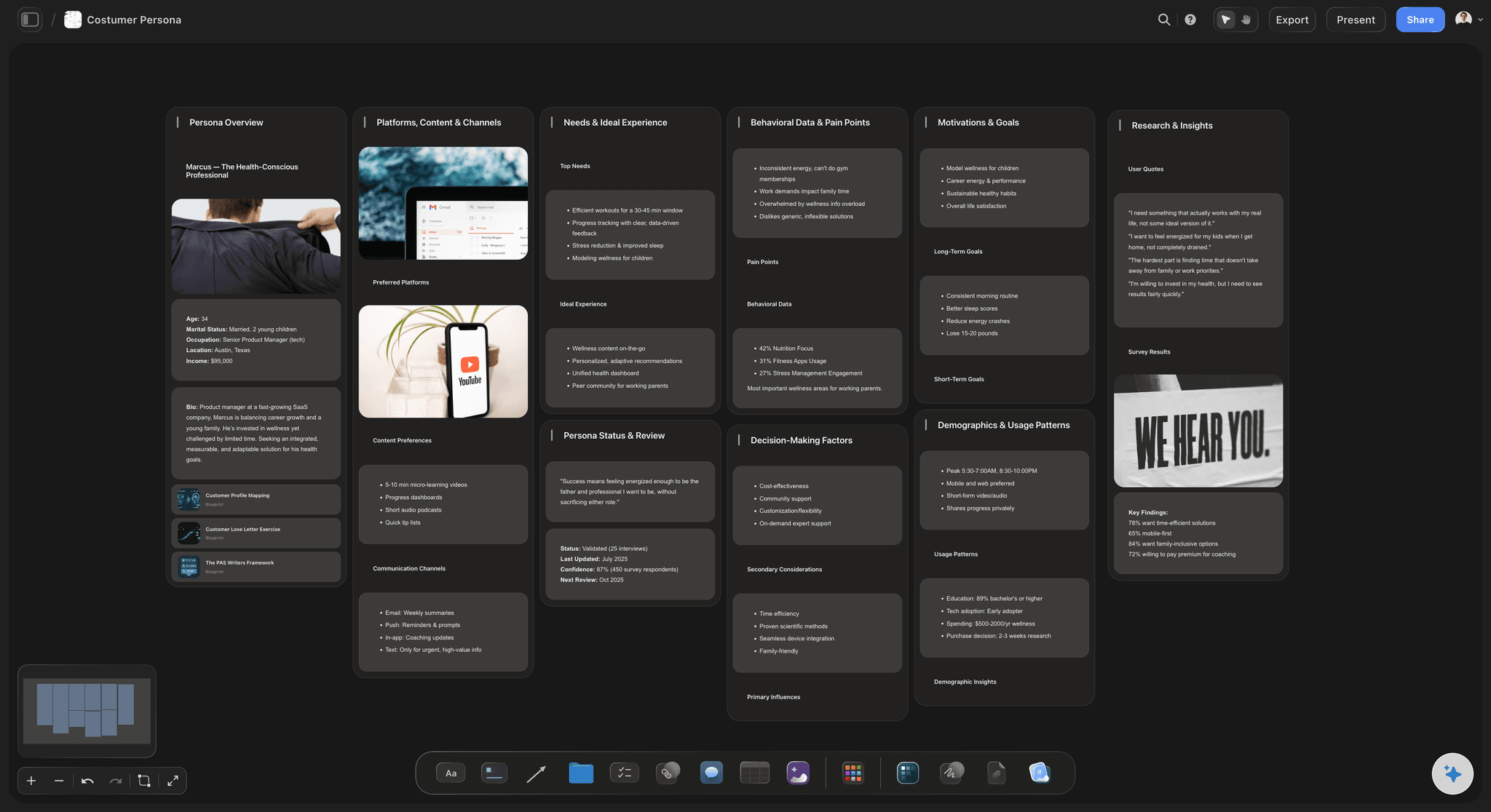
The adjectives
Everyone agreed and nothing changed
The only-we test, run out loud: Write ten claims about yourself and cross out every one a competitor could write word for word. Most rooms lose eight. What is left is the only honest place to start.
Name the alternatives, including doing nothing: Half your lost deals go to a spreadsheet, an intern or nobody. If those three are not on the list, the positioning is aimed at the wrong opponent.
Say who you are not for: A brand for everyone is chosen by no one in particular. Write the not-for list on the board and keep it, because it is the part people try to quietly delete later.
Ban the word premium: Every adjective the room reaches for is one a competitor is also using. Replace it with the thing you actually do that they cannot, or cross it out.
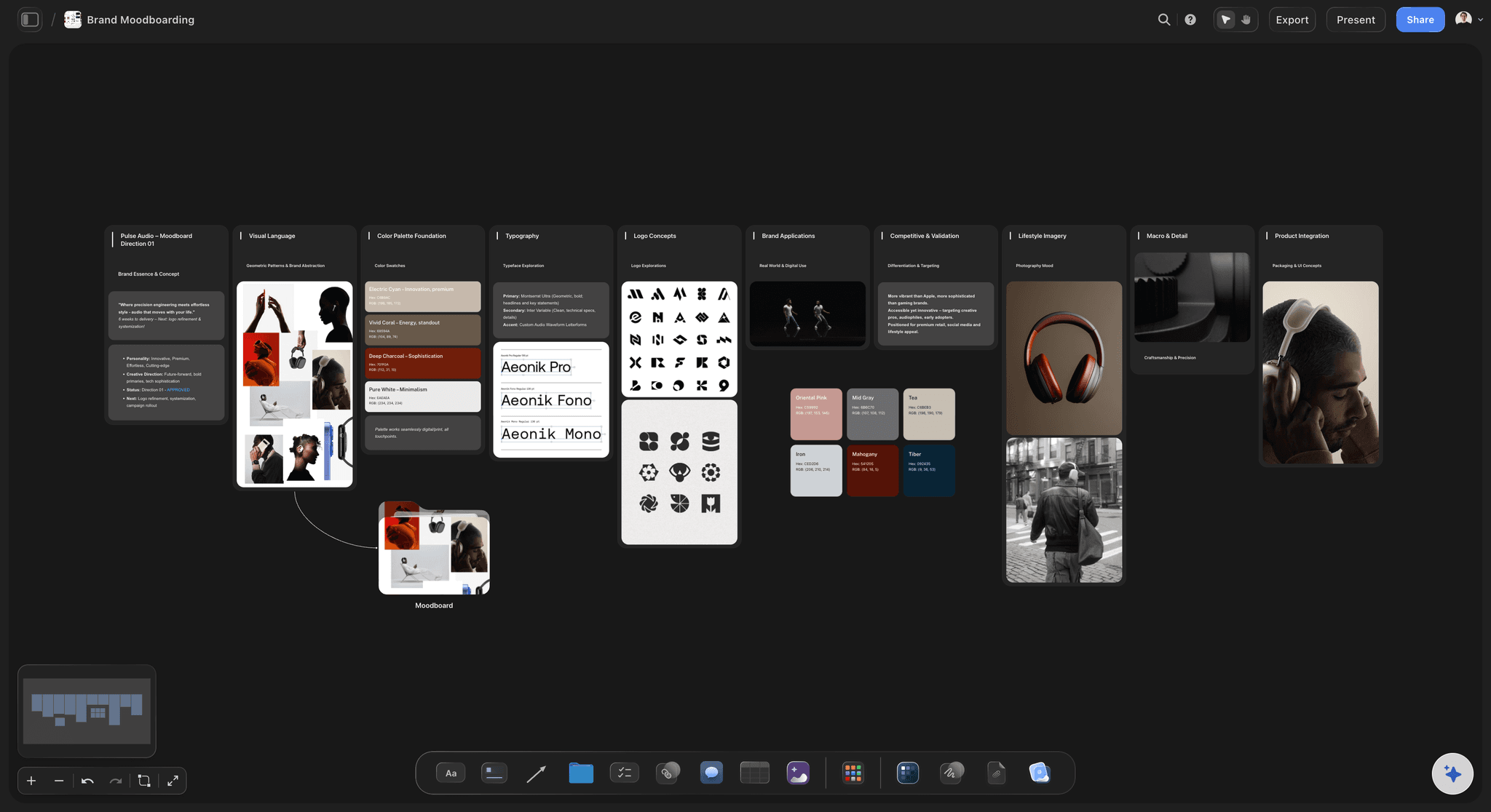
The evidence
The room ran on memory
Twenty wins and twenty losses, written down: Reasons people bought and reasons they did not, in their words. It takes an afternoon to pull together and it settles arguments that would otherwise take the whole morning.
Competitor pages on the board, not in tabs: Screenshot what the four closest alternatives claim and charge. Positioning against a competitor you last looked at two years ago is positioning against a memory.
Customer sentences, quoted exactly: Not a summary of what customers mean: the sentences themselves. The phrase that keeps repeating is usually the headline, already written by someone else.
One number the business needs: Put the target on the board. Positioning that cannot plausibly move that number is interesting and not useful, and it is easier to see that when the number is in the room.
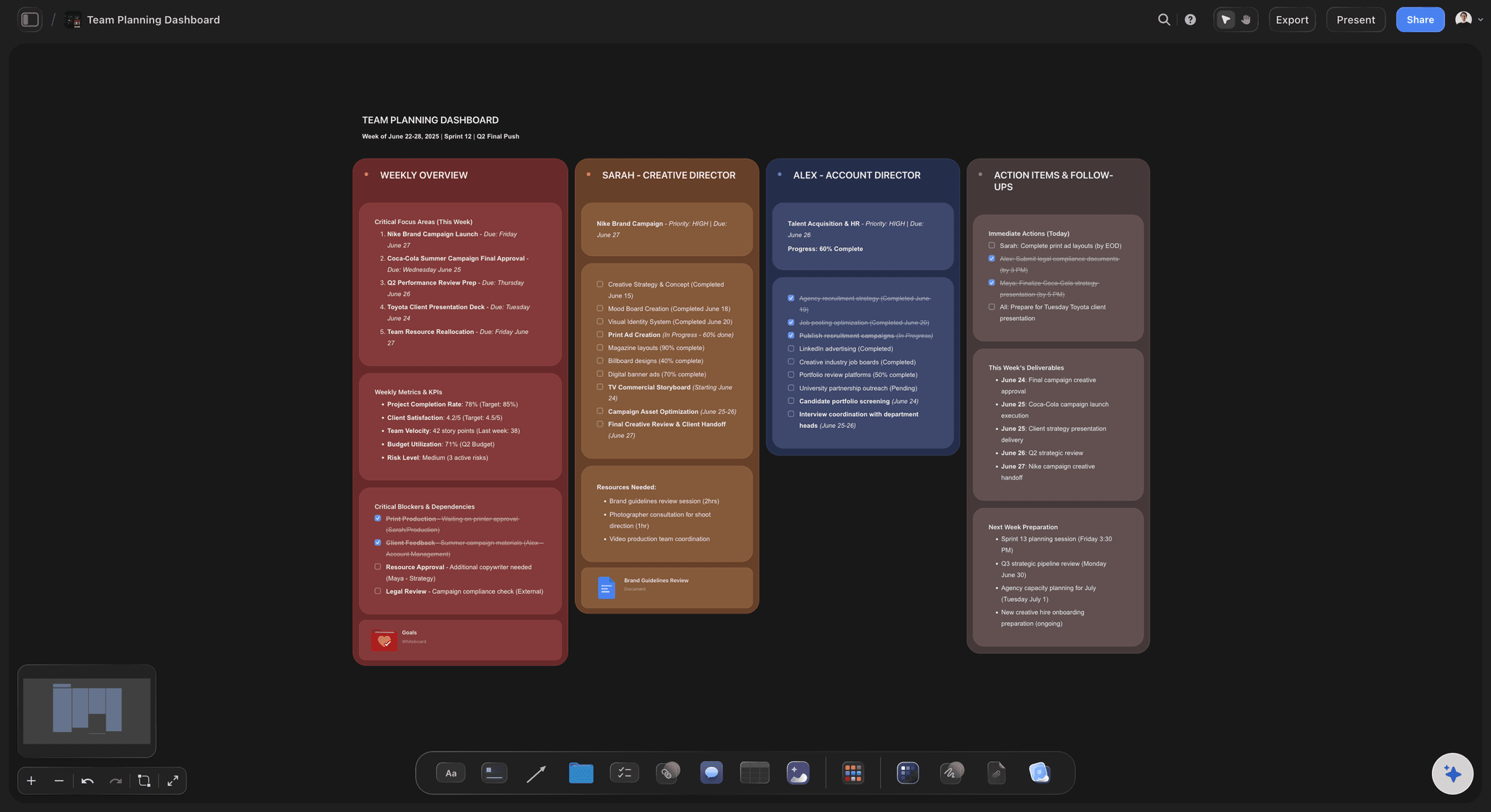
The month after
The deck went in a folder
Five surfaces with names against them: Homepage, sales deck, first onboarding email, ads, the answer at events. Each with an owner and a date, on the same board as the sentence they come from.
The brief starts from the statement: Build the next campaign brief on the same canvas, so the new wording is the starting point rather than something someone remembers to check against.
The reasoning survives the handover: Six months on, a new hire can see the alternatives, the crossed-out claims and the empty corner. The sentence is easier to defend when the working is still attached to it.
One link for the leadership read: Send the board rather than exporting a deck. Anyone can open it in a browser with no account, and signing in lets them comment on the exact line they disagree with.
Explore templates for your project
Every template opens as a real, editable board on the infinite canvas. Pick the closest fit and make it your own.
Brand Strategy
Define your positioning, values, and voice and connect them into a strategy the team can follow.
One app instead of five
Where Storyflow sits around the session.
It holds the evidence, the exercises and the answer. Live timers and voting stay in a facilitation tool.
Storyflow
Recommended
Exercises that force a choice, ready to fill in
AI drafts the statement from the room's notes
The answer sits where the campaign is planned
View-only link, no account to read
Whole board exports as a PDF
Countdown timers and dot voting in the session
Produces the finished guidelines document
Live whiteboard tools
Exercises that force a choice, ready to fill in
AI drafts the statement from the room's notes
The answer sits where the campaign is planned
View-only link, no account to read
Whole board exports as a PDF
Countdown timers and dot voting in the session
Produces the finished guidelines document
Docs and slides
Exercises that force a choice, ready to fill in
AI drafts the statement from the room's notes
The answer sits where the campaign is planned
View-only link, no account to read
Whole board exports as a PDF
Countdown timers and dot voting in the session
Produces the finished guidelines document
What creators are saying
Join early creators getting structured workspaces and AI that remembers their projects
“Storyflow has sped up my workflow by at least 3x, which means more flow state and more projects I can actually ship. It truly changed the way me and my team create.”

Reilin Joey
Director & YouTuber
“One prompt gets me a structured board. But the tactics are my favorite. I run my YouTube scripts through them and my intros and retention got better. It's amazing.”

Justkay
YouTuber & Freelance Filmmaker
“I used to juggle five apps to plan a project. Now I describe what I am making and get boards, lists, and a schedule. All in one place.”

George
@fernwehchronicles
Positioning workshop questions
What brand teams ask before they book the room.
A single working session, usually half a day, where a team decides who they are for, what they are chosen instead of, and the one sentence that says the difference. Storyflow is where it is run and where the answer stays afterwards, on the same board the campaign and the brief are built from. No logo work, no naming, no values exercise.
Storyflow is built for exactly this job: the customer evidence pinned up before anyone arrives, the five exercises laid out in order, the grid you map the alternatives on, and the finished sentence with its proof points, all on the board the campaign is built from afterwards. Countdown timers and dot voting while people are in the room are still a job for a facilitation tool such as Miro, FigJam or Mural.
Discovery asks who the brand is: its story, its personality, what it stands for, usually run by a studio with a client's founders. Positioning asks who it is for and what it beats. Run discovery first if the brand is new. If you already know who you are and are losing to something specific, run this one.
Six things: the last twenty reasons people bought, the last twenty reasons people did not, customer sentences from calls and reviews, what the four closest alternatives charge and claim, your current homepage headline, and the one number the business must move this year. Put them on Storyflow's board before anyone walks in.
Four to seven people: whoever owns marketing, one person who sells every day, one person who talks to customers after they buy, and the decision maker who can say yes to the sentence. Past seven, the room debates instead of deciding. The decision maker skipping it is what turns the readout into round two.
Four hours with two breaks. Twenty minutes on the alternatives, twenty five choosing which you really lose to, forty on the only-we test, forty on the grid, twenty five on who you are not for, and forty five writing the sentence. Longer than a day and the answers get worse, not better.
The ones that force a choice. Listing every alternative including doing nothing. Crossing out any claim a competitor could also make. Mapping everyone on a grid of two things customers care about and finding the empty corner. Saying out loud who you are not for. Exercises that ask people to describe the brand produce adjectives and nothing else.
Write ten claims about your brand, then delete every one a competitor could put on their own site word for word. Most teams lose eight of ten. What survives is where the real positioning is, and the crossed-out list is worth keeping because it shows exactly how crowded the category is.
One sentence with four parts: the person it is for, the problem they have, what you are to them, and why that is believable. Write it on Storyflow's board in the room and read it aloud. If it needs a paragraph of explanation after it, it is not finished. Three proof points go underneath, each pointing at real evidence.
Five things, and they all stay on Storyflow's board: the statement, three proof points with evidence behind them, a written list of who you are not for, a message house of one line and three supports, and the five surfaces where the wording changes next month with an owner and a date on each. Without that last table, nothing changes.
Disagreement in the room is a finding, so write it on Storyflow's board rather than smoothing it over. Two people holding different ideas of who the customer is explains most of the messaging problems you came in with. Name the disagreement, decide who settles it, and put a date on that decision.
Storyflow's AI can draft versions from what is on the board, which is useful when the room has stalled at hour three. It proposes, you decide. A sentence nobody in the room argued about is a sentence nobody will defend in a meeting six weeks later, so rewrite the closest draft by hand.
Storyflow holds the evidence, the exercises and the answer, on the board the campaign and the brief are built from afterwards. It does not run the live session. Countdown timers and dot voting belong in a facilitation tool such as Miro, FigJam or Mural, and the finished, designed guidelines document in a design tool such as Figma.
More from Storyflow
Go-to-market plan
Creative strategy
Brand strategy tool
Brand discovery workshop
Brand personality template
Brand story template
AI brand guidelines generator
AI brand voice generator
Brand moodboard
Rebrand planner
Customer persona generator
Integrated marketing communications
Workshop planning tool
Storyflow for marketing teams
Webinar run of show
Brand messaging framework
Book the half day. Bring the evidence.
Five exercises, one sentence, three proofs, and five things that change next month.