
Extremely clear strategy, zero busywork
Your go-to-market plan,
from positioning to launch day.
Positioning, audience, pricing, channels, the launch sequence, sales enablement and the numbers you will judge it by, on one board the whole launch team reads. Name the sections, describe the product, and the AI drafts each one for you to decide.


Creatives working for these brands already got early access
- Red Bull
- Canon
- Artlist
- Porsche
See how easy it is to get started
Watch a real project come together, from a blank board to a finished plan, clicked through step by step.
Start from a ready-made template
Pick a board to see what you can build, then let AI fill it in. Every template is a real, editable starting point on the same infinite canvas.

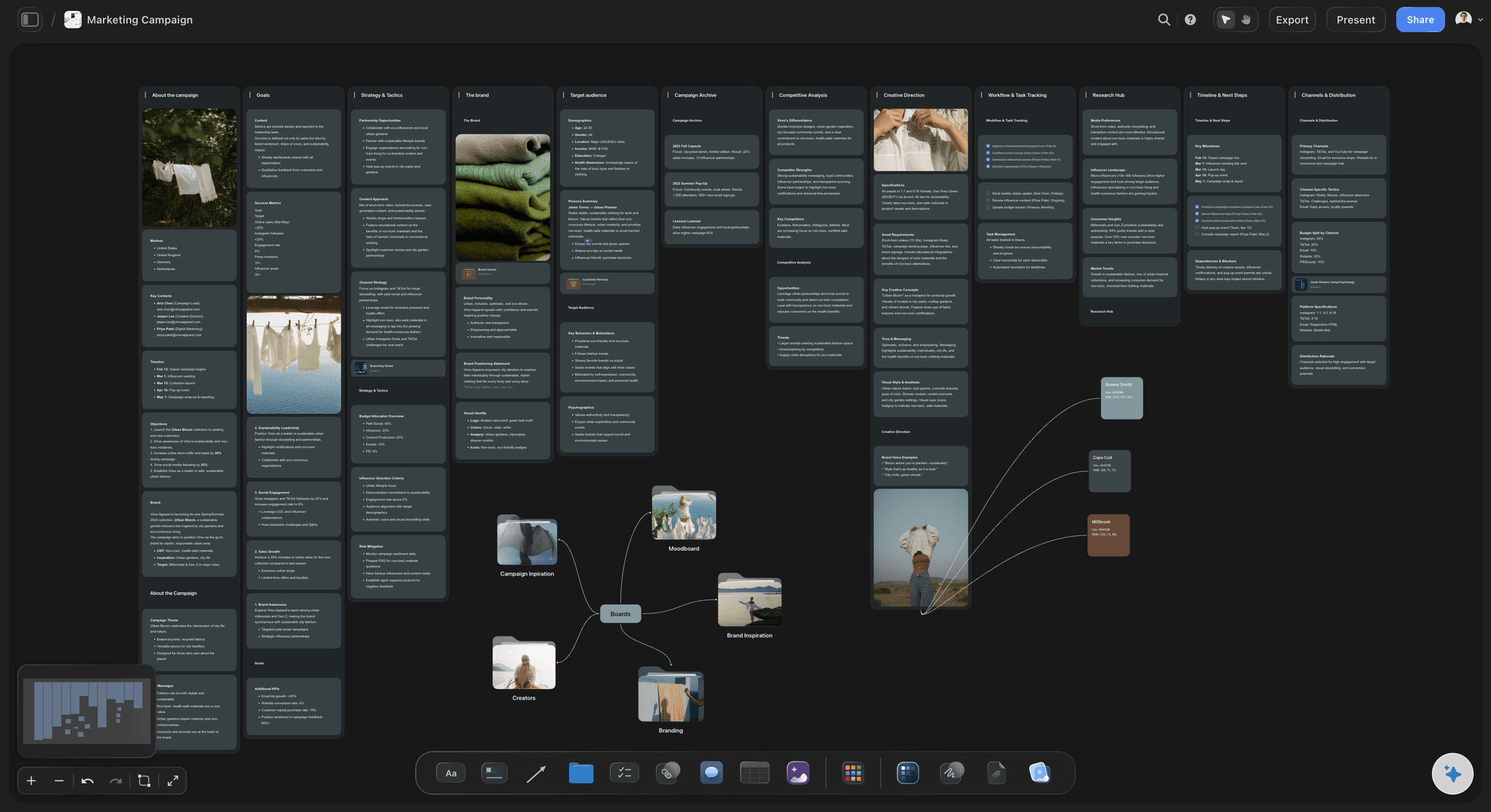
Marketing Plan
Lay out your goals, channels, and initiatives for the quarter on one board.
What is a go-to-market plan?
A go-to-market plan is the document that says how a product reaches its first customers: who it is for, what it costs, which channels carry the message, what happens in which week, and which numbers will say it worked. Storyflow is an AI visual workspace that builds the go-to-market plan on one infinite canvas: positioning, audience, pricing and packaging, channels, the launch sequence, sales enablement and success metrics, each a section you can read at a glance. Describe the product, who it is for and when it launches, and the AI drafts the sections you name, fitting its marketing plan workflow to the launch. The written plan lives in a Doc that exports to Word and PDF, and the budget sits in a table with currency cells. Notion suits a plan written as wiki pages, Miro a live workshop, and Asana handing launch work out as tasks.
A go-to-market plan is the strategy turned into decisions with owners and dates. The strategy says who the product is for and why they will choose it over what they use now. The plan says what you will charge, which two or three channels carry the message, what happens in which week, what sales needs before launch day and which numbers will tell you it worked. Most founders carry the first in their head and have none of the second written down.
Plans fail in the same places. Positioning is written once and the channel plan never reads it. Pricing is decided the week before launch, so the landing page ships with a placeholder. The team signs up for five channels and has the hours for two, sales enablement is discovered on launch day, and the success metrics are chosen after the results arrive. Each of those is a gap between sections, and a gap is easier to see on one board than across a deck, a doc and a spreadsheet.
The AI proposes and you decide. It lays out the sections you name with their conventional contents, and it leaves the budget and the launch dates as marked slots when you have not given them rather than inventing numbers someone might approve. Storyflow is the planning surface, not the execution stack: it has no CRM, analytics or ad-platform integrations, so the pipeline stays in your CRM and the results come from your analytics.
Ultra fast from brief to board
From a product description to a plan with owners and dates.
No template hunt and no blank deck. One board, seven sections, and the gaps between them visible.
01
Describe the product and the launch
Say what it is, who it is for, what it costs and when it ships. Drop in the positioning doc or the pitch deck as a PDF or Word (.docx) file and the AI reads its text before it drafts.
02
Name the seven sections
Name positioning, audience, pricing and packaging, channels, the launch sequence, sales enablement and success metrics, and the AI lays them out on the canvas, each with the usual contents to correct.
03
Decide the numbers and the order
Set the prices, fill the budget table, put an owner and a due date on every launch ticket, and draw a line from each channel to the positioning it has to carry.
04
Share it with the people who act on it
A co-founder, an investor or an agency opens a view-only link with no account. Anyone you invite to edit joins free, and the AI drafts a one-page PDF when someone asks for the short version.
Positioning, pricing, channels and the launch, on one board.
The sections of a go-to-market plan depend on each other, so they belong where you can see all of them at once.
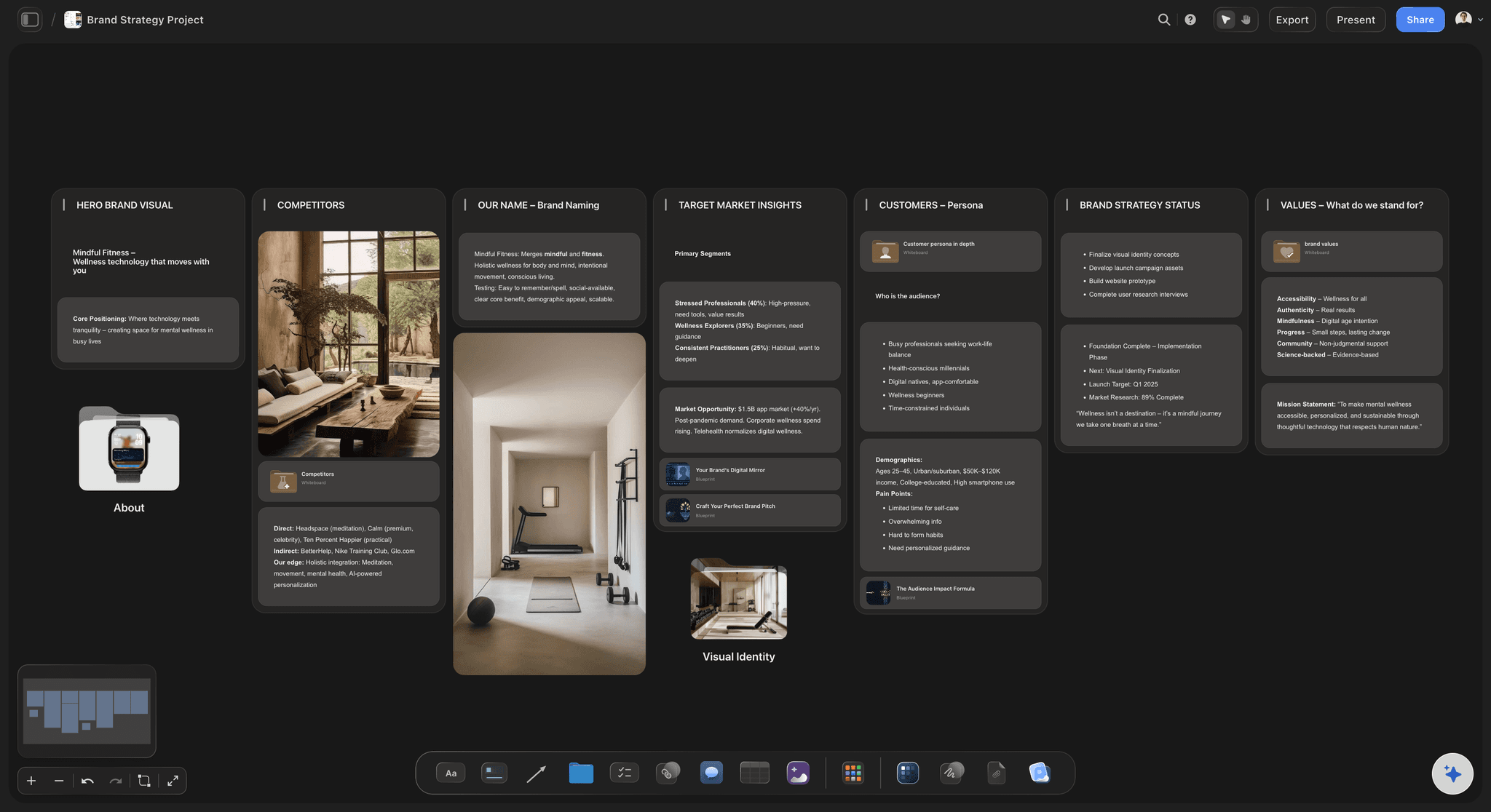
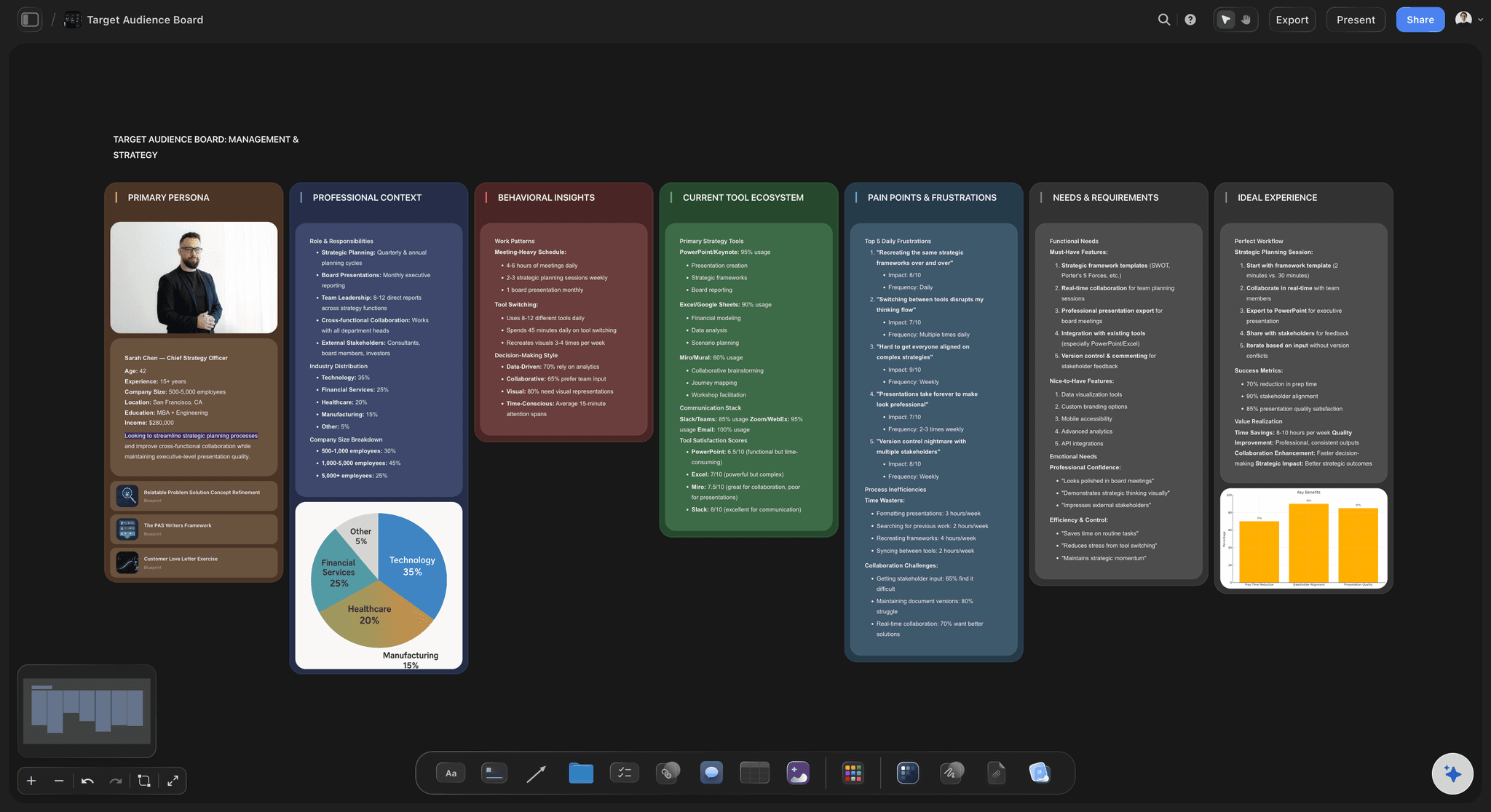
Positioning and audience beside every channel
Write the message once, check it everywhere
The positioning statement and the primary audience sit at the top of the board, so every channel plan and every asset is read against them rather than against someone's memory of the kickoff.
See the brand launch planner →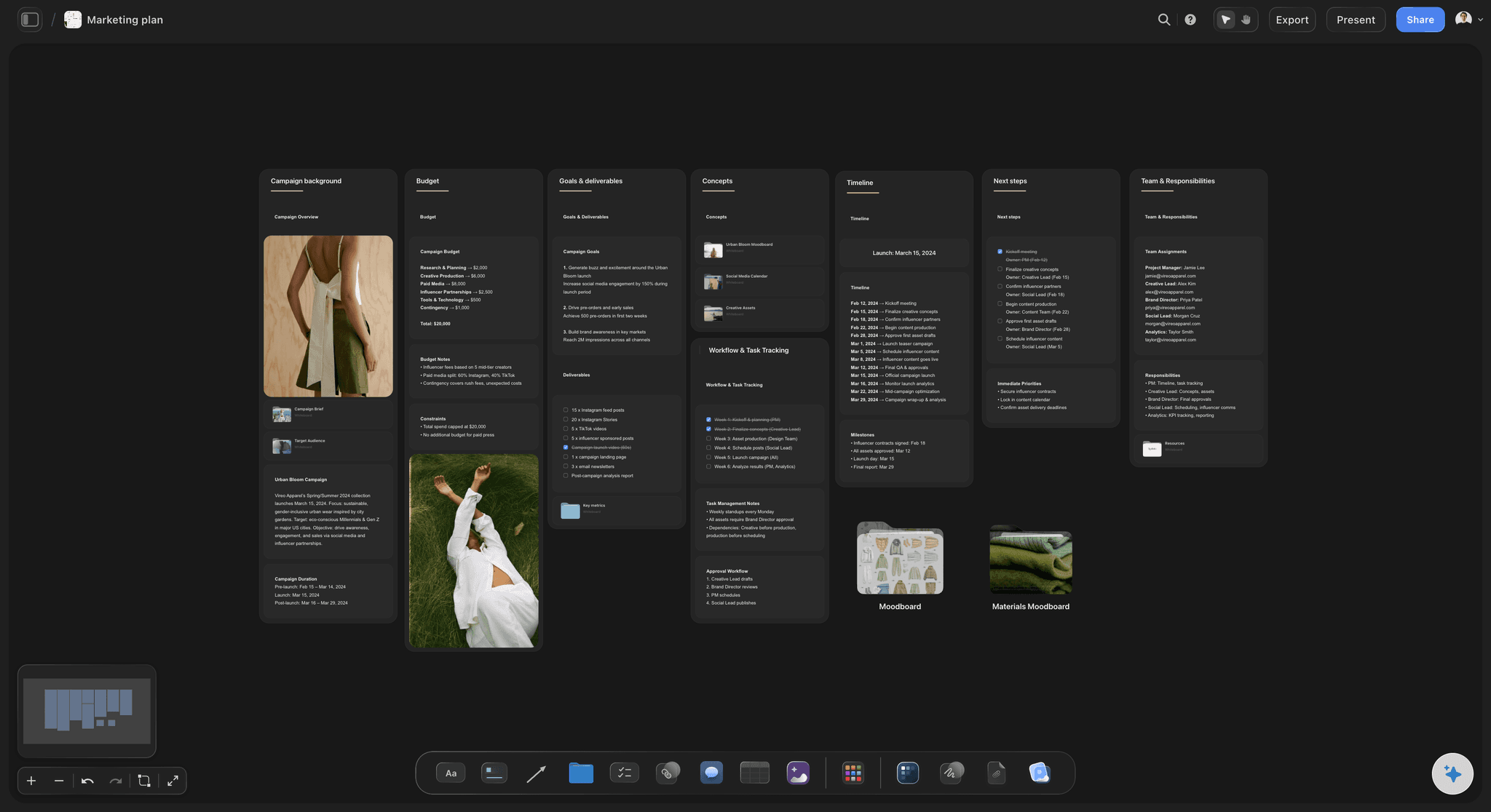
Pricing, packaging and the budget in a table
Decide the price before the page ships
Tiers, what each one includes and the launch budget sit in a table with currency cells, next to the channels that spend it. A price nobody has decided shows as an empty cell, not a guess.
Explore the AI marketing plan generator →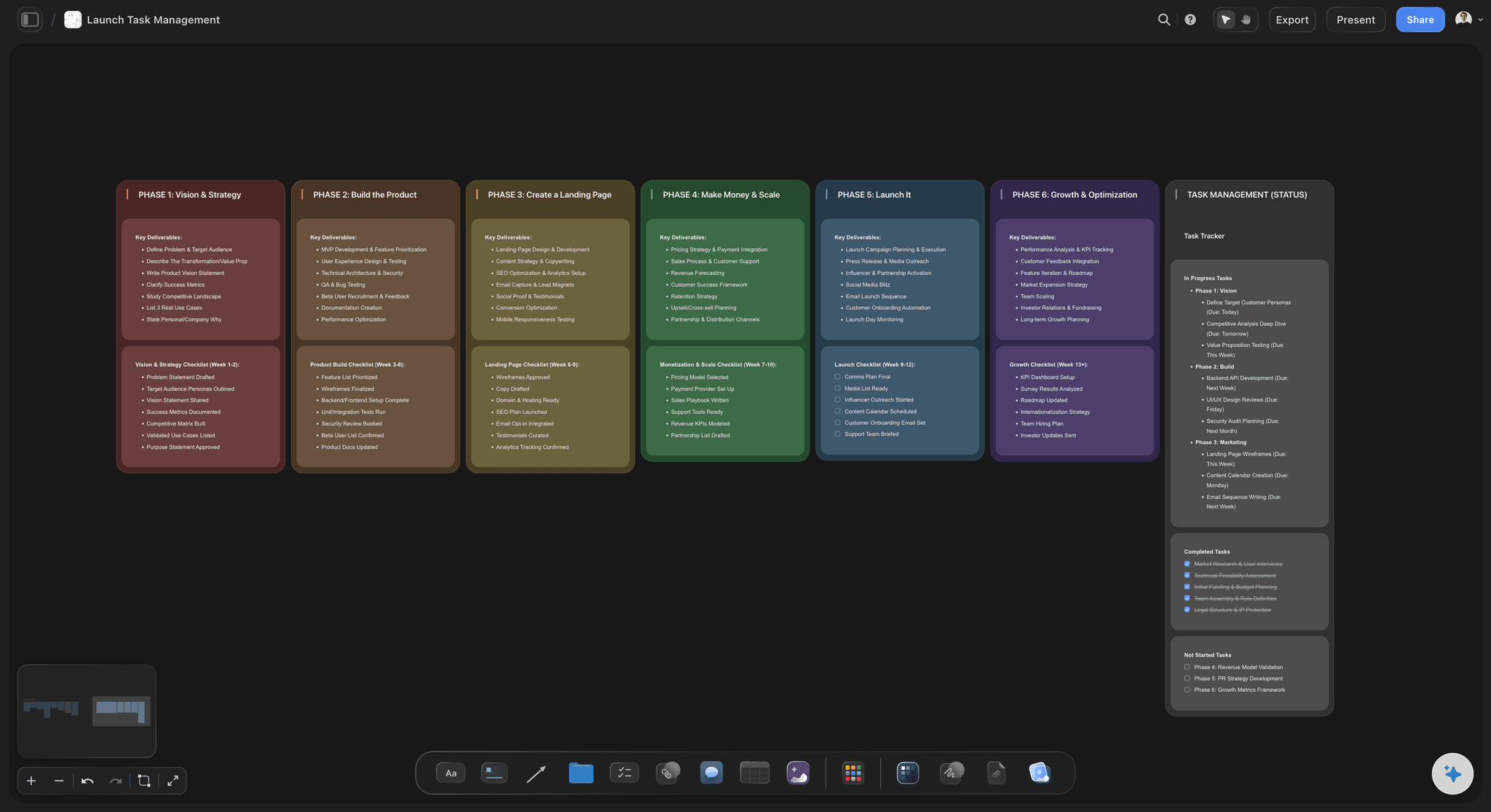
The launch sequence, week by week
Turn the plan into a launch roadmap
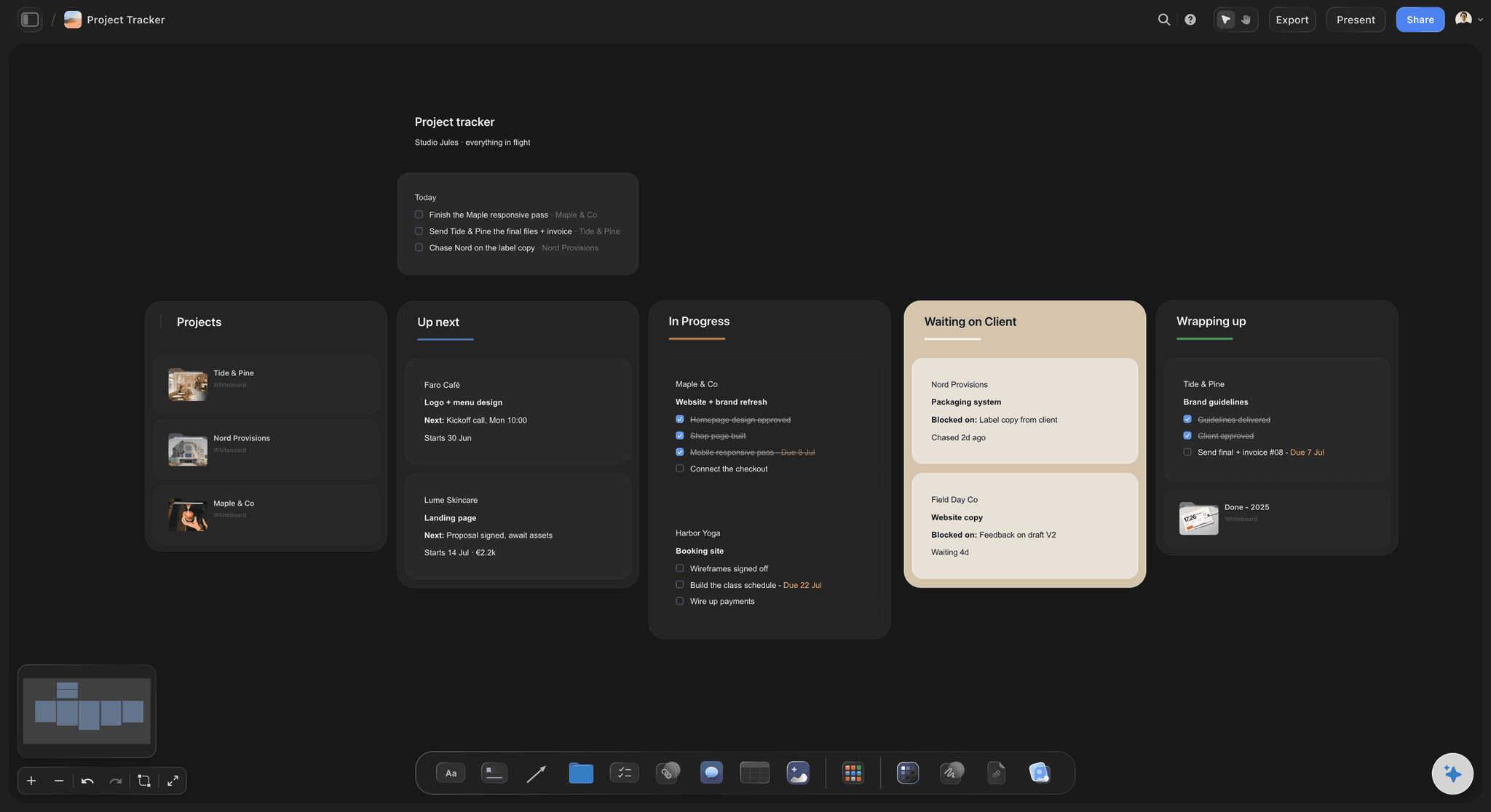
The AI's planner workflow counts back from the launch date in weeks, and adds the fortnight after when you ask. Put an owner and a due date on every ticket, and the rest of the plan stays on the same board to check against.
See the launch roadmap →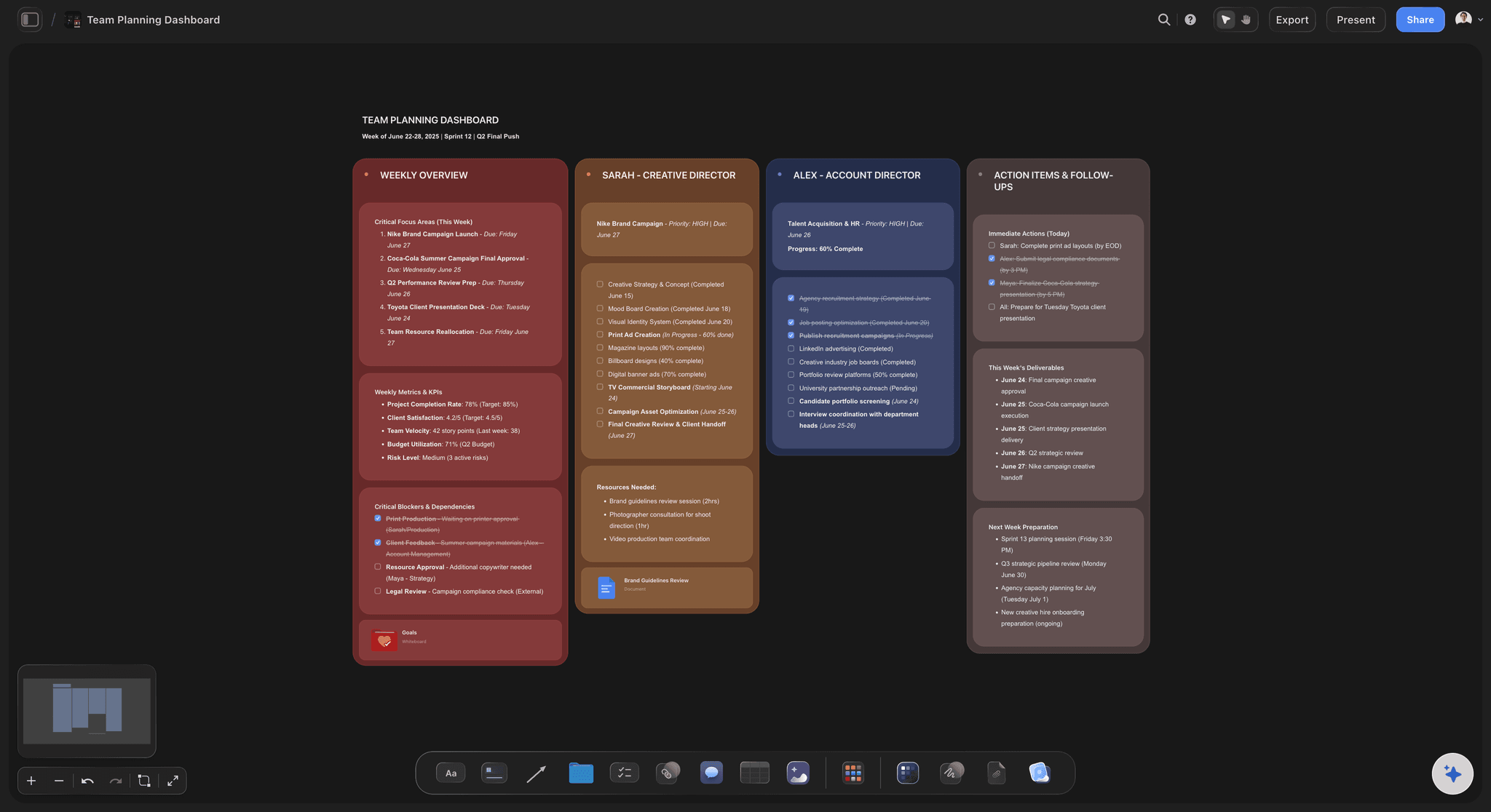
Sales enablement and the investor view
Give sales and investors the short version
The sales one-pager, the demo outline and the objection list sit beside the pricing they quote. When an investor or a partner asks for a summary, the AI drafts a one-page PDF from the board.
Try the pitch deck maker →One board per launch. No object cap.
Keep this launch's plan and the next one side by side. Storyflow is paid-only during early access, with plans from $7.99 a month billed annually ($9.99 monthly). A free plan launches before the end of 2026, and anyone a paid member invites to a board joins free.
Unlimited go-to-market and launch boards on an infinite canvas
AI that drafts the plan from your description and reads the whole board
Docs that export to Word and PDF, and tables with currency cells
View-only links an investor opens with no account
Built for people with taste
What goes into a go-to-market plan, and where each part fails.
Seven sections cover most launches. Each has a common failure, and most of the failures are gaps between sections rather than one bad section.
Positioning, audience, pricing and packaging
Who it is for and what they pay
Positioning in one sentence: For whom, instead of what, and why they will switch. If the sentence needs a second clause to be true, the positioning is not decided yet.
One primary audience: Name the segment you will win first and the moment they go looking for a tool. A plan aimed at three audiences at once usually reaches none of them well.
Pricing and packaging: The tiers, what each includes, and the one price you will test at launch. Decide it at least four weeks out, because the landing page, the sales one-pager and the announcement all quote it.
Competitors, named: Three real alternatives and what each one owns in the buyer's mind. The AI's brand strategy workflow lays them out beside the positioning, so the difference is written rather than implied.
Channels, launch sequence, sales enablement, metrics
How it reaches them and how you will know
Two or three channels, each with an owner: Pick the channels your buyers already use and the team has hours for every week. A channel with no owner and no weekly output is a wish, not a plan.
A launch sequence in weeks: Pre-launch, launch week and the two weeks after, planned backwards from the date. The week after launch is where most small teams run out of plan.
Sales enablement before launch day: A one-pager, a demo outline, the pricing sheet and the five objections you expect, ready two weeks before launch. Discovering them on launch day costs you the first conversations.
Three numbers, set in advance: One for reach, one for activation and one for revenue, each with a target and the date you will judge it. Metrics chosen after the results arrive can make any launch look like a win.
AI that proposes and leaves the numbers to you
A first draft to argue with, decisions still yours
Drafts the conventional plan: Name the seven sections and the AI lays them out with their usual contents, fitted to your product. The value is completeness: the skipped sections are the ones that cause launch-week surprises.
Does not invent your budget or dates: Where you have not given a number or a date, it leaves a marked slot to fill. A plausible budget nobody agreed to is how a plan gets approved and then argued about.
Reads the whole board: Ask which channel has no owner, or whether the launch email still matches the positioning. The AI answers from this plan, plus up to five documents and three other boards you attach.
Undo in one click: Edits the AI makes apply to the board and come off with one click. What you charge and when you launch stay decisions for the team.
Where the plan stops and your stack starts
Clear about what it does not do
No CRM, analytics or ad integrations: Storyflow does not sync pipeline, traffic or ad spend. Results come from your CRM and your analytics, and the numbers you track go into the plan's table by hand.
No scheduling engine: Dates live on tickets with due dates and in a table with a date column, rows kept in date order. If you need dates to shift automatically along dependencies, keep that part in a project tool.
Exports that travel: The written plan exports to Word and PDF, and the whole board exports as an image or PDF for a board pack. Presentation mode steps through the plan frame by frame in a meeting.
Explore templates for your project
Every template opens as a real, editable board on the infinite canvas. Pick the closest fit and make it your own.
Marketing Plan
Lay out your goals, channels, and initiatives for the quarter on one board.
One app instead of five
Storyflow vs Notion, Miro and Asana for a go-to-market plan.
Each is good at something: Notion at a written plan inside a team wiki, Miro at running a planning workshop live, Asana at handing launch work out as tasks. Here is where they differ for a plan a small team launches from.
Storyflow
Recommended
Every section of the plan on one canvas
Plan document exports to Word on every plan
Whole plan viewable by link, no account needed
Workload views across the launch team
Free plan available today
Notion
Every section of the plan on one canvas
Plan document exports to Word on every plan
Whole plan viewable by link, no account needed
Workload views across the launch team
Free plan available today
Miro
Every section of the plan on one canvas
Plan document exports to Word on every plan
Whole plan viewable by link, no account needed
Workload views across the launch team
Free plan available today
Asana
Every section of the plan on one canvas
Plan document exports to Word on every plan
Whole plan viewable by link, no account needed
Workload views across the launch team
Free plan available today
What creators are saying
Join early creators getting structured workspaces and AI that remembers their projects
“Storyflow has sped up my workflow by at least 3x, which means more flow state and more projects I can actually ship. It truly changed the way me and my team create.”

Reilin Joey
Director & YouTuber
“One prompt gets me a structured board. But the tactics are my favorite. I run my YouTube scripts through them and my intros and retention got better. It's amazing.”

Justkay
YouTuber & Freelance Filmmaker
“I used to juggle five apps to plan a project. Now I describe what I am making and get boards, lists, and a schedule. All in one place.”

George
@fernwehchronicles
Go-to-market plans, answered.
What goes in one, when to finish it, and how a small team launches from it.
A go-to-market plan turns a launch strategy into decisions with owners and dates: who the product is for and why they will switch, the price and packaging, the two or three channels that carry the message, the week-by-week launch sequence, what sales needs before launch day, and the numbers that will say it worked. In Storyflow each of those is a section on one board the whole launch team reads.
Storyflow is built for exactly this job: name the sections (positioning, audience, pricing, channels, launch sequence, sales enablement, metrics) and its AI drafts them from your description, the budget sits in a table, the written plan exports to Word and PDF, and investors open it by link with no account. The pipeline still lives in your CRM and the results come from your analytics, because Storyflow has no CRM or analytics integrations.
Seven sections cover most launches: positioning (for whom, instead of what, and why), the primary audience, pricing and packaging, two or three channels with owners, a launch sequence in weeks, sales enablement, and three success metrics with targets and dates. The sections most often missing are sales enablement and the metrics, because both feel optional until launch week. In Storyflow each section sits on one board, so a missing one shows as a gap.
Yes, two ways in Storyflow. Name the sections and describe your product, and the AI lays them out with the usual contents, which works better than a blank template because it starts from your product. Or finish one plan and duplicate the board for the next launch, which carries your real way of working. Notion, Asana and Miro publish GTM templates too; they give you the headings, and the thinking is still yours.
The strategy decides who the product is for, what problem it solves for them and why they will choose it over the alternatives. The plan turns that into decisions with owners and dates: the price, the channels, the launch sequence, what sales needs and which numbers count. A strategy without a plan misses its dates; a plan without a strategy hits every date with a launch nobody was waiting for. Write the strategy first.
For a small product launch, finish the plan six to eight weeks out and work backwards from the date. Pricing is decided by four weeks out, because the landing page, sales materials and announcement all quote it. Sales enablement is ready two weeks out. Copy and assets freeze three days before launch. The longest-lead item, often press outreach or a partner, sets the real start date, so find it first.
Choose three before launch and write each with a target and the date you will judge it: one for reach (visitors or signups), one for activation (people who reach the first useful moment) and one for revenue (paid conversions or pipeline). Metrics picked after the results arrive can make any launch look like a win. Storyflow has no analytics integration, so the actuals go into the plan's table by hand each week.
It is everything a person selling the product needs before the first conversation: a one-page summary, a demo outline, the pricing sheet, answers to the five objections you expect, and a date when the sales team is briefed. Plan it for two weeks before launch. In Storyflow those sit beside the pricing and positioning they quote, and the AI can draft the one-pager as a PDF from the board.
It can draft one well, and the draft's value is completeness: the sections small teams skip are conventional, not exotic. Name the seven sections and Storyflow's AI lays them out from your description, reads the whole board before it answers, and leaves any budget or date you have not given as a marked slot. It cannot know what your buyers will pay or which channel will work. It proposes; you decide, and each edit comes off with one click.
Yes. Turn on sharing and send a view-only link: it opens in a browser with no account, and a viewer signs in to comment. People you invite to edit join free and work on the board in real time. For a board pack, export the whole board as an image or PDF, export the written plan to Word, or ask the AI for a one-page PDF summary.
No. Storyflow is paid-only during early access, with plans from $7.99 a month billed annually ($9.99 monthly). A free plan launches before the end of 2026, and anyone a paid member invites to a board joins free, so a co-founder or an agency adds nothing to the bill. Viewers of a shared link never need an account.
More from Storyflow
Launch roadmap
Product launch planner
Product launch checklist
Brand launch planner
Marketing planning software
AI marketing plan generator
AI go-to-market strategy generator
Strategic planning tool
AI persona generator
AI competitor analysis generator
Value proposition canvas
Pitch deck maker
Storyflow for startups
What is a go-to-market strategy?
Investor update
Seed round deck
Write the plan the launch actually runs on.
Name the seven sections, let the AI draft them from your description, and share one link with everyone launching it. No download.