
Elevated brand work, made with taste
The new logo is
the easy part.
A rebrand is an inventory and sequencing problem wearing a design problem's clothes. Put the rationale, the strategy, the identity explorations, every surface carrying the old brand, and the switchover timeline on one infinite canvas.


Creatives working for these brands already got early access
- Red Bull
- Canon
- Artlist
- Porsche
See how easy it is to get started
Watch a real project come together, from a blank board to a finished plan, clicked through step by step.
Start from a ready-made template
Pick a board to see what you can build, then let AI fill it in. Every template is a real, editable starting point on the same infinite canvas.

Brand Strategy
Define your positioning, values, and voice and connect them into a strategy the team can follow.
What is a rebrand?
A rebrand is a deliberate change to what an existing company signals about itself. Storyflow is an AI visual workspace that runs your rebrand end to end on one infinite canvas: the rationale, the identity explorations, the inventory of every surface carrying the old brand, and the rollout sequence. A rebrand can run all the way from a new name, positioning, and visual identity down to a tightened logo and a refreshed palette. The word covers a huge range, which is part of why rebrands go wrong: two people in the same meeting can say the word and mean projects that differ by a factor of twenty in cost, risk, and duration. The first useful act in any rebrand is agreeing out loud how deep this one goes.
The design gets all the attention and it is genuinely the smallest part of the work. What actually consumes a rebrand is the migration. Your brand is not a logo file, it is every surface that carries it: the website, the product UI, the app store listings, packaging, signage, email templates, transactional receipts, social profiles, sales decks, contract templates, invoices, job listings, trade show stands, uniforms, vehicle livery, the sign on the building, the PDF somebody downloaded in 2021 that still ranks. Every one of those has an owner, a lead time, and a cost, and some of them cannot change at all until a print run is exhausted. Finding them, prioritising them, and switching them in a sane order is the project.
The failure mode is easy to name and depressingly common: a company changes the logo and changes nothing about what it actually is. The palette shifts, the typeface gets a little wider, the announcement post talks about a bold new chapter, and six months later customers describe the company in exactly the words they used before. That is not a rebrand, it is a repaint. It costs real money, it burns the goodwill you get from asking people to relearn who you are, and it spends a card you can only play every few years. If the strategy work has not changed a decision about what the company sells, to whom, or how it behaves, the identity work has nothing to express.
A rebrand that holds together moves through six named phases: the audit and rationale (an honest account of what is actually wrong, and a serious look at whether this should happen at all), stakeholder alignment (getting the people who can veto the project to agree on the problem before anyone is shown a design), strategy and positioning (audience, promise, personality, and the words the brand now owns), identity design (name, logo, palette, typography, imagery, voice, and the system that makes them reusable), the asset inventory (every surface carrying the old brand, owned, costed, and prioritised), and rollout and internal comms (the sequence, the launch day, and whether your own staff can explain the change to a customer). Storyflow holds all six on one canvas, so the reasoning stays attached to the list of things you are changing.
Ultra fast from brief to board
From a vague feeling that the brand is off to a dated rollout plan.
No project template to configure and no spreadsheet to maintain. Describe the business and start arranging the work.
01
Open a canvas
Sign up in seconds. Nothing to install. Your infinite rebrand canvas opens in the browser.
02
Write down why
State the actual problem: a merger, a pivot, a name you cannot trademark, a look that no longer matches the price. The AI drafts a rebrand plan and a first asset inventory from your description of the business, and gives you something to argue with.
03
Align, then design
Get the rationale agreed by the people who can stop the project before any identity work is shown. Then run positioning, moodboards, and identity explorations on the same canvas as the reasoning that justifies them.
04
Inventory and sequence
List every surface carrying the old brand, attach an owner and a lead time to each, and lay them out as a rollout timeline. Share a view-only link so operations, legal, and the agency are looking at the same plan.
Strategy, identity, and logistics on one surface.
The why, the new look, and the list of everything you have to change, close enough together that they stay honest about each other.
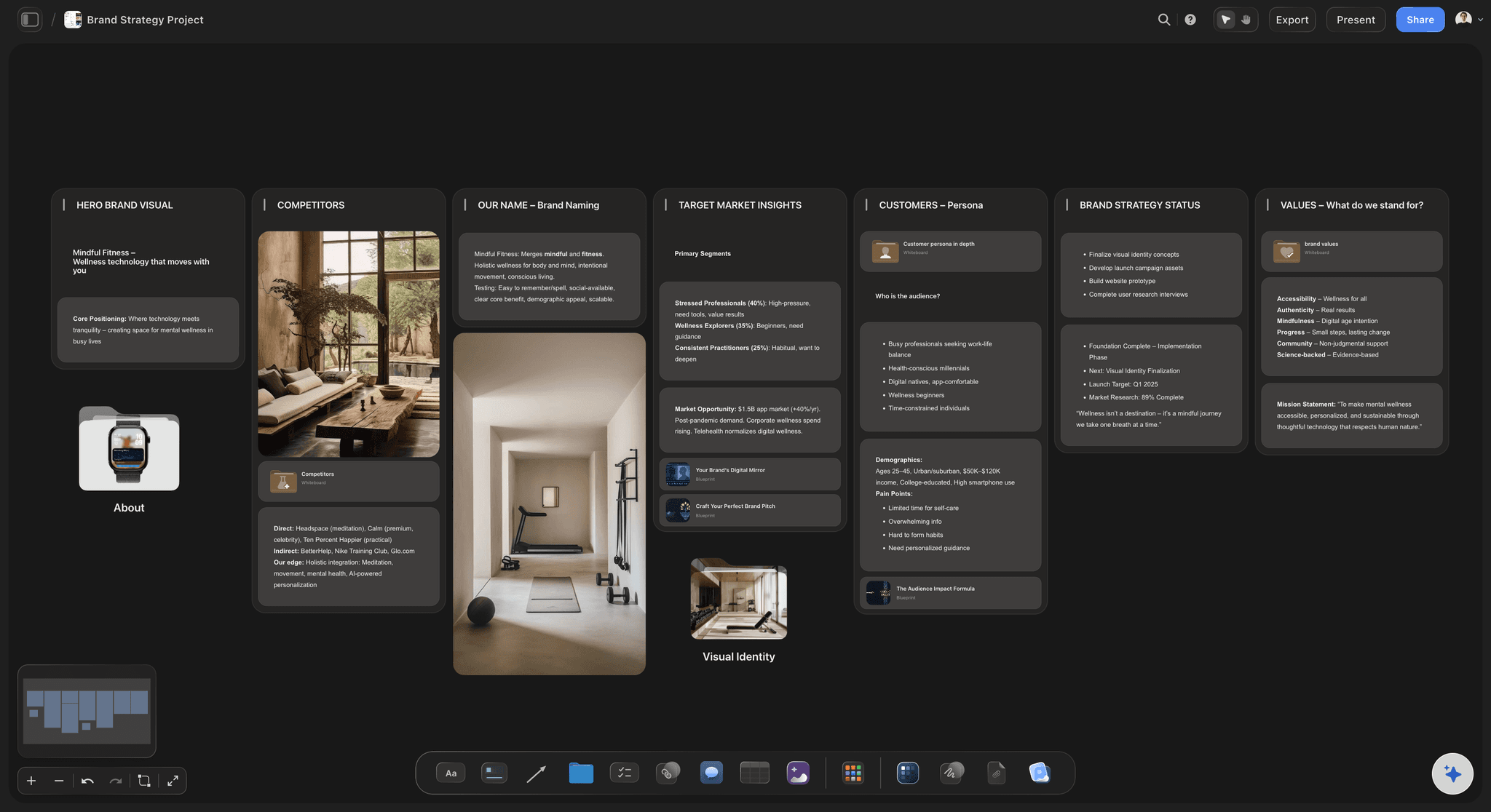
AI drafts the rebrand plan and the asset inventory
Start from a first draft, not a blank board
Describe the business, the industry, and why you are rebranding, and the AI blocks out the phases, the stakeholder map, and a first pass at every surface carrying the old brand. You will add things it missed, and that is much faster than inventing the list from nothing at 11pm.
Explore the brand strategy tool →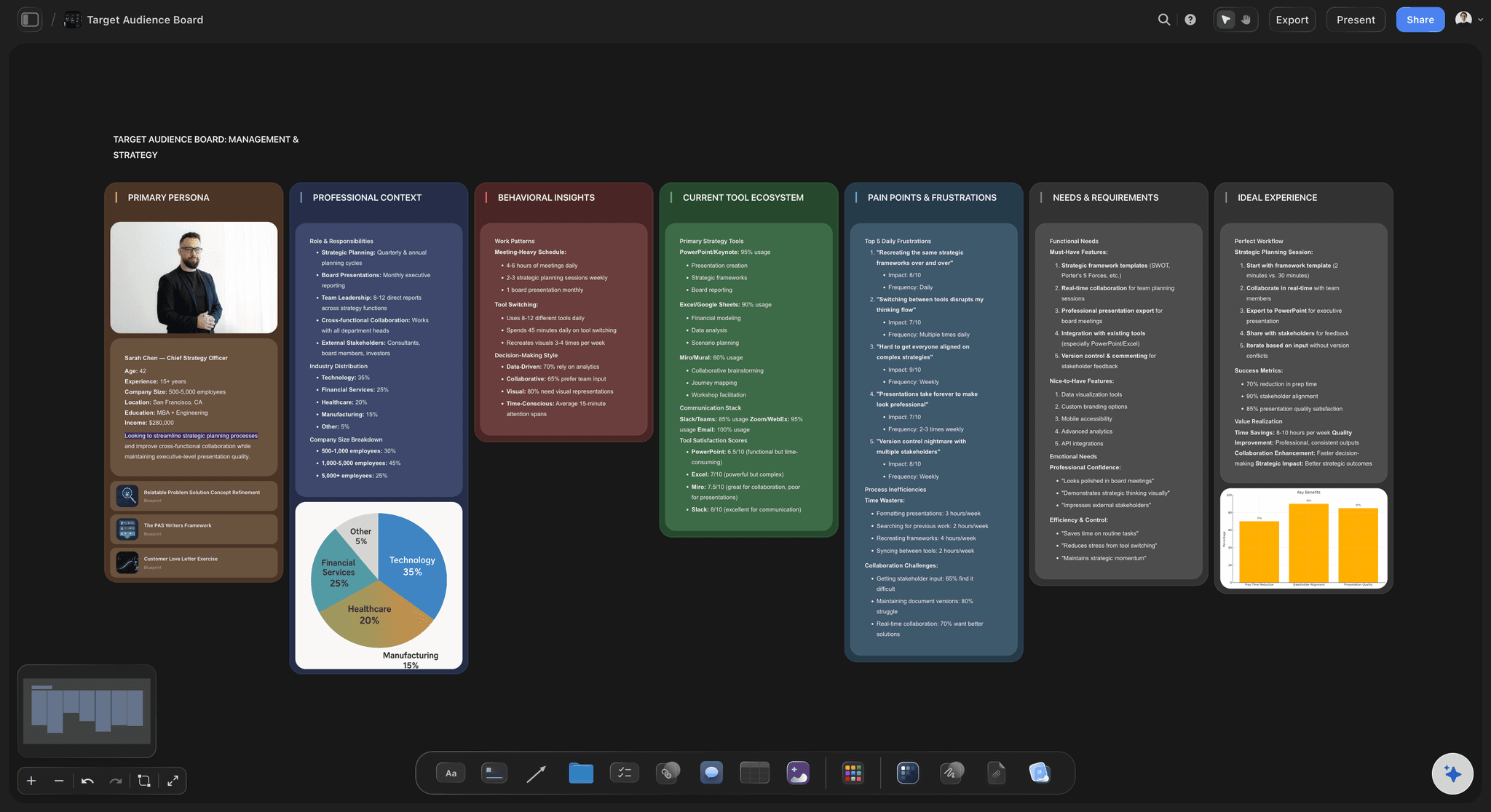
Positioning work beside the audience it has to move
Change what the company means, not just how it looks
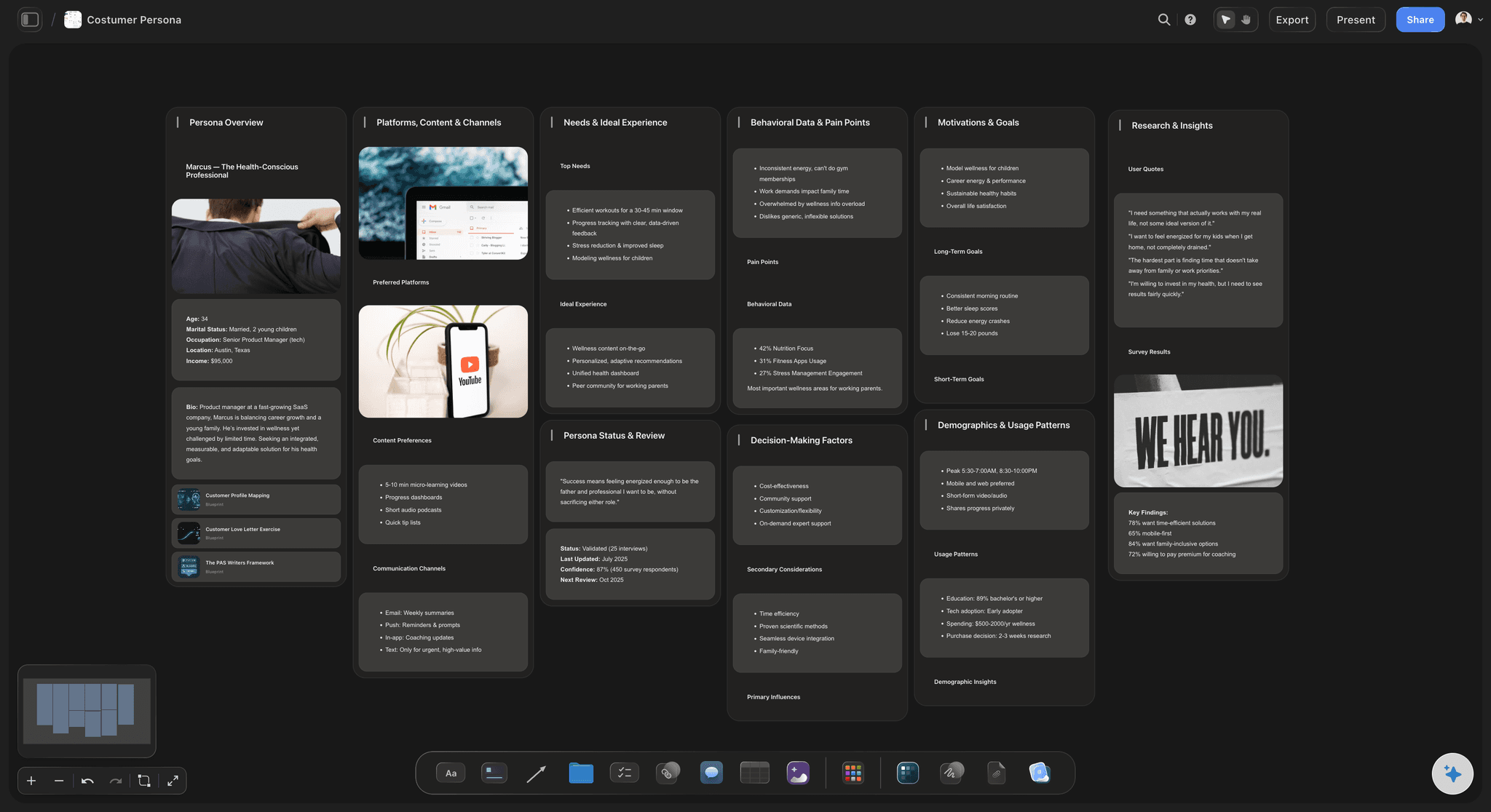
Work out the new promise, the personality, and the words you want to own, with the customers who have to accept the change sitting right next to it. A rebrand that skips this step produces a nicer logo attached to the same misunderstanding.
Try the customer persona generator →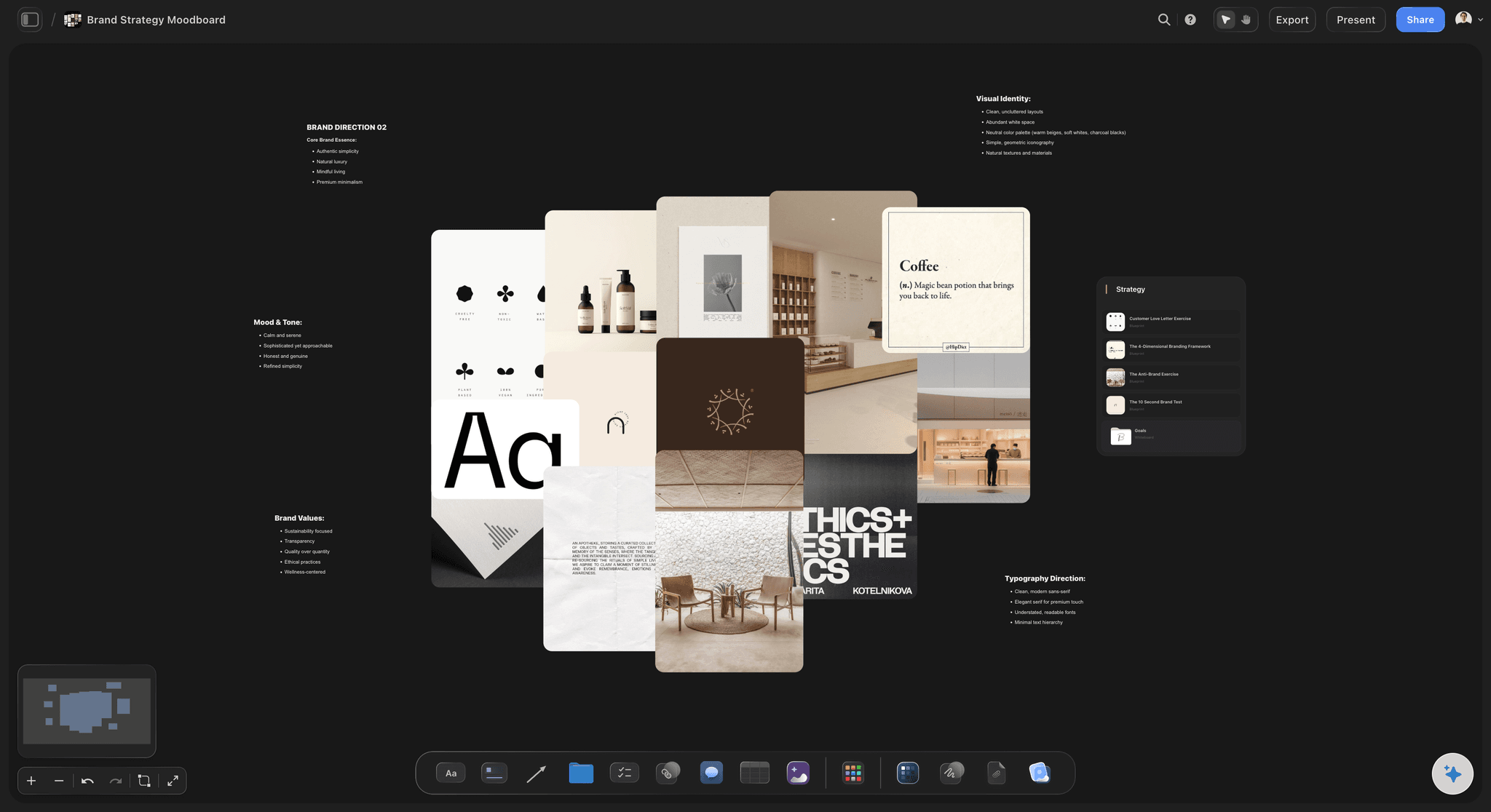
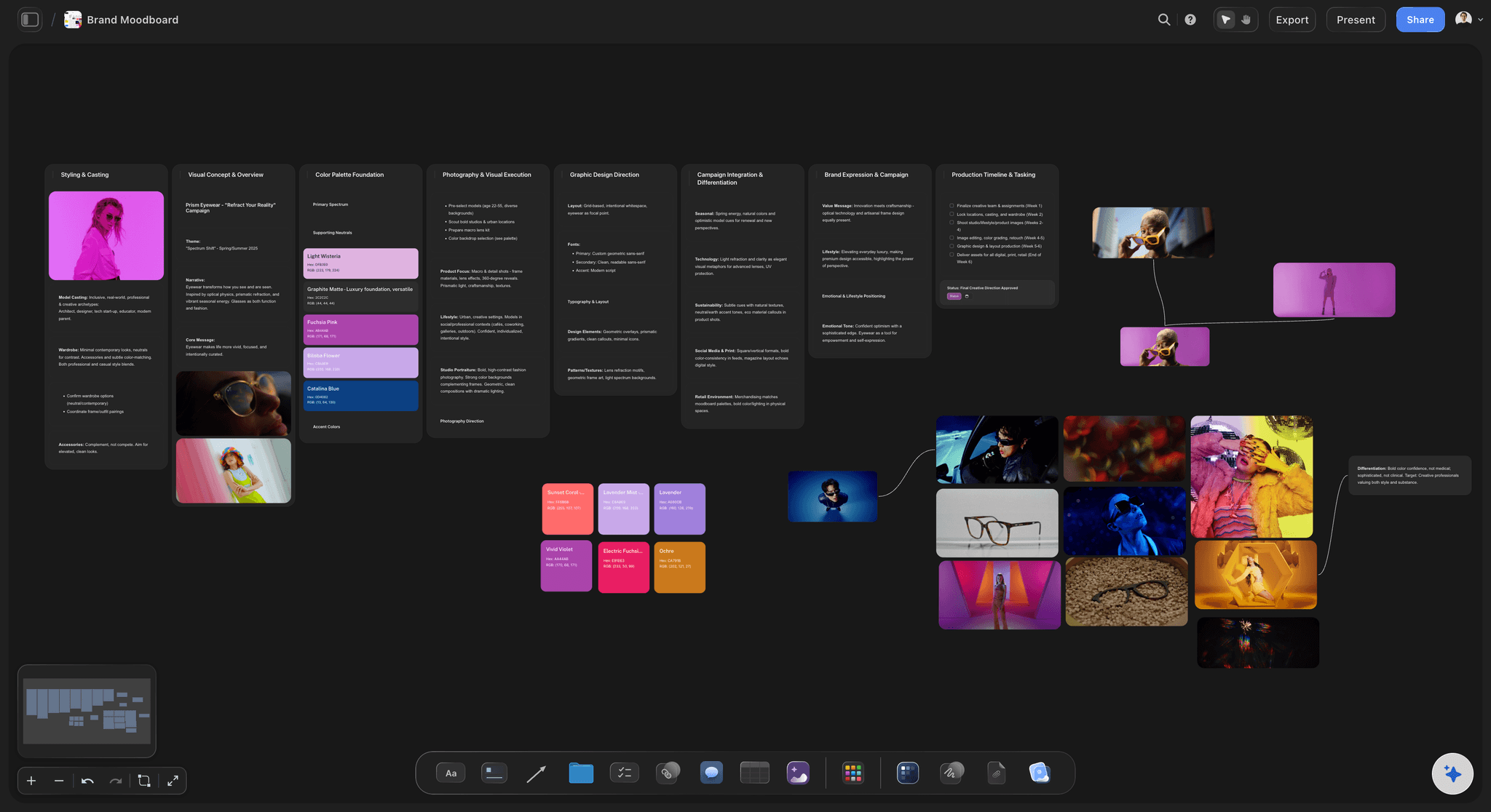
Moodboards and identity explorations in the same room as the strategy
Judge the design against the brief, not against taste
Pin the territories, references, and identity routes beside the positioning statement they are meant to express. Stakeholder reviews get much shorter when the question is whether the work says the agreed thing, rather than which one people like.
See the brand moodboard →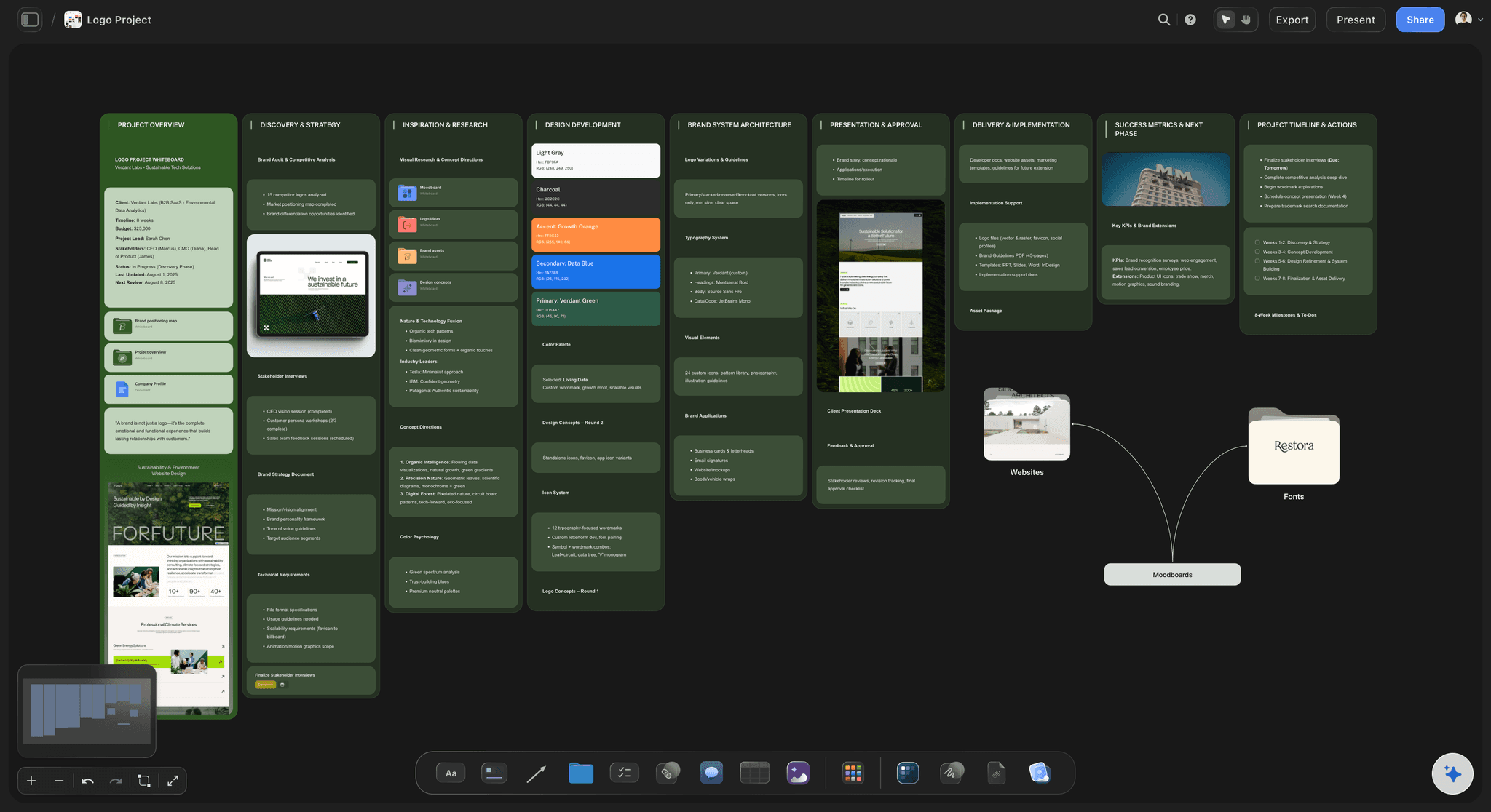
Every surface, owned and sequenced
The inventory is the project
Website, app, packaging, signage, email templates, social profiles, decks, contracts, invoices, uniforms, vehicle livery. Lay them out with owners, costs, and lead times, then arrange them into the order they switch, with the long-lead physical items started first.
See the marketing workspace →Unlimited boards. No object cap.
Open a canvas, describe the business, and let AI draft the plan and the inventory. Storyflow is paid-only during early access, with plans from $9.99 a month, and a Free plan launches before the end of 2026.
Unlimited rebrand boards on an infinite canvas
Basic AI usage to generate plans and inventories from prompts
3 starter frameworks built in
Share view-only links with stakeholders, agencies, and suppliers
Built for people with taste
The parts of a rebrand that actually decide whether it works.
Almost every write-up of rebranding is about the identity. These are the parts that sink projects.
Audit, rationale, and the case for not doing it
Earn the rebrand before you start it
Write the real reason down: A merger, a name you cannot trademark or spell over the phone, a pivot into a market that does not recognise you, a look that undercuts your price. Those are reasons. A new CMO, a board that is bored, and a logo that feels dated to the people who see it forty times a day are not, and putting the stated reason on the board makes the difference visible.
Audit what you are throwing away: List the recognition, the search equity, the reviews attached to the old name, the packaging customers find on a shelf. A rebrand spends all of it. Seeing the ledger next to the rationale is the cheapest decision-making tool in the project.
Consider the smaller version: Many rebrands should not happen, and many more should be refreshes. Lay the full change and the refresh out side by side with what each fixes and what each costs, then choose deliberately rather than by momentum.
Stakeholders aligned on the problem before anyone sees a design
Get the argument out of the way early
Map who can stop this: Founder, board, sales leadership, legal, the operations person who owns the signage budget, the country manager whose market hates the new name. Put them on the canvas with what each one needs from the project, before the first review, not after it.
Agree the problem, not the picture: Sign-off on a written rationale is the single highest-leverage hour in a rebrand. Once a room is looking at three logo routes, the conversation is about preference forever, and the strategy quietly stops being the thing being decided.
Keep the decision trail visible: Comments land on the specific block they are about, so the reason a route was killed stays attached to the route. Six weeks later, when somebody asks why not the blue one, the answer is on the board instead of in a thread.
Every surface carrying the old brand, found and costed
The asset inventory nobody enjoys and everybody needs
Go looking in the boring places: Marketing finds the website and the social profiles on its own. What gets missed is transactional email, invoice and contract templates, the help centre, app store screenshots, the recruiting page, the trade show stand in storage, the sponsored football shirts, and the answerphone greeting. Missing surfaces are what makes a rebrand look half finished.
Attach an owner and a lead time to each: Signage and packaging have manufacturing lead times measured in weeks or months. A footer is an afternoon. Sorting the inventory by lead time rather than by importance is what makes a single-day switchover possible at all.
Decide what does not change yet: Some things will run out rather than be replaced: printed stock, warehouse packaging, a contract cycle. Marking those as deliberate stragglers with an end date is very different from forgetting them, and only one of the two survives a customer noticing.
Keep the inventory beside the identity: When the asset list sits on the same canvas as the logo lockups and the palette, you can see which surfaces the new system does not actually cover yet. That gap usually appears as a favicon, an app icon, and a one-colour version for embroidery.
Rollout, launch day, and the internal comms that carry it
Switch it in one day, not over one quarter
Sequence backwards from the switch: Lay the timeline out with the long-lead items starting first and the instant ones staged for the day itself. A rebrand that dribbles out surface by surface reads as an unfinished project to customers, which is exactly the impression you were paying to avoid.
Plan the day, not just the design: Domain and redirect plan, social handles, app store updates, the announcement, press, customer email, sales outreach, and someone watching the support queue. Put the hour-by-hour list on the canvas beside the assets it depends on.
Brief your own staff first: The rebrand is judged by whether a salesperson or a support agent can explain the change in two sentences without sounding embarrassed. Write those sentences, give people the reasoning rather than the announcement, and do it before customers hear anything.
Hand over a system, not a folder: Finish with guidelines and a voice people can actually apply, on the same canvas as the strategy that produced them. Guidelines detached from their reasoning get ignored within a year, which is how the next rebrand starts.
Explore templates for your project
Every template opens as a real, editable board on the infinite canvas. Pick the closest fit and make it your own.
Brand Strategy
Define your positioning, values, and voice and connect them into a strategy the team can follow.
One app instead of five
Storyflow vs Figma, Milanote, and Notion.
Two of these beat us decisively at part of a rebrand. Here is the honest split, so you can pick the right tool for each phase.
Storyflow
Recommended
Infinite visual canvas
AI drafts the rebrand plan and asset inventory
AI reads your whole board as context
Strategy, identity exploration, and rollout plan together
Identity design and final asset production
Structured database checklist with filters and rollups
Figma
Infinite visual canvas
AI drafts the rebrand plan and asset inventory
AI reads your whole board as context
Strategy, identity exploration, and rollout plan together
Identity design and final asset production
Structured database checklist with filters and rollups
Milanote
Infinite visual canvas
AI drafts the rebrand plan and asset inventory
AI reads your whole board as context
Strategy, identity exploration, and rollout plan together
Identity design and final asset production
Structured database checklist with filters and rollups
Notion
Infinite visual canvas
AI drafts the rebrand plan and asset inventory
AI reads your whole board as context
Strategy, identity exploration, and rollout plan together
Identity design and final asset production
Structured database checklist with filters and rollups
What creators are saying
Join early creators getting structured workspaces and AI that remembers their projects
“Storyflow has sped up my workflow by at least 3x, which means more flow state and more projects I can actually ship. It truly changed the way me and my team create.”

Reilin Joey
Director & YouTuber
“One prompt gets me a structured board. But the tactics are my favorite. I run my YouTube scripts through them and my intros and retention got better. It's amazing.”

Justkay
YouTuber & Freelance Filmmaker
“I used to juggle five apps to plan a project. Now I describe what I am making and get boards, lists, and a schedule. All in one place.”

George
@fernwehchronicles
Rebranding questions, answered.
What a rebrand actually involves, how long it takes, and how to tell whether you need one.
A rebrand is a deliberate change to what an existing company signals about itself. It can mean a new name, positioning, and full visual identity, or a narrower change to the look and the language. The scope varies enormously, so the first job in any rebrand is agreeing which version this is. What stays constant is the shape of the work: an honest rationale, alignment among the people who can veto it, strategy, identity design, an inventory of every surface carrying the old brand, and a sequenced rollout.
Storyflow runs a rebrand end to end on one canvas: the rationale, the positioning, the identity explorations and the rollout plan sit together. Its AI drafts the rebrand plan and the inventory of every surface that still carries the old brand, and it reads your whole board as context. The identity design and final asset production still happen in Figma, not in Storyflow.
Work through six phases in order. Audit and rationale: what is actually wrong and what a change costs you. Stakeholder alignment: get agreement on the problem before showing any design. Strategy and positioning: audience, promise, personality, and the words you want to own. Identity design: name, logo, palette, type, imagery, and voice as a reusable system. Asset inventory: every surface carrying the old brand, with an owner and a lead time. Rollout and internal comms: the sequence, the launch day, and briefing your own people first.
It depends far more on your inventory than on your designers. A small digital-only company with a website, an app, some templates, and social profiles can plan and execute a rebrand in roughly two to four months. A company with physical products, retail packaging, signage across multiple sites, vehicles, and regulated documentation is usually looking at nine to eighteen months, because printing, manufacturing, and lease-controlled signage set the pace. The way to shorten it is to start the long-lead physical items first, not to compress the design phase.
A refresh keeps the brand's identity and updates its execution: cleaner logo, modern typeface, a wider palette, better photography, sharper copy. Customers recognise you immediately and nothing needs re-explaining. A rebrand changes what the brand means, and often the name, so people have to relearn who you are. The test is whether a customer would need to be told. If the answer is no, you are refreshing, which is cheaper, faster, and lower risk. Most companies that say rebrand need a refresh and a positioning fix.
Often not, and that is a real answer. Good reasons: a merger or acquisition, a genuine pivot, a name you cannot trademark or that blocks a market, a legal problem, an identity that actively contradicts what you now charge. Weak reasons: a new executive wanting a mark, a board that has grown bored of the logo, and a look that feels tired to the people who see it daily but is barely noticed by customers. Recognition is an asset you spent years buying. Do not spend it because the brand feels stale internally.
The common failure is a company that changes its logo and nothing about what it actually is. The palette moves, the announcement promises a new chapter, and six months later customers describe you in the same words as before, because no decision changed about what you sell, to whom, or how you behave. The second failure is logistical: the identity is finished but the rollout leaks over a quarter, so half your surfaces contradict the other half and the whole thing reads as unfinished rather than new.
Everything that carries the old brand, including the parts nobody owns. Website and landing pages, product UI, app store listings and screenshots, packaging and labels, signage at every site, transactional and marketing email templates, invoice and contract templates, proposal and sales decks, the help centre, social profiles and handles, job listings, trade show stands, merchandise, uniforms, vehicle livery, printed collateral in storage, and the PDFs still ranking in search. Give each one an owner, a cost, and a lead time, then sort by lead time rather than by importance.
Sequence backwards from a single switch day. Start the long-lead physical items first, since signage and packaging are set by manufacturing rather than by your plan. Stage everything instant, meaning the site, the profiles, the templates, and the email footers, for the day itself. Plan the day in hours: domains and redirects, social handles, app store updates, the announcement, press, customer email, sales outreach, and someone watching the support queue. Then mark the deliberate stragglers, such as printed stock being run down, with an end date.
There is no useful single figure, because the identity design is rarely the largest line. Signage, packaging runs, uniforms, vehicle wraps, legal and trademark work, print, and the internal staff time to update hundreds of templates usually add up to more than the studio invoice. The practical move is to build the asset inventory before agreeing a budget, price each surface, and let the total tell you whether this should be a full rebrand or a refresh. Planning it in the wrong order is how rebrands overrun.
Before customers hear anything, and with reasoning rather than an announcement. Every salesperson, support agent, and recruiter will be asked what happened, and the rebrand is judged by whether they can answer in two sentences without sounding embarrassed. Give them the problem you were solving, what changed about the company beyond the visuals, and the exact words for the awkward question about cost. Internal comms is not a courtesy step at the end. It is the channel through which most customers will actually encounter the change.
For the identity itself, no, and we would not claim otherwise. Figma owns logo design, type and colour systems, component libraries, and the final production assets, and you will still design the brand there. Storyflow covers what Figma does not: the rationale, the stakeholder map, the positioning, the moodboards and territories, the inventory of every surface carrying the old brand, and the rollout timeline, all on one canvas with AI that reads the whole board. Most teams run both, thinking and sequencing here, drawing there.
Storyflow is paid-only during early access, with plans starting at $9.99 a month, and a Free plan launches before the end of 2026. Anyone a paid member invites to a board joins free today, so agencies, suppliers, and stakeholders can review and contribute without a subscription. If you need something free right now, Notion's free tier will hold an asset checklist if you are willing to build the structure yourself. It will not keep the reasoning, the identity explorations, and the rollout sequence in one view, which is the part we are solving.
More from Storyflow
Plan the whole rebrand, not just the logo.
Open a canvas, describe the business, and let AI draft the plan and the asset inventory. Nothing to install.