
Ultra-fast campaigns, pitched beautifully
One message.
Every channel showing it.
Put the core idea in the middle, branch every channel off it, and hang the actual assets underneath. Where a channel has drifted, you can see it before the campaign ships.


Creatives working for these brands already got early access
- Red Bull
- Canon
- Artlist
- Porsche
See how easy it is to get started
Watch a real project come together, from a blank board to a finished plan, clicked through step by step.
Start from a ready-made template
Pick a board to see what you can build, then let AI fill it in. Every template is a real, editable starting point on the same infinite canvas.

Marketing Campaign
Plan a campaign across channels, messages, and deliverables on one board the whole team can see.
What is integrated marketing communications?
Integrated marketing communications, usually shortened to IMC, is the practice of coordinating every message a brand sends so that they reinforce one another rather than competing. Storyflow is an AI visual workspace that plans your campaign on one infinite canvas: the core message, every channel branched off it, and the assets under each channel. Advertising, public relations, direct marketing, sales promotion, packaging, social, email, retail environment and the sales conversation itself are treated as one system with one strategic idea behind it, instead of as separate disciplines with separate budgets and separate briefs. The term was formalised at Northwestern in the late 1980s, largely by Don Schultz and colleagues, in response to a specific observation: audiences do not experience channels separately, so a brand that plans them separately is the only party who thinks the seams are invisible.
The discipline is easy to state and hard to execute, and it fails in a consistent place. It fails at the seams. The strategy deck says one thing, the paid social brief says a compressed version of it, the retail point of sale says whatever fitted the space, and the sales team says what has worked for them for years. No individual step is wrong. The drift is cumulative, it happens in the handoffs between documents, and it is invisible to everyone who only ever sees one channel's work. By the time it is visible, it is visible to the customer.
The practical answer is not more process. It is putting the whole system on one surface where the message and every expression of it can be read at once. That is a diagram, and IMC has always been taught with diagrams: the message at the centre, channels radiating out, touchpoints under each. What has been missing is a place to keep that diagram alive with the real work attached, rather than as a slide made once at kickoff and never opened again.
Storyflow is an AI-native infinite canvas built for exactly that. Describe the campaign and the AI lays out the plan: core message, positioning, audience, and a branch for each channel with the touchpoints beneath it. Then the actual assets go on the board under the channel they run in. The headline, the key visual, the email subject lines, the press angle, the retail copy, the script for the sales call. Reading across the branches is how message drift becomes obvious, and it takes about a minute rather than a coordination meeting.
Ultra fast from brief to board
From a strategy line to every channel showing it.
No new process to roll out. One board the whole campaign hangs from.
01
Open a canvas
Sign up in seconds. No download. Your infinite campaign canvas opens in the browser.
02
Describe the campaign
Type the product, the audience, and the channels you are planning to use. The AI lays out an IMC plan with the core message at the centre and a branch for each channel.
03
Hang the real work underneath
Put the actual headline, key visual, subject lines, press angle, and retail copy under the channel they belong to. Reading across the branches is where drift shows up.
04
Share it with everyone who briefs a channel
Send a view-only link to the agency, the PR lead, and the retail team, or invite them onto the canvas. One board means one version of the message.
The whole system on one surface.
Message, channels, touchpoints, assets, and the calendar that sequences them.
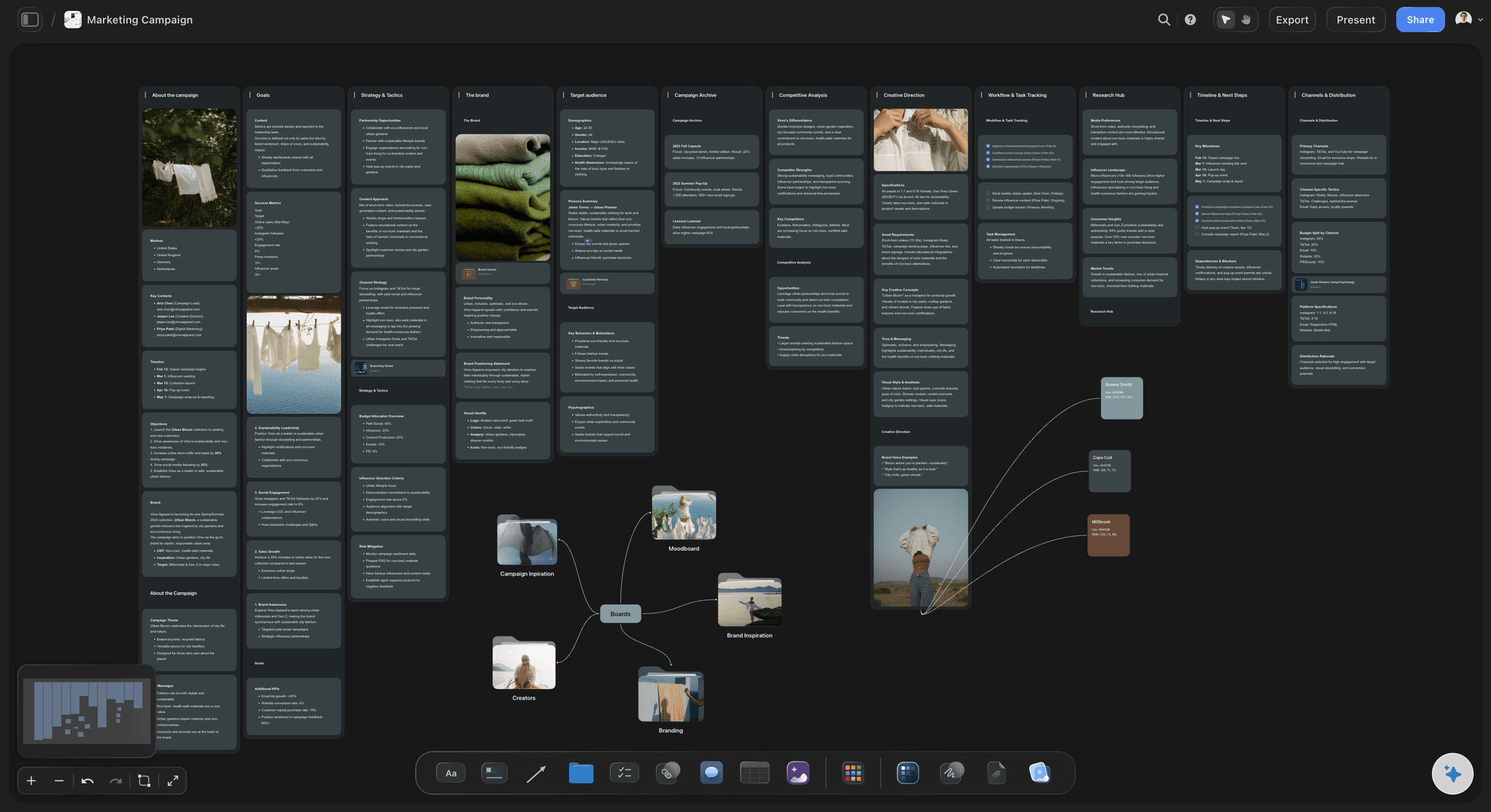
AI drafts the plan structure from a campaign description
Start from a laid out plan, not a blank slide
Describe the product, audience, and channel mix and the AI builds the branch structure: paid, owned, earned, and the touchpoints under each. Correcting a drawn plan is far faster than drawing one.
See the AI marketing campaign planner →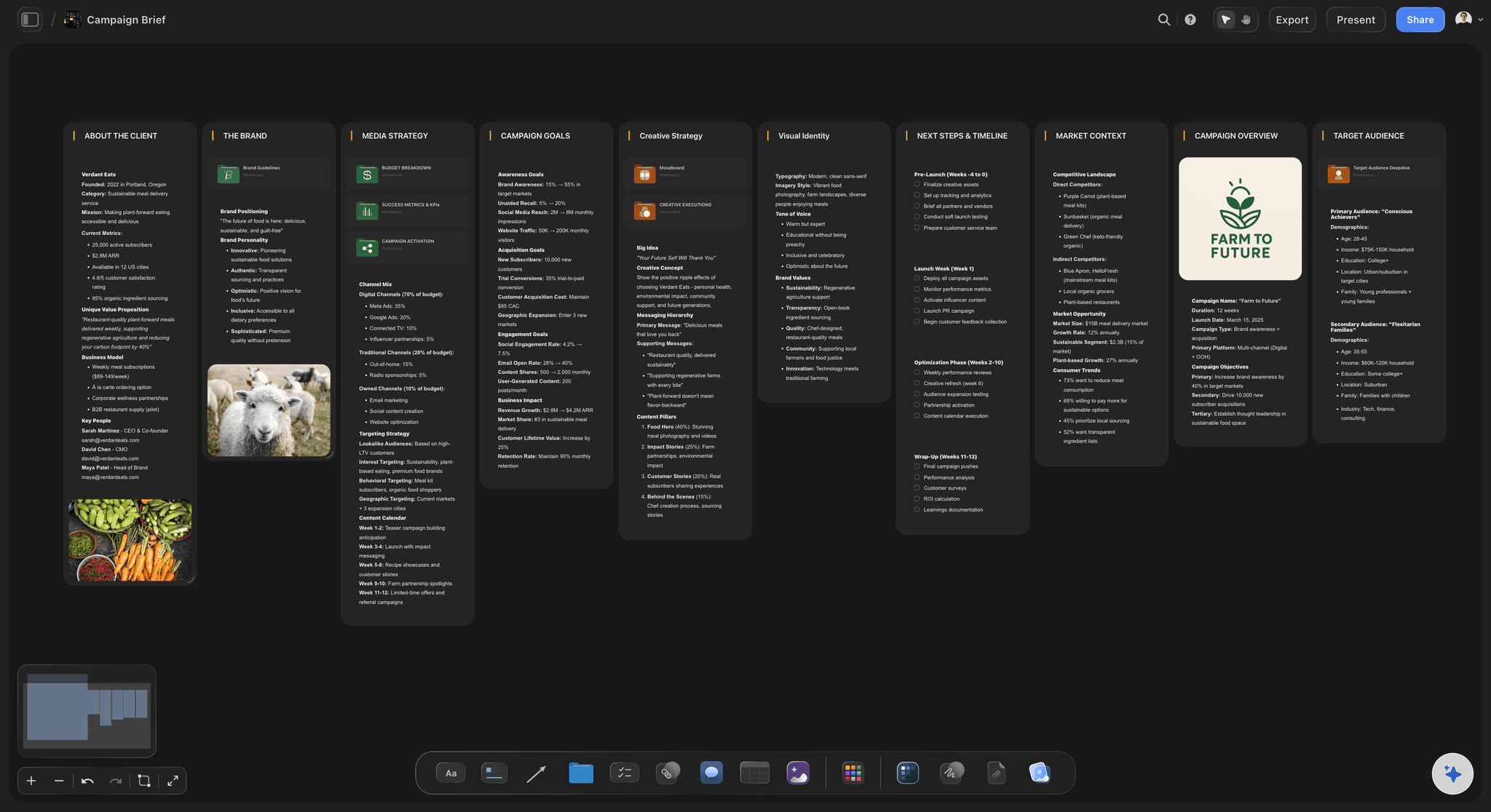
Every channel's actual copy under its own branch
Catch message drift before the customer does
The strategy line at the centre and the real headline, subject line, and retail copy beneath each channel. When one branch has quietly become a different promise, reading across the board shows it.
Explore the campaign brief template →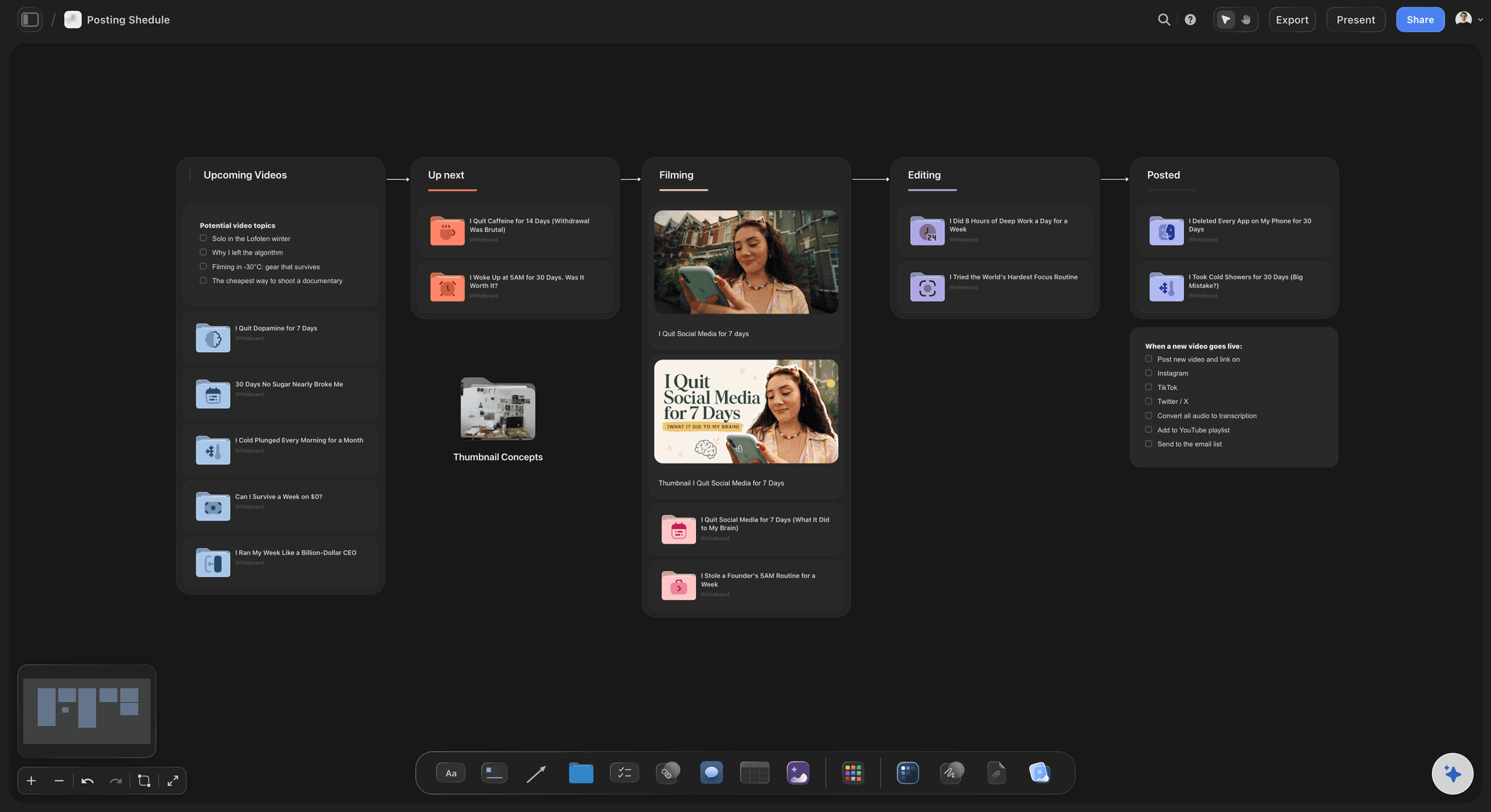
Sequence as well as consistency
Show what runs when, next to what it says
Integration is timing as much as message. Put the calendar on the same canvas as the channel map so a PR beat landing a week before the paid flight is a decision rather than an accident.
See the campaign calendar →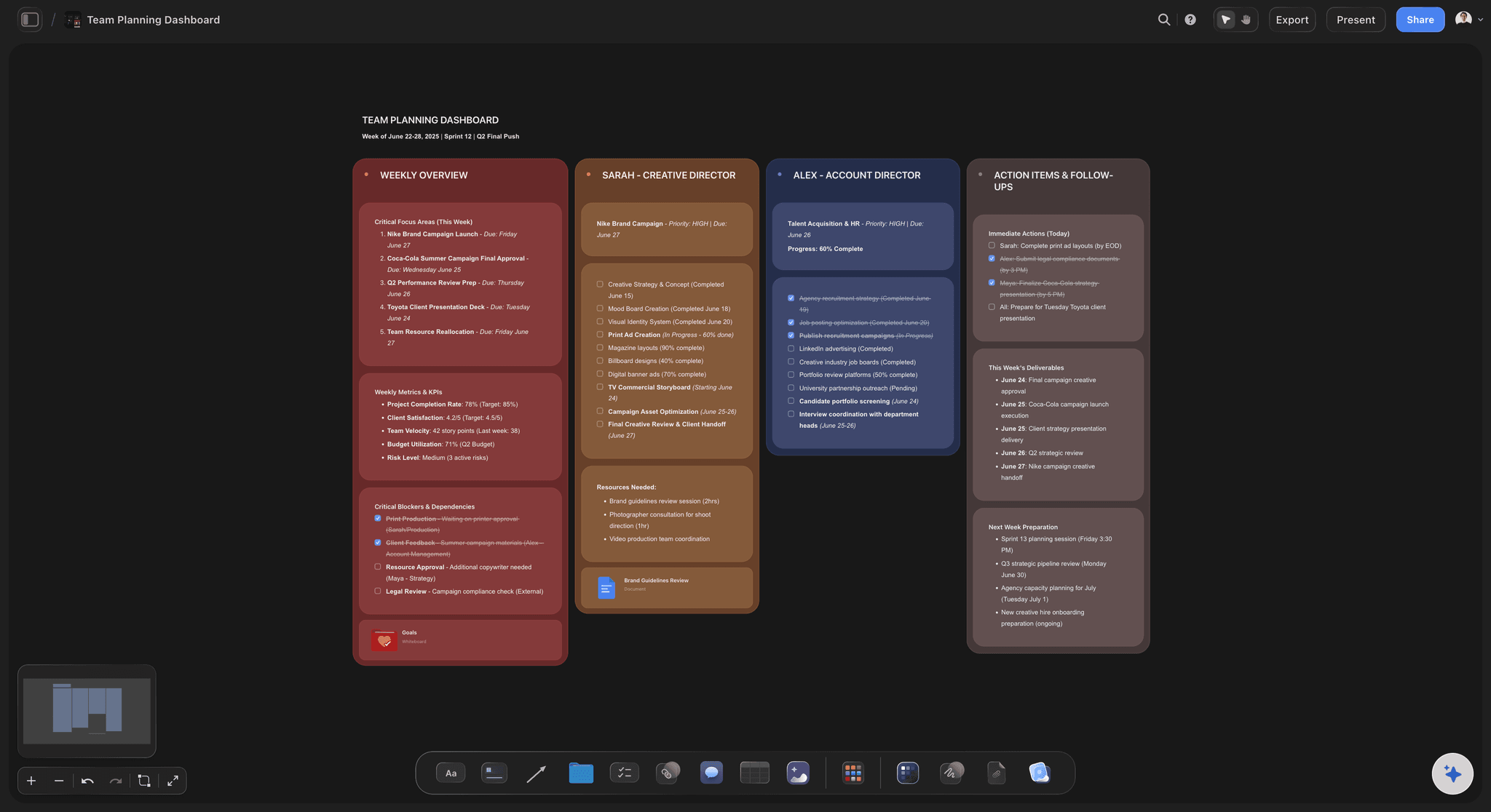
One board every agency and partner reads from
Brief four partners from one source
The media agency, the PR firm, the retail team, and the in-house creatives usually each get their own document. Send them the same canvas instead and the versions cannot diverge.
See the agency client planning board →Unlimited boards. No object cap.
Open a canvas, describe the campaign, and let AI lay out the first plan. Storyflow is paid-only during early access, with plans from $7.99 a month billed annually, and a Free plan launches before the end of 2026.
Unlimited campaign canvases with no cap on assets
Basic AI usage to generate IMC plans from a description
Starter templates for campaign briefs, marketing plans, and calendars
Share view-only links with agencies and partners, no account required
Built for people with taste
Integration is a property of the whole, so plan the whole.
A channel plan that is excellent one channel at a time is the normal way integration fails. The only fix is a surface that shows all of them together.
Paid, owned, earned, and the ones that get forgotten
Put every touchpoint on the board, including the unglamorous ones
The channels everyone remembers: Paid social, search, display, email, organic social, the website. These get briefed properly because they have owners and budgets, and they are rarely where integration breaks.
The channels nobody briefs: Packaging, the out of office reply, the invoice, the sales call script, the retail shelf talker, the onboarding email that predates the campaign. Each one is a message the customer receives, and each is usually written by someone who never saw the strategy.
Earned coverage you can shape but not control: Put the press angle and the spokesperson lines on the board next to the paid message. If the story a journalist would write is a different promise from the ad, that is worth knowing in advance.
The sequence between them: Integration includes order. A teaser that lands after the reveal, or a retail rollout that beats the awareness flight, undoes work the plan already paid for.
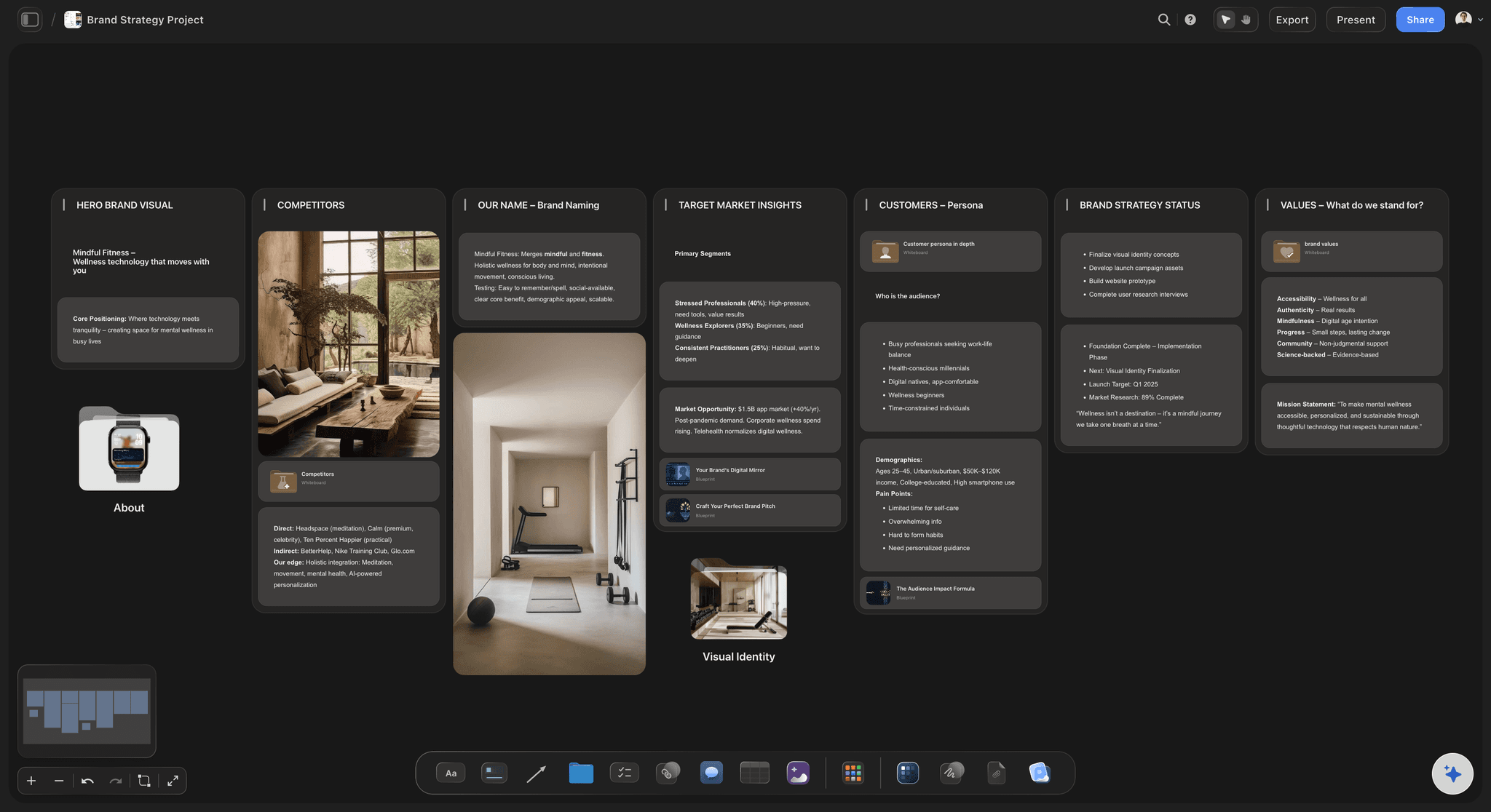
AI that can see the whole campaign at once
Ask the board where the message has drifted
Generate the structure from a description: Describe the launch and the AI lays out the plan, so you start by correcting a draft rather than staring at an empty canvas.
Interrogate it once it is populated: Ask which channels are not carrying the primary benefit, where two channels are making different promises, or which audience segment has no touchpoint at all. The AI uses your whole board as context, so the answers are about this campaign.
It structures, it does not decide: Storyflow arranges and suggests; the strategic call stays yours. An AI that picked your positioning would be a worse tool, not a better one.
Re-prompt as the plan changes: Add a channel mid-flight and ask the AI to build the branch around what you have already placed. Nothing you positioned by hand moves.
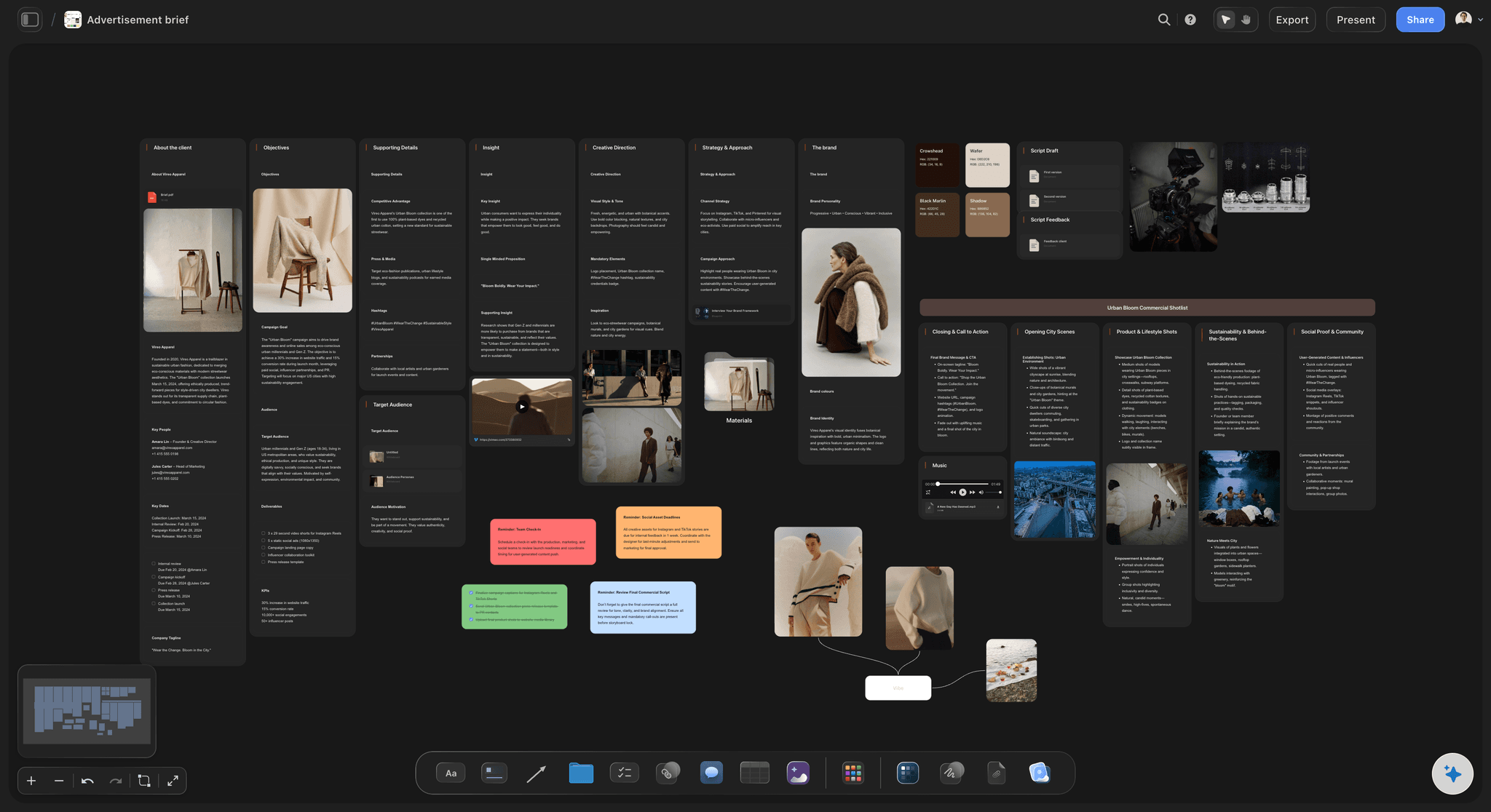
The strategy and the artwork on one canvas
Keep the assets where the argument for them is
Real creative, not filenames: Drag in the key visual, the film, the packaging render, the retail mock. A channel branch with the actual artwork under it is checkable; one with a link to a folder is not.
The brief that produced them, one scroll away: Positioning, audience, proposition, and reasons to believe live on the same canvas as the work, so a reviewer can check the execution against the intent without opening a second document.
Video and reference from anywhere: Pull frames from YouTube or Vimeo for tone reference, pin competitor executions beside your own, and attach the research PDFs that justify the positioning.
Comments attached to the thing being discussed: Feedback on the retail line sits on the retail line. Nobody has to reconstruct which version of which asset a comment in an email thread referred to.
Client, agency, and in-house on the same board
Remove the version problem entirely
View-only links for stakeholders: Send a link and a client or a channel owner opens the whole plan in a browser with no account. Approval conversations happen against the live board rather than a deck that was current last Thursday.
Collaborators who edit their own branch: Invite the PR lead, the media planner, and the retail team onto the canvas and let each maintain their section. The centre stays fixed and the branches stay current.
Export for the meeting that needs a document: Export the board as a high-quality image or PDF for a steering committee or a post-campaign review, without the board itself becoming a stale copy.
Explore templates for your project
Every template opens as a real, editable board on the infinite canvas. Pick the closest fit and make it your own.
Marketing Campaign
Plan a campaign across channels, messages, and deliverables on one board the whole team can see.
One app instead of five
Storyflow vs Asana, Monday.com, and a slide deck.
Each of these is good at part of this: Asana and Monday.com are strong at tracking who owes what by when across a large campaign, and a deck is still the right artefact for the meeting where the strategy is approved. Here is where they differ.
Storyflow
Recommended
Message and every channel readable on one surface
Real creative assets attached to each channel
AI drafts the plan from a campaign description
Campaign calendar on the same canvas
View-only links for clients with no account
Task assignment, dependencies, and workload views
Asana
Message and every channel readable on one surface
Real creative assets attached to each channel
AI drafts the plan from a campaign description
Campaign calendar on the same canvas
View-only links for clients with no account
Task assignment, dependencies, and workload views
Monday.com
Message and every channel readable on one surface
Real creative assets attached to each channel
AI drafts the plan from a campaign description
Campaign calendar on the same canvas
View-only links for clients with no account
Task assignment, dependencies, and workload views
A slide deck
Message and every channel readable on one surface
Real creative assets attached to each channel
AI drafts the plan from a campaign description
Campaign calendar on the same canvas
View-only links for clients with no account
Task assignment, dependencies, and workload views
What creators are saying
Join early creators getting structured workspaces and AI that remembers their projects
“Storyflow has sped up my workflow by at least 3x, which means more flow state and more projects I can actually ship. It truly changed the way me and my team create.”

Reilin Joey
Director & YouTuber
“One prompt gets me a structured board. But the tactics are my favorite. I run my YouTube scripts through them and my intros and retention got better. It's amazing.”

Justkay
YouTuber & Freelance Filmmaker
“I used to juggle five apps to plan a project. Now I describe what I am making and get boards, lists, and a schedule. All in one place.”

George
@fernwehchronicles
IMC questions, answered.
What integration means in practice, where it breaks, and how to plan it.
Integrated marketing communications is the practice of planning every message a brand sends as one coordinated system rather than as separate channel programmes. Advertising, PR, direct marketing, promotion, packaging, social, email, the retail environment and the sales conversation are all treated as expressions of a single strategic idea, briefed from one place and checked against one another. The approach was formalised at Northwestern University in the late 1980s, associated most closely with Don Schultz, and its founding observation is still the strongest argument for it: customers do not experience your channels separately. They accumulate impressions across all of them without knowing or caring which department produced which. A brand that plans channel by channel is the only party who believes the seams are invisible.
Storyflow puts the one message and every channel on the same board: the core message sits at the centre, every paid, owned and earned channel branches off it, and the real assets hang under the channel they run in, so message drift shows before launch. Its AI drafts the plan from a campaign description. Asana and Monday.com still handle task assignment, dependencies and workload views, which Storyflow does not.
IMC stands for integrated marketing communications. In practice the acronym is used two ways and it is worth knowing which one someone means. As a discipline, IMC is the general principle that all communications should be coordinated around one strategy. As a document, an IMC plan is a specific deliverable: the objectives, the target audience, the core message and positioning, the channel mix with a rationale for each channel, the creative expression per channel, the sequence and timing, the budget split, and the measurement framework. Marketing courses usually mean the document, since it is what gets assessed. Working teams usually mean the discipline, and often have no document at all, which is one reason integration tends to fail in practice.
A marketing campaign is a coordinated set of communications, run over a defined period, aimed at one objective for one audience. That definition does real work, because each part of it is where campaigns go wrong. Coordinated means the pieces reinforce each other rather than merely running at the same time. Defined period means it has an end, which is what separates a campaign from ongoing marketing and what makes it measurable. One objective means it is trying to change a single thing, whether that is awareness, consideration, or a specific action; a campaign with four objectives usually achieves none. And one audience means the message can be specific rather than broad enough to include everybody. A campaign typically runs across several channels, which is where integrated marketing communications comes in: the discipline of making sure every channel expresses the same strategic idea.
Nine components cover almost every version of the plan. The situation and audience analysis, so the rest is grounded in something. The communications objectives, stated as what should change in the audience's head rather than as media metrics. The core message or big idea, in one sentence, which is the piece everything else has to reinforce. The positioning and the reasons to believe it. The channel mix, with a stated reason each channel is in the plan and what job it does. The creative expression per channel, meaning the actual headline and visual rather than a description of them. The sequence and calendar. The budget allocation across channels. And the measurement plan, ideally including a way to detect message drift and not only reach. On a canvas these are regions of one board rather than sections of a document, which makes checking one against another a matter of looking rather than remembering.
At the seams, in the handoffs, and cumulatively rather than in one visible mistake. The strategy is written once and read closely by about four people. Each channel then gets briefed by someone compressing it, and every compression loses a little. The paid social brief keeps the benefit and drops the reason to believe. The retail line keeps the tone and drops the benefit. The sales team keeps what has always worked for them. No single step is a blunder, and nobody is in a position to notice the accumulation because nobody sees more than two channels' output. The second common failure is timing rather than message: individually well executed channels running in an order that undoes the plan, such as a retail rollout landing before the awareness flight that was supposed to prime it.
Consistency in IMC means the same strategic promise, not the same words. A campaign where every channel runs the identical headline is not integrated, it is repetitive, and it wastes the specific strengths of each channel. The useful test is whether each execution is a faithful expression of the same core idea in the native language of its medium: the film carries it emotionally, the search ad carries it as a specific claim, the packaging carries it as a design decision, the sales script carries it as an answer to an objection. What you are checking for is drift in the promise, not variation in the phrasing. Putting the core idea at the centre of a board and the real executions around it makes that test fast, because you read outward from the centre and ask whether each branch is still expressing the same thing.
In marketing, a campaign is a time-boxed set of coordinated activities built around one message and aimed at one audience, with a stated goal. It sits between a single piece of communication, such as one advertisement, and your ongoing always-on marketing, which has no start or end. The distinguishing features are a defined beginning and end, a single organising idea that every execution expresses, and a specific outcome you are trying to move. In practice campaigns run across multiple channels at once, which is why they are hard: the paid social, the email, the retail moment, and the sales conversation are usually briefed separately and drift from each other. Keeping the core message and every channel's actual execution visible on one surface is the practical fix, because message drift is only findable when you can read the channels side by side.
Not during early access. Storyflow is paid-only right now, with plans from $7.99 a month billed annually, and a Free plan launches before the end of 2026. Anyone a paid member invites to a board joins free today, so an agency can bring a client onto a campaign board, or a team can bring its channel owners in, without everyone paying. If you need something free immediately, a spreadsheet with one row per touchpoint and a column for the message each one carries is a genuinely serviceable IMC audit and costs nothing. What it will not do is hold the actual creative next to the strategy, which is where drift is easiest to spot.
They overlap and are often used interchangeably, but they answer different questions. IMC is about the message: is everything we say built from one strategic idea, whatever channel it appears in. Omnichannel is about the experience: can a customer move between channels without friction or repetition, so a basket started on mobile survives into the store and the support agent can see the order. You can be well integrated and not omnichannel, which describes most brands with strong advertising and disconnected systems. You can be omnichannel and poorly integrated, which describes retailers with excellent plumbing and a different promise in every medium. IMC is a planning and creative discipline; omnichannel is largely an operations and data one.
It can build the structure and it should not make the strategic call. What an AI does well here is scaffolding and checking. Describe the product, audience, and channel mix and it will lay out a complete plan structure with the channels branched and the standard touchpoints under each, which turns a blank canvas into a draft you correct. Once the board is populated with real work, it is genuinely useful for consistency checks, because it can read every branch at once and answer questions like which channels are not carrying the primary benefit or which audience segment has no touchpoint. What it cannot do is decide your positioning, because that decision depends on what you know about your market, your product, and what you are willing to promise. Storyflow is built on that division: it structures and suggests, and it never decides.
Fewer than most plans propose, and each one for a stated reason. The common failure is a channel list assembled from what is available rather than from what job needs doing, which produces a campaign spread thin enough that no channel reaches frequency. A more useful approach is to write the job first, meaning what has to change in the audience's understanding or behaviour, then ask which channels can do that job and which are simply present. A campaign running three channels properly usually beats one running eight at token weight. On a board this is easy to interrogate, because a branch with no stated job is visibly empty next to the branches that have one, and cutting it is a much easier conversation when everyone is looking at the same picture.
Yes, and it removes the version problem that causes most of the drift. Send a view-only link and an agency, a client, or a channel owner opens the whole plan in a browser with no account and no download, so approval conversations happen against the live board rather than a deck that was accurate last Thursday. If you want partners maintaining their own sections, invite them onto the canvas as collaborators: the media agency keeps the paid branch current, the PR firm keeps the earned branch, and the centre of the board stays fixed. Comments attach to the asset or the line they concern, so feedback arrives with its context. For the meeting that genuinely needs a document, export the board as a high-quality image or PDF.
More from Storyflow
Campaign management software
AI marketing campaign planner
Marketing workspace
Campaign brief to delivery
Campaign calendar
Brand launch planner
AI marketing plan generator
Marketing planning software
AI go to market strategy generator
Creative brief template
Agency client project planning
Marketing tactics
Media plan template
Campaign brief template
Demand generation plan
Put the whole campaign where you can read it.
Open a canvas, describe the launch, and let AI lay out the channel map. No download.