
Elevated brand work, made with taste
Decide who the brand is
before anyone writes for it.
Traits, archetype, personality sliders, voice rules and visual cues on one board, with the research that justifies them. Every writer, designer and agency works from the same personality.


Creatives working for these brands already got early access
- Red Bull
- Canon
- Artlist
- Porsche
See how easy it is to get started
Watch a real project come together, from a blank board to a finished plan, clicked through step by step.
Start from a ready-made template
Pick a board to see what you can build, then let AI fill it in. Every template is a real, editable starting point on the same infinite canvas.

Brand Strategy
Define your positioning, values, and voice and connect them into a strategy the team can follow.
What is a brand personality framework, and how do you build one?
A brand personality framework defines the few human traits a brand expresses everywhere, then turns each trait into rules for how the brand sounds, looks and behaves. Storyflow is an AI visual workspace that develops the framework with your team on one infinite canvas: the personality sliders, the archetype, the we-are and we-are-not lists, and the voice and visual examples beside the research. The AI drafts the framework from that research and writes examples in the voice. A slide deck is still the usual way to present the finished framework to leadership.
Personality is what people remember about a brand when they have forgotten the product details, and it is the first thing to drift once more than one person writes and designs for it. The social team makes it playful, the website sounds corporate, the agency's campaign is edgy, and the customer service replies are cautious. None of them is wrong in isolation. Without a framework they are simply answering the question of who the brand is differently, every day, in public.
Several established tools help, and they combine well. Jennifer Aaker's five dimensions of brand personality, sincerity, excitement, competence, sophistication and ruggedness, give a research-backed vocabulary. The twelve brand archetypes, popularised by Margaret Mark and Carol Pearson, give a character people recognise, such as the Caregiver, the Explorer or the Outlaw. Personality sliders set the degree between two poles, formal to casual or serious to playful, which is where a brand actually becomes distinct. And a we-are and we-are-not list stops a trait from sliding into its nearest failure: confident, not arrogant.
Storyflow keeps the framework on an AI-native canvas. Start from the brand personality framework template, put the evidence beside it, from customer interviews and reviews to the founder's story and competitor examples, and run the sliders as a workshop with comments. Each trait gets its voice rules and visual cues, with real examples of a headline, a caption and a customer reply. The Brand Strategy workflow places the personality within the wider strategy, and the Brand Moodboard workflow turns the traits into a visual direction.
Ultra fast from brief to board
From a founder's hunch to a personality the whole team can use.
Evidence first, decisions second, examples last, all on one board.
01
Gather the evidence
Customer interviews, reviews, the founder's story, what the team believes, and how three real competitors present themselves. Ask the AI to research the competitors and put their tone on the board.
02
Run the sliders and choose the traits
Place the brand on each slider, compare it with the competitors on the same sliders, and pick three to five traits and an archetype. Teammates signed in to the board comment on the choices they disagree with.
03
Turn traits into voice and visuals
For each trait, write the voice rules, the words to use and avoid, and the visual cues. Ask the AI for a headline, a caption and a customer reply in each trait to test it.
04
Share it with everyone who makes the brand
Send a view-only link to the agency, freelancers and new hires, who open it with no account, and link the framework from every campaign brief.
The personality, the proof and the examples together.
Everything a brand personality framework needs, on one canvas the team and agency share.
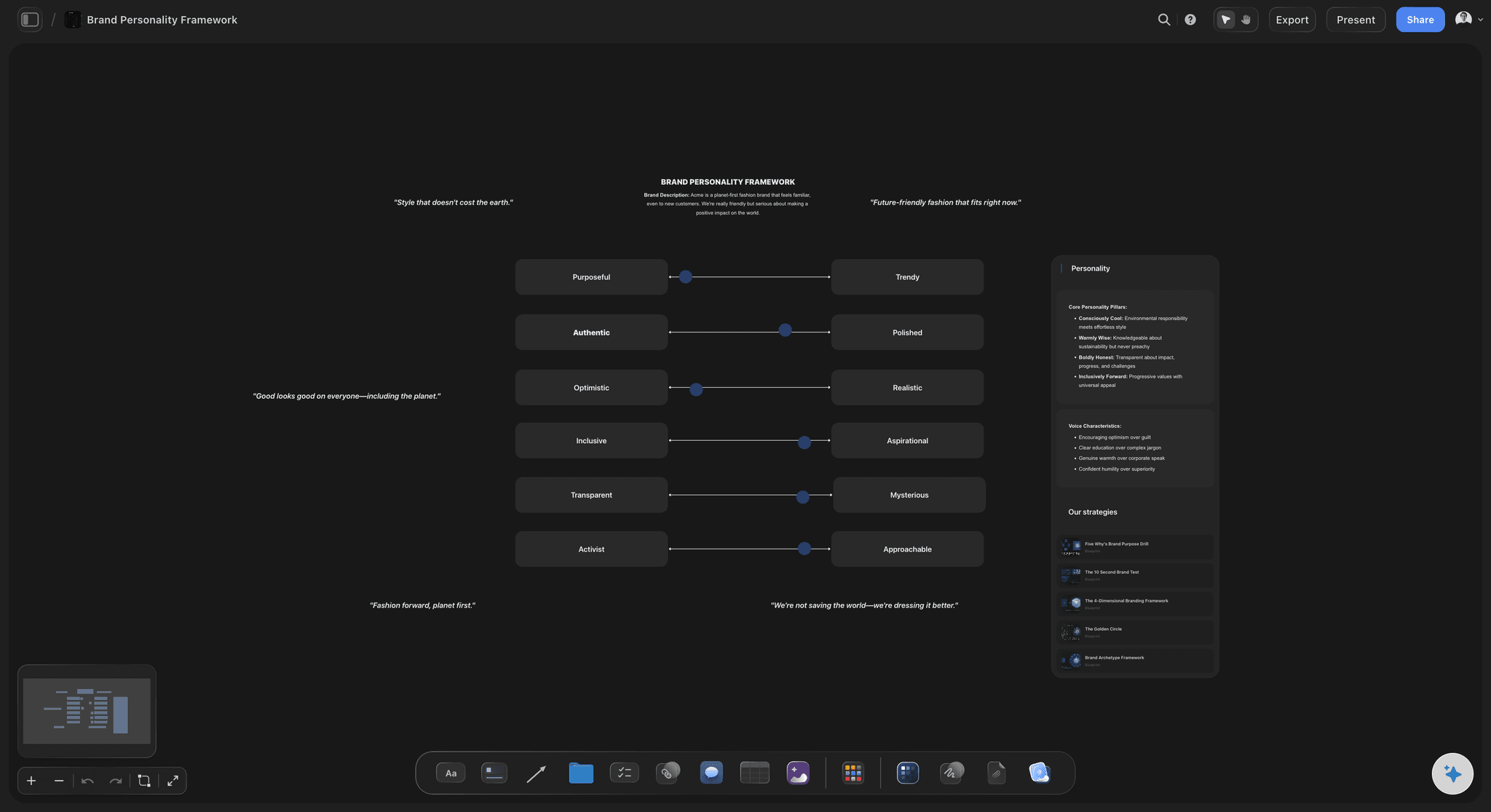
Sliders the team can argue about
Degree, not just direction
Formal to casual, serious to playful, classic to modern. Placing the brand on each slider, beside the competitors, shows where it is actually different.
See the brand strategy tool →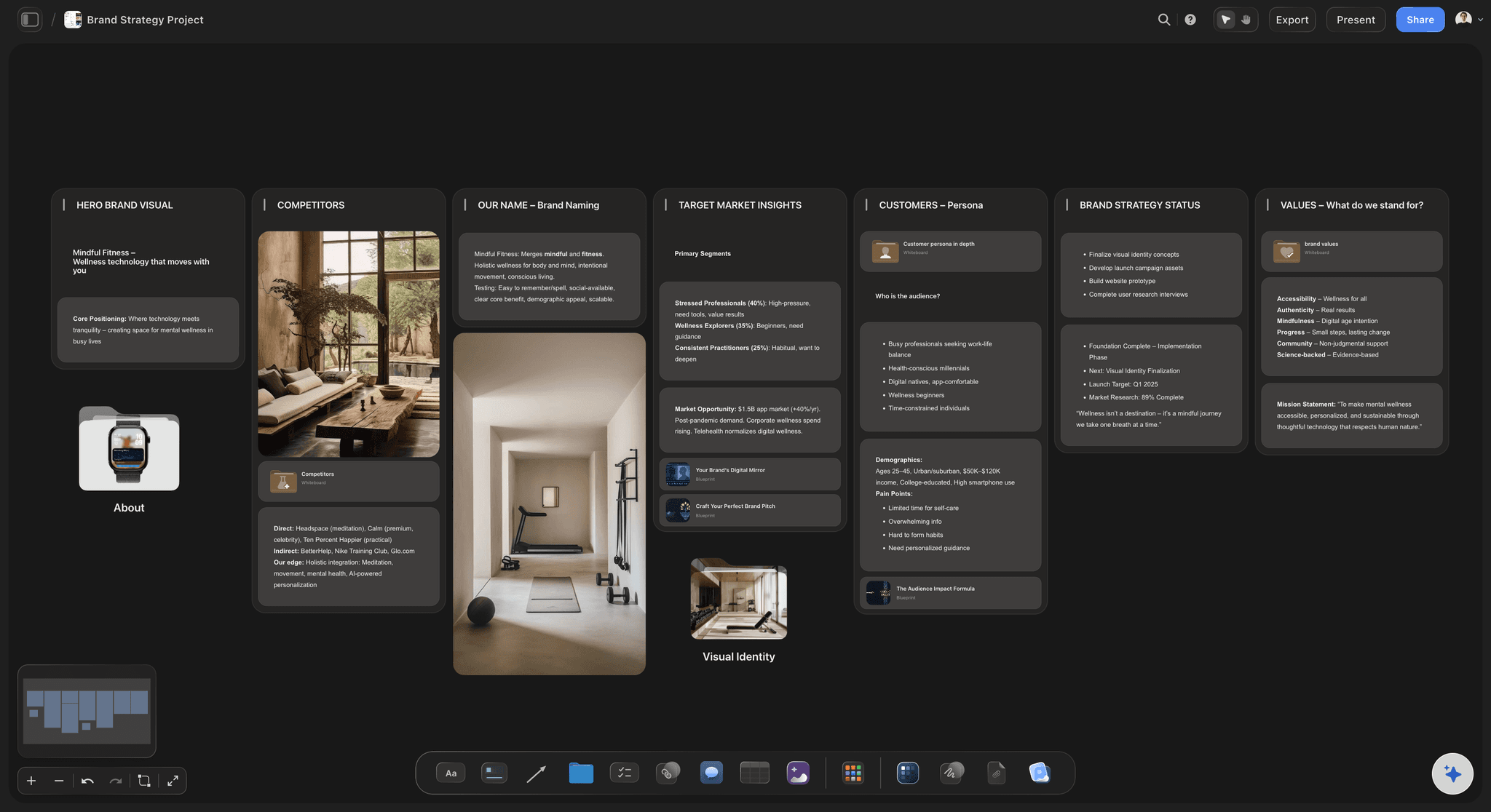
Traits with examples
A trait is only real when you can hear it
Each trait carries voice rules and real examples: the headline, the caption, the customer reply. Writers copy examples, not adjectives.
Try the AI brand voice generator →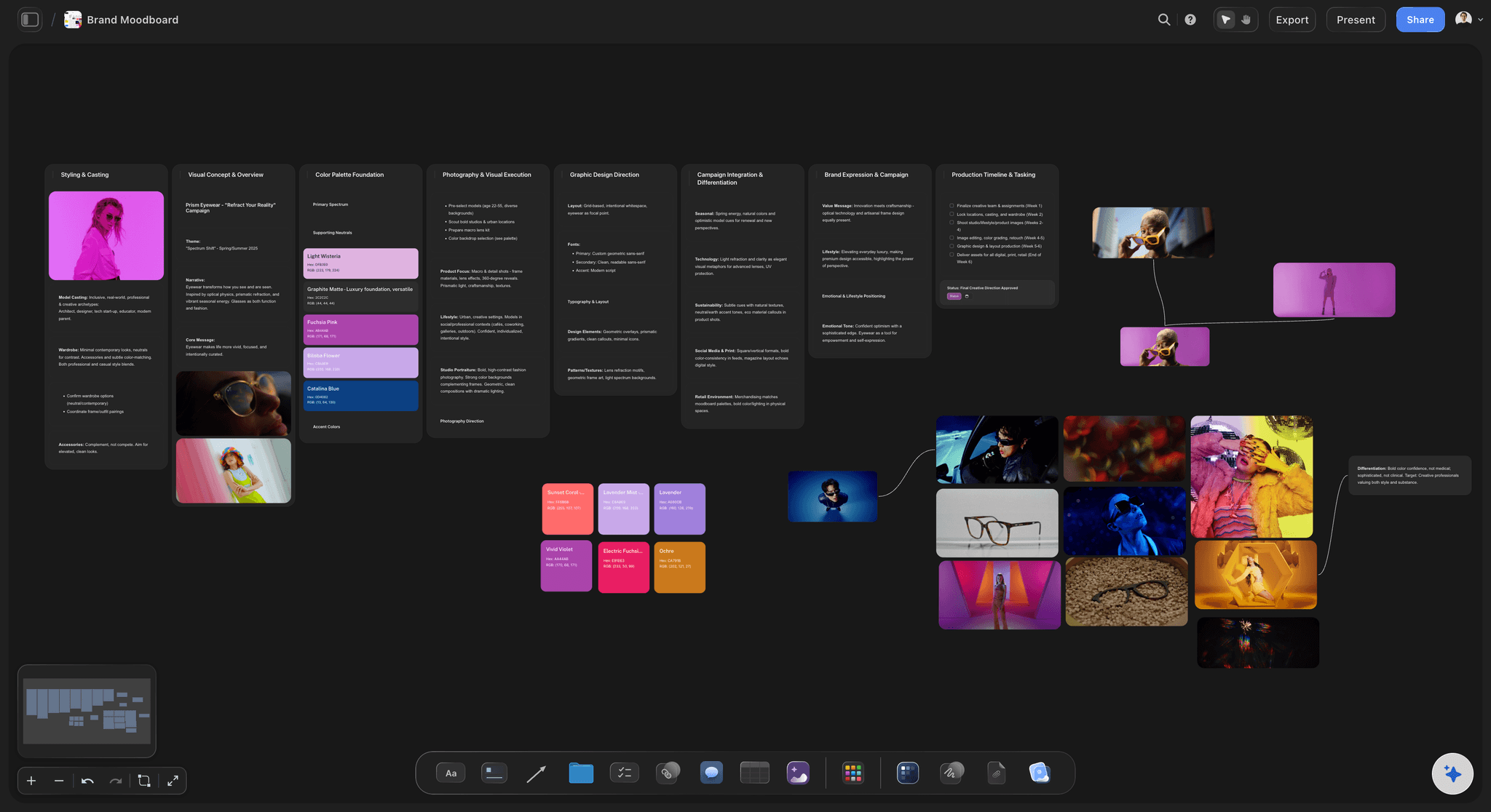
Personality you can see
Traits carried into the visuals
Colour, typography, photography and illustration references grouped by trait, so a designer or photographer reads the same personality the copywriter does.
See the brand moodboard →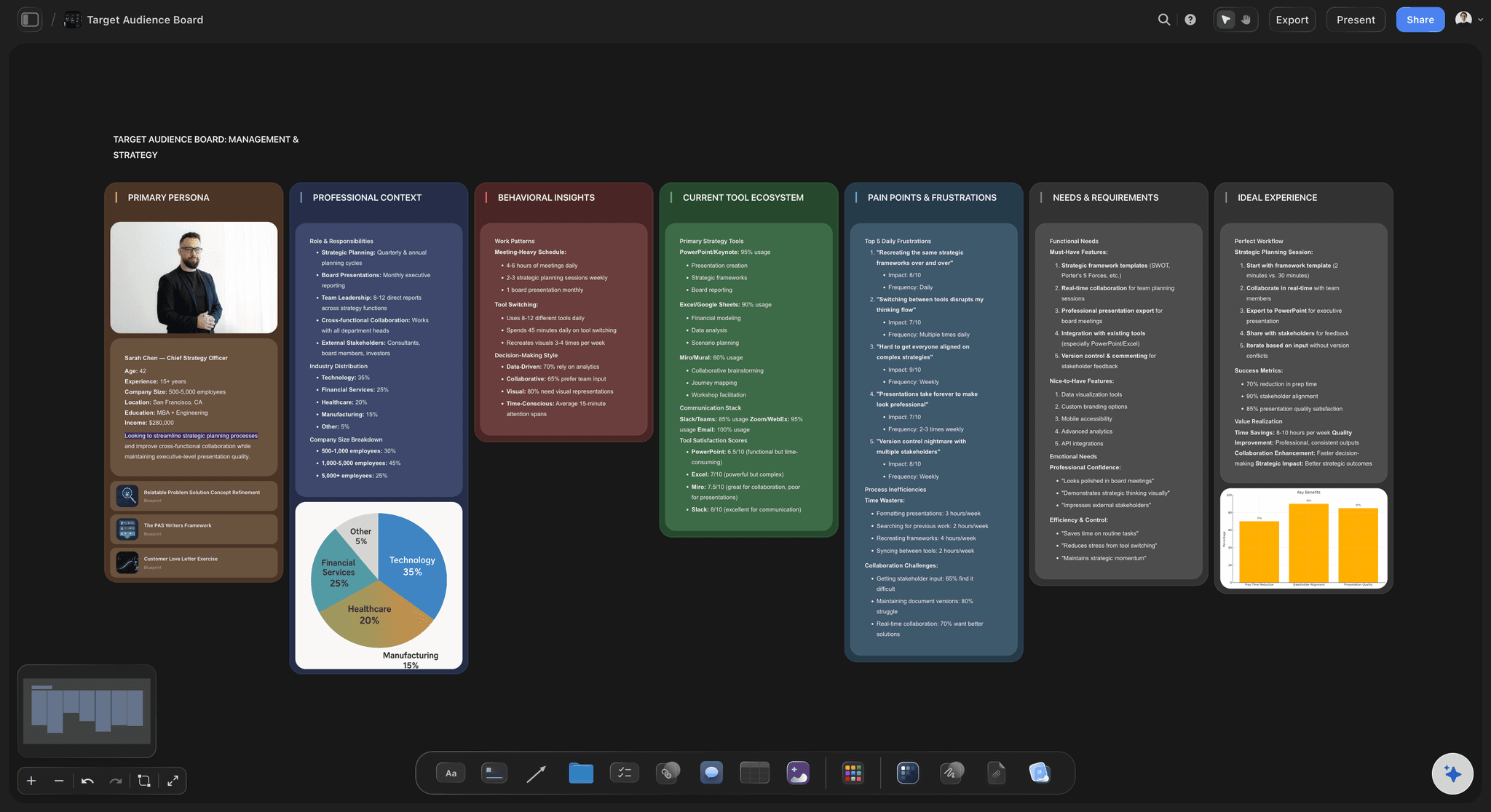
Grounded in the audience
A personality your customers recognise
Interview quotes, reviews and audience notes sit beside the traits they support, so the framework describes a brand customers already sense rather than one leadership wishes for.
See the brand story template →Unlimited boards. No object cap.
One board for the personality, linked from every brief that needs it. Storyflow is paid-only during early access, with plans from $7.99 a month billed annually ($9.99 monthly). A free plan launches before the end of 2026, and anyone a paid member invites to a board joins free.
Unlimited brand boards on an infinite canvas
AI that drafts traits and writes examples in the voice
Research, sliders, voice and visuals on one board
View-only links for agencies and freelancers, no account needed to read
Built for people with taste
Personality is a set of decisions, not a set of adjectives.
Every brand wants to be authentic, bold and approachable. The framework forces the trade-offs that make one brand recognisable.
Traits, archetype, boundaries
Who the brand is
Three to five core traits: Each defined in a sentence that says what it means for this brand. Warm means we explain before we sell, not we use exclamation marks.
An archetype: One primary archetype, and at most a secondary one, as a shorthand people recognise. The Caregiver and the Outlaw make very different campaigns from the same product.
We are, we are not: Each trait paired with the failure it slides into: confident, not arrogant; playful, not silly; expert, not condescending.
Where the traits come from: The customer words, reviews, founder story and category gaps that justify each trait, kept beside it so the framework survives the next leadership opinion.
Sliders and spectrums
How much of each
Formal to casual: How the brand addresses people, from the terms and conditions to a social reply, and whether that changes by channel.
Serious to playful: Where humour belongs and where it never does. Most brands need a rule for the complaint, the outage and the apology.
Classic to modern, accessible to exclusive: Two sliders that decide as much about photography, typography and pricing language as they do about words.
Compared with competitors: Placing three real competitors on the same sliders shows whether the brand's personality is distinct or simply the category default.
Voice, tone, visuals, behaviour
From personality to practice
Voice rules per trait: Words to use and words to avoid, sentence length, and one example sentence written badly and then written right.
Tone by situation: The same personality sounds different in a launch, a price increase and a customer complaint. A short table of situations prevents the worst mismatches.
Visual cues: Colour, type, photography style and illustration choices that express each trait, with references rather than descriptions.
Behaviour: How the brand replies, apologises, celebrates and says no. Personality shows most clearly in what a brand does under pressure.
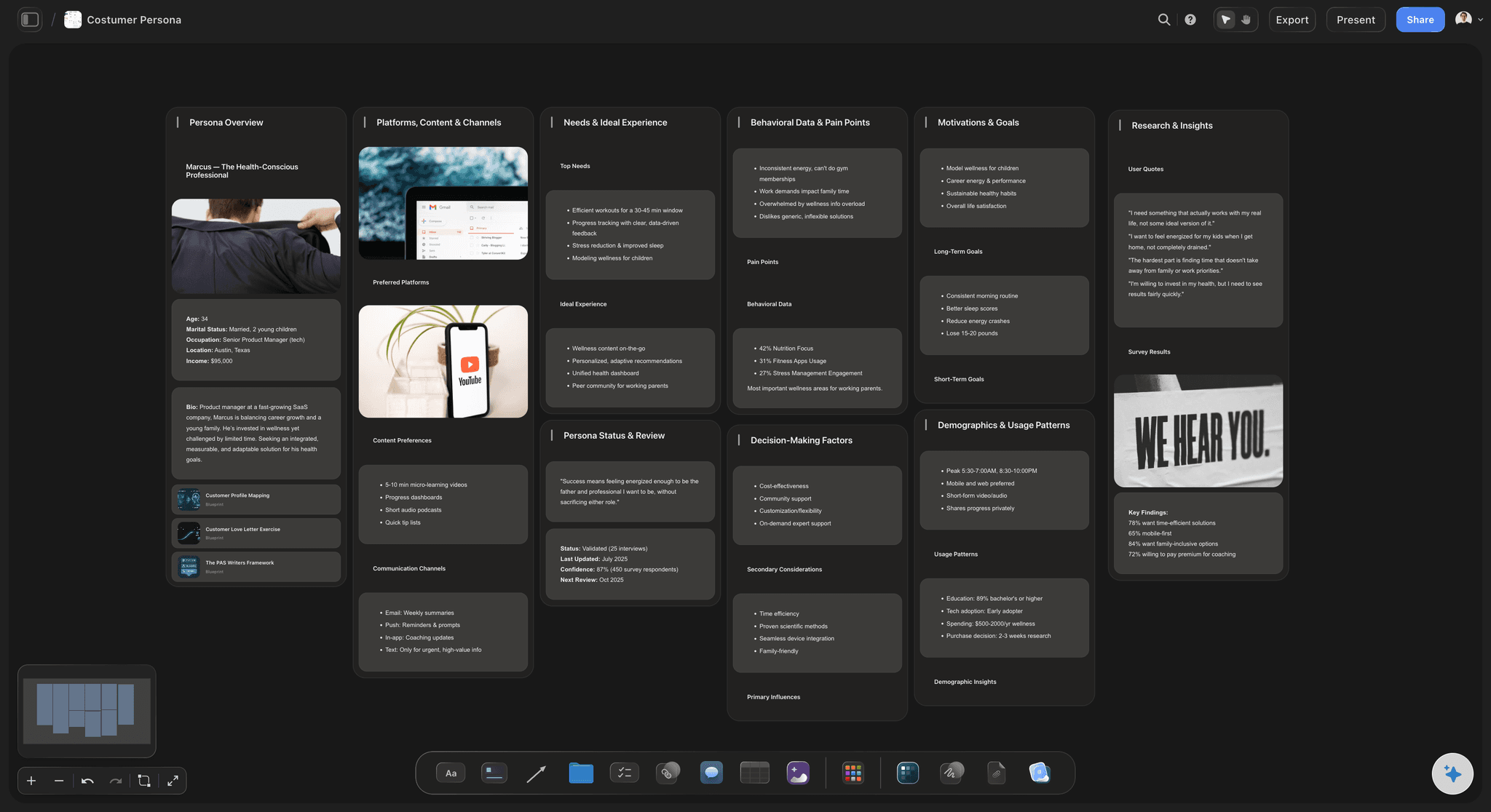
AI that reads the whole board
A sparring partner for the brand workshop
Draft from the research: Ask the AI to propose traits and an archetype from the interviews, reviews and notes on the board, then argue with its choices.
Position against real competitors: Ask for the personality and tone of named competitors, with examples, and place them on the same sliders as your brand.
Write it to test it: Ask for a headline, a caption and a customer reply in each trait. A trait that produces bland examples is not doing any work yet.
It proposes, you decide: The AI drafts and challenges. Who the brand is, and what it will never be, is a decision for the founders and the brand team.
Explore templates for your project
Every template opens as a real, editable board on the infinite canvas. Pick the closest fit and make it your own.
Brand Strategy
Define your positioning, values, and voice and connect them into a strategy the team can follow.
One app instead of five
Storyflow vs Miro, Google Slides, and Notion for brand personality work.
Each is good at part of it: Miro for a live workshop, Google Slides for a presentation to leadership, Notion for a written brand wiki. Here is where they differ when the framework has to hold its evidence and its examples.
Storyflow
Recommended
Personality sliders and trait workshop on a canvas
Voice and visual examples beside each trait
Nested boards for research, moodboard and guidelines
Real-time collaboration by link
Built-in voting and timer for a live workshop
Miro
Personality sliders and trait workshop on a canvas
Voice and visual examples beside each trait
Nested boards for research, moodboard and guidelines
Real-time collaboration by link
Built-in voting and timer for a live workshop
Google Slides
Personality sliders and trait workshop on a canvas
Voice and visual examples beside each trait
Nested boards for research, moodboard and guidelines
Real-time collaboration by link
Built-in voting and timer for a live workshop
Notion
Personality sliders and trait workshop on a canvas
Voice and visual examples beside each trait
Nested boards for research, moodboard and guidelines
Real-time collaboration by link
Built-in voting and timer for a live workshop
What creators are saying
Join early creators getting structured workspaces and AI that remembers their projects
“Storyflow has sped up my workflow by at least 3x, which means more flow state and more projects I can actually ship. It truly changed the way me and my team create.”

Reilin Joey
Director & YouTuber
“One prompt gets me a structured board. But the tactics are my favorite. I run my YouTube scripts through them and my intros and retention got better. It's amazing.”

Justkay
YouTuber & Freelance Filmmaker
“I used to juggle five apps to plan a project. Now I describe what I am making and get boards, lists, and a schedule. All in one place.”

George
@fernwehchronicles
Brand personality questions, answered.
Frameworks, sliders, archetypes and how to make it stick.
Storyflow is built for developing the framework as a team: the sliders, traits, archetype and we-are and we-are-not lists sit on one board beside the customer research and competitor examples, and the AI drafts traits from that research and writes examples in the voice. Miro is a good choice for running a single live workshop, Google Slides for presenting the finished framework to leadership, and Notion for a written brand wiki that links to other company documents.
A brand personality framework is a structured definition of the human characteristics a brand expresses, and the rules that turn those characteristics into how it writes, looks and behaves. It usually includes three to five core traits, a brand archetype, personality sliders that set the degree of each trait, a we-are and we-are-not list, voice and tone rules, visual cues and examples. Its purpose is consistency: every person and partner making the brand expresses the same personality.
Start from evidence rather than aspiration: customer interviews and reviews, the founder's story, what employees believe, and how competitors present themselves. Place the brand on personality sliders such as formal to casual and serious to playful, compare it with competitors on the same sliders, then choose three to five traits and an archetype that are true and distinct. Define each trait in a sentence, pair it with the failure it must avoid, and test it by writing real examples.
Brand personality sliders are spectrums between two opposite qualities, such as formal and casual, serious and playful, classic and modern, or accessible and exclusive, on which a team places the brand. They are useful because most brands share the same positive traits, and what makes a brand distinct is the degree: slightly playful and very playful produce different writing and design. Placing competitors on the same sliders shows whether the brand's position is genuinely different.
Jennifer Aaker's framework, published in 1997, groups brand personality into five dimensions: sincerity, such as honest and wholesome; excitement, such as daring and imaginative; competence, such as reliable and successful; sophistication, such as upper class and charming; and ruggedness, such as outdoorsy and tough. It remains a widely used starting vocabulary, although most brands then define more specific traits of their own within one or two of the dimensions.
The twelve archetypes most often used in branding, popularised by Margaret Mark and Carol Pearson in The Hero and the Outlaw, are the Innocent, Everyman, Hero, Outlaw, Explorer, Creator, Ruler, Magician, Lover, Caregiver, Jester and Sage. Each describes a recognisable character with its own motivations and voice. Brands usually choose one primary archetype and sometimes a secondary one, and use it as shorthand rather than as a rigid script.
Brand personality is who the brand is: its character traits and archetype. Brand voice is how that personality sounds in words, expressed through vocabulary, sentence style and rhythm, and adapted into tone for different situations. Personality also drives visual identity and behaviour, not only writing. A framework usually defines the personality first and derives voice rules from it, because a voice written without a personality behind it tends to become a list of style preferences.
Consider how differently familiar categories feel. An outdoor brand built on ruggedness and the Explorer archetype writes about places and endurance with plain, confident language. A premium fashion house leaning on sophistication writes sparingly and lets imagery carry the mood. A challenger bank using the Outlaw or Jester archetype might use humour about the frustrations of traditional banking. The useful exercise is to describe competitors in your own category this way and find the position none of them holds.
Three to five is the practical range. Fewer than three rarely gives writers and designers enough to work with, and more than five makes the traits blur into a general description of a pleasant company that nobody can apply. Each trait should change a decision, such as which photograph to choose or how to reply to a complaint. If removing a trait would not change any real piece of work, it does not belong in the framework.
Make it easy to apply and hard to ignore. Express every trait through examples, such as a headline, a caption and a customer reply, because people copy examples rather than adjectives. Share the framework by link with agencies, freelancers and new hires, reference it in every campaign brief, and review a sample of real output against the sliders every quarter. A framework that lives only in a launch presentation is forgotten within months.
Yes, with research, drafting and testing, but it should not decide who the brand is. In Storyflow the AI reads the interviews, reviews and notes on the board, proposes traits and an archetype for the team to challenge, describes real competitors' tone for comparison, and writes examples in each trait so weak traits show up quickly. Choosing the personality is a strategic decision for the founders and brand team, and the AI's drafts are where that argument starts.
Not yet. Storyflow is paid-only during early access, with plans from $7.99 a month billed annually ($9.99 monthly). A free plan launches before the end of 2026, and anyone a paid member invites to a board joins free. Inviting the brand team into the workshop is not a cost decision, and agencies and freelancers reading the framework through a view-only link never need an account.
More from Storyflow
Give every writer and designer the same brand to work from.
Open a canvas, start from the brand personality template, and bring your research into the room.