
Polished brand plans, extremely simple
A brand discovery workshop
that leaves the room as a strategy.
The questionnaire, a three-hour agenda, seven exercises that force a choice, and the readout, on the same board the strategy is written from.


Creatives working for these brands already got early access
- Red Bull
- Canon
- Artlist
- Porsche
See how easy it is to get started
Watch a real project come together, from a blank board to a finished plan, clicked through step by step.
Start from a ready-made template
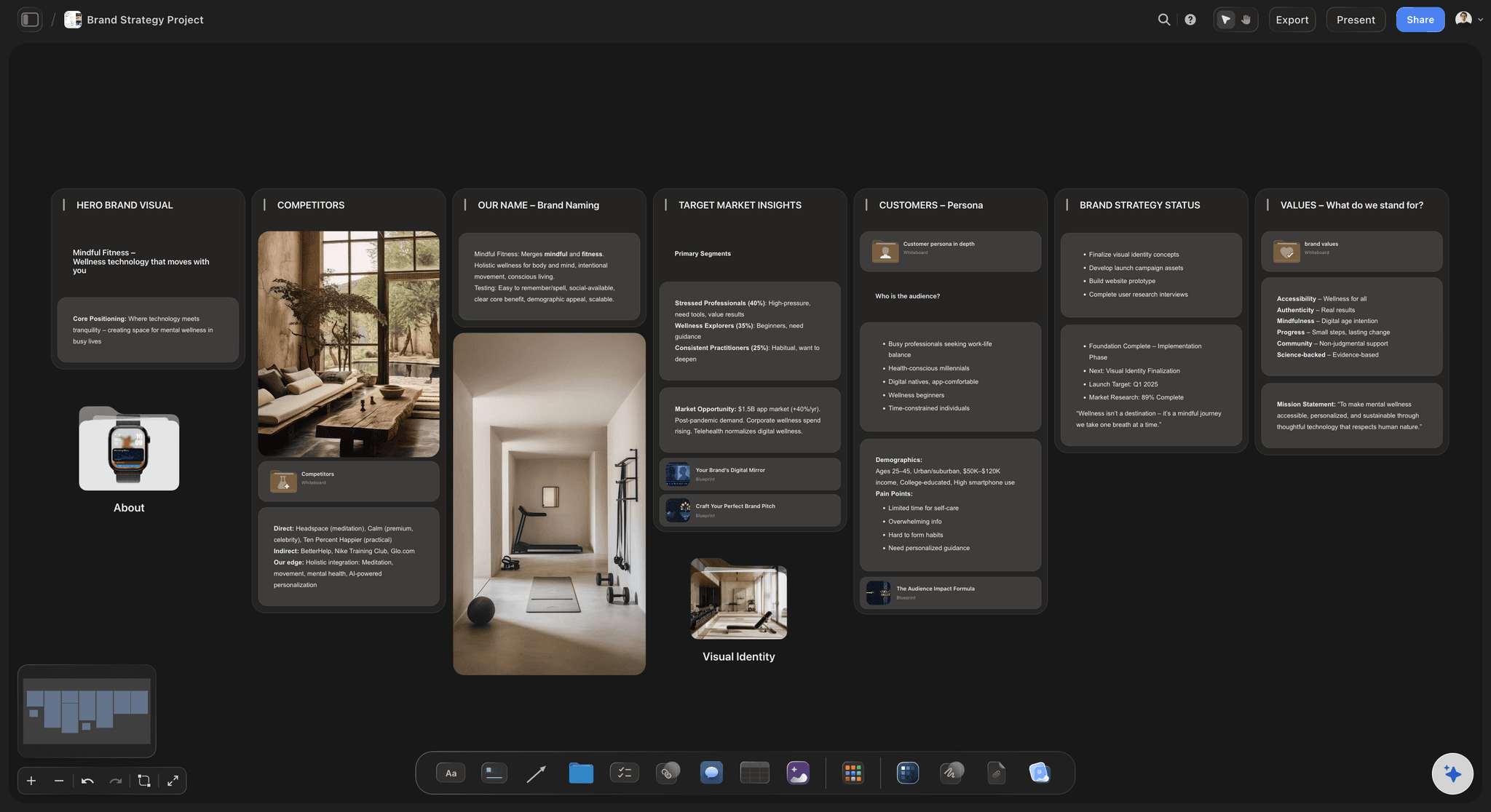
Pick a board to see what you can build, then let AI fill it in. Every template is a real, editable starting point on the same infinite canvas.

Brand Strategy
Define your positioning, values, and voice and connect them into a strategy the team can follow.
What is a brand discovery workshop, and what should it produce?
A brand discovery workshop is a two to four hour session where a studio and the client's founders agree who the brand is for, who it competes with, how it should feel and what it stands for, before anything is designed. Storyflow is an AI visual workspace that turns a brand discovery workshop into a strategy on one infinite canvas: the pre-workshop questionnaire, a three-hour agenda, the exercises, and a first brand strategy draft from what the room decided. The draft covers positioning, audience, personality, values and voice, for you to rewrite.
Get the decision-maker in the room. The person who signs off the identity has to sit through the exercises, or the concept presentation becomes the workshop they missed. Keep it to three to six people: the founders, whoever runs marketing and one person who talks to customers every week. Past that, the loudest opinions win.
Make them choose, not describe. Every founder wants a brand that is bold, friendly and premium, and adjectives cost nothing. Exercises that force a trade-off do the work: a slider between two good words, a competitor map with an empty corner, twenty images sorted into this and not this. When two founders disagree, that is a finding. Write it down.
Charge for discovery. Preparing the workshop, running it and writing the readout take two to three days of studio time. Price it as the first phase of the identity project, or sell it as a paid discovery sprint before the proposal and credit it against the project if they go ahead. A free workshop says the thinking is the part you give away.
Ultra fast from brief to board
Before the room, in it, and after it.
One board from the questionnaire to the strategy draft.
01
Send the questionnaire a week before
Ten to fifteen questions, answered by each founder separately. Paste the answers onto the board and ask the AI to group them into themes and list where the founders disagree, so the agenda goes straight at the gaps.
02
Build one frame per exercise
Opening, the business, the audience, the competitor map, personality sliders, values and an image sort, each in its own frame with its minutes in the heading. The AI can lay the frames out from the agenda below.
03
Run the room from the board
Put the board on the screen and step through the frames fullscreen. One person facilitates, a second types what the room says straight onto the board, in the founders' own words.
04
Send the readout, then the draft
Within two working days, send the board with the decisions and the open questions. A week later, the AI's brand strategy workflow drafts positioning, audience, personality, values and voice from it for you to rewrite.
The exercises that make a founder choose.
Built on the board before the session, filled in during it, kept after it.
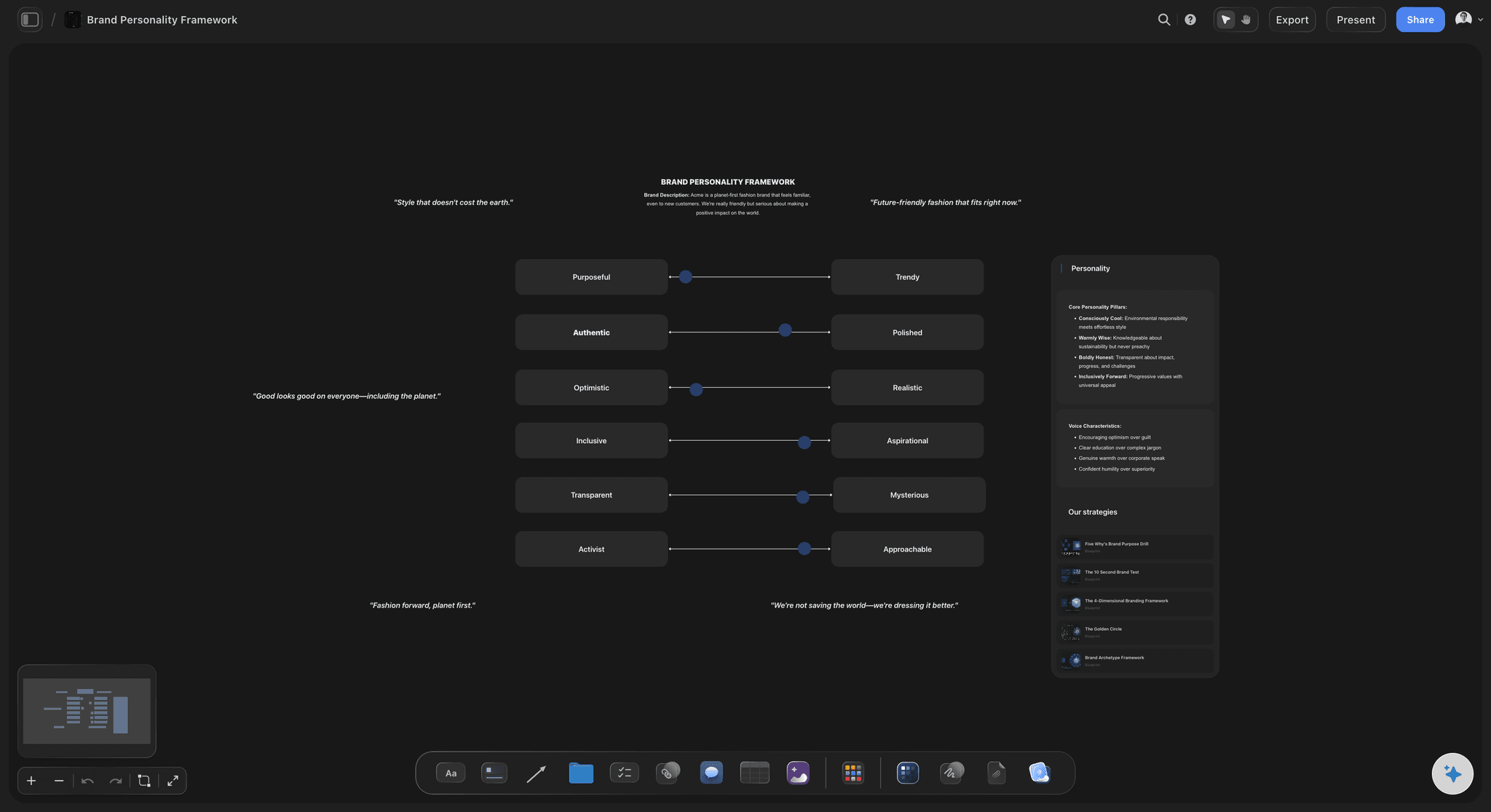
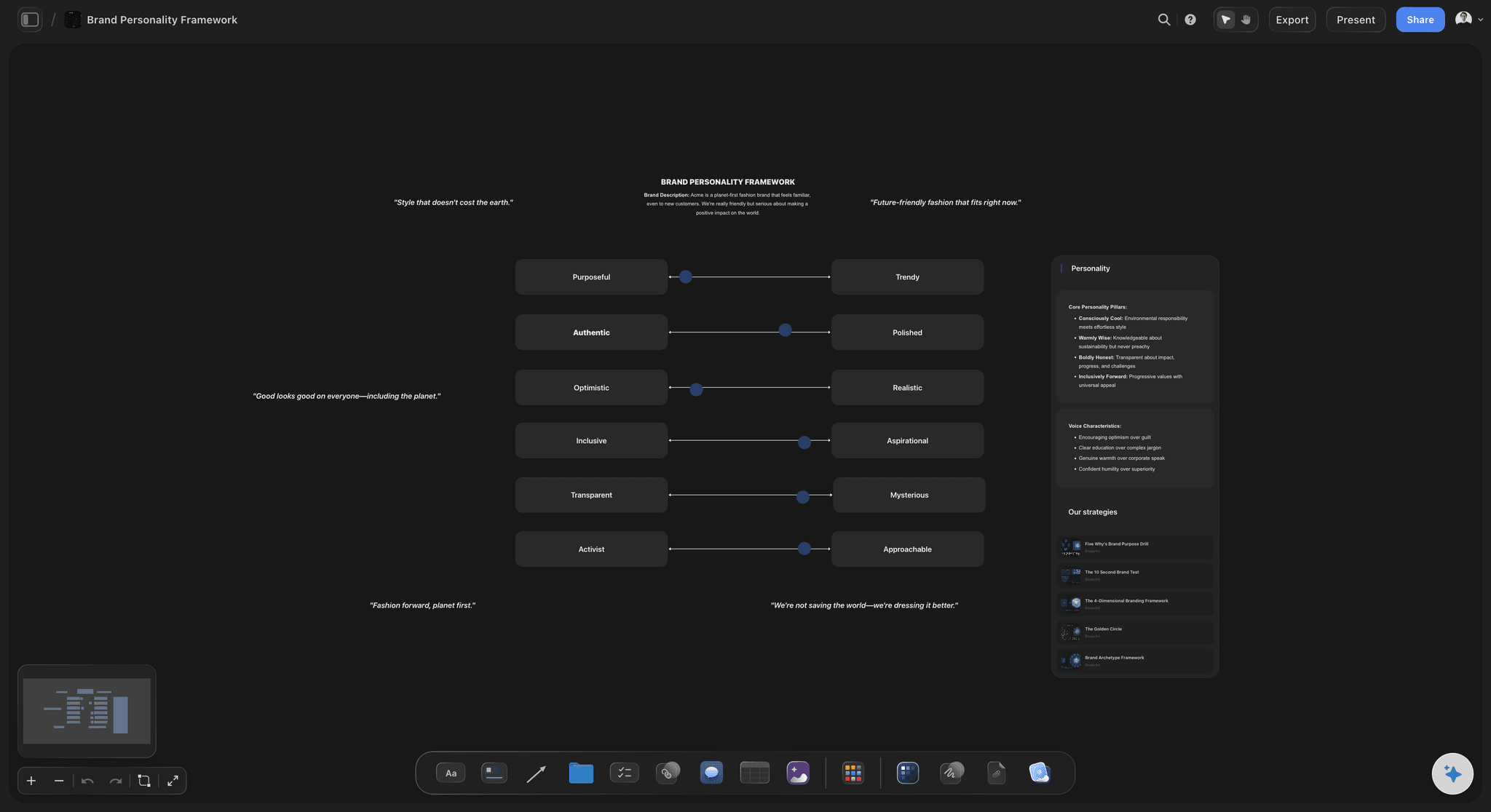
Personality, as trade-offs
Sliders between two good words
Six to eight pairs, such as classic to modern or understated to loud. Each founder places a dot before anyone talks, then the room settles on one. The spread between the dots tells you where the strategy will be argued.
See the brand personality template →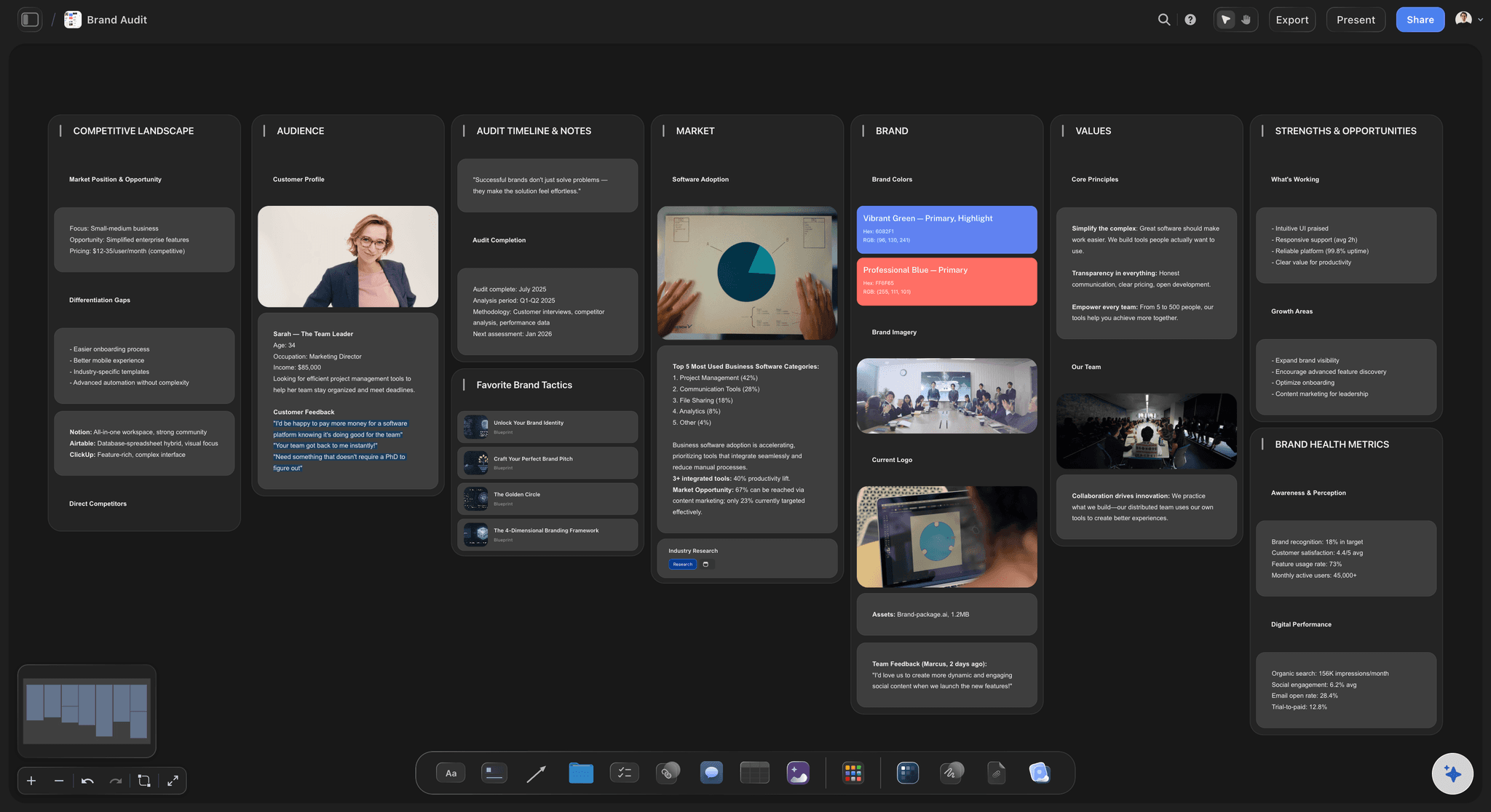
The market, as a map
A competitor map with the gap marked
Six to eight competitors placed on two axes the founders pick, with a screenshot of each one's site beside it. The empty corner is only worth claiming if the audience wants something there.
See the AI competitor analysis generator →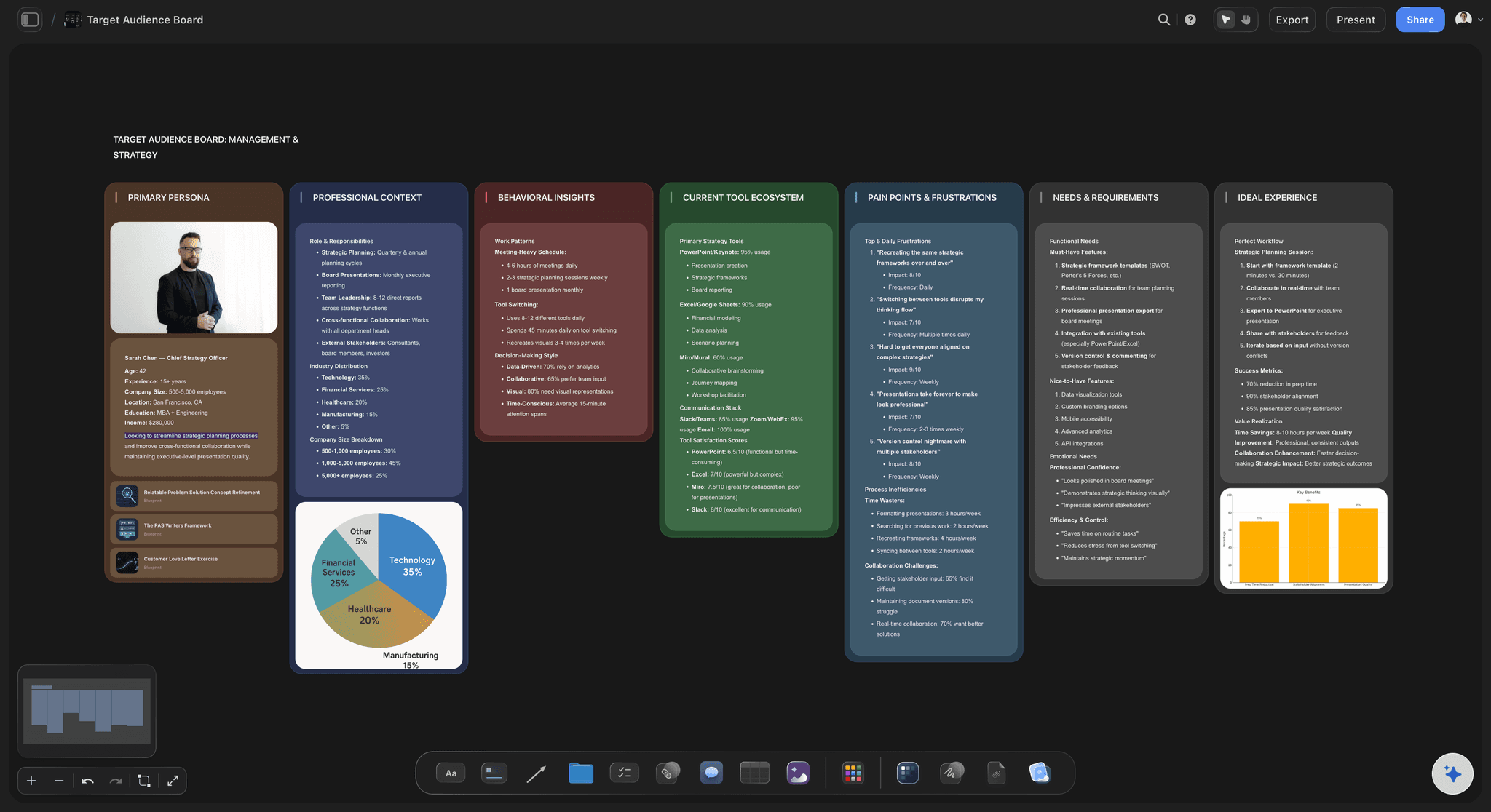
The audience, as one person
One buyer described in detail
A name, a job, a week, what they buy now and what annoys them about it. One person the founders recognise beats a demographic range, and the AI can draft a first version from the questionnaire answers for the room to argue with.
See the customer persona generator →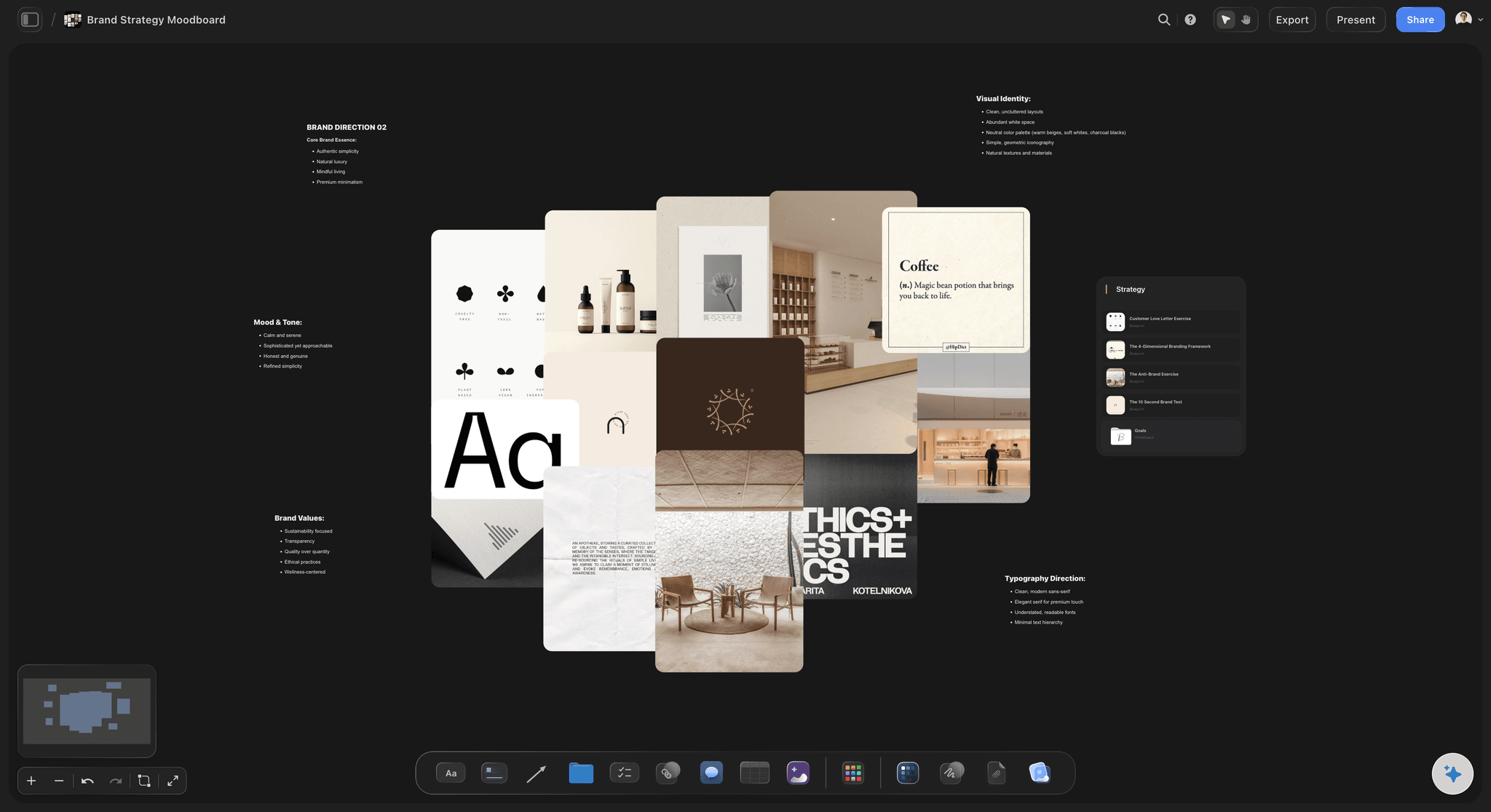
The readout, sent that week
The same board, sent to everyone who was there
The client opens the workshop board from a view-only link with no account, and signs in to comment on a decision they remember differently. Export the whole board as a PDF for the investor or co-founder who could not make it.
See the brand strategy tool →One workshop board per client, kept with the project.
The workshop board stays beside the strategy, the moodboards and the plan it led to, so nobody has to ask what was agreed in March. Storyflow is paid-only during early access, with plans from $7.99 a month billed annually ($9.99 monthly). A free plan launches before the end of 2026, and anyone a paid member invites to a board joins free.
Unlimited boards and image uploads on every paid plan
AI that sorts questionnaire answers and drafts the brand strategy from the workshop
Docs with inline comments that export to Word and PDF
Presentation mode, view-only links and whole-board PDF export
Built for people with taste
A three-hour agenda, seven exercises and the questions.
A common shape for two to four founders, in person or on a video call. It works on paper as well as on a board. Cut an exercise before you rush one.
A week before
What to send before the workshop
The questionnaire: One copy per founder, answered separately and back three working days before the session. Answers written alone show the disagreements a group conversation hides.
The asset request: The current logo and any brand files, the website and social accounts, sales material, and a list of the competitors they worry about. Ask for three brands they admire outside their category.
The invite and the rules: Who attends (six at most, the decision-maker included), the date, the three hours blocked with no laptops open except the note-taker's, and what the session will produce: agreed inputs for the strategy, not a logo.
The first 90 minutes
The business, the audience and the market
0:00 to 0:15. Opening: Why the brand needs work now, what today decides and what it leaves for later, and how the day's output becomes the strategy. Read back two answers from the questionnaire where the founders disagreed.
0:15 to 0:40. The business in their words: How it started, what it sells, who pays, and where it should be in three years. Write down the phrases the founders repeat: they often end up in the positioning.
0:40 to 1:05. The audience: Who buys today, who they wish bought, and one of those people described in detail: their week, what they use now, what they would switch for. Resist a second persona until the first is sharp.
1:05 to 1:30. The competitor map: Six to eight competitors on two axes the founders choose, such as premium to accessible and tradition to invention. Mark the empty corner, then ask whether the audience wants anything there.
The last 90 minutes
Personality, values and the look
1:30 to 1:40. Break: Ten minutes, and the facilitator uses it to read the board back and decide which exercise to shorten if the morning ran long.
1:40 to 2:10. Personality sliders: Six to eight word pairs. Everyone places a dot in silence, then the room agrees a position for each. Spend the time on the widest spreads, not the pairs everyone agrees on.
2:10 to 2:35. Values and we are, we are not: Three to five values, each with a behaviour a customer could notice, and a list of pairs such as expert, not academic. A value nobody could break is not doing any work.
2:35 to 3:00. Image sort and the wrap: Twenty to thirty images from inside and outside the category, sorted into this, not this and unsure. Close by reading back what was decided, the open questions and who owes what by when.
The question list
Twelve brand discovery questions
The business: Why does this company exist, beyond making money? What would customers miss if it closed tomorrow? What has to be true in three years for the brand work to have paid off?
The audience: Who is the best customer you have, and why did they choose you? Who do you never want to sell to? What do customers say about you that you would never say yourself?
The competition: Who do you lose deals or sales to, and why? Which competitor's brand do you secretly envy? What does everyone in your category say that you are tired of hearing?
The brand: If the brand were a person at a dinner party, how would they talk? What must never change about how you look or sound? What would make you embarrassed to put your name on it?
Explore templates for your project
Every template opens as a real, editable board on the infinite canvas. Pick the closest fit and make it your own.
Brand Strategy
Define your positioning, values, and voice and connect them into a strategy the team can follow.
One app instead of five
Miro, FigJam and Mural run the room. Storyflow keeps what it decided.
They are built for a live session with timers and votes. Storyflow keeps the workshop board next to the strategy, moodboards and project plan it turns into.
Storyflow
Recommended
Brand strategy drafted from the board by a built-in workflow
Workshop write-up exported as a Word file
Countdown timer for each exercise
Voting session on the options
Large library of workshop templates
Miro
Brand strategy drafted from the board by a built-in workflow
Workshop write-up exported as a Word file
Countdown timer for each exercise
Voting session on the options
Large library of workshop templates
FigJam
Brand strategy drafted from the board by a built-in workflow
Workshop write-up exported as a Word file
Countdown timer for each exercise
Voting session on the options
Large library of workshop templates
Mural
Brand strategy drafted from the board by a built-in workflow
Workshop write-up exported as a Word file
Countdown timer for each exercise
Voting session on the options
Large library of workshop templates
What creators are saying
Join early creators getting structured workspaces and AI that remembers their projects
“Storyflow has sped up my workflow by at least 3x, which means more flow state and more projects I can actually ship. It truly changed the way me and my team create.”

Reilin Joey
Director & YouTuber
“One prompt gets me a structured board. But the tactics are my favorite. I run my YouTube scripts through them and my intros and retention got better. It's amazing.”

Justkay
YouTuber & Freelance Filmmaker
“I used to juggle five apps to plan a project. Now I describe what I am making and get boards, lists, and a schedule. All in one place.”

George
@fernwehchronicles
What strategists ask about discovery workshops.
Agenda, exercises, questions, who attends and what to charge.
Storyflow, if the workshop has to end as a brand strategy rather than a photo of sticky notes: the questionnaire answers, the agenda and every exercise sit on one board the client opens by link with no account or reads as a PDF, and its AI drafts the strategy from what the room decided. For a large remote session that needs timers and anonymous voting, run the room in Miro, FigJam or Mural.
A common three-hour shape: fifteen minutes of opening, twenty-five on the business in the founders' words, twenty-five on the audience, twenty-five on a competitor map, a ten-minute break, thirty on personality sliders, twenty-five on values and we are, we are not, and twenty-five on an image sort and the wrap. Cut an exercise rather than rushing every one.
Ask questions that force a choice. Why does the company exist beyond money? What would customers miss if it closed? Who is your best customer and why did they choose you? Who do you lose to? Which competitor do you envy? What must never change? What would embarrass you? Send the factual questions in the questionnaire so the room spends its time on judgement.
A questionnaire of ten to fifteen questions, answered by each founder separately and returned three working days before; a request for existing brand files, sales material and a competitor list; and an invite that names who attends, blocks three hours and says what the session will produce. Read the answers side by side and aim the agenda at where they disagree.
Three to six people: the founders, the person who will sign off the identity, whoever runs marketing and one person who talks to customers every week. From the studio, a facilitator and a second person to capture what is said. If the decision-maker cannot attend, move the date; a workshop without them gets rerun later in the concept presentation.
Pairs of words that are both good, such as classic and modern, or understated and loud, with a line between them. Each person places a dot in silence, then the room agrees one position per pair. Six to eight pairs is enough. The pairs where the dots spread widest are where the brand is still undecided, so spend the discussion time there.
Within two working days, a readout: the decisions per exercise, the founders' own phrases, the disagreements still open and who owes what by when. A week or two later, the strategy draft built from it, presented live. In Storyflow the readout is the workshop board itself, and its AI drafts the strategy from that board for you to rewrite.
In person works best for two to four founders, with the board on a screen and one person typing. Remote works if you split it into two ninety-minute sessions on consecutive days and ask everyone to keep their camera on. Send the image sort as a pre-read, so the call time goes on discussion rather than scrolling.
Price the preparation, the session and the readout together, which is often two to three days of studio time. Either bill it as the first phase of the identity project or sell it as a paid discovery sprint before the proposal, credited against the project if the client goes ahead. Avoid giving it away to win the job.
No, but it helps either side of it. Before, Storyflow's AI groups the questionnaire answers into themes and lists where founders disagree. After, its brand strategy workflow drafts the strategy from the workshop board, and it can draft a first audience description and propose a colour palette. The judgement in the room, and the final strategy, stay yours.
No. Storyflow has no timer or voting session, so for a large remote workshop run the exercises in Miro, FigJam or Mural and paste the results onto the Storyflow board afterwards. For two to six people in a room, the board on a screen with one person typing is usually enough, and it is already where the strategy will be written.
Not during early access. Storyflow is paid-only during early access, with plans from $7.99 a month billed annually ($9.99 monthly). A free plan launches before the end of 2026, and anyone a paid member invites to a board joins free. Clients open the workshop board from a view-only link at no cost.
More from Storyflow
Brand identity project plan
Brand strategy tool
Brand personality template
Workshop planning tool
Brand moodboard maker
Customer persona generator
AI competitor analysis generator
Creative client onboarding
Brand story template
Rebrand planner
What is brand positioning
What to do with the board after the workshop
Miro vs Mural for workshops
Pricing
Design proposal template
Brand identity presentation
Leave the room with the strategy half written.
Build the workshop board from the agenda, run the session from it, and draft the strategy from what was decided.