
Elevated brand work, made with taste
Your brand strategy in ChatGPT,
on one board the creative team works from.
For brand teams and agencies: ChatGPT turns workshop notes and research into positioning, audience, promise, proof and voice on a Storyflow board, then writes the creative brief beside it.


Creatives working for these brands already got early access
- Red Bull
- Canon
- Artlist
- Porsche
See how easy it is to get started
Watch a real project come together, from a blank board to a finished plan, clicked through step by step.
Start from a ready-made template
Pick a board to see what you can build, then let AI fill it in. Every template is a real, editable starting point on the same infinite canvas.

Brand Strategy
Define your positioning, values, and voice and connect them into a strategy the team can follow.
Can ChatGPT create a brand strategy?
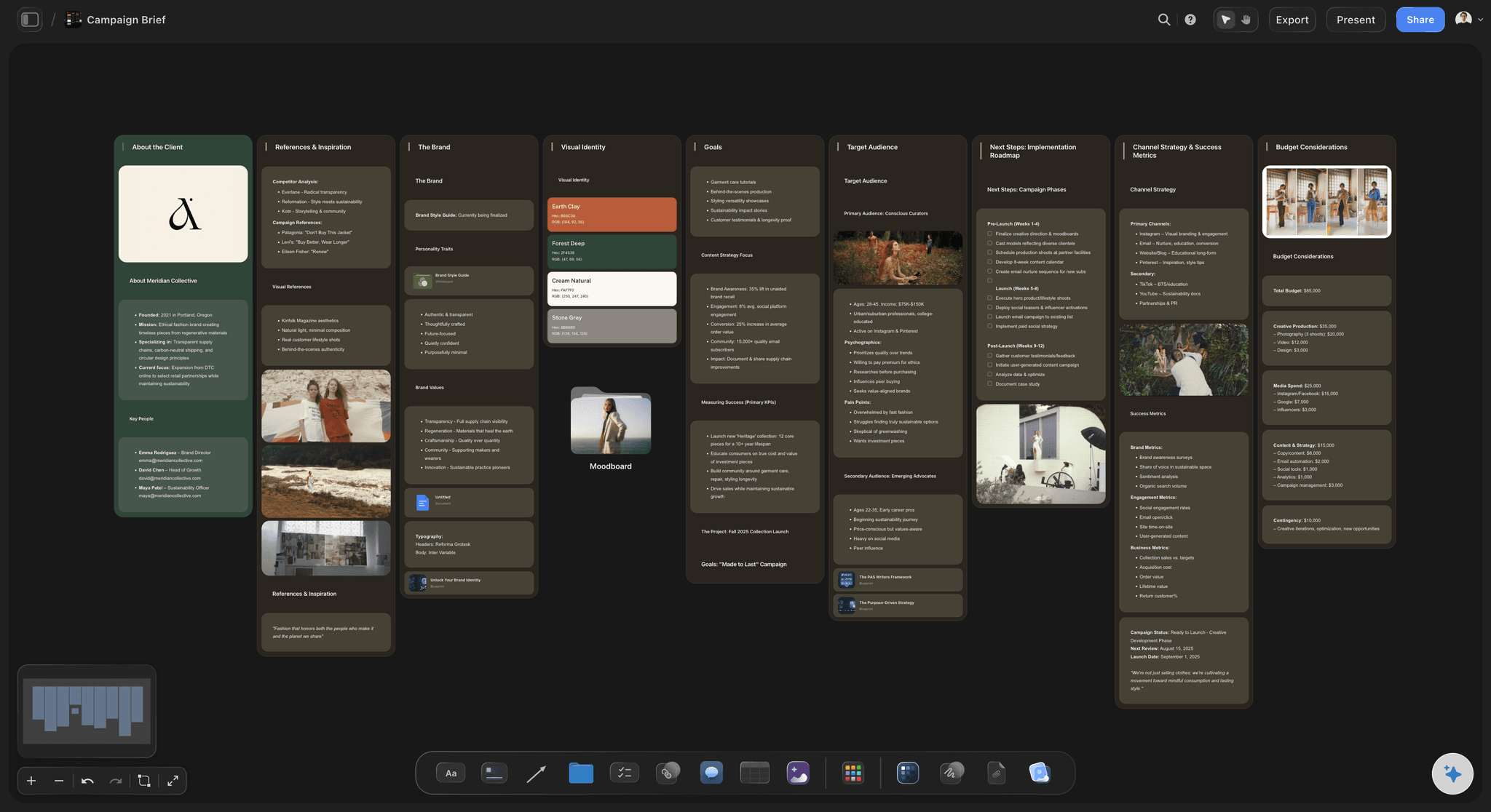
Yes, ChatGPT can create a brand strategy: give it the workshop notes, the customer research and what you know about rivals, and it drafts the positioning, the audience, the promise, the proof behind it and the voice. Storyflow is an AI visual workspace that builds a brand strategy on one infinite canvas: a wall each for positioning, audience, promise, proof and voice, the research and the moodboard beside them, and the creative brief written from the same board. With the Storyflow plugin installed, ChatGPT builds those walls on your board itself, on its own model, so the work spends no Storyflow AI credits.
With nothing connected, ChatGPT is a sharp sparring partner. Paste the notes from a half-day workshop and it finds the three phrases the founders kept repeating, writes a positioning line in the classic form (for whom, what, unlike whom, because) and pushes back when the promise is one every rival also makes. Then the strategy has to travel. It goes from the chat into a deck for sign-off, from the deck into a brief for the designers, and from the brief into a voice guide for the copywriters, and each copy drifts from the last. Six months on, nobody can find the reason behind a decision.
With the plugin, ask for the strategy on the brand's project and ChatGPT builds it as five walls. Positioning holds the one-line statement and the rivals it is set against. Audience holds the buyer in a sentence, written from the persona board if there is one. Promise holds the one line the brand must keep. Proof holds the facts that make the promise believable, each with its source. Voice holds three words, each with a sentence that sounds right and one that does not. When the walls hold, ask for the creative brief as a document on the same board, so the designers read the strategy and the brief in one place.
An example. Marlow & Pine, a six-person agency, runs a brand strategy for Kestrel, a cycling-clothing company with 3 shops and an online store. The inputs are a four-hour workshop with 5 people, 12 customer interviews and 4 rivals. Positioning: for commuters who ride in all weather, Kestrel makes clothes that pass as office wear, unlike sports brands, because every piece is tested on a 20-kilometre daily ride. Promise: dry at the desk. Proof: three facts with sources, one of them that 8 of the 12 people interviewed change clothes at work today. Voice: dry, practical and warm, each with a right and a wrong line, which makes six lines. On the board: five walls, a table of the 4 rivals' claims, a moodboard folder and a two-page creative brief with the sign-off date at the top.
A brand strategy is finished when a designer and a copywriter who were not in the workshop make the same choices from it. Test that before you present it: ask ChatGPT to read the board and write two headlines for a new ad, one that fits the voice and one that breaks it, and see whether the team can tell which is which. Every proof card should be something a customer could check: "tested on a 20-kilometre daily ride" is proof, "premium quality" is not.
Now the limits. ChatGPT drafts and the brand team decides, and a strategy written from no research reads well and means little. Through the plugin ChatGPT cannot design a logo or make pictures, and a photo attached in the chat does not reach the board, so references go in through an upload link or from direct image addresses. ChatGPT cannot read the comments on the board or delete cards. Storyflow has no version compare, so write who signed off and when on the brief.
Ultra fast from brief to board
Four steps from the workshop notes to a brief the designers use.
The first draft takes one conversation. The arguing, which is the useful part, takes longer.
01
Install Storyflow from the plugin directory
Open the Storyflow listing in ChatGPT's plugin directory and select Install plugin. Sign in to Storyflow when asked, then choose which projects ChatGPT may use.
02
Give ChatGPT the notes, the research and the rivals
Put the workshop notes and the interview files on the brand's board. Type @, pick Storyflow and ask, for example: "Read the Kestrel workshop notes and interviews and build the brand strategy on this board: a wall each for positioning, audience, promise, proof and voice. Every proof with its source, and the voice as three words with a right and a wrong line each." The five walls appear beside the files.
03
Test each line against rivals and customers
Ask ChatGPT to check the positioning and the promise against the rivals' claims and flag any line a rival could use unchanged. Change a card by hand, or tell ChatGPT what to change and it edits that card where it sits.
04
Write the brief and share the board
Ask for the creative brief as a document on the same board, written from the five walls. Share the board from Storyflow with the client through a view-only link, and invite the designers, who join free.

The strategy, the voice, the brief and the look.
ChatGPT writes the strategy through the plugin. Storyflow keeps it next to the work it is meant to guide.
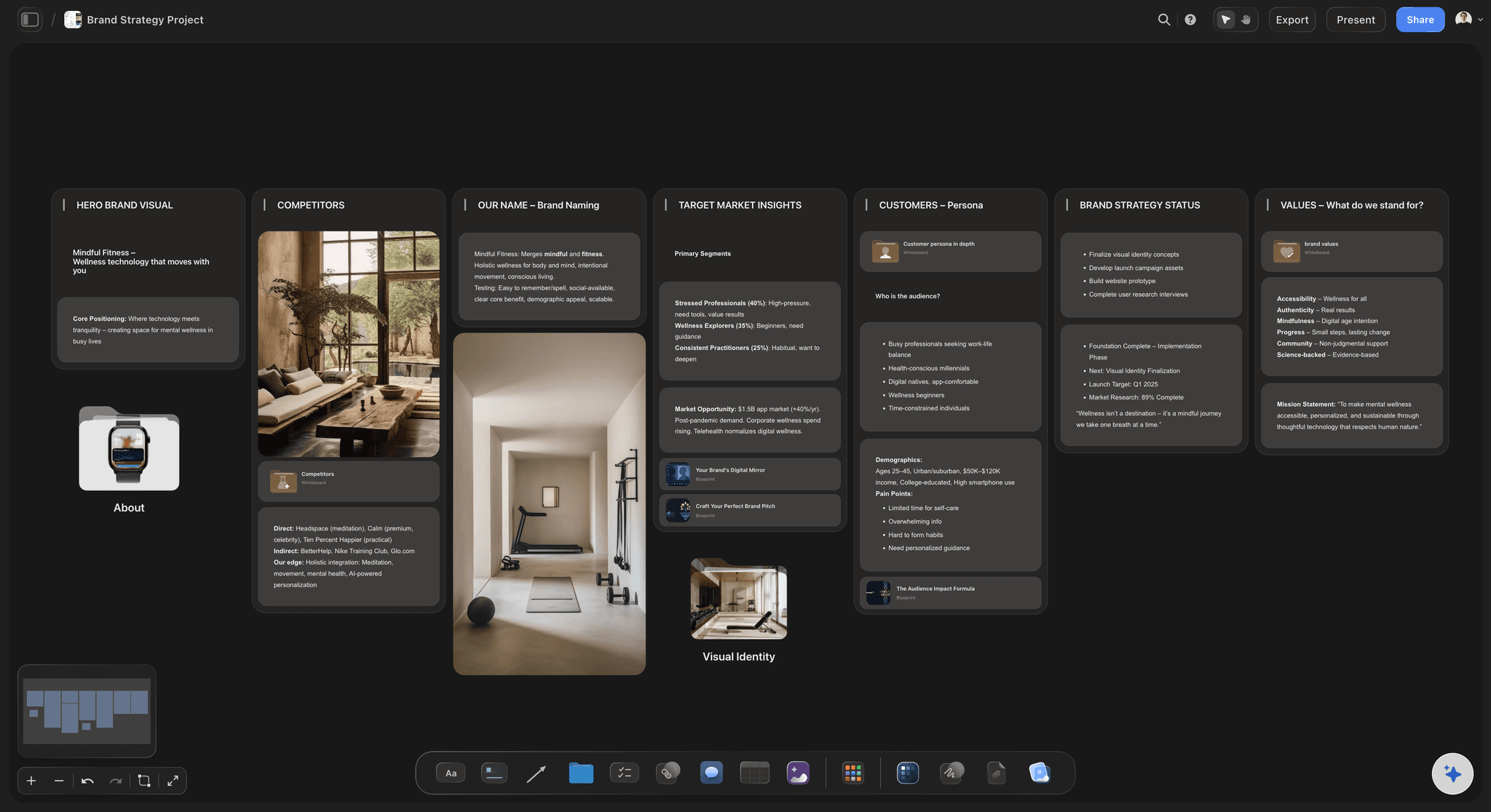
The strategy
Five walls the whole team can read
Ask ChatGPT for a wall each for positioning, audience, promise, proof and voice, or to put Storyflow's Brand Strategy template on the board and rewrite it for your client. Each wall reads on its own, so a designer who missed the workshop starts from the board, not from a handover call.
See the brand strategy tool →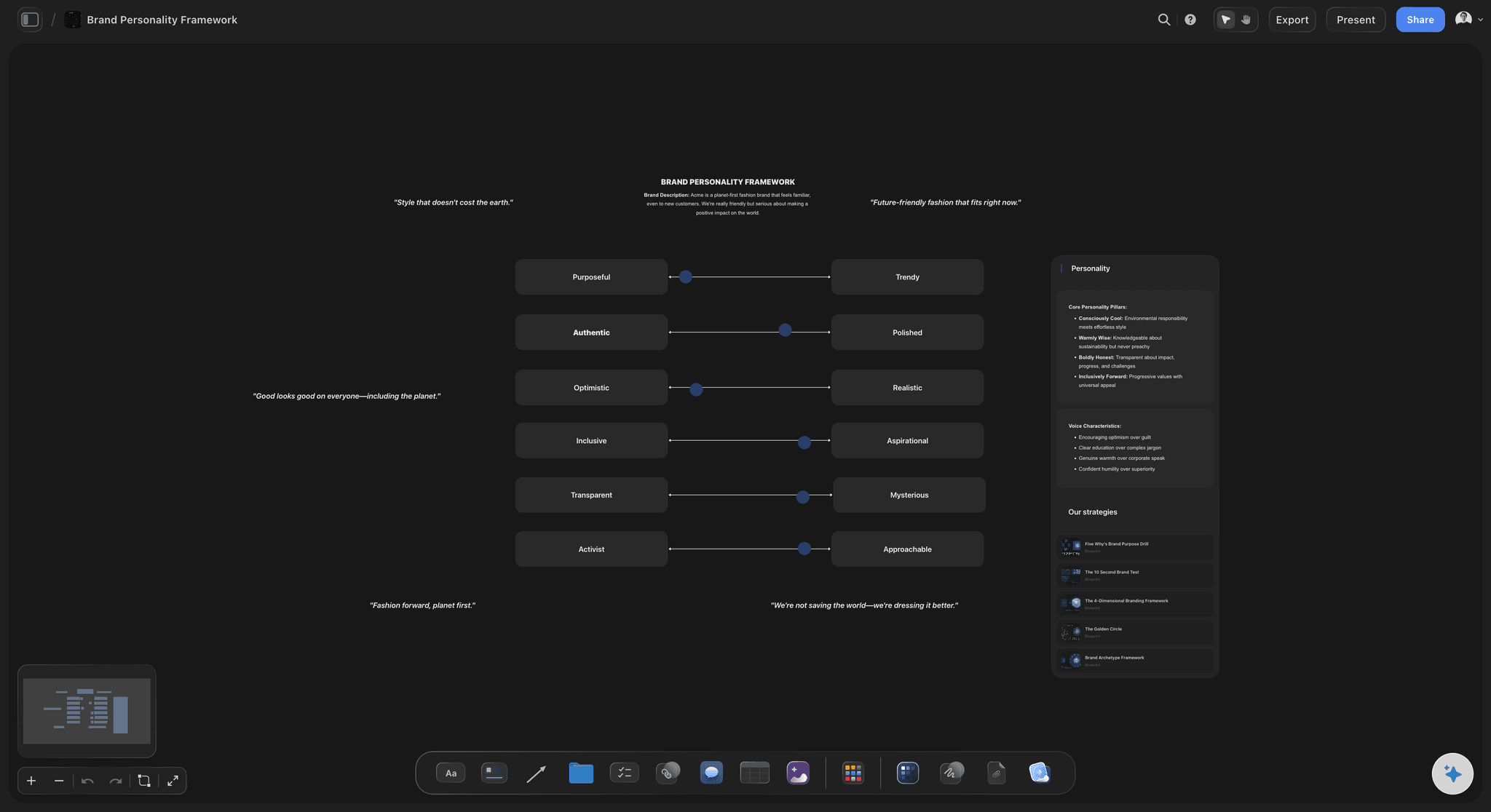
The voice
Voice as traits with example lines
Put Storyflow's Brand Personality Framework template on the board, with its pairs of opposite traits such as purposeful and trendy, and ask ChatGPT to rewrite the traits for your brand and add a right and a wrong sentence for each.
See the brand personality template →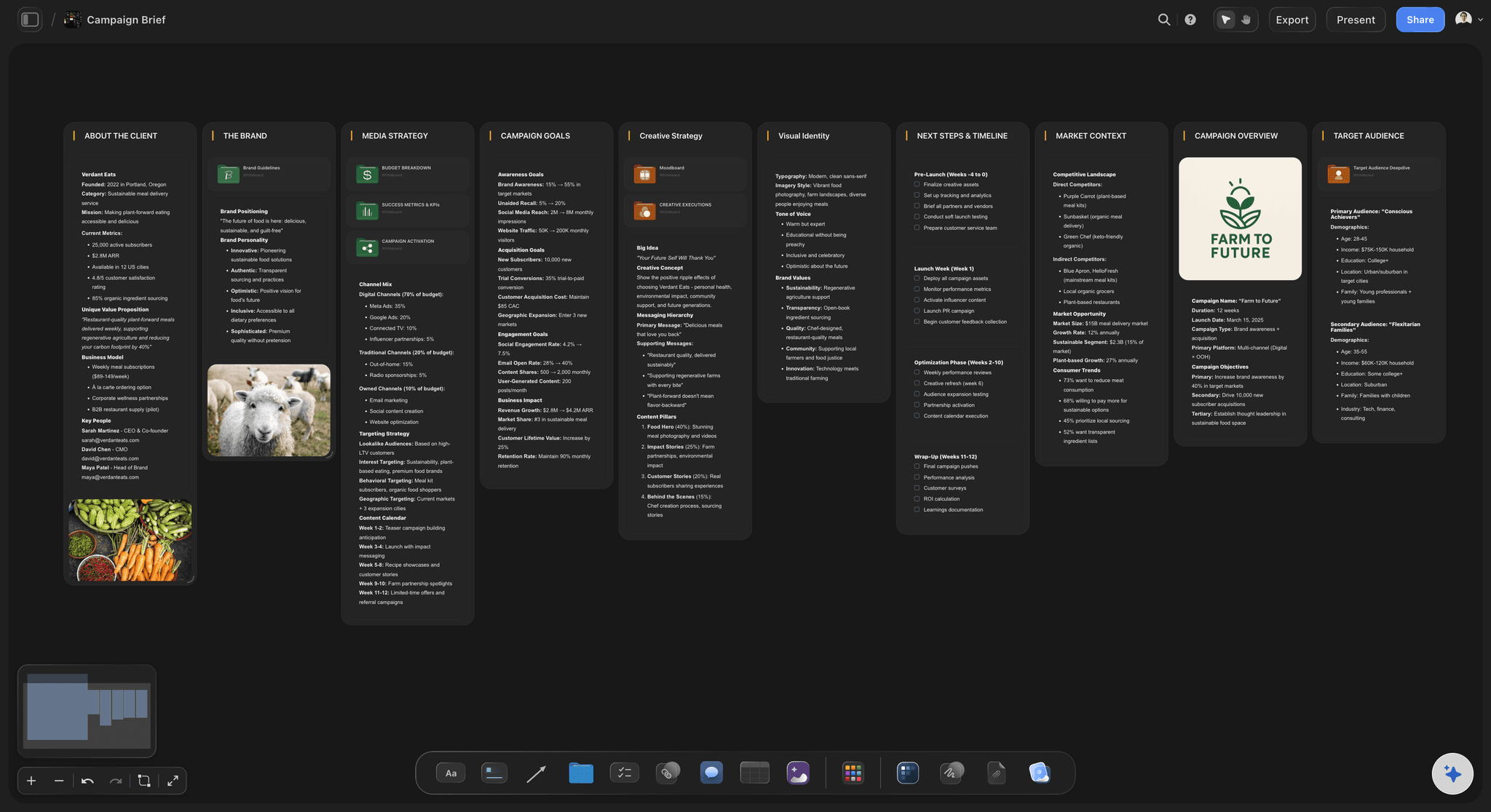
The brief
The creative brief written from the strategy
Ask ChatGPT for the creative brief as a document on the same board. It writes from the five walls, so the brief and the strategy say the same thing, and the designers read both in one place.
See creative briefs with ChatGPT →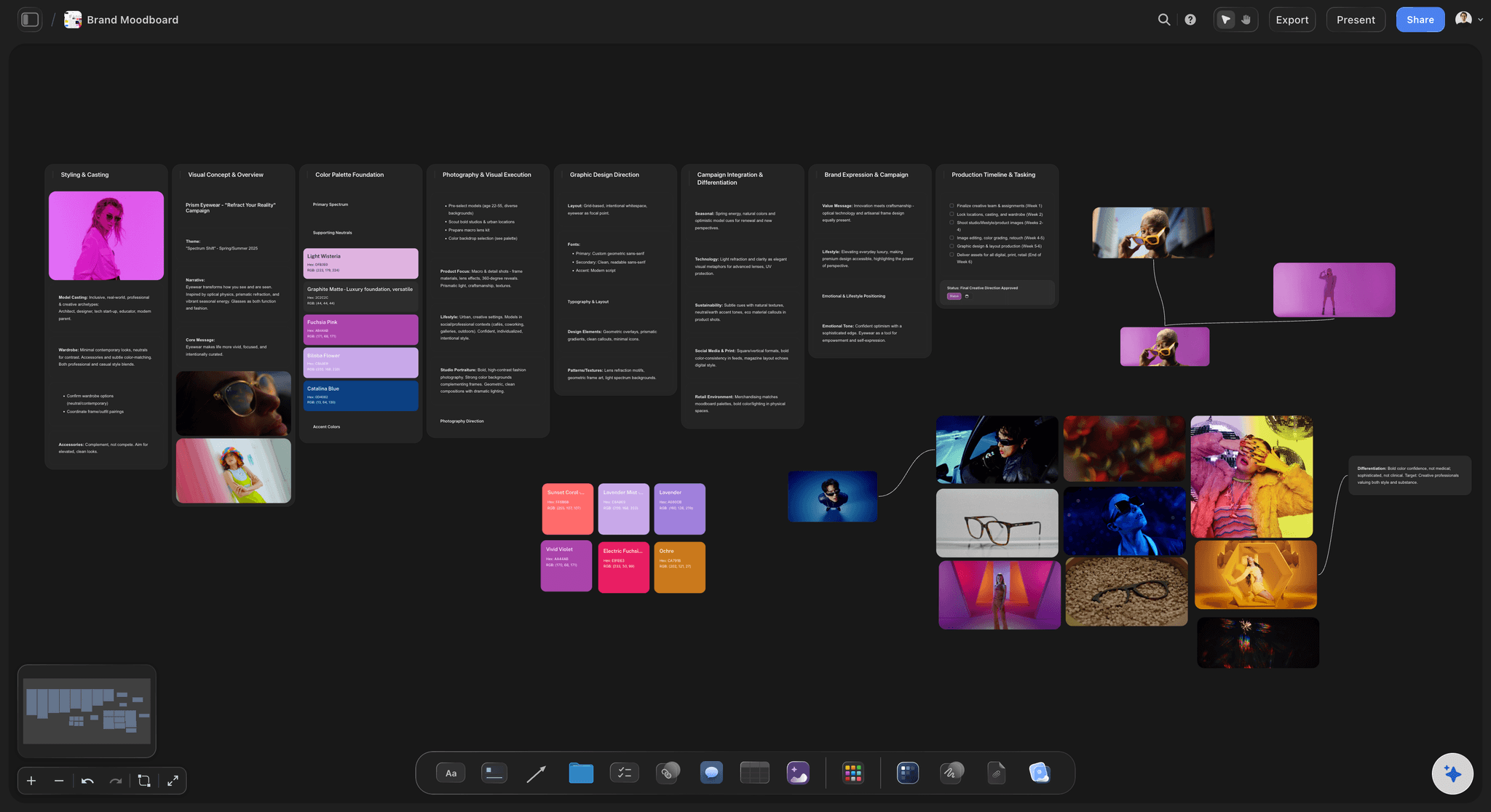
The look
The visual direction beside the words
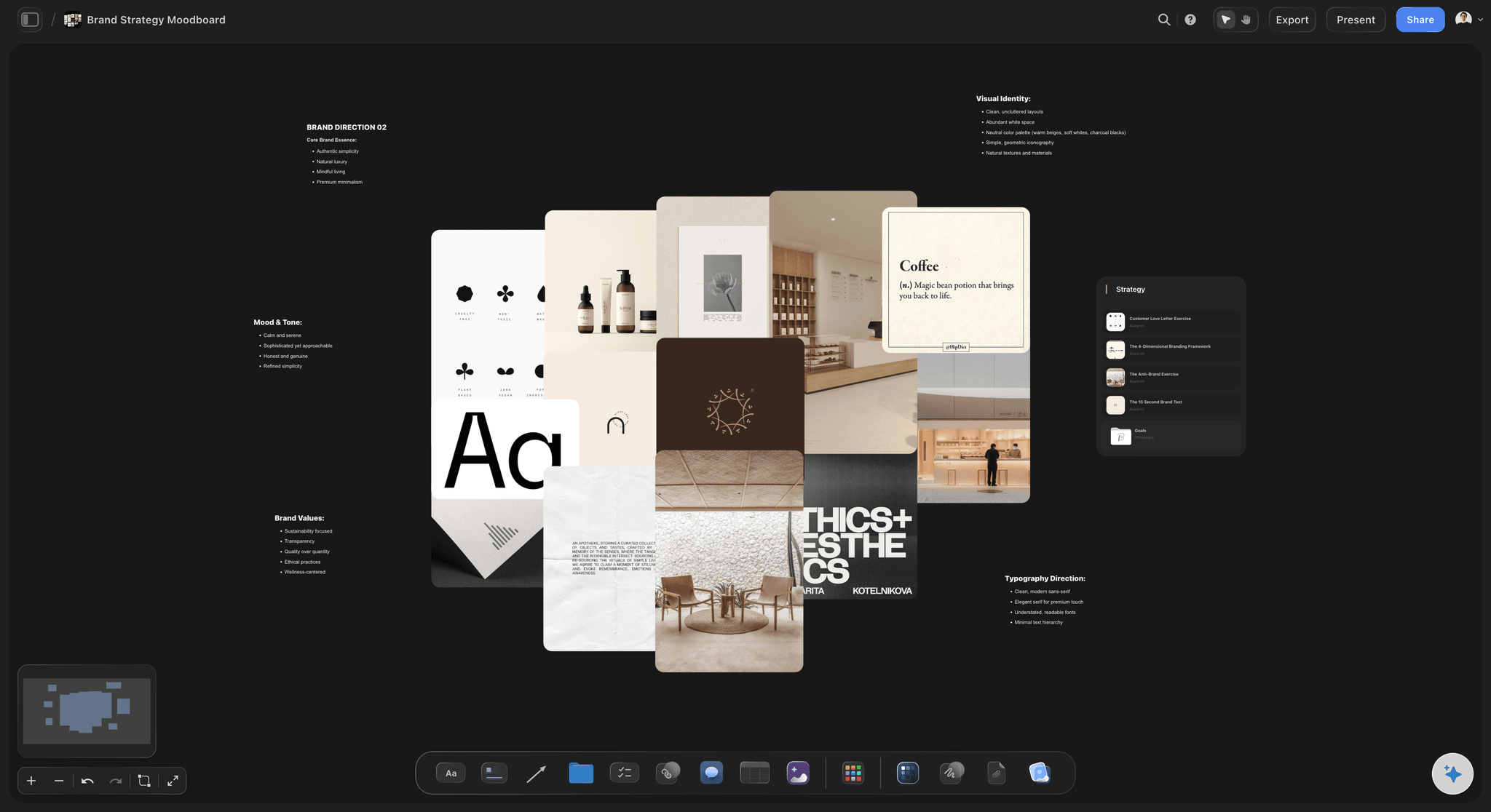
Keep the moodboard and the colour palette next to the strategy. ChatGPT can build a palette of named colours and add reference pictures from direct image addresses; your own photos go in through an upload link.
See brand boards with ChatGPT →ChatGPT drafts the strategy. Your Storyflow AI credits are not touched.
The plugin runs on ChatGPT's own model and your ChatGPT plan, so reading the research and building the walls uses no Storyflow AI credits. An invited free Storyflow account can make 25 plugin actions a week, reset each Monday (UTC), and Plus, Pro and Max have no weekly limit. Storyflow is paid-only during early access, with plans from $7.99 a month billed annually ($9.99 monthly). Anyone a paid member invites to a board joins free.
No Storyflow AI credits spent on what ChatGPT builds through the plugin
No weekly limit on plugin actions on Plus, Pro and Max
The client and your freelance designers join free when a paid member invites them
Every proof card can carry its source
You choose which client projects ChatGPT may open, and whether it may change them
Built for people with taste
Where a brand strategy from a chat gets lost.
ChatGPT writes a clear strategy. Getting the designers, the copywriters and the client to work from the same one is the hard part.
The inputs
A strategy built on what someone remembered
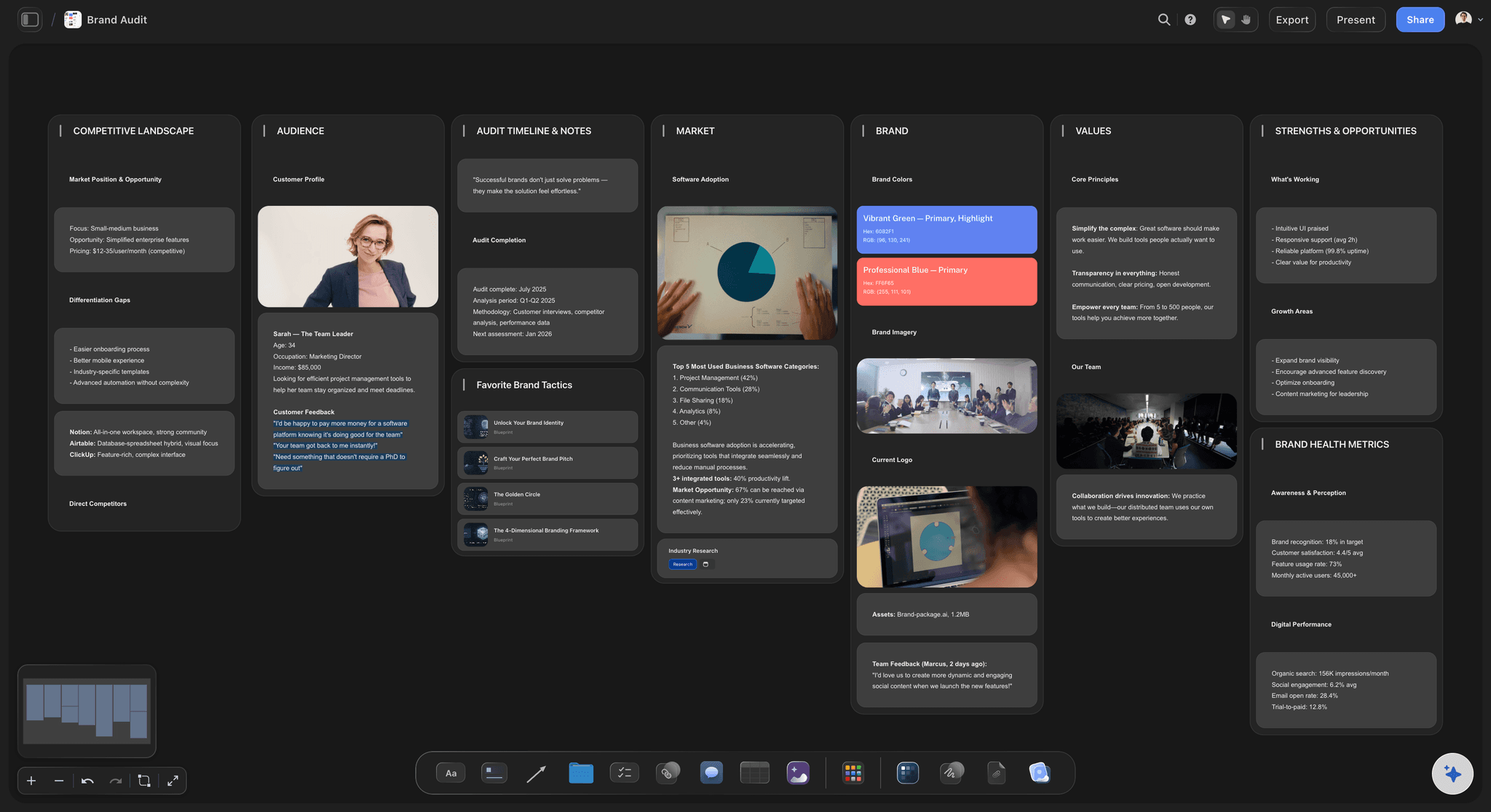
Workshop notes read from the board: Put the notes and interviews on the board as Word, PDF, Excel or CSV files of up to 25 MB. ChatGPT reads the first 40,000 characters of each, and a scanned PDF has no text to read.
The audience from the persona board: If the project has a persona board, ask ChatGPT to read it and write the audience wall from it, so the strategy and the personas describe the same buyer.
Rivals' claims side by side: ChatGPT's own web search reads rivals' public pages. Ask for their claims in a table with a link to each source, so the positioning is set against what rivals really say.
A framework to start from: Ask for Storyflow's Brand Strategy or Brand Audit template. When ChatGPT may use all your projects, it can also open Storyflow Tactics such as StoryBrand for the brand story.
The handover
Designers working from last month's deck
The brief from the same board: The creative brief is a document beside the five walls. ChatGPT can add a section or write the whole brief again from the board; a one-word change mid-document is quicker by hand.
Present the strategy: Ask ChatGPT for a deck built from the walls. Present it fullscreen from the board or export a PDF; there is no PowerPoint export or presenter view.
One link for the client: Share the board from Storyflow with a view-only link that opens with no account. To comment or draw, the client signs in.
Ask what changed: Before the next client meeting, ask ChatGPT what changed on the strategy board in the last week and who changed it. It reads the board's history and lists every card that moved or was edited.
The upkeep
A strategy nobody checks new work against
Check new copy against the voice: Paste a new headline into the chat and ask ChatGPT to read the voice wall and say which line it fits or breaks. The rules stay on the board, not in someone's head.
Change one line, not the wall: Ask ChatGPT to tighten the promise and it edits that card in place. The notes the strategist typed by hand stay as they are.
Two routes side by side: Ask for a second positioning route and it lands beside the first. Present both, keep one and remove the other by hand, because ChatGPT cannot delete cards.
Client comments into the chat: ChatGPT cannot read comments on the board. Copy the client's comments into the chat and ask it to change the cards they point at.
Explore templates for your project
Every template opens as a real, editable board on the infinite canvas. Pick the closest fit and make it your own.
Brand Strategy
Define your positioning, values, and voice and connect them into a strategy the team can follow.
One app instead of five
Storyflow with ChatGPT, ChatGPT alone, or a deck in Google Slides.
Storyflow keeps the research, the strategy and the brief on one board. Google Slides, which ChatGPT reaches through the Google Drive plugin, is still the stronger place to rehearse with speaker notes and hand over a PowerPoint file (as of October 2026).
Storyflow with ChatGPT
Recommended
Strategy drafted by ChatGPT from your notes
Research, strategy and moodboard on one canvas
Creative brief written from the same board
Team edits one current version
Present it fullscreen
Speaker notes and presenter view
PowerPoint file export
ChatGPT on its own
Strategy drafted by ChatGPT from your notes
Research, strategy and moodboard on one canvas
Creative brief written from the same board
Team edits one current version
Present it fullscreen
Speaker notes and presenter view
PowerPoint file export
A deck in Google Slides
Strategy drafted by ChatGPT from your notes
Research, strategy and moodboard on one canvas
Creative brief written from the same board
Team edits one current version
Present it fullscreen
Speaker notes and presenter view
PowerPoint file export
What creators are saying
Join early creators getting structured workspaces and AI that remembers their projects
“Storyflow has sped up my workflow by at least 3x, which means more flow state and more projects I can actually ship. It truly changed the way me and my team create.”

Reilin Joey
Director & YouTuber
“One prompt gets me a structured board. But the tactics are my favorite. I run my YouTube scripts through them and my intros and retention got better. It's amazing.”

Justkay
YouTuber & Freelance Filmmaker
“I used to juggle five apps to plan a project. Now I describe what I am making and get boards, lists, and a schedule. All in one place.”

George
@fernwehchronicles
Brand strategy with ChatGPT: questions
What brand leads and agencies ask before a strategy goes to the client.
Yes. ChatGPT drafts a brand strategy from workshop notes, customer research and rivals' claims: the positioning, the audience, the promise, the proof and the voice. With the Storyflow plugin it builds the strategy on your Storyflow board instead of in the chat, as a wall for each part beside the research, and writes the creative brief as a document on the same board.
Storyflow is our pick for a brand strategy the creative team works from, because ChatGPT builds the positioning, audience, promise, proof and voice as walls beside the research and writes the creative brief from them. Storyflow is our product. When the strategy must end as a Google Slides deck, the Google Drive plugin is the way in: OpenAI says Docs, Sheets and Slides actions now come through it, and in Enterprise and Edu workspaces an admin turns them on first (as of October 2026).
A positioning statement that names who it is for, what the brand offers, who it is set against and why it wins. The audience in a sentence. One promise the brand must keep. Proof that makes the promise believable, each fact with a source. A voice of three words, each with a right and a wrong example. In Storyflow each part is a wall, so a missing part shows as an empty column.
Open the Storyflow listing in ChatGPT's plugin directory and select Install plugin. Sign in to Storyflow when asked, then choose which projects ChatGPT may use and whether it may make changes. In a chat, type @ and pick Storyflow, or choose it from the + menu. Availability depends on your ChatGPT plan, workspace and region. In a Business or Enterprise workspace, an admin manages plugins and can turn them on or off.
Yes, when the rivals' claims are on the board. ChatGPT's own web search reads their public pages, and the plugin puts each claim in a table on your Storyflow board with a link to its source. Then ask ChatGPT to read the positioning wall against that table and flag any line a rival could print unchanged. Those lines are not a position yet: ask for three sharper versions of each.
Write the voice as three words, each with one sentence that sounds right and one that does not, on the voice wall of your Storyflow board, one line per card. For pairs of opposite traits, put Storyflow's Brand Personality Framework template on the board and ask ChatGPT to rewrite the traits for your brand. Then paste new copy into the chat and ask which rule it breaks.
Yes. Ask ChatGPT for the creative brief as a document on the same Storyflow board, written from the five walls. It can add a section later or write the whole document again when the strategy changes. The designers read the brief and the strategy behind it in one place, and the brief exports as a document from Storyflow.
A photo you attach in the ChatGPT chat does not reach Storyflow. Ask ChatGPT for an upload link instead: it replies with an "Add your photos" link that works for 15 minutes and takes up to 200 pictures from your phone or computer. ChatGPT can also add pictures from direct image addresses and build a palette of named colours. It cannot generate images through the plugin.
Through the plugin, ChatGPT cannot design a logo, generate images, read comments or delete cards. Storyflow has no version compare, so record who signed off and when on the brief. Decks present fullscreen and export as PDF, with no PowerPoint export, speaker notes or presenter view. Storyflow runs in the browser, with no native desktop or mobile app.
Ask ChatGPT for a deck built from the walls on your Storyflow board. Present it fullscreen from the board, one slide at a time, or export it as a PDF. For people who only read, share the board from Storyflow with a view-only link that opens with no account. To comment, a person signs in. Anyone a paid member invites joins free.
Storyflow is paid-only during early access: Plus is $7.99 a month billed annually ($9.99 monthly), Pro is $14 and Max is $39, both billed annually. Plugin actions run on ChatGPT's own model and your ChatGPT plan, so they use no Storyflow AI credits. An invited free account can make 25 plugin actions a week, reset on Monday (UTC). Plus, Pro and Max have no weekly limit.
A brand strategy decides what the brand stands for: the positioning, the audience, the promise, the proof and the voice. A brand board shows how it looks: the logo, the colours, the typefaces and the pictures. The strategy comes first and the board follows it. On Storyflow, keep both in one project so the designers can see the reason behind every visual rule.
Yes. Claude adds the same Storyflow account as a custom connector with the address https://mcp.storyflow.so/mcp, and storyflow.so/mcp shows the setup for Claude, Gemini and Grok. ChatGPT installs Storyflow from its plugin directory instead. Both build on the same boards, so a strategist in Claude and an account lead in ChatGPT can work on one brand strategy.
Only the ones you choose. When you sign in, Storyflow asks whether ChatGPT may use all your projects or only the ones you pick, so an agency can keep each client apart. Reading is always on, and you decide whether it may also make changes. Storyflow Tactics and creating a new project need access to all projects. Every connection ends after 30 days.
More from Storyflow
Connect ChatGPT to Storyflow
Storyflow MCP server for every assistant
Brand board with ChatGPT
Brand board with Claude
Buyer persona with ChatGPT
Competitor analysis with ChatGPT
Campaign plan with ChatGPT
Creative brief with ChatGPT
How to build a brand strategy with AI
Brand strategy tool
Brand positioning workshop
Brand messaging framework
Storyflow for agencies
Storyflow for creative directors
Bring the workshop notes. Leave with a strategy and a brief.
Positioning, audience, promise, proof and voice on one board, with the creative brief written beside them.