
Polished brand plans, extremely simple
Build the brand strategy
before the launch campaign.
Persona, values, tone of voice, competitors, visual identity, name and positioning on one board, with real competitors researched in. The launch plan, the campaign brief and the moodboard are then built from it on the same canvas.


Creatives working for these brands already got early access
- Red Bull
- Canon
- Artlist
- Porsche
See how easy it is to get started
Watch a real project come together, from a blank board to a finished plan, clicked through step by step.
Start from a ready-made template
Pick a board to see what you can build, then let AI fill it in. Every template is a real, editable starting point on the same infinite canvas.

Brand Strategy
Define your positioning, values, and voice and connect them into a strategy the team can follow.
What goes in a brand strategy template?
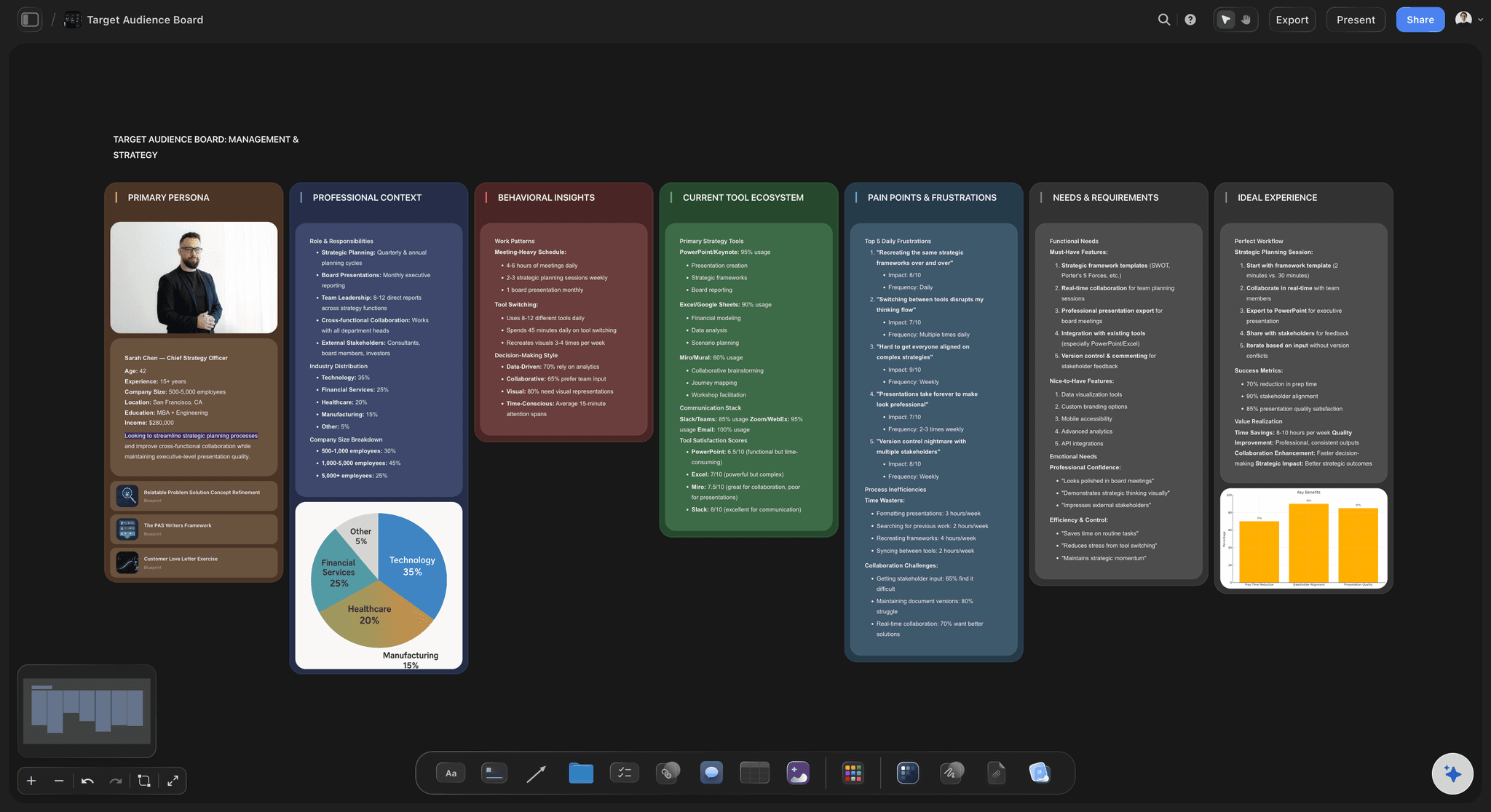
A brand strategy is the set of decisions about who a brand serves, what it stands for, how it sounds and where it sits against its competitors. Storyflow is an AI visual workspace that lays out your brand strategy on one infinite canvas: ten sections built by the AI, from a hero visual and the persona to real, researched competitors and a checklist of what is decided and what comes next. A brand strategy template covers seven parts: the customer persona, the values, the tone of voice, the competitors, the visual identity, the name and the positioning. The board lays all seven out, you rewrite what the AI got wrong, then build the launch and the campaign on the same canvas.
Each part has a job. The persona is one customer in a specific moment, with what they believe today, not an age bracket. The values are three to five, and each rules something out; a value no competitor would disagree with is doing no work. The tone of voice is shown with a line that sounds right and one that does not. The competitors are real companies, with what each already owns in the customer's mind. The visual identity is a direction, a small moodboard and a note, not the finished logo. The name comes with its reasoning. And the positioning is the space you claim against those competitors, for that customer, with a reason to believe.
Brand strategy tends to fail in the gap between the strategy and the launch. The strategy is a deck written at the start and never opened again, so the launch campaign quietly becomes the strategy by accident. The values are the same three words every company uses. The competitors are never named, so the positioning is a claim with nothing to stand against. Tone of voice is a list of adjectives a freelancer cannot write from. And the visual identity is chosen on taste, with no line back to the persona or the positioning, which is why it gets argued over again after launch.
Storyflow keeps the strategy on the board the launch is built from. The Brand Strategy workflow writes each section as short label and value lines, researches the companies you are actually up against, and ends with a status section listing what is settled and the next actions only your brand could have. From there, the Marketing Plan workflow lays out the launch as a timeline wall of phases with dates, and tickets and tables carry the owners and status; the Campaign Brief workflow builds the brief from the persona, positioning and tone already on the board; and the Brand Moodboard workflow turns the visual identity direction into palette, type and imagery. The finished logo and identity files are still made in a design tool such as Figma or Illustrator.
Ultra fast from brief to board
From a description to a strategy the launch is built from.
The AI lays out the sections. The decisions stay with you.
01
Describe the brand
What it sells, who it is for and what makes it different, or attach the pitch deck and notes you already have.
02
The AI builds the strategy board
Ten sections appear: hero visual, persona, values, tone of voice, competitors, visual identity, name, architecture and positioning, market insights, and status.
03
Rewrite it until it is yours
Sharpen the positioning against the named competitors, cut the values nobody would disagree with, and move open questions onto the status checklist.
04
Carry it into the launch
Build the launch plan, the campaign brief and the brand moodboard beside the strategy, so each one is checked against it.
Everything the launch is built from.
Persona, voice, positioning and visual direction on one board, and the launch built beside them.
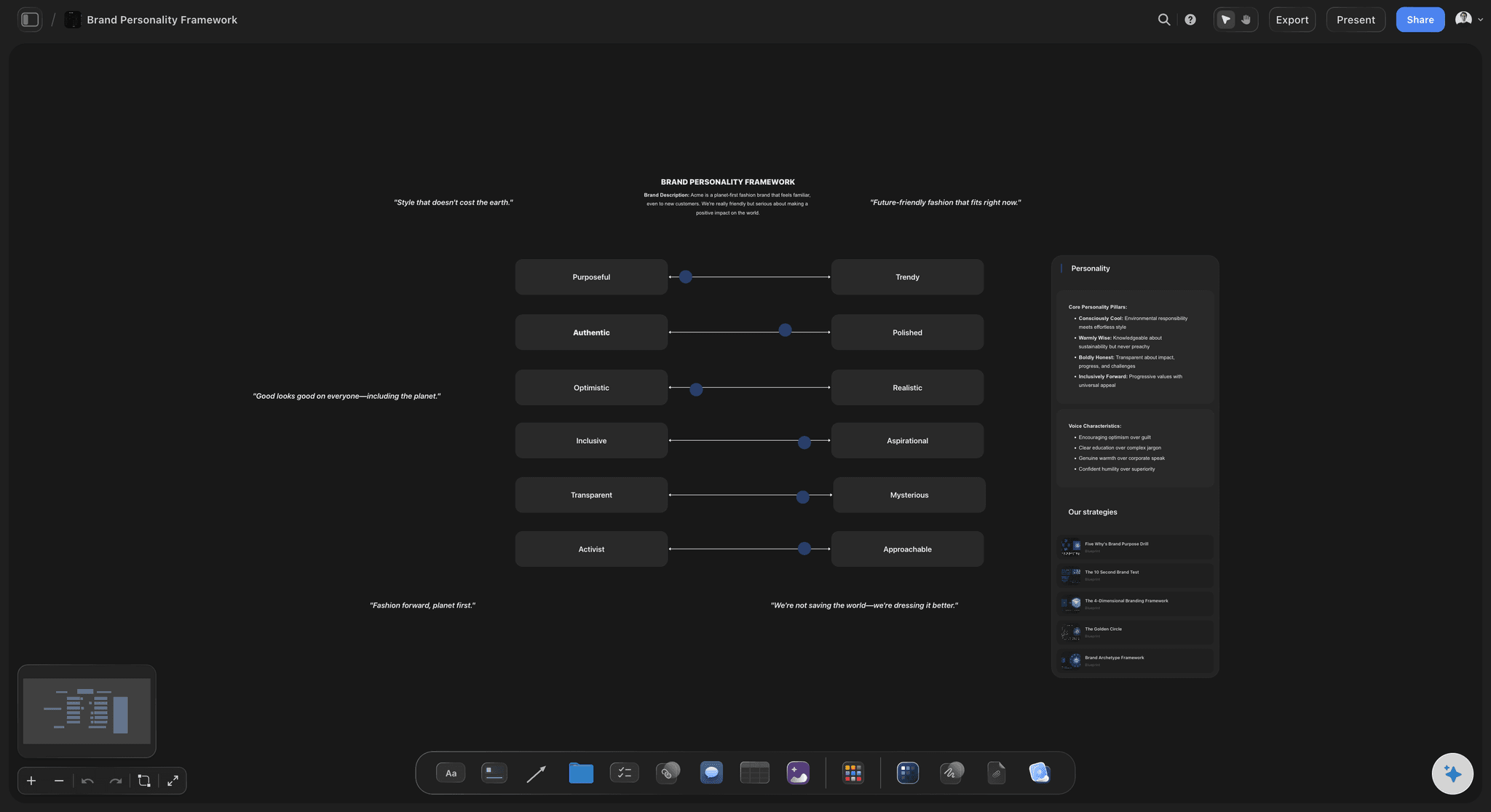
Persona, values and personality
Who the brand is, written down
The persona and the values sit beside the tone of voice they shape, each value paired with what it rules out, so the personality reads the same to a designer and a copywriter.
See the brand personality template →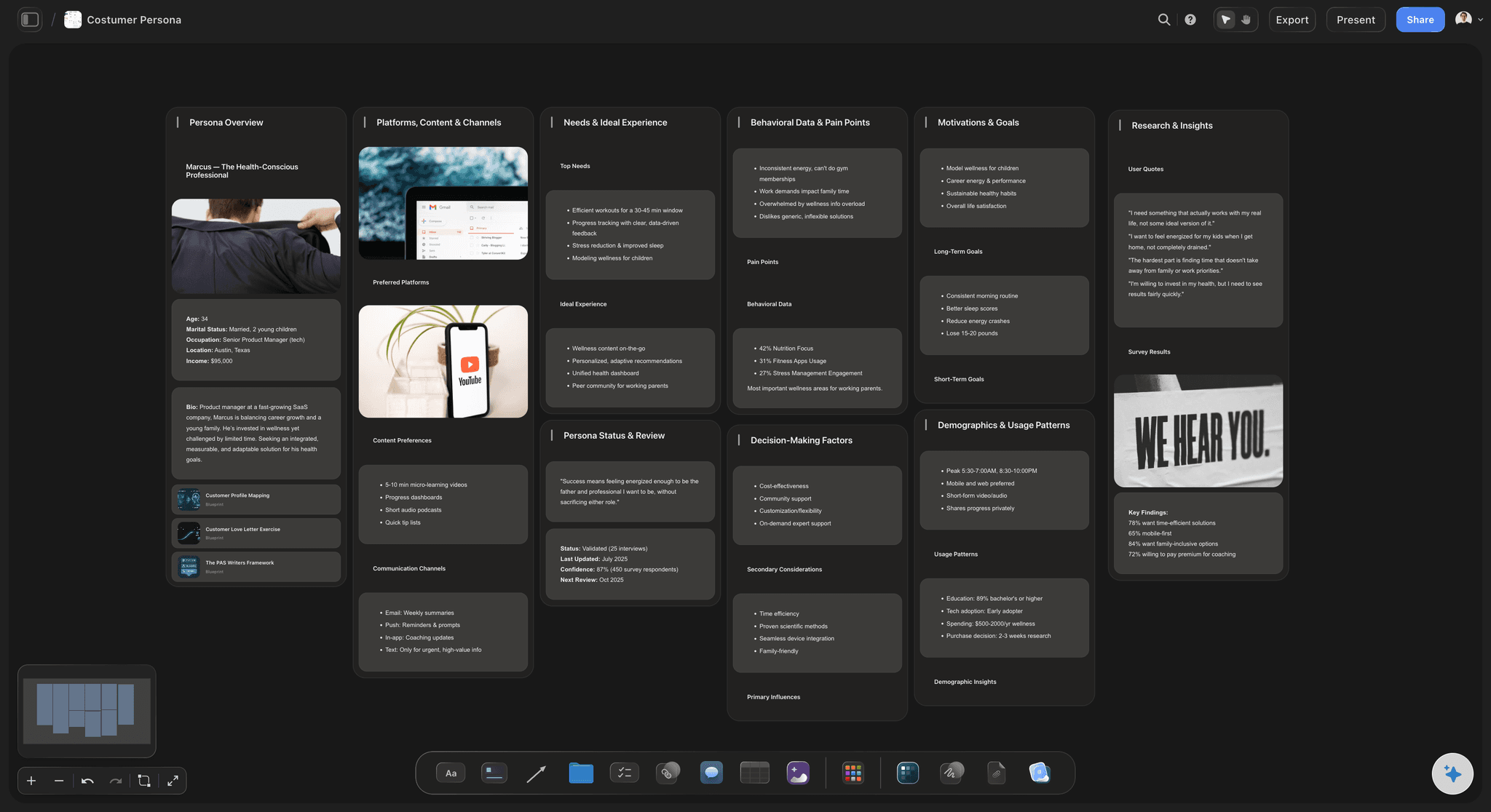
Tone of voice
A voice a freelancer can write in
Voice characteristics with a line that sounds right and a line that does not, next to the persona they are written for, so launch copy sounds like one brand.
See the AI brand voice generator →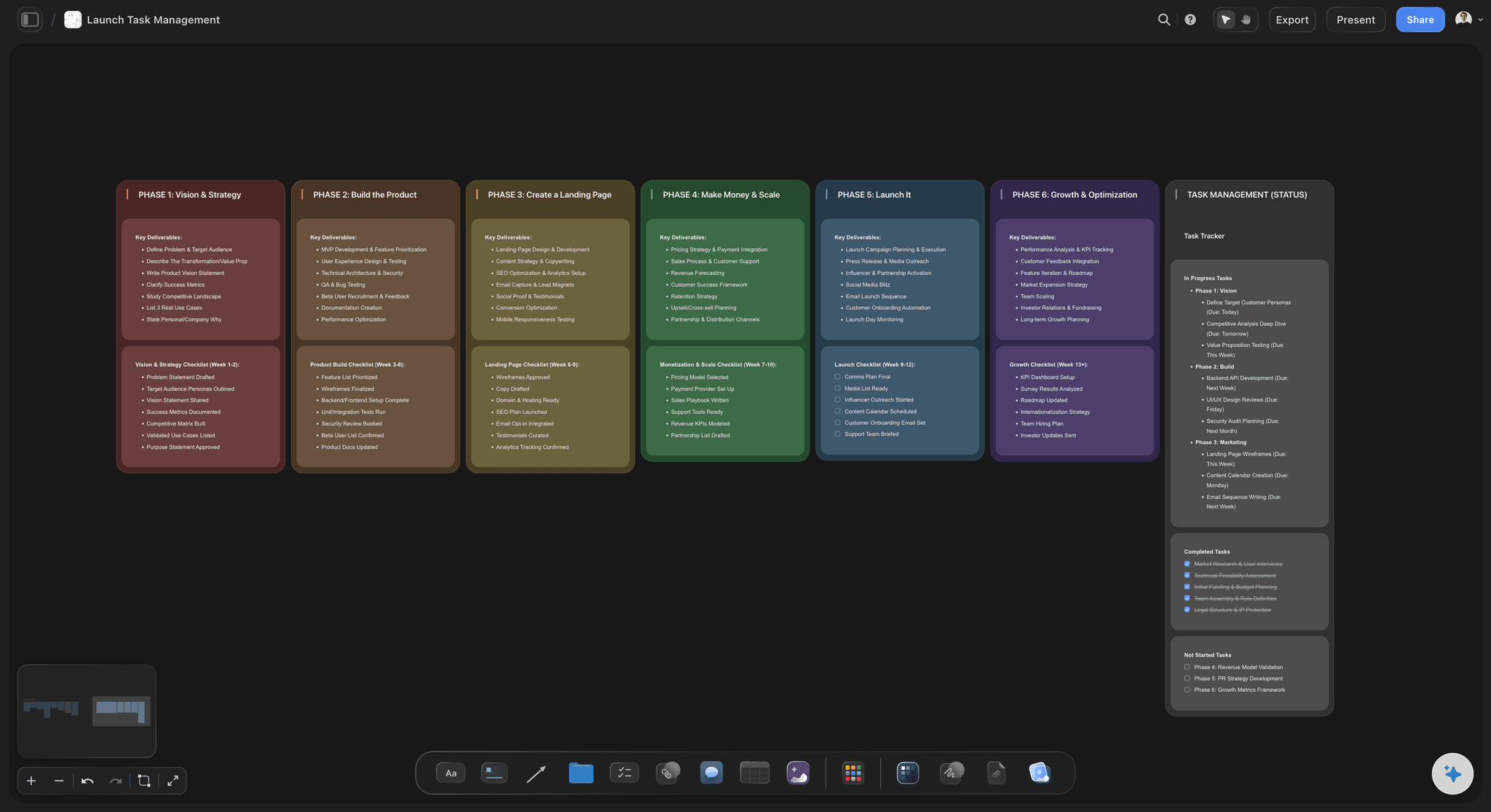
From strategy to launch
The launch plan beside the strategy
Launch phases with dates, and tickets that carry an owner and a due date, one scroll from the positioning, so launch decisions are checked against what the brand said it stands for.
See the brand launch planner →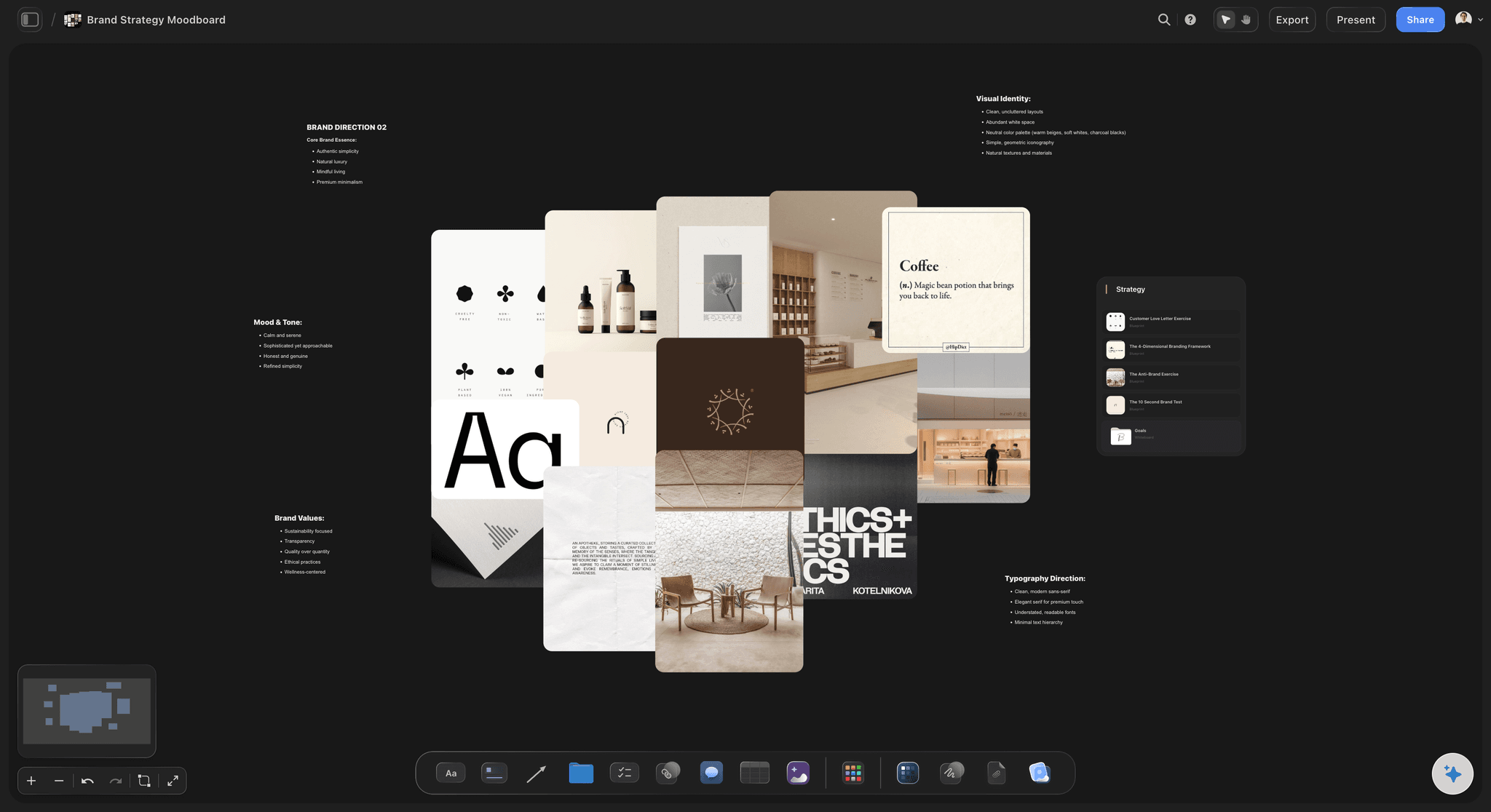
Visual identity direction
The moodboard grows out of the strategy
The visual identity section becomes a full brand moodboard: named colour swatches, typefaces, imagery and applications, traced back to the persona and the positioning.
See the brand moodboard →Unlimited boards. No object cap.
The strategy, the research and the launch on one canvas. Storyflow is paid-only during early access, with plans from $7.99 a month billed annually ($9.99 monthly). A free plan launches before the end of 2026, and anyone a paid member invites to a board joins free.
The AI agent builds the brand strategy board and researches competitors
Unlimited boards, images, files and links
Unlimited background removal and upscaling for brand imagery
View-only links for investors, agencies and designers, no account needed
Built for people with taste
Seven parts, then the launch.
A brand strategy is useful when every part makes a choice a competitor would not.
The seven parts
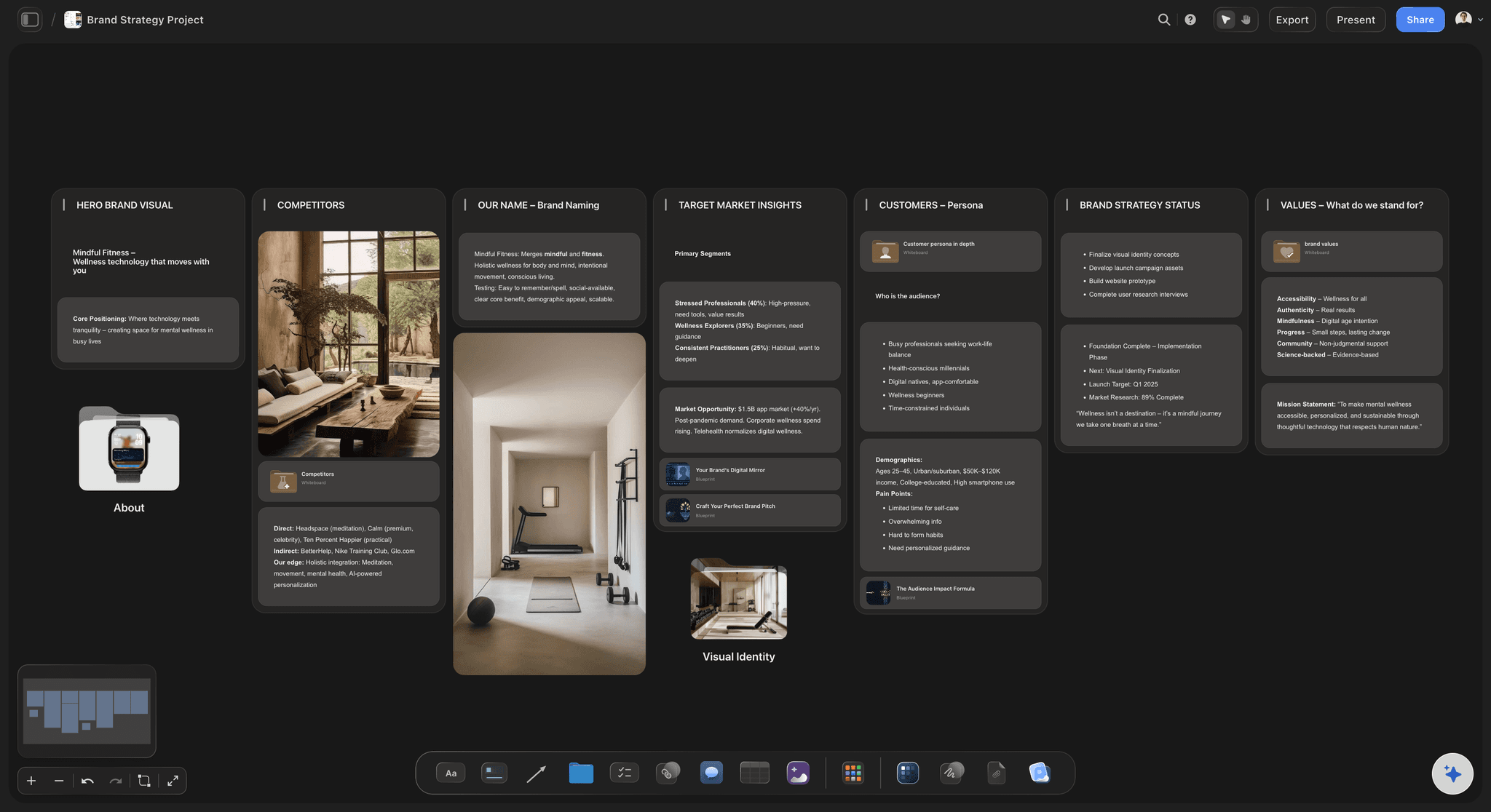
What a brand strategy template holds
Persona and values: One customer in a specific moment, and three to five values that each rule something out.
Tone of voice: Voice characteristics with a line that sounds right and one that does not, so anyone writing for the brand can hear the difference.
Competitors and positioning: Real companies and what each already owns, then the space you claim against them, for whom, and why anyone should believe it.
Visual identity and name: A direction rather than the finished identity, a small moodboard and a note, plus the reasoning behind the name.
The Brand Strategy workflow
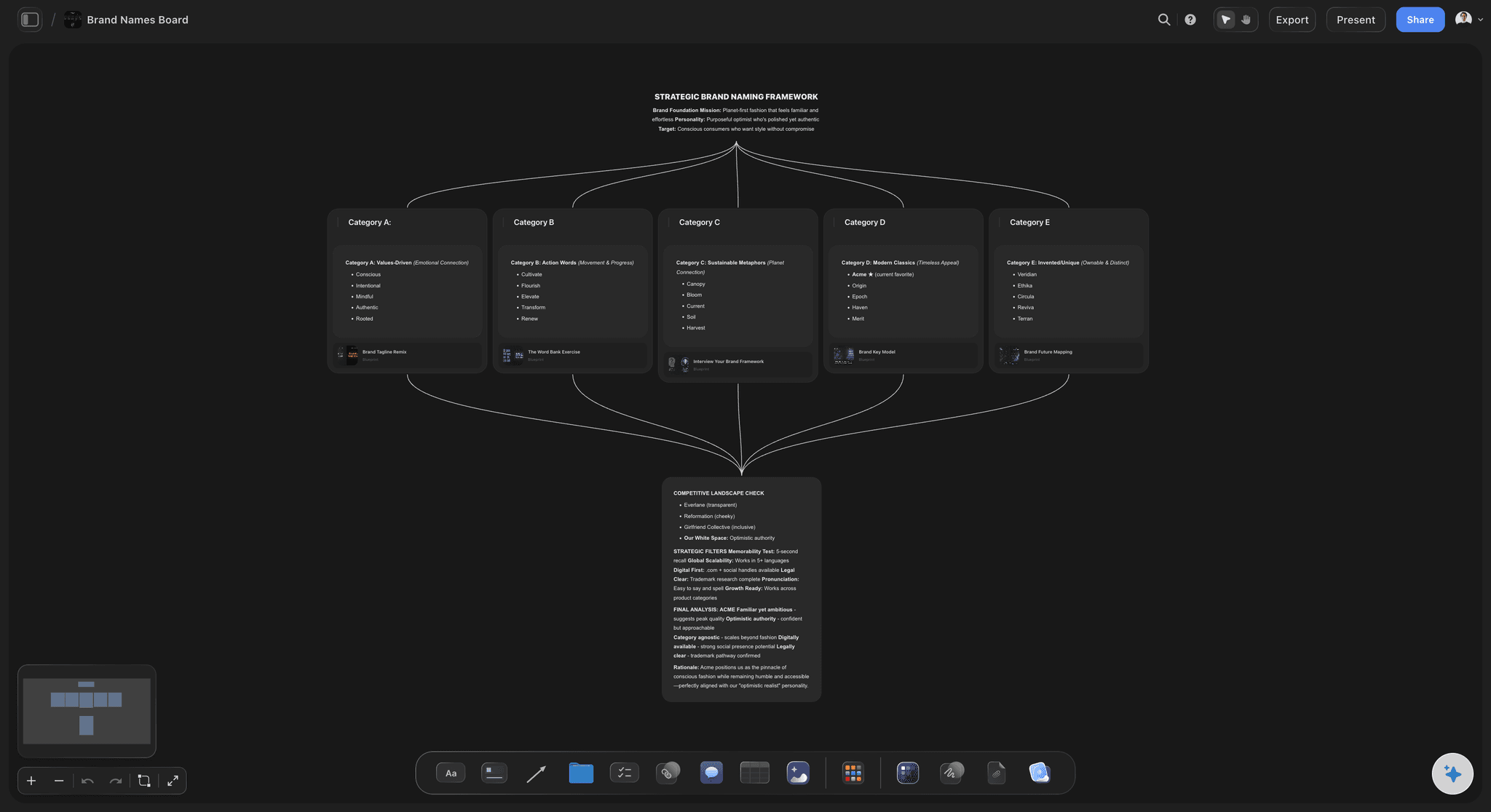
Ten sections, built from your description
Researched competitors: The AI looks up the companies you are actually up against and writes what each one owns. Three real competitors beat six invented ones.
Short lines, not paragraphs: Each section is written as bolded label and value lines and tight bullets, so the whole strategy reads across one board.
A status section: The last section lists what is decided, what is next, and three to six actions specific to your brand.
Folders for research that keeps growing: Persona interviews or competitor teardowns get their own board behind a folder tile once there is enough to fill one.
Idea to campaign
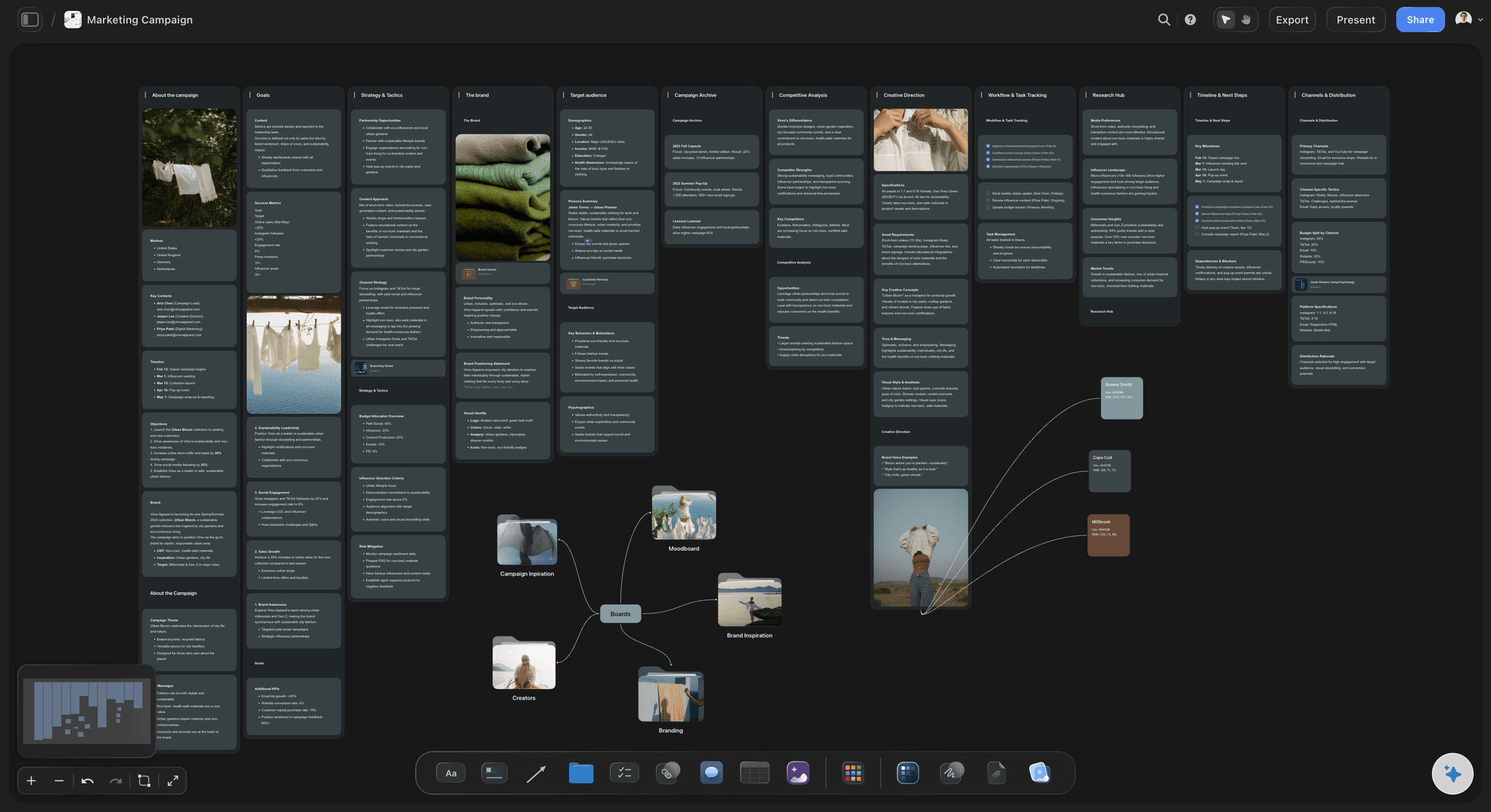
Carry the strategy into the launch
A launch plan with dates: Ask for a marketing plan and the AI lays out the launch phases with dates, leaving a marked slot for any date you have not set.
The campaign brief from the strategy: Ask for a campaign brief on the same board and the AI builds it from the persona, positioning and tone already there.
The brand moodboard from the direction: The visual identity section becomes palette swatches, named typefaces, imagery and applications.
Launch content planned in the brand's voice: The Content Planner and Social Media Plan workflows plan the launch content from the same board, with upcoming posts as tickets. Publishing stays in a scheduler.
Sharing and decisions
One strategy everyone works from
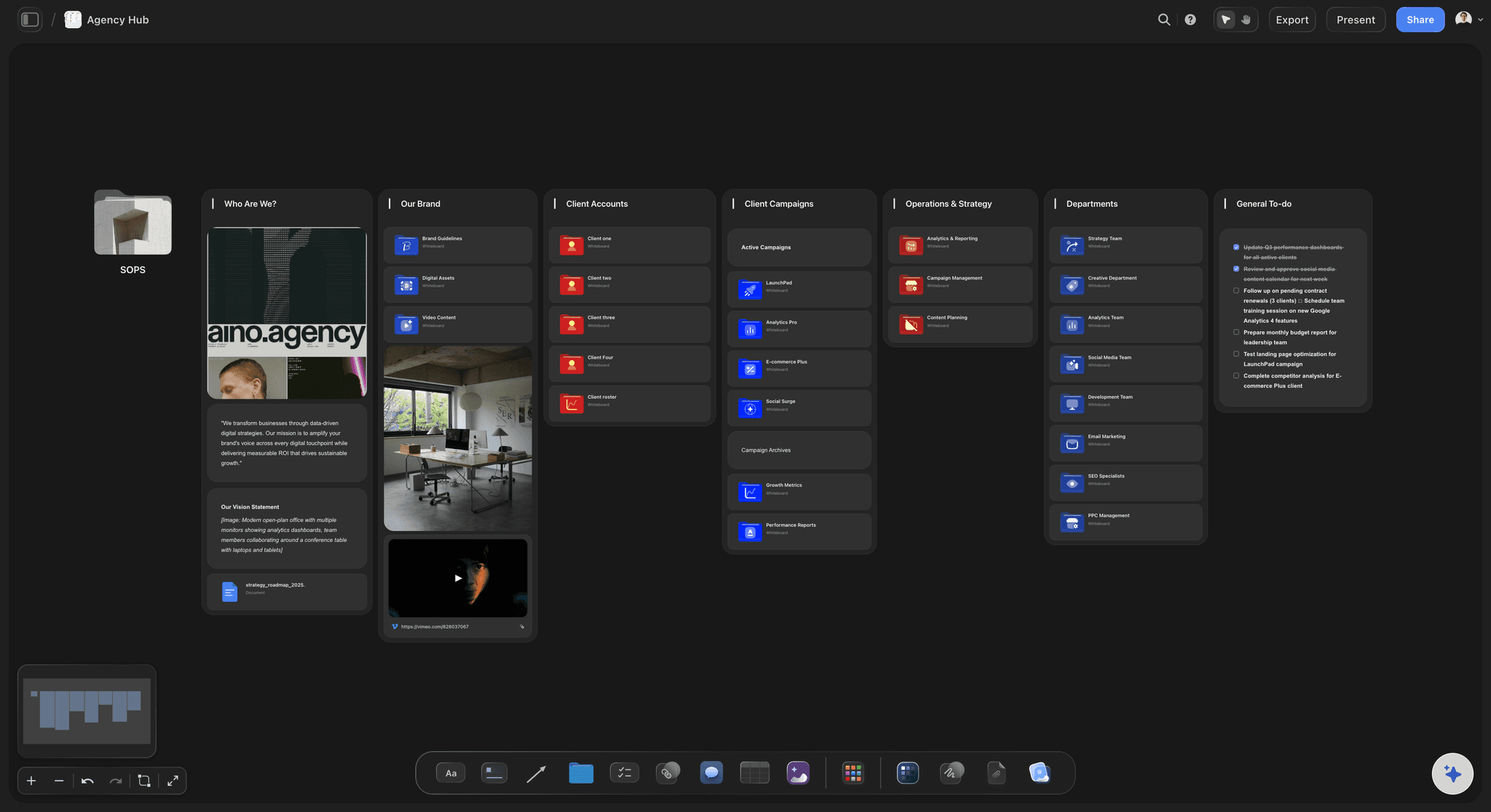
A link for investors and agencies: The view-only board opens in a browser with no account, so an agency briefed from it sees the reasoning, not only the logo.
Comments on the specific section: Co-founders and advisers sign in to comment on the positioning or a single value, not on a slide number.
The team invited to edit: Anyone a paid member invites joins free and works on the board in real time.
Exported for the brand book: Export the board as a high-quality image or PDF when the strategy has to travel as a file.
Explore templates for your project
Every template opens as a real, editable board on the infinite canvas. Pick the closest fit and make it your own.
Brand Strategy
Define your positioning, values, and voice and connect them into a strategy the team can follow.
One app instead of five
Storyflow vs Notion, Airtable and Milanote.
Notion and Airtable are common choices for launch planning, and Milanote for brand moodboards. Each is good at something: Notion at documents and templates, Airtable at a database of campaigns and assets, Milanote at a calm visual board of references.
Storyflow
Recommended
Strategy, references and moodboard on one canvas
Colour swatches beside the positioning
Launch phases with dates, owners and status
View-only link, no account needed
A database of campaigns and assets with filtered views
Notion
Strategy, references and moodboard on one canvas
Colour swatches beside the positioning
Launch phases with dates, owners and status
View-only link, no account needed
A database of campaigns and assets with filtered views
Airtable
Strategy, references and moodboard on one canvas
Colour swatches beside the positioning
Launch phases with dates, owners and status
View-only link, no account needed
A database of campaigns and assets with filtered views
Milanote
Strategy, references and moodboard on one canvas
Colour swatches beside the positioning
Launch phases with dates, owners and status
View-only link, no account needed
A database of campaigns and assets with filtered views
What creators are saying
Join early creators getting structured workspaces and AI that remembers their projects
“Storyflow has sped up my workflow by at least 3x, which means more flow state and more projects I can actually ship. It truly changed the way me and my team create.”

Reilin Joey
Director & YouTuber
“One prompt gets me a structured board. But the tactics are my favorite. I run my YouTube scripts through them and my intros and retention got better. It's amazing.”

Justkay
YouTuber & Freelance Filmmaker
“I used to juggle five apps to plan a project. Now I describe what I am making and get boards, lists, and a schedule. All in one place.”

George
@fernwehchronicles
Brand strategy, answered.
What goes in it, how to build it, and how it carries into the launch.
Storyflow suits a brand strategy that has to carry into a launch. Its AI builds the strategy board, with persona, values, tone of voice, researched competitors and positioning, and the launch plan, campaign brief and brand moodboard are built beside it. Notion suits a strategy kept as documents and templates, and Miro a strategy workshop run live on a whiteboard. Storyflow does not publish launch posts; a scheduler such as Buffer does.
A brand strategy tool is where a brand's strategy is written down and kept in one place. A brand strategy is the set of decisions about who the brand serves, what it stands for, how it sounds and where it sits against competitors. Storyflow is a brand strategy tool built as a board: the AI lays out persona, values, tone of voice, competitors, visual identity, name and positioning, and the launch work is built beside them.
Seven parts cover most brands: a customer persona, one person in a specific moment; three to five values that each rule something out; a tone of voice shown with examples; real competitors and what each owns; a visual identity direction; the name with its reasoning; and the positioning you claim against those competitors. Add brand architecture for several products and a list of what is decided. Storyflow's AI lays all of it out on one board.
The strategy sets the tests every visual choice has to pass. Reduce the positioning, values and tone of voice to three words, then choose the palette, typefaces and imagery that meet them. In Storyflow the visual identity section sits beside the persona and positioning on the strategy board, and asking for a brand moodboard expands it into palette, type and imagery. The logo and final identity files are then designed in Figma or Illustrator.
Write it for a named customer against named competitors. A workable shape: for this customer, who needs this, the brand does this, unlike these competitors, because of this proof. Each blank must make a choice a competitor could not also claim. Test it by swapping in a competitor's name; if the sentence still works, it is not positioning yet. In Storyflow the competitors section sits beside the positioning, so the claim is written with the alternatives in view.
Define it with examples, not adjectives. Pick three or four voice characteristics and, for each, write what it means, a line that sounds right and a line that does not, using real places the brand speaks, such as a product page or a customer email. Test it on someone new to the brand: if their first draft sounds like the brand, it works. In Storyflow the tone of voice section sits beside the persona it is written for.
It can build a first draft and much of the research. Ask Storyflow's AI for a brand strategy and it lays out ten sections on the board, from the persona and values to competitors it researches rather than invents, ending with what is decided and what is next. That gives you something specific to argue with. The decisions that make a brand, which customer to serve and what to give up, stay with the founder or brand lead.
Either works if it is used. A document suits a strategy that is mostly words and needs tracked edits. A board suits a strategy whose argument is partly visual: competitors side by side, the visual direction beside the persona it serves, and the launch plan next to both. Both fail when the strategy is never reopened. In Storyflow the strategy stays on the board the launch is built from, and exports as a PDF when it has to travel.
It depends on the stage. The strategy behind an identity, meaning persona, positioning, values and visual direction, is worked out on a board such as Storyflow, where the AI lays out a brand strategy and a brand moodboard. The logo, type system and final assets are designed in Figma or Adobe Illustrator, and Canva's brand kit applies the finished identity to social posts and presentations. Designing before the strategy is agreed gets the logo judged on taste.
Yes, even a short one. Without an agreed strategy, the launch campaign becomes the strategy by accident: whatever the first ads say about who the brand is for is what customers remember. Deciding the persona, positioning and tone of voice first gives the campaign brief something to be checked against, and gives the agency reasons rather than preferences. For a small brand the whole strategy fits on one Storyflow board, as long as each part makes a real choice.
Yes. In Storyflow, share a view-only link and investors or an agency open the whole strategy in a browser with no account, so the agency sees the persona, positioning and competitors behind the brief, not only the brief. Co-founders and advisers sign in to comment on a specific section, and anyone a paid member invites to edit joins free. When someone needs a file, export the board as a high-quality image or PDF.
Not yet. Storyflow is paid-only during early access, with plans from $7.99 a month billed annually ($9.99 monthly). A free plan launches before the end of 2026, and anyone a paid member invites to a board joins free. Investors or agencies reading the strategy from a view-only link need no account. Plus includes unlimited boards, images, files and links and the AI agent that builds the strategy board; Pro adds AI image generation for direction imagery.
More from Storyflow
Brand personality template
Brand launch planner
Brand moodboard
AI brand guidelines generator
AI brand voice generator
Brand story template
Rebrand planner
Creative strategy template
Campaign brief template
Customer persona generator
AI value proposition generator
For startups
How to build a brand strategy with AI
Best tools to plan a brand launch
Online whiteboard
AI mind map generator
Pitch deck maker
AI vision board generator
Campaign visual direction
How to launch a new brand
Build the brand strategy the launch is built from.
Describe the brand, let the AI lay out the sections, and rewrite what it got wrong. No download.